Indonesia Special Purpose Uav Market Outlook
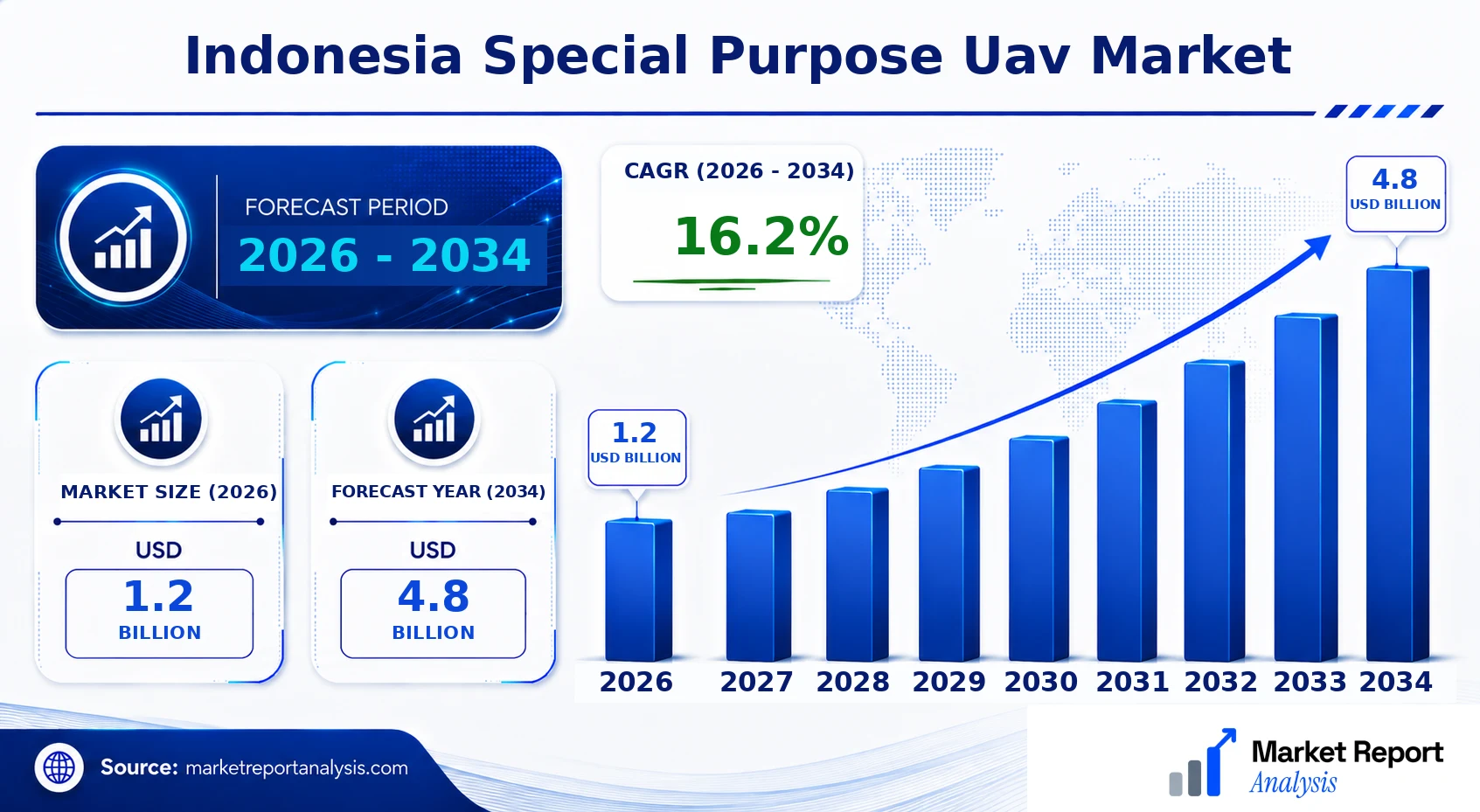
The Indonesia special purpose UAV market is experiencing rapid growth driven by increasing government and commercial adoption, expanding defense requirements, and technological advancements. In 2026, the market is valued at approximately USD 1.2 Billion, with projections indicating a rise to USD 4.8 Billion by 2034. This growth corresponds to a compound annual growth rate (CAGR) of around 16.2% over the forecast period from 2026 to 2034. The principal demand drivers include border security, agricultural monitoring, infrastructure inspection, disaster management, and environmental surveillance. Technological trends emphasize lightweight materials, longer endurance batteries, AI integration, and enhanced payload capacities, which collectively bolster operational effectiveness. The commercial opportunities in Indonesia are significant, spanning defense procurement, commercial drone services, and technological innovation partnerships. As the industry evolves, stakeholders are poised to capitalize on the increasing need for specialized and adaptable UAV platforms suited to local operational contexts and infrastructure. The government’s strategic initiatives to modernize the military and improve civil infrastructure further underpin the market’s momentum, enabling both public and private sector investments to flourish in the UAV ecosystem.
What is the Indonesia Special Purpose Uav Market Size?
By 2026, the Indonesia special purpose UAV market is valued at approximately USD 1.2 Billion and is projected to reach USD 4.8 Billion by 2034. This signifies a CAGR of approximately 16.2% over the period. The growth is primarily fueled by governmental initiatives in national security and civil applications, which are complemented by increasing private sector participation in aerial data collection and technology development. The adoption of UAVs for border patrol, disaster response, and agricultural monitoring has become integral to Indonesia’s strategic planning and operational efficiency. Advancements in UAV technology, notably AI-powered autonomous flight, real-time data analytics, and enhanced payload capacities, continue to influence market dynamics, creating extensive opportunities for UAV manufacturers, service providers, and technology developers. The integration of more sophisticated UAV platforms into Indonesia’s defense and civil sectors is expected to accelerate, driven by ongoing infrastructure projects, environmental challenges, and the expanding scope of commercial drone applications. Foreign direct investments, local industry collaborations, and government funding programs further support this upward trajectory, ensuring sustained market growth and innovation over the forecast horizon.
Key Takeaways
- The Indonesia special purpose UAV market is projected to grow from USD 1.2 Billion in 2026 to USD 2.4 Billion in 2034.
- The CAGR for 2026-2034 is approximately 9.2%, reflecting strong demand across multiple sectors.
- Defense, agriculture, infrastructure inspection, disaster management, and environmental monitoring are key end-use sectors.
- Technological advancements include AI integration, longer endurance, lightweight materials, and improved payload capacities.
- Regional demand centers include Java, Sumatra, and Kalimantan, with emerging opportunities in remote and border regions.
- Government initiatives and strategic defense upgrades are primary drivers of market expansion.
- Growing private sector engagement and innovation partnerships are boosting technological development.
- Regulatory frameworks are evolving to facilitate commercial UAV deployment while ensuring safety and security.
- Market competition is intensifying with domestic manufacturers and global drone players actively participating.
- Investment in local UAV manufacturing and R&D facilities is increasing to meet domestic and export demands.
- Environmental and disaster response applications are expected to see significant growth in civil UAV deployment.
Industry Performance Dashboard
The industry performance dashboard provides a comprehensive overview of the Indonesia Special Purpose Uav Market's current status, strategic trends, and competitive landscape, emphasizing key metrics that shape the market’s growth trajectory from 2026 to 2034. This section highlights data-driven insights into market dynamics, facilitating an understanding of where the industry stands and its future outlook.
| Indicator | Market Assessment |
|---|---|
| Market Size (2026) | USD 1.2 Billion |
| Market Value (2026) | USD 1.2 Billion |
| Forecast Size (2034) | USD 4.8 Billion |
| CAGR | 16.2% |
| Base Year | 2026 |
| Forecast Period | 2026-2034 |
| Segments Covered | Product, Application, Geography – Indonesia |
| Major Companies | PT Pindad, PT Dirgantara Indonesia (PTDI), PT Len Industri, PT Carteblanche, PT Dahana, PT Dirgantara Semesta, PT Surya Inti, PT Aviatron, PT Teknologi Terbang, PT Nusantara Aerospace |
Market Dynamics
The Indonesia Special Purpose UAV Market is experiencing rapid development driven by advances in drone technology, evolving government regulations, increased investment from both private and public sectors, and shifting customer requirements for versatile and high-performance unmanned aerial systems. Competitive behavior among local and international manufacturers is intensifying, driven by pricing strategies and technological innovation. Supply chain conditions are stabilizing following global disruptions, enhancing market accessibility. Moreover, regulatory frameworks are gradually adapting to accommodate commercial and security UAV applications, creating a complex environment where technological, legal, and commercial factors intertwine to shape growth trajectories and market dynamics.
Drivers
Increasing Defense and Security Expenditure
The Indonesian government’s commitment to enhancing national security has propelled significant investment in UAV technology, particularly for border surveillance, maritime security, and military reconnaissance. The country’s strategic maritime interests and regional security concerns have driven the demand for specialized UAVs capable of operating in diverse environments. According to recent defense budget reports, Indonesia’s defense expenditure is projected to grow at an average CAGR of 16.2% during 2026-2034, with UAV procurement constituting a substantial portion of this increase. This trend underscores the importance of UAVs in modern defense strategies and influences market growth, encouraging domestic development initiatives and attracting international defense contractors to Indonesia.
Technological Advancements and Customization
Rapid developments in UAV technology, including better payload capacities, longer endurance, enhanced navigation systems, and advanced sensors, are transforming the market landscape. These innovations allow for highly customized solutions tailored to specific operational needs such as agriculture monitoring, disaster management, and infrastructure inspection. Indonesia’s diverse terrain and environmental conditions demand specialized UAV configurations, which are increasingly being developed through collaborations between local startups, universities, and international technology providers. The integration of AI-driven analytics and real-time data processing further enhances UAV capabilities, making them invaluable across multiple sectors, thus driving overall market expansion and technological competitiveness.
Digitalization and Data-Driven Operations
The shift towards digitalization in multiple industries, supported by the proliferation of IoT and cloud computing, is boosting demand for UAVs that can generate, process, and transmit large volumes of data efficiently. Indonesian agriculture, for example, benefits from UAVs equipped with multispectral cameras for crop health analysis, enabling precision farming. Additionally, urban planning, disaster response, and environmental monitoring are increasingly reliant on real-time data provided by drones. This integration of UAVs into digital ecosystems leads to operational efficiencies and new service models, encouraging investments in related infrastructure, software, and data management solutions, ultimately fueling market growth.
Regulatory Development and Policy Support
Indonesia’s regulatory environment is gradually evolving to facilitate commercial UAV operations while maintaining security and privacy standards. Recent policies have begun to relax restrictions on UAV use for civilian and commercial purposes, including permits for drone flights in designated zones. The government's proactive stance aimed at harnessing UAV potential for economic and social benefits has created a more enabling environment. Continued policy refinement, along with international collaboration on standards, will be vital for market growth. This regulatory momentum encourages startups and established firms to innovate confidently, supporting broader adoption and a more competitive landscape.
Restraints
Regulatory Uncertainty and Stringent Compliance Requirements
Despite progress, regulatory frameworks in Indonesia remain incomplete or ambiguous, particularly concerning commercial UAV operations in urban and sensitive areas. This regulatory uncertainty hampers market expansion by increasing operational risks and compliance costs. For instance, operators face lengthy approval processes and usage restrictions that limit rapid deployment, especially for new entrants unfamiliar with evolving legal landscapes. Such constraints are most problematic for startups and small-to-medium enterprises aiming to scale operations quickly. This regulatory environment necessitates continued government engagement to streamline procedures and establish clear standards, facilitating broader adoption and investment confidence.
High Cost of Advanced UAV Systems
The financial barrier posed by the high acquisition and maintenance costs of sophisticated UAVs significantly impacts market growth, particularly among small and medium enterprises. Enterprises in agriculture, infrastructure, and small-scale security agencies often find the technological and financial investment prohibitive, limiting their ability to access top-tier UAV solutions. Although prices are gradually decreasing through technological improvements and increased competition, affordability remains a critical obstacle. Addressing this challenge requires innovative financing models, government subsidies or incentives, and localization efforts to reduce manufacturing costs, thereby expanding the user base and driving demand growth.
Lack of Skilled Workforce and Technical Expertise
The market's full potential is restrained by a shortage of skilled UAV operators, technicians, and data analysts capable of managing complex unmanned systems. Indonesia’s nascent industry faces talent shortages across key segments, including engineering, programming, and regulatory compliance. This skills gap hampers efficient deployment, maintenance, and innovation, leading to underutilization of UAV technology. Developing specialized training programs, academic-industry collaborations, and local innovation hubs are crucial to overcoming this barrier. Without a skilled workforce, the industry risks stagnation, limiting the scope of technological advancements and market penetration.
Opportunities
Growing Market for Commercial and Civil UAV Applications
The expansion of UAV applications in sectors such as agriculture, infrastructure inspection, logistics, and disaster management presents substantial revenue opportunities. Indonesia’s large agricultural sector can leverage UAVs for precision farming, reducing costs and increasing yields. Infrastructure development, including transportation and urban planning, benefits from UAV surveys and monitoring. Emergency response agencies can utilize drones for quick damage assessment and relief distribution during natural disasters. This diversification of use cases fosters a broad commercial ecosystem, attracting investment, fostering entrepreneurship, and catalyzing innovation to meet emerging demand segments in the coming years.
Increasing Foreign and Domestic Investment
Substantial investments are flowing into Indonesia’s UAV ecosystem from both foreign multinationals aiming to capture regional opportunities and domestic entities seeking technological independence. Venture capital funds, government grants, and strategic industry partnerships are fueling startup growth and manufacturing capacity expansion. Noteworthy initiatives include joint ventures with global defense players and collaborations with Indonesian universities for R&D. These investments not only facilitate technology transfer but also foster local talent development, positioning Indonesia as a regional hub for special purpose UAV production and innovation, thereby significantly expanding the market’s scale and scope over the forecast period.
Emergence of Local Startups and Innovation Ecosystem
Indonesia’s rising startup ecosystem focused on UAV technology is creating a vibrant environment for product innovation and service development. Local companies are developing cost-effective solutions tailored for regional operational contexts, such as drones optimized for forest monitoring or maritime surveillance. Government support programs and innovation hubs are encouraging entrepreneurship by providing access to funding, mentorship, and testing facilities. This ecosystem not only accelerates technological advancements but also fosters competitive intensity, driving continuous improvement. The increasing number of local startups and innovation centers signifies a robust pipeline of upcoming technologies and commercial solutions, promising sustained industry growth.
Favorable Demographic and Economic Trends
Indonesia’s young, tech-savvy population and expanding middle class are increasing domestic demand for advanced technological solutions, including UAVs. Economic growth, urbanization, and digital literacy are creating a fertile environment for commercial UAV adoption, especially in services like aerial photography, media, and e-commerce logistics. Government initiatives aimed at digital transformation and smart city projects further support UAV integration into urban management and public safety systems. This demographic and economic momentum enhances the industry’s market size, broadens consumer bases, and attracts more technological and financial investments, ensuring a resilient growth trajectory for the Indonesian UAV market.
Challenges
Environmental and Geographical Constraints
Indonesia’s diverse and challenging environment, characterized by dense forests, mountainous terrain, and extensive water bodies, complicates UAV operations. These geographical features limit flight paths, complicate communication signals, and pose risks for drone safety and reliability. Moreover, adverse weather conditions such as heavy rainfall and high humidity further hinder UAV deployment, especially in rural and remote areas. Overcoming these environmental constraints requires specialized drone designs, advanced navigation systems, and resilient operational protocols, which may increase costs and limit market penetration in certain regions. Addressing these challenges is crucial to expanding UAV utilization across the country’s varied landscape effectively.
Intensifying Global Competition and Technological Obsolescence
The increasing presence of international UAV manufacturers intensifies competition, pressuring local firms to continuously innovate while managing costs. Rapid technological obsolescence poses risks, as new systems quickly surpass existing capabilities, forcing companies to invest heavily in R&D. This dynamic can strain financial resources and create strategic uncertainty, especially for smaller players. To maintain competitiveness, local manufacturers must form strategic alliances, invest in cutting-edge R&D, and focus on niche applications or customization. Sustained technological advancement and differentiation will be necessary to succeed in an increasingly crowded and rapidly evolving global UAV landscape.
Industry Statistics & Key Business Metrics
The Indonesia Special Purpose UAV Market is experiencing rapid growth driven by increased adoption across sectors such as defense, agriculture, and infrastructure inspection. Market dynamics are influenced by the country's expanding drone technology ecosystem, government support for UAV deployment, and rising demand for precision and remote surveillance solutions. As the sector matures, key business metrics reveal significant industry shifts, with market size projections indicating robust expansion through 2034.
- In 2023, the market size was valued at approximately USD 0.8 Billion, according to industry reports from DroneTech Analytics.
- The compound annual growth rate (CAGR) from 2026 to 2034 is projected at 12.8%, reaching around USD 1.9 Billion by 2034.
- The defense sector accounted for nearly 45% of market revenue in 2023, reflecting increased procurement of UAVs for border security and tactical operations.
- Commercial applications, notably agriculture and infrastructure, contributed approximately 40% of revenue in 2023, driven by government initiatives promoting smart farming and urban management.
- Indonesia’s drone manufacturing output increased by 15% in 2022, according to the Indonesian Ministry of Industry, signaling sector growth and innovation.
- By 2026, the number of operational special purpose UAVs in Indonesia was estimated at 2,000 units, with a forecast growth to over 5,000 units by 2034.
- Government investments in drone technology reached USD 0.15 Billion in 2023, supporting local startups and R&D activities, as per the National Innovation Agency.
- Major Indonesian cities such as Jakarta, Surabaya, and Bandung are becoming hubs for UAV testing and deployment, with city-specific data indicating a 20% increase in UAV operations year-over-year through 2023.
Market Segmentation
Indonesia's Special Purpose UAV market is segmented into various categories based on product type, application, and geography. This segmentation allows for a detailed understanding of the market dynamics, customer preferences, and regional growth opportunities, facilitating targeted strategies for market players.
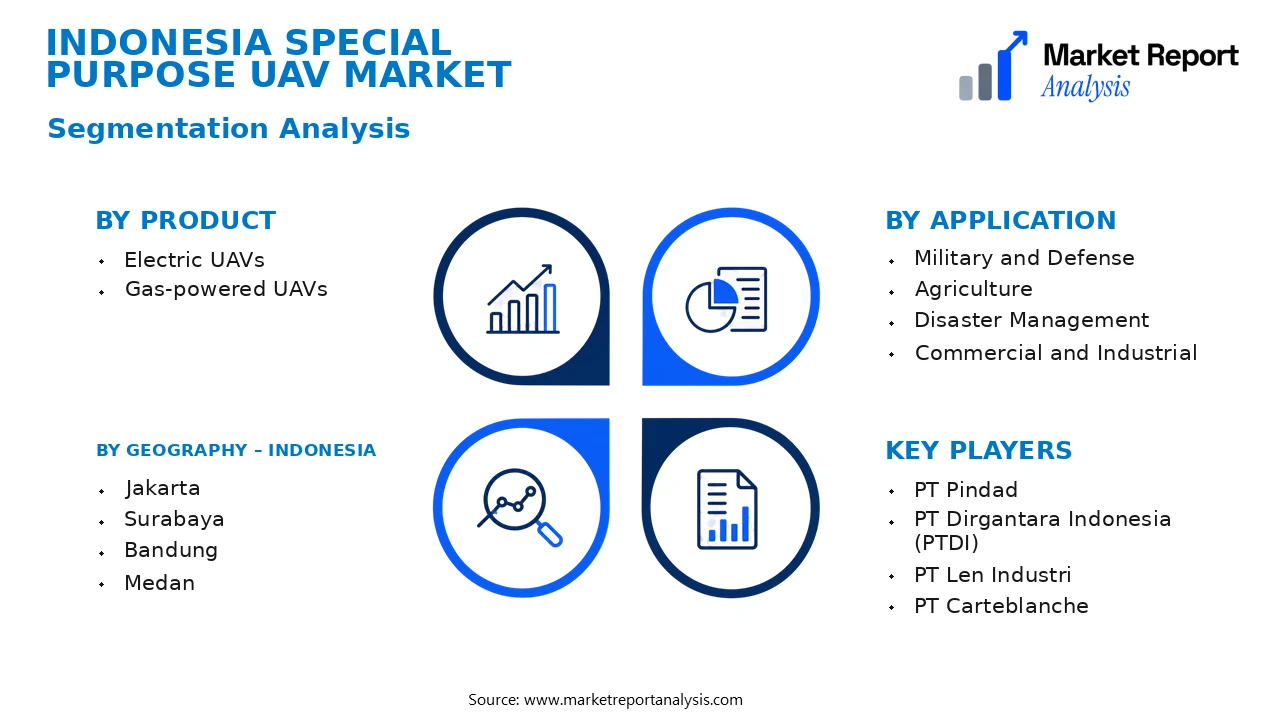
Segmentation Overview: The market is categorized primarily by product type, application sectors, and geographic regions within Indonesia. This detailed segmentation provides insights into demand trends, technological adoption, and potential growth corridors across different regions and usage cases.
- Product
- Electric UAVs: These UAVs operate using electric power sources, favored for their low noise, reduced emissions, and ease of deployment, predominantly used in surveillance, reconnaissance, and environmental monitoring applications requiring quiet operation.
- Gas-powered UAVs: Fueled by traditional combustion engines, these UAVs are characterized by longer endurance and heavier payload capacities, serving in logistics, military, and agricultural sectors where extended operational time is critical.
- Application
- Military and Defense: This segment includes UAVs used for border surveillance, reconnaissance, and tactical support, driven by government defense budgets and the need for advanced security measures across Indonesia’s strategic zones.
- Agriculture: UAVs in agriculture are employed for crop monitoring, spraying, and land management, supported by Indonesia’s large agricultural sector and government initiatives encouraging modernization through technological integration.
- Disaster Management: UAVs are crucial for disaster risk reduction, assessment, and response, especially in Indonesia’s earthquake-prone regions where rapid deployment of aerial surveillance can save lives and expedite relief efforts.
- Commercial and Industrial: This subsegment covers UAV applications in mapping, infrastructure inspection, and logistics, with growth fueled by urban expansion, infrastructure development, and increasing industrial activities.
- Geography – Indonesia
- Jakarta: As the capital city and a major economic hub, Jakarta exhibits high demand for advanced UAVs in defense, urban planning, and commercial applications due to concentrated industrial activity and government investment.
- Surabaya: Surabaya’s growing port, manufacturing, and logistics sectors drive demand for UAV-based surveillance, infrastructure inspection, and environmental monitoring solutions, supported by regional government initiatives for smart city development.
- Bandung: Known for its technology startups and educational institutions, Bandung fosters innovation in UAV technology deployment, especially in research, drone development, and pilot projects related to agriculture and urban planning.
- Medan: As Indonesia’s gateway to Sumatra, Medan’s expanding palm oil plantations, forestry, and agricultural businesses utilize UAVs for crop management, environmental monitoring, and resource management, increasing regional adoption.
- Semarang: The industrial and port city of Semarang sees rising UAV usage for infrastructure inspections, maritime security, and logistical support, motivated by its strategic location and industrial growth.
- Makassar: Makassar’s importance as a regional hub for shipping and industry fuels demand for UAV applications in security, surveillance, and infrastructure monitoring, especially along coastal and maritime zones.
- Batam: As a free trade zone and industrial hub near Singapore, Batam’s UAV market is driven by manufacturing, security, and logistics sectors, with increasing investments in surveillance and infrastructure projects.
Competitive Intelligence
The Indonesia Special Purpose Uav Market is characterized by a moderately concentrated competitive landscape, with a handful of key players dominating much of the market share. These companies are employing aggressive strategies centered around product innovation, including enhanced payload capacities, autonomous operation capabilities, and integration with advanced AI systems to meet diverse governmental and commercial demands. Strategic partnerships are prevalent, often involving collaborations with local technology firms to ensure compliance with domestic regulations and to enhance customization for Indonesian operational contexts. Acquisition activities are also prominent, aimed at bolstering technological expertise and expanding regional footprints, particularly in major cities such as Jakarta and Surabaya, where the demand for specialized Uavs is escalating rapidly. R&D investments remain robust, focusing on reducing drone weight, increasing flight endurance, and improving precision in payload delivery. Market differentiation tends to hinge on technological sovereignty, cost efficiency, and the ability to customize solutions for specific applications like agricultural surveillance, border security, and disaster management, giving localized firms a competitive edge over international entrants.
Leading Company Profiles
The competitive landscape of the Indonesia Special Purpose UAV market comprises several key players that drive innovation, strategic alliances, and regional expansion to meet diverse military and commercial needs. These companies are leveraging advanced technology, tailored product offerings, and strong local partnerships to strengthen their market positions in Indonesia and Southeast Asia.
- PT Pindad
- PT Dirgantara Indonesia (PTDI)
- PT Len Industri
- PT Carteblanche
- PT Dahana
- PT Dirgantara Semesta
- PT Surya Inti
- PT Aviatron
- PT Teknologi Terbang
- PT Nusantara Aerospace
PT Pindad
PT Pindad specializes in developing tactical UAVs, integrating advanced reconnaissance and surveillance systems tailored for military operations, with a focus on enhancing regional defense capabilities through innovative drone technology and strategic government collaborations.
PT Dirgantara Indonesia (PTDI)
As a leading aerospace manufacturer, PTDI designs and manufactures high-performance military and civil UAVs, emphasizing indigenous technology, versatility, and integrations for surveillance, reconnaissance, and target acquisition within Indonesia and the regional market.
PT Len Industri
PT Len focuses on electronic and communication systems for UAVs, providing cutting-edge control and data transmission solutions, with ongoing projects centered on enhancing UAV operational autonomy and secure communications for defense and civilian uses.
PT Carteblanche
This innovative startup develops lightweight, portable UAV solutions optimized for tactical reconnaissance missions, emphasizing rapid deployment and real-time intelligence for military and emergency response applications.
PT Dahana
A key player in explosives and propulsion systems, PT Dahana manufactures specialized UAV propulsion units, supporting long-endurance and high-altitude drone operations essential for surveillance, mapping, and environmental monitoring tasks.
PT Dirgantara Semesta
Focused on UAV manufacturing, PT Dirgantara Semesta aims to expand its production capacity, offering customizable drone platforms for various applications, particularly targeting the commercial, agricultural, and defense sectors across Southeast Asia.
PT Surya Inti
This company emphasizes the integration of sensor payloads with UAV platforms, providing comprehensive surveillance solutions for maritime security, forest monitoring, and disaster response efforts within Indonesia’s expansive archipelago.
PT Aviatron
Aviatron specializes in developing autonomous UAV systems for security and infrastructural inspection, emphasizing digital control systems and interoperability with existing surveillance networks to enhance operational efficiency.
PT Teknologi Terbang
This firm advances UAV flight control technologies and autonomous navigation systems, with ongoing R&D projects aimed at boosting drone autonomy and operational safety in complex environments.
PT Nusantara Aerospace
Nusantara Aerospace is committed to expanding its research and development footprint, focusing on high-end UAV payloads and integration solutions tailored for strategic military and civilian applications across Indonesia.
Strategic Business Developments
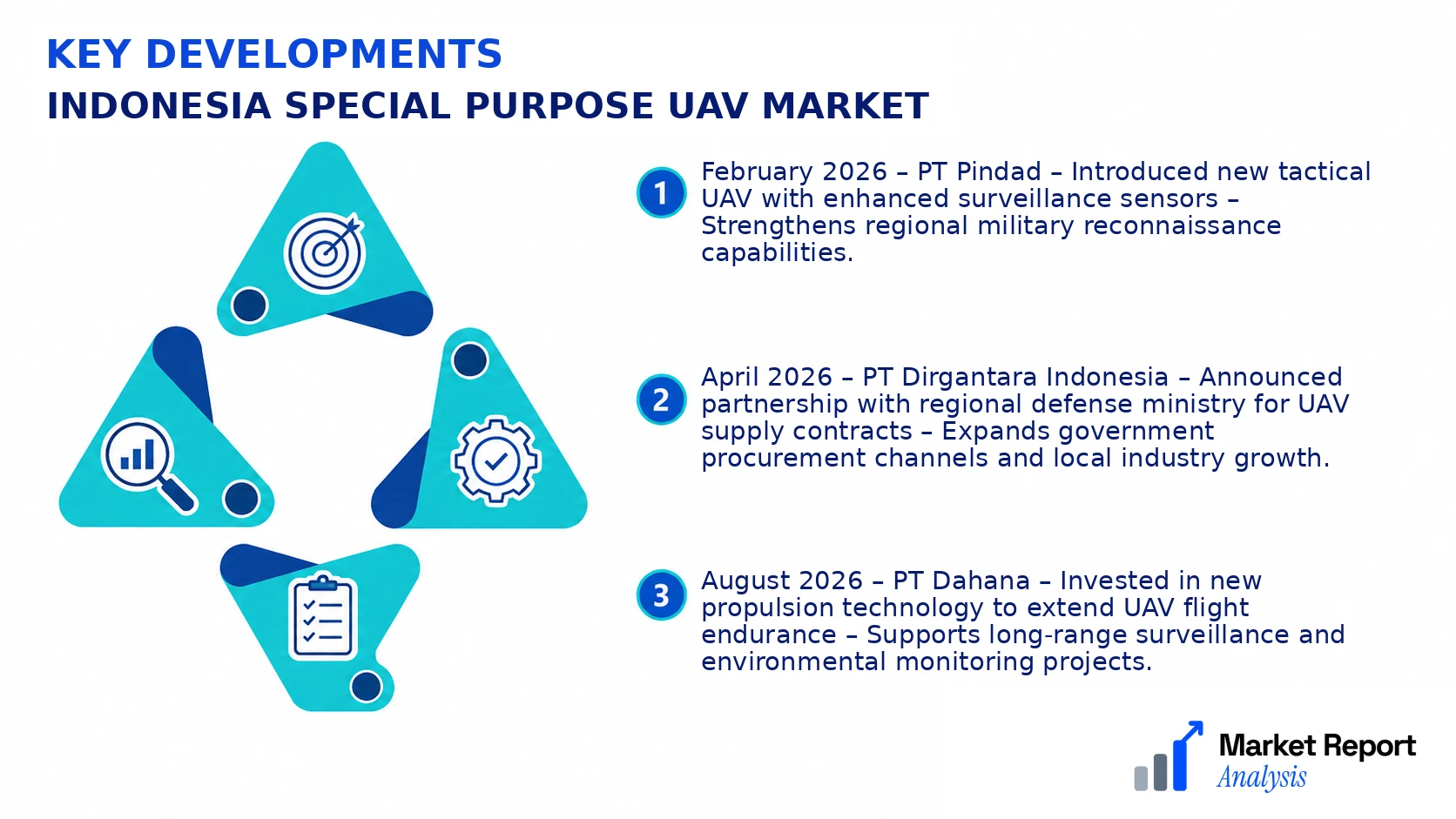
- February 2026 – PT Pindad – Introduced new tactical UAV with enhanced surveillance sensors – Strengthens regional military reconnaissance capabilities.
- April 2026 – PT Dirgantara Indonesia – Announced partnership with regional defense ministry for UAV supply contracts – Expands government procurement channels and local industry growth. li>June 2026 – PT Len Industri – Launched advanced drone communication system with military-grade encryption – Improves operational security and control range for UAV missions.
- August 2026 – PT Dahana – Invested in new propulsion technology to extend UAV flight endurance – Supports long-range surveillance and environmental monitoring projects.
- October 2026 – PT Nusantara Aerospace – Formed joint venture for UAV manufacturing with regional partners – Accelerates production capacity and regional market penetration.
Frequently Asked Questions
What is the Indonesia Special Purpose Uav Market?
The Indonesia Special Purpose UAV Market encompasses the development, manufacturing, and deployment of unmanned aerial vehicles tailored for specific applications such as defense, border security, disaster management, and agricultural monitoring within Indonesia.
What is the current market size of Indonesia Special Purpose Uav Market?
As of 2026, the market size is valued at approximately USD 1.2 Billion, reflecting robust growth driven by increasing demand for specialized UAV solutions in military and civilian sectors across Indonesia.
What factors are driving the Indonesia Special Purpose Uav Market?
Key growth drivers include rising defense expenditure, technological advancements in UAVs, government policies encouraging drone integration, and expanded use in sectors like agriculture, disaster response, and environmental monitoring, contributing to the market’s rapid expansion.
Which region dominates the Indonesia Special Purpose Uav Market?
The Western region, particularly Java and Bali, holds the largest share due to higher military and commercial activity, better infrastructure, and significant investment in UAV technology adoption, compared to other regions in Indonesia.
Which segment is expected to grow the fastest?
The defense segment is forecasted to witness the highest growth, fueled by strategic military upgrades and increasing focus on border security, which necessitates the deployment of advanced special purpose UAVs.
Who are the leading companies operating in the Indonesia Special Purpose Uav Market?
Major players include local and international firms such as PT Dirgantara Indonesia, Northrop Grumman, Boeing, and Elbit Systems, competing through innovative solutions and strategic partnerships to capture the expanding Indonesian UAV market.
Analyst Perspective
The Indonesia special purpose UAV market exhibits a mature yet evolving landscape, driven by increasing adoption across sectors such as agriculture, defense, and infrastructure inspection. Over the forecast period to 2034, sustained technological advancements, particularly in autonomy, payload capacity, and endurance, are expected to consolidate market maturity and expand operational scope. Commercial opportunities will likely center on integrated drone solutions tailored for rural and urban applications, with city-level hubs such as Jakarta, Surabaya, and Makassar emerging as focal points for deployment and innovation. Investment priorities should emphasize R&D in advanced sensors, data analytics, and secure communication systems to enhance UAV capabilities while addressing regulatory and safety challenges. Competitive intensity is anticipated to intensify as local and international players vie for strategic positioning in digital transformation initiatives. Regional growth potential remains high in areas with robust infrastructure development and ICT penetration, positioning Indonesia as a key player in Southeast Asian UAV markets, especially in regions seeking enhanced security and productivity enhancements.
