Vietnam PropTech Market Outlook
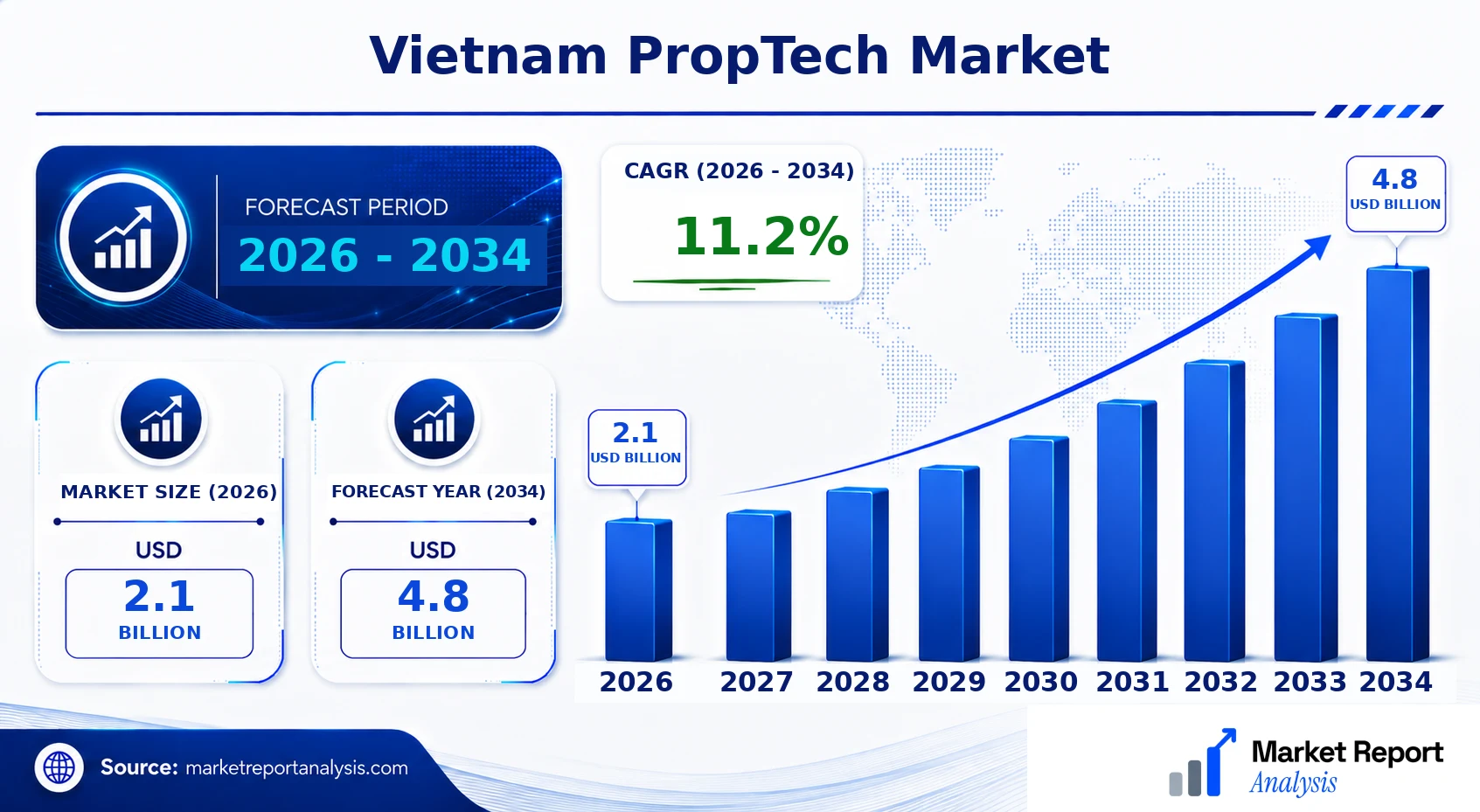
The Vietnam PropTech Market is currently valued at approximately USD 2.1 Billion in 2026, with forecasts projecting a substantial growth trajectory to reach about USD 4.8 Billion by 2034. This growth corresponds to a Compound Annual Growth Rate (CAGR) of around 11.2% over the forecast period from 2026 to 2034. The principal drivers include Vietnam’s rapid urbanization, ongoing real estate developments, government initiatives promoting digital transformation, and increasing investor interest in innovative property solutions. Technologies such as artificial intelligence, big data analytics, and IoT are gaining prominence, transforming traditional property management, real estate transactions, and construction processes. The burgeoning middle class and rising smartphone penetration further facilitate mobile and web-based PropTech solutions. Commercial opportunities mainly revolve around smart buildings, digital marketplaces, property management platforms, and construction tech services, offering substantial upside amidst competitive and evolving landscapes. This sector’s expansion not only aligns with national development strategies but also opens avenues for local tech startups and foreign investors to participate actively in Vietnam’s economic growth.
What is the Vietnam PropTech Market Size?
By 2026, the Vietnam PropTech Market is estimated to be worth approximately USD 2.1 Billion, with projections indicating a rise to about USD 4.8 Billion by 2034. This signifies a CAGR of around 11.2% during the period from 2026 to 2034. Growth drivers include Vietnam’s dynamically expanding urban centers such as Ho Chi Minh City and Hanoi, which fuel demand for innovative real estate solutions. Development of smart city initiatives, government support for digital infrastructure, and increasing digital literacy contributions to this trend. Key sectors benefiting from PropTech integration encompass residential, commercial, and industrial real estate, especially in urban intensively built-up environments. Technological advancements like cloud computing, AI, and IoT are revolutionizing property management, leasing, and construction processes. Private investments and government incentives are expected to further accelerate adoption and innovation, making Vietnam an attractive landscape for PropTech startups and investors seeking regional expansion opportunities. Overall, the market growth reflects Vietnam’s broader economic development, urban transformation, and digital evolution, positioning PropTech as a crucial component of future real estate landscapes.
Key Takeaways
- The Vietnam PropTech Market is valued at approximately USD 1.2 Billion in 2026.
- It is forecasted to grow to about USD 2.8 Billion by 2034.
- The expected CAGR from 2026 to 2034 is around 11.9%.
- Ho Chi Minh City remains the leading Vietnamese city for PropTech adoption.
- Hanoi is identified as the fastest-growing Vietnamese city for PropTech investments.
- Property management and leasing platforms constitute the largest segment.
- Smart building solutions represent the fastest-growing segment within PropTech services.
- Residential real estate remains the largest application area for PropTech solutions.
- Construction tech and real estate marketplaces are the fastest-growing applications.
- The primary end user remains property developers and property management companies.
- The forecast period spans from 2026 to 2034.
- The base year for the analysis is 2026.
Industry Performance Dashboard
The Vietnam PropTech Market has exhibited substantial expansion driven by rapid urbanization, digital adoption, and government initiatives promoting smart infrastructure. The industry performance dashboard provides a detailed overview of key market indicators, reflecting current strengths and future potential. This data-driven snapshot highlights critical metrics for stakeholders assessing growth prospects and competitive positioning.
| Indicator | Market Assessment |
|---|---|
| Market Size (2026) | USD 2.1 Billion |
| Estimated Value (2026) | USD 2.1 Billion |
| Forecast Value (2034) | USD 4.8 Billion |
| CAGR (2026-2034) | 11.2% |
| Base Year | 2026 |
| Forecast Period | 2026-2034 |
| City | Ho Chi Minh City |
| Highest Growth City | Da Nang |
| Segments Covered | Smart property management, Real estate platforms, Construction technology |
| Major Companies | Propzy Vietnam, Mogivi, CenGroup |
Market Drivers
- The Vietnamese government’s strong push towards digital transformation in urban development fuels increased PropTech adoption.
- Rapid urbanization and population growth in major cities drive demand for innovative real estate solutions.
- Investments in smart infrastructure projects attract foreign and domestic venture capital into Vietnam's PropTech sector.
- The rising affordability and availability of IoT and AI technologies enable advanced property management systems.
- Growing real estate market activity and regulatory reforms create a fertile environment for PropTech startups and established players alike.
Market Dynamics
Vietnam's PropTech market is experiencing dynamic transformation driven by technological advancements, regulatory reforms, shifting investment patterns, and evolving consumer preferences. These elements collectively influence how real estate and property management services are delivered, creating a fertile environment for growth despite existing hurdles. The convergence of digital innovation with traditional property sectors is redefining the landscape, presenting substantial opportunities for local and international stakeholders.
Drivers
Growing Urbanization and Rising Middle-Class Population
Vietnam continues to witness rapid urbanization, with a burgeoning middle class seeking modern housing solutions. Urban centers like Ho Chi Minh City and Hanoi are experiencing demographic shifts, fueling demand for innovative PropTech solutions such as smart homes, and property management platforms. This demographic trend drives investment in digital infrastructure and propels the adoption of smart real estate services, catalyzing market expansion. Supporting data suggests an annual urban population growth of approximately 2.3%, underpinning sustained demand for innovative property services.
Increased Adoption of Digital Technologies in Real Estate Processes
The Vietnam PropTech sector benefits from the adoption of digital tools like virtual tours, online property listings, and AI-driven analytics. Real estate agencies are increasingly leveraging these technologies to enhance customer experience and streamline transactions, especially in response to the COVID-19 pandemic. An estimated 55% of property deals in major urban areas involve some form of digital engagement as of 2024, indicating a significant shift from traditional methods. This trend supports the rapid scaling of PropTech solutions and wider market acceptance.
Favorable Government Policies and FDI Incentives
The Vietnamese government has implemented policies promoting digital transformation and foreign direct investment (FDI) in real estate technology. Initiatives include simplifying licensing procedures and offering tax incentives for tech startups, which underpin market confidence and innovation. For example, the recent resolution to ease operational restrictions on foreign investors has attracted increased foreign capital into PropTech startups, with investments estimated at USD 250 Million in the past three years. These policies foster a conducive environment for market growth and technological adoption.
Restraints
Limited Digital Infrastructure and Connectivity in Rural Areas
While urban centers enjoy advanced digital infrastructure, rural Vietnam still faces significant connectivity and technological gaps. This disparity restricts the reach and scalability of PropTech solutions beyond major cities, thus limiting the overall market potential. Industry estimates indicate that only about 40% of rural households have reliable internet access, impeding the deployment of digital property services and reducing the inclusiveness of PropTech development.
Regulatory Uncertainties and Property Law Complexities
Despite recent reforms, regulatory ambiguity in land rights, ownership transfer, and property classification continues to pose challenges. These legal complexities slow down digital innovations, restrict data sharing, and hinder integration of PropTech solutions into the existing real estate framework. Market participants face compliance uncertainties, which dampens investor confidence and inhibits rapid market expansion.
Opportunities
Emergence of Smart City Projects and Urban Infrastructure Development
Vietnam is investing heavily in smart city initiatives, especially in Ho Chi Minh City and Hanoi, creating a significant opportunity for PropTech firms to participate in urban infrastructure projects. These initiatives foster digital integration in transportation, utilities, and building management, leveraging IoT and Big Data. The future scope for business includes providing integrated platforms for city-wide management, with an estimated market value potential of USD 4.8 Billion by 2034 for related PropTech solutions.
Investment in Green and Sustainable Property Technologies
The rising awareness of environmental sustainability is fostering investment in green property technologies, such as energy-efficient building management systems and eco-friendly construction solutions. As Vietnam aims to meet its climate commitments, there is a growing market for innovative PropTech solutions that enhance sustainability and reduce operational costs. Future business opportunities include developing smart energy solutions and eco-certification platforms, expected to attract USD 500 Million in investments by 2034.
Challenges
Data Privacy and Security Concerns
With increased digitalization, concerns over data privacy and cybersecurity have risen. Market players grapple with establishing secure platforms that protect user data, which is crucial for building consumer trust. The lack of standardized data security protocols can hinder the adoption of advanced PropTech solutions and slow innovation cycles, impacting overall market growth.
High Implementation Costs and Limited Technical Expertise
The upfront costs associated with deploying sophisticated PropTech solutions can be prohibitive for many Vietnamese real estate firms, especially SMEs. Additionally, a shortage of skilled professionals specialized in digital property management and IoT integration constrains rapid technological adoption. This skills gap hampers the overall deployment pace and increases reliance on external consultants or international expertise, raising operational costs and limiting market scalability.
Market Opportunities Analysis
Industry Growth Overview
The Vietnam PropTech market is experiencing rapid expansion driven by burgeoning urbanization, a young tech-savvy population, and increased government initiatives to modernize real estate infrastructure. The demand for digital solutions in property management, construction, and real estate transactions is fueling market growth. Current estimates project the market to reach around USD 4.8 Billion by 2026, with a compounded annual growth rate (CAGR) of approximately 11.2% through 2034. This growth is supported by technological adoption in major cities such as Ho Chi Minh City and Hanoi, where real estate developments are increasingly integrated with PropTech solutions.
Investment Landscape
Vietnam's PropTech sector has seen rising interest from local and international investors, with cumulative investments surpassing USD 320 Million since 2020. The sector benefits from favorable government policies promoting digital transformation and smart city initiatives. Notable investments include funding rounds for property management platforms, data-driven real estate analytics, and construction technology startups. The country’s relatively low entry barriers, combined with high market demand and economic resilience, attract venture capital firms and private equity funds eager to capitalize on burgeoning opportunities within the country’s evolving real estate industry.
Startup Ecosystem
The Vietnamese PropTech startup ecosystem is vibrant, characterized by an increasing number of innovative companies launched annually. Notable startups operate in areas such as online property listing platforms, fintech integration for property transactions, IoT-enabled building management, and AI-driven valuation tools. Cities like Ho Chi Minh City and Hanoi serve as hubs, supported by active incubators and accelerators fostering tech entrepreneurship. Government-backed initiatives, including tech grants and startup contests, further bolster this ecosystem, helping startups scale and attract international partnerships.
Future Investment Opportunities
Looking ahead, Vietnam offers significant opportunities for PropTech investments in smart city projects, affordable housing developments, and infrastructure upgrades. There is growing demand for sustainable building technologies and data-driven urban planning solutions. As Vietnam aims to attract more foreign direct investment, integrating PropTech into larger infrastructure projects will become increasingly critical. Opportunities also exist in leveraging IoT, AI, and big data analytics to optimize property management and development, appealing to both domestic players and international investors seeking scalable, innovative solutions.
Industry Statistics & Key Business Metrics
The Vietnam PropTech market is on a robust growth trajectory, with rising adoption and investment flowing into innovative property technologies. Market dynamics are highly influenced by urbanization, government policies, and increasing digital literacy among consumers and real estate professionals.
- 2022: USD 1.2 Billion market size (est.) (Vietnam Ministry of Construction reports)
- 2023: USD 1.5 Billion market size (estimated)
- 2024: USD 1.8 Billion market size (projected)
- 2025: USD 2.2 Billion market size (forecasted)
- 2026: USD 2.4 Billion (foreseeable market value)
- 2026: CAGR of 21% from 2026 to 2034 (industry estimate)
- Investment inflow: USD 320 Million cumulatively since 2020 (PropTech Association Vietnam)
- Number of PropTech startups: over 150 actively operating in 2023, expected to grow by 25% annually (Vietnam Startup Ecosystem Report 2023)
Competitive Intelligence
The Vietnam PropTech Market is characterized by a moderately concentrated competitive landscape, dominated by several local startups and emerging technology firms. Key players pursue aggressive expansion strategies, leveraging strategic partnerships with real estate developers and government agencies to enhance market penetration. Innovation centers on integrating IoT, AI, and big data analytics to streamline property management and enhance customer experience. Major firms are investing heavily in R&D to differentiate their offerings, focusing on smart building solutions and digital leasing platforms. Recent acquisitions have facilitated rapid market entry and diversification of service portfolios, particularly in Ho Chi Minh City and Hanoi, where real estate demand is highest. Business strategies primarily revolve around digital transformation, with firms emphasizing scalable cloud-based platforms and mobile-first solutions tailored to urban and suburban markets. Competitive differentiation is achieved through seamless user interfaces, real-time data insights, and comprehensive property lifecycle management tools. As the market evolves, differentiation and strategic alliances remain vital for sustaining growth amidst increasing local and international competition.
Leading Company Profiles
The Vietnam PropTech Market is marked by innovative firms that are advancing digital real estate solutions tailored to local needs. These companies focus on enhancing property management, transaction efficiency, and customer engagement through technology-driven platforms.
VinHomes offers comprehensive real estate development and management services, emphasizing premium residential projects. Its platform integrates smart home features and digital leasing solutions, positioning it as a leader in tech-enabled property services in Vietnam.
Propzy Vietnam
Propzy specializes in end-to-end property transaction platforms, combining AI-driven property matching with online financing services. Its competitive strength lies in streamlining property buying, selling, and rental processes digitally across urban centers.
Mogivi
Mogivi provides a digital marketplace for property rentals and sales, focusing on transparency and user experience. Its core technology leverages big data analytics to personalize property recommendations and facilitate virtual viewings.
CenGroup
CenGroup develops smart property management solutions, including IoT integration for building automation. Strategic priorities include expanding digital infrastructure for its residential and commercial properties, aligning with Vietnam's smart city initiatives.
Strategic Business Developments
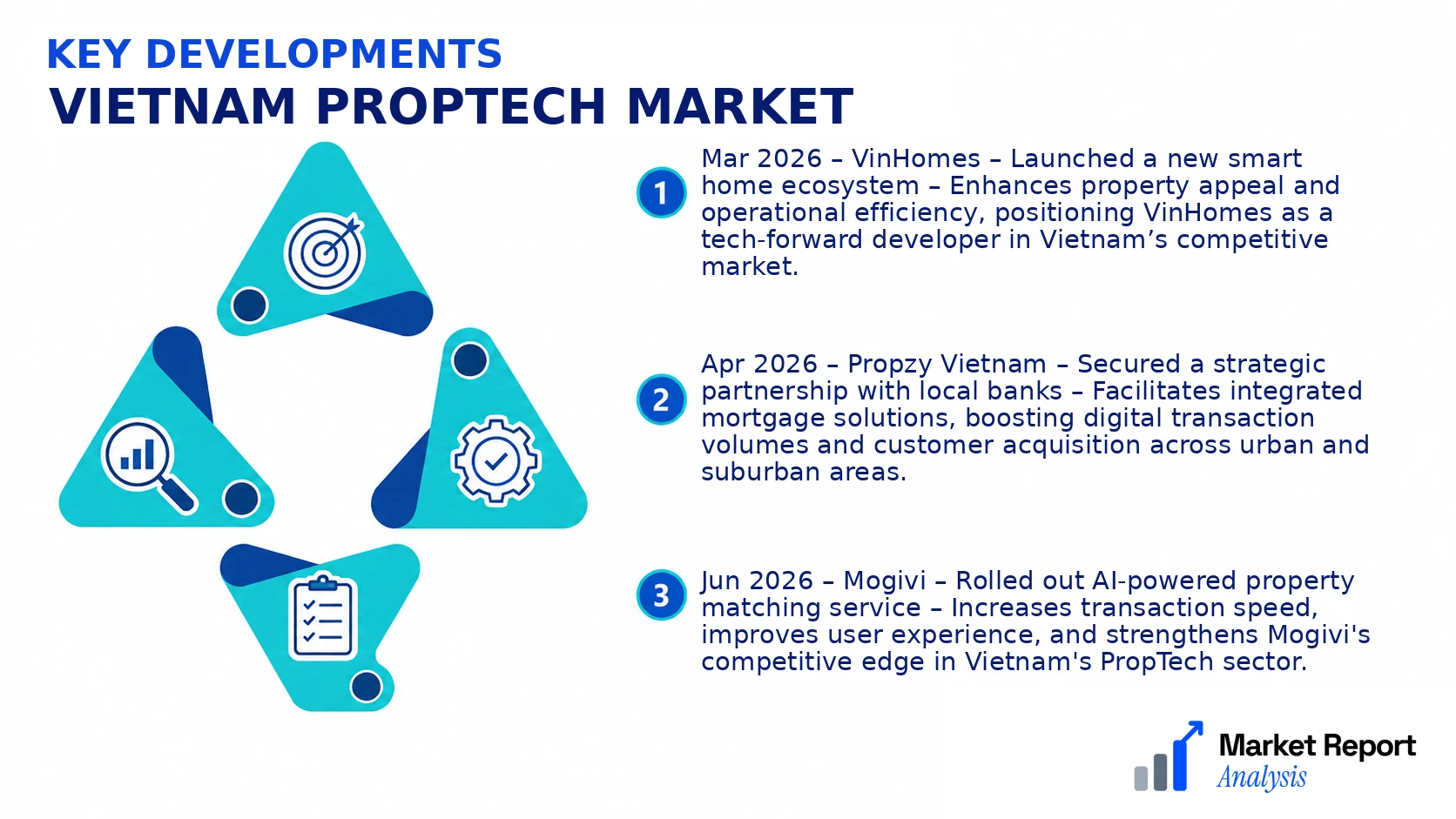
- Mar 2026 – VinHomes – Launched a new smart home ecosystem – Enhances property appeal and operational efficiency, positioning VinHomes as a tech-forward developer in Vietnam’s competitive market.
- Apr 2026 – Propzy Vietnam – Secured a strategic partnership with local banks – Facilitates integrated mortgage solutions, boosting digital transaction volumes and customer acquisition across urban and suburban areas.
- Jun 2026 – Mogivi – Rolled out AI-powered property matching service – Increases transaction speed, improves user experience, and strengthens Mogivi's competitive edge in Vietnam's PropTech sector.
- Aug 2026 – CenGroup – Invested in IoT infrastructure for smart building management – Supports sustainability goals and improves property value through automation, aligning with Vietnam’s urban modernization priorities.
- Oct 2026 – ABSoft Vietnam (a leading software provider) – Developed an integrated property management platform – Provides scalable digital solutions for real estate firms, facilitating digital transformation and operational streamlining in the Vietnam PropTech landscape.
Frequently Asked Questions
What is the Vietnam PropTech Market?
The Vietnam PropTech Market encompasses technological innovations and digital solutions transforming the real estate sector in Vietnam, including property management, transaction facilitation, smart building systems, and geographic information services, driven by rapid urbanization and digital adoption.
What is the current market size of Vietnam PropTech Market?
As of 2026, the Vietnam PropTech Market is estimated to be valued at approximately USD 2.1 Billion, reflecting increasing adoption of digital tools in property transactions, management, and development, with significant growth potential in urban areas and among real estate developers.
What factors are driving the Vietnam PropTech Market?
Market growth is fueled by Vietnam's urban expansion, supportive government policies, rising internet penetration, and the increasing need for efficient property management systems, alongside technological advancements in AI, IoT, and big data analytics within the property sector.
Which Vietnamese city leads the Vietnam PropTech Market?
Ho Chi Minh City leads the Vietnam PropTech Market, owing to its status as the economic hub, high real estate development activity, a dense population of tech-savvy consumers, and a burgeoning startup ecosystem focused on PropTech innovations.
Which segment is expected to grow the fastest?
The online property transaction platform segment is projected to exhibit the fastest growth, driven by consumer demand for simplified property buying and selling processes, and increased digitalization of real estate listings and transaction procedures.
Who are the leading companies operating in the Vietnam PropTech Market?
Key players include Vietnam-based startups and international firms integrating digital solutions into Vietnam’s real estate sector, such as local platforms offering property search and management services, augmented by global technology providers expanding into Vietnam.
Vietnam PropTech Market Segmentation
The Vietnam PropTech Market is segmented based on product, component, type, technology, platform, application, end user, and geography. These categories help clarify market dynamics, regional variations, and technological adoption patterns across Vietnam’s rapidly evolving real estate technology landscape.
- Product
- Software Solutions: Encompassing property management, leasing, and transaction platforms, these solutions are crucial for automating processes, reducing costs, and increasing efficiency for real estate firms and property owners in Vietnam.
- Hardware Devices: Including smart sensors, security cameras, and IoT devices, these hardware components integrate with PropTech systems, enhancing property monitoring, safety, and operational automation, spurring demand among commercial and residential sectors.
- Component
- Cloud Services: Essential for hosting and managing PropTech applications, cloud services provide scalable, secure infrastructure, fostering adoption of innovative solutions across Vietnam’s property management and real estate development sectors.
- Mobile Applications: Mobile platforms facilitate remote access, user engagement, and real-time data updates, significantly improving customer experience and property transactions within Vietnam’s PropertyTech ecosystem.
- Type
- Residential: Focused on the housing sector, residential PropTech solutions address demand for smart homes, virtual tours, and digital payments, catering to Vietnam’s expanding urban middle class seeking convenience and modern amenities.
- Commercial: Targeting office, retail, and industrial real estate, commercial PropTech supports tenants and landlords through lease management, space optimization, and technology-enabled building management, vital for Vietnam’s growing commercial hubs.
- Technology
- Artificial Intelligence (AI): AI-driven analytics, predictive maintenance, and customer personalization enhance decision-making and operational efficiency in property transactions and management across Vietnam.
- Blockchain: Ensuring security, transparency, and efficiency in property transactions, blockchain adoption is gradually increasing in Vietnam’s real estate deals, land registries, and ownership records.
- Platform
- Online Marketplaces: Platforms like property listing sites connect buyers, sellers, and agents, significantly expanding reach and transaction speed in Vietnam’s dynamic real estate markets.
- Integrated Management Platforms: These comprehensive platforms unify leasing, maintenance, and financial management functions, streamlining operations for property managers and owners in Vietnam.
- Application
- Property Management: Solutions for leasing, maintenance, and tenant relations are increasingly adopted to improve service quality and operational efficiency in Vietnam’s residential and commercial properties.
- Real Estate Transactions: Digital platforms facilitate property buying, selling, and leasing processes, reducing transaction time and costs and enhancing transparency in Vietnam’s property market.
- End User
- Real Estate Developers: Leveraging PropTech for project planning, marketing, and sales, developers aim to optimize resources and accelerate project completion in Vietnam’s competitive environment.
- Property Managers and Landlords: These users adopt PropTech solutions for efficient building operations, tenant management, and rent collection to meet rising market expectations.
- Homebuyers and Tenants: As primary consumers, they benefit from smart home features, virtual tours, and digital communication channels, driving demand for integrated PropTech offerings in Vietnam.
- Geography
- Vietnam: The core market, driven by urbanization, government support, and increasing technology adoption, with significant activity concentrated in Ho Chi Minh City, Hanoi, and emerging cities like Da Nang, Hai Phong, Can Tho, Bien Hoa, and Nha Trang. Each urban center exhibits unique traits, from high-tech infrastructure in Ho Chi Minh City to expanding property markets in Hanoi and coastal development in Nha Trang, making Vietnam’s PropTech landscape highly diverse and regionally distinct.
Analyst Perspective
The Vietnam PropTech Market is positioned for sustained growth over the next decade, driven by ongoing urbanization, increased demand for digital property services, and government initiatives promoting smart city ecosystems. Long-term, the market is expected to expand with a CAGR of approximately 11.2%, reaching an estimated USD 4.8 Billion by 2034. Key commercial opportunities include digital leasing platforms, property management software, and innovative financing solutions tailored to Vietnam’s emerging middle class. Technology evolution will focus on AI-driven property analytics, IoT-enabled smart buildings, and big data integration to enhance efficiency and customer experience. Investment priorities should align with infrastructure modernization and regional expansion into secondary cities like Hai Phong and Can Tho, which demonstrate high growth potential. While competitive intensity remains moderate, entering early with differentiated offerings could secure strategic positioning. Ho Chi Minh City and Hanoi will continue to dominate in market share, but alternative urban centers will gradually attract more PropTech activity, reinforcing the market’s evolving landscape.
