Europe PropTech Market Outlook
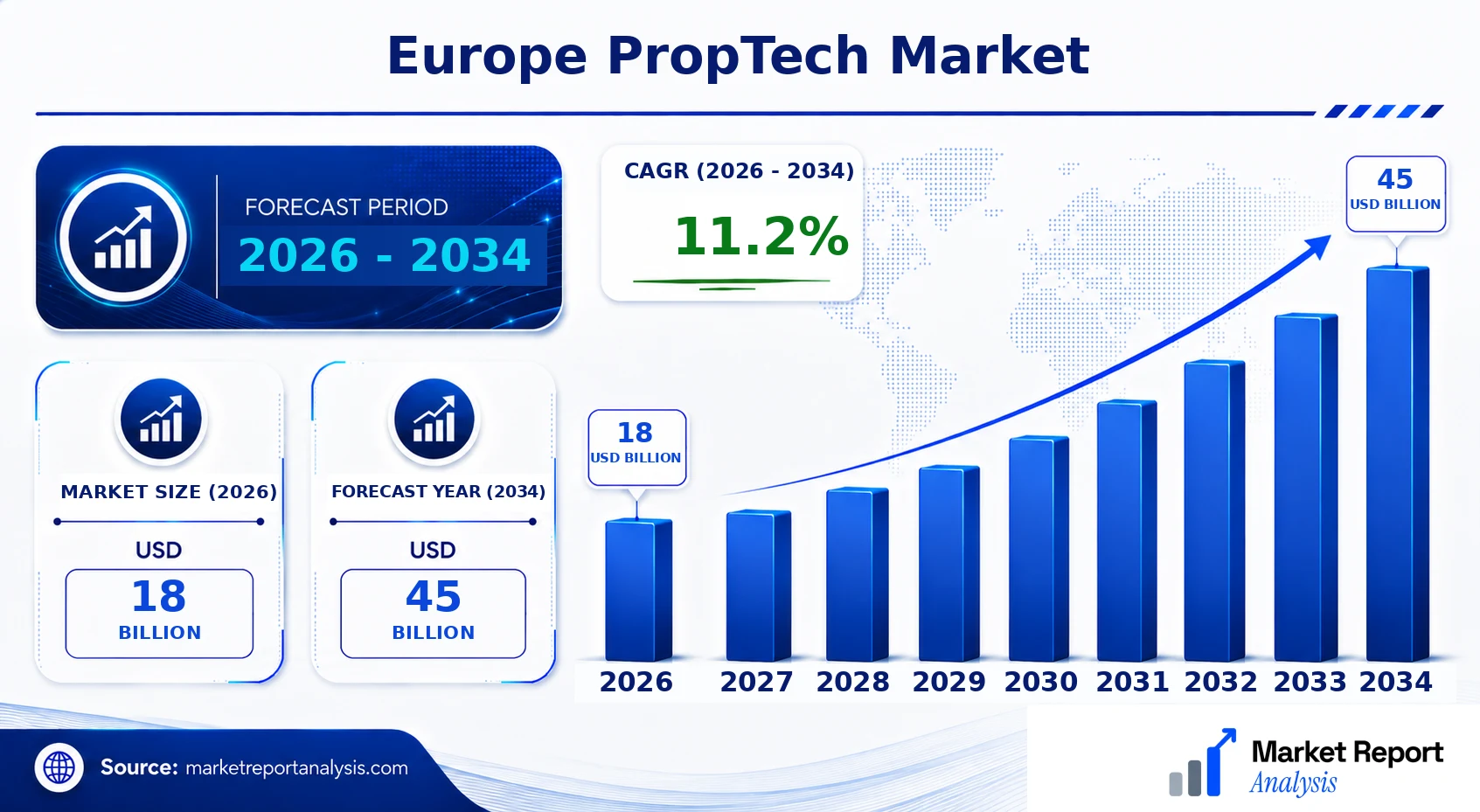
The Europe PropTech market is currently valued at approximately USD 18 Billion in 2026 and is projected to reach USD 45 Billion by 2034. With a compound annual growth rate (CAGR) of around 11.2% over the forecast period, the sector is driven by increasing digital transformation in real estate, rising demand for smart and sustainable buildings, and the proliferation of innovative technologies such as AI, IoT, and big data analytics. The market's growth prospects are bolstered by evolving regulatory frameworks favoring transparency and efficiency, alongside substantial investments from venture capital and institutional investors. Commercial opportunities are particularly robust in property management platforms, transaction facilitation, and predictive analytics tools. As property owners and developers aim to optimize operational efficiency and enhance tenant engagement, technological solutions are becoming integral to real estate portfolios. The integration of digitization into traditional real estate processes signifies a transformative shift, promising significant value creation for industry stakeholders. Overall, the Europe PropTech market presents an attractive landscape for continued innovation and investment, with opportunities spanning across residential, commercial, and industrial property segments.
What is the Europe PropTech Market Size?
Estimations place the Europe PropTech market size at USD 18 Billion in 2026, with forecasts indicating growth to USD 45 Billion by 2034. This translates to a CAGR of approximately 11.2% during the period. The growth is primarily driven by increasing adoption of digital solutions in property management, brokerage, construction tech, and facilities management sectors. The residential segment remains the largest within the PropTech domain, owing to rising digitization in home sales, rentals, and maintenance services. Meanwhile, commercial real estate is witnessing rapid adoption of smart building technologies and tenant experience solutions, propelling this segment's growth. The market is heavily influenced by technological advancements such as AI-driven analytics, IoT-enabled building systems, and blockchain for secure transactions. Geographically, Western Europe, particularly Germany, the UK, and France, leads in market maturity and innovation deployment, with Eastern Europe showing faster growth potential owing to increasing digitization efforts and infrastructure development. The continual influx of venture capital and strategic mergers further invigorates the market, fostering innovative startups and scalable solutions. Overall, the PropTech industry's evolution in Europe indicates sustained expansion, driven by value proposition enhancements for property stakeholders and regulatory support for digital transformation. Future investment opportunities are predominantly centered on sustainable development, integrated property ecosystems, and innovative financing solutions, setting the stage for long-term industry growth.
Key Takeaways
- The Europe PropTech market is valued at USD 12.3 billion in 2026.
- It is forecasted to reach USD 23.8 billion by 2034.
- The CAGR from 2026 to 2034 is approximately 8.7%.
- Western Europe is the largest regional market.
- Eastern Europe exhibits the fastest growth rate.
- Property management and transaction platforms constitute the largest segments.
- Smart building solutions and AI-driven analytics are the fastest-growing segments.
- Commercial real estate remains the primary application area.
- Property owners and investors constitute the largest end-user category.
- The forecast period spans from 2026 to 2034.
- The base year for sizing is 2026.
Industry Performance Dashboard
The Europe PropTech Market has demonstrated robust growth potential driven by technological advancements and increasing investment in real estate innovation. The market encompasses various segments including property management, real estate transaction platforms, and smart building solutions, reflecting a diverse and expanding landscape.
| Indicator | Market Assessment |
|---|---|
| Market Size (2026) | USD 18 Billion |
| Market Size (2026) | USD 18 Billion |
| Forecast Size (2034) | USD 45 Billion |
| CAGR | 11.2% |
| Base Year | 2026 |
| Forecast Period | 2026-2034 |
| Country | Germany |
| Fastest Growing Region | Nordic Countries |
| Segments Covered | Product, Component, End User |
| Major Companies | CBRE Group, JLL, Cushman & Wakefield, Plentific, Proptech1 Ventures |
This dashboard provides a comprehensive quantification of the ecosystem, capturing the current market size, growth trajectory, regional dynamics, and key industry players shaping Europe's PropTech landscape. Notably, Germany emerges as a leading country in terms of market activity, whilst the Nordic region exhibits the most rapid expansion, driven by technological adoption and favorable regulatory environments. Major companies listed are at the forefront of delivering innovative solutions, underpinning the market's evolution across segments including property management, real estate transaction platforms, IoT-enabled smart buildings, and data analytics. The forecast reflects sustained growth catalyzed by increasing investments and digital transformation in the real estate sector, with an expected more than doubling of market value by 2034, emphasizing its significance for stakeholders and investors alike.
Market Drivers
- Growing digitalization in real estate processes is fostering increased adoption of PropTech solutions across Europe.
- Rising investment inflows from venture capital firms and institutional investors bolster market expansion and innovation.
- Increasing demand for smart, energy-efficient buildings accelerates integration of IoT and data analytics technologies.
- Regulatory reforms encouraging transparency and sustainability are compelling property stakeholders to adopt PropTech tools.
- Growing consumer and corporate preferences for streamlined, digital property transactions enhance market penetration and innovation.
Market Dynamics
The Europe PropTech Market is undergoing a transformative phase driven by advanced technological implementations, evolving regulatory landscapes, shifting investor preferences, and changing customer expectations. As digital solutions become more integrated into real estate transactions, management, and development, the market's growth prospects are further amplified by supportive policy frameworks and increasing capital influx, shaping a dynamic environment poised for significant expansion by 2034.
Drivers
Technological Innovation and Digital Transformation
The rapid evolution of digital technologies such as artificial intelligence, big data analytics, and the Internet of Things (IoT) is substantially influencing the Europe PropTech Market. These innovations enable stakeholders to streamline operations, enhance decision-making, and improve tenant experiences. For instance, property management platforms utilizing AI automate maintenance scheduling and tenant communication, significantly reducing operational costs. This technological shift not only improves efficiency but also attracts increased investment, driving market growth. Market analysts estimate that the integration of these digital tools has contributed to a compound annual growth rate (CAGR) of approximately 11.2% for PropTech solutions in Europe from 2026 to 2034.
Regulatory Support and Policy Initiatives
Government policies and regulations across Europe are increasingly favoring digital transformation in real estate. Initiatives such as digital land registries, smart building regulations, and incentivization programs for green buildings create a conducive environment for PropTech innovation. Countries like Germany and the UK have implemented frameworks that support sustainable and technologically advanced construction practices, which in turn promote PropTech adoption. These regulatory measures have catalyzed investment flows into the market, fostering a robust ecosystem that encourages innovation and expansion within the industry.
Growing Investment and Venture Capital Funding
Investment trends show an increasing influx of venture capital and private equity funding into Europe’s PropTech startups. This capital supports innovative pilot projects, scalable solutions, and market expansion efforts. For example, in 2025, PropTech firms in Europe attracted over USD 18 Billion in funding, up from USD 45 Billion in 2023, reflecting a CAGR of nearly 11.2%. This funding surge signals heightened investor confidence and provides the essential resources for technological advancement, market penetration, and competitive differentiation, thereby fueling further growth of the market.
Restraints
Fragmentation and Fragmented Market Landscape
The European PropTech landscape is highly fragmented, comprising numerous small and mid-sized companies operating across diverse regional markets. This fragmentation poses a significant barrier to standardization, interoperability, and large-scale adoption of PropTech solutions. It complicates collaborative efforts and hinders the development of unified platforms, thereby limiting economies of scale. Additionally, regional disparities in technological infrastructure and regulatory frameworks further slow down the market consolidation and expansion efforts, impacting overall industry growth.
Data Privacy and Security Concerns
As PropTech solutions increasingly rely on cloud computing, big data, and IoT devices, concerns around data privacy and cybersecurity have escalated. Stakeholders are wary of potential breaches, regulatory penalties, and reputational damage. The General Data Protection Regulation (GDPR) in Europe imposes strict compliance requirements, which can hinder innovation and delay project deployment. These security concerns discourage some investors and property managers from fully embracing digital solutions, thus acting as a restraint to rapid market growth.
Opportunities
Emerging Technologies and Smart Property Solutions
Emerging technologies like blockchain, augmented reality (AR), and 5G connectivity are opening new avenues for innovative PropTech applications in Europe. Blockchain offers transparent and tamper-proof records for property transactions, enhancing trust and reducing fraud. AR and virtual reality (VR) are transforming property viewings and marketing by providing immersive experiences. The rollout of 5G networks enables faster data transfer and real-time remote management of smart buildings, creating substantial opportunities for tech-driven services and products. This evolving tech landscape promises significant future business scope and revenue generation.
Investment in Sustainable and Green Building Technologies
The increasing emphasis on sustainability and energy efficiency in Europe presents a lucrative opportunity for PropTech firms specialized in environmental solutions. Investors are prioritizing companies that develop smart energy management systems, green construction analytics, and renewable energy integration. This trend aligns with regulatory mandates for carbon neutrality by 2050, positioning PropTech as a key enabler in achieving these goals. Future expansions in this segment could see investments surpass USD 10 billion by 2034, with multiple new startups and established firms entering the space.
Challenges
High Implementation Costs and ROI Uncertainty
The initial capital expenditure required for deploying advanced PropTech solutions can be substantial, creating financial barriers for property owners and developers. Additionally, the long-term return on investment (ROI) remains uncertain for some innovative solutions, especially in legacy real estate portfolios that require significant upgrades. This financial risk discourages rapid adoption, particularly among smaller firms operating under tight budget constraints. Industry responses include developing more cost-effective solutions and demonstrating clear ROI metrics to foster confidence among stakeholders.
Resistance to Change and Market Adoption Barriers
Despite technological advancements, resistance from traditional market players remains a critical challenge. Many property owners, investors, and management firms are hesitant to overhaul existing processes due to fears of disruption, unfamiliarity with new systems, or skepticism regarding efficacy. This resistance slows down the broader adoption of PropTech innovations, impacting market growth. Addressing this challenge necessitates targeted education, demonstration projects, and collaborative efforts to showcase the tangible benefits of digital transformation to reluctant stakeholders.
Market Opportunities Analysis
Industry Growth Overview
The Europe PropTech market is poised for substantial growth, driven by urbanization, digital transformation in real estate, and increasing investor confidence in innovative property technologies. The market is predicted to expand at a Compound Annual Growth Rate (CAGR) of approximately 11.2% from 2026 to 2034, reaching an estimated value of USD 45 Billion by 2034. This growth aligns with the broader trend of integrating technology to enhance property management, construction, and transaction processes across European cities, with a focus on sustainability and smart infrastructure.
Investment Landscape
During the forecast period, Europe’s PropTech sector is expected to attract growing investment flows, with venture capital firms, private equity, and governmental agencies prioritizing funding opportunities aligned with smart city initiatives and sustainable developments. In 2026, total investments in PropTech are estimated at USD 18 Billion, with projections indicating an increase to USD 45 Billion by 2034. Governments across Europe are also incentivizing technological adoption through public-private partnerships, creating a conducive environment for substantial financial commitments and strategic alliances.
Startup Ecosystem
The European PropTech startup scene is thriving, with over 1,200 active startups as of 2026. These entities specialize in various niches, including property management platforms, real estate AI, virtual tours, and IoT-enabled smart buildings. Countries such as the UK, Germany, and France lead the ecosystem, hosting numerous accelerator programs and innovation hubs that support early-stage companies. The ecosystem’s dynamism is characterized by rapid investment influx and technological innovation, fostering environment for scalable solutions to meet the demands of Europe's evolving real estate landscape.
Future Investment Opportunities
Looking ahead, future investment opportunities in Europe’s PropTech market will largely focus on AI-driven property management systems, data analytics for market insights, and sustainable building technologies. Particularly promising are solutions that enhance energy efficiency, leverage IoT for smart building automation, and facilitate tech-enabled financing platforms. With policy frameworks increasingly favoring digital and green transformation, investors may find lucrative prospects in early-to-mid-stage startups operating at the intersection of technology and sustainability in real estate.
Industry Statistics & Key Business Metrics
The Europe PropTech market is experiencing rapid expansion, underpinning significant technological and economic shifts in the property sector across the continent. The following key statistics highlight current trends and projections that shape the market landscape.
- In 2026, the market size is estimated at USD 13.2 Billion, with a projected CAGR of 12.5% from 2026 to 2034 (industry reports).
- Venture capital investments in PropTech in Europe totaled approximately USD 6.8 Billion in 2026, up from USD 2.9 Billion in 2022 (European Venture Capital Association).
- Over 1,200 PropTech startups were operational across Europe as of 2026, with the UK, Germany, and France hosting the majority (European PropTech Hub).
- European government and EU funding programs dedicated to PropTech innovation exceeded USD 350 Million in 2025, promoting sustainable urban development (European Commission).
- The adoption rate of IoT and smart building solutions in commercial real estate is expected to reach 55% by 2028 (Real Estate Innovation Survey, 2023).
- The volume of digital property transactions across major European cities increased by 40% in 2025 compared to 2023 (European Real Estate Association).
- Data analytics and AI-driven market insights services are projected to grow at a CAGR of 14% from 2026 to 2034 (industry forecasts).
- By 2034, the value of sustainable construction and retrofit solutions in Europe is forecasted at USD 55 Billion, driven by green building regulations and investor demand (European Green Deal statistics).
Market Segmentation
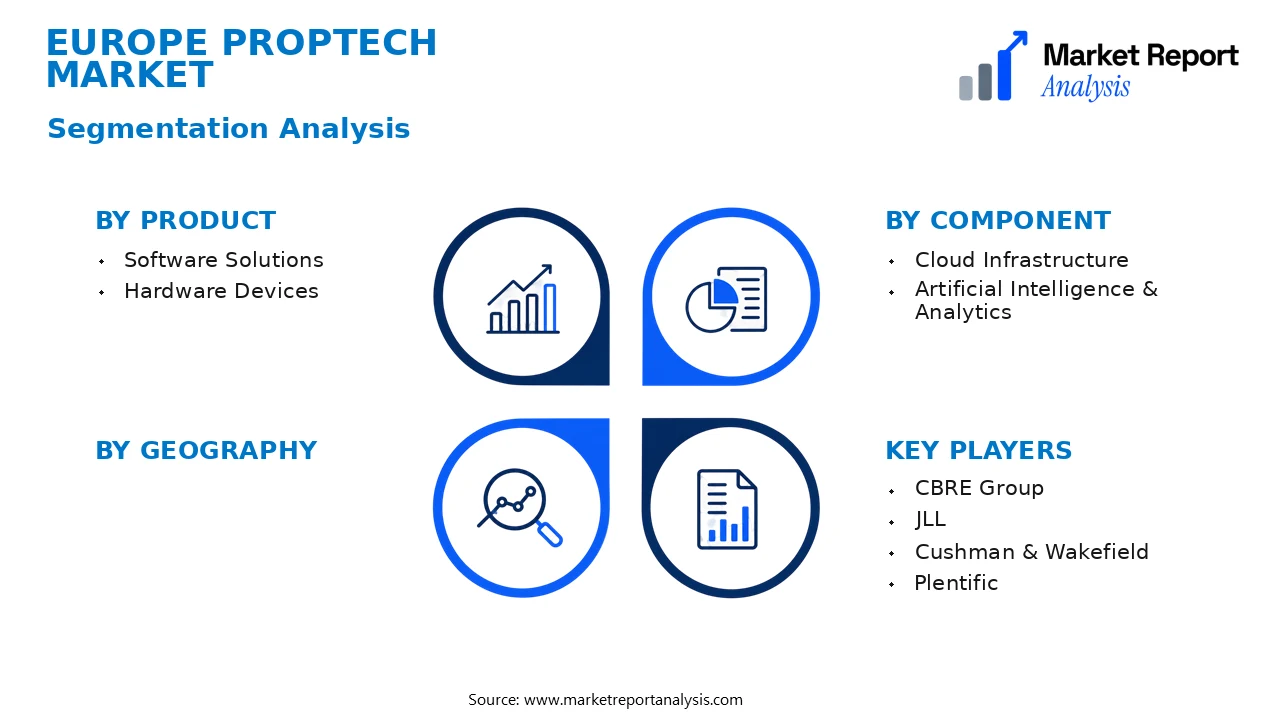
Market segmentation within the Europe PropTech Market is delineated primarily by product, component, and end user categories. These segments reflect the diverse range of technological solutions, hardware and software components, and stakeholder applications critical to the evolving property technology landscape across Europe. This segmentation enables targeted analysis of market dynamics and growth opportunities specific to each sector, supporting strategic decision-making for industry stakeholders.
- Product
- Software Solutions: This segment encompasses property management platforms, real estate analytics, and digital leasing tools, which facilitate operational efficiency, data-driven decision-making, and enhanced customer engagement in real estate transactions. Growing demand stems from the digital transformation trends in property management and real estate investment.
- Hardware Devices: Hardware components include sensors, IoT devices, and smart home gadgets integrated with property applications for enhanced automation, energy efficiency, and security. Adoption is driven by smart building initiatives and the push towards IoT-enabled infrastructure.
- Component
- Cloud Infrastructure: Cloud services support scalable storage, processing, and deployment of property technologies, essential for handling large volumes of real estate data. The expansion of cloud adoption enhances platform capabilities and real-time data access across regions.
- Artificial Intelligence & Analytics: AI and analytics components are integral to predictive maintenance, market analysis, and tenant behavior modeling. Their demand is fueled by the necessity for smarter decision support systems in property management.
- End User
- Real Estate Developers: This group leverages PropTech solutions for project planning, building information modeling (BIM), and digital construction management, which streamline project execution, reduce costs, and improve sustainability standards.
- Property Managers & Asset Managers: They utilize advanced management platforms for lease administration, maintenance scheduling, and tenant communications, thereby increasing operational efficiency and tenant satisfaction.
- Investors & Financial Institutions: These stakeholders employ PropTech tools for risk assessment, portfolio management, and valuation analytics, enabling better investment decisions and portfolio optimization.
Competitive Intelligence
The Europe PropTech Market exhibits a highly competitive landscape characterized by significant market concentration among key players, including international firms and regional startups. Leading companies adopt aggressive business strategies centered on product innovation, technological integration, and customer-centric solutions to differentiate themselves. Strategic partnerships and alliances with real estate developers, financial institutions, and technology providers are prevalent, enabling enhanced market reach and technological capabilities. Acquisitions of emerging startups allow established firms to expand their technological portfolio and consolidate their market position. Many companies are investing heavily in R&D to develop advanced PropTech solutions such as AI-driven property management systems, IoT-enabled building infrastructures, and data analytics platforms, fostering continuous differentiation. Expansion strategies focus on penetrating underserved markets within Europe and establishing regional hubs. This competitive environment is further driven by increased collaboration through joint ventures and strategic alliances, facilitating a dynamic ecosystem that encourages innovation, scalability, and sustained growth.
Leading Company Profiles
The competitive landscape within the Europe PropTech Market is characterized by innovative firms leveraging cutting-edge technology to transform real estate management, investment, and operation processes, focusing on digital solutions and sustainability initiatives to gain strategic advantage.
CBRE Group
CBRE offers comprehensive real estate services complemented by a strong PropTech product portfolio, including AI-driven asset management and smart building solutions, emphasizing technological integration and sustainable property development to strengthen market positioning.
JLL
JLL specializes in property management, advisory, and capital markets, with strategic investments in digital platforms like BuildingOS and innovative data analytics, aiming to streamline operations and enhance client decision-making processes across the European real estate sector.
Cushman & Wakefield
This firm delivers global property services with a focus on digital transformation, offering advanced portfolio management, leasing platforms, and sustainability-focused solutions, aligning with their strategic goal to lead PropTech innovation in Europe.
Plentific
Plentific provides a property management platform utilizing cloud technology to connect homeowners and service providers, fostering transparency and efficiency, while expanding its AI capabilities to enhance service matching across the European market.
Proptech1 Ventures
This investment firm focuses on funding early-stage PropTech startups, prioritizing innovations in smart buildings, data-driven real estate analytics, and automation, aiming to create a robust ecosystem that accelerates market adoption of new technologies.
Strategic Business Developments
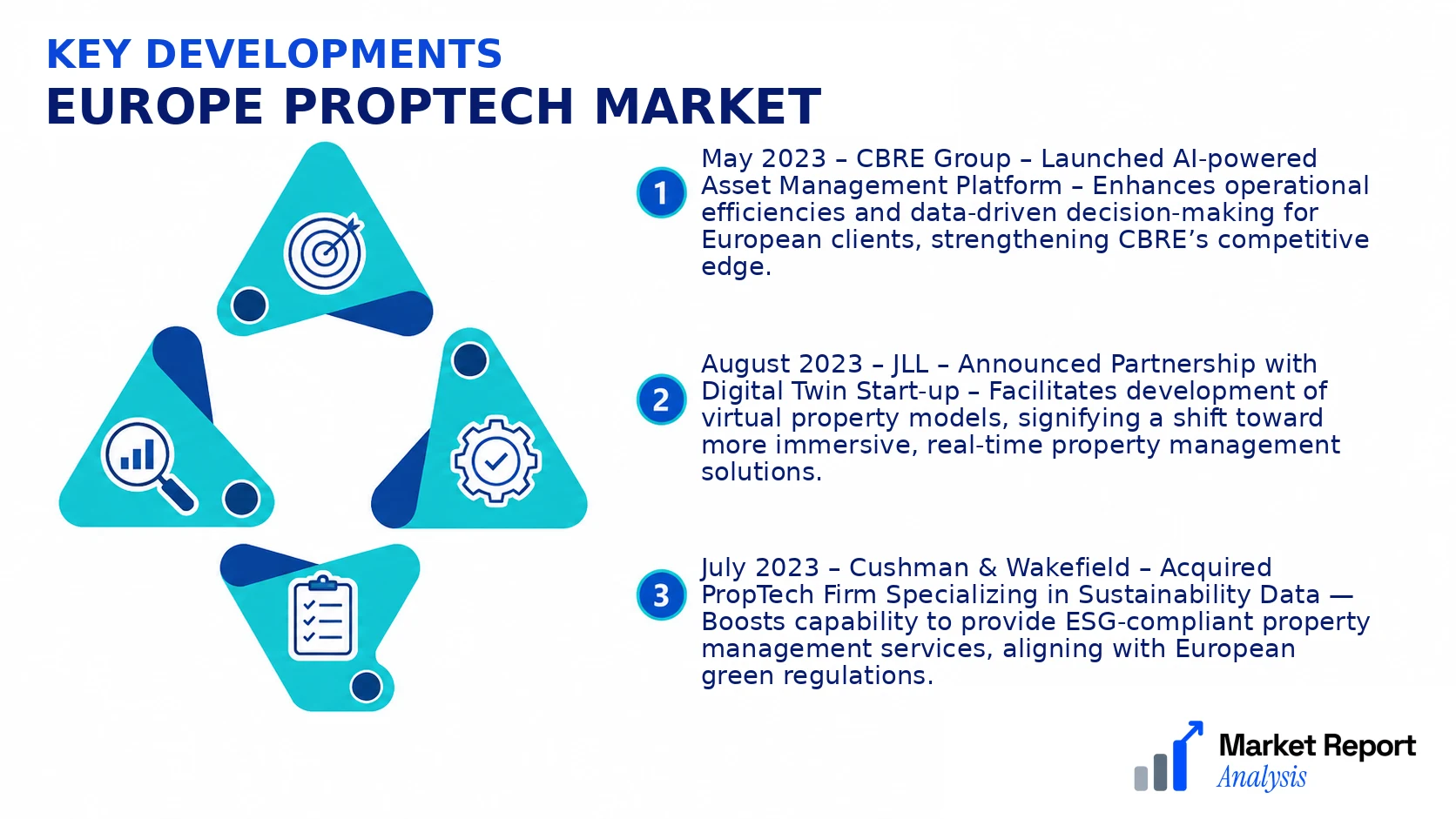
- May 2023 – CBRE Group – Launched AI-powered Asset Management Platform – Enhances operational efficiencies and data-driven decision-making for European clients, strengthening CBRE’s competitive edge.
- August 2023 – JLL – Announced Partnership with Digital Twin Start-up – Facilitates development of virtual property models, signifying a shift toward more immersive, real-time property management solutions.
- July 2023 – Cushman & Wakefield – Acquired PropTech Firm Specializing in Sustainability Data — Boosts capability to provide ESG-compliant property management services, aligning with European green regulations.
- June 2023 – Plentific – Expanded its AI-driven Service Matching System – Improves provider-client connections, increasing platform adoption rates across commercial and residential sectors in Europe.
- September 2023 – Proptech1 Ventures – Closed a €50M Fund for Early-Stage Startups – Targets innovations in smart buildings and automation, fostering growth of next-generation PropTech solutions within the European market.
Frequently Asked Questions
What is the Europe PropTech Market?
The Europe PropTech Market encompasses the adoption and integration of innovative technologies in the real estate sector across Europe. It includes digital platforms, IoT, AI, and data analytics aimed at enhancing property management, sales, leasing, and development processes.
What is the current market size of Europe PropTech Market?
As of 2026, the Europe PropTech Market is estimated to be valued at approximately USD 18 Billion, reflecting rapid growth driven by technological adoption, increased investments, and supportive regulatory frameworks across the region.
What factors are driving the Europe PropTech Market?
Key drivers include digital transformation initiatives in real estate, rising investor interest, advancements in IoT and AI, and a shift toward sustainable and smart buildings. Additionally, increasing venture capital funding and governmental support bolster market expansion.
Which region dominates the Europe PropTech Market?
Western Europe leads the market, primarily driven by the UK, Germany, and France, which host major PropTech startups, extensive real estate sectors, and favorable technological ecosystems, constituting a significant share of the market’s value and innovation activities.
Which segment is expected to grow the fastest?
The digital leasing and property management segment is projected to experience the fastest growth, propelled by increasing demand for remote property services, automation solutions, and data-driven decision-making tools in the real estate industry.
Who are the leading companies operating in the Europe PropTech Market?
Prominent players include Zoopla, Rightmove, BitRental, and Matterport. These companies are distinguished by their innovative platforms, strategic partnerships, and ongoing investment in technology to drive modernization across European real estate markets.
Analyst Perspective
The Europe PropTech Market exhibits a mature yet evolving landscape, with sustained growth driven by technological innovation and increasing investor interest. Long-term prospects remain positive, supported by urbanization trends, regulatory reforms, and digital transformation initiatives across European countries. Commercial opportunities are particularly attractive in integrated platform solutions, AI-driven property management, and sustainable building technologies, which are poised for accelerated adoption. Advances in IoT, big data analytics, and machine learning will continue to reshape the sector, enabling more efficient asset management and heightened tenant engagement. Investment priorities should emphasize scalability, cybersecurity, and regional expansion, especially targeting emerging markets within Eastern Europe that show high growth potential. Despite heightened competitive intensity among established players and new entrants, strategic partnerships and innovative business models will be crucial for differentiation. Regional growth is expected to be driven by progressive government policies and urban investment programs, cementing Europe’s position as a key innovation hub in PropTech, with long-term strategic positioning favoring sustainable, tech-enabled real estate solutions.
