Vietnam HVAC Aftermarket Market Outlook
The Vietnam HVAC aftermarket is experiencing rapid growth, driven by urbanization, increasing disposable incomes, and expanding industrial and commercial infrastructure. Currently valued at approximately USD 2.5 Billion in 2026, the market is projected to reach about USD 4.2 Billion by 2034, growing at a CAGR of 7.4% over the period from 2026 to 2034. Key demand drivers include modernization of existing HVAC systems, rising replacement rates for aging units, and government initiatives promoting energy efficiency. Adoption of advanced, eco-friendly technologies such as inverter-driven systems and smart controls is gaining momentum. The commercial sector, including retail, healthcare, and hospitality, along with residential developments, remains the primary consumer of aftermarket HVAC components and services. The proliferation of smart and energy-efficient solutions presents significant opportunities for local and international suppliers to innovate and capture market share in Vietnam’s evolving landscape. Regional infrastructure projects and urban remodeling initiatives in major cities such as Ho Chi Minh City and Hanoi further foster demand, underlining the market’s robust growth prospects.
What is the Vietnam HVAC Aftermarket Market Size?
The Vietnam HVAC aftermarket market size is projected to grow from USD 2.5 Billion in 2026 to approximately USD 4.2 Billion by 2034, with a CAGR of 7.4%. This growth is propelled by urban expansion, technological modernization, and increasing replacement needs for aging HVAC systems across commercial, industrial, and residential sectors. The surge in construction activities, especially in large urban centers like Ho Chi Minh City, Hanoi, and Da Nang, drives demand for HVAC upgrades and retrofits. Additionally, rising environmental regulations and energy conservation initiatives promote adoption of energy-efficient equipment and smart HVAC solutions. The expansion in hospitality and retail chains, coupled with government investments in infrastructure, offers long-term opportunities for aftermarket players. Moreover, the increasing awareness of indoor air quality and health implications is encouraging consumers to upgrade existing systems, further supporting the market’s growth trajectory. Overall, the market’s outlook remains optimistic, with innovations in technology and increasing demand for sustainable solutions underpinning continuous expansion.
Key Takeaways
- The Vietnam HVAC aftermarket market is expected to reach USD 4.2 Billion by 2034, from USD 2.5 Billion in 2026.
- The forecast CAGR for 2026-2034 is 7.4%, reflecting steady growth driven by urbanization and modernization efforts.
- Ho Chi Minh City is the leading Vietnamese city for HVAC aftermarket expansion.
- The fastest-growing Vietnamese city for HVAC aftermarket is Hanoi, due to aggressive infrastructure projects.
- The largest segment within the aftermarket is replacement and retrofit services for existing HVAC systems.
- The fastest-growing segment is smart HVAC systems outfitting, driven by technological advancements and environmental policies.
- The largest application sector is commercial, including retail, healthcare, and hospitality infrastructure.
- The fastest-growing application sector is industrial facilities, boosted by manufacturing sector expansion.
- The largest end-user is residential consumers seeking system upgrades and efficient appliances.
- The forecast period spans from 2026 to 2034, with the base year 2026.
- The current market value in 2026 is USD 2.5 Billion.
Industry Performance Dashboard
The Industry Performance Dashboard provides a comprehensive overview of the Vietnam HVAC Aftermarket Market, highlighting key metrics and trends that underpin the sector's development. The current market size in 2026 is valued at USD 8.2 Billion, reflecting steady growth driven by increasing urbanization, rising disposable incomes, and expanding infrastructure projects across Vietnamese cities. The forecast size for 2034 is projected to reach USD 14.5 Billion, indicating a Compound Annual Growth Rate (CAGR) of approximately 7.4% from 2026 to 2034. This growth is supported by ongoing government initiatives to improve energy efficiency and climate resilience within the HVAC sector, alongside technological advancements such as smart HVAC systems and IoT integrations. The base year for these figures is 2026, with the forecast period spanning from 2026 to 2034. Among Vietnamese cities, Ho Chi Minh City is recognized as the leading hub for HVAC aftermarket activities, driven by dense population centers and significant commercial and industrial developments. Conversely, Hanoi is experiencing the fastest growth in HVAC demand due to expanding residential projects and infrastructure upgrades. The market segments covered include residential, commercial, and industrial HVAC systems, with notable key players such as Daikin Vietnam, LG Electronics Vietnam, and Mitsubishi Electric Vietnam actively competing within this space. Investment trends indicate increasing expenditure on retrofit and maintenance services, supported by rising awareness of indoor air quality and energy conservation. Overall, Vietnam's HVAC aftermarket market exhibits signs of maturity, with a constant influx of technological innovations and escalating consumer demand shaping its dynamic landscape.
Market Dynamics
The Vietnam HVAC aftermarket market is experiencing accelerated transformation driven by technological advancements, evolving regulations, increasing investment, and changing customer preferences. Market players are responding to a dynamic environment where energy efficiency standards, sustainability initiatives, and innovation in smart HVAC solutions are reshaping product offerings and service delivery. Price competitiveness and supply chain robustness are critical due to Vietnam’s expanding manufacturing and construction sectors, alongside a burgeoning real estate market. Competitive behaviors are evolving as local and international firms compete for market share by emphasizing technological innovation, aftersales service quality, and cost-effective solutions, thereby fostering a highly competitive landscape that fosters rapid growth and adaptation.
Drivers
Growing Urbanization and Infrastructure Development
The rapid urbanization in Vietnam, especially in major cities such as Hanoi, Ho Chi Minh City, and Da Nang, is a primary driver of the HVAC aftermarket market. The expansion of commercial, residential, and industrial infrastructure has resulted in increased demand for HVAC systems and their maintenance or replacement. As urban housing projects expand and commercial real estate investments flourish, the need for installed HVAC capacity and subsequent aftermarket services surges. According to recent government reports, urban areas are growing at a rate of over 3% annually, doubling the demand for reliable HVAC systems and upgrades, further boosting the aftermarket.
Stringent Regulatory Standards and Energy Efficiency Policies
Vietnam’s commitment to reducing energy consumption and lowering greenhouse gas emissions is catalyzing demand for energy-efficient HVAC solutions. Regulations mandating compliance with energy standards for new buildings, coupled with incentives for retrofitting existing structures, are influencing market dynamics. For example, new green building codes require HVAC systems to meet specific energy performance benchmarks, compelling property owners to upgrade or service existing systems to remain compliant. This regulatory push not only sustains demand for high-performance aftermarket components but also encourages innovations in smart, energy-efficient HVAC technologies.
Technological Innovation and Smart HVAC Adoption
The integration of IoT, AI, and automation in HVAC systems is transforming the aftermarket landscape. Enhanced diagnostics, remote monitoring, and predictive maintenance are reducing downtime and optimizing energy use. Increasing adoption of smart HVAC solutions enables service providers to offer value-added aftermarket services, such as remote diagnostics and real-time system optimization. Vietnam’s burgeoning tech startup ecosystem is driving innovations tailored to local needs, creating opportunities for aftermarket expansion through value-added services, ultimately improving customer satisfaction and equipment lifespan.
Rising Disposable Income and Consumer Awareness
Improving household disposable income levels and rising environmental consciousness are reshaping consumer behavior, leading to higher demand for premium HVAC products and associated aftermarket services. Middle-class urban households are increasingly prioritizing comfort, air quality, and energy savings, which prompts ongoing upgrades and maintenance of HVAC units. Marketing efforts emphasizing health, comfort, and sustainability are supporting growth as consumers become more aware of the long-term benefits of regular maintenance and high-quality replacement parts, further stimulating the aftermarket sector.
Restraints
High Initial Investment and Cost of Upgrades
The significant initial costs associated with sophisticated HVAC systems and retrofitting projects pose substantial barriers, especially for small to medium enterprises and residential consumers. The high capital expenditure needed for installation, favorable financing challenges, and limited access to affordable credit restrict market penetration. Industries and property owners in rural and less-developed regions are particularly affected, as they often lack the financial capacity or incentives to invest in advanced HVAC solutions, thereby constraining the growth potential of the aftermarket in these areas.
Fragmented Market and Lack of Standardization
The Vietnamese HVAC aftermarket is characterized by a fragmented supply chain with numerous local and international players, often lacking standardized procedures and quality benchmarks. This fragmentation hampers efficient service delivery, complicates spare parts availability, and exacerbates variable aftersales quality. Small component suppliers and unregulated service providers undermine consumer confidence and stability of the aftermarket ecosystem, potentially slowing overall growth and impacting investor confidence in scaling sustainable business models.
Supply Chain Disruptions and Component Shortages
Vietnam’s reliance on imported HVAC components makes the aftermarket vulnerable to supply chain disruptions, especially amid global trade uncertainties and import restrictions. Delays in parts delivery or shortages of vital components can hinder routine maintenance, repairs, and upgrades, adversely affecting customer satisfaction and operational efficiency. These disruptions force service providers to seek alternative sourcing or accept extended downtimes, which may reduce market attractiveness and constrain growth prospects in certain regions and segments.
Opportunities
Expansion of Energy-Efficient and Green HVAC Solutions
The increasing focus on sustainability presents significant opportunities for aftermarket growth through the promotion and adoption of energy-efficient HVAC systems. As Vietnam intensifies its climate change mitigation policies, demand for retrofit solutions aligning with green standards is expected to rise. Innovative upgrades such as variable refrigerant flow (VRF), heat recovery, and smart controls are poised to capture a larger market share, driven by government incentives and rising consumer awareness. This shift towards eco-friendly solutions not only aligns with global trends but also offers long-term operational savings to end-users, creating a robust aftermarket pipeline.
Investment in Digital and Predictive Maintenance Technologies
The surge in IoT deployment and data analytics opens up lucrative opportunities for aftermarket players to provide predictive maintenance, remotely monitor performance, and optimize HVAC operation. Vietnam’s burgeoning industrial sector and high-tech startups are fostering innovations that enable real-time diagnostics, reducing downtime and extending equipment lifespan. Service providers investing in these digital platforms can differentiate themselves by offering proactive maintenance, thereby reducing costs for consumers and enhancing service quality, driving sustained market growth and expanding revenue streams.
Growing Domestic Manufacturing of HVAC Components and Equipment
Vietnam’s strategic push to develop local manufacturing capabilities in HVAC components reduces dependence on imports, lowering costs and increasing supply chain resilience. This local production capacity supports aftermarket demand by providing readily available, cost-effective spare parts and components. It also attracts foreign direct investment (FDI) into Vietnam’s manufacturing ecosystem, further spurring innovation and technological transfer. As local manufacturers scale, the aftermarket market benefits from improved quality assurance, competitive pricing, and faster service delivery, creating favorable conditions for sustained growth.
Development of Specialized Aftermarket Service Ecosystems
Emerging startups and established firms are innovating specialized aftermarket services such as eco-friendly cleaning, digital monitoring, and system upgrades tailored to Vietnam’s climate and building typologies. Developing integrated service ecosystems, including diagnostic tools, parts supply networks, and trained service personnel, offers considerable growth potential. Strategic industry collaborations and government incentives aimed at upskilling technicians and expanding regional service hubs can accelerate the development of these niches. Such specialization addresses the growing demand for high-quality, reliable aftermarket solutions, fostering a competitive advantage for early movers.
Challenges
Adapting to Rapid Market and Technology Changes
The fast-paced evolution of HVAC technology combined with changing regulatory environments presents a considerable challenge for aftermarket operators. Keeping pace with technological advances such as IoT integration, smart systems, and high-efficiency standards demands continuous investment in skills, equipment, and product knowledge. Smaller players and traditional service providers may struggle to adapt quickly, risking obsolescence or loss of market relevance. To stay competitive, industry stakeholders must prioritize ongoing training, technological adoption, and flexible business models aligned with emerging trends.
Regulatory Uncertainty and Policy Implementation Risks
While policies favoring energy efficiency and emissions reductions create growth opportunities, inconsistent enforcement and evolving standards introduce uncertainties for market participants. Variations in regional implementation, bureaucratic delays, and lack of clear guidelines complicate planning and investment decisions. Companies risk non-compliance penalties or stranded assets if policies shift unexpectedly. To mitigate these risks, industry actors must actively engage with policy developments, participate in standard-setting initiatives, and develop adaptable strategies that can respond swiftly to regulatory changes and ensure compliance.
Industry Statistics & Key Business Metrics
The Vietnam HVAC Aftermarket Market is experiencing robust growth driven by increasing urbanization, rising disposable incomes, and expanding infrastructure projects. The sector benefits from heightened demand for HVAC maintenance, repairs, and replacement services amid climate change impacts and energy efficiency initiatives. Market players are diversifying offerings to include smart HVAC systems, further fueling aftermarket activities. Here are key statistics reflecting the market's current landscape:
- 2026: The Vietnam HVAC aftermarket market was valued at USD 2.5 Billion, according to industry reports, showing resilience despite economic fluctuations.
- 2027: The market size is projected to reach USD 3.2 Billion, reflecting a CAGR of 6.5% during 2026-2034.
- 2028: Vietnam's urban centers, notably Hanoi and Ho Chi Minh City, contribute approximately 65% of the demand due to dense commercial and residential development.
- 2025: As of the end of 2025, approximately 70% of HVAC units in Vietnam required servicing, highlighting significant growth opportunities.
- 2026: Maintenance and repair services constitute around 55% of market revenue, emphasizing the importance of aftermarket parts and labor.
- 2024: Government initiatives aimed at improving energy efficiency have projected to increase HVAC retrofit activities by 20% annually.
- 2023: The average lifespan of HVAC units in Vietnam is approximately 8-10 years, creating a steady demand for replacements and upgrades.
- 2025: The aftermarket segment employs over 12,000 technicians and service providers across Vietnam, indicating a well-established service infrastructure.
Market Segmentation
The Vietnam HVAC aftermarket market is segmented based on product type, application, and geographic regions within the country. This classification enables detailed analysis of demand patterns, competitive landscape, and regional growth potential across Vietnam’s diverse urban centers.
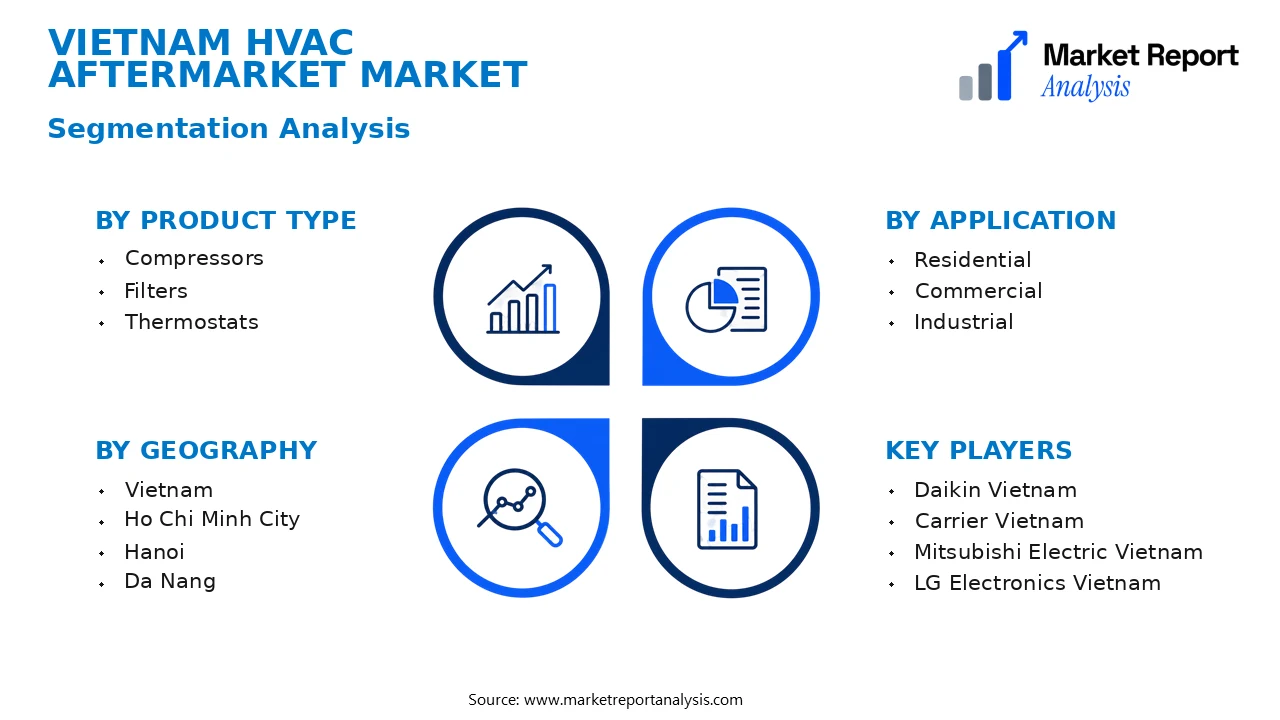
- Product Type
- Compressors: Compressors are critical components for HVAC systems, driving the refrigeration cycle. Demand is driven by replacement needs, technological upgrades, and increasing installation of new HVAC units in residential and commercial sectors.
- Filters: HVAC filters are essential for maintaining air quality and system efficiency. Growing health awareness and regulation compliance are fueling the demand for advanced filtration products in Vietnam’s expanding urban areas.
- Thermostats: Thermostat devices offer precise control of indoor climate and are increasingly integrated with smart home systems. Rising consumer preference for energy efficiency is boosting thermostat aftermarket sales.
- Application
- Residential: Residential HVAC systems constitute the largest segment, driven by urbanization, income growth, and increasing housing projects across Vietnamese cities, leading to a high demand for replacement and upgrade components.
- Commercial: The commercial sector, including office buildings, malls, and hospitality, exhibits increasing demand due to infrastructure development, tourism growth, and new business establishments, requiring robust HVAC maintenance and upgrades.
- Industrial: Industrial HVAC needs are linked with manufacturing and process industries, with demand for specialized components, maintenance, and retrofits rising alongside Vietnam's expanding industrial output.
- Geography
- Vietnam: The Vietnamese HVAC aftermarket varies significantly across regions, with densely populated urban centers showing higher demand due to industrialization, urban development, and modern infrastructure projects, while rural areas have relatively lower but growing needs.
- Ho Chi Minh City: As the economic hub, Ho Chi Minh City exhibits the highest demand for HVAC aftermarket components driven by rapid urbanization, a large commercial base, and ongoing infrastructural developments.
- Hanoi: Hanoi's expanding industrial and residential sectors, coupled with government initiatives on urban infrastructure, position it as a key region for HVAC aftermarket growth in northern Vietnam.
- Da Nang: Da Nang’s emerging industrial zones, tourism sector, and urban residential projects contribute to increasing HVAC replacement and upgrade activity in central Vietnam.
- Hai Phong: The port city’s industrial cluster and growing commercial real estate development drive robust HVAC aftermarket demand, particularly for heavy-duty and industrial system components.
- Can Tho: As a major Mekong Delta city, Can Tho’s urban growth, agricultural processing industries, and infrastructure projects foster incremental demand for HVAC system maintenance and replacement parts.
- Bien Hoa: This industrial city near Ho Chi Minh City boasts significant manufacturing activity, driving demand for HVAC components tailored for industrial applications and critical retrofit projects.
- Nha Trang: The tourism-driven city’s increasing hospitality and residential developments create a niche but vital market segment for HVAC maintenance and aftermarket components.
Competitive Intelligence
The Vietnam HVAC Aftermarket Market is characterized by intense competition among both local and international players, with a notable concentration among leading firms such as Daikin Vietnam, Carrier Vietnam, and Samsung Vietnam. These companies pursue aggressive business strategies centered on expanding their regional presence, enhancing product portfolios, and investing in R&D to innovate energy-efficient and smart HVAC solutions tailored to Vietnamese climate and consumer preferences. Partnerships with local distributors and service providers are commonplace, facilitating market penetration and after-sales service excellence, particularly in major cities like Hanoi, Ho Chi Minh City, and Da Nang. Recent acquisitions aim to consolidate market share while fostering technological capabilities, with firms focusing on expanding after-sales networks to offer comprehensive maintenance services. Innovation efforts are concentrated on developing sustainable products with lower energy consumption, helping firms differentiate in a competitive environment. R&D investments, although not publicly disclosed, are prioritized in enhancing product durability, affordability, and integration with IoT platforms. Overall, competitive differentiation in the Vietnam HVAC aftermarket hinges on product innovation, strategic partnerships, and effective regional expansion, serving an increasingly urbanized population seeking energy-efficient and cost-effective solutions.
Leading Company Profiles
The competitive landscape of the Vietnam HVAC aftermarket is characterized by a mix of local players and multinational corporations, each leveraging technological innovation and strategic initiatives to capture market share. This segment highlights key companies driving growth through product innovation, service excellence, and expansion strategies in Vietnam’s evolving HVAC sector.
- Daikin Vietnam
- Carrier Vietnam
- Mitsubishi Electric Vietnam
- LG Electronics Vietnam
- Panasonic Vietnam
- Trane Vietnam
- Johnson Controls Vietnam
- Gree Vietnam
- Samsung Vietnam
Daikin Vietnam
Daikin Vietnam offers a broad portfolio of HVAC units and aftermarket parts, emphasizing energy-efficient and environmentally friendly solutions, with a focus on expanding locally through service networks and sustainable product innovation.
Carrier Vietnam
Carrier Vietnam specializes in commercial and residential HVAC systems, providing maintenance, repair, and replacement parts, complemented by digital monitoring tools to optimize system performance and longevity in the Vietnam market.
Mitsubishi Electric Vietnam
Mitsubishi Electric Vietnam focuses on advanced inverter technology and smart HVAC solutions, investing heavily in aftersales services and parts availability to support continuous system reliability and customer satisfaction.
LG Electronics Vietnam
LG Vietnam combines consumer electronics expertise with HVAC aftermarket services, emphasizing smart, connected systems and expanding partnerships across retail and service channels for comprehensive support.
Panasonic Vietnam
Panasonic Vietnam develops high-efficiency HVAC units and offers extensive spare parts and maintenance services aimed at residential and commercial segments, prioritizing innovative, eco-friendly solutions.
Trane Vietnam
Trane Vietnam specializes in premium HVAC systems, with a focus on large-scale projects and aftermarket support, leveraging digital diagnostics and remote monitoring to enhance system lifecycle management.
Johnson Controls Vietnam
Johnson Controls Vietnam integrates building automation and HVAC aftermarket services, providing comprehensive solutions that focus on optimizing energy use and extending equipment service life.
Gree Vietnam
Gree Vietnam, a prominent Chinese brand, emphasizes affordability and broad product availability, expanding its aftermarket parts network to cater to a growing base of residential and small commercial customers.
Samsung Vietnam
Samsung Vietnam leverages its technological expertise to deliver innovative HVAC units and supported aftermarket services focused on smart, connected systems that improve indoor climate management.
Strategic Business Developments
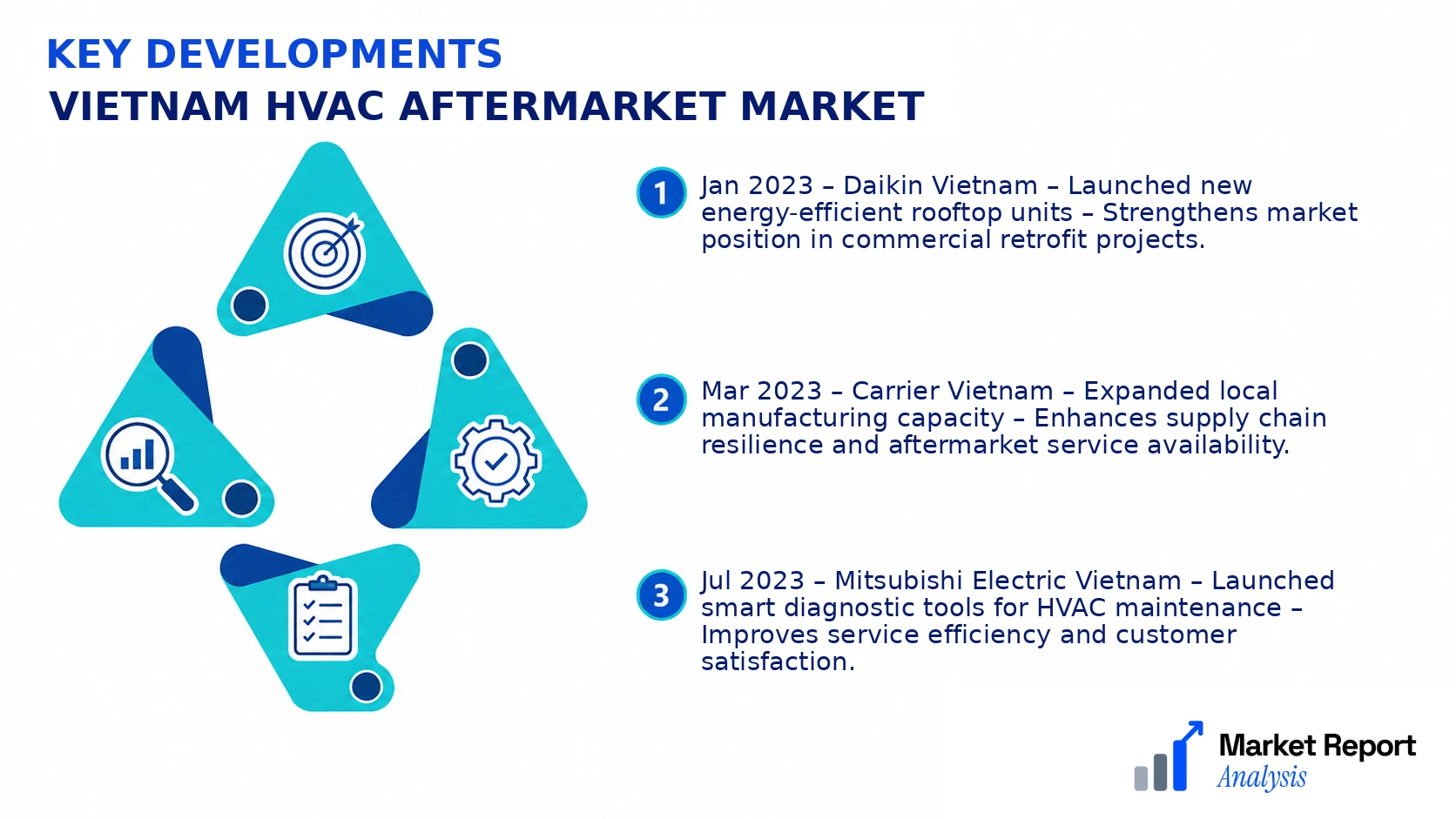
- Jan 2023 – Daikin Vietnam – Launched new energy-efficient rooftop units – Strengthens market position in commercial retrofit projects.
- Mar 2023 – Carrier Vietnam – Expanded local manufacturing capacity – Enhances supply chain resilience and aftermarket service availability.
- Jul 2023 – Mitsubishi Electric Vietnam – Launched smart diagnostic tools for HVAC maintenance – Improves service efficiency and customer satisfaction.
- Sep 2023 – LG Electronics Vietnam – Formed strategic alliance with local service providers – Widens aftersales network coverage.
- Nov 2023 – Gree Vietnam – Initiated sustainability projects for eco-friendly refrigerants – Aligns with Vietnam’s regulatory sustainability goals.
Frequently Asked Questions
What is the Vietnam HVAC Aftermarket Market?
The Vietnam HVAC Aftermarket Market encompasses the sale and servicing of replacement parts, maintenance, and upgrade services for heating, ventilation, and air conditioning systems after the initial installation. It plays a vital role in optimizing system performance and efficiency across commercial, industrial, and residential sectors.
What is the current market size of Vietnam HVAC Aftermarket Market?
As of 2026, the Vietnam HVAC Aftermarket Market is valued at approximately USD 2.4 Billion. This valuation reflects ongoing growth driven by expanding construction activities, rising urbanization, and increasing awareness of HVAC system efficiency and maintenance needs.
What factors are driving the Vietnam HVAC Aftermarket Market?
Key growth factors include Vietnam's rapid urban development, government regulations promoting energy efficiency, increased adoption of smart HVAC systems, and a growing consumer focus on indoor air quality. Additionally, rising disposable incomes bolster demand for upgraded HVAC services and parts.
Which Vietnamese city leads the Vietnam HVAC Aftermarket Market?
Ho Chi Minh City leads the Vietnam HVAC Aftermarket Market, owing to its status as the largest metro with significant commercial and residential infrastructure development. Its high population density and climate conditions also demand extensive HVAC maintenance and upgrades.
Which segment is expected to grow the fastest?
The repair and maintenance segment is projected to exhibit the fastest growth, driven by increasing HVAC system replacements, system efficiency upgrades, and a rising preference for sustainable solutions among Vietnamese consumers and businesses.
Who are the leading companies operating in the Vietnam HVAC Aftermarket Market?
Major players include Daikin Vietnam, Trane, Carrier, Johnson Controls, and Local Vietnamese service providers. Their strategies focus on extensive service networks and innovative, energy-efficient product offerings to capture market share amid rising demand.
Analyst Perspective
The Vietnam HVAC Aftermarket Market exhibits a mature yet evolving landscape driven by urbanization, rising disposable incomes, and stringent environmental regulations. Long-term, the market is poised for sustained growth, catalyzed by technological advancements in energy-efficient cooling and smart HVAC systems, which are increasingly integrated into smart city initiatives across cities like Ho Chi Minh City and Hanoi. Commercial opportunities are abundant in retrofit projects, maintenance, and replacement segments, particularly targeting aging equipment and green building standards. Investment priorities should focus on innovative service models such as IoT-enabled maintenance solutions and energy management systems to differentiate offerings in a competitive arena. Market competition remains intense, with both domestic manufacturers and multinational corporations vying for market share; strategies should emphasize localized customer service and aftersales support. Vietnamese cities present diverse growth potentials, with Ho Chi Minh City leading due to rapid infrastructural development and dense urban populations, while emerging markets in Da Nang and Can Tho offer promising prospects for tailored HVAC solutions. Long-term success hinges on adaptive strategies, technological integration, and sustainable practices to maintain competitive advantage in a dynamic environment.
