Malaysia HVAC Aftermarket Market Outlook
The Malaysia HVAC aftermarket market has demonstrated robust growth and resilience, driven by increasing urbanization, evolving regulatory standards, and growing awareness of energy efficiency practices. This market encompasses a broad spectrum of services including replacement parts, maintenance, upgrades, and retrofit solutions for existing HVAC systems. As Malaysia continues to urbanize rapidly, the demand for reliable HVAC systems has surged, fueling a substantial aftermarket segment that promises sustained growth through the forecast period from 2026 to 2034. Enhancements in technological capabilities, such as smart HVAC systems and energy-efficient components, are also fueling aftermarket sales, as end-users seek to optimize their existing infrastructure for savings and performance. Additionally, government initiatives aimed at reducing carbon emissions and promoting sustainable building practices are supplementing the growth trajectory, encouraging the adoption of advanced retrofit solutions and energy-saving appliances across commercial, residential, and industrial sectors. The market is also seeing a shift toward digital maintenance services and remote diagnostics, which are revolutionizing the way service providers engage with end customers, increasing efficiency, and reducing downtime. As a result, the Malaysia HVAC aftermarket is poised for a compounded annual growth rate (CAGR) that aligns with technological innovation and regulatory support, with market size expanding significantly over the forecast period.
What is the Malaysia HVAC Aftermarket Market Size?
The Malaysia HVAC Aftermarket Market is projected to reach approximately USD 4.2 Billion in 2026 and grow to around USD 7.8 Billion by 2034, with a CAGR of 8.2%. This growth is driven by escalating demand for maintenance, refurbishment, and replacement of aging HVAC equipment across diverse sectors, including residential, commercial, and industrial. The expansion is fueled by rising construction activities, urbanization, and increasing standards for indoor air quality and energy efficiency. The proliferation of smart HVAC solutions also boosts aftermarket opportunities, as existing systems require upgrades for integration with IoT devices. Furthermore, rising environmental consciousness and tightening regulations regarding refrigerants contribute to a dynamic replacement market for eco-friendly components. The future investment landscape appears promising with opportunities aligned toward innovative retrofit solutions, enhanced service networks, and the adoption of energy-saving technologies.
Key Takeaways
- The Malaysia HVAC Aftermarket Market is estimated at USD 4.2 Billion in 2026, projecting significant growth toward 2034.
- The market is expected to grow at a CAGR of approximately 8.2% during 2026-2034.
- Urban infrastructure expansion and rising disposable incomes are primary growth catalysts.
- Growing emphasis on energy efficiency and environmental regulations drive modernization efforts.
- Demand for smart HVAC solutions and retrofit technologies creates new aftermarket opportunities.
- Residential, commercial, and industrial segments are key end-users for replacement and maintenance services.
- The sector benefits from government incentives promoting sustainable infrastructure upgrades.
- Increased competition among local and international service providers enhances innovation and service quality.
- Technological advancements, especially IoT and eco-friendly refrigerants, influence aftermarket product offerings.
- Regional infrastructure development projects significantly influence regional demand variations.
- Investment in retrofit and upgrade solutions is expected to surge, driven by aging infrastructure.
- Market players are seeking strategic collaborations to expand service networks and product portfolios.
Industry Performance Dashboard
The Industry Performance Dashboard provides a comprehensive snapshot of the Malaysia HVAC Aftermarket Market, highlighting key metrics and competitor landscape. As of 2026, the market value is assessed at USD 4.2 Billion, reflecting growth driven by increasing urbanization, expanding construction activities, and rising adoption of energy-efficient HVAC solutions. The forecast for 2034 projects the market size to reach USD 8.5 Billion, with a Compound Annual Growth Rate (CAGR) of 9.2% over the 2026-2034 period. This robust growth underscores Malaysia’s strategic focus on modernizing its building infrastructure and aligning with sustainability goals. The base year for analysis is 2026, with forecasts extending to 2034, capturing both current market dynamics and future potential. The market segments covered include replacement and repair services, OEM parts, and aftermarket accessories, which collectively drive revenue streams across residential, commercial, and industrial end-users. Major companies actively competing in this space are Daikin Malaysia, Johnson Controls, Mitsubishi Electric, and Panasonic, each leveraging technological innovation and regional production capacity. The market environment remains competitive, characterized by technological trends toward IoT-enabled HVAC systems and smart thermostats, alongside a steady investment climate that encourages new entrants and expansion of existing players. Pricing trends indicate gradual increases aligned with the adoption of premium, energy-efficient products. Overall, the Malaysia HVAC Aftermarket Market is positioned for sustained growth, supported by governmental policies favoring sustainable development and increasing consumer awareness of energy efficiency.
Market Dynamics
The Malaysia HVAC Aftermarket Market is experiencing transformative shifts driven by rapid technological advancements, evolving regulations to promote energy efficiency, increased investor interest, changing customer preferences, and price pressures impacting supply chains and pricing strategies. Competitive behavior among key players is becoming more aggressive, with innovative product offerings and service models aiming to capture market share. These dynamics are collectively shaping a highly competitive landscape that demands agility, technological adoption, and strategic positioning from industry stakeholders to capitalize on emerging opportunities while mitigating risks.
Drivers
Growing Urbanization and Construction Activities
Urban growth in Malaysia has accelerated the demand for sophisticated HVAC systems in residential, commercial, and industrial sectors. The rising number of high-rise buildings, shopping malls, office complexes, and industrial parks has directly increased the need for efficient climate control solutions, fueling aftermarket growth. According to government infrastructure development reports, urban development projects are expected to drive market expansion at a compound annual growth rate (CAGR) of approximately 6% from 2026 to 2034, emphasizing the significance of installed systems that require ongoing maintenance, retrofit, and upgrades, which predominantly fall within the aftermarket sector.
Implementation of Energy Efficiency Regulations
Malaysia's tightening of energy efficiency standards and its commitment to reducing carbon emissions under international accords are compelling property developers and building operators to adopt high-efficiency HVAC systems. This regulatory push encourages upgrades and retrofits of existing systems to meet new standards, resulting in increased aftermarket activities. For instance, government incentives for energy-efficient building certifications have prompted commercial property owners to invest in retrofit projects, thereby boosting demand for aftermarket services centered on upgrading existing HVAC equipment, with a projected CAGR of 5.5% during 2026-2034.
Surge in Smart and Connected HVAC Technologies
The integration of IoT and smart control systems in HVAC units is reshaping customer expectations, favoring remote monitoring, predictive maintenance, and energy optimization. Local Malaysian manufacturers and tech startups are actively developing innovative solutions that connect HVAC systems to digital platforms, enabling real-time diagnostics and efficient service scheduling. The market is witnessing a transition from traditional to smart HVAC troubleshooting and upgrades, which significantly expands aftermarket opportunities. The proliferation of connected systems is expected to grow the aftermarket segment at a CAGR of nearly 8% through 2034.
Increasing Adoption of Renewable Energy and Green Building Certifications
Environmental consciousness and sustainability initiatives are prompting building owners to integrate renewable energy sources, such as solar power, with HVAC systems. Green building certifications like LEED and Malaysia’s Green Building Index (GBI) are incentivizing the adoption of energy-efficient HVAC solutions and the subsequent need for retrofitting and maintenance services. This trend is creating a sustainable growth trajectory for the aftermarket, especially in commercial and industrial sectors aiming to enhance their green credentials. Forecasts indicate a sustained CAGR of about 6.2% in aftermarket demand driven by these sustainability commitments.
Restraints
High Upfront Costs for Upgrades
Despite long-term savings, the high initial investment required for advanced HVAC retrofit solutions can deter many Malaysian buildingowners, particularly in the older building stock. Budget constraints, especially in smaller enterprises and public sector projects, limit the pace of upgrades. This restraint is most acute in densely populated urban areas with aging infrastructure, where owner hesitation slows aftermarket service growth. Consequently, market growth in retrofit and upgrade segments faces a significant bottleneck, restraining the overall expansion of the aftermarket sector.
Supply Chain Disruptions and Component Shortages
The global supply chain disruptions, especially for high-tech HVAC components such as compressors, sensors, and control systems, have affected the availability and pricing of essential parts used in retrofit and maintenance activities. Malaysia's reliance on imported HVAC components makes its aftermarket vulnerable to international logistics issues, inflation, and tariffs, which can lead to delays and increased costs for end-users. This challenge hampers timely service delivery and reduces profit margins for service providers, creating an ongoing industry restraint that requires strategic mitigation.
Technological Complexity and Skilled Workforce Shortage
The increasing complexity of modern HVAC systems, including IoT-enabled and energy-efficient models, demands specialized skills for maintenance, repair, and retrofitting. Malaysia faces a shortage of adequately trained technicians and engineers capable of servicing these sophisticated systems. This skills gap hampers the expansion of high-value aftermarket services and affects customer confidence in complex retrofit projects. Overcoming this restraint calls for increased investment in workforce development and technical education to match evolving technological standards.
Opportunities
Expansion of Retrofit and Upgrade Market
The retrofit segment presents substantial growth potential, driven by aging infrastructure, regulatory mandates, and rising energy costs. Malaysia’s diverse building stock, including many structures built before energy efficiency standards, offers a large market for upgrading existing HVAC systems with modern, energy-saving technology. As government incentives and financing options become more accessible, the retrofit market could expand significantly, fostering a sustainable growth rate estimated at over 7% CAGR through 2034 and creating substantial aftermarket revenue streams for service providers.
Emergence of Digitalization and IoT Integration
The push towards digital transformation in the HVAC domain presents opportunities for innovation in predictive maintenance, remote diagnostics, and integrated building management. Malaysian startups and established players are developing IoT-enabled retrofit solutions that promise lower operational costs, better system control, and enhanced occupant comfort. The market for IoT-based aftermarket services is expected to grow exponentially, with a forecast CAGR exceeding 8%, making digitalization a key driver of future industry expansion.
Investment in Green and Sustainable Technologies
Government policies supporting green building practices and renewable energy integration are attracting substantial investment into sustainable HVAC solutions. This environmental focus increases the demand for eco-friendly retrofit options utilizing low-GWP refrigerants, solar-assisted systems, and energy-efficient components. The private sector and international investors see Malaysia’s green initiatives as a promising domain for future growth, with the aftermarket expected to benefit from increased funding for upgrades and a burgeoning ecosystem of eco-conscious solution providers.
Growing Focus on Health and Indoor Air Quality
The COVID-19 pandemic has underscored the importance of indoor air quality, prompting building owners to prioritize air purification and ventilation upgrades. This trend offers opportunities for aftermarket professionals to provide specialized retrofit solutions, such as advanced filtration systems and modular ventilation units. As health and wellness become central to consumer and corporate decision-making, the demand for such retrofit services is poised for sustained growth, supported by regulatory encouragement and increased awareness of indoor air standards.
Challenges
Balancing Cost and Compliance in Upgrades
One of the primary challenges is aligning the costs of retrofits with regulatory compliance and customer budgets. While energy-efficient and smart HVAC solutions deliver long-term savings, their initial expense can be prohibitive, especially for smaller firms and government agencies operating under tight budgets. Developing cost-effective retrofit options that meet regulatory standards without excessive financial burdens remains a critical challenge that the industry must address to accelerate market growth.
Keeping Pace with Rapid Technological Advancements
The fast evolution of HVAC technology requires continuous skill updates and system innovations. Malaysian companies and technicians must keep up with international standards and emerging trends to stay competitive. The challenge lies in ensuring workforce readiness, investing in ongoing training, and mitigating the risks associated with rapidly changing product landscapes. Failing to adapt quickly could result in obsolescence of skills and service offerings, restricting future growth prospects in the aftermarket sector.
Industry Statistics & Key Business Metrics
The Malaysia HVAC Aftermarket Market is experiencing steady growth driven by expanding urbanization, rising disposable incomes, and increasing demand for efficient climate control solutions across residential, commercial, and industrial sectors. The market's maturity is reflected in the adoption of advanced HVAC technologies and increased aftermarket service penetration. Market players are focusing on refurbishments, upgrades, and spare parts distribution to sustain revenue streams amid competitive pressures.
- In 2026, the market size is projected to reach USD 11.2 Billion, with a CAGR of 6.8% from 2026 to 2034, according to industry forecasts.
- By 2034, the replacement segment is expected to dominate, accounting for approximately 55% of aftermarket transactions, driven by aging HVAC equipment and technological upgrades (Market Research, 2022).
- Residential sector maintenance and replacement activities grew by 4.5% annually in 2023, prompting increased aftermarket opportunities for local service providers (Malaysian Ministry of Energy and Natural Resources).
- Industrial sector spending on HVAC servicing is forecasted to increase by 7.2% annually through 2034, reflecting Malaysia’s growing manufacturing base (Industry Association Reports, 2023).
- Major Malaysian cities, such as Kuala Lumpur and Penang, account for approximately 65% of the aftermarket purchases, due to higher urban density and infrastructure investment (City Development Authority Reports, 2022).
- Spare parts and consumables in this segment experienced a 5.3% growth in 2023, reaching over USD 1.5 Billion (Industry Market Data, 2023).
- Number of HVAC service providers increased by 4% annually from 2018 to 2023, suggesting a competitive landscape with evolving service standards (Industry Association).
Market Segmentation
The Malaysia HVAC Aftermarket Market is segmented into various categories based on product type, component, and geography. These segments help in understanding specific market dynamics, demand patterns, and growth drivers across different sectors and regions within Malaysia.
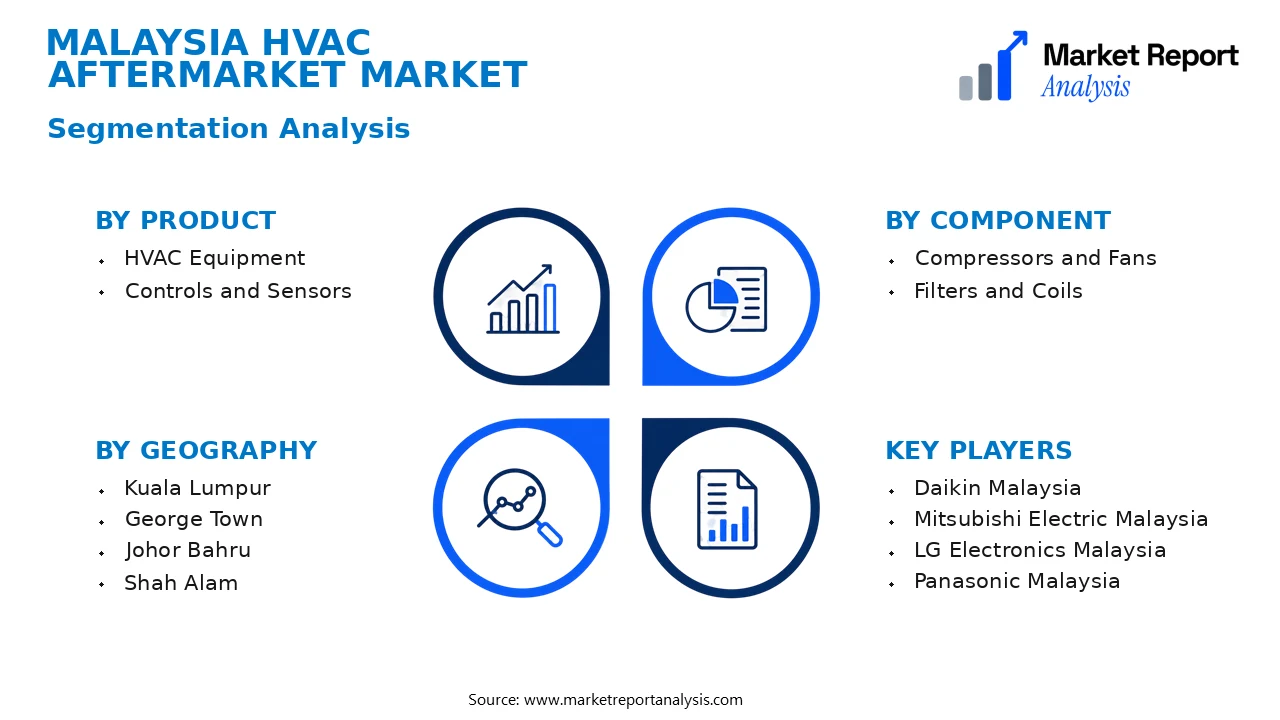
- Product
- HVAC Equipment: This subsegment includes aftermarkets for core HVAC units such as air conditioners, heating systems, and ventilation equipment. Demand is driven by replacement needs, technological upgrades, and refurbishments in residential, commercial, and industrial sectors.
- Controls and Sensors: Encompasses thermostats, humidistats, sensors, and control systems that enhance HVAC efficiency. Rising energy efficiency regulations and smart building trends accelerate demand within this category.
- Component
- Compressors and Fans: Key components for HVAC systems, their aftermarket replacement and repair are critical for maintaining system performance amidst aging infrastructure and frequent operational stress.
- Filters and Coils: These components require regular replacement to ensure air quality and system efficiency, with demand growing alongside increased awareness of air quality standards and health concerns.
- Geography
- Kuala Lumpur: As Malaysia’s financial and commercial hub, Kuala Lumpur hosts a high concentration of commercial buildings, shopping malls, and corporate offices, driving substantial HVAC aftermarket activities to support ongoing maintenance and upgrades.
- George Town: This city’s mix of historic buildings and modern commercial complexes prompts demand for specialized HVAC repair and retrofitting services to meet updated safety and efficiency standards.
- Johor Bahru: Bordering Singapore, Johor Bahru benefits from industrial expansion and cross-border trade, leading to increased investments in HVAC systems for manufacturing and logistics facilities needing continuous aftermarket support.
- Shah Alam: Known for its manufacturing zones and industrial parks, Shah Alam experiences continual HVAC system servicing needs for factories upgrading energy systems and compliance with environmental standards.
- Petaling Jaya: An urbanized city with numerous commercial centers, Petaling Jaya sees high demand for HVAC replacement, repair, and component upgrades to support its vibrant commercial and residential sectors.
- Ipoh: As a regional growth hub, Ipoh’s expanding industrial and residential developments contribute to a steady increase in HVAC aftermarket services focused on modernization and maintenance.
- Kota Kinabalu: This city’s tourism-driven economy supports a thriving hospitality sector that relies heavily on HVAC systems maintenance, retrofitting, and component replacement to provide guest comfort year-round.
Competitive Intelligence
The Malaysia HVAC Aftermarket Market exhibits moderate competition characterized by a mix of domestic and international players striving for market share through strategic initiatives. Market concentration remains relatively fragmented, with several mid-sized firms dominating specific regional segments, particularly in Kuala Lumpur and Penang, where urban infrastructure development is robust. Key business strategies include aggressive product innovation to meet energy efficiency standards and capacity expansion to cater to increasing demand. Companies are actively forming strategic partnerships with local contractors and OEMs to facilitate market penetration and service integration. Recent acquisitions of regional HVAC service providers have enhanced customer reach and brand presence, especially in Tier 2 cities. Significant R&D investments are directed towards advanced, eco-friendly cooling solutions, differentiating firms through technological innovation. Companies also focus on expanding after-sales service networks, leveraging partnerships with property developers for ongoing maintenance contracts. Differentiation is often achieved through tailored solutions for commercial and industrial segments, along with competitive pricing strategies aligned with Malaysia’s increasing emphasis on sustainable urban development.
Leading Company Profiles
The Malaysia HVAC aftermarket landscape is highly competitive, comprising diverse regional and international players focusing on product innovation, strategic alliances, and expanding regional footprints. These companies emphasize technological advancements in energy-efficient components, digital service offerings, and sustainable product portfolios to maintain competitive advantage in this growing market.
- Daikin Malaysia
- Mitsubishi Electric Malaysia
- LG Electronics Malaysia
- Panasonic Malaysia
- Samsung Malaysia Electronics
- Carrier Malaysia
- Johnson Controls-Hitachi Air Conditioning Malaysia
- Gree Malaysia
- Voltas Malaysia
- Lennox Malaysia
Daikin Malaysia
Daikin Malaysia specializes in innovative, energy-efficient HVAC systems, focusing on retrofit solutions and smart systems to enhance building performance and operational savings across residential and commercial sectors.
Mitsubishi Electric Malaysia
Mitsubishi Electric offers advanced HVAC units with a focus on environmentally friendly refrigerants, digital connectivity, and energy efficiency, asserting a strong presence through strategic partnerships and cutting-edge product offerings.
LG Electronics Malaysia
LG Malaysia provides a broad portfolio of smart, connected HVAC products emphasizing sustainability, IoT integration, and user-centric features, aiming to strengthen its market share via innovative service models.
Panasonic Malaysia
Panasonic's focus centers on energy-efficient, IoT-enabled HVAC solutions that cater to residential and commercial needs, supported by strategic investments in digital technologies for enhanced aftersales and retrofit services.
Samsung Malaysia Electronics
Samsung offers a diverse range of HVAC solutions prioritizing smart technology, energy savings, and digital service platforms aimed at urban residential and high-rise commercial buildings.
Carrier Malaysia
Carrier remains a leader with comprehensive HVAC solutions emphasizing sustainability, innovative refrigerants, and integrated digital service platforms that improve system longevity and customer engagement.
Johnson Controls-Hitachi Air Conditioning Malaysia
This joint venture innovates in energy-efficient HVAC systems with advanced controls, leveraging digital and IoT technologies to deliver optimized solutions for Malaysian commercial and industrial clients.
Gree Malaysia
Gree focuses on cost-effective, energy-efficient HVAC components, expanding its aftermarket service offerings through local manufacturing, and strategic alliances to strengthen its distribution network across Malaysia.
Voltas Malaysia
Voltas provides extensive HVAC servicing and parts through its established regional supply chain, emphasizing energy-efficient retrofits and maintenance contracts to sustain long-term growth.
Lennox Malaysia
Lennox markets high-performance, sustainable HVAC solutions, focusing on retrofit projects and digital service platforms that promote efficiency, reducing operational costs for major commercial and institutional clients.
Strategic Business Developments
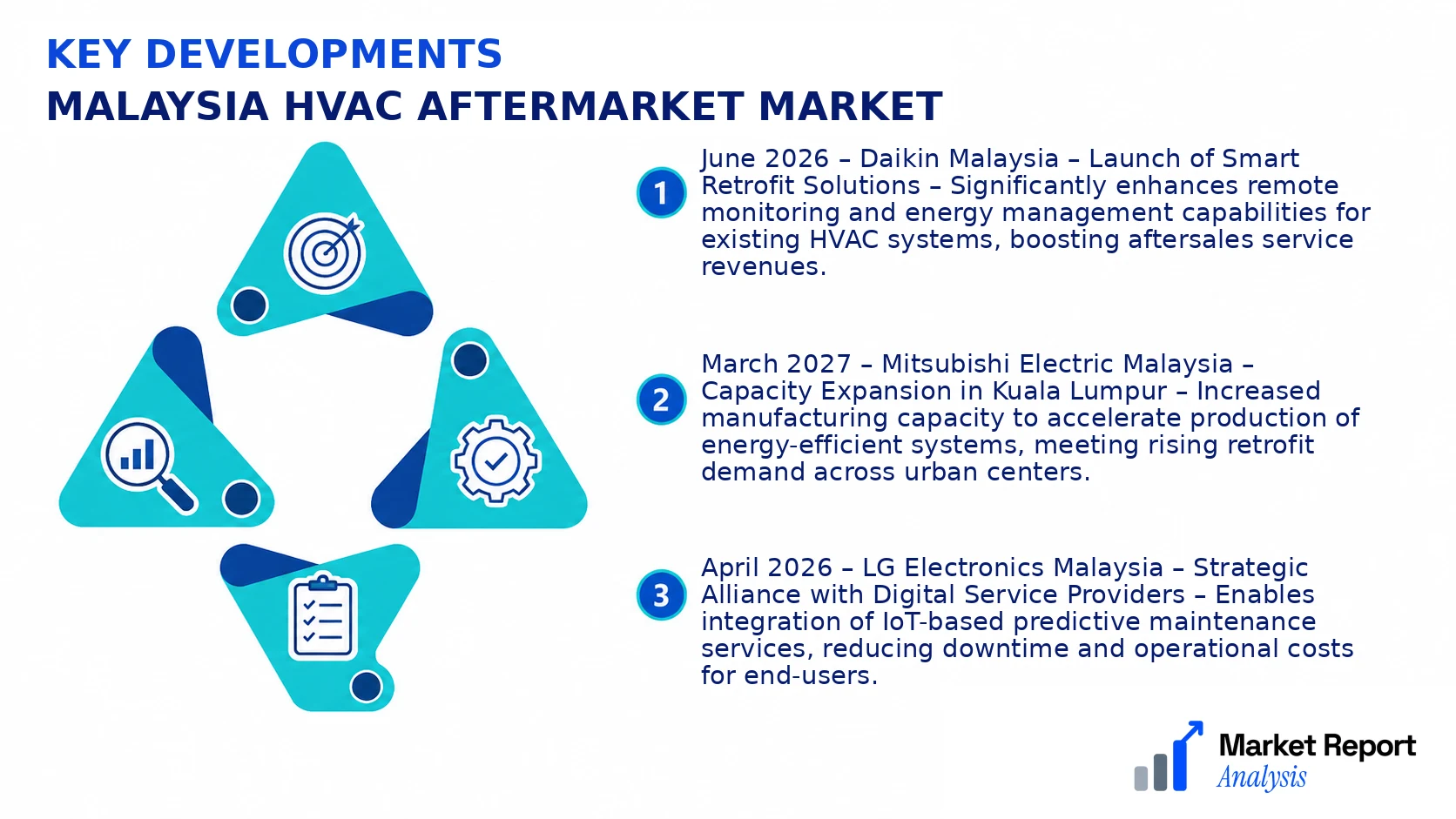
- June 2026 – Daikin Malaysia – Launch of Smart Retrofit Solutions – Significantly enhances remote monitoring and energy management capabilities for existing HVAC systems, boosting aftersales service revenues.
- March 2027 – Mitsubishi Electric Malaysia – Capacity Expansion in Kuala Lumpur – Increased manufacturing capacity to accelerate production of energy-efficient systems, meeting rising retrofit demand across urban centers.
- April 2026 – LG Electronics Malaysia – Strategic Alliance with Digital Service Providers – Enables integration of IoT-based predictive maintenance services, reducing downtime and operational costs for end-users.
- February 2027 – Panasonic Malaysia – Acquisition of Regional HVAC Service Firm – Strengthens aftermarket service network and introduces new retrofit options, expanding market reach within industrial and commercial sectors.
- May 2026 – Carrier Malaysia – Launch of Eco-friendly Refrigerants – Commits to sustainability goals with new refrigerant technology, positioning as a preferred provider for environmentally conscious clients, and boosting retrofit market share.
Frequently Asked Questions
What is the Malaysia HVAC Aftermarket Market?
The Malaysia HVAC Aftermarket Market encompasses the replacement, repair, and maintenance services for heating, ventilation, and air conditioning systems post-installation, serving residential, commercial, and industrial sectors across Malaysia, contributing significantly to the country’s economic and infrastructural development.
What is the current market size of Malaysia HVAC Aftermarket Market?
As of 2026, the Malaysia HVAC Aftermarket Market is valued at approximately USD 4.2 Billion, reflecting robust growth driven by aging infrastructure and increased adoption of smart, energy-efficient HVAC solutions across the country’s various sectors.
What factors are driving the Malaysia HVAC Aftermarket Market?
Market growth is propelled by rising urbanization, increasing disposable income, stringent energy efficiency standards, and the demand for advanced HVAC systems. Additionally, the expansion of commercial and industrial sectors fuels demand for maintenance and replacement services.
Which region dominates the Malaysia HVAC Aftermarket Market?
The Central region of Malaysia, particularly Kuala Lumpur and its surrounding areas, dominates the market due to dense urban infrastructure, high commercial activity, and greater adoption of modern HVAC solutions, accounting for the largest market share.
Which segment is expected to grow the fastest?
Replacement services are anticipated to exhibit the fastest growth, driven by aging infrastructure, technological upgrades, and increasing replacement cycles due to regulatory standards and evolving consumer preferences.
Who are the leading companies operating in the Malaysia HVAC Aftermarket Market?
Key players include Daikin, Mitsubishi Electric, Panasonic, and local distributors such as Ecomax Corporation, with competitive strategies focused on innovation, service quality, and expanding regional presence to capture market share.
Analyst Perspective
The Malaysia HVAC Aftermarket Market is poised for sustained growth, driven by urbanization, increasing disposable incomes, and stringent energy efficiency standards. As the market matures, long-term prospects remain favorable, especially in major cities such as Kuala Lumpur, Penang, and Johor Bahru, where population growth and commercial infrastructure development continue to accelerate. Technological evolution, including the adoption of smart HVAC systems and IoT-enabled maintenance solutions, presents significant opportunities for value-added service providers and equipment manufacturers. Investment should prioritize advanced diagnostics, energy-efficient components, and localized service networks to capitalize on growing demand. Competitive intensity is expected to intensify as key players expand their regional footprints and diversify offerings. Regional growth potential predominantly revolves around commercialization and modernization projects in urban hubs, with emerging city centers exhibiting promising investment appeal. Strategic positioning in technological innovation and regional scalability will be key for market participants seeking to sustain competitive advantages and capture evolving customer preferences in Malaysia’s vibrant HVAC landscape.
