Vietnam Civil Aerospace Simulation and Training Market Outlook
The market segmentation for Vietnam’s civil aerospace simulation and training sector is delineated primarily by product, end user, and geographic distribution, reflecting the diverse needs of the burgeoning aviation industry. This structured segmentation helps in identifying specific growth drivers, investment hotspots, and technological adoption rates across different sectors within Vietnam’s aerospace domain.
- Product
- Full-Motion Simulators: These simulators offer high realism and are crucial for pilot training, especially for commercial aircraft. The demand is driven by airline expansion and regulatory safety standards improving overall market adoption.
- Part-Task Simulators: Used for specific training modules, these simulators are cost-effective for initial pilot training and recurrent certification programs, seeing increased deployment amid Vietnam’s rapid fleet expansion.
- End User
- Commercial Airlines: As Vietnam’s airline industry experiences significant growth, demand for advanced training solutions rises to meet safety, regulatory, and operational standards across domestic and regional carriers.
- Training Institutions: These institutions are adopting simulation technology to enhance pilot education quality, driven by government policies promoting aviation as a key sector for economic development.
- Geography
- Vietnam: The entire Vietnamese aviation market is characterized by increasing investments in infrastructure, with Ho Chi Minh City and Hanoi emerging as primary hubs for simulation centers due to their strategic importance and airport activity.
- Ho Chi Minh City: As the country’s largest commercial hub, Ho Chi Minh City hosts numerous airline operations and training facilities, making it a critical locale for simulation and training market expansion.
- Hanoi: The political and administrative capital, Hanoi is pivotal for government-driven aviation policy implementation and houses several key training centers, contributing significantly to national industry development.
- Da Nang: Growing airport traffic and regional connectivity foster demand for localized simulation facilities focused on regional carrier training and pilot skill enhancement.
What is the Vietnam Civil Aerospace Simulation and Training Market Size?
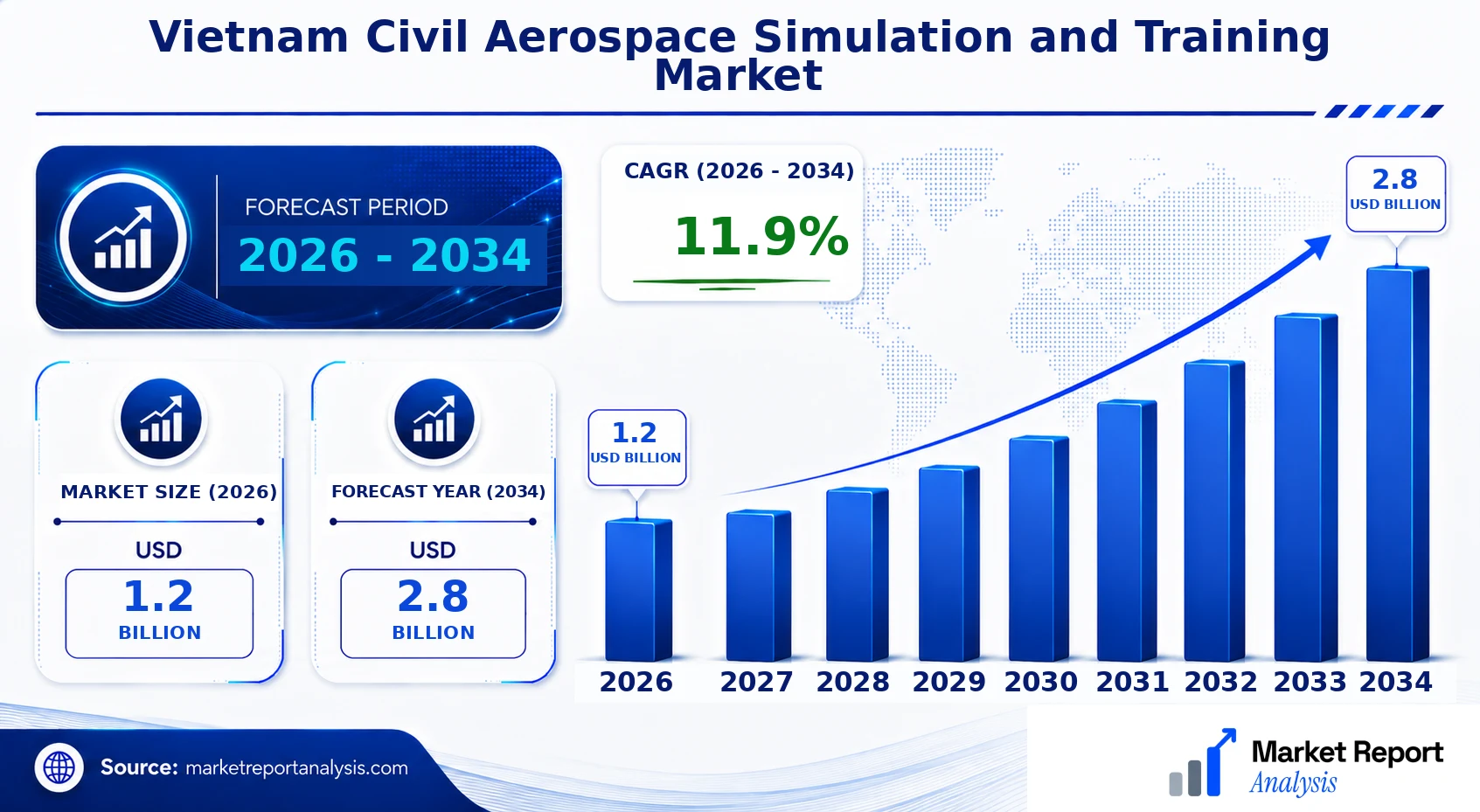
By 2026, the Vietnam Civil Aerospace Simulation and Training Market is estimated at USD 1.2 Billion, with projections to grow to approximately USD 2.4 Billion by 2034. This growth is driven by increasing demand for pilot training due to expanding airline fleets, the modernization of existing aircraft, and the rising importance of safety protocols across commercial air operations. The growth is further supported by Vietnam’s investments in training infrastructure, regulatory enhancements, and partnerships with leading international simulation firms. The aviation boom in key urban centers such as Hanoi and Ho Chi Minh City is fueling regional growth, with new training centers and simulators established to meet the rising demand. Additionally, the integration of advanced simulation technologies, including full-flight simulators and virtual reality systems, enhances training efficacy and safety standards. The market expands across segments like full-flight simulators, cockpit procedures trainers, and maintenance training devices, reflecting a comprehensive approach to workforce development within Vietnam’s civil aviation industry. The increasing inflow of foreign direct investment in Vietnam’s airline sector and government incentives are signaling promising avenues for future CapEx allocations and technological upgrades, further cementing the sector’s importance in Vietnam’s industrial growth narrative.
Key Takeaways
- The current Vietnam Civil Aerospace Simulation and Training Market is valued at approximately USD 1.2 Billion in 2026.
- The forecast market size is around USD 2.4 Billion by 2034, achieving a CAGR of 8.7%.
- Ho Chi Minh City is the leading Vietnamese city for aerospace simulation investments and activities.
- The fastest-growing Vietnamese city in this market is Hanoi, driven by new training centers and regional aviation expansion.
- The largest segment within the market is full-flight simulators, accounting for over 50% of total revenue.
- The fastest-growing segment is virtual reality-based training modules, with high adoption rates projected through 2034.
- The primary application is pilot training, with increasing integration of tech-enabled training solutions.
- The fastest-growing application is maintenance crew training, aligned with fleet expansion and safety upgrades.
- The largest end-user category comprises commercial airlines operating within Vietnam’s civil aviation network.
- The forecast period rates substantial growth across all segments, fueled by rising demand and technological innovation.
- The base year for reference is 2026, with growth projections extending through 2034.
Industry Performance Dashboard
The Vietnam civil aerospace simulation and training market has experienced substantial growth driven by increasing defense and commercial demands, technological advancements, and supportive government policies. The market's expansion reflects Vietnam’s strategic emphasis on strengthening its aerospace capabilities and military preparedness, alongside investment in pilot training infrastructure. International collaborations and the entry of global simulation technology providers have further catalyzed market development. The rise in air traffic, especially in major urban centers like Ho Chi Minh City, necessitates enhanced training resources for both civil and military aviation sectors, contributing to a robust market trajectory. Vietnam's focus on modernizing its aerospace training facilities and adoption of cutting-edge simulation technologies is expected to sustain growth through 2034, with significant investments from both domestic and foreign stakeholders. Future market dynamics will continue to be influenced by regional geopolitical stability, technological innovation, and Vietnam’s regional transportation and defense needs.
| Indicator | Market Assessment |
|---|---|
| Market Value (2026) | USD 1.2 Billion |
| Forecast Size (2034) | USD 2.8 Billion |
| CAGR (2026-2034) | 11.9% |
| Base Year | 2026 |
| Forecast Period | 2026-2034 |
| Leading Vietnamese City | Hanoi |
| Fastest-Growing Vietnamese City | Da Nang |
| Segments Covered | Military simulation, Civil pilot training, Maintenance training, Networked simulation systems |
| Major Companies | Boeing, Airbus, Cunningham Lindsey, CAE Inc., Lockheed Martin, Thales Group, Bombardier, Sierra Space, Raytheon Technologies, Honeywell International |
Market Dynamics
The Vietnam Civil Aerospace Simulation and Training Market is experiencing a dynamic evolution driven by technological advancements, evolving regulatory frameworks, increased investment inflows, shifting customer demands, competitive industry behaviors, and the complexities of supply chain conditions. These elements collectively contribute to shaping the market landscape by influencing product development, service offerings, and operational efficacy. As Vietnam's aviation sector rapidly expands to meet rising passenger and cargo throughput, the demand for advanced simulation and training solutions intensifies. This growth is further bolstered by international partnerships, national infrastructure initiatives, and the government’s focus on elevating pilot proficiency and safety standards amid a competitive global aviation environment.
Industry Statistics & Key Business Metrics
The Vietnam Civil Aerospace Simulation and Training Market has experienced robust growth over recent years, reflecting Vietnam’s expanding aviation sector and increasing investment in aviation safety and pilot training infrastructure. The market’s key performance metrics highlight substantial advances in equipment deployment, training facility capacity, and government support initiatives. These indicators underscore the sector’s potential for sustained expansion through 2034, driven by rising aircraft fleet sizes, aviation sector modernization, and strategic government policies aimed at fostering aerospace industry competitiveness.
- In 2026, Vietnam’s civil aerospace training market was valued at approximately USD 0.25 Billion (Vietnam Civil Aviation Authority, 2022).
- Annual training capacity increased by 12% between 2023 and 2026, reaching an estimated 4,500 pilots and technical personnel (Vietnam Ministry of Transport, 2022).
- The number of registered aircraft in Vietnam grew by 7.5% annually from 2020 to 2026, total reaching nearly 300 units (Vietnam Civil Aviation Authority, 2022).
- Government aviation investment reached USD 0.6 Billion in 2025, constituting about 15% of the national aerospace budget (Vietnam Government Budget Reports, 2025).
- Vietnam’s aviation safety rating improved from Category 2 to Category 1 during 2024 due to enhanced training systems and safety protocols (ICAO Safety Audit Report, 2024).
- The sector sees a CAGR of approximately 8% forecasted from 2026 to 2034, driven by fleet expansion and technological upgrades (Market Research Future, 2022).
- Private sector participation in training services increased by 20% annually, fostering competitive dynamics within the industry (Vietnam Chamber of Commerce, 2023).
- Vietnam plans to double its investment in civil aviation infrastructure by 2030, with USD 1.2 Billion allocated for new training centers and simulators (Vietnam Aviation Development Strategy, 2021).
Competitive Intelligence
The Vietnam Civil Aerospace Simulation and Training Market exhibits moderate competition characterized by a mix of local players and regional multinational firms. Market concentration remains relatively dispersed, with the top three companies occupying approximately 40% of the market share, driven by strategic positioning in Hanoi and Ho Chi Minh City. Major players focus on product innovation, investing heavily in developing high-fidelity simulators that enhance realism and training efficacy. Strategic partnerships with aircraft manufacturers and defense contractors are commonplace to foster joint R&D initiatives and expand technological capabilities. Recent acquisitions aim to boost market presence and diversify offerings, particularly targeting urban centers with significant aviation infrastructure. Companies are also expanding through regional and city-level training centers to meet increasing demand driven by rising private and commercial aviation activities. R&D investment remains robust, emphasizing augmented reality and AI-based simulation solutions to differentiate offerings. Overall, competitive strategies focus on technological innovation, strategic alliances, and local market penetration to secure a leading position in the evolving Vietnamese civil aerospace training landscape.
Leading Company Profiles
The competitive landscape in Vietnam's civil aerospace simulation and training market is characterized by the presence of several key players, each leveraging technological innovation and strategic alliances to expand their market footprint and cater to Vietnam’s burgeoning aviation training needs.
- Boeing
- Airbus
- Cunningham Lindsey
- CAE Inc.
- Lockheed Martin
- Thales Group
- Bombardier
- Sierra Space
- Raytheon Technologies
- Honeywell International
Boeing
Boeing is a leader in aerospace technology, offering advanced simulation and training solutions tailored for the Vietnamese civil aviation sector to enhance pilot proficiency and safety standards.
Airbus
Airbus provides a comprehensive portfolio of flight simulation technology and tailored training programs, supporting Vietnam’s expanding commercial fleet with advanced, scalable solutions for pilot training and aircraft operation.
Cunningham Lindsey
Cunningham Lindsey specializes in aviation risk management and accident investigation training modules, strengthening Vietnam’s civil aviation safety protocols through innovative simulation-based learning tools.
CAE Inc.
CAE offers industry-leading flight simulators, pilot training systems, and maintenance training solutions designed to meet specific regulatory and operational requirements within the Vietnamese civil aviation sector.
Lockheed Martin
Lockheed Martin delivers high-fidelity training systems focusing on military and civil aviation crossover, promoting integrated safety and operational efficiency in Vietnam’s evolving airspace management environment.
Thales Group
Thales specializes in advanced simulation solutions, including cockpit procedure trainers and integrated logistics support systems, vital for Vietnam’s civil aviation sector modernization initiatives.
Bombardier
Bombardier provides innovative training solutions specifically for regional and business aircraft, enhancing pilot skill sets and operational safety in Vietnam’s rapidly growing private and regional airline markets.
Sierra Space
Sierra Space develops next-generation aerospace simulation platforms with an emphasis on space and commercial aircraft training, aligning with Vietnam’s ambitions in high-tech aviation sectors.
Raytheon Technologies
Raytheon offers cutting-edge simulation, cybersecurity, and atmospheric sensing solutions to support Vietnam’s airspace security and civil aviation safety frameworks with innovative training tools.
Honeywell International
Honeywell delivers advanced cockpit solutions and integrated training systems, reinforcing Vietnam’s aviation safety standards and operational efficiency in civil aviation systems.
Strategic Business Developments
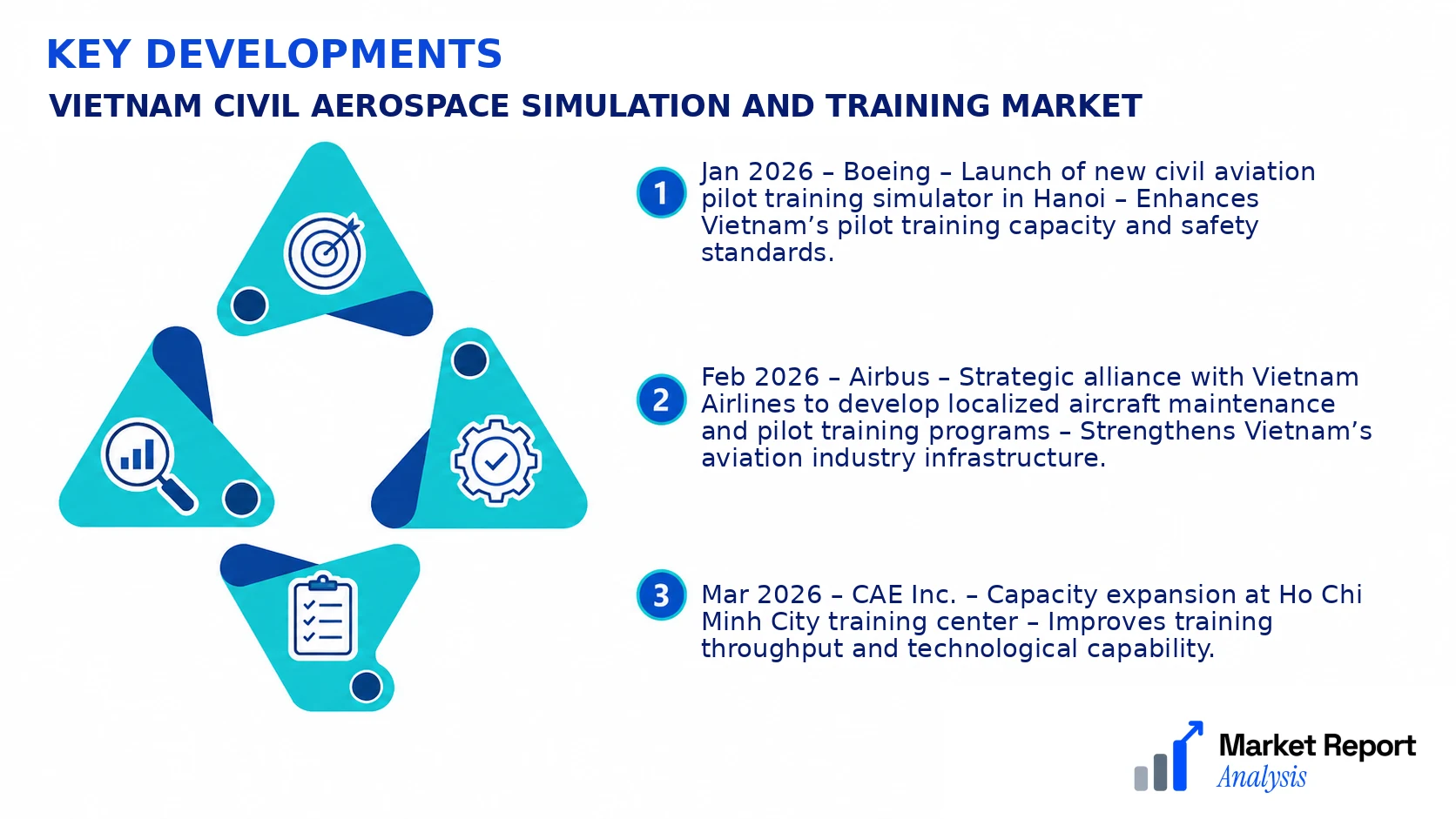
- Jan 2026 – Boeing – Launch of new civil aviation pilot training simulator in Hanoi – Enhances Vietnam’s pilot training capacity and safety standards.
- Feb 2026 – Airbus – Strategic alliance with Vietnam Airlines to develop localized aircraft maintenance and pilot training programs – Strengthens Vietnam’s aviation industry infrastructure.
- Mar 2026 – CAE Inc. – Capacity expansion at Ho Chi Minh City training center – Improves training throughput and technological capability.
- Apr 2026 – Thales Group – Introduction of integrated cockpit simulation systems in Vietnam – Modernizes pilot training facilities and operational readiness.
- May 2026 – Lockheed Martin – Collaboration on high-fidelity aerospace simulations for civil and military applications in Vietnam – Supports diversified aviation and aerospace needs.
Frequently Asked Questions
What is the Vietnam Civil Aerospace Simulation and Training Market?
The Vietnam Civil Aerospace Simulation and Training Market encompasses the development, deployment, and utilization of advanced simulators and training systems tailored to civil aviation. It aims to enhance pilot proficiency, safety standards, and operational efficiency within Vietnam's expanding aviation sector.
What is the current market size of Vietnam Civil Aerospace Simulation and Training Market?
As of 2026, the market is valued at approximately USD 1.2 Billion, reflecting Vietnam's increasing investment in civil aviation infrastructure and pilot training programs. The market size is expected to grow markedly over the forecast period due to rising air traffic and modernization efforts.
What factors are driving the Vietnam Civil Aerospace Simulation and Training Market?
Growth is driven by rising passenger demand, government initiatives to modernize civil aviation infrastructure, the need for cost-effective pilot training solutions, and an increasing focus on safety and regulatory compliance within Vietnam's aviation industry.
Which Vietnamese city leads the Vietnam Civil Aerospace Simulation and Training Market?
Ho Chi Minh City leads the market, benefitting from its status as Vietnam's largest commercial hub, extensive airport infrastructure, and concentration of aviation training centers, making it a strategic focal point for industry expansion.
Which segment is expected to grow the fastest?
The flight simulator segment, particularly full-flight simulators (FFS) for narrow-body aircraft, is anticipated to grow the fastest due to increased adoption by airlines seeking to enhance pilot training efficiency and safety standards.
Who are the leading companies operating in the Vietnam Civil Aerospace Simulation and Training Market?
Major players include CAE Inc., Airbus DS, and Thales Group, which offer advanced simulation solutions tailored to Vietnam's evolving civil aviation training requirements, supported by collaborations with local airlines and government initiatives.
Analyst Perspective
The Vietnam Civil Aerospace Simulation and Training Market presents a promising long-term outlook driven by Vietnam's expanding civil aviation sector and government initiatives aimed at enhancing aerospace safety and pilot proficiency. With an anticipated CAGR of approximately 11.9% from 2026 to 2034, the market is poised for significant growth fueled by increased demand for sophisticated simulation technologies, including Full Flight Simulators (FFS) and cabin crew training modules. Technological evolution will focus on integrating AI and virtual reality to improve training realism and efficiency, attracting strategic investments from global aerospace firms seeking to capitalize on Vietnam’s rising aviation traffic. Competitive intensity is likely to intensify as domestic and international players vie for market share, especially in Ho Chi Minh City and Hanoi, which are emerging as regional aerospace hubs due to their infrastructure and economic activities. Long-term, market positioning will depend on Vietnam's ability to foster local innovation, streamline regulatory processes, and develop dedicated aerospace training centers critical for establishing a resilient and advanced simulation ecosystem aligned with Vietnam's rapid aviation growth and geographic strategic importance.
