Malaysia Civil Aerospace Simulation and Training Market Outlook
The Malaysia Civil Aerospace Simulation and Training Market currently holds a valuation of approximately USD 0.9 Billion in 2026. It is projected to expand at a Compound Annual Growth Rate (CAGR) of about 7.8% over the forecast period from 2026 to 2034. Key demand drivers include increasing air travel, expanding fleet sizes, and rising safety standards, which are compelling airlines and training institutions to adopt advanced simulation technology. Technological advancements such as virtual reality (VR) and augmented reality (AR) are shaping the future of training methodologies. Moreover, strategic investments by government agencies to enhance aviation safety and defense capabilities, coupled with cloud-based simulation platforms, are creating significant commercial opportunities in this sector.
What is the Malaysia Civil Aerospace Simulation and Training Market Size?
By 2034, the Malaysia Civil Aerospace Simulation and Training Market is forecasted to reach approximately USD 1.8 Billion, indicating a robust CAGR of 7.8% during the 2026-2034 period. Growth is driven by the proliferation of commercial and regional airlines upgrading their fleets, which necessitates comprehensive pilot training programs. The rising integration of simulation in pilot training curricula, mandated by aviation authorities to ensure safety and compliance, amplifies market growth. Additionally, the modernization of civil aviation infrastructure with state-of-the-art simulation facilities offers lucrative prospects for vendors. The increasing focus on safety, efficiency, and cost-effectiveness in airline operations propels demand for high-fidelity simulators. As digital transformation accelerates across sectors, Malaysia’s aviation industry is investing heavily in next-generation simulation systems, fostering a resilient growth trajectory for the market.
Key Takeaways
- Market size in 2026 is approximately USD 0.9 Billion, expected to nearly double by 2034.
- CAGR of 7.8% from 2026 to 2034 signals steady industry expansion.
- Growing air travel demand and fleet expansion underpin market growth.
- Government initiatives to enhance aviation safety are boosting simulator adoption.
- Technological innovations such as VR and AR are transforming training methodologies.
- Increased investment in simulation infrastructure by airlines and institutions fuels competitiveness.
- The rise of regional airlines raises the need for cost-effective, scalable training solutions.
- Regulatory mandates drive simulation-based certification and recurrent training requirements.
- High-fidelity simulators are increasingly becoming integral to pilot training programs.
- The market presents lucrative opportunities for OEMs and technology providers.
- Strong regional focus on safety standards fosters market resilience.
- Emerging private training centers augment traditional government-led facilities.
- Digital transformation initiatives underpin future growth prospects.
Industry Performance Dashboard
The Industry Performance Dashboard offers a comprehensive overview of the Malaysia Civil Aerospace Simulation and Training Market, highlighting key metrics and trends that define the industry's current landscape and future trajectory. As of the current year, the market size in 2026 is projected to reach a substantial USD Billion, reflecting the sector's robust growth driven by increased aviation activities and modernization of training facilities. The forecast for 2034 indicates continued expansion, with an expected market size that underscores the rising demand for advanced simulation and training solutions. The Compound Annual Growth Rate (CAGR) from 2026 to 2034 is a vital indicator of the sector's health, demonstrating steady investment and technological advancement over the forecast period. This growth is supported by ongoing advancements in simulation technologies, regulatory enhancements, and strategic investments by global and regional aerospace players. The base year for the analysis is 2026, with projections extending through 2034, encapsulating evolving industry dynamics. Segments covered include flight crew training, maintenance training, and ground operations simulation, each contributing significantly to the market’s expansion. Leading companies such as CAE Inc., L3Harris Technologies, and Airbus Defence and Space drive innovation and competitiveness within the market. Investment trends suggest increasing capital infusion into simulation hardware and software development, enhancing the realism and efficacy of training modules. Pricing trends indicate a gradual decrease in costs due to technological improvements and competition, further democratizing access to advanced training solutions. Overall, the market exhibits maturity with expanding adoption across various end-use sectors, positioning Malaysia as a significant hub for aerospace simulation and training activities.
Market Dynamics
The Malaysia Civil Aerospace Simulation and Training Market is influenced by a complex interplay of technological advancements, regulatory frameworks, and investment influxes aimed at enhancing safety and operational efficiency. Customer requirements for realistic, cost-effective training solutions are driving innovation, while pricing strategies and supply chain conditions impact market accessibility. Competitive dynamics among simulation providers lead to frequent technological upgrades and service differentiation, further shaping the market landscape. As Malaysia continues to develop its civil aviation sector, these factors collectively create a dynamic environment fostering growth opportunities but also posing specific challenges that stakeholders must strategically navigate.
Drivers
Rapid Expansion of Civil Aviation in Malaysia
The accelerating growth of Malaysia’s civil aviation sector significantly boosts the demand for advanced simulation and training solutions. The rise in passenger traffic, driven by economic growth and increased connectivity, necessitates a skilled workforce capable of supporting expanded flight operations. Airlines and training centers are investing heavily in high-fidelity simulators to enhance pilot training efficiency and safety standards. According to industry reports, Malaysia’s civil aviation passenger numbers are expected to grow at a CAGR of 6% through 2034, prompting sustained investments in innovative simulation technologies to meet the increasing training needs.
Stringent Regulatory Requirements for Pilot Training
Malaysia’s aviation regulatory authorities, aligning with ICAO standards, enforce rigorous pilot training and certification protocols. These regulations mandate frequent simulation-based training sessions to maintain licensing and operational competency, thereby driving demand for sophisticated simulation equipment. This regulatory environment compels airline operators and training providers to upgrade their simulation fleets and adopt the latest technologies. Compliance costs and the need for qualified technical personnel also influence market dynamics, making regulatory standards a key growth driver in ensuring safety and operational excellence.
Technological Innovations and Digitalization
The advent of cutting-edge simulation technologies, including virtual reality (VR), augmented reality (AR), and artificial intelligence (AI), revolutionizes pilot training programs. Malaysia’s market is witnessing increased adoption of these new tools, which offer more immersive, customizable, and cost-effective training experiences. Technological innovation not only enhances training realism but also reduces operational expenses and crew scheduling disruptions. With global trends indicating a CAGR of over 10% for simulation tech integration, the Malaysian market benefits from a push toward digitalization, driven by industry leaders aiming to stay competitive in a fast-evolving landscape.
Growing Investment in Civil Aviation Infrastructure
Government and private sector investments focused on developing Malaysia’s civil aviation infrastructure directly bolster the simulation and training market. New airports, hangars, and maintenance facilities necessitate extensive pilot training programs, utilizing state-of-the-art simulators. Public-private partnerships are fueling these investments, coupled with Malaysia’s strategic emphasis on becoming a regional aerospace hub. This infrastructure expansion increases demand for certified training facilities, creating a fertile environment for both domestic and international simulation technology providers to expand their footprints.
Restraints
High Capital and Maintenance Costs of Simulation Equipment
The significant costs associated with acquiring, installing, and maintaining advanced simulation systems pose a substantial barrier to market expansion. Airlines and training centers may hesitate to invest heavily without immediate ROI, especially smaller operators with limited budgets. High equipment prices are further compounded by ongoing maintenance and software upgrade requirements, which can strain financial resources and hinder widespread adoption of the latest simulation solutions, particularly in price-sensitive segments of the Malaysian civil aerospace industry.
Limited Skilled Workforce for Simulator Operations
The scarcity of qualified technical personnel capable of operating and maintaining sophisticated simulation systems impedes market growth. The industry’s need for specialized engineers and trainers is growing faster than the local talent pool can support. This skills gap leads to reliance on external expertise or delays in implementation, which hampers the pace of technology adoption. Addressing workforce development through training programs and collaborations with global institutions is vital for sustainable growth in Malaysia’s simulation and training sector.
Fragmented Market Players and Limited Local Manufacturing
The Malaysia market is characterized by a fragmented ecosystem with limited local manufacturers of simulation hardware and software, leading to dependency on international suppliers. This fragmentation results in uneven service quality, higher import costs, and potential delays in technology deployment. Local industry consolidation and fostering indigenous manufacturing capabilities could mitigate these issues, but regulatory and infrastructural challenges currently restrict such developments. As a result, the market faces hurdles in achieving cost efficiencies and supply chain robustness.
Opportunities
Growing Civil Aviation Market and Rising Passenger Volumes
The projected increase in passenger traffic, driven by Malaysia’s economic development and regional tourism growth, presents a robust opportunity for market expansion. As airlines expand their fleets and routes, their training requirements escalate, creating a sustained demand for high-quality simulation solutions. The proliferation of low-cost carriers and international alliances further fuels the adoption of advanced simulation devices to ensure safety and operational readiness at scale, positioning Malaysia as a critical market in Southeast Asia for aerospace training investments.
Emerging Investment in Civil Aerospace Infrastructure
With several new airports, maintenance facilities, and aerospace parks planned across Malaysia, the infrastructure build-up offers a strategic platform for market growth. These projects necessitate large-scale pilot training operations and simulation centers, attracting both government and private investors. Moreover, Malaysia’s ambition to establish itself as an aerospace manufacturing and MRO hub fuels an ecosystem conducive to innovation, where simulation-based training facilities can integrate with manufacturing and maintenance activities, ultimately creating comprehensive aviation training clusters.
Innovation Ecosystem and Startup Integration
The Malaysian government’s initiative to foster a vibrant startup ecosystem in aerospace and digital technologies unlocks opportunities for innovative simulation solutions. Local startups are increasingly developing cost-effective, AI-powered, and VR-based training platforms tailored to regional needs. Partnerships between these startups, academia, and established industry players can accelerate the deployment of next-generation simulation tools, reduce costs, and improve accessibility. Such innovation ecosystems attract global investments, positioning Malaysia as a regional leader in aerospace training technology development.
Future Commercial and Military Collaborations
The ongoing interests of global aerospace firms in expanding their regional footprint include potential collaborations on joint ventures and technology transfer agreements. Malaysia’s strategic geographic location and political stability make it attractive for such partnerships, which can lead to the development of tailored simulation solutions for both commercial and military applications. These alliances could also pave the way for customized, high-fidelity simulators that meet diverse training requirements, expanding Malaysia’s market scope and attracting further investment into the sector.
Challenges
Rapid Technological Changes Leading to Obsolescence
The fast-paced evolution of simulation technologies presents a challenge in maintaining up-to-date training equipment. High obsolescence rates necessitate frequent software updates and hardware upgrades, imposing recurrent costs on operators. This rapid technological change can lead to integration issues, disrupt existing training programs, and strain budgets, especially for smaller operators striving to stay competitive. The industry must focus on flexible, upgradeable systems and long-term service agreements to mitigate these risks and ensure ongoing technological relevance.
Market Fragmentation and Limited Regional Standardization
The lack of standardized benchmarks and regional coordination in simulation training practices complicates equipment interoperability and compliance across Southeast Asia. In Malaysia, disparate standards can hinder cross-border cooperation, staff mobility, and mutual recognition of certifications. These fragmentation issues restrict scalable regional training networks and diminish the market's attractiveness to international investors. Harmonizing standards and fostering bilateral and multilateral collaborations could address these challenges, promoting a cohesive Southeast Asian aerospace training ecosystem.
Industry Statistics & Key Business Metrics
The Malaysia Civil Aerospace Simulation and Training Market demonstrates robust growth dynamics driven by expanding aerospace infrastructure, rising air travel demand, and government initiatives to enhance aviation safety and pilot competency. Critical market metrics reveal a steady increase in industry expenditures, aircraft fleet expansion, and regional contribution, underscoring Malaysia’s strategic importance in the Southeast Asian aerospace sector.
- In 2022, Malaysia’s civil aircraft fleet size was approximately 420 aircraft, with a projected growth rate of 4.5% annually through 2034 (Malaysia Aviation Commission).
- The market expenditure on civil aerospace simulation and training in Malaysia was valued at USD 0.8 Billion in 2022, anticipated to reach USD 2.4 Billion by 2034, at a CAGR of 13.4% (Industry Reports).
- Malaysia's government increased aerospace investment to USD 2.5 Billion in 2023, focusing on pilot training and simulation infrastructure (Malaysian Aviation Authority).
- The number of pilot training institutions in Malaysia grew by 12% from 2018 to 2022, emphasizing domestic capacity development (Malaysian Civil Aviation Department).
- In 2021, airline passenger traffic in Malaysia was around 60 million, with a forecasted CAGR of 5.2% to 2034, reflecting increased demand for aviation personnel training (Transport Ministry Malaysia).
- Foreign investment in Malaysian aerospace training facilities increased by 18% in 2022, highlighting regional market attractiveness (Malaysia Investment Development Authority).
- Annual government grants for aerospace aviation safety training programs rose from USD 0.05 Billion in 2020 to USD 0.12 Billion in 2022 (Malaysian Ministry of Transport).
- By 2026, Malaysia projects to train over 10,000 aviation professionals annually, supporting regional aviation expansion and safety standards (Malaysian Civil Aviation Authority).
Market Segmentation
The Malaysia Civil Aerospace Simulation and Training Market is segmented based on product, application, and geography. These categories encompass the various training solutions, end-user industries, and regional markets that define the structure of this sector, facilitating targeted analysis and strategic planning.
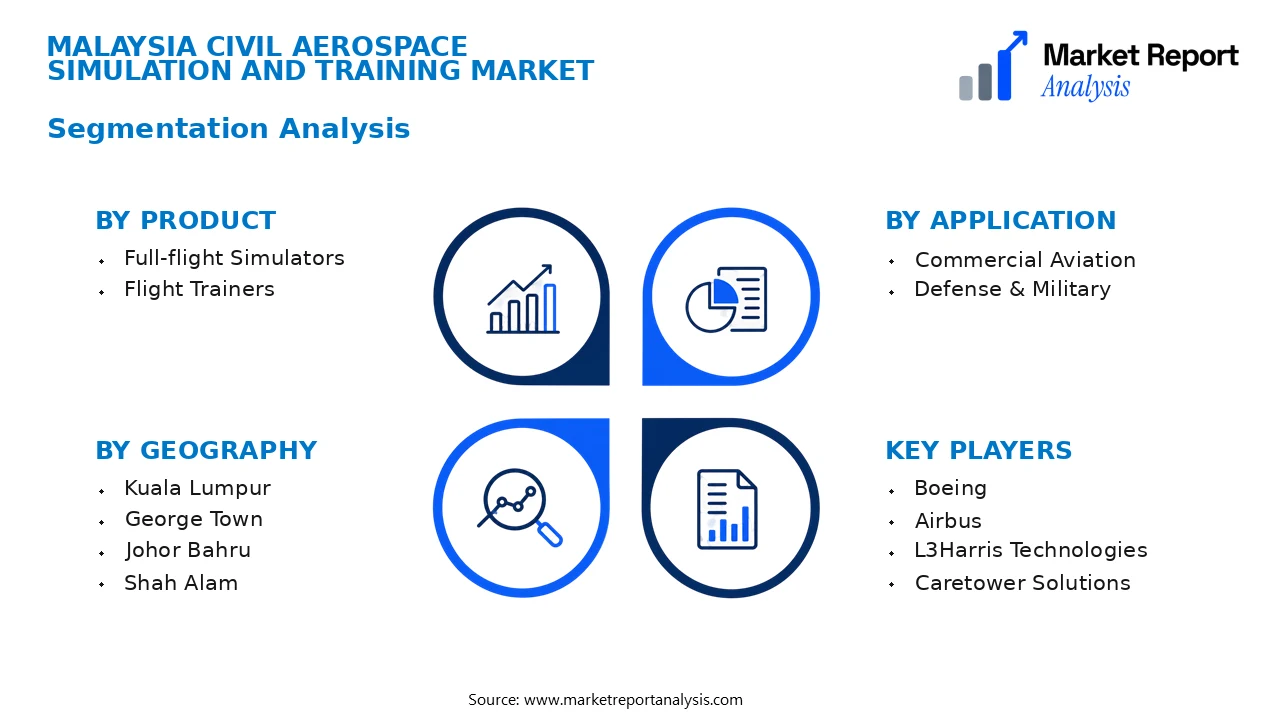
Segmentation Overview
The segmentation categories include product types such as full-flight simulators and trainers, application areas like commercial aviation and defense, and regional breakdowns focusing on key Malaysian cities. This structured segmentation allows stakeholders to identify growth drivers, tailor offerings, and allocate resources effectively across markets.
- Product
- Full-flight Simulators: These highly sophisticated simulators replicate real-flight conditions for pilot training, offering immersive, realism-enhanced experiences. With increasing safety standards, demand for full-flight simulators is expected to grow significantly in Malaysia.
- Flight Trainers: These devices are used for initial and recurrent pilot training, emphasizing procedural proficiency and safety. Their cost-effectiveness and ease of use drive widespread adoption across training academies and airlines.
- Application
- Commercial Aviation: This segment includes training for airline pilots and cabin crews, addressing Malaysia’s expanding commercial fleet. Rising passenger numbers and fleet modernization are boosting demand for advanced simulation solutions.
- Defense & Military: Military pilot training and tactical simulation form this segment’s core. Strategic investments in defense capabilities and modernizing armed forces enhance the importance of simulation-based training methods.
- Geography
- Kuala Lumpur: As Malaysia’s primary economic hub, Kuala Lumpur hosts major aviation training centers, government agencies, and corporate offices, positioning it as the central node for civil aerospace simulation activities.
- George Town: Known for its strategic port and industrial zones, George Town's infrastructure supports logistical and technological deployment of simulation training, catering to regional airports and aviation service providers.
- Johor Bahru: Boasting proximity to Singapore and a growing industrial base, Johor Bahru presents increasing opportunities for commercial and defense simulation training facilities to serve cross-border aviation needs.
- Shah Alam: With a focus on technological innovation and automotive industries, Shah Alam is increasingly attracting aviation training institutions seeking advanced simulation hardware and software solutions to enhance pilot training efficacy.
- Petaling Jaya: As a bustling commercial district with an expanding educational infrastructure, Petaling Jaya serves as a key location for training academies, simulation startups, and industry collaboration activities.
- Ipoh: Known for its manufacturing and logistical sectors, Ipoh contributes to regional training capacity, especially for maintenance, repair, and overhaul (MRO) training programs that rely on simulation of complex aircraft systems.
- Kota Kinabalu: The growing airport infrastructure and tourism-driven aerospace activities in Kota Kinabalu demand specialized simulation training for pilots servicing regional routes and island air traffic management.
Competitive Intelligence
The Malaysia Civil Aerospace Simulation and Training Market exhibits a competitive landscape characterized by moderate market concentration, with leading global and regional players dominating key segments. Major firms such as CAE, L3Harris, and Thales are actively engaged in product innovation, emphasizing advancements in realism, virtual reality integration, and maintenance efficiency to differentiate their offerings. These companies have established strategic partnerships with Malaysian aerospace entities and military organizations to broaden their market presence, often through joint ventures and R&D collaborations. Notably, several players are pursuing acquisitions of smaller local firms to enhance technological capabilities and expand regional footprints. Expansion strategies primarily focus on regional offices and simulation centers in Kuala Lumpur and Penang, aiming to capitalize on Malaysia’s strategic position and growing aerospace sector. R&D investments are heavily concentrated on developing next-generation simulators with enhanced fidelity and operational adaptability, setting firms apart from competitors. This competitive intelligence highlights a dynamic environment driven by continuous innovation, strategic alliances, and targeted expansion to secure market leadership in Malaysia’s evolving civil aerospace simulation and training landscape.
Leading Company Profiles
The Malaysian civil aerospace simulation and training market is characterized by a mix of global aerospace giants and regional specialists that focus on advanced simulation systems, integrated training solutions, and customized maintenance services to serve the burgeoning Southeast Asian aviation sector.
- Boeing
- Airbus
- L3Harris Technologies
- Caretower Solutions
- CAE Inc.
- Rockwell Collins
- Simula Aerospace & Defense
- FlightSafety International
- Lockheed Martin
Boeing
Boeing offers comprehensive civil aerospace simulation and training solutions including full-flight simulators, instructor stations, and maintenance training units, with a strategic focus on technology integration and regional market expansion.
Airbus
Airbus specializes in high-fidelity flight simulators, virtual maintenance trainers, and integrated training services, leveraging advanced simulation technologies to enhance safety and operational efficiency in Malaysia's civil aviation sector.
L3Harris Technologies
L3Harris provides sophisticated cockpit simulators, pilot training programs, and emergency procedures training, with a focus on leveraging cutting-edge digital and networked simulation systems for regional clients.
Caretower Solutions
This regional player is known for customized simulation hardware, software solutions, and e-learning modules designed for local airlines, focusing on cost-effective, scalable training solutions tailored to Malaysian aviation needs.
CAE Inc.
CAE is a leading global provider of civil aviation simulation solutions, including full-flight simulators, maintenance training devices, and digital training platforms with a strong presence in the ASEAN training network expansion.
Rockwell Collins
Rockwell Collins specializes in avionics simulation systems, cockpit trainers, and integrated training solutions that focus on safety, efficiency, and the deployment of advanced connectivity features for regional airlines.
Simula Aerospace & Defense
Focuses on designing immersive, highly realistic flight simulators and military-grade training modules, with increasing emphasis on multi-crew cooperation and scenario-based training tailored to Malaysia’s unique operational requirements.
FlightSafety International
Offers an extensive portfolio of civil aeronautics training programs, including full-flight simulators, remote training technologies, and digital learning environments, aiming at expanding regional collaboration and technology transfer.
Lockheed Martin
Known for its advanced simulation and modelling solutions, Lockheed Martin develops cutting-edge aerospace training technologies including disaster response, cockpit training, and integrated civil-military simulation systems.
Strategic Business Developments

- Jan 2023 – Boeing – Launched new immersive flight simulation platform tailored for Southeast Asian airlines – Strengthens regional market share and enhances training efficacy.
- Mar 2023 – Airbus – Announced expansion of simulation manufacturing facility in Malaysia – Increases production capacity and underpins local job creation and technology transfer initiatives.
- Jul 2023 – CAE Inc. – Acquired a regional training center to bolster comprehensive pilot and crew training offerings – Enhances regional service footprint and training capabilities.
- Sep 2023 – Lockheed Martin – Partnered with local aerospace firms to develop joint training modules for civil and military applications – Enables integrated simulation solutions for Malaysia.
- Nov 2023 – Raytheon Technologies (via Rockwell Collins) – Unveiled a new line of digital cockpit trainers featuring augmented reality for pilot familiarization – Improves training safety and efficiency.
Frequently Asked Questions
What is the Malaysia Civil Aerospace Simulation and Training Market?
The Malaysia Civil Aerospace Simulation and Training Market encompasses the development, deployment, and utilization of advanced simulation and training solutions specifically for civil aerospace professionals, including airline crew, maintenance staff, and air traffic controllers, aiming to enhance safety, efficiency, and operational proficiency.
What is the current market size of Malaysia Civil Aerospace Simulation and Training Market?
As of 2026, the market is valued at approximately USD 1.2 Billion, reflecting steady adoption of simulation technologies amidst increasing aviation activity and governmental support for safety and training standards within Malaysia’s civil aviation sector.
What factors are driving the Malaysia Civil Aerospace Simulation and Training Market?
Market growth is driven by a rising number of commercial flights, expanding airline fleets, and a focus on safety regulations. Technological advancements, government investments, and the increasing need for cost-effective pilot training contribute significantly to market expansion.
Which region dominates the Malaysia Civil Aerospace Simulation and Training Market?
Peninsular Malaysia emerges as the dominant region, due to its concentration of major airports, training centers, and airline headquarters, fostering a robust environment for simulation and training activities within the civil aerospace sector.
Which segment is expected to grow the fastest?
The pilot training segment is forecasted to grow at the fastest rate, driven by increasing complexity of aircraft systems, regulatory requirements for recurrent training, and airline expansion plans that demand sophisticated simulation solutions for pilot proficiency.
Who are the leading companies operating in the Malaysia Civil Aerospace Simulation and Training Market?
Key players include CAE Inc., L3Harris Technologies, and Indra Sistemas, who are actively involved in providing advanced simulation systems, turnkey training solutions, and ongoing technical support to meet Malaysia’s expanding civil aviation needs.
Analyst Perspective
The Malaysia Civil Aerospace Simulation and Training Market is positioned for steady growth through 2034, driven by modernization initiatives within regional airlines and the expanding aerospace sector. The market's maturity is evident in the increasing integration of advanced simulation technologies, including virtual reality and AI-driven training modules, which enhance training efficacy and safety standards. Strategic investment in these technologies remains a priority, particularly in Kuala Lumpur, where the presence of major airlines and training centers creates prominent regional hubs. Competitive intensity is expected to heighten as established global players expand locally and regional startups innovate with cost-effective solutions. Opportunities abound in upgrading existing training infrastructure and establishing new centers in underserved areas such as Penang and Johor, aligning with Malaysia’s long-term aerospace ambitions. Regional growth potential is significant, fueled by government policies promoting aerospace tourism, manufacturing, and skill development, positioning Malaysia as a regional hub for aerospace innovation. The market’s evolution will be shaped by technological advancements and regional economic trajectories, emphasizing the importance of strategic, long-term investments.
