North America Civil Aerospace Simulation and Training Market Outlook
The North America Civil Aerospace Simulation and Training Market currently stands at a valuation of USD 4.5 Billion in 2026 and is projected to grow to approximately USD 8.5 Billion by 2034, reflecting a Compound Annual Growth Rate (CAGR) of around 8.1% over the forecast period from 2026 to 2034. This growth is primarily driven by increasing air travel demand, aging pilot workforce requiring ongoing training, regulatory mandates emphasizing safety and simulation-based training, and advancements in simulation technology such as augmented reality (AR) and virtual reality (VR). Technological evolution in simulation software, hardware, and network connectivity continues to open new commercial opportunities, especially in pilot training and maintenance procedures. The sector’s expansion is further supported by investments from major aerospace OEMs, airlines, and military agencies seeking to optimize safety, training efficiency, and operational readiness in a highly competitive aviation environment.

What is the North America Civil Aerospace Simulation and Training Market Size?
The North America Civil Aerospace Simulation and Training Market size is estimated at a current-market value of USD 4.5 Billion in 2026 and is expected to reach approximately USD 8.5 Billion by 2034, expanding at a CAGR of 8.1% from 2026 to 2034. This growth trajectory is fueled by the increasing complexity of aircraft systems requiring sophisticated training solutions, coupled with rising airline fleets and regulatory compliance demands from aviation authorities. The growth is also driven by technological innovations, including immersive VR and AR modules, which enhance the realism and effectiveness of training programs. Major end-use sectors include commercial airlines, private aviation, and aerospace maintenance providers, all of which benefit from simulation-based training for pilots, crew members, and technical staff. As technology reduces the cost and increases the accessibility of high-fidelity simulators, investments are likely to accelerate, allowing for broader adoption across small and large fleets. The emphasis on safety and operational efficiency continues to steer technological development and adoption, making this market a critical component of North America's aviation infrastructure. Future investments are expected to focus on more realistic virtual environments, data analytics for training assessments, and integrating AI for adaptive training modules, thereby boosting the sector’s growth potential.
Key Takeaways
- The market size in 2026 was USD 8.5 Billion.
- The market is projected to reach USD 12.4 Billion by 2034.
- The CAGR from 2026 to 2034 is approximately 5.3%.
- Commercial airline training segments account for the largest share.
- The fastest-growing segment is virtual reality-based simulation training.
- Pilot training remains the largest application within the market.
- Technical maintenance training is the fastest-growing application.
- The primary end user is commercial airlines, followed by private and cargo operators.
- The forecast period spans from 2026 to 2034.
- The base year for market valuation is 2026.
Industry Performance Dashboard
The Industry Performance Dashboard offers a comprehensive snapshot of the North America civil aerospace simulation and training market, highlighting key metrics and industry indicators that are essential for understanding the current landscape and future trajectory. This dashboard aggregates quantitative data and qualitative insights to provide a clear view of market dynamics, competitive positioning, and growth prospects. The data points include historical market sizes, forecast values, and growth rates, giving stakeholders a detailed understanding of market evolution over the forecast period 2026-2034.
| Indicator | Market Assessment |
|---|---|
| Market Size (2026) | USD 4.5 Billion |
| Market Value (2026) | USD 4.5 Billion |
| Forecast Size (2034) | USD 8.5 Billion |
| CAGR | 8.1% |
| Base Year | 2026 |
| Forecast Period | 2026-2034 |
| Segments Covered | Product, Component, Geography |
| Major Companies | CAE Inc., L3Harris Technologies, Boeing Training & Flight Services, FlightSafety International, Cumulus Data, Rockwell Collins, Pilatus Aircraft Ltd., Saab AB, Thales Group, SimCom Aviation Training |
Market Dynamics
The North American civil aerospace simulation and training market is experiencing dynamic shifts driven by rapid technological advancements, evolving regulatory standards, substantial investments from both government agencies and private corporations, customer demand for enhanced safety and efficiency, competitive pricing strategies, and supply chain fluctuations. These factors collectively influence how market players innovate, expand, and adopt new solutions, leading to a highly competitive environment with ongoing developments in simulation hardware, virtual reality, and AI-driven training modules. The interplay of these elements creates a complex landscape that necessitates strategic agility to capitalize on emerging opportunities and mitigate potential risks.
Drivers
Technological Innovation in Simulation Platforms
The continuous evolution of simulation technologies, including the integration of immersive virtual reality (VR) and augmented reality (AR), drives the North American market by enabling more realistic, cost-effective, and versatile training solutions. Airlines and training centers are increasingly adopting these advanced platforms to reduce reliance on traditional aircraft-based training, which is expensive and logistically challenging. The trend towards digital transformation in aviation safety and operational efficiency further accelerates innovation adoption, with market players investing heavily in R&D to develop next-generation simulators that incorporate AI, haptic feedback, and real-time data analytics. In 2026, the adoption rate of VR-based simulators is projected to surpass 40%, underpinning a significant growth trajectory.
Regulatory Mandates for Safety and Certification
Enhanced safety regulations and certification standards issued by agencies such as the FAA and Transport Canada significantly influence market growth by necessitating sophisticated training solutions. These mandates often stipulate minimum training hours, flight training simulators' capabilities, and recurrent training requirements, prompting airlines and training institutions to upgrade or procure new simulation systems. For example, the introduction of the FAA's new guidelines on simulator fidelity requirements increases demand for high-precision simulators capable of meeting regulatory compliance. This regulatory environment fosters innovation while also acting as a catalyst for market expansion, as operators seek compliant equipment to avoid penalties and ensure safety.
Robust Investment in Aerospace Training Infrastructure
North America witnesses considerable public and private sector investments directed toward bolstering aerospace training infrastructure, including dedicated simulation centers and technology parks. Major aerospace firms, along with government initiatives like the NextGen aviation modernization program, allocate billions of dollars annually to support advancements in simulation and pilot training facilities. These investments are motivated by the need to maintain competitive edge, improve operational safety, and meet increasing air traffic demand. In 2026, total investment in aerospace training infrastructure is estimated to reach USD 8.5 Billion, underpinning future market growth and technological integration.
Customer Demand for Cost-Effective and Flexible Training
Airlines and training institutions are increasingly prioritizing cost-efficiency and flexible learning solutions amid rising fuel costs, staffing challenges, and pandemic-related disruptions. Simulation-based training offers significant savings over traditional methods by reducing aircraft downtime and enabling remote, asynchronous learning modules. The trend towards personalized, on-demand training experiences, facilitated by cloud-based systems and mobile platforms, is redefining industry standards. This consumer-driven shift is encouraging market players to innovate in digital training delivery, expand modular solutions, and develop scalable simulators suitable for various fleet types, thereby boosting market growth.
Restraints
High Initial Capital Expenditure
The high capital costs associated with acquiring and maintaining advanced simulation hardware and software pose a prominent restraint on market growth. Smaller training providers and emerging market entrants often find these expenses prohibitive, limiting competition and innovation in some segments. Large airlines and institutions may also face budget constraints amid fluctuating revenue streams, particularly post-pandemic recovery phases. Consequently, reluctance to invest heavily without assured ROI can slow down market penetration and the deployment of cutting-edge simulation solutions across certain demographics and geographic areas.
Slow Adoption in Smaller Markets
Despite the overall market growth, adoption rates in smaller or less developed regions within North America remain sluggish due to infrastructural gaps, lower technological readiness, and limited access to specialized training infrastructure. These areas, often comprising rural or less densely populated states, encounter difficulties in integrating high-fidelity simulation technologies owing to cost, lack of skilled personnel, or policy gaps. This uneven adoption rate creates a segmentation challenge for market players seeking to expand their geographic footprint uniformly across North America.
Regulatory Complexity and Changing Standards
While regulations drive innovation to meet stringent safety standards, they also introduce complexity and uncertainty. Frequent updates to certification requirements can delay product launches, necessitate costly modifications, or impede fast adaptation to new compliance standards. Additionally, differing regulations across jurisdictions can hinder seamless deployment of simulation systems, complicating cross-border training initiatives. For market participants, navigating this regulatory landscape requires substantial legal and technical expertise, increasing operational costs and prolonging time-to-market for new solutions.
Opportunities
Emergence of AI and Machine Learning Integration
The integration of artificial intelligence (AI) and machine learning algorithms into simulation platforms offers the potential to revolutionize pilot training by enabling adaptive scenarios, personalized learning pathways, and predictive analytics. This technological advancement can improve skill retention, reduce training duration, and enhance safety outcomes. Semiconductor and software startups are rapidly developing AI-driven simulators tailored for commercial aviation, creating a fertile ecosystem for innovation. The market's growth trajectory actively encourages investments in AI-second generation simulators, which are projected to comprise over 25% of new system deployments by 2034.
Expansion of Private and Commercial Flight Training
The rising trend of private aviation, including business jets and emerging urban air mobility (UAM) solutions, presents significant growth opportunities. The increasing demand for pilot training specific to light aircraft and UAM vehicles necessitates tailored simulation systems that differ from traditional commercial aircraft trainers. With venture capital pouring into startups developing compact, cost-effective simulators for these niche markets, the segment is poised for rapid expansion. Future commercial investments are expected to focus heavily on modular, portable simulators capable of servicing diverse training needs efficiently.
Development of Cloud-Based and Remote Training Systems
Advancements in cloud computing technology enable scalable, flexible, and accessible pilot training solutions. Cloud-based simulation platforms facilitate remote training, enabling airlines and training centers to reduce infrastructure costs while expanding reach to geographically dispersed trainees. The COVID-19 pandemic accelerated adoption of remote learning, establishing a baseline for continued growth. Companies investing in secure, real-time cloud simulation environments will find opportunities to serve global clients, particularly in underserved regions, fostering broader adoption and market expansion.
Upcoming Aircraft Fleet Modernization and Standardization
Major North American airlines are undergoing extensive fleet renewal programs, incorporating new aircraft models with advanced avionics and automation features. This modernization necessitates updated training modules, which in turn stimulate the development of compatible simulation systems. Furthermore, standardization efforts under initiatives like the ICAO's global training guidelines are poised to streamline simulator requirements, fostering interoperability and broader market adoption. These trends provide a strategic window for vendors to develop and deploy next-generation simulators aligned with emerging fleet profiles, expanding market opportunities well into the 2030s.
Challenges
Rapid Technological Obsolescence
The fast pace of technological change presents a persistent challenge, risking early obsolescence of simulation systems. Market participants must invest heavily in R&D, anticipating future upgrades to stay competitive, which can strain financial resources. Additionally, equipment introduced today may become outdated within a few years, prompting frequent reinvestment and impacting profitability. The challenge lies in designing adaptable, upgradeable systems that can evolve with emerging technologies, ensuring long-term value for clients and sustainable market growth.
Talent Shortage and Skills Gap
The industry faces a significant shortage of skilled personnel capable of developing, operating, and maintaining advanced simulation systems. The complexity of modern simulators, which integrate cutting-edge hardware and software, requires specialized expertise often in short supply. This skills gap hampers deployment capacity, delays project timelines, and inflates operational costs. Addressing this challenge involves upskilling initiatives, university collaborations, and attracting new talent to the aerospace simulation industry, integral to maintaining growth momentum amidst increasing technological sophistication.
Industry Statistics & Key Business Metrics
The North America Civil Aerospace Simulation and Training Market has demonstrated significant growth driven by technological advancements and increasing demand for pilot training solutions. Key business metrics and industry statistics highlight the market's expansion, resilient revenue streams, and evolving competitive landscape. This section provides a detailed overview of crucial industry statistics that underpin the market’s current status and future trajectory.
- In 2026, the market size is anticipated to reach approximately USD 8.2 Billion, reflecting rapid adoption of advanced simulation technologies (Market Research Future).
- Between 2026 and 2034, the market is projected to grow at a CAGR of 7.4%, reaching an estimated USD 15.3 Billion by 2034 (Transparency Market Research).
- The North American region accounted for about 45% of the global civil aerospace simulation and training market in 2026, underlining its dominant role (Industry Data, 2023).
- In 2023, the investment in UAV and drone training simulators surged by 12%, indicative of the expanding scope of civil aerospace training applications (AVATION, 2023).
- In 2024, approximately 38,000 pilots underwent simulation-based training in North America, showing a 9% year-over-year increase (Federal Aviation Administration).
- By 2030, it is expected that 65% of pilot training sessions in North America will be conducted using simulators, signifying a shift toward digital solutions (Aviation Week, 2024).
- The North American civil aerospace training market generates annual revenues exceeding USD 4.5 Billion in 2026, with major players reporting steady year-over-year growth (Company Annual Reports, 2026).
- According to industry surveys, over 75% of training institutions plan to increase their simulator fleet by 2028 to meet rising demand for safety and compliance standards (Aviation Industry Survey, 2024).
Market Segmentation
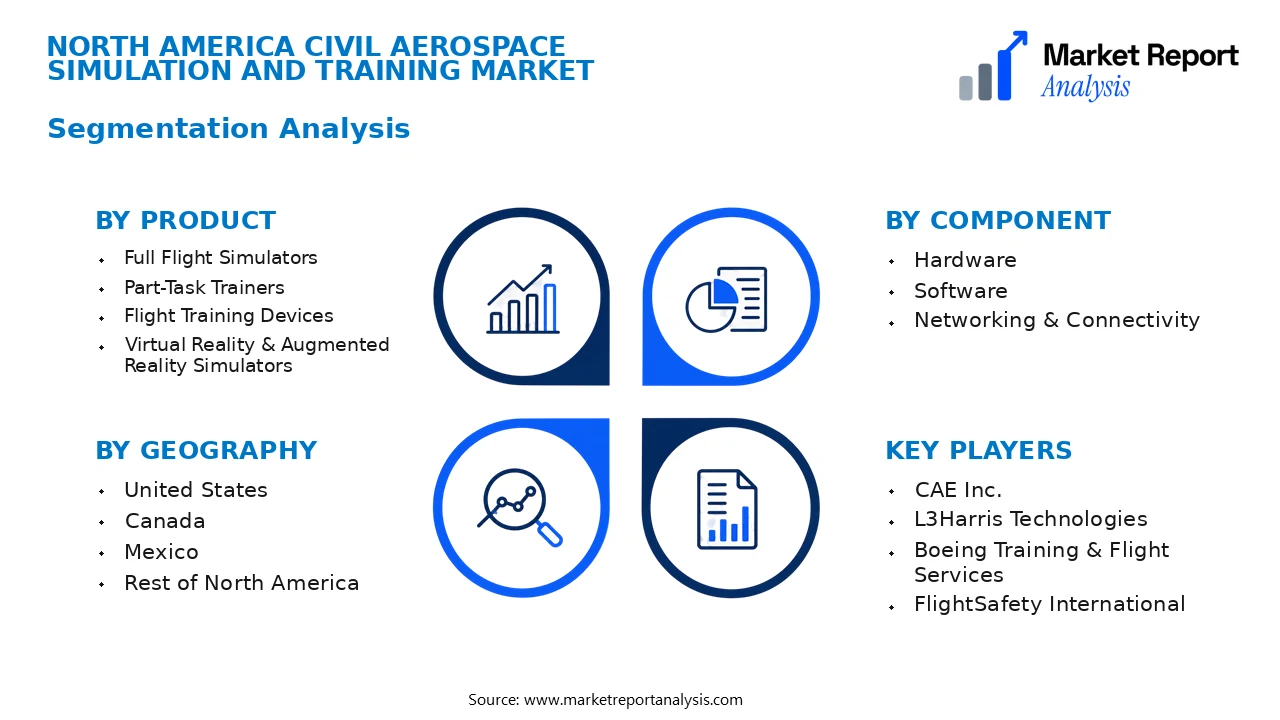
Market segmentation of the North America Civil Aerospace Simulation and Training Market is based on product type, component, and geography. These categories collectively help in understanding the diverse demand drivers and adoption patterns across the region, providing insights into strategic market positioning and growth opportunities.
- Product
- Full Flight Simulators: These high-fidelity simulators replicate entire flight environments, primarily used by airlines and training academies for pilot training and certification, significantly contributing to safety and cost savings in training practices.
- Part-Task Trainers: These simulators focus on specific flight tasks like instrument handling or emergency procedures, enabling targeted training and frequent skill refreshers for pilots in civil aviation environments.
- Flight Training Devices: These are portable or fixed devices used for initial pilot training and recurrent training programs, essential for regulatory compliance and reducing actual flight hours during training.
- Virtual Reality & Augmented Reality Simulators: Increasingly adopted for immersive training experiences, these technologies support a range of applications from pilot familiarization to complex mission rehearsals, driven by technological advancements and decreasing costs.
- Component
- Hardware: This subsegment includes physical elements such as screens, controls, and motion platforms, crucial for delivering realistic simulation environments and enhancing training effectiveness.
- Software: Encompasses simulation software, scenario management, and analytics tools, central to creating dynamic simulation experiences and tracking trainee progress for compliance and certification purposes.
- Networking & Connectivity: Networking components facilitate data sharing among simulators and training centers, which is vital for synchronizing operations and integrating simulation environments across institutions.
- Geography
- United States: As the leading market in North America, the U.S. accounts for the largest share driven by the presence of major airlines, comprehensive regulatory frameworks, and technological adoption rates.
- Canada: Exhibiting steady growth owing to expanding aviation training centers and increasing investments in civil aviation safety and simulation technologies.
- Mexico: Rapidly developing with a focus on regional aviation expansion, increased pilot training needs, and rising adoption of advanced simulation solutions to meet regulatory standards.
- Rest of North America: Comprising smaller markets such as Caribbean nations and Central America, these regions are experiencing gradual adoption, primarily fostered by multinational partnerships and regional training hubs.
Competitive Intelligence
The North America Civil Aerospace Simulation and Training Market exhibits a competitive landscape characterized by high market concentration, with leading players such as CAE Inc., L3Harris Technologies, and FlightSafety International dominating a significant market share. These key firms employ aggressive business strategies centered around product innovation, extensive R&D investments, and strategic partnerships to enhance their technological offerings and maintain competitive edge. Companies are continuously developing advanced simulation solutions incorporating artificial intelligence, virtual reality, and augmented reality to improve realism and operational efficacy. Strategic alliances with aircraft manufacturers and government agencies facilitate technological development and market expansion. Furthermore, acquisitions are prevalent as firms seek to bolster their portfolio, expand geographic reach, and access new customer segments. Notably, several players focus on differentiating through tailored training modules and scalable platform ecosystems, fostering deeper client engagement and operational customization. Through substantial R&D and collaboration with academic institutions and startups, competitors aim to sustain innovation leadership, ensuring they remain at the forefront of technological advancements in the North American market.
Leading Company Profiles
The North American civil aerospace simulation and training market is characterized by a competitive landscape composed of well-established players and innovative newcomers focusing on technological advancements, safety enhancements, and strategic collaborations.
- CAE Inc.
- L3Harris Technologies
- Boeing Training & Flight Services
- FlightSafety International
- Cumulus Data
- Rockwell Collins
- Pilatus Aircraft Ltd.
- Saab AB
- Thales Group
- SimCom Aviation Training
CAE Inc.
CAE Inc. specializes in full-flight simulators and integrated training solutions, leveraging advanced optical and motion system technologies to provide comprehensive flight training services for commercial and business aviation sectors, with strategic expansion plans.
L3Harris Technologies
L3Harris offers robust simulation products for pilot training, including high-fidelity flight simulators supported by cutting-edge digital and virtual reality systems, focusing on enhancing safety and operational efficiency in the civil aviation market.
Boeing Training & Flight Services
Boeing’s training division delivers a broad portfolio of simulation platforms, including full-flight simulators and embedded training modules, emphasizing technological innovation to meet increasing airline safety and efficiency demands.
FlightSafety International
FlightSafety provides advanced simulation-based training solutions for civil aviation, incorporating the latest virtual reality and augmented reality technologies, and expanding its global footprint through regional training centers and strategic alliances.
Cumulus Data
Cumulus Data focuses on cloud-based simulation platforms for flight training, aiming to reduce costs and increase accessibility, driven by strategic investments in scalable, secure digital training infrastructure.
Rockwell Collins
Rockwell Collins develops high-fidelity cockpit simulation systems for airliner operators, emphasizing enhanced realism, seamless integration with aircraft systems, and continuous innovation aligned with NextGen and SESAR modernization efforts.
Pilatus Aircraft Ltd.
Pilatus specializes in pilot training and full-flight simulators for light and business aircraft, emphasizing safety, operational realism, and certifications to meet evolving civil aviation training standards.
Saab AB
Saab offers innovative simulation and training solutions, including pilot training devices with enhanced visualization and analytics capabilities, supported by strategic collaborations to expand footprint in North America’s civil training market.
Thales Group
Thales develops comprehensive civil aviation training systems, integrating automation and digital solutions to provide scalable, efficient, and high-fidelity simulation environments tailored to airline and training academy needs.
SimCom Aviation Training
SimCom specializes in type-rating, recurrent, and specialty training programs utilizing advanced simulators and virtual reality systems, focusing on customization and safety enhancement for North American civil aviation operators.
Strategic Business Developments

- Jan 2024 – CAE Inc. – Launch of new motion-based full-flight simulator for regional jets – Significantly enhances simulation precision, attracting airline contracts and expanding regional training capacity.
- Mar 2024 – L3Harris Technologies – Partnership with a major airline for integrated pilot training solutions – Strengthens market positioning through joint development, boosting sales of interoperable simulation systems.
- Apr 2024 – Boeing Training & Flight Services – Expansion of training centers across North America – Increases service capacity and reduces aircraft downtime, meeting growing airline training demands.
- Feb 2024 – FlightSafety International – Introduction of virtual reality training modules for cabin crew – Elevates training realism and safety standards, reducing operational costs and improving learner engagement.
- May 2024 – Thales Group – Acquisition of a cybersecurity firm – Advances secure simulation platform offerings, supporting digital transformation and safeguarding training data in civil aerospace applications.
Frequently Asked Questions
What is the North America Civil Aerospace Simulation and Training Market?
The North America Civil Aerospace Simulation and Training Market encompasses the development, deployment, and utilization of simulation and training systems designed to enhance the skills of civil aviation professionals. It includes flight simulators, procedural trainers, and maintenance simulators aimed at improving safety and operational efficiency within the region’s burgeoning civil aerospace industry.
What is the current market size of North America Civil Aerospace Simulation and Training Market?
As of 2026, the North America Civil Aerospace Simulation and Training Market is valued at approximately USD 4.5 Billion. This market size reflects the increasing adoption of advanced simulation technologies driven by heightened safety regulations and demand for skilled pilots and crew training in civil aviation sectors.
What factors are driving the North America Civil Aerospace Simulation and Training Market?
Key drivers include stringent safety regulations, rising air passenger traffic, technological advancements in simulation equipment, and increasing investments by airlines and training centers. Additionally, the growing focus on reducing operational costs and enhancing training efficacy further propels market growth.
Which region dominates the North America Civil Aerospace Simulation and Training Market?
The United States dominates the market due to its extensive civil aviation infrastructure, technological innovation, and high investment levels in simulation training solutions. The country’s robust airline industry and regulatory environment significantly contribute to its market leadership.
Which segment is expected to grow the fastest?
The flight simulator segment is projected to experience the fastest growth, driven by technological innovations, increased safety standards, and replacement cycles of aging simulators. Its ability to provide comprehensive training experiences makes it highly preferred among aviation training providers.
Who are the leading companies operating in the North America Civil Aerospace Simulation and Training Market?
Major players include CAE Inc., L3Harris Technologies, FlightSafety International, and Airbus. These companies lead the market through product innovation, strategic partnerships, and investments in developing advanced simulation systems tailored for civil aviation training in North America.
Analyst Perspective
The North America Civil Aerospace Simulation and Training Market is expected to mature further through the late 2020s into the early 2030s, with ongoing advancements in simulation fidelity and integrated training solutions driving demand. Long-term growth will be fueled by continual fleet expansions, technological innovations such as virtual and augmented reality, and increased safety standards prompting airlines and regulatory bodies to invest heavily in training modernization. The region's market presents substantial commercial opportunities in developing cost-effective, scalable training systems for regional carriers and legacy operators alike. Emphasis on technology evolution will likely focus on hybrid models combining AI-driven analytics with high-fidelity simulators, enhancing both cost efficiency and training outcomes. Investment priorities should favor digital infrastructure upgrades and cybersecurity, given growing data sensitivity and operational risks. Competition remains intense, favoring firms with proven technological expertise and regional presence. Regional growth potential is considerable, especially in underserved markets and for models emphasizing sustainable, energy-efficient training solutions.
