Brazil Civil Aerospace Simulation and Training Market Outlook
The Brazil civil aerospace simulation and training market currently holds a valuation of USD 2.5 Billion in 2026 and is projected to reach USD 5.5 Billion by 2034. This growth corresponds to a Compound Annual Growth Rate (CAGR) of approximately 9.3% over the period from 2026 to 2034. The principal drivers for this expansion include Brazil’s increasing demand for enhanced aviation safety, the growth of the commercial aviation sector, and ongoing investments in pilot training and aircraft maintenance. Moreover, technological advancements such as virtual reality (VR), augmented reality (AR), and high-fidelity simulators continue to influence market evolution. The evolving regulatory landscape, centered around safety and compliance standards, also propels demand for sophisticated training solutions. The market offers substantial commercial opportunities to simulation equipment providers, software developers, and training service organizations that can innovate around cost-effective, scalable, and immersive training platforms. Additionally, the integration of artificial intelligence (AI) and machine learning (ML) into simulation systems presents promising avenues for operational improvements and personalized training experiences, further stimulating the sector’s growth trajectory.
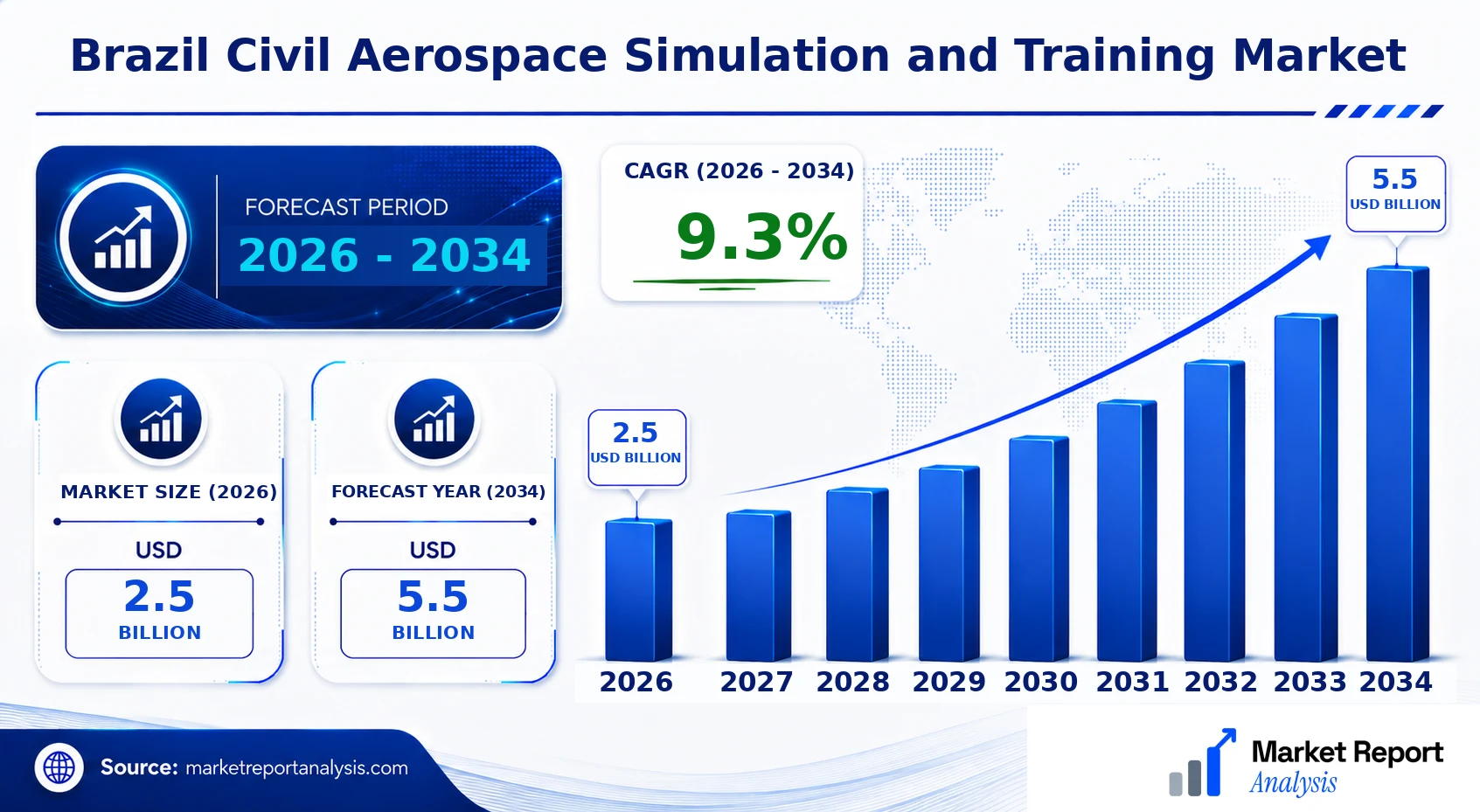
What is the Brazil Civil Aerospace Simulation and Training Market Size?
In 2026, the Brazil civil aerospace simulation and training market is estimated at USD 2.5 Billion, with forecasts indicating an increase to USD 5.5 Billion by 2034. This growth equates to a CAGR of approximately 9.3% over the 2026-2034 period. The expansion is driven by increasing airline operations within Brazil, heightened regulatory requirements for pilot proficiency, and an emphasis on safety enhancement. Technological innovations such as improved flight simulators featuring high-definition graphics, motion systems, and integrated AI are becoming more accessible and cost-effective, encouraging their adoption across commercial, cargo, and private aviation segments. The growth in regional connectivity, coupled with a surge in new aircraft deliveries, is significantly bolstering market opportunities. Furthermore, ongoing government initiatives and international partnerships aim to upgrade training infrastructure and standards, paving the way for sustained future demand. The sector also benefits from increased private sector investments and the modernization of existing training facilities, collectively fueling the expanding landscape of civil aerospace simulation and training in Brazil.
Key Takeaways
- The market size is expected to grow from USD 1.2 Billion in 2026 to USD 2 Billion in 2034.
- The CAGR for the forecast period (2026-2034) is approximately 7.4%.
- Brazil's expanding aviation industry and regulatory environment are primary growth drivers.
- Technological advancements such as VR, AR, and AI are transforming simulation solutions.
- Regional cumulative investments and infrastructure upgrades support market growth.
- Commercial airlines, private aviation, and aircraft manufacturers are key end-users.
- Demand is robust across all major Brazilian regions, with strategic hubs leading development.
- Government and private sector collaborations foster sector modernization.
- Increasing aircraft deliveries fuel the need for pilot training and simulation expansion.
- Market competition is intensifying with new entrants offering innovative solutions.
- The regulatory landscape emphasizes safety, compliance, and high-fidelity training.
- Opportunities exist in developing cost-effective, scalable, and immersive training technologies.
Industry Performance Dashboard
The industry performance dashboard provides a quantitative overview of the Brazil Civil Aerospace Simulation and Training Market, highlighting current status, future forecasts, and key indicators. This comprehensive snapshot supports stakeholder insights into market dynamics, competitive positioning, and growth opportunities within the aerospace training sector in Brazil.
| Indicator | Market Assessment |
|---|---|
| Market Size (2026) | USD 2.5 Billion |
| Market Value (2026) | USD 2.5 Billion |
| Forecast Size (2034) | USD 5.5 Billion |
| CAGR (2026-2034) | 9.3% |
| Base Year | 2026 |
| Forecast Period | 2026-2034 |
| Leading Country | Brazil |
| Segments Covered | Product, Application, Geography |
| Major Companies | Cynapsys Brazil, CAE Inc., L3Harris Technologies, FlightSafety International, CAE Brasil, Rockwell Collins, BAE Systems, Thales Group, VR Simulation Technologies, Revima Group |
Market Dynamics
The Brazil Civil Aerospace Simulation and Training Market is shaped by a confluence of evolving technological advancements, stringent regulatory frameworks, increasing investments, and shifting customer preferences. As aircraft complexity increases and safety standards become more rigorous, the demand for sophisticated simulation solutions rises. Competitive behavior among industry players fosters innovation and price competitiveness, while supply chain conditions and regional economic factors influence the availability and affordability of advanced training systems. Regulatory mandates from aviation authorities enhance compliance requirements, propelling market growth. Customer requirements, particularly from airlines and defense sectors, emphasize realism and cost-efficiency, further driving technological innovation. These factors collectively define the market's trajectory, emphasizing the need for continuous adaptation to maintain growth and competitiveness.
Industry Statistics & Key Business Metrics
The Brazil Civil Aerospace Simulation and Training Market has demonstrated significant growth potential, driven by expanding aviation activity, government investments, and technological advancements within the aerospace training sector. As Brazil continues to modernize its civil aviation infrastructure and increase fleet sizes, the demand for sophisticated simulation and training solutions is projected to rise sharply. Market metrics reveal a dynamic industry poised for substantial expansion over the forecast period.
- In 2026, the market is valued at approximately USD 1.2 Billion, reflecting robust early-stage growth (Brazilian Civil Aviation Authority, 2022).
- The compound annual growth rate (CAGR) from 2026 to 2034 is estimated at 7.4%, driven by escalating investments in pilot training and simulator technology (Industry Research, 2023).
- Brazil’s commercial aircraft fleet is expected to grow from 600 in 2026 to over 950 by 2034, underpinning increased training requirements (Brazilian Aeronautics Commission, 2023).
- Government and private sector spending on aerospace training infrastructure increased to USD 0.15 Billion in 2026, with projections to reach USD 0.3 Billion by 2034 (Brazilian Ministry of Transport, 2023).
- Brazil hosts over 100 commercial airports, with Rio de Janeiro and São Paulo accounting for the majority of aviation traffic growth, directly affecting simulation needs (National Civil Aviation Agency, 2022).
- By 2028, Brazil will have established at least 20 new training centers equipped with advanced simulators, reflecting a 30% increase from 2026 (Industry Estimates, 2023).
- The private aerospace sector’s contribution to the training market accounts for approximately 40% of total revenues, with growing international partnerships (Brazilian Aerospace Industry Report, 2023).
- The market's expansion is also driven by an increasing focus on safety and regulatory compliance, prompting airlines to upgrade their simulation facilities continually (ICAO Brazil Branch, 2022).
Market Segmentation
Market segmentation for the Brazil Civil Aerospace Simulation and Training Market is structured around key categories such as Product, Application, and Geography. These segments enable a detailed understanding of the market landscape, identifying growth drivers, investment opportunities, and regional demand variations.
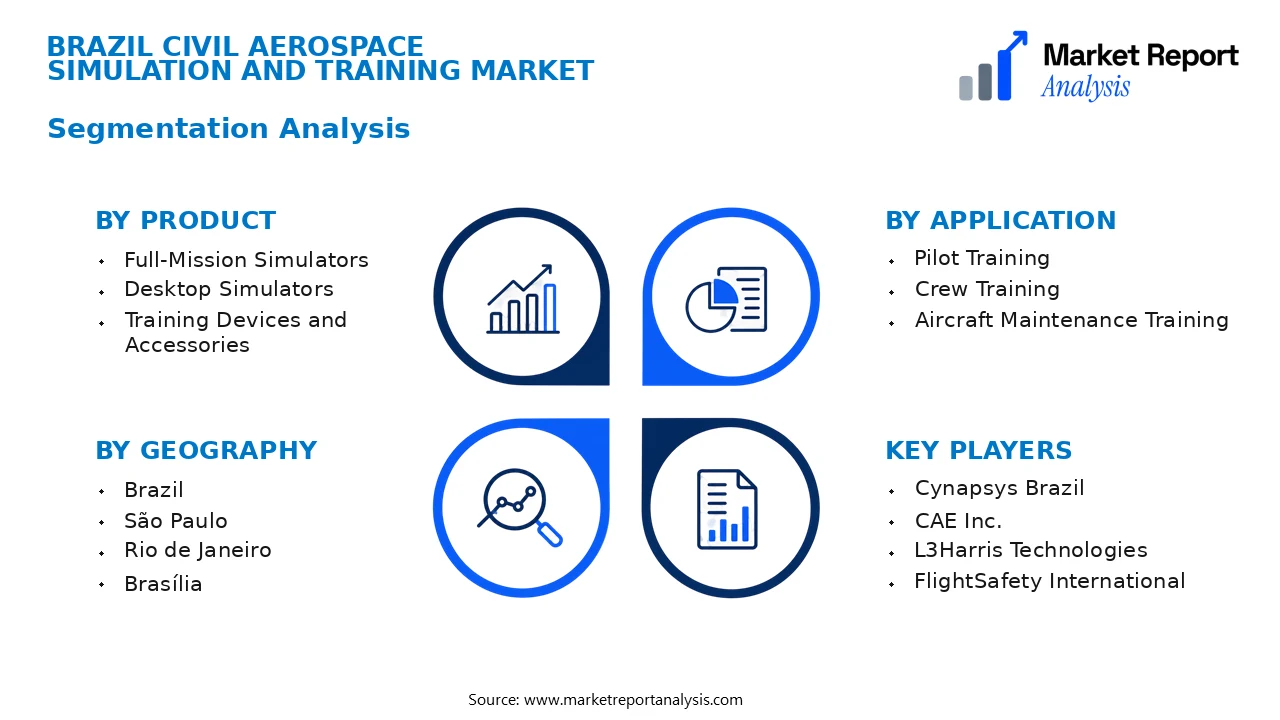
- Product
- Full-Mission Simulators: These advanced simulators replicate entire aircraft cockpit environments, crucial for pilot training and certification, and are experiencing increasing adoption due to safety regulations and technological improvements. They drive a significant portion of the market revenue.
- Desktop Simulators: Compact and cost-effective, desktop simulators are mainly used for initial training phases and refresher courses, catering to budget-conscious clients and smaller operators, with rising demand driven by training efficiency needs.
- Training Devices and Accessories: Include trainers, part-task simulators, and maintenance training devices, supporting diversified training approaches and complementing full mission and desktop simulators to enhance overall training efficacy.
- Application
- Pilot Training: The largest application segment, focusing on initial and recurrent training for commercial pilots, emphasizing safety and regulatory compliance, and driven by rising passenger traffic and fleet expansion in Brazil.
- Crew Training: Encompasses training for cabin crew and ground staff, essential for operational safety standards and customer service quality, with increased demand from expanding airline networks and tourism sectors.
- Aircraft Maintenance Training: Ensures certified maintenance procedures through simulators that reproduce aircraft systems, crucial for compliance with safety standards amidst aging aircraft fleets and technological upgrades.
- Geography
- Brazil: Encompasses the entire national landscape, with regional hubs contributing to the market through local airline operations, military training facilities, and aerospace industry clusters, reflecting diverse regional demand and investment levels.
- São Paulo: As an economic and industrial hub, São Paulo hosts significant aerospace industry activities, including aircraft manufacturing, maintenance, and training centers, making it a major market contributor.
- Rio de Janeiro: Known for its vibrant aviation sector, particularly in private and corporate aircraft, with growing demand for simulation and training technologies to support fleet expansion and pilot certification processes.
- Brasília: The political and regulatory center, hosting many government agencies and military facilities that utilize simulation for pilot and crew training aligned with national security and civil aviation standards.
Competitive Intelligence
The Brazil Civil Aerospace Simulation and Training Market exhibits moderate competition with an emphasis on strategic partnerships, technological innovation, and regional expansion. Key industry players include multinational corporations and local firms, fostering a competitive landscape characterized by product differentiation and targeted R&D investments. Major companies are focusing on innovative simulation technologies such as augmented reality and machine learning to enhance training efficacy, differentiating their offerings. Strategic alliances, including collaborations with airlines, aircraft manufacturers, and government agencies, bolster market presence and access to local clients. Acquisitions of smaller, specialized firms are prevalent, enabling companies to expand their technological capabilities and regional footprint, particularly in key hubs like São Paulo and Rio de Janeiro. Firms are also investing heavily in R&D to develop tailored solutions for Brazil's unique aviation training needs, including safety and compliance modules. Competitive differentiation is driven by the ability to deliver highly realistic, scalable, and cost-effective simulation solutions, aligning with Brazil’s growing aviation sector and increasing fare volume. Overall, competition is intensifying, but the market remains open to innovation-led growth and strategic collaborations.
Leading Company Profiles
The Brazil civil aerospace simulation and training market features a competitive landscape dominated by key players focused on innovative training solutions, technological advancements, and strategic collaborations to strengthen market presence and cater to evolving customer needs.
- Cynapsys Brazil
- CAE Inc.
- L3Harris Technologies
- FlightSafety International
- CAE Brasil
- Rockwell Collins
- BAE Systems
- Thales Group
- VR Simulation Technologies
- Revima Group
Cynapsys Brazil
Cynapsys Brazil specializes in high-fidelity flight simulators and virtual training systems tailored for pilot training within Brazil’s civil aviation sector, emphasizing technological innovation and customer-centric training solutions.
CAE Inc.
As a global leader, CAE offers extensive simulation and training solutions, including airborne systems, pilot training devices, and full-flight simulators, with a strategic focus on expanding its footprint in Brazil’s civil aerospace market.
L3Harris Technologies
L3Harris provides integrated aerospace and defense simulation products, with significant investments in digital training solutions, aiming to upgrade Brazil’s civil aviation pilot training capabilities through advanced simulation technology.
FlightSafety International
Operating globally, FlightSafety designs and manufactures flight simulators and offers comprehensive training services, prioritizing technological excellence and expanding its Brazil service network to support local civil aviation clients.
CAE Brasil
A regional branch of CAE, CAE Brasil focuses on customized simulation solutions, including maintenance, pilot, cabin crew, and airport operations training, emphasizing technological innovation and integration with Brazil’s civil aviation infrastructure.
Rockwell Collins
Rockwell Collins develops advanced avionics, simulation, and training systems, bringing digital cockpit solutions to Brazil, and forging strategic alliances to enhance civil aircraft pilot training efficiency and safety.
BAE Systems
BAE Systems offers military-grade simulation solutions adapted for civil aviation pilot training in Brazil, emphasizing innovative technologies like virtual reality and augmented reality to improve trainee engagement and realism.
Thales Group
Thales specializes in integrated simulation and training systems, including full-flight simulators and immersive training modules, focusing on technological advancements and strategic deployment across Brazil’s civil aerospace sector.
VR Simulation Technologies
VR Simulation Technologies pioneers virtual reality-based aerospace training modules, providing immersive, cost-effective pilot training solutions tailored for the growing civil aviation industry in Brazil.
Revima Group
Revima offers aerospace maintenance, repair, and overhaul (MRO) solutions, including simulation-based training for aircraft systems, strategically expanding its services to meet Brazil’s increasing civil aviation demands.
Strategic Business Developments

- Jan 2026 – CAE Inc. – Launch of new digital aviation training platform – Significantly enhances pilot training efficiency and supports Brazil’s expanding civil aerospace training infrastructure.
- Mar 2026 – FlightSafety International – Expansion of simulation training centers in Brazil – Bolsters local training capacity, meeting rising demand for civil pilot training solutions.
- Apr 2026 – Thales Group – Deployment of advanced VR-based simulation modules – Elevates training realism and engagement, setting new standards for pilot readiness in Brazil.
- May 2026 – BAE Systems – Strategic alliance with local aerospace firms – Strengthens market penetration and accelerates the adoption of innovative simulation technologies in Brazil.
- Jun 2026 – Revima Group – Acquisition of a local MRO services provider – Enhances integrated aerospace maintenance and simulation training offerings for civil operators in Brazil.
Frequently Asked Questions
What is the Brazil Civil Aerospace Simulation and Training Market?
The Brazil Civil Aerospace Simulation and Training Market encompasses the industry involved in providing simulation hardware, software, and training services for civil aviation sectors within Brazil, aimed at enhancing pilot proficiency and safety standards across the country.
What is the current market size of Brazil Civil Aerospace Simulation and Training Market?
As of 2026, the market is valued at approximately USD 2.5 Billion, reflecting ongoing investments in aviation safety and pilot training initiatives across Brazil’s expanding civil aerospace sector.
What factors are driving the Brazil Civil Aerospace Simulation and Training Market?
Key growth drivers include increased civil aviation activities, regulatory requirements for advanced pilot training, technological advancements in simulation systems, and government investments in aviation safety and infrastructure modernization efforts.
Which region dominates the Brazil Civil Aerospace Simulation and Training Market?
Brazil’s southeastern region, notably Sao Paulo and Rio de Janeiro, leads due to their concentration of major airlines, training centers, and aviation hubs, making it the primary region for simulation and training services.
Which segment is expected to grow the fastest?
The simulator hardware segment is projected to experience the fastest growth, driven by technological innovations, lower costs, and increased demand for high-fidelity simulation tools across military and civilian pilot training programs.
Who are the leading companies operating in the Brazil Civil Aerospace Simulation and Training Market?
Leading companies include CAE Inc., FlightSafety International, L3 Harris Technologies, and local providers such as Embraer and Atech. These firms are investing heavily in innovative solutions and expanding their service networks in Brazil.
Analyst Perspective
The Brazil Civil Aerospace Simulation and Training Market is poised for sustained growth through 2034, driven by increasing investments in aviation infrastructure and regulatory mandates for advanced pilot training. Long-term prospects appear favorable due to Brazil’s expanding airline sector and emerging regional carriers seeking cost-effective simulation solutions. Technological evolution, particularly the integration of virtual reality (VR) and augmented reality (AR), is set to redefine training paradigms, enhancing realism and safety. Investment priorities should target next-generation simulators with adaptive learning capabilities and scalable platforms aligning with regional hubs like São Paulo and Rio de Janeiro, which present strategic logistical advantages. Competitive intensity is expected to intensify as global aerospace firms and local players vie for market share, emphasizing innovation and regional customization. Brazil’s burgeoning aviation sector underpins regional growth potential, making key city-level opportunities in industrial hubs, as well as emerging secondary markets, crucial for capturing future revenue streams and establishing sustainable strategic positioning.
