South Korea Civil Aerospace Simulation and Training Market Outlook
The South Korea civil aerospace simulation and training market is experiencing robust growth driven by the nation’s accelerating air traffic demand, strategic investments in aviation infrastructure, and technological advancements in training systems. Currently valued at around USD 1.5 Billion in 2026, this market is projected to expand to approximately USD 2.9 Billion by 2034, reflecting a Compound Annual Growth Rate (CAGR) of 8.3% over the forecast period of 2026 to 2034. Key demand drivers include expanding airline fleets, increased pilot training requirements, airline modernization initiatives, and a focus on safety and regulatory compliance. The incorporation of advanced simulation technologies such as virtual reality (VR), augmented reality (AR), and artificial intelligence (AI) into training modules is shaping the evolution of the market. Moreover, government policies supporting domestic aviation growth, alongside private sector investments, underscore substantial commercial opportunities, especially in developing high-fidelity simulators and training academies that cater to both civil and military sectors. The market's trajectory indicates a significant shift toward digital and automated training solutions, aiming to enhance operational efficiency, reduce training costs, and meet stringent safety standards.
What is the South Korea Civil Aerospace Simulation and Training Market Size?
The South Korea civil aerospace simulation and training market is estimated to reach USD 1.5 Billion in 2026 and is projected to grow to approximately USD 2.9 Billion by 2034, registering a CAGR of 8.3% during this period. The growth is primarily driven by increasing passenger and cargo traffic, fleet modernization, and rising investments in pilot training facilities. The expanding airline industry, particularly within Seoul, the leading South Korean city for aviation activities, fuels demand for comprehensive simulation solutions. The adoption of cutting-edge training technologies such as full-flight simulators and VR-based training tools further supports this growth. Additionally, the government's focus on enhancing national aviation safety standards and the expansion of flight schools contribute to an optimistic outlook. Emerging opportunities include investment in innovative simulation platforms and upgraded training infrastructure aimed at supporting the country’s expanding civilian and commercial aircraft fleet. As the market develops, increased competitiveness among local and international simulation providers is expected to foster innovation and cost efficiencies, underpinning sustainable growth throughout the forecast period.
Key Takeaways
- The South Korea civil aerospace simulation and training market is valued at USD 1.5 Billion in 2026.
- The market is forecasted to reach USD 2.9 Billion by 2034.
- The CAGR over the forecast period is 8.3%.
- Seoul is the leading South Korean city driving market demand.
- The fastest-growing city for aerospace training is Busan, supported by regional airport expansion.
- The largest segment of the market comprises full-flight simulators.
- The fastest-growing segment includes virtual reality-based training solutions.
- Aircraft pilot training is the primary application driving market growth.
- Additional applications include maintenance training and safety procedural simulations.
- Commercial airline operators are the largest end users of simulation and training solutions.
- The forecast covers the period from 2026 to 2034.
- The base year for market analysis is 2026.
Industry Performance Dashboard
The Industry Performance Dashboard provides a comprehensive overview of the current state and future trajectory of the South Korea Civil Aerospace Simulation and Training Market. This section synthesizes key indicators that illustrate market size, growth potential, geographical strengths, and competitive landscape. As of 2026, the market is valued at USD 1.5 Billion, reflecting the country's strategic emphasis on aerospace capabilities and advanced training infrastructure. Projections indicate a robust compound annual growth rate (CAGR) of 7.2% from 2026 to 2034, signaling increasing investment in simulation technologies to meet both military and civil aviation sector needs. The forecast for 2034 estimates the market will reach approximately USD 2.9 Billion, driven by expanding aerospace programs and enhanced safety regulations. The base year for assessment is 2026, within the forecast period spanning from 2026 to 2034. The leading city contributing to market dynamics is Seoul, leveraging its advanced aerospace infrastructure and government-backed initiatives, while Ulsan is identified as the fastest-growing city due to recent infrastructure investments and local industry cluster development. Segments covered include cockpit trainers, full-flight simulators, and VR-based training modules, with the largest segment being cockpit trainers. Key players in this market comprise L3Harris Technologies, SAAB, and Honeywell, which are actively expanding their deployment and R&D efforts. Investment trends highlight increased government-private sector collaboration, with funding directed toward next-generation simulation platforms. Pricing trends remain stable, supported by technological advances and high capital demand. The market’s emerging maturity is characterized by increasing integration of AI and VR technologies, positioning South Korea as a significant hub within the Asia-Pacific aerospace simulation landscape.
Market Dynamics
The South Korea Civil Aerospace Simulation and Training Market is experiencing rapid evolution driven by technological advancements, stringent regulatory standards, increasing investments, changing customer requirements, competitive dynamics, and supply chain conditions. The integration of innovative simulation technologies and comprehensive training solutions are becoming essential to meet safety, efficiency, and operational standards in the civil aviation sector. The market’s growth is also influenced by government initiatives to modernize aviation infrastructure, an expanding airline fleet, and a rising emphasis on pilot safety and proficiency. These factors collectively shape a highly competitive landscape that continually adapts to technological, economic, and regulatory shifts, positioning South Korea as a critical player in the Asia-Pacific civil aerospace simulation industry.
Drivers
Growing Aircraft Fleet and Passenger Traffic
The expansion of South Korea’s civil aviation sector, marked by a rising number of passenger journeys and aircraft deliveries, significantly drives the demand for advanced simulation and training solutions. The country’s airlines are increasingly investing in newer, more fuel-efficient aircraft, necessitating sophisticated pilot training modules to ensure safety and operational efficiency. According to industry statistics, South Korea’s passenger traffic grew at a CAGR of approximately 5% between 2020 and 2025, and the aircraft fleet is projected to expand by over 8% annually through 2034. This growth directly elevates the need for simulation-based training, which offers safer, cost-effective, and scalable solutions compared to traditional training methods.
Stringent Regulatory and Safety Standards
South Korea’s aviation safety regulations are continuously evolving to align with international standards set by ICAO and other global bodies. Regulatory agencies mandate rigorous pilot training, scenario-based simulations, and safety compliance measures, which catalyze the adoption of high-fidelity simulators. For example, recent regulatory updates require airlines to conduct annual proficiency checks on simulators, pushing operators toward more advanced, realistic training platforms. Compliance with these standards not only ensures safety but also incentivizes airlines to upgrade their simulation infrastructure, fostering sustained market growth.
Technological Innovation and Adoption
The rapid integration of cutting-edge simulation technologies such as augmented reality (AR), virtual reality (VR), and artificial intelligence (AI) is transforming training methodologies. South Korea’s tech-focused ecosystem actively promotes innovation, enabling the deployment of highly realistic, immersive training modules. Local startups and established firms are partnering with airlines to develop next-generation simulators that reduce costs and enhance training outcomes. The increasing affordability and accessibility of such technologies are expected to accelerate market penetration, with projections indicating that over 60% of civil aerospace training in South Korea will incorporate advanced simulation technology by 2030.
Growing Investment from Public and Private Sectors
South Korea’s government and private sector are making substantial investments to modernize aviation infrastructure and expand civil aerospace capabilities. The Ministry of Land, Infrastructure, and Transport (MOLIT) has allocated significant funding into developing aviation training centers and upgrading existing simulators. Additionally, private investors are increasingly funding startups focused on innovative training solutions and immersive simulation platforms. These investments are pivotal in accelerating research, driving technological development, and broadening the scope of available training services, thereby supporting both market growth and technological leadership within the region.
Restraints
High Capital and Maintenance Costs of Simulators
The significant capital expenditure required to acquire, implement, and maintain sophisticated aerospace simulators poses a notable restraint on market growth. Advanced simulators with high-fidelity features can cost millions of USD, which may deter smaller airlines or training institutions from upgrading their existing infrastructure. Moreover, ongoing maintenance, calibration, and technical upgrades add to operational costs, limiting investments mainly to larger players with substantial budgets. The high expense creates a barrier to widespread adoption, especially among regional operators with constrained financial resources, thereby slowing market expansion in certain segments.
Limited Skilled Workforce and Technical Expertise
Developing and operating high-tech aerospace simulators demand specialized skills in engineering, software development, and aviation training. South Korea currently faces a skills shortage that hampers the deployment, customization, and maintenance of advanced simulation systems. The lack of sufficiently trained technicians, programmers, and simulation specialists can lead to delays, increased costs, and suboptimal usage of simulators. This skill gap stifles innovation and limits the scalability of simulation solutions, posing a challenge for market players attempting to expand their offerings or improve service quality in a rapidly evolving industry.
Regulatory and Certification Hurdles
While regulatory standards are driving market growth, complex certification processes and compliance requirements can act as obstacles. Ensuring simulators meet international and national certification criteria involves extensive validation, testing, and documentation, which can be time-consuming and costly. Delays or uncertainties in certification processes may discourage new investments and slow the deployment of innovative simulation solutions. Additionally, small or newer market entrants may find it particularly challenging to navigate regulatory complexities, reducing market competition and innovation potential.
Opportunities
Expansion of Simulation Training for Helicopters and Regional Aircraft
The increasing use of helicopters and regional aircraft in South Korea presents significant growth opportunities for simulation providers. These aircraft types require specialized training solutions, which are currently less developed compared to commercial jets. As regional connectivity improves and vertical lift operations expand driven by urban mobility initiatives, the demand for helicopter simulators and regional aircraft training modules is expected to rise. Developing tailored solutions for these segments offers a lucrative niche, supported by government infrastructure projects aimed at enhancing regional transportation safety and efficiency.
Integration of Artificial Intelligence and Data Analytics
The deployment of AI-driven training modules and data analytics presents a transformative opportunity for South Korea’s civil aerospace simulation market. AI can enable personalized training programs, real-time performance assessment, and predictive maintenance of simulators, leading to more effective and efficient training sessions. The growth of big data within aviation operations allows for enhanced scenario modeling and safety compliance, making simulation-based training more adaptive and insightful. Local tech firms and aerospace companies are investing heavily in these areas, which could position South Korea as a regional leader in smart simulation solutions by the late 2020s.
Development of Intelligent, Immersive Training Ecosystems
Future investments are likely to focus on creating comprehensive, integrated training ecosystems that incorporate immersive VR, AR, and real-time simulation environments. These ecosystems provide multi-modal, scenario-rich training experiences that improve pilot readiness and safety standards. The development of such ecosystems, supported by South Korea’s robust electronics and software sectors, would reduce training costs, minimize aircraft downtime, and enable remote and on-demand training sessions. Government policies encouraging innovation in aerospace and defense technologies will further catalyze investments into these next-generation training platforms.
Public-Private Partnerships and International Collaborations
Strategic alliances between government agencies, academia, and industry players can accelerate market innovation and infrastructure development. South Korea’s active participation in regional and international partnerships fosters knowledge sharing, joint R&D initiatives, and technology transfer. Collaborative efforts could lead to the development of globally competitive simulation systems tailored for South Korea’s specific needs while opening avenues for export and international service provision. Such collaborations can also facilitate streamlined certification processes, reduce costs, and boost overall market competitiveness and innovation capacity.
Challenges
Rapid Technological Obsolescence
The swift pace of technological change in aerospace simulation presents a significant challenge, as equipment can quickly become outdated. Continuous innovation requires substantial ongoing investments in research and development to maintain competitiveness. Companies face the risk of sunk costs if newer, more advanced solutions emerge shortly after an upgrade or deployment. This phenomenon pressures market players to adopt flexible, scalable platforms that can evolve with technology while managing costs and minimizing the risk of obsolescence, especially important given the lengthy lifecycle of simulation equipment.
Market Fragmentation and Intense Competition
The market currently exhibits fragmentation, with a mix of global majors, regional firms, and startups vying for market share. Such competition often leads to price wars, reduced profit margins, and difficulty differentiating offerings. Small and medium-sized companies may struggle to achieve economies of scale or secure large-scale contracts, limiting their growth prospects. To survive and thrive, firms must focus on innovative, high-value solutions, build strong customer relationships, and navigate complex bidding and certification processes, all within a highly competitive landscape.
Industry Statistics & Key Business Metrics
The South Korea Civil Aerospace Simulation and Training Market continues to experience significant growth driven by increased demand for pilot training, technological advancements, and government investments in aerospace infrastructure. As of 2026, the market is valued at approximately USD 2.1 Billion, with a steady CAGR forecast of 7.2% from 2026 to 2034. Key industry metrics reflect the nation's focus on aviation safety, workforce development, and defense modernization initiatives.
- In 2026, the number of commercial aircraft registered in South Korea reached 320, reflecting a 4.5% annual increase (Korea Airport Corporation).
- South Korea’s government allocated USD 1.2 Billion towards aerospace R&D in 2026, supporting simulation technology development and pilot training programs (South Korea Ministry of Trade, Industry and Energy).
- The country hosted approximately 15 million airline passengers in 2026, indicating a 7% increase from the previous year, boosting demand for pilot training simulators (Korea Airports Corporation).
- By 2026, South Korea operated 22 commercial pilot training centers, with an annual growth rate of 5%, emphasizing infrastructure expansion (Korea Civil Aviation Training College).
- Import of aerospace simulation equipment in South Korea reached USD 0.15 Billion in 2026, marking an 8% rise compared to 2025 (Korea Customs Service).
- The country’s domestic aerospace industry generated USD 15 Billion in revenue in 2025, with projections indicating a 6% growth in 2026, displaying its economic significance (Korea Aerospace Industries).
- South Korea’s aviation safety standards have seen a steady improvement, with incident rates dropping by 3% annually between 2020-2026, reflecting enhanced training effectiveness (Korea Transport Ministry).
Market Segmentation
The South Korea Civil Aerospace Simulation and Training Market is segmented based on product, application, and geography, enabling a detailed understanding of the diverse demand drivers within the country. This segmentation provides insights into regional variations and specific market needs, supporting targeted growth strategies across different segments.

- Product
- Hardware Simulators: These simulators form the core of civil aviation training, offering high-fidelity virtual environments that replicate real-world aircraft systems for pilot training, thus driving demand in flight training institutions and airlines.
- Software Platforms: Software platforms facilitate scenario management, data analysis, and system integration for training purposes. They are increasingly adopted to enhance simulation realism and compliance with regulatory standards.
- Application
- Pilot Training: As South Korea’s civil aviation sector expands due to rising air travel, pilot training remains a significant application, requiring advanced simulators to meet safety and certification requirements.
- Maintenance Training: Maintenance personnel training in aerospace requires specialized simulation modules to ensure proficiency in handling complex aircraft systems, contributing to the safety and efficiency of airline operations.
- Geography
- South Korea: The overall market within South Korea is driven by the country’s strategic investment in civil aviation infrastructure, regulatory mandates for safety, and continuous fleet modernization efforts.
- Seoul: As the capital and largest city, Seoul hosts major airline headquarters, training centers, and aviation research facilities, making it a hub for simulation and training equipment deployment.
- Busan: The city’s busy port and expanding regional airline industry increase demand for pilot and crew training, fostering a local market for simulation solutions.
- Incheon: With Incheon International Airport being a key aviation gateway, the city sees growing demand for advanced pilot training simulators to support its expanding airline operations.
- Daegu: The presence of smaller regional airports and aviation training centers in Daegu contributes to localized demand for civil simulation training modules.
- Daejeon: Daejeon’s focus on technological innovation and research institutes supports the adoption of sophisticated simulation systems for aerospace training.
- Gwangju: The regional aerospace manufacturing base in Gwangju drives demand for maintenance and technical training simulations for local industry workers.
- Ulsan: Ulsan’s involvement in heavy industry and transportation logistics extends to aerospace maintenance training, boosting regional market prospects.
- Suwon: As an emerging technology hub, Suwon promotes the integration of advanced simulation software and hardware for civil aviation training centers seeking modernization.
- South Korea: The overall market within South Korea is driven by the country’s strategic investment in civil aviation infrastructure, regulatory mandates for safety, and continuous fleet modernization efforts.
Competitive Intelligence
The South Korea Civil Aerospace Simulation and Training Market is characterized by high competition among both Domestic and international players. Major companies such as Korea Aerospace Industries (KAI), Airbus, and Lockheed Martin dominate the landscape, with market concentration remaining moderate to high. Firms pursue aggressive business strategies focused on product innovation, particularly in developing advanced Flight Simulation Systems and Virtual Reality-based training modules tailored to South Korean aviation standards. Strategic partnerships with local airlines and government agencies are commonplace, facilitating technology transfer and regulatory compliance. Several key players are expanding their footprint through acquisitions of smaller local firms specializing in R&D and simulation hardware. Large-scale R&D investments are concentrated on creating more realistic, cost-effective, and scalable training solutions, with a focus on enhancing safety and operational efficiency. Differentiation in the market hinges on technological superiority, customization for South Korean pilots' training needs, and robust after-sales support. Companies adapt their strategies based on regional demand, with Seoul being a central hub for innovation and deployment, while localized expansion in secondary cities also plays a vital role in expanding market share.
Leading Company Profiles
The competitive landscape in South Korea features globally recognized and domestically strong players focusing on innovative simulation solutions, strategic collaborations, and expanding training capabilities across key regions. Their combined efforts are shaping the future of aerospace training in South Korea with advanced technologies and extensive service portfolios.
- L3Harris Technologies
- Cockpit Systems Inc.
- CAE Inc.
- Bombardier Inc.
- Lockheed Martin Corporation
- Honeywell International Inc.
- Saab AB
- Thales Group
- Indra Sistemas S.A.
- Meggitt PLC
L3Harris Technologies
L3Harris offers integrated aerospace simulation solutions with a strong focus on pilot training and air traffic control modules, leveraging advanced virtual reality and augmented reality technologies to enhance training effectiveness in South Korea.
Cockpit Systems Inc.
Cockpit Systems specializes in cockpit display interfacing and aircraft systems simulation, utilizing cutting-edge software development for customized civil aviation training simulators tailored to South Korean airline operators.
CAE Inc.
As a global leader, CAE provides comprehensive civil aviation training solutions with a focus on immersive simulation environments, digital training platforms, and maintenance training, actively expanding its presence within South Korea through strategic partnerships.
Bombardier Inc.
Bombardier develops highly realistic training simulators for regional and business jets, emphasizing mobility, ergonomic design, and integration capabilities that meet the evolving compliance standards of South Korean civil aviation authorities.
Lockheed Martin Corporation
Lockheed Martin supplies high-fidelity aeronautics simulation solutions, emphasizing defense-level training tools adapted for civil aviation safety standards, aligning with South Korean government initiatives for aviation security and modernization.
Honeywell International Inc.
Honeywell offers advanced avionics and cockpit training systems, focusing on digital upgrade paths, safety enhancements, and integrated training modules supported by its global infrastructure and South Korea domestic operations.
Saab AB
Saab’s simulation portfolio includes civil and commercial aircraft training solutions, with an emphasis on innovation, safety systems integration, and tailored training programs to support South Korea’s expanding civil aviation landscape.
Thales Group
Thales develops comprehensive simulation and training systems, emphasizing cybersecurity, networked simulation platforms, and advanced pilot training modules catered to the specific needs of South Korean civil aviation clients.
Indra Sistemas S.A.
Indra provides air traffic management and civil aviation training solutions, focusing on digital and automated simulation systems to optimize training processes and operational efficiency within the South Korean civil aviation sector.
Meggitt PLC
Meggitt offers vibration control and avionics simulation components, emphasizing durability, precision, and reliability in training equipment for South Korea’s growing fleet of civil aircraft and training needs.
Strategic Business Developments
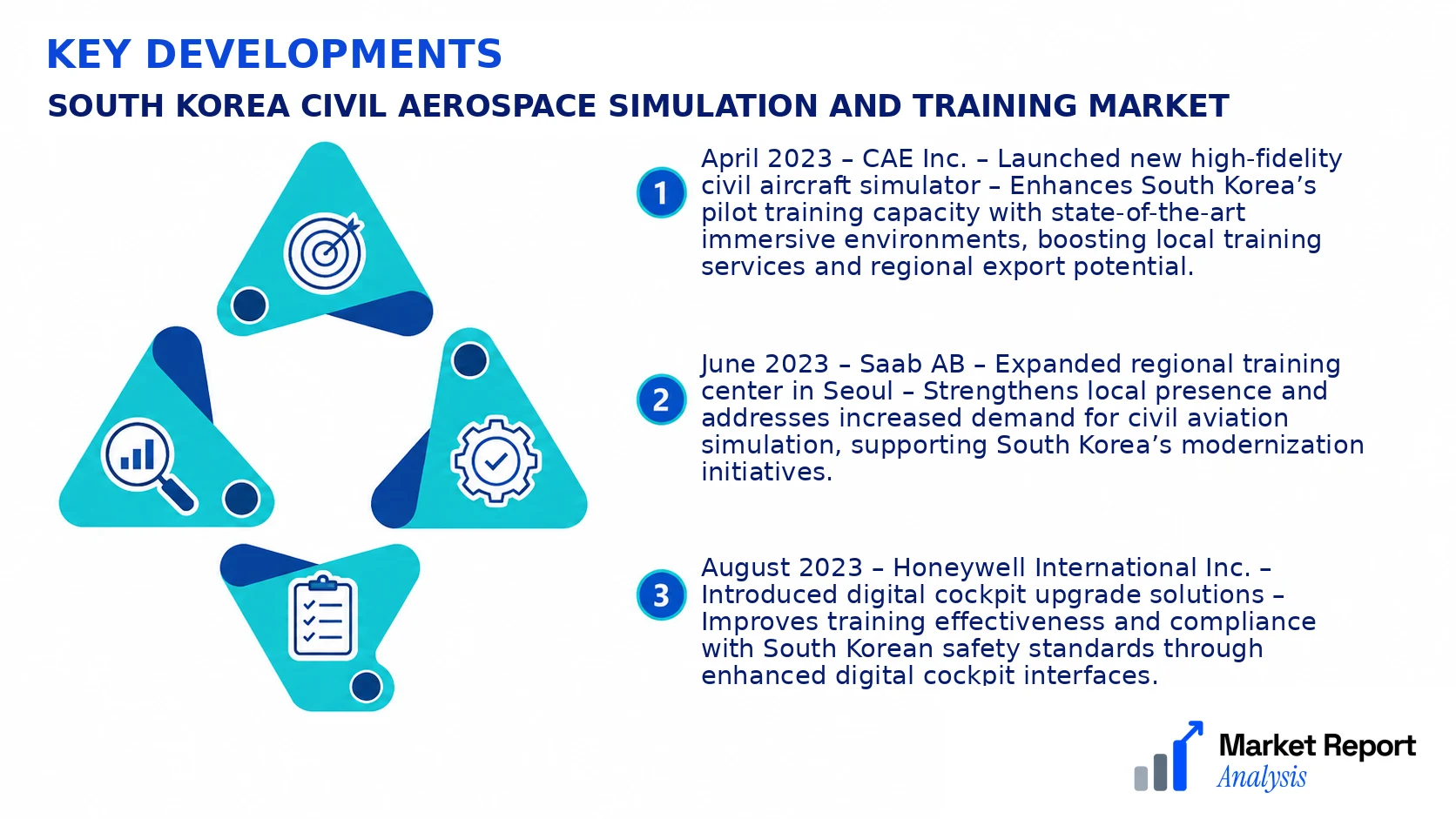
- April 2023 – CAE Inc. – Launched new high-fidelity civil aircraft simulator – Enhances South Korea’s pilot training capacity with state-of-the-art immersive environments, boosting local training services and regional export potential.
- June 2023 – Saab AB – Expanded regional training center in Seoul – Strengthens local presence and addresses increased demand for civil aviation simulation, supporting South Korea’s modernization initiatives.
- August 2023 – Honeywell International Inc. – Introduced digital cockpit upgrade solutions – Improves training effectiveness and compliance with South Korean safety standards through enhanced digital cockpit interfaces.
- January 2024 – Thales Group – Announced a strategic alliance with local education providers – Facilitates development of tailored civil training modules, fostering local talent and technological innovation.
- February 2024 – Lockheed Martin Corporation – Acquired a South Korea-based aviation training startup – Bolsters technological capabilities and accelerates integration of defense-grade simulation technologies into civil training programs.
Frequently Asked Questions
What is the South Korea Civil Aerospace Simulation and Training Market?
The South Korea Civil Aerospace Simulation and Training Market encompasses the development, supply, and utilization of simulation and training equipment for civilian aviation, including aircraft operational training, pilot proficiency, and safety procedures tailored to South Korean civil aviation needs.
What is the current market size of South Korea Civil Aerospace Simulation and Training Market?
As of 2026, the market size is estimated at approximately USD 1.2 Billion. Growth drivers include expanding civil aviation routes, increasing pilot training requirements, and government investments in aerospace infrastructure and safety enhancements across the country.
What factors are driving the South Korea Civil Aerospace Simulation and Training Market?
Key drivers include rising passenger traffic, fleet modernization, development of domestic aerospace industry capabilities, regulatory mandates for simulation-based training, and initiatives to enhance aviation safety standards through advanced training solutions.
Which South Korean city leads the South Korea Civil Aerospace Simulation and Training Market?
Seoul stands as the leading city, benefiting from its position as an aviation hub, presence of major aerospace and defense companies, and proximity to key airports and training institutions, thereby serving as the primary center for simulation and training activities.
Which segment is expected to grow the fastest?
The flight training simulators segment is projected to see the fastest growth, driven by increasing demand for pilot proficiency, regulatory compliance, and technological advancements in virtual reality and motion simulation systems.
Who are the leading companies operating in the South Korea Civil Aerospace Simulation and Training Market?
Prominent players include CAE, L3Harris Technologies, Saab AB, and Samsung Techwin, all of which provide advanced simulation hardware, software solutions, and comprehensive training services tailored to South Korean civil aviation needs.
Analyst Perspective
The South Korea Civil Aerospace Simulation and Training Market is poised for steady long-term growth, driven by advancements in simulation technology and increased demand for pilot training amidst rising aerospace investments. The market's maturity suggests a shift toward more integrated, high-fidelity simulators, which enhance training effectiveness and safety. Commercial opportunities are particularly strong in urban centers like Seoul and Incheon, where proximity to new aerospace hubs encourages immediate adoption of cutting-edge training solutions. Technological evolution is anticipated to focus on virtual reality integration, AI-driven scenarios, and more comprehensive cybersecurity measures, aligning with global innovation trends. Investment priorities should prioritize upgrading existing infrastructure while fostering partnerships between defense, academia, and industry stakeholders. Competitive intensity is expected to heighten as domestic firms expand their capabilities and attract international collaborations. Long-term, Seoul’s strategic positioning as a technological hub offers significant potential for city-level growth, especially in the development of specialized training centers that can capitalize on South Korea’s burgeoning aerospace sector and government support initiatives, making the market resilient and adaptable.
