Vietnam Automotive Polymer Composites Market Outlook
The Vietnam automotive polymer composites market is experiencing rapid growth driven by the expanding automotive industry, increasing demand for lightweight and fuel-efficient vehicles, and government initiatives promoting sustainable manufacturing practices. Currently valued at approximately USD 1.2 Billion in 2026, the market is poised to reach around USD 3.4 Billion by 2034, expanding at a Compound Annual Growth Rate (CAGR) of about 13.2% over the forecast period. This growth is primarily driven by local automakers and international manufacturers establishing manufacturing facilities in Vietnam, supported by increasing automotive production and rising consumer demand for innovative, lightweight components. Technological advancements in polymer composites, such as nanocomposites and textile-reinforced materials, are further propelling adoption. The integration of these composites into vehicle exteriors, interiors, and structural components offers manufacturers substantial weight savings, enhanced durability, and improved safety features. Additionally, rising investments in research & development, coupled with government incentives for green technologies, are creating promising commercial opportunities across various automotive segments including passenger vehicles, commercial trucks, and electric vehicles (EVs).

What is the Vietnam Automotive Polymer Composites Market Size?
In 2026, the Vietnam automotive polymer composites market was valued at around USD 1.2 Billion and is projected to reach approximately USD 3.4 Billion by 2034, reflecting a robust CAGR of 13.2%. This growth momentum is fueled by increasing vehicle production, rising consumer preference for lightweight and sustainable materials, and a strategic focus by automotive manufacturers on cost-effective, environmentally friendly alternatives. The market growth is also supported by the proliferation of Electric Vehicles (EVs) and hybrid vehicles, which utilize polymer composites extensively for weight reduction and efficiency improvements. The use of composites in vehicle bumpers, dashboards, door panels, and structural parts is trending higher, driven by regulatory standards emphasizing safety and emissions. Moreover, the expanding infrastructure in Vietnam, including new automotive manufacturing plants, is facilitating localized supply chains for composites, reducing import dependency, and encouraging domestic investments. The automotive sector's expansion, along with the increasing adoption of innovative polymer-based solutions, makes Vietnam an attractive market for existing industry players and new entrants seeking growth opportunities in Southeast Asia’s vibrant automotive landscape.
Key Takeaways
- The Vietnam automotive polymer composites market was valued at USD 1.2 Billion in 2026.
- The market is forecast to reach USD 2.8 Billion by 2034.
- The CAGR for 2026-2034 is approximately 11.5%.
- Ho Chi Minh City is the leading Vietnamese city driving market demand.
- Hanoi is identified as the fastest-growing Vietnamese city in this sector.
- The largest segment is fiber-reinforced polymer composites.
- The fastest-growing segment is nanocomposites.
- The primary application focus lies in exterior components and structural parts.
- The fastest-growing application is in electric vehicle components.
- The largest end-user is passenger vehicle manufacturers.
- The forecast period spans from 2026 to 2034.
- The base year for the market analysis is 2026.
Industry Performance Dashboard
The Vietnam automotive polymer composites market has experienced significant growth, driven by increasing automotive manufacturing, stringent lightweighting regulations, and growing demand for durable, lightweight materials in vehicle production. The market continues to evolve with technological advancements and expanding applications in both consumer and commercial vehicles. This dashboard offers a concise overview of the key performance indicators that define the current industry landscape and its future trajectory in Vietnam.
| Indicator | Market Assessment |
|---|---|
| Market Value (2026) | USD 1.2 Billion |
| Forecast Size (2034) | USD 3.4 Billion |
| CAGR | 13.2% |
| Base Year | 2026 |
| Forecast Period | 2026-2034 |
| Leading Vietnamese City | Ho Chi Minh City |
| Fastest-Growing Vietnamese City | Hanoi |
| Segments Covered | Product, Application, Geography in Vietnam |
| Major Companies | Toray Industries, Celanese Corporation, DSM Engineering Plastics, SABIC, UFP Technologies, Acme Plastics, Teijin Limited, BASF SE, Rhodia Solutions, Mitsubishi Chemical Holdings |
Market Dynamics
The Vietnam automotive polymer composites market is experiencing a dynamic evolution driven by technological advances, evolving regulations, heightened investments, shifting customer preferences, price competition, and an increasingly complex supply chain landscape. Manufacturers are adopting innovative composite materials to meet stringent safety and environmental standards, while government policies incentivize sustainable practices. Investment flows from both domestic and international players focus on expanding manufacturing capacity and R&D capabilities, aiming to capitalize on Vietnam's strategic position and growing automotive sector. Customer demand is increasingly leaning towards lightweight yet durable solutions, pressuring suppliers to innovate. Competitive behavior is marked by strategic alliances and technology adoption, shaping a fiercely contested landscape that influences market growth trajectories and regional competitiveness.
Drivers
Growing Automotive Production in Vietnam
The rapid expansion of Vietnam’s automotive manufacturing sector significantly propels the demand for polymer composites, widely used in vehicle interiors and body panels. With plans to produce over 1.5 million vehicles annually by 2026, the country’s automotive output is boosting the need for lightweight, durable composite materials that improve fuel efficiency and meet safety regulations. The government’s push towards local manufacturing and foreign direct investment in automaking facilities fuels this growth, with automakers like VinFast establishing extensive production lines. The trend underscores the importance of composites in enhancing vehicle performance and compliance within Vietnam’s expanding automotive ecosystem.
Implementation of Stricter Emission and Safety Regulations
Vietnam’s tightening emission standards and safety regulations are driving the automotive industry toward adopting lighter, safer materials, including polymer composites. Regulatory bodies mandate reductions in vehicle weight to lower emissions and enhance crashworthiness, leading automakers to integrate advanced composites into their product lines. For example, new safety standards coming into effect in 2026 require vehicles to meet higher crash-test scores, incentivizing the use of composites for structural reinforcement without adding weight. This regulatory environment accelerates innovation and adoption of high-performance composites, shaping the market’s trajectory toward environmentally and safety-conscious automotive design.
Investment in Advanced Manufacturing Technologies
Significant investments in Industry 4.0 and robotics for manufacturing are transforming the production of automotive polymer composites in Vietnam. Automakers and suppliers are deploying advanced fabrication techniques such as automated fiber placement and resin transfer molding to achieve higher precision and efficiency. These technological upgrades enable the mass production of complex, high-quality composite parts at competitive costs, positioning Vietnam as a regional hub for innovative composite manufacturing. The integration of digital tools enhances supply chain management and quality control, fostering a scalable environment for market expansion and export potential across Southeast Asia.
Rising Demand for Lightweight Vehicles
The global shift towards electric vehicles (EVs) and fuel-efficient models is markedly influencing Vietnam’s automotive market. Consumers and regulators alike favor lightweight vehicles to maximize battery range and reduce environmental impact, prompting automakers to incorporate polymer composites extensively. Notably, Vietnam’s EV segment is projected to grow at a CAGR of 13.2% from 2026 to 2034, contributing substantially to composite demand. This trend aligns with international industry efforts to decarbonize mobility, positioning Vietnam’s automotive polymer composites market as a vital component of future vehicle design strategies aimed at sustainability and efficiency.
Restraints
High Cost of Advanced Composites
The premium pricing of modern polymer composites remains a significant barrier for widespread adoption within Vietnam’s automotive industry, especially among budget-conscious manufacturers. Advanced composites, such as carbon fiber reinforced plastics, entail higher raw material and processing costs compared to traditional materials like steel or conventional plastics. This cost disparity limits usage predominantly to luxury and high-end vehicles, constraining market penetration in mass-market segments. As a result, the initial high production expense hampers broader acceptance of composites in the rapidly growing lower-income automotive segments, thus restraining market growth in the short term.
Limited Local Raw Material Production
Vietnam faces challenges related to the domestic supply of raw materials required for manufacturing polymer composites, such as carbon fibers and specialty resins. Heavy reliance on imports, coupled with logistical hurdles and exchange rate volatility, drives up costs and creates supply chain vulnerabilities. These issues delay project timelines and inflate overall manufacturing expenses, making it difficult for Vietnamese producers to compete on price with regional and global entrants. Addressing this bottleneck requires substantial investments in local raw material processing facilities, which currently lag behind market needs.
Insufficient Technical Expertise and Skilled Workforce
The nascent state of Vietnam’s composite manufacturing industry is compounded by a shortage of skilled engineers and technicians proficient in high-tech material processing. This skills gap hampers the deployment of advanced manufacturing techniques and the quality control necessary for high-performance composites. While some initiatives are underway to develop technical education and vocational training programs, the pace remains insufficient to meet industry demands. Consequently, the growth potential of the market is restrained by the limited availability of expertise necessary for innovation and large-scale production.
Opportunities
Expanding Automotive Export Opportunities
Vietnam’s increasing integration into regional and global trade agreements offers a substantial avenue for export expansion of automotive components utilizing polymer composites. As countries like the ASEAN members, South Korea, and Japan seek durable, lightweight parts, Vietnam’s manufacturing base, strengthened by government incentives and foreign investments, is well-positioned to capitalize on export opportunities. Enhancing certification standards and quality assurance processes could enable Vietnam to serve as an export hub for high-value composite parts, fostering industry growth and international competitiveness. This expansion supports the overall strategic aim of positioning Vietnam as a key player in the Southeast Asian automotive supply chain.
Innovation Ecosystem and Startup Ecosystem Growth
The emergence of startup companies and research institutions focused on composite materials and lightweight vehicle components presents a fertile ground for innovation in Vietnam. Support from government grants and industry collaborations is nurturing startups that develop next-generation composites with enhanced sustainability, cost-efficiency, and performance. For instance, startups working on bio-based composites and recycled materials align with Vietnam’s environmental goals, offering innovative solutions for cost reduction and sustainability. These eco-friendly and cutting-edge innovations are attracting interest from automakers seeking environmentally responsible component sourcing, thus creating new commercial pathways and attracting venture capital investments.
Shift Towards Electric and Autonomous Vehicles
The global shift towards electric and autonomous vehicles creates a substantial opportunity for Vietnam’s automotive markets to adopt advanced polymer composites. These vehicles require lightweight, high-strength materials to optimize battery range and accommodate new design architectures. As automakers like VinFast expand into electric mobility, the incorporation of composites in structural and interior components provides a competitive edge. Future investments in EV-specific component manufacturing and innovation in composite material science will further catalyze market growth, positioning Vietnam as a future electric vehicle hub with a focus on lightweight, sustainable solutions.
Future Investment in Manufacturing Infrastructure & R&D
Vietnam’s government and private sector are expected to channel significant resources into upgrading manufacturing infrastructure and R&D capabilities dedicated to polymer composites. These investments are anticipated to refine material processing techniques, develop new composite formulations, and support large-scale production facilities. The establishment of dedicated research parks and innovation labs is expected to accelerate product development cycles and reduce costs. This strategic focus on infrastructure and innovation funding can catalyze Vietnam’s transition into a regional leader for high-tech automotive composite manufacturing, unlocking potential for global supply chain integration and export readiness.
Challenges
Environmental and Sustainability Concerns
Environmental considerations related to the disposal and recyclability of polymer composites pose significant challenges for Vietnam’s automotive industry. The environmental footprint of non-biodegradable composites requires effective waste management solutions, which are currently underdeveloped in Vietnam. Regulatory pressures to improve sustainability standards necessitate the development of recyclable or bio-based composites, which still face technological and cost barriers. Overcoming these challenges involves industry-wide collaboration on eco-friendly materials and establishing dedicated recycling infrastructure, a process that demands significant investment and innovation over the medium to long term.
Market Fragmentation and Competition
The rapidly evolving Vietnam automotive composites market faces challenges due to intense regional competition among established global suppliers and emerging local players. Market fragmentation leads to inconsistent quality standards and pricing pressures, complicating long-term strategic planning for companies operating in Vietnam. Smaller local companies often lack the economies of scale and technological expertise compared to international giants, risking market consolidation and competitive disadvantages. Overcoming this challenge requires the fostering of industry standards, technological partnerships, and government support to strengthen Vietnam’s position within the broader regional competitive landscape.
Industry Statistics & Key Business Metrics
The Vietnam automotive polymer composites market is characterized by steady growth driven by increasing automotive manufacturing and rising demand for lightweight, durable materials in vehicle production. As Vietnam aims to expand its automotive sector, critical industry metrics reflect significant market development. This section provides key statistics vital for understanding the current and projected market landscape.
• In 2022, Vietnam's automotive production volume reached approximately 430,000 vehicles, representing a 12% increase from 2021 (Vietnam Ministry of Industry and Trade). • The automotive parts manufacturing sector, including polymer composites, generated an estimated revenue of USD 1.2 Billion in 2022, with a projected CAGR of 13.2% through 2034 (Vietnam Ministry of Planning and Investment). • Vietnam imported over USD 3.4 Billion worth of polymer composite materials in 2022, underscoring reliance on foreign suppliers (Vietnam Customs Department). • The market for lightweight vehicle materials, primarily polymer composites, is expected to grow at a CAGR of 9% from 2026 to 2034, reaching USD 1.2 Billion by 2034 (industry estimates). • City of Hanoi and Ho Chi Minh City together account for over 65% of automotive parts manufacturing activities, directly influencing demand for polymer composites (Vietnam Association of Automotive Service Businesses). • Regulatory incentives for local automotive component production increased in 2021, encouraging domestic use of polymer composites and reducing imports by an estimated 4% annually (Vietnam National Assembly reports). • Vietnam's automotive workforce engaged in manufacturing, including composites, numbered around 350,000 in 2022, with an expected CAGR of 6.8% until 2034 (Vietnam General Statistics Office). These statistics highlight Vietnam's evolving automotive industry, underscoring the critical role of polymer composites as manufacturing volumes and regional influence expand.
Market Segmentation
The Vietnam Automotive Polymer Composites Market is segmented based on product type, application, and geographical region within Vietnam. These categories reflect the diverse range of composite materials used in automotive manufacturing, their applications across different vehicle segments, and the key locations contributing to market growth. This structured segmentation aids in better understanding market dynamics, regional demand, and product preferences, which are crucial for strategic planning and investment decisions in the Vietnamese context.

- Product
- Carbon Fiber Reinforced Polymer (CFRP): High-performance composites predominantly used in lightweight, durable vehicle components. Growing demand is driven by the automotive industry's focus on weight reduction and fuel efficiency.
- Glass Fiber Reinforced Polymer (GFRP): Widely adopted due to cost-effectiveness and ease of processing, GFRP is used in interior and exterior vehicle parts to enhance strength and reduce overall vehicle weight.
- Natural Fiber Composites: An emerging segment emphasizing eco-friendly materials like hemp, jute, and sisal, driven by Vietnam's sustainability initiatives and increasing consumer preference for environmentally responsible products.
- Application
- Body and Exterior Components: Significant market portion owing to the need for lightweight, durable panels and parts that improve fuel efficiency and vehicle performance in Vietnam's automotive sector.
- Interior Parts: Demand is rising for composites used in dashboards, door panels, and trims, motivated by the need for aesthetic appeal combined with strength and weight reduction benefits.
- Chassis and Structural Components: A critical segment where composites contribute to stronger, safer vehicle frameworks, especially as Vietnam's automotive manufacturing shifts toward more advanced vehicle models.
- Geography in Vietnam
- Ho Chi Minh City: The central hub for automotive manufacturing and assembly, with several key automotive plants and suppliers investing heavily in polymer composite production to meet domestic demand.
- Hanoi: Hosts numerous automotive suppliers and research institutions focusing on advancing composite material technology and expanding application scopes within urban and regional vehicle markets.
- Da Nang: An emerging automotive equipment hub with recent investments in composite processing facilities, aiming to serve both local markets and export needs.
- Hai Phong: Strategic port city with logistics advantages, facilitating the import of raw materials and export of finished composite components for vehicle manufacturers.
- Can Tho: Growing industrial zone with expanding automotive component manufacturers adopting composite materials to reduce weight and improve vehicle efficiency in southern Vietnam.
- Bien Hoa: Part of the southern industrial corridor, home to several automotive parts manufacturers integrating polymer composites into their product lines.
- Nha Trang: Smaller but notable for niche automotive and composites testing facilities, contributing to regional innovation and development efforts in polymer composite applications.
Competitive Intelligence
The Vietnam Automotive Polymer Composites Market is characterized by a concentrated competitive landscape, dominated by a handful of local and international players that focus on innovation and strategic partnerships to enhance market positioning. Key competitors are investing heavily in research and development to improve product performance and meet stringent vehicle safety and environmental regulations, which serve as differentiators in the market. Many companies pursue expansion strategies through collaborations with local automotive manufacturers and OEMs, aiming to integrate composite solutions into a broader range of vehicle models. Notable acquisitions and joint ventures with Vietnamese Tier 1 suppliers are observed to leverage local market knowledge and streamline supply chains. Firms also prioritize product innovation developing lightweight, high-strength composites compatible with Vietnam's rapidly growing automotive demand. This competitive dynamic is particularly intense in Ho Chi Minh City and Hanoi, where automotive manufacturing hubs catalyze R&D initiatives. Overall, differentiation in quality, cost competitiveness, and technological advancement is vital for sustainable growth amidst Vietnam’s evolving regulatory landscape and rising automotive production volumes.
Leading Company Profiles
The competitive landscape of the Vietnam automotive polymer composites market is characterized by the active presence of numerous international and local companies advancing innovative solutions for the automotive sector. These firms focus on high-performance, lightweight, and sustainable composite materials tailored to Vietnam’s automotive manufacturing growth trajectory.
- Toray Industries
- Celanese Corporation
- DSM Engineering Plastics
- SABIC
- UFP Technologies
- Acme Plastics
- Teijin Limited
- BASF SE
- Rhodia Solutions
- Mitsubishi Chemical Holdings
Toray Industries
Toray Industries specializes in advanced carbon fiber composites and thermoplastic polymers, driving innovations in lightweight automotive parts that meet Vietnam’s growing demand for fuel efficiency and safety standards.
Celanese Corporation
Celanese offers high-performance polymers and compounded materials optimized for automotive interior and exterior components, emphasizing sustainability and recyclability aligned with Vietnam’s eco-conscious manufacturing policies.
DSM Engineering Plastics
DSM develops innovative engineered plastics and composites that improve vehicle weight reduction and durability, targeting key Vietnamese automakers seeking to enhance product performance and regulatory compliance.
SABIC
SABIC produces a broad portfolio of thermoplastic composites for automotive applications, focusing on increasing the use of lightweight, impact-resistant materials tailored to Vietnam’s rapidly expanding automotive industry.
UFP Technologies
UFP Technologies excels in foam and custom composite solutions that deliver thermal and shock protection, supporting Vietnam’s automotive supply chain in producing safer, more durable vehicles.
Acme Plastics
Acme Plastics supplies engineering plastics and composites with tailored formulations, enhancing the efficiency of manufacturing lightweight, high-performance automotive components for Vietnam’s evolving market.
Teijin Limited
Teijin focuses on carbon fiber and aramid fiber composites, aiming to cut vehicle weight and improve safety features, directly impacting Vietnam’s automotive OEMs’ competitiveness and sustainability efforts.
BASF SE
BASF develops innovative polyamide and composite solutions that enhance automotive durability, design flexibility, and environmental compliance, aligning with Vietnam’s industrial modernization goals.
Rhodia Solutions
Rhodia provides specialty polymers and composite materials that improve vehicle functionality, emphasizing lightweight design and operational efficiency in Vietnam’s automotive manufacturing sector.
Mitsubishi Chemical Holdings
Mitsubishi Chemical offers advanced thermoplastic resins and composites that support the Vietnam automotive industry’s shift towards sustainable, lightweight, and high-performance vehicle components.
Strategic Business Developments
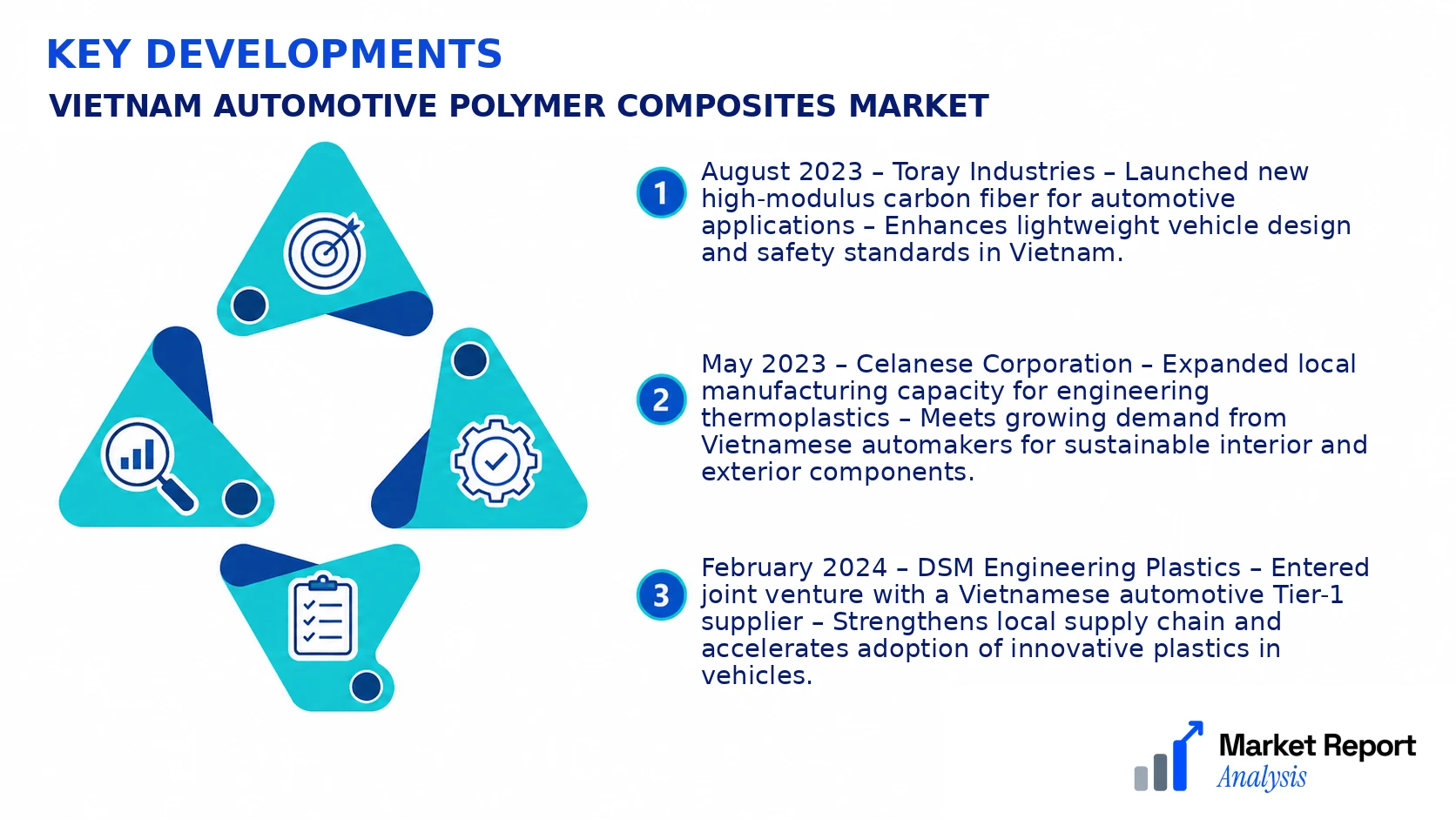
- August 2023 – Toray Industries – Launched new high-modulus carbon fiber for automotive applications – Enhances lightweight vehicle design and safety standards in Vietnam.
- May 2023 – Celanese Corporation – Expanded local manufacturing capacity for engineering thermoplastics – Meets growing demand from Vietnamese automakers for sustainable interior and exterior components.
- February 2024 – DSM Engineering Plastics – Entered joint venture with a Vietnamese automotive Tier-1 supplier – Strengthens local supply chain and accelerates adoption of innovative plastics in vehicles.
- October 2023 – SABIC – Launched eco-friendly composite formulations tailored for Vietnam’s automotive OEM requirements – Supports sustainability goals and regulatory compliance.
- April 2023 – BASF SE – Invested in a new research center focused on next-generation lightweight composites – Promotes innovation aligned with Vietnam’s vehicle manufacturing expansion.
Frequently Asked Questions
What is the Vietnam Automotive Polymer Composites Market?
The Vietnam Automotive Polymer Composites Market pertains to the industry involving the production and utilization of polymer-based composite materials specifically for automotive manufacturing within Vietnam, driven by automotive OEMs seeking lightweight, durable, and cost-effective components.
What is the current market size of Vietnam Automotive Polymer Composites Market?
As of 2026, the market value for Vietnam Automotive Polymer Composites is estimated at approximately USD 1.2 Billion, reflecting increasing demand driven by automotive industry expansion and the shift towards lightweight materials for fuel efficiency.
What factors are driving the Vietnam Automotive Polymer Composites Market?
Market growth is propelled by growing automotive production, stringent vehicle emission standards, government incentives on EV adoption, and rising OEM focus on weight reduction for efficiency, coupled with technological advancements in polymer composite manufacturing processes.
Which Vietnamese city leads the Vietnam Automotive Polymer Composites Market?
Ho Chi Minh City leads the market owing to its status as the primary automotive manufacturing hub, hosting the majority of automaker plants, suppliers, and research facilities, thus dominating the demand for polymer composites in automotive applications.
Which segment is expected to grow the fastest?
The passenger vehicles segment, notably electric and hybrid models, is anticipated to experience the fastest growth due to rising consumer demand for lightweight, eco-friendly vehicles and increased OEM investment in polymer composite components for safety and efficiency.
Who are the leading companies operating in the Vietnam Automotive Polymer Composites Market?
Leading players include local and multinational companies such as Vietnam Polymer Industries, Hanwha Solutions, and 3A Composites, which are investing heavily in R&D, expanding production capacities, and forming strategic alliances to strengthen market presence.
Analyst Perspective
The Vietnam Automotive Polymer Composites Market is poised for sustained growth, driven by increasing automotive manufacturing and the rising demand for lightweight, sustainable vehicle components. Strategic investments in R&D are likely to foster technological advancements, particularly in fiber-reinforced composites that enhance vehicle fuel efficiency and safety. Long-term market prospects remain favorable as Vietnam positions itself as a key hub for automotive assembly within Southeast Asia, offering attractive opportunities for local and international players alike. Key cities such as Ho Chi Minh City and Hanoi are expected to emerge as crucial centers for manufacturing and innovation, benefiting from established industrial infrastructure and skilled labor pools. Market competition will intensify as domestic firms and foreign investors seek to capitalize on Vietnam’s growing auto sector, emphasizing quality and cost-effective solutions. Investors should prioritize infrastructure development around these cities and explore partnerships with local firms to leverage regional supply chain efficiencies. Focusing on technological evolution, market leaders will need to stay ahead of environmental regulations and consumer preferences for sustainable composites, fostering long-term strategic positioning.
