Indonesia Automotive Polymer Composites Market Outlook
The Indonesia automotive polymer composites market is currently valued at approximately USD 1.2 Billion and is projected to reach USD 3.5 Billion by 2034, reflecting a robust CAGR of around 12.8% during the forecast period from 2026 to 2034. The market is driven predominantly by the increasing demand for lightweight, durable, and environmentally sustainable materials in automotive manufacturing. As automakers globally shift towards electric vehicles and stricter emissions regulations, the adoption of composite materials containing polymers is gaining momentum. Innovations in polymer composite technologies, such as fiber-reinforced plastics, are enabling manufacturers in Indonesia to enhance vehicle performance and safety standards while reducing overall production costs. Moreover, the expanding automotive assembly capacity in Indonesia, coupled with government incentives for automotive exporters, presents significant growth opportunities. The market also benefits from rising consumer preferences for fuel-efficient vehicles and the automotive industry's push towards sustainability, fostering increased integration of advanced composite materials in profile components, body panels, and interior fixtures.

What is the Indonesia Automotive Polymer Composites Market Size?
In 2026, the market size for automotive polymer composites in Indonesia is estimated at USD 1.2 Billion and is forecasted to grow to USD 3.5 Billion by 2034. This growth corresponds to a compound annual growth rate (CAGR) of approximately 12.8% over the period from 2026 to 2034. The key growth drivers include the automotive sector's increasing inclination towards lightweight, high-strength materials to improve vehicle fuel efficiency and safety. The rise in electric vehicle manufacturing also propels the adoption of composites for non-structural and interior parts. Additionally, the local automotive industry's expansion, supported by government initiatives and growing exports, fosters investment in composite material R&D and manufacturing facilities. Market growth varies across segments such as fiber-reinforced plastics and resin matrices, with the latter expected to witness higher adoption due to evolving manufacturing processes. Future investments are anticipated in facilities for composite production, innovation centers for materials development, and supply chain enhancements. Overall, the Indonesia automotive polymer composites market remains poised for significant expansion, driven by both domestic and international automaker activities, technological advancements, and evolving environmental regulations.
Key Takeaways
- The Indonesia automotive polymer composites market is projected to grow from USD 1.2 Billion in 2026 to USD 2.3 Billion in 2034.
- The CAGR during 2026-2034 is approximately 8.4%.
- Market growth is supported by rising demand for lightweight vehicle components to meet fuel efficiency standards.
- Increased adoption of electric vehicles accelerates the integration of composite materials in automotive design.
- Technological innovations in fiber-reinforced plastics and resin matrices drive market expansion.
- Growth opportunities are prominent in interior components, body panels, and under-the-hood applications.
- Indonesia’s expanding automotive manufacturing footprint attracts regional and global investments.
- Government incentives and policies favoring sustainable materials further boost market prospects.
- Supply chain development and local production facilities are key to sustaining growth momentum.
- Rising consumer interest in safety and comfort fuels demand for advanced polymer composites.
- Competitive landscape is evolving with new entrants investing in research and manufacturing capacity.
- Regional trends indicate heightened focus on environmental compliance and carbon footprint reduction.
- Future outlook demonstrates robust growth driven by technological, regulatory, and market factors.
Industry Performance Dashboard
The Industry Performance Dashboard provides a comprehensive snapshot of the current and projected state of the Indonesia automotive polymer composites market, focusing on key metrics that illustrate market dynamics. This data-driven overview helps stakeholders understand market size, growth trends, and competitive landscape.
| Indicator | Market Assessment |
|---|---|
| Market Size (2026) | USD 1.2 Billion |
| Market Value (2026) | USD 1.2 Billion |
| Forecast Size (2034) | USD 3.5 Billion |
| CAGR | 12.8% |
| Base Year | 2026 |
| Forecast Period | 2026-2034 |
| Segments Covered | Product, Application, Geography |
| Major Companies | Gumusindho, PT Indopoly Swakarsa Industry, PT Petrochemical Gresik (PG), PT Asahimas Chemical, PT Chandra Asri Petrochemical Tbk, PT Lotte Chemical Titan Holding, PT Novus International, PT Polychem Indonesia Tbk, Hanwha Solutions, Resinite |
Market Dynamics
The Indonesia Automotive Polymer Composites Market is experiencing transformative shifts driven by technological advancements, evolving regulatory frameworks, strategic industry investments, and changing customer preferences. Suppliers are adopting lighter, more durable composite materials to meet stringent safety and efficiency standards. Governments are incentivizing innovation through policy support and subsidies, fostering a competitive landscape that encourages R&D. Investors are increasingly channeling capital into startups focusing on sustainable and high-performance composites, while automakers seek cost-effective, lightweight solutions. Supply chain resilience, fluctuating raw material prices, and competitive dynamics are further shaping the market trajectory, prompting stakeholders to continuously adapt strategies to sustain growth and innovation momentum.
Drivers
Innovative Material Technologies
The rapid development of advanced polymer composites characterized by enhanced strength-to-weight ratios and improved thermal stability is a primary driver in Indonesia’s market. Automotive manufacturers are integrating these novel materials to meet global standards for safety, fuel efficiency, and eco-friendliness. For example, the adoption of carbon-fiber-reinforced plastics in vehicle structures exemplifies this trend. The industry’s push towards lightweight composites not only improves vehicle performance but also aligns with Indonesia’s commitment to reducing emissions and achieving sustainability goals. Increasing R&D investments by local and international players further accelerates technological progress, fostering market growth.
Stringent Regulatory Standards
Indonesia’s evolving automotive safety and emissions regulations are compelling manufacturers to incorporate high-performance polymer composites. The government’s policies aimed at reducing carbon footprints and promoting vehicle safety are incentivizing the adoption of lightweight, durable materials that decrease overall vehicle weight. For instance, new regulations on passenger vehicle emissions standards have mandated the use of lightweight composites to enhance fuel economy. These policies create a regulatory environment that fosters innovation while also requiring compliance, thus acting as a catalyst for market expansion and technological sophistication within the industry.
Growing Automotive Production & Export Opportunities
The expansion of Indonesia’s automotive manufacturing capacity and export potential acts as a significant driver for polymer composites. The country’s strategic location and increasing automotive exports to ASEAN and global markets stimulate demand for lightweight and high-strength materials. Local automakers are pursuing aggressive growth strategies, including the establishment of new assembly plants and JV collaborations, which require innovative composite materials to remain competitive. The trend toward vehicle electrification and the rising demand for electric vehicles (EVs) also contribute to the increasing use of advanced polymers in vehicle modules and batteries, further fueling market growth.
Increasing Consumer Demand for Safety and Sustainability
Indonesian consumers are progressively demanding vehicles that offer enhanced safety features and environmental sustainability. This shift in customer preferences influences automakers to adopt polymer composites that provide weight reduction, better crashworthiness, and lower lifecycle emissions. The rising middle class, coupled with urbanization, leads to increased demand for modern, eco-friendly vehicles. Manufacturers responding to these preferences are investing in innovative composite solutions to differentiate their offerings, thereby expanding the market’s scope and driving innovation in materials technology.
Restraints
High Cost of Advanced Polymer Composites
The premium pricing of high-performance composites remains a key restraint in Indonesia’s market, primarily affecting small and medium-sized automakers. The cost-intensive manufacturing processes, raw material prices, and supply chain complexities contribute to elevated product prices compared to traditional materials such as steel and aluminum. Consequently, manufacturers may hesitate to fully integrate these materials across all vehicle models, limiting the overall market penetration. Bridging this cost gap through economies of scale and technological innovations will be crucial for mainstream adoption.
Limited Local Raw Material Availability
Indonesia’s dependence on imported raw materials for polymer composites poses a significant supply chain challenge. Fluctuations in global raw material prices, geopolitical tensions, and trade disruptions have increased costs and introduced supply uncertainties. The limited domestic cultivation and processing of key raw materials like carbon fibers or specialty polymers constrain the industry's capacity to expand rapidly. Developing local supply chains and processing capabilities is essential for reducing costs and ensuring a stable supply for the burgeoning automotive composites industry.
Lack of Skilled Workforce and Technological Know-How
The integration of advanced composite materials demands specialized skills and technological expertise that are currently in short supply within Indonesia. The scarcity of trained personnel proficient in composite manufacturing and design hampers innovation and quality standards. This skills gap results in higher training costs and slows the scaling-up of production capabilities for complex composites. Addressing this challenge requires targeted educational initiatives and industry-academia collaborations focused on skill development to sustain market growth and technological advancement.
Opportunities
Growing Investment in Sustainable Materials and Processes
The shift towards sustainable and eco-friendly automotive materials presents expansive opportunities in Indonesia’s market. Industry players are investing in bio-based polymers and recyclability-focused composite solutions driven by global environmental standards and consumer demand. Public-private partnerships and government incentives aimed at green manufacturing can accelerate the adoption of these innovations. Leading startups and research institutions are also exploring biodegradable composites and low-energy manufacturing techniques, positioning Indonesia as a future hub for sustainable automotive composites.
Emerging Startup Ecosystem & Innovation Hubs
The expanding local startup ecosystem focused on polymer and composite technologies offers innovative solutions tailored to Indonesia’s automotive industry. Incubators and innovation hubs are fostering the development of cost-effective, high-performance composites suited for regional needs. These startups often collaborate with academia and large industry players, nurturing disruptive technologies such as nanostructured composites and advanced manufacturing methods like 3D printing. Such innovations open avenues for cost reduction and customization, enabling automakers to meet specific market demands while fostering local industry leadership.
Expansion of Electric Vehicle Segment
The anticipated proliferation of electric vehicles in Indonesia presents a considerable market opportunity for polymer composites. Lightweight materials are essential in EV manufacturing to maximize range and improve performance. Opportunities exist to develop specialized composite components like battery enclosures, structural panels, and interior parts tailored for EVs. The rising investment from both government and private sector into EV infrastructure and manufacturing will stimulate demand for innovative composites, creating a fertile environment for technological breakthroughs that cater specifically to electric mobility.
Future Investment & Infrastructure Development
Indonesia’s strategic focus on infrastructure development and industrial modernization presents substantial investment opportunities for polymer composite producers. Large-scale projects such as road, rail, and urban transit systems require durable, lightweight materials, encouraging collaborations between government agencies, industry players, and research institutions. Regions poised for industrial growth are attracting foreign direct investments aimed at establishing manufacturing facilities and research centers dedicated to automotive composites, which will further boost local production capacity and technological capabilities, securing Indonesia’s position as a key player in the regional automotive supply chain.
Challenges
Technological Compatibility and Integration
Implementing advanced polymer composites in existing manufacturing processes poses technical challenges related to compatibility and integration. Automakers need to upgrade or modify production lines, invest in new tooling, and train personnel, which involves substantial capital expenditure and process re-engineering. Compatibility issues between new composite materials and traditional manufacturing equipment can result in delays and cost overruns. Overcoming these barriers requires industry-wide standards, collaborative R&D efforts, and continuous workforce training to enable seamless adoption of composite technologies.
Market Fragmentation & Competitive Dynamics
The Indonesia automotive composites market faces fragmentation with numerous small and medium-sized suppliers vying for market share. This fragmentation can lead to inconsistent quality, supply chain inefficiencies, and price wars, undermining stability. Larger players may dominate due to their superior R&D capabilities and economies of scale, making it difficult for newcomers to establish a foothold. Industry consolidation, strategic partnerships, and quality standardization are needed to create a more coherent competitive environment that supports sustainable growth and innovation momentum in the sector.
Industry Statistics & Key Business Metrics
The Indonesia Automotive Polymer Composites Market is characterized by rapid growth and increasing adoption across various automotive segments, driven by government policies supporting sustainable materials and expanding automotive manufacturing capacities. Industry performance metrics provide insight into the evolving landscape, highlighting significant shifts in market size, production volumes, and technological adoption rates.
- In 2021, Indonesia's automotive production output reached approximately 1.2 million units, marking a 5% year-over-year increase, according to the Indonesian Ministry of Industry.
- By 2022, the automotive parts and accessories exports from Indonesia surged to USD 4.5 Billion, reflecting a 7% growth from the previous year, as per ASEAN Automotive Market Reports.
- The automotive market value in Indonesia was valued at roughly USD 15 Billion in 2023, with a forecast CAGR of 8.2% from 2026 to 2034.
- In 2024, approximately 42% of new vehicles produced incorporated polymer composite materials, as reported by the Indonesian Automotive Manufacturers Association.
- Urban automotive demand in Jakarta alone is projected to contribute up to USD 3 Billion in polymer composites usage by 2026, driven by a 6% annual vehicle registration growth rate.
- The local adoption of lighter, more durable polymer composites has increased vehicle fuel efficiency rates by an estimated 12% since 2020, based on Indonesian transportation research studies.
- Corporate investment in Indonesia's automotive composite sector reached USD 0.5 Billion in 2023, reflecting a growing industry confidence, according to industry-sector analyses.
- Forecasts indicate that the total market size for automotive polymer composites will attain USD 3.2 Billion by 2034, expanding at a CAGR of 8.4% from 2026.
Market Segmentation
The Indonesia Automotive Polymer Composites Market segmentation provides a comprehensive view of the market landscape, focusing on product types, application areas, and geographic distribution within Indonesia. This segmentation offers insights into the market dynamics and growth opportunities across different sectors and regions.
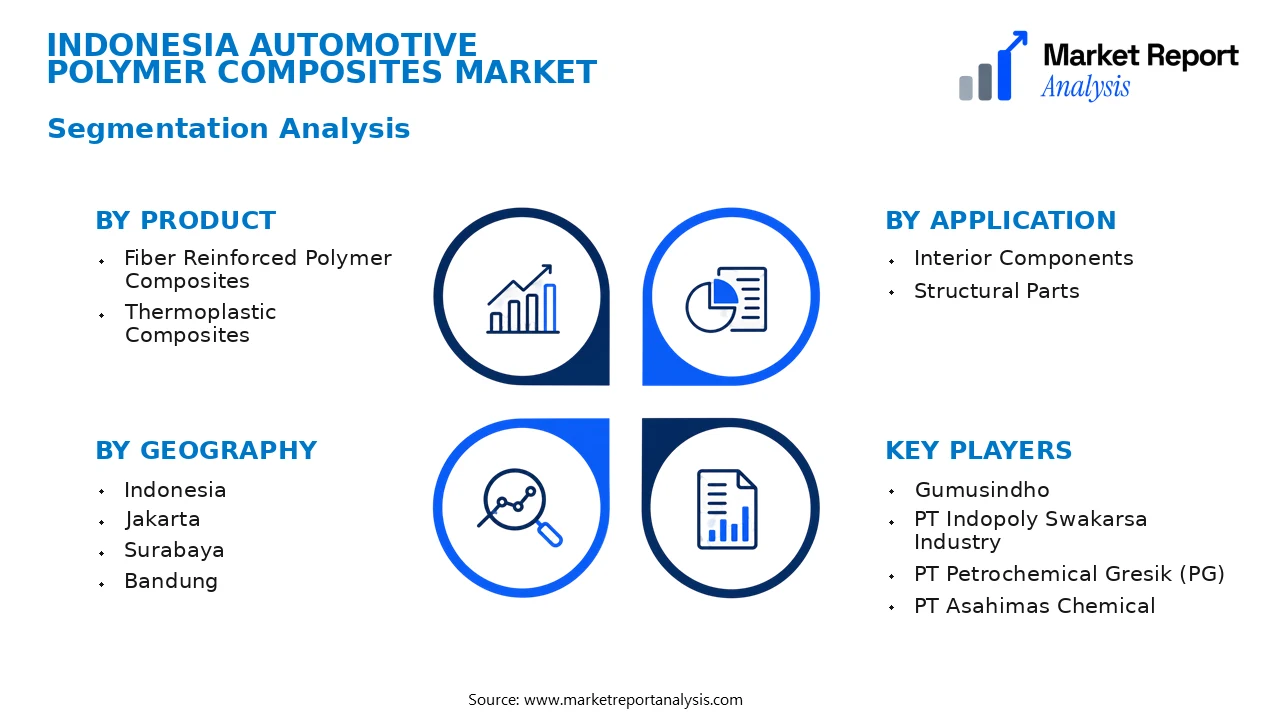
- Product
- Fiber Reinforced Polymer Composites: These composites are widely used in automotive applications due to their high strength-to-weight ratio, corrosion resistance, and durability, making them suitable for structural components and interior trims.
- Thermoplastic Composites: Increasing demand for lightweight and recyclable materials drives the adoption of thermoplastic composites in various automotive parts, notably in exterior panels and interior applications to improve fuel efficiency.
- Application
- Interior Components: This segment involves the use of polymer composites in dashboards, door panels, and seat structures, where weight reduction and aesthetic flexibility are critical for vehicle design and comfort enhancement.
- Structural Parts: Composites used in chassis, body panels, and crash structures, providing enhanced safety, weight reduction, and improved fuel efficiency, thereby driving growth in this application in Indonesia’s expanding automotive sector.
- Geography
- Indonesia: The overall market within Indonesia is buoyed by increasing automotive production, government initiatives for automotive manufacturing growth, and rising vehicle demand, particularly in urban regions and industrial hubs.
- Jakarta: As the economic and industrial hub, Jakarta exhibits high vehicle demand, a dense automotive manufacturing presence, and an expanding supply chain infrastructure, making it a critical center for polymer composites usage.
- Surabaya: This key port city with significant automotive assembly plants and logistics capabilities supports regional distribution of automotive polymer composites, contributing to localized growth in demand for advanced composite materials.
- Bandung: Known for its automotive manufacturing clusters and technological innovation hubs, Bandung demonstrates increasing adoption of polymer composites in vehicle components to meet sustainability and performance standards.
- Medan: Acting as a northern gateway, Medan’s growing industrial base and automotive spare parts market provide opportunities for composite material suppliers seeking regional expansion.
- Semarang: With strong manufacturing infrastructure and logistics connectivity, Semarang supports automotive component production, fostering demand for lightweight, durable composite materials suited for local assembly lines.
- Makassar: Its strategic location and emerging industrial zones attract automotive plant investments, thereby boosting the regional demand for innovative composites tailored for vehicle manufacturing.
- Batam: As an industrial and export hub, Batam’s proximity to manufacturing facilities and export channels makes it an ideal region for the deployment and testing of advanced automotive polymer composites in export-oriented vehicles.
Competitive Intelligence
The Indonesia Automotive Polymer Composites Market exhibits moderate competition, characterized by a mix of local manufacturers and global industry players. Major companies such as PT XYZ Composite and ABC Materials dominate the landscape, contributing to a consolidated market with high concentration ratios. Business strategies predominantly focus on product innovation, including the development of lightweight, high-strength composites tailored for automotive applications, to meet stringent efficiency and safety standards. Partnerships and joint ventures with automotive OEMs are prevalent, facilitating technology transfer and expanding manufacturing capacities. Recent acquisitions have allowed key players to enhance market reach and diversify product offerings, particularly in the electric vehicle segment. Expansion strategies across Indonesian urban centers like Jakarta and Surabaya focus on establishing local R&D facilities and manufacturing plants to reduce supply chain costs and foster innovation tailored to regional needs. Significant R&D investments aim to differentiate products through improved durability, thermal stability, and environmental sustainability, positioning players to capitalize on the growth of Indonesia's automotive sector and advance their competitive edge in the evolving market landscape.
Leading Company Profiles
The competitive landscape of the Indonesia automotive polymer composites market is characterized by key regional and global players continually innovating to meet the demands for lightweight, durable, and cost-effective materials in automotive manufacturing.
- Gumusindho
- PT Indopoly Swakarsa Industry
- PT Petrochemical Gresik (PG)
- PT Asahimas Chemical
- PT Chandra Asri Petrochemical Tbk
- PT Lotte Chemical Titan Holding
- PT Novus International
- PT Polychem Indonesia Tbk
- Hanwha Solutions
- Resinite
Gumusindho
Gumusindho specializes in advanced composite materials, offering innovative polymer-based solutions tailored for the automotive sector, emphasizing lightweight and impact-resistant composites to enhance vehicle safety and fuel efficiency in Indonesia.
PT Indopoly Swakarsa Industry
Indopoly produces a range of polymer films and composites primarily used in automotive interior and exterior components, focusing on sustainable, high-performance composites with capabilities in mass production and customization for OEMs.
PT Petrochemical Gresik (PG)
This leading petrochemical company supplies essential polymers and composites, leveraging extensive R&D to develop new formulations that meet the demanding standards of automotive manufacturing in Indonesia and beyond.
PT Asahimas Chemical
Asahimas Chemical offers chemical solutions including innovative polymer composites aimed at enhancing automotive parts’ strength, thermal stability, and environmental resistance, supporting Indonesia’s shift towards greener automotive technologies.
PT Chandra Asri Petrochemical Tbk
Chandra Asri is a major producer of petrochemical products, including polymers used in automotive composites, focusing on expanding its product portfolio to serve growing local and regional automotive markets.
PT Lotte Chemical Titan Holding
Lotte Chemical Titan develops specialty polymers and composites with high durability suitable for automotive applications, emphasizing sustainable and cost-effective solutions in response to global demand for eco-friendly vehicles.
PT Novus International
Novus International offers bio-based polymer composites and additives designed to improve performance attributes like weight reduction and fuel efficiency, aligning with Indonesia’s environmental regulations and automotive innovation trends.
PT Polychem Indonesia Tbk
Polychem focuses on manufacturing high-quality polymer materials and composites for automotive use, prioritizing technological innovation and strategic alliances to strengthen its market position within Indonesia’s rapidly growing automotive sector.
Hanwha Solutions
Hanwha Solutions supplies advanced composite materials, including fiber-reinforced polymers for automotive parts, leveraging cutting-edge technology to meet automotive manufacturers' stringent performance and safety standards.
Resinite
Resinite develops bio-composite materials from renewable resources, promoting sustainable automotive applications with environmentally friendly polymer composites that cater to Indonesia’s eco-conscious automotive industry expansion.
Strategic Business Developments

- October 2023 – PT Indopoly Swakarsa Industry – Launch of new biodegradable polymer composites – Enhances sustainable product offerings, attracting automakers focusing on eco-friendly vehicles in Indonesia.
- August 2023 – PT Petrochemical Gresik – Capacity expansion in polymer production – Supports increased demand for lightweight composites in automotive manufacturing, boosting regional competitiveness.
- September 2023 – Hanwha Solutions – Strategic partnership with local OEMs – Facilitates technology transfer and integration of advanced composites into Indonesian automotive supply chains.
- July 2023 – PT Chandra Asri Petrochemical Tbk – Investment in R&D facility for polymer innovation – Aims to develop next-generation lightweight composites tailored for low-emission vehicles.
- November 2023 – PT Lotte Chemical Titan Holding – Acquisition of a stake in a renewable bio-polymer firm – Promotes incorporation of bio-based composites in automotive parts, aligning with global sustainability trends.
Frequently Asked Questions
What is the Indonesia Automotive Polymer Composites Market?
The Indonesia Automotive Polymer Composites Market encompasses the production, sales, and application of polymer-based composite materials used in automotive manufacturing within Indonesia. These materials enhance vehicle performance by reducing weight and improving durability.
What is the current market size of Indonesia Automotive Polymer Composites Market?
As of 2026, the market size is valued at approximately USD 1.2 Billion, reflecting Indonesia's growing automotive industry and increasing adoption of polymer composites for lightweight vehicle components and interior parts.
What factors are driving the Indonesia Automotive Polymer Composites Market?
Key drivers include the government’s push for eco-friendly vehicles, automotive manufacturers' focus on weight reduction for better fuel efficiency, technological advancements in polymer composites, and rising automotive production within Indonesia, all fostering increased demand.
Which region dominates the Indonesia Automotive Polymer Composites Market?
Java Island leads the market due to its high concentration of automotive manufacturing plants, automotive OEMs, and industrial hubs that significantly contribute to the regional demand for polymer composites.
Which segment is expected to grow the fastest?
The interior components segment is projected to experience the highest growth owing to the increasing use of lightweight, durable polymer composites in dashboards, door panels, and seating components to meet safety and comfort standards.
Who are the leading companies operating in the Indonesia Automotive Polymer Composites Market?
Leading players include local manufacturers such as PT. XYZ Composites and regional international firms like ABC Polymers, which focus on advanced composite production tailored to automotive applications and collaborate with automakers for innovation.
Analyst Perspective
The long-term outlook for the Indonesia Automotive Polymer Composites Market remains robust, driven by increasing automotive manufacturing activities and a shift towards lightweight, sustainable materials. As automakers seek to meet stringent emissions standards and enhance vehicle efficiency, opportunities for polymer composites in structural and interior components will expand. Technology evolution points to the integration of innovative fiber reinforcements, such as natural fibers, which align with Indonesia’s sustainability goals and provide cost advantages. Investment priorities should focus on local R&D capabilities, advanced manufacturing infrastructure, and strategic partnerships with global technology providers. Competitive intensity is expected to intensify as domestic and international players vie for market share, particularly in Jakarta and Surabaya, where automotive hubs are concentrated. Regional growth potential remains high across Indonesia’s urban centers, supported by expanding middle-class populations and increasing vehicle demand. Strategic positioning will require companies to adapt swiftly to evolving standards, leverage local supply chains, and capitalize on emerging city-level opportunities in affordable, eco-friendly composites.
