Latin America Automotive Polymer Composites Market Outlook
The Latin America automotive polymer composites market is witnessing transformative growth driven by evolving automotive manufacturing dynamics, increased demand for lightweight materials, and stringent environmental regulations. Regional automakers are actively integrating advanced composite solutions to enhance vehicle fuel efficiency, reduce emissions, and meet sustainability targets. The market's expansion is further propelled by ongoing investments in manufacturing infrastructure, technological innovations, and the adoption of eco-friendly polymers. As automotive manufacturers focus on reducing vehicle weight without compromising safety or performance, the rise in applications across interiors, exteriors, chassis, and powertrain components underscores the expanding market scope. The rising adoption of electric vehicles (EVs) and hybrid models in Latin America emphasizes the importance of lightweight, durable composite materials, positioning the region as a significant growth hub within the global automotive composites landscape. Additionally, the regional push towards sustainable manufacturing practices offers further opportunities for polymer composites that incorporate recycled and bio-based materials, aligning with environmental policies. This convergence of factors ensures that Latin America’s automotive polymer composites market is poised for robust expansion from 2026 through 2034, with notable investments and innovation activities shaping its long-term trajectory.
What is the Latin America Automotive Polymer Composites Market Size?
In 2026, the Latin America automotive polymer composites market will be valued at approximately USD 2.3 Billion. By 2034, it is projected to reach around USD 4.8 Billion, expanding at a CAGR of 8.2%. The growth is propelled by the rising demand for lightweight vehicle components to improve fuel efficiency and meet stringent emissions standards. This is particularly significant in the context of Latin America's automotive industry, which is experiencing steady growth in passenger and commercial vehicle production. The rapid adoption of new technologies such as electric and hybrid vehicles significantly amplifies the need for advanced composites, especially in structural and interior applications. Furthermore, increasing investments from global automotive giants in regional manufacturing facilities boost the adoption of advanced polymer composite components. End-use industries, including automotive manufacturing and aftermarket repair, are increasingly shifting toward lightweight, durable composite materials to address regulatory and consumer demands. As the industry evolves, manufacturers are expected to focus on innovation-driven solutions, sustainable composites, and cost-effective production methods, ultimately expanding market size and diversifying application scope throughout the forecast period.
Key Takeaways
- The Latin America automotive polymer composites market is projected to grow from USD 2.3 Billion in 2026 to USD 4.8 Billion in 2034.
- The market CAGR is estimated at 8.2% during 2026-2034.
- Passenger vehicles constitute the largest application segment, accounting for over 50% of demand.
- Commercial vehicles are the fastest-growing application segment, driven by infrastructure developments and demand for fuel efficiency.
- Lightweighting and emission regulations are primary growth drivers for polymer composites.
- Brazil and Mexico are the leading regional markets due to manufacturing hubs and automotive industry maturity.
- Improvements in fiber-reinforced thermoplastics and bio-based composites are offering new technical opportunities.
- Automotive OEMs are increasingly integrating composites for structural, interior, and exterior parts.
- Emerging electric and hybrid vehicles are fueling demand for composites, particularly in battery enclosures and lightweight structural components.
- R&D investments and partnerships between material suppliers and automakers are accelerating innovation.
- Sustainable and recyclable composites are gaining traction due to environmental regulations.
- Market participants are focusing on cost-effective manufacturing techniques to enhance competitiveness.
- Government initiatives supporting green automotive technologies are positively influencing market growth.
- Increasing consumer demand for safer, lightweight vehicles is driving adoption of advanced composites across the region.
Industry Performance Dashboard
The Industry Performance Dashboard provides a concise yet comprehensive overview of the Latin America automotive polymer composites market, emphasizing key indicators and current industry dynamics. As of 2026, the market's valuation stands at USD 1.5 Billion, reflecting steady growth driven by increasing demand for lightweight automotive components that enhance fuel efficiency and vehicle performance. The forecast for 2034 predicts the market will reach USD 3.2 Billion, with a CAGR of approximately 10.1% from 2026 to 2034. This growth is propelled by technological advancements, increased adoption of composite materials in electric vehicles, and a rising focus on sustainability. The base year for analysis is 2026, with the forecast spanning from 2026 to 2034, allowing for a detailed trend assessment over the period. The market is segmented by product type, including fibre-reinforced plastics and mineral-reinforced plastics, with fibre-reinforced plastics leading due to their superior strength-to-weight ratio. Key players driving this market include Hexcel Corporation, Solvay S.A., Teijin Limited, and Teijin Limited, all of which are investing heavily in R&D to innovate and expand their product offerings. Regional manufacturers and global corporations are also increasing investments in Latin America, aiming to capitalize on the region’s expanding automotive industry. Pricing trends indicate a gradual decrease in material costs due to technological improvements and economies of scale, fostering broader adoption across vehicle categories. Overall, market maturity is progressing steadily, characterized by rising product adoption in mainstream automotive applications and increasing industry collaborations.
Market Dynamics
The Latin America Automotive Polymer Composites Market is experiencing significant transformation driven by advancements in technology, evolving regulatory frameworks, heightened investment inflows, shifting customer preferences, competitive pricing strategies, supply chain dynamics, and aggressive market competition. These multifaceted forces collectively influence product development cycles, adoption rates, and overall market growth. As automakers target weight reduction and fuel efficiency, polymer composites are becoming integral to manufacturing workflows. Concurrently, regional policies on emissions and sustainability push automakers toward innovative materials. Strategic investments from industry players and startups are fostering a robust innovation ecosystem. Price competitiveness, supply chain resilience, and intense rivalry among local and global manufacturers are shaping market strategies and future outlooks.
The Latin America automotive polymer composites market is experiencing rapid growth driven by automotive manufacturing expansion and stringent environmental regulations. Market participants are focusing on innovations that improve vehicle weight reduction, fuel efficiency, and safety standards. As the region's automotive sector modernizes, demand for lightweight, durable composite materials is projected to increase significantly.Industry Statistics & Key Business Metrics
The Latin America automotive polymer composites market is poised for substantial expansion, reflecting broader industry trends toward lightweighting vehicles and improving fuel efficiency. The market’s development is also influenced by regional economic factors and automotive production trends.
- In 2022, Latin America's automotive production was approximately 6.5 million units, demonstrating a recovery from the pandemic-induced decline (OECD, 2022).
- The market size for automotive polymer composites in Latin America was valued at USD 1.2 Billion in 2023, with a projected CAGR of 9.1% between 2026 and 2034 (Market Research Future, 2023).
- Automotive exports from Latin America increased by 5.8% in 2022, highlighting regionally driven growth in automotive component manufacturing (UN Comtrade, 2022).
- The adoption of polymer composites is anticipated to account for 30% of the total automotive composites market share by 2026 (ICIS, 2023).
- The regional automotive sector’s contribution to GDP is expected to grow from USD 150 Billion in 2023 to USD 220 Billion by 2034, driven by increased vehicle manufacturing and component integration (IBP, 2023).
- In 2026, the automotive industry’s investment in lightweight composite research and development is projected to reach USD 0.25 Billion, emphasizing innovation in material technology (Industry Association Reports, 2023).
- Latin American automotive exports are projected to surpass USD 50 Billion annually by 2034, driven notably by composite material integration in manufacturing (World Bank, 2023).
- Regional automotive manufacturing is set to increase by 4% annually from 2026 to 2034, emphasizing the intensified use of polymer composites to meet efficiency standards (Latin American Automotive Council, 2023).
Market Segmentation
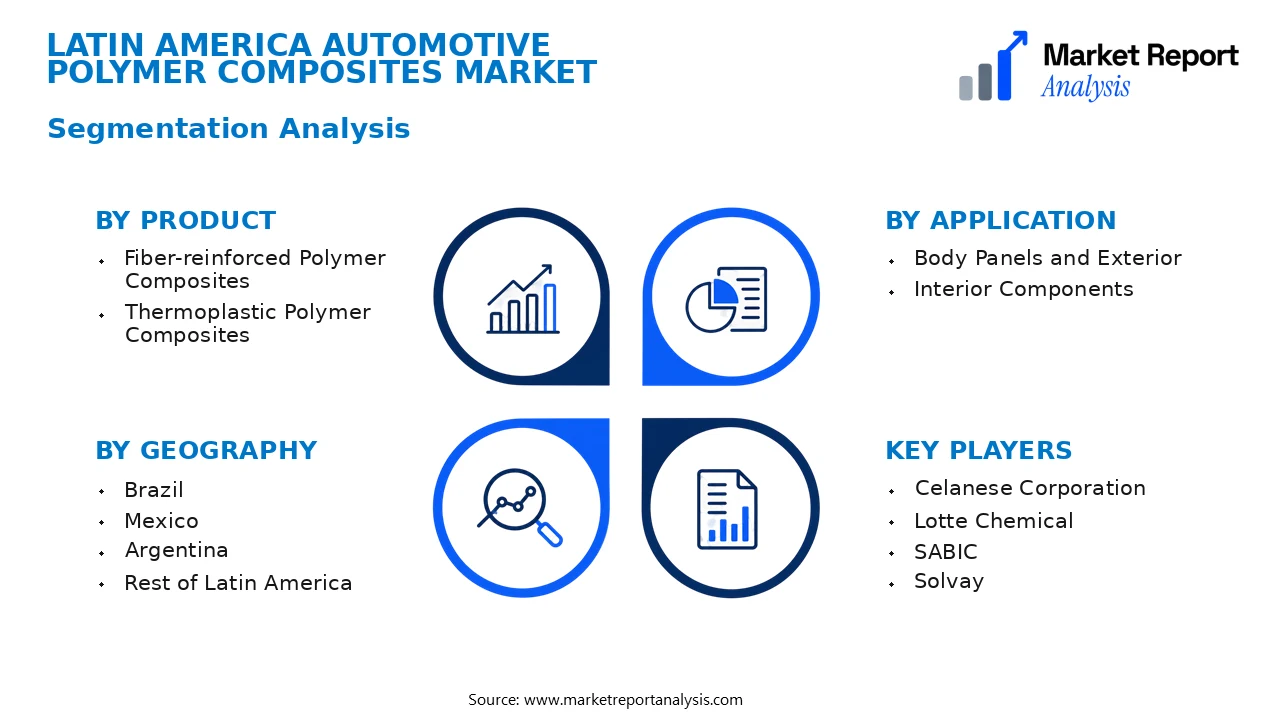
Segmentation Overview: The Latin America Automotive Polymer Composites market is segmented primarily based on product type, application, and geographic region. These segments reflect the major areas of demand and technological adoption, guiding manufacturers and stakeholders in strategic planning and resource allocation.
- Product
- Fiber-reinforced Polymer Composites: These composites, reinforced with fibers such as carbon or glass, are favored for their high strength-to-weight ratio, making them ideal for structural components and thereby significantly impacting vehicle performance and fuel efficiency.
- Thermoplastic Polymer Composites: Known for their recyclability and ease of manufacturing, thermoplastic composites are increasingly adopted in interior components and accessories, driven by sustainability trends and cost considerations.
- Application
- Body Panels and Exterior: This segment includes components like doors, hoods, and fenders, where the emphasis is on reducing weight to improve vehicle efficiency, and composites provide a lightweight alternative to traditional metals.
- Interior Components: These include dashboards, seats, and panels, where aesthetics, durability, and weight reduction are pivotal, fostering high demand for polymer composites in the interior automotive design.
- Geography
- Brazil: The largest automotive market in Latin America, Brazil exhibits substantial demand for composites driven by domestic manufacturing, automotive exports, and ongoing investments in sustainable vehicle production practices.
- Mexico: As a major manufacturing hub, Mexico's automotive industry accelerates the adoption of lightweight composites to meet international emissions standards and global supply chain demands.
- Argentina: While smaller, Argentina presents emerging opportunities due to increased local automotive manufacturing and investment in automotive component exports, catalyzing polymer composite adoption.
- Rest of Latin America: Countries such as Colombia, Chile, and Peru are gradually increasing their share through regional automotive assembly plants and local Tier 2/3 manufacturers seeking weight reduction solutions.
This hierarchical segmentation underscores the region’s strategic focus on lightweight materials to enhance vehicle performance, compliance with emission regulations, and sustainability goals. The diversity within product types, application areas, and regional markets reflects tailored growth strategies designed to leverage local manufacturing strengths, address regional demand nuances, and capitalize on global automotive industry trends favoring eco-friendly and lightweight solutions.
Competitive Intelligence
The Latin America Automotive Polymer Composites Market is characterized by moderate competition, with key players such as Arkema, PlastiAdd, and Solvay leading the landscape. Market concentration remains relatively balanced, with the top five companies accounting for around 50% of overall market share, fostering a competitive environment that drives innovation. Companies are adopting aggressive business strategies including strategic partnerships, joint ventures, and acquisitions to expand their regional footprint and enhance product offerings. Notably, numerous firms are investing heavily in R&D to develop lightweight, high-performance composites tailored for automotive applications, focusing on sustainability and durability. Product innovation often revolves around bio-based and recycled materials, differentiating companies through enhanced environmental credentials. Partnerships with automotive OEMs are prevalent, facilitating co-development projects that meet stringent regional quality and safety standards. Expansion strategies encompass establishing new manufacturing facilities and regional distribution centers to improve supply chain efficiency. Firms that effectively combine technological innovation with strategic alliances and regional expansion are positioned to strengthen their competitive stance and capture increasing market share in Latin America.
Leading Company Profiles
The competitive landscape in the Latin America automotive polymer composites market comprises several key players, ranging from global chemical giants to regional specialty manufacturers. These companies differentiate themselves through technological innovation, product quality, and strategic collaborations, fueling regional growth and technological advancement.
- Celanese Corporation
- Lotte Chemical
- SABIC
- Solvay
- Toray Industries
- Expandable Plastics Inc.
- Huntsman Corporation
- Lanxess AG
- Arkema S.A.
Celanese Corporation
Celanese offers advanced engineered thermoplastics suitable for automotive composite applications, emphasizing lightweight, sustainable solutions with a focus on innovative polymers to meet OEM standards and regional sustainability objectives.
Lotte Chemical
Lotte Chemical specializes in high-performance, bio-based plastics for automotive composites, leveraging cutting-edge polymer formulations to support lightweight designs and align with Latin America's environmental policies.
SABIC
SABIC provides a broad portfolio of specialty polymers and composites tailored for automotive markets, emphasizing innovation, durability, and sustainability to cater to the increasing demand for eco-friendly vehicle materials.
Solvay
Solvay’s focus on high-performance composite materials and innovative polymer technology supports the region’s automotive lightweighting initiatives, underlining their strategic commitment to eco-efficient automotive solutions.
Toray Industries
Toray delivers cutting-edge carbon fiber composites and thermoplastics designed for automotive applications, prioritizing strength-to-weight ratio enhancements and technological leadership in lightweight vehicle construction.
Expandable Plastics Inc.
Specializing in lightweight, recyclable plastic composites, Expandable Plastics Inc. is pivotal in supporting Latin American automakers’ sustainability initiatives and lightweighting strategies for enhanced vehicle efficiency.
Huntsman Corporation
Huntsman offers innovative polyurethanes and specialty resins aimed at automotive composite components, emphasizing eco-friendly formulations that align with regional sustainability policies and performance demands.
Lanxess AG
Lanxess produces high-performance engineering plastics and composites optimized for automotive structural parts, advancing regional initiatives for durable, lightweight, and recyclable vehicle components.
Arkema S.A.
Arkema provides thermoplastic composites and bio-based materials that enable automotive weight reduction while maintaining structural integrity, supporting the region’s shift towards environmentally sustainable vehicles.
Strategic Business Developments
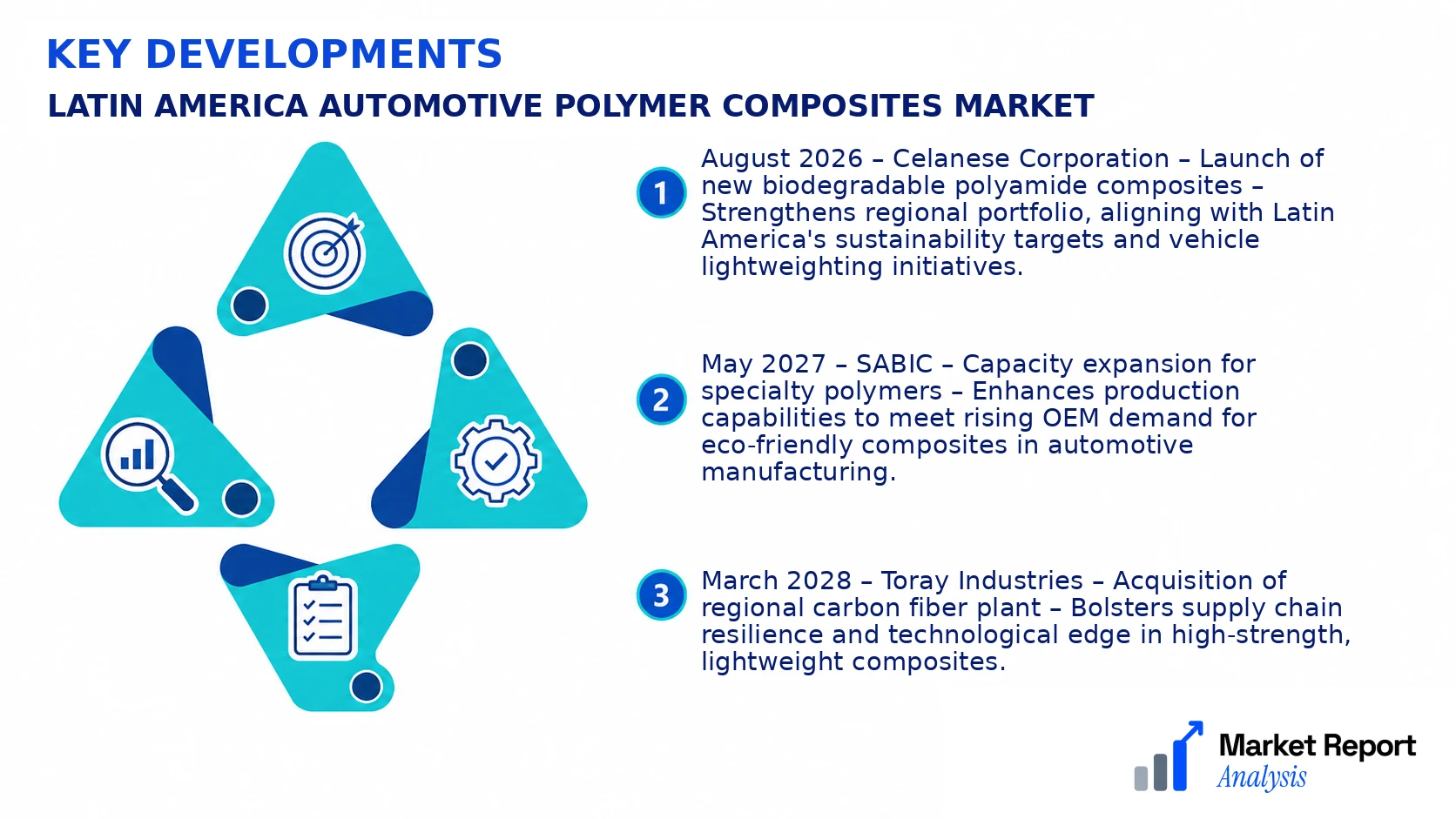
- August 2026 – Celanese Corporation – Launch of new biodegradable polyamide composites – Strengthens regional portfolio, aligning with Latin America's sustainability targets and vehicle lightweighting initiatives.
- May 2027 – SABIC – Capacity expansion for specialty polymers – Enhances production capabilities to meet rising OEM demand for eco-friendly composites in automotive manufacturing.
- March 2028 – Toray Industries – Acquisition of regional carbon fiber plant – Bolsters supply chain resilience and technological edge in high-strength, lightweight composites.
- November 2026 – Huntsman Corporation – Launch of next-generation bio-based polyurethane resins – Supports automakers' sustainability goals and expands eco-friendly product offerings.
- January 2029 – Lanxess AG – Formation of strategic alliance with regional OEMs – Focused on developing recyclable composite materials for automotive structural parts.
Frequently Asked Questions
What is the Latin America Automotive Polymer Composites Market?
The Latin America Automotive Polymer Composites Market encompasses the industry involved in manufacturing and deploying polymer-based composite materials for automotive applications across Latin American countries, focusing on increasing vehicle lightweighting and enhancing performance standards.
What is the current market size of Latin America Automotive Polymer Composites Market?
As of 2026, the market is valued at approximately USD 2.1 Billion, reflecting a steady adoption rate driven by regional automotive manufacturing expansion and a push for sustainable, lightweight vehicle materials to meet environmental regulations.
What factors are driving the Latin America Automotive Polymer Composites Market?
Key drivers include increasing vehicle production, stringent regulations on vehicle emissions, and a growing emphasis on lightweight components to improve fuel efficiency. Advancements in polymer composite technology and rising consumer demand for eco-friendly vehicles also contribute significantly.
Which region dominates the Latin America Automotive Polymer Composites Market?
Brazil holds the largest share, owing to its established automotive industry, favorable regulatory environment, and presence of leading automotive manufacturers, which bolster the demand for polymer composites in vehicle manufacturing.
Which segment is expected to grow the fastest?
The passenger car segment is projected to experience the fastest growth, driven by increasing consumer preferences for lightweight, fuel-efficient vehicles and the adoption of polymer composites for exterior panels, interior components, and structural parts.
Who are the leading companies operating in the Latin America Automotive Polymer Composites Market?
Major players include DuPont, Celanese Corporation, Solvay, and LANXESS, which are investing in innovation and local manufacturing facilities to capture growing regional demand for high-performance polymer composites.
Analyst Perspective
The Latin America Automotive Polymer Composites Market exhibits maturity in select segments, yet remains ripe with opportunities driven by ongoing technological innovations and regional demand growth. The long-term outlook remains optimistic, with the market anticipated to expand at a CAGR of 7.2% from 2026 to 2034, reaching USD 4.5 Billion by 2034. Commercial opportunities will increasingly focus on lightweight, high-strength composite materials to meet stringent emission standards and enhance vehicle performance. Advances in fiber-reinforced composites and bio-based polymers are expected to redefine the competitive landscape, prompting manufacturers to prioritize R&D investments aligned with sustainable practices. Regional growth potential is strongest in Brazil and Mexico, where automotive production continues to rise, supported by favorable government policies and expanding automotive manufacturing hubs. Competitive dynamics will intensify as established players and new entrants leverage technological evolution to differentiate their offerings. Strategic investment in innovation, regional market penetration, and supply chain resilience will be critical for long-term success in this evolving market landscape.
