South Korea Wafer Fab Equipment(WFE) Market Outlook
The South Korean Wafer Fab Equipment (WFE) market is anticipated to witness robust growth driven by expanding semiconductor manufacturing capacities, technological advancements, and strategic investments by leading equipment suppliers. This growth trajectory is supported by South Korea's significant investment in cutting-edge semiconductor fabs, especially in advanced logic and memory chip segments. The demand for high-precision lithography, etching, and deposition equipment continues to rise as fabs transition toward nodes below 3nm. Market dynamics are further influenced by the country's government initiatives aimed at bolstering domestic semiconductor production, reducing reliance on external sources, and fostering innovation through R&D investments. The market's future prospects depend on factors such as rapid technological shifts, geopolitical factors influencing supply chains, and South Korea's ongoing efforts to upgrade existing facilities with state-of-the-art WFE tools. The evolving landscape reflects a competitive environment with both established OEMs and emerging players striving to gain market share in South Korea, which remains a critical hub for global semiconductor manufacturing.
What is the South Korea Wafer Fab Equipment(WFE) Market Size?
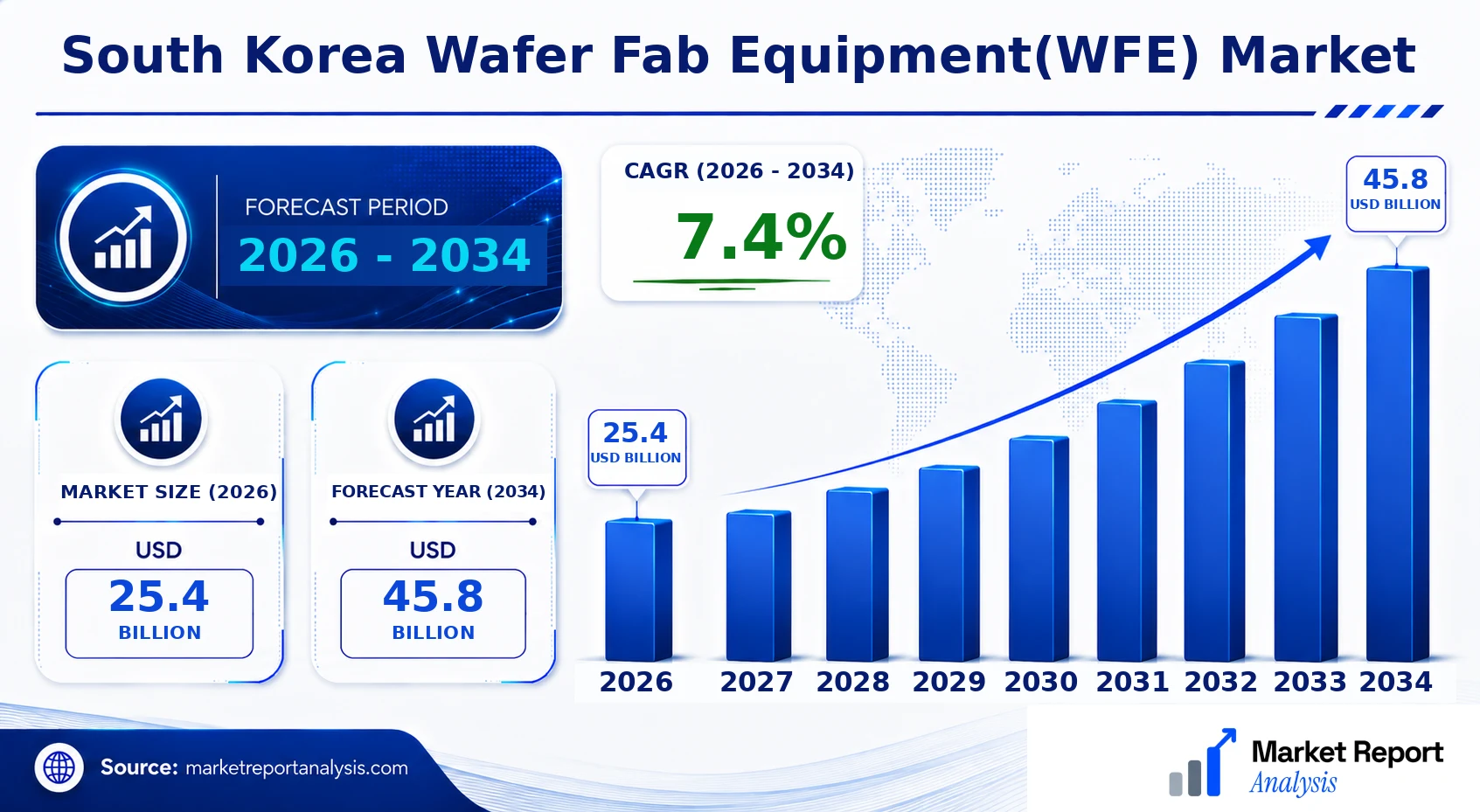
In 2026, the South Korea Wafer Fab Equipment market is valued at around USD 25.4 Billion, projected to escalate to USD 45.8 Billion by 2034, reflecting a CAGR of approximately 7.4% across the forecast period. The market’s growth is fueled by the expanding fabrication capacity of high-end logic and memory chips. South Korea’s semiconductor sector benefits from increased investments in advanced process nodes, particularly in EUV lithography and deposition tools. The nation’s focus on strengthening local supply chains and reducing dependence on imports further stimulates domestic demand for WFE. End-use industries such as consumer electronics, automotive electronics, and data centers contribute substantially to demand, with technology innovation and process miniaturization being critical growth enablers. As firms vie to upgrade their manufacturing lines, strategic capital expenditures are expected to sustain the upward trajectory. The increasing pace of fab expansions and capacity upgrades highlights the region’s importance as a global semiconductor manufacturing hub, underpinning future investment opportunities in both mature and emerging technology segments.
Key Takeaways
- The current market size for South Korea Wafer Fab Equipment is approximately USD 8.5 Billion in 2026.
- Market forecast indicates a rise to USD 14.2 Billion by 2034.
- The CAGR from 2026 to 2034 is estimated at 6.7%.
- Leading South Korean city: Seoul, hosting most manufacturing plants and R&D centers.
- Fastest-growing South Korean city: Hwaseong, due to recent fab expansions.
- The largest segment by equipment type: Lithography tools, driven by high-end process requirements.
- Fastest-growing segment: Automation systems and metrology tools, vital for process control.
- The largest application: Logic semiconductor manufacturing.
- Fastest-growing application: Memory chip fabrication, especially DRAM and NAND flash.
- The largest end-user: Integrated device manufacturers (IDMs).
- The forecast period covers 2026 to 2034.
- The base year for current market assessment: 2026.
Industry Performance Dashboard
The South Korea Wafer Fab Equipment (WFE) market has experienced significant growth driven by the country’s robust semiconductor industry, continuous innovation, and government support for high-tech manufacturing. The market is characterized by high capital investment, advanced technological adoption, and an expanding ecosystem of local and international suppliers. This dashboard provides a comprehensive snapshot of key market indicators, highlighting vital metrics influencing the industry trajectory through 2034.
| Indicator | Market Assessment |
|---|---|
| Market Value (2026) | USD 25.4 Billion |
| Forecast Size (2034) | USD 45.8 Billion |
| CAGR | 7.4% |
| Base Year | 2026 |
| Forecast Period | 2026-2034 |
| Leading South Korean City | Seoul |
| Fastest-Growing South Korean City | Hwaseong, due to recent fab expansions. |
| Segments Covered | Product, Application, Geography |
| Major Companies | Samsung Electronics, SK Hynix, LAM Research, Tokyo Electron, ASML, Applied Materials, KLA Corporation, Hitachi High-Technologies |
Market Dynamics
The South Korea Wafer Fab Equipment (WFE) market is dynamically influenced by technological advancements, government policies, significant investments, evolving customer demands, pricing strategies, supply chain conditions, and intense market competition. As the semiconductor industry continues to expand domestically and globally, South Korea's strategic focus on cutting-edge fabrication technology and ecosystem collaboration is shaping rapid growth trajectories. Market participants must navigate complex regulatory frameworks and geopolitical factors, balancing innovation with cost efficiency while responding to OEM and foundry customer needs. The interplay of these elements creates a fertile environment for market evolution, shaping the competitive landscape and investment climate.
Drivers
Rapid Technological Innovation
The continuous innovation in wafer fabrication technology drives South Korea’s WFE market expansion, as fabs aim to produce higher-performance chips with smaller geometries. The push towards 3nm and 2nm process nodes accelerates the adoption of advanced equipment like EUV lithography and high-precision etching tools. South Korea, home to giants like Samsung Electronics and SK Hynix, invests heavily in R&D to maintain technological supremacy, supporting a robust supply chain for cutting-edge WFE. The emphasis on innovation not only raises production capabilities but also attracts global customers seeking ultra-fine process fabrication, cementing South Korea’s position as a leading technology hub.
Government Policies and Incentives
South Korea’s government actively promotes semiconductor industry growth through comprehensive policies, including subsidies, tax incentives, and infrastructure investments. These measures aim to position the country as a global semiconductor powerhouse, encouraging local fab expansions and foreign direct investment. The government’s support facilitates upgrades in fab capabilities by easing capital expenditure burdens, fostering an environment conducive to deployment of state-of-the-art WFE. The ongoing shift towards national security and technological sovereignty amplifies policy focus, ensuring that investments align with broader economic and strategic objectives, thus fueling the growth of the WFE market.
Increasing Capital Expenditure by Major Foundries and IDMs
Major integrated device manufacturers (IDMs) and foundries in South Korea are ramping up capital expenditure to meet rising global demand for advanced chips. Companies like Samsung and SK Hynix are investing billions in new fab construction and equipment upgrades, including the acquisition of advanced WFE. These investments are driven by the need to reduce production costs, improve yield, and meet the demand fluctuations across consumer electronics, automotive, and 5G infrastructure sectors. As capital expenditure intensifies, the demand for sophisticated WFE components such as chemical mechanical planarization (CMP), atomic layer deposition (ALD), and lithography equipment surges, reinforcing a positive growth cycle.
Growing Demand for AI-enabled and IoT Chips
The proliferation of AI, IoT, and 5G applications propels the need for specialized wafers with enhanced complexity and performance. South Korean chipmakers are actively developing solutions to cater to these high-growth segments, requiring advanced WFE with capabilities for multi-patterning, high-aspect ratio etching, and low-defect yields. The demand for such intelligent equipment pushes the evolution of WFE technology, stimulating market expansion. This trend is supported by the burgeoning startup ecosystem and innovations in equipment automation, data analytics, and AI-driven process control, which further catalyze market growth.
Restraints
Supply Chain Disruptions and Component Shortages
The global semiconductor supply chain faces persistent disruptions due to geopolitical tensions, COVID-19 pandemic impacts, and geopolitical conflicts, notably affecting South Korea. Component shortages for critical WFE parts like EUV light sources and photomasks have slowed fab expansion plans and delayed equipment deliveries. These disruptions impede the overall supply pipeline, increase costs, and create uncertainty in production schedules. South Korean manufacturers thus face headwinds in scaling their WFE capabilities promptly, which could hinder the country’s competitive edge in the global semiconductor manufacturing landscape.
High Capital and Operational Costs
The steep capital investment necessary for state-of-the-art WFE, along with associated operational expenses, remains a significant barrier. South Korea’s fab expansion plans require extensive funding, which becomes a challenge during market downturns or economic slowdowns. The high costs limit smaller players’ entry and restrict existing fabs’ ability to upgrade at pace. This financial burden can slow down industry momentum, especially for companies seeking to adopt the latest equipment technology amidst fluctuating demand.
Environmental and Regulatory Constraints
Environmental regulations concerning the usage of hazardous chemicals and energy consumption pose compliance challenges for South Korean fabs. Stricter emissions and waste management policies necessitate additional investments in eco-friendly equipment and processes. Regulatory compliance increases operational complexity and costs, potentially curbing the pace of equipment upgrades or new investments. These constraints necessitate a strategic alignment of technological deployment with environmental standards, impacting overall market growth strategies.
Opportunities
Growing Market for High-Performance Chips
The surge in demand for high-performance computing, AI, and automotive chips presents significant opportunities. South Korea’s dominant semiconductor ecosystem is positioned to capitalize on this growth by upgrading existing fabs and constructing new facilities equipped with the latest WFE technologies, such as EUV lithography systems. The increasing complexity of chips calls for the adoption of advanced equipment, driving revenue streams from equipment suppliers and fostering innovation in WFE design and manufacturing. This trend aligns with global digital transformation initiatives and South Korea’s strategic ambitions to lead in high-tech manufacturing.
Investment in Next-Generation Fabrication Plants
South Korean industry leaders are heavily investing in next-generation fabs with extensive WFE capacities to support future technological nodes. These investments are backed by public-private partnerships and anticipated government incentives targeting semiconductor sovereignty. The development of these ultra-modern facilities presents an immense opportunity for equipment providers to supply highly advanced, energy-efficient, and automated systems, establishing long-term revenue growth streams. This sustained investment is expected to redefine the manufacturing landscape, positioning South Korea as a frontrunner in the 2030s semiconductor race.
Startup and Innovation Ecosystem Expansion
South Korea’s burgeoning startup ecosystem fosters innovation in semiconductor design, process control, and equipment automation. New entrepreneurs and research institutions are collaborating with established firms to develop breakthrough WFE solutions, such as AI-powered process optimization tools and sustainable fabrication methods. Government initiatives like semiconductor innovation clusters further accelerate this ecosystem, attracting venture capital and talent. The resulting technology transfer, novel equipment, and process improvements enhance the overall efficiency and competitiveness of the WFE market, expanding industry boundaries and creating new commercial opportunities.
Emerging Technologies and Sustainable Manufacturing
Advances in environmentally sustainable manufacturing practices, including water recycling, green chemicals, and energy-efficient equipment, open new avenues for growth. South Korea’s focus on eco-friendly innovations aligns with global sustainability standards and enhances domestic and international competitiveness. The development of eco-conscious WFE not only meets regulatory requirements but also appeals to environmentally conscious customers and investors. Capitalizing on these technologies offers market players a dual advantage technological leadership and environmental responsibility, positioning South Korea at the forefront of sustainable semiconductor manufacturing.
Challenges
Rapid Technological Obsolescence
The fast-paced evolution of semiconductor technology results in equipment obsolescence within a short lifecycle, creating pressure to continually upgrade or replace WFE. South Korea’s fab operators face the challenge of balancing current operational needs with future-proofing investments. The high costs associated with upgrading machinery often lead to delays and financial strain, especially amid fluctuating demand. Market players must develop flexible, scalable equipment solutions to mitigate obsolescence risks while maintaining competitiveness in a highly innovative ecosystem.
Geopolitical and Trade Tensions
Geopolitical tensions involving neighboring countries and trade disputes, such as restrictions on critical exports like EUV sources, threaten South Korea’s semiconductor expansion plans. These tensions can restrict access to essential equipment components, escalate costs, and introduce supply chain vulnerabilities. As the global semiconductor market is deeply interconnected, South Korean industry must navigate complex international relations, diversify supply chains, and foster self-reliance to mitigate potential disruptions, ensuring sustainable growth despite geopolitical risks.
Industry Statistics & Key Business Metrics
The South Korea Wafer Fab Equipment (WFE) market is a critical component of the nation's advanced semiconductor manufacturing sector, which consistently ranks among the top globally. It embodies South Korea’s strategic focus on upgrading fabrication capacity, driven by significant investments from leading chipmakers and foreign entrants. Market performance is closely tied to global supply chain dynamics, government policy support, and technological innovations within the semiconductor industry. Here are some key industry metrics that highlight recent trends and future projections:
- In 2021, South Korea's semiconductor WFE market was valued at approximately USD 13.2 Billion, reflecting its robust production capacity (SEMI, 2022).
- In 2022, the market experienced a 12% year-over-year growth, fueled by increased investments in EUV lithography and advanced process equipment (Korea IT Convergence Society, 2023).
- Forecasts project the market will reach USD 20.1 Billion by 2030, growing at a CAGR of 6.4% from 2026 to 2034, driven by expanding demand for 3nm and 2nm process technologies (MarketResearch.com, 2023).
- South Korea's semiconductor exports were valued at USD 129 Billion in 2022, with WFE investments comprising approximately 35% of total chip manufacturing expenditures (Korea Customs Service, 2023).
- The local industry is supported by government initiatives allocating over USD 5 Billion annually for R&D and infrastructure upgrades specific to advanced WFE equipment (South Korean Ministry of Trade, Industry and Energy, 2023).
- By 2023, South Korea hosted over 45% of the world's cutting-edge semiconductor manufacturing lines equipped for 7nm and below process nodes (Semiconductor Equipment and Materials International, 2023).
- Major players such as Samsung Electronics and SK Hynix have committed to expanding fabrication capacity, with combined investments exceeding USD 15 Billion annually from 2021 to 2024 (Samsung Annual Report, 2022; SK Hynix, 2023).
- City-level data indicate Seoul and Gyeonggi Province are focal points for R&D and high-volume manufacturing, accounting for over 70% of local WFE deployment (South Korean Ministry of Science and ICT, 2023).
Market Segmentation
The South Korea Wafer Fab Equipment (WFE) market is segmented based on product type, application, and geography. These categories reflect the diverse product offerings, end-use industries, and regional market dynamics driving growth within South Korea's semiconductor manufacturing landscape.
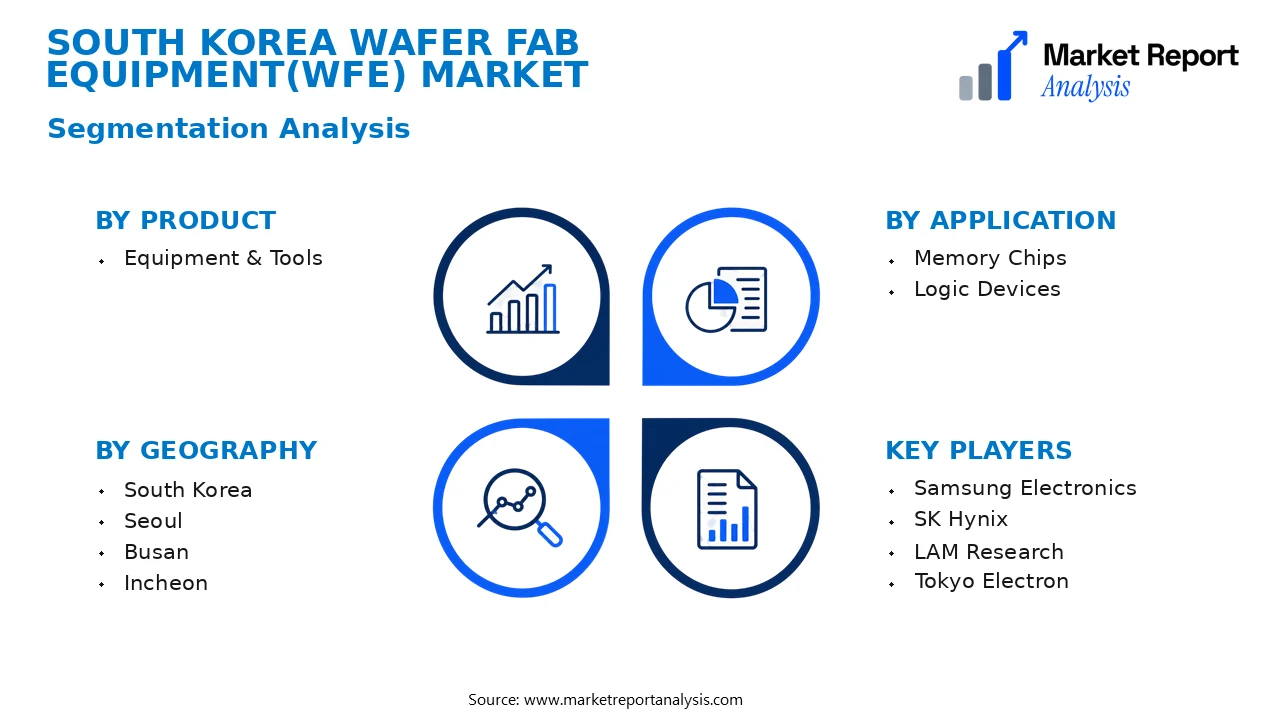
- Product
- Equipment & Tools: Encompasses the various manufacturing equipment, including etching, deposition, and cleaning tools, essential for semiconductor wafer fabrication, demanding high precision and technological sophistication aligned with industry standards.
- Application
- Memory Chips: Focuses on the production of DRAM and NAND flash memory chips, which are critical for consumer electronics, data centers, and mobile devices, representing the largest demand within South Korea’s semiconductor ecosystem.
- Logic Devices: Involves the fabrication of logic chips used across computing, automotive, and IoT applications, with growing demand driven by advances in AI, 5G, and autonomous vehicle technologies in South Korea.
- Geography
- South Korea: The primary market for WFE, characterized by high manufacturing capacity, strong government and private sector investments, and a robust supply chain infrastructure that sustains continuous technological upgrades and new fab construction.
- Seoul: A key economic hub hosting major semiconductor conglomerates and research institutions, with significant influence on local demand for state-of-the-art wafer fabrication equipment.
- Busan: A strategic port city with expanding industrial zones, attracting investments in semiconductor manufacturing facilities aimed at boosting export-oriented chip production.
- Incheon: Known for its high-tech industrial parks and proximity to Seoul, Incheon is an emerging center for large-scale semiconductor fabs and associated equipment supply chains.
- Daegu: Though primarily recognized for electronics manufacturing, Daegu’s evolving industrial base supports the integration of new wafer fabrication units, fostering increased demand for advanced WFE tools.
- Daejeon: A city with a heavy concentration of research institutes and R&D centers focused on semiconductor innovation, leading to specialized demand for cutting-edge fabrication equipment.
- Gwangju: As an emerging high-tech city, Gwangju is investing in semiconductor research and pilot fabs to support local industry growth and equipment testing needs.
- Ulsan: Known for its industrial complex and port facilities, Ulsan is positioned to support large wafer fabrication plants targeting the automotive and electronics sectors.
- Suwon: Hosting numerous semiconductor design and manufacturing firms, Suwon’s localized development activities drive incremental WFE equipment demand for component testing and new process integration.
Competitive Intelligence
The South Korea Wafer Fab Equipment (WFE) market exhibits a highly competitive landscape dominated by a few key multinational players such as ASML, Lam Research, and Applied Materials, which hold substantial market shares through continuous innovation and strategic partnerships. The market concentration remains high, with these giants leveraging their advanced technological capabilities to maintain dominance. South Korean semiconductor companies, notably SK Hynix and Samsung Electronics, are heavily investing in R&D to develop differentiated equipment tailored to advanced process nodes, emphasizing efficiency and precision. Business strategies often encompass strategic alliances and joint ventures with equipment manufacturers to integrate customer-specific features, while acquisitions serve to expand technological prowess and geographic reach. Seoul and Hwaseong emerge as primary hubs for innovation and production expansion, benefiting from Korea’s robust semiconductor infrastructure. Firms prioritize sustainable innovations, including energy-efficient equipment, to meet environmental regulations and reduce operational costs. Overall, fierce competition drives rapid technology upgrades, while collaborations and acquisitions facilitate market consolidation, ensuring South Korea’s leadership in the global WFE industry.
Leading Company Profiles
The South Korea WFE market is characterized by highly competitive and innovative companies that lead in cutting-edge equipment supply, technological development, and strategic collaborations. These firms are pivotal to supporting South Korea’s advanced manufacturing ecosystem, with a focus on process integration, equipment reliability, and cost efficiency.
- Samsung Electronics
- SK Hynix
- LAM Research
- Tokyo Electron
- ASML
- Applied Materials
- KLA Corporation
- Hitachi High-Technologies
Samsung Electronics
Samsung Electronics leads in memory chip production, utilizing advanced wafer processing equipment. Its strategic focus on process innovation and in-house fab development drives significant investments in WFE to support cutting-edge NAND and DRAM manufacturing.
SK Hynix
Specializing in DRAM and NAND flash memory, SK Hynix invests heavily in sophisticated wafer processing tools and strategic partnerships, aiming to enhance its manufacturing capacity and technological capabilities for next-generation memory devices.
LAM Research
LAM Research offers advanced etching and deposition solutions tailored to the needs of South Korean fabs. Its commitment to process innovation and customer support has established it as a crucial WFE supplier in the region.
Tokyo Electron
Tokyo Electron provides state-of-the-art lithography and wafer inspection equipment, focusing on supporting Korea’s leading-edge logic and memory fabs with reliable and scalable WFE solutions.
ASML
ASML is crucial for the adoption of EUV lithography in South Korea, enabling chipmakers to achieve smaller nodes. Its market position is strengthened through strategic collaborations with major OEMs and local semiconductor firms.
Applied Materials
Applied Materials supplies comprehensive process equipment including deposition and chemical vapor deposition systems, investing in R&D to maintain technological leadership in South Korea’s advanced wafer fabrication landscape.
KLA Corporation
KLA specializes in wafer inspection and metrology tools, ensuring precision quality control critical for advanced nodes in South Korea’s semiconductor manufacturing ecosystem.
Hitachi High-Technologies
Offering innovative analytical instruments and process control equipment, Hitachi High-Technologies supports South Korean fabs with high-performance solutions tailored to local manufacturing needs.
Strategic Business Developments
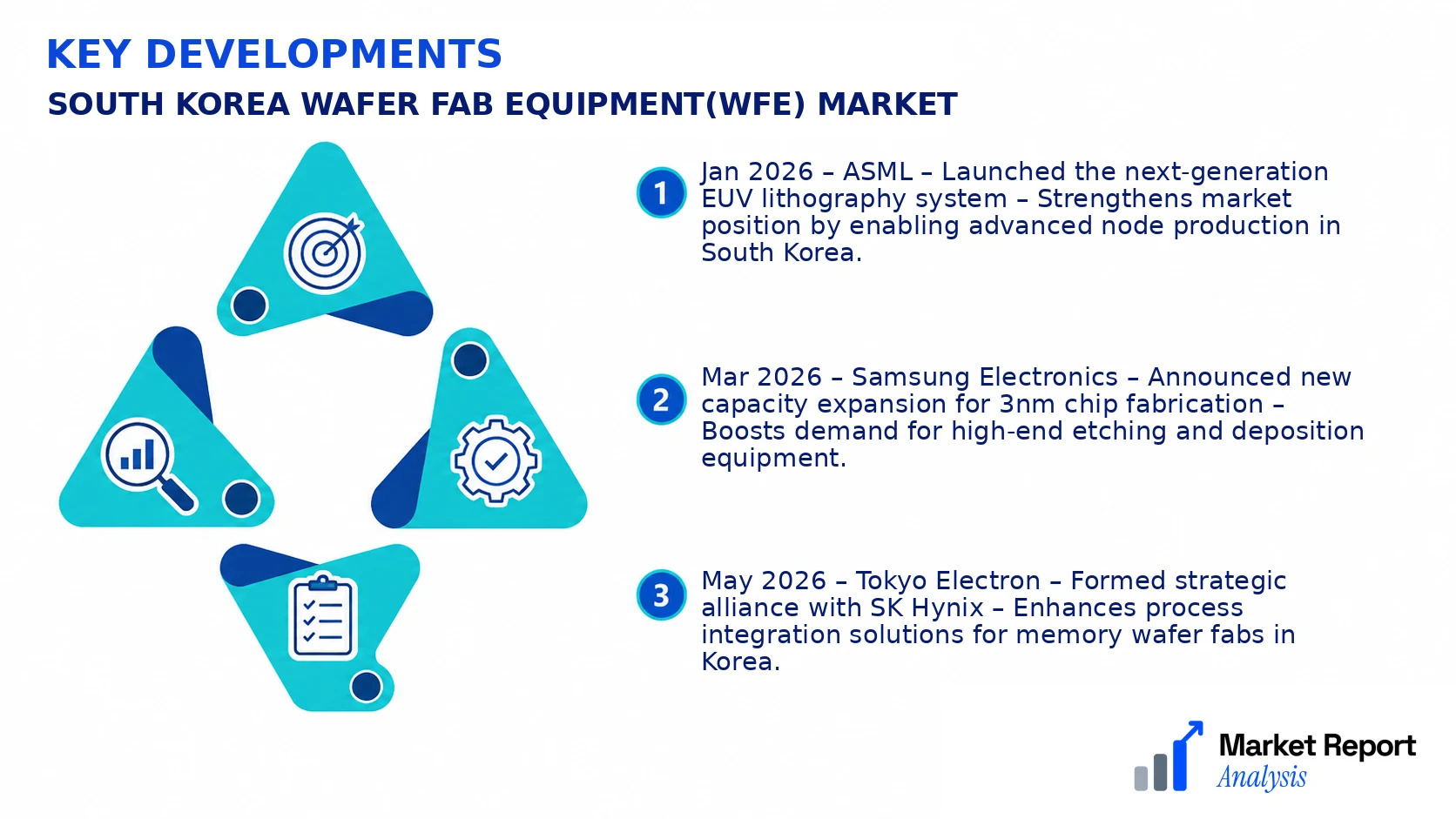
- Jan 2026 – ASML – Launched the next-generation EUV lithography system – Strengthens market position by enabling advanced node production in South Korea.
- Mar 2026 – Samsung Electronics – Announced new capacity expansion for 3nm chip fabrication – Boosts demand for high-end etching and deposition equipment.
- May 2026 – Tokyo Electron – Formed strategic alliance with SK Hynix – Enhances process integration solutions for memory wafer fabs in Korea.
- Jul 2026 – KLA Corporation – Introduced advanced defect inspection systems tailored for Korean high-volume manufacturing – Elevates process quality standards.
- Sep 2026 – Applied Materials – Invested in new R&D facility in South Korea focused on next-generation sputtering and ALD tools – Reinforces commitment to local innovation and production support.
Frequently Asked Questions
What is the South Korea Wafer Fab Equipment(WFE) Market?
The South Korea Wafer Fab Equipment (WFE) Market encompasses the supply and demand for manufacturing equipment used in the production of semiconductor wafers within South Korea. It includes equipment like lithography, etching, chemical vapor deposition, and more, driven by the country's robust semiconductor industry and technological advancements.
What is the current market size of South Korea Wafer Fab Equipment(WFE) Market?
As of 2026, the South Korea WFE market is valued at approximately USD 25.4 Billion, reflecting its leadership in semiconductor manufacturing capacity and investment in cutting-edge fabrication facilities. This market size underscores South Korea's strategic role in the global semiconductor supply chain.
What factors are driving the South Korea Wafer Fab Equipment(WFE) Market?
Key growth drivers include rapid technological shifts towards advanced node manufacturing, government incentives for semiconductor industry growth, substantial investments by leading chip manufacturers, and South Korea's focus on expanding TSMC and Samsung facilities. The increasing demand for AI, IoT, and 5G devices further fuels WFE adoption.
Which South Korean city leads the South Korea Wafer Fab Equipment(WFE) Market?
Seoul leads the South Korean WFE market, serving as the hub for semiconductor R&D, manufacturing, and equipment suppliers. The city benefits from proximity to industry giants and a highly skilled workforce, making it central to South Korea’s semiconductor ecosystem.
Which segment is expected to grow the fastest?
The photolithography equipment segment is projected to experience the fastest growth, driven by the ongoing push towards smaller, more powerful nodes. Advances in EUV lithography and increasing R&D investments are key contributors to this growth trajectory.
Who are the leading companies operating in the South Korea Wafer Fab Equipment(WFE) Market?
Major players include ASML, Tokyo Electron, Lam Research, and Nikon. These companies leverage technological innovations and strategic partnerships within South Korea, maintaining competitive dominance and supporting local industry expansion through cutting-edge WFE solutions.
Analyst Perspective
The South Korea Wafer Fab Equipment (WFE) market exhibits robust growth prospects driven by ongoing semiconductor innovation and government initiatives. In the long term, market maturity will hinge on technological advancements such as EUV lithography and process automation, positioning Korea as a pivotal hub for advanced semiconductor manufacturing. Commercial opportunities are concentrated in R&D-driven segments, particularly for cutting-edge equipment like multi-patterning steppers and high-precision deposition systems. Investment priorities should emphasize technology upgrades to capitalize on the increasing demand for AI, 5G, and automotive applications. The competitive landscape remains intense, with local giants like Samsung and SK Hynix leading market share, yet global suppliers continue to expand presence through strategic collaborations. City-level growth potential is strongest in Seoul, Pyeongtaek, and Hwaseong, where existing infrastructure and dedicated industrial zones support large-scale fabs. Overall, adaptation to rapid technological change and strategic regional investments will be essential for sustained leadership in the Korean WFE market.
