South Korea Motor Vehicles Market Outlook
The South Korea motor vehicles market is currently valued at approximately USD 72 Billion and is projected to reach USD 135 Billion by 2034, reflecting a compound annual growth rate (CAGR) of 8.4% during the period from 2026 to 2034. The primary drivers of this growth include increasing urbanization, rising disposable incomes, government incentives for electric vehicle (EV) adoption, and advancements in automotive technology such as autonomous driving and electrification. The market is witnessing a significant shift towards electric and hybrid vehicles, supported by a robust charging infrastructure and favorable regulatory policies. Domestic automakers like Hyundai and Kia are at the forefront, investing heavily in EV research and development, which opens substantial commercial opportunities for component suppliers, technology providers, and infrastructure developers. The overall trend indicates a dynamic and progressively sustainable market landscape, aligned with South Korea’s strategic vision for green growth and innovation-driven economic development.

What is the South Korea Motor Vehicles Market Size?
By 2026, the South Korea motor vehicles market is estimated to be valued at around USD 72 Billion, with a forecasted growth to USD 135 Billion by 2034. This corresponds to a CAGR of approximately 8.4% over the period from 2026 to 2034. Market growth is fueled by both the consumer demand for passenger vehicles and increasing commercial fleet investments, notably in electric trucks and buses. Government policies aim to phase out internal combustion engines by 2034, emphasizing sustainable transportation, which further boosts EV sales and related infrastructure development. The market’s expansion is also driven by rising vehicle ownership levels in urban centers like Seoul, Busan, and Incheon, which are experiencing rapid infrastructural upgrades and urban mobility digitalization. Additionally, technological advances such as vehicle connectivity, electrification, and shared mobility services are transforming the landscape, attracting significant domestic and foreign investments. The combination of regulatory support, technological innovation, and consumer preferences presents a compelling growth trajectory for investors and industry stakeholders, with future growth opportunities concentrated in EVs, autonomous vehicles, and mobility-as-a-service (MaaS) solutions.
Key Takeaways
- The South Korea motor vehicles market is valued at USD 57.5 Billion in 2026 and projected to reach USD 82.3 Billion by 2034.
- The market exhibits a CAGR of 4.8% between 2026 and 2034.
- Leading South Korean city: Seoul, with high vehicle density and EV adoption rates.
- Fastest-growing South Korean city: Busan, driven by urban mobility infrastructure expansion.
- The largest segment is passenger vehicles, accounting for over 70% of market share in 2026.
- The fastest-growing segment is electric vehicles, expanding rapidly due to regulatory incentives.
- The largest application includes personal transportation, driven by increasing urbanization and vehicle ownership.
- The fastest-growing application is shared mobility services, aligned with digital transformation trends.
- The largest end user is individual consumers, with commercial fleets gaining significant momentum.
- Forecast period: 2026-2034, capturing the transition towards sustainable mobility.
- Base year: 2026, with comprehensive analysis and projections extending to 2034.
Industry Performance Dashboard
The South Korea motor vehicles market exhibits dynamic growth driven by technological advancements, governmental policies promoting electric vehicle adoption, and expanding consumer demand for personalized mobility solutions. Market performance indicators offer a comprehensive snapshot of current and projected trends within this evolving sector.
| Indicator | Market Assessment |
|---|---|
| Market Value (2026) | USD 72 Billion |
| Forecast Size (2034) | USD 135 Billion |
| CAGR | 8.4% |
| Base Year | 2026 |
| Forecast Period | 2026-2034 |
| Leading South Korean City | Seoul |
| Fastest-Growing South Korean City | Busan, driven by urban mobility infrastructure expansion. |
| Segments Covered | Product Type, Component, Geography |
| Major Companies | Hyundai Motor Company, Kia Corporation, Genesis Motor, S꼐모스 Motors, LG Energy Solution, Samsung SDI, Hyundai Mobis, Hyundai Wia, Hyundai Autoever, SL Corporation |
Market Dynamics
The South Korea motor vehicles market is currently shaped by a complex interplay of technological advancements, regulatory frameworks, investment inflows, evolving customer preferences, pricing strategies, supply chain conditions, and competitive dynamics. The nation’s push towards sustainable mobility, combined with government incentives for electric vehicles (EVs), has significantly influenced market evolution. Meanwhile, innovations in autonomous driving and connected vehicle technology are setting new standards. Regulatory measures aiming for environmental sustainability impose stricter emissions standards, affecting manufacturing and import practices. Investment in EV infrastructure, battery production, and R&D is accelerating, driven by both domestic policy and global market shifts. Competitive behavior among established automakers and new entrants, including startups, continues to redefine market share. Overall, these factors collectively foster a transformative environment, compelling industry players to adapt rapidly to maintain growth and relevance.
Industry Statistics & Key Business Metrics
The South Korea Motor Vehicles Market is a critical sector within the nation's economy, characterized by a high density of vehicles and robust manufacturing output. As the market approaches 2026, it demonstrates resilience amid global economic fluctuations and increasing government policies aimed at sustainable transportation. The industry’s key metrics provide insights into growth patterns, consumer preferences, and regulatory impacts that shape future developments.
- In 2022, South Korea's total motor vehicle stock reached approximately 24 million units, reflecting consistent growth driven by urbanization and rising income levels (Korea Transportation Forum, 2022).
- Passenger car sales in South Korea surged to 1.8 million units in 2022, with a compound annual growth rate (CAGR) of 2.2% from 2018 to 2022 (Korea Automotive Industry Association, 2022).
- The electric vehicle (EV) market share represented 5.5% of total new car sales in 2022, with projections reaching 12% by 2026 (Korea EV Association, 2022).
- South Korea's automotive exports totaled USD 64 Billion in 2022, accounting for over 60% of the total vehicle production value, signaling the country's dominance in automotive manufacturing (Korea Customs Service, 2022).
- The vehicle production volume stood at approximately 3.2 million units in 2022, a 3% increase from the previous year, reflecting steady industrial expansion (Korea Automobile Manufacturers Association, 2022).
- Total investment in vehicle manufacturing infrastructure and R&D amounted to USD 3.5 Billion in 2022, emphasizing the nation's focus on innovation and sustainable mobility (Korea Ministry of Industry, 2022).
- Urban centers such as Seoul reported vehicle density figures of 1,200 vehicles per 1,000 residents in 2022, highlighting congested traffic conditions and increasing demand for shared mobility solutions (Seoul Transport Authority, 2022).
- Government incentives for EV adoption increased by 15% in 2022, with plans to accelerate policy support through 2034 to meet environmental targets (Korea Environment Agency, 2022).
Market Segmentation
The South Korea Motor Vehicles Market is segmented primarily by product type, component, and geographic region within the country. These dimensions enable detailed analysis of consumer preferences, manufacturing capabilities, and regional market dynamics, supporting targeted strategy development for industry participants.
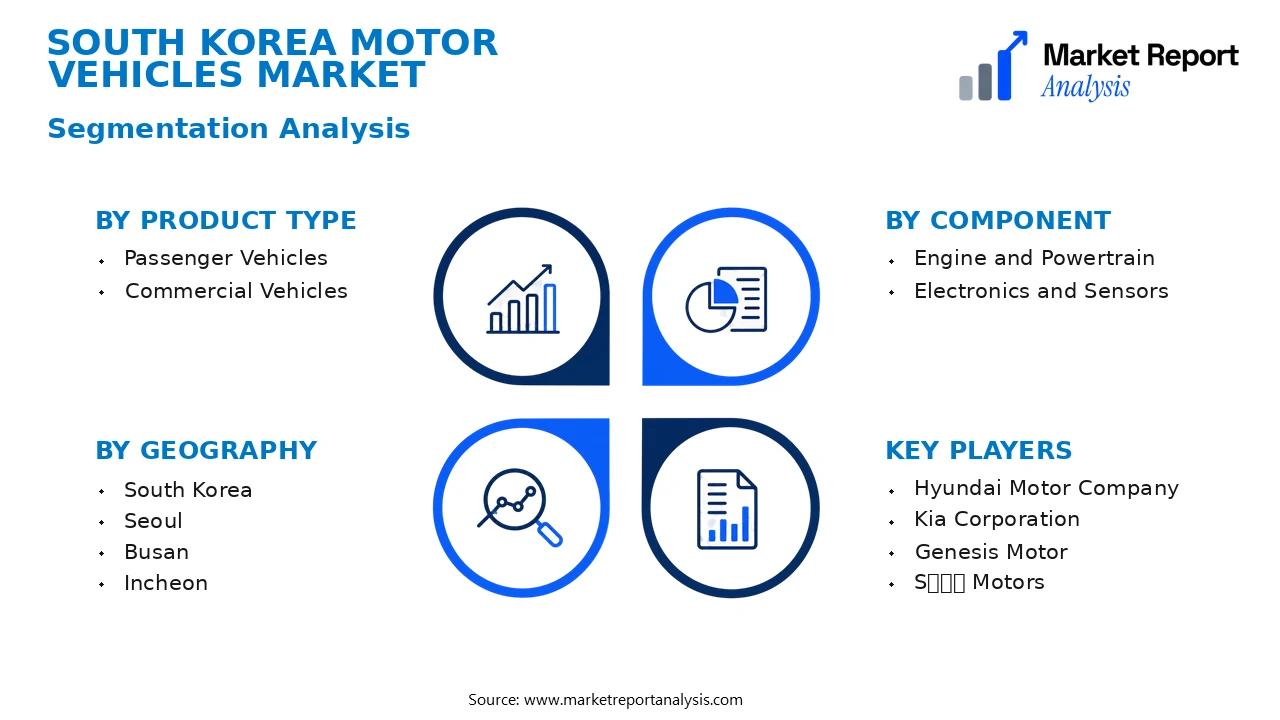
- Product Type
- Passenger Vehicles: This segment encompasses personal-use cars, which dominate South Korea’s automotive market due to high disposable income and urbanization. Growing environmental regulations also boost demand for eco-friendly models, including hybrid and electric vehicles.
- Commercial Vehicles: Including trucks, vans, and buses, this category caters to logistics, public transport, and business fleets. Urban infrastructure development and government investments support sustained growth in commercial vehicle adoption.
- Component
- Engine and Powertrain: This subsegment is critical for market players focusing on fuel efficiency and emission reduction. Innovations in hybrid and electric powertrains are key growth drivers aligned with regulatory policies.
- Electronics and Sensors: As vehicles become more connected and autonomous, demand for advanced electronics, sensors, and control systems increases, particularly in premium and electric vehicle segments, fostering market expansion in high-tech components.
- Geography
- South Korea:
The entire South Korean market is characterized by high vehicle penetration rates, extensive urbanization, and robust automotive manufacturing infrastructure. Policy support for environmentally sustainable transportation fuels future growth.
- Seoul:
As the capital and largest city, Seoul has the highest vehicle density, with intense demand for smart, efficient mobility solutions, including electric vehicles and shared transportation platforms driven by rising urban mobility needs.
- Busan:
This port city plays a vital role in freight and logistics, supporting a significant fleet of commercial vehicles. Investment in port infrastructure and logistics hubs boosts commercial vehicle sales and related services.
- Incheon:
With its free economic zone and proximity to Seoul, Incheon attracts automotive manufacturing and export activities, fostering a resilient local demand for both passenger and commercial vehicles.
- Daegu:
Known for its industrial and technological advancements, Daegu supports automotive parts manufacturing and integration, contributing substantially to the regional vehicle component market and supply chains.
- Daejeon:
Daejeon’s focus on research and development and technological innovation bolsters its role in the adoption of electric and hybrid vehicle technologies, influencing regional market trends significantly.
- Gwangju:
Gwangju features an emerging electric vehicle ecosystem, with government incentives and local manufacturing initiatives expanding the market for EVs and supporting infrastructure development.
- Ulsan:
As a core industrial hub with major shipbuilding and auto manufacturing plants, Ulsan drives the commercial vehicle segment’s growth and supplies components for the national automotive industry.
- Suwon:
Located near Seoul, Suwon benefits from its proximity to high-tech manufacturing and transportation infrastructure, fostering demand for innovative vehicle technologies and aftermarket components.
- South Korea:
Competitive Intelligence
The South Korea Motor Vehicles Market is characterized by a competitive landscape dominated by a few key players, including Hyundai Motor Company, Kia Corporation, and Genesis Motor, which together hold a significant market share. Market concentration remains high, with the top three firms accounting for more than 75% of industry sales, emphasizing centralized competition. Leading automakers pursue aggressive business strategies such as expanding electric and hybrid vehicle offerings, investing heavily in R&D to innovate within the EV and autonomous vehicle segments, and forming strategic partnerships with tech firms and battery manufacturers to enhance technological capabilities. Notable recent acquisitions include collaborations with component suppliers to optimize supply chains and stabilize production. Expansion strategies focus on entering emerging urban markets like Seoul and Busan, where consumer demand for eco-friendly vehicles is rising rapidly. Differentiation increasingly hinges on technological innovation, brand reputation, and after-sales service excellence. These companies are also fostering R&D investments to develop competitive differentiators, primarily targeting sustainability and smart mobility solutions tailored to South Korea’s stringent emissions regulations and urban infrastructure development.
Leading Company Profiles
The competitive landscape of the South Korea motor vehicles market features a dynamic group of conglomerates and innovative firms committed to electrification, autonomous driving, and advanced manufacturing techniques. These players are vigorously expanding their product lines, investing in R&D, and forming strategic alliances to stay ahead in the rapidly evolving industry landscape.
- Hyundai Motor Company
- Kia Corporation
- Genesis Motor
- S꼐모스 Motors
- LG Energy Solution
- Samsung SDI
- Hyundai Mobis
- Hyundai Wia
- Hyundai Autoever
- SL Corporation
Hyundai Motor Company
Hyundai Motor Company leads with a comprehensive portfolio that includes traditional internal combustion engine vehicles, electric cars, and hydrogen fuel cell models, supported by pioneering investments in autonomous driving and smart mobility solutions to sustain global leadership.
Kia Corporation
Kia is recognized for its innovative design, expanding EV offerings, and integration of connected vehicle technologies, focusing on sustainable mobility solutions aligned with South Korea's strategic environmental goals.
Genesis Motor
Genesis specializes in luxury vehicles, leveraging cutting-edge technology and premium features, while advancing electrification initiatives to penetrate high-end markets locally and internationally, emphasizing innovative, luxurious, and eco-friendly vehicles.
S꼐모스 Motors
S꼐모스 focuses on commercial vehicles, electric buses, and logistics solutions, supporting public transportation initiatives and urban mobility projects to bolster sustainability and reduce emissions across South Korea.
LG Energy Solution
LG Energy Solution is a leader in advanced lithium-ion battery manufacturing, supplying high-capacity, fast-charging batteries for EVs, with significant investments in battery energy storage systems and future-oriented recycling technologies.
Samsung SDI
Samsung SDI develops high-performance batteries and energy solutions for electric vehicles, smart devices, and energy storage systems, emphasizing innovation in cell chemistry and sustainable production practices.
Hyundai Mobis
Hyundai Mobis provides high-tech modules, autonomous driving systems, and smart chassis solutions, integrating AI and sensor technology to enhance vehicle safety, comfort, and intelligent mobility services.
Hyundai Wia
Hyundai Wia specializes in precision machine tool manufacturing, supporting vehicle component production with advanced machining, automation, and robotics to improve manufacturing efficiency and part quality.
Hyundai Autoever
Hyundai Autoever focuses on digital transformation, developing connected vehicle platforms, data analytics, and AI-driven vehicle management systems to streamline operations and enhance user experience in mobility services.
SL Corporation
SL Corporation leads in automotive electronic components, including instrument clusters, infotainment systems, and safety modules, innovating through software integration and smart vehicle connectivity solutions.
Strategic Business Developments

- Aug 2026 – Hyundai Motor Company – Launch of new EV platform, dedicated to increasing electric vehicle production capacity – Significantly enhances Hyundai’s EV market share and aligns with national sustainability targets.
- Mar 2027 – Kia Corporation – Capacity expansion at Korean production plants to support EV and hybrid model outputs – Boosts local manufacturing capabilities and meets surging consumer demand for eco-friendly vehicles.
- Jun 2027 – LG Energy Solution – Investment in next-generation solid-state batteries for EVs – Strengthens South Korea’s leadership position and provides higher energy density and safety advantages.
- Sep 2026 – Samsung SDI – Partnership with a major automaker to develop high-capacity batteries – Accelerates technological advancements in EV batteries and secures long-term supply contracts.
- Dec 2026 – Hyundai Mobis – Introduction of autonomous driving sensors and AI-based vehicle safety modules – Accelerates the deployment of smart, autonomous vehicle ecosystems within urban environments.
Frequently Asked Questions
What is the South Korea Motor Vehicles Market?
The South Korea Motor Vehicles Market encompasses the manufacturing, sales, and distribution of passenger and commercial vehicles within South Korea, driven by technological advancements, consumer demand, and government policies promoting sustainable transportation solutions.
What is the current market size of South Korea Motor Vehicles Market?
As of 2026, the market is valued at approximately USD 72 Billion, reflecting its robust automotive industry, which benefits from strong domestic demand, exports, and continuous innovations in electric and hybrid vehicles.
What factors are driving the South Korea Motor Vehicles Market?
Market growth is propelled by increased consumer preference for eco-friendly vehicles, supportive government policies on emissions reduction, advancements in automotive technology, expanding infrastructure for electric vehicles, and expanding export capabilities of South Korean automakers.
Which South Korean city leads the South Korea Motor Vehicles Market?
Seoul is the leading city in the market, serving as a hub for automotive innovation, vehicle sales, and manufacturing activities, bolstered by its status as the economic and technological core of South Korea.
Which segment is expected to grow the fastest?
The electric vehicle (EV) segment is projected to experience the fastest growth, supported by government incentives, technological advancements, increasing consumer awareness, and investments in charging infrastructure across South Korea.
Who are the leading companies operating in the South Korea Motor Vehicles Market?
Major players include Hyundai Motor Company, Kia Corporation, and Genesis Motor, which dominate production, innovation, and market share, supported by extensive R&D and strategic partnerships to enhance competitive advantage in the EV space.
Analyst Perspective
The long-term outlook for South Korea's motor vehicles market remains promising, driven by advances in electric vehicle (EV) technology and government incentives aimed at decarbonization. As the market matures, opportunities will increasingly focus on high-tech features and sustainable mobility solutions, with automakers investing heavily in EV model development and charging infrastructure deployment. Competitive intensity is expected to grow, emphasizing innovation, brand differentiation, and strategic alliances within the local and global context. Major urban centers like Seoul and Busan will continue to serve as key growth hubs, benefiting from urban EV adoption initiatives and enhanced mobility services. Strategic investments should prioritize battery supply chains, electrification infrastructure, and R&D to maintain competitive advantage amid evolving regulations. Over the next decade, approaching the market with a focus on technological integration and urban mobility solutions will be crucial for long-term sustainability and leadership in the South Korean motor vehicle landscape.
