Japan Motor Vehicles Market Outlook
The Japan Motor Vehicles Market is currently valued at approximately USD 360 Billion in 2026, with forecasts indicating a steady growth trajectory reaching around USD 610 Billion by 2034. This expansion reflects a compound annual growth rate (CAGR) of approximately 6.0% over the period from 2026 to 2034. The principal demand drivers include increasing urbanization, government incentives aimed at promoting electric and hybrid vehicles, and technological advancements in autonomous driving. Additionally, Japan’s focus on sustainable mobility solutions and the strong automotive manufacturing heritage foster significant opportunities for innovation, particularly in electric vehicle (EV) and connected vehicle segments. This market outlook underscores a shift towards cleaner, smarter transportation modes, with strategic investments in EV infrastructure and autonomous vehicle technologies expected to shape future growth. As automakers and technology firms continue to collaborate, Japan’s market offers lucrative commercial opportunities for stakeholders aiming to leverage innovations that meet both regulatory standards and consumer preferences.

What is the Japan Motor Vehicles Market Size?
In 2026, the Japan Motor Vehicles Market is estimated at USD 360 Billion, and it is forecast to grow to approximately USD 610 Billion by 2034, marking a CAGR of around 6.0%. Growth drivers include rising urban population densities, government policies encouraging electric and hybrid vehicle adoption, and technological innovations in vehicle automation and connectivity. These factors are enhancing consumer appeal and operational efficiency, while also aligning with Japan’s commitment to environmental sustainability. The automotive sector’s development is underpinned by strong industrial infrastructure and a focus on export markets, with notable investments in EV and autonomous vehicle technology R&D. Key end-use industries such as logistics, personal mobility, and commercial fleet management are increasingly adopting advanced vehicle solutions, further fueling market expansion. The evolving regulatory landscape, driven by stricter emissions standards, continues to influence production strategies, encouraging OEMs to prioritize energy-efficient models. Looking ahead, the market is poised for continuous evolution, with significant potential for new entrants and established automakers to capitalize on green mobility trends and digital infrastructure developments, thereby ensuring sustained growth and diversification of the automotive landscape in Japan.
Key Takeaways
- The Japan Motor Vehicles Market is valued at USD 220 Billion in 2026, with a projected growth to USD 320 Billion by 2034.
- The market exhibits a CAGR of approximately 4.5% during 2026-2034.
- Electric and hybrid vehicles are the primary growth drivers, supported by government incentives.
- Urbanization and demographic shifts are increasing demand for compact and emission-compliant vehicles.
- Technological innovations such as autonomous driving and vehicle connectivity are transforming the market landscape.
- Strong automotive manufacturing capabilities bolster export-oriented growth prospects.
- Regulatory pressures are accelerating the adoption of energy-efficient and low-emission vehicles.
- Investment in EV charging infrastructure and smart mobility solutions presents significant commercial opportunities.
- Japanese automakers are pioneering advancements in sustainable transportation, fostering international competitiveness.
- The market’s evolution is underpinned by collaboration between automotive and tech firms, promoting innovation.
- The growth prospects are reinforced by Japan’s strategic focus on reducing carbon emissions and adopting green mobility policies.
- Regional variations within Japan, particularly in urban centers, influence localized demand patterns.
- The industry continues to adapt to global supply chain dynamics, with emphasis on battery technology and component sourcing.
- Future investments will likely focus on next-generation vehicles, digital infrastructure, and sustainable mobility ecosystems.
Industry Performance Dashboard
The Japan motor vehicles market demonstrates resilient growth driven by technological innovation, government policies supporting electric vehicles, and increasing consumer demand for safe and efficient transportation. The following dashboard offers a comprehensive overview of current and forecast metrics essential for assessing market dynamics and investment opportunities.
| Indicator | Market Assessment |
|---|---|
| Market Size (2026) | USD 360 Billion |
| Market Value (2026) | USD 360 Billion |
| Forecast Size (2034) | USD 610 Billion |
| CAGR | 6.0% |
| Base Year | 2026 |
| Forecast Period | 2026-2034 |
| Segments Covered | Product, Technology, Geography |
| Major Companies | Toyota Motor Corporation, Honda Motor Co., Ltd., Suzuki Motor Corporation, Mitsubishi Motors Corporation, Subaru Corporation, Isuzu Motors Limited, Daimler Truck Asia, Yamaha Motor Co., Ltd., Hino Motors, Ltd. |
Market Dynamics
The Japan motor vehicles market is experiencing dynamic transformation driven by advancements in technology, evolving regulatory frameworks, significant investment inflows, changing customer preferences, fluctuating pricing strategies, supply chain adjustments, and intense competitive behavior. These multifaceted factors collectively influence market growth, product innovation, and strategic positioning within the industry. As environmental concerns and digital adoption accelerate, manufacturers and stakeholders are reevaluating their approaches to meet stricter emission standards, incorporate cutting-edge connectivity features, and optimize supply chains amid geopolitical tensions. This environment demands agility, strategic foresight, and innovation to capitalize on emerging opportunities while navigating complex challenges.
Drivers
Technological Innovation in Powertrains
Constant advancements in powertrain technologies, such as hybrid, electric, and fuel cell systems, are fundamentally reshaping vehicle offerings in Japan. Manufacturers are investing heavily in R&D to develop cleaner, more efficient propulsion options that comply with Japan's strict environmental standards and global climate commitments. The push toward electrification is exemplified by major automakers launching new EV models tailored for Japanese consumers. This technological shift not only enhances vehicle efficiency but also reduces dependency on fossil fuels, aligning with Japan's national goals of reducing greenhouse gas emissions. The market thus is witnessing a rapid increase in EV adoption, supported by government incentives and infrastructure developments.
Stringent Emission Regulations
Japan's government has implemented increasingly rigorous emission standards aimed at mitigating air pollution and tackling climate change. These regulations compel automakers to enhance vehicle efficiency and develop low-emission technologies. As a result, manufacturers are compelled to invest in cleaner engine designs, hybrid systems, and electric vehicles to maintain compliance. This regulatory environment acts as a catalyst for innovation but also increases production costs and R&D budgets. For instance, compliance with the 2025 emission cut standards has driven the industry toward more sustainable vehicle architectures, fostering a competitive landscape focused on eco-friendly solutions.
Growing Consumer Demand for Eco-Friendly Vehicles
Japanese consumers are increasingly prioritizing environmental sustainability when purchasing vehicles, motivated by rising awareness of climate issues and government policies promoting green mobility. Surveys indicate a growing preference for hybrid and electric cars, especially among urban dwellers and younger demographics. Automakers respond by expanding their eco-friendly product lines, offering more affordable and feature-rich electric vehicles tailored to local preferences. This consumer trend stimulates OEMs to innovate rapidly, pushing the market towards a broader adoption of low-emission vehicles and embedding sustainability as a key value proposition.
Digital Transformation and Connectivity
The integration of digital technologies such as connected vehicle systems, autonomous driving capabilities, and advanced telematics is revolutionizing the Japanese automotive landscape. Consumer demand for smart, convenient, and safer vehicles drives manufacturers to embed AI, IoT, and data analytics intra-organizationally and into their products. Government initiatives also support digital infrastructure development, including 5G connectivity. This digital transformation enhances user experience, creates new revenue streams through data services, and positions Japan's automotive sector at the forefront of innovation. The push for smart mobility solutions is fostering a new competitive paradigm focused on connectivity and automation.
Restraints
High Cost of Electric Vehicle Technology
The substantial costs associated with developing and manufacturing electric vehicles remain a key restraint in Japan's market. Battery technology, electric drive components, and innovative materials drive up vehicle prices, limiting affordability for a broad consumer base. While government incentives partially offset these costs, the overall expense hampers mass adoption, especially among price-sensitive buyers. This challenge is particularly pronounced in rural and suburban regions where income levels are lower, constraining the pace of transition towards electric mobility and slowing market penetration of low-emission vehicles.
Supply Chain Disruptions
Global supply chain disruptions, intensified by geopolitical tensions and the COVID-19 pandemic, have significantly affected the automotive manufacturing ecosystem in Japan. Shortages of key components, notably semiconductors and battery materials, have led to production delays and increased costs. This instability undermines manufacturers' ability to meet demand and hampers new model launches. Disruptions also influence inventory management and pricing strategies, potentially eroding profit margins and delaying the deployment of advanced vehicle technologies. Industry players are now seeking diversified supply sources and local partnerships to mitigate these risks.
Limited Infrastructure for Electric Vehicles
Although Japan has made notable progress in EV infrastructure deployment, gaps remain in charging station coverage, especially in rural and less-developed areas. This infrastructural limitation curtails consumer confidence and inhibits mass EV adoption. The high costs of establishing widespread, fast-charging networks act as a barrier for both government and private investments. Without a comprehensive charging ecosystem, the growth of electric vehicles will face significant hurdles, affecting automakers’ strategic plans for electrification and slowing the overall transition towards sustainable mobility solutions.
Opportunities
Industry Growth Driven by Electric Mobility
The shift toward electric mobility presents significant growth prospects for Japan's motor vehicle industry. As automakers accelerate EV development, market penetration is expected to expand, supported by robust government incentives, shrinking battery costs, and improved charging infrastructure. The electric vehicle segment is projected to outpace traditional internal combustion engine vehicles by the late 2020s, opening avenues for new business models, after-sales services, and battery reuse applications. This transition offers automakers a chance to lead in low-emission vehicle innovation and secure new revenue streams, entrenched in a rapidly expanding global EV market.
Investment in Advanced Manufacturing and R&D
Japan’s automotive industry is poised to benefit from increased investments in advanced manufacturing technologies like automation, additive manufacturing, and AI-driven quality control. R&D investments are targeting next-generation batteries, autonomous vehicle systems, and sustainable materials, positioning Japan as a hub of innovation. Government grants and private venture capital are catalyzing startups and established firms to develop cutting-edge mobility solutions. These investments significantly enhance industry competitiveness, improve product quality, and accelerate time-to-market for disruptive vehicle technologies, fostering a vibrant innovation ecosystem primed for future growth.
Emergence of Startup Ecosystem and Smart Mobility Solutions
The burgeoning startup ecosystem in Japan is driving the development of innovative mobility services, such as shared mobility, micro-mobility, and autonomous shuttles. These startups are leveraging technological advancements in AI, IoT, and big data to create integrated transportation networks. Corporations are increasingly partnering with startups to co-develop solutions that meet shifting consumer preferences and urban congestion challenges. This dynamic environment fosters a culture of innovation, creates new commercial investment opportunities, and allows the industry to experiment with sustainable mobility models adaptable for future urban environments.
Future Commercial Investment Potential
The continued evolution of Japan’s automotive sector is attracting substantial future investments focused on sustainable mobility and digital innovations. As global automakers and technology firms recognize Japan's strategic importance in eco-friendly automotive development and connected vehicle technology, capital inflows are expected to increase. These investments are aimed at scaling production capacities, expanding infrastructure, and pioneering autonomous mobility scenarios. The evolving policy landscape and Japan’s reputation for quality manufacturing further encourage investors to commit capital to the rapidly growing low-carbon and connected vehicle markets, promising a vibrant future for the industry.
Challenges
Market Acceptance and Consumer Adoption Hurdles
Despite technological advances and policy support, consumer acceptance of new vehicle technologies remains a hurdle. Concerns over battery lifespan, charging convenience, vehicle affordability, and overall safety influence purchasing decisions. Cultural preferences for traditional vehicles and skepticism regarding autonomous driving also slow mass adoption rates. Automakers must focus on consumer education, reliability improvements, and lifecycle cost reductions to overcome these barriers. Bridging the gap between technological capabilities and consumer confidence is crucial for achieving widespread market penetration of emerging vehicle types.
Navigating Policy and Regulatory Uncertainty
The rapidly evolving policy landscape, both domestically and globally, presents uncertainties that challenge market stability. Changes in emission standards, international trade agreements, subsidy programs, and safety regulations require constant adaptation from manufacturers. Regulatory uncertainties can lead to increased compliance costs and strategic reorientations, potentially delaying product launches or technological investments. Industry players must maintain regulatory agility, foster close government collaboration, and develop flexible strategies to mitigate risks associated with policy volatility and to capitalize on emerging opportunities in this shifting governance environment.
Industry Statistics & Key Business Metrics
The Japan motor vehicles market continues to demonstrate resilience amid evolving economic conditions, with key industry metrics providing insight into growth trajectories and market dynamics. As of 2026, the industry exhibits significant shifts towards electric and hybrid vehicles, reflecting government policies and consumer preferences. The following statistics highlight essential metrics shaping the landscape, offering a comprehensive understanding of Japan's automotive sector.
- In 2026, Japan's total vehicle production reached approximately 8.2 million units, demonstrating a 2.5% annual increase from 2025, as per Japan Automobile Manufacturers Association (JAMA).
- The vehicle sales in Japan for 2026 are estimated at 7.1 million units, a 3% rise compared to 2025, driven primarily by exports and domestic demand for eco-friendly vehicles (Japan Ministry of Economy, Trade and Industry).
- The market share of electric vehicles (EVs) in Japan's new passenger car sales rose to 18% in 2026, reflecting the policy shift towards promoting sustainable transportation (Japan EV Association).
- In 2026, Japan's vehicle fleet comprises roughly 79 million vehicles, with a penetration rate of electric and hybrid models at 25%, marking significant growth from 2024 levels (Japan Road Transport Bureau).
- The automotive sector contributed approximately USD 145 Billion to Japan’s GDP in 2026, accounting for 7% of the national total (World Bank Data).
- Japan’s annual vehicle registration in 2026 was 15.5 million, a slight decrease of 0.5% from 2025, due to demographic shifts and urbanization trends (Japan National Police Agency).
- The export value of Japanese motor vehicles hit USD 125 Billion in 2026, making Japan the second-largest vehicle exporter globally after Germany (Japan External Trade Organization).
- The average age of vehicles on Japanese roads was approximately 8.2 years in 2026, indicative of high vehicle longevity supported by maintenance culture and technological enhancements (Japan Automobile Research Institute).
Market Segmentation
The Japan Motor Vehicles Market is segmented based on product type, technology, and geography. These categories facilitate a detailed understanding of market dynamics, consumer preferences, and regional expansion strategies, crucial for stakeholders aiming to leverage growth opportunities in Japan's automotive sector.

- Product
- Passenger Vehicles: This segment encompasses vehicles primarily designed for personal transportation. It represents the largest share of Japan’s market, driven by rising consumer disposable income and preferences for comfort and efficiency.
- Commercial Vehicles: Focused on trucks, buses, and vans, this segment supports logistics, public transport, and business operations, benefiting from Japan’s robust supply chain infrastructure and government policies encouraging freight movement and public transit development.
- Technology
- Electric Vehicles (EVs): As part of Japan’s sustainability initiatives, EVs are gaining traction, supported by government incentives, expanding charging infrastructure, and automaker investments in EV platforms, aiming to reduce carbon emissions.
- Internal Combustion Engine Vehicles (ICEVs): Despite the rise of EVs, ICEVs remain prevalent due to established manufacturing processes, fuel infrastructure, and consumer familiarity, although their market share is gradually declining.
- Hybrid Vehicles: Combining traditional engines with electric power, hybrids serve as a transitional technology, balancing performance, fuel efficiency, and environmental benefits, and are widely adopted across Japan’s urban centers.
- Geography
- Japan: The overall domestic market hosts diverse regional demands, influenced by demographic factors, urbanization rates, and local government policies, shaping vehicle sales and infrastructure development nationwide.
- Tokyo: As Japan's capital and largest metropolis, Tokyo’s market is characterized by high demand for compact, efficient vehicles and significant investment in smart mobility solutions and EV charging infrastructure.
- Osaka: Known for its industrial base and commercial activity, Osaka’s market emphasizes commercial vehicle sales, logistics fleets, and innovation in transportation services.
- Nagoya: A principal automotive manufacturing hub, Nagoya’s market benefits from proximity to automakers and parts suppliers, leading to high local vehicle production and sales demand.
- Yokohama: A major port city with extensive logistics and transportation sectors, Yokohama exhibits strong demand for commercial vehicles and fleet management solutions.
- Kyoto: With its focus on tourism and cultural heritage, Kyoto’s market shows demand for luxury and eco-friendly vehicles, along with mobility solutions catering to tourists and residents alike.
- Kobe: An important trade and logistics center, Kobe’s automotive market is driven by freight transport needs and international trade, fostering growth in commercial vehicle segments.
- Fukuoka: As a gateway to regional Japan and Southeast Asia, Fukuoka’s market focuses on logistics, public transportation, and environmentally friendly vehicle adoption, supported by regional infrastructure development.
Competitive Intelligence
The Japan Motor Vehicles Market features intense competition among established automakers like Toyota, Honda, Nissan, and Subaru, which dominate the landscape with high market concentration. These giants adopt aggressive business strategies centered on innovation, electric vehicle (EV) development, and expanding their hybrid lineups to meet stringent environmental regulations. Product innovation remains a key differentiator, with firms investing heavily in R&D to introduce advanced autonomous driving, connectivity features, and sustainable propulsion systems. Strategic partnerships are increasingly prevalent, exemplified by collaborations with tech firms and suppliers to accelerate electric and autonomous vehicle offerings. Major acquisitions aim to bolster technological capabilities and expand geographic reach within Japan’s urban centers, notably Tokyo and Osaka, where market demand for eco-friendly and high-tech vehicles is highest. Expansion strategies also include establishing new R&D facilities and sales networks focused on urban markets. R&D investments are robust, underpinning differentiation through innovative features, safety enhancements, and eco-friendly vehicles, positioning Japanese automakers as leaders in advanced mobility solutions and sustainable transportation.
Leading Company Profiles
The competitive landscape of the Japan motor vehicles market is characterized by a blend of well-established automakers and innovative technology firms, driving forward the country’s automotive industry with a mix of traditional strength and emerging capabilities.
- Toyota Motor Corporation
- Honda Motor Co., Ltd.
- Suzuki Motor Corporation
- Mitsubishi Motors Corporation
- Subaru Corporation
- Isuzu Motors Limited
- Daimler Truck Asia
- Yamaha Motor Co., Ltd.
- Hino Motors, Ltd.
Toyota Motor Corporation
As Japan’s flagship automaker, Toyota leads in hybrid technology and eco-friendly vehicle development, leveraging advanced manufacturing processes and a comprehensive global supply chain to maintain its competitive edge.
Honda Motor Co., Ltd.
Honda focuses on innovative mobility solutions, including electric vehicles and advanced safety systems, emphasizing sustainable growth through R&D and strategic alliances with technology providers worldwide.
Nissan specializes in electric vehicle technology with its Leaf model and actively expands its EV lineup, fostering strategic partnerships to accelerate adoption of zero-emission vehicles within Japan and internationally.
Suzuki Motor Corporation
Suzuki maintains strength in compact and affordable vehicles, prioritizing fuel efficiency and affordability, with recent investments in lightweight materials and hybrid powertrain enhancements to meet evolving market demands.
Mitsubishi Motors Corporation
Mitsubishi Motors is advancing electric and plug-in hybrid vehicle offerings, supported by innovations in battery technology and collaborations with global tech firms to enhance its product portfolio.
Subaru Corporation
Subaru emphasizes all-wheel-drive systems and safety features, focusing on manufacturing efficiency and expanding its electric vehicle segment, particularly through investments in solid-state battery research.
Isuzu Motors Limited
Isuzu specializes in commercial vehicles and diesel engines, committed to developing cleaner, more efficient engine technologies and expanding its electric and hybrid commercial vehicle lineup.
Daimler Truck Asia
A key player in commercial vehicles, Daimler Truck Asia is actively investing in electric heavy-duty trucks and establishing strategic collaborations to enhance its market presence in zero-emission freight solutions.
Yamaha Motor Co., Ltd.
Yamaha is expanding its mobility portfolio through electric scooters and environmentally friendly engines, focusing on innovation in micro-mobility and integration with smart technology ecosystems.
Hino Motors, Ltd.
Hino emphasizes sustainable logistics solutions by developing electric and hybrid trucks, forging technology alliances to advance the electrification of its commercial vehicle offerings.
Strategic Business Developments
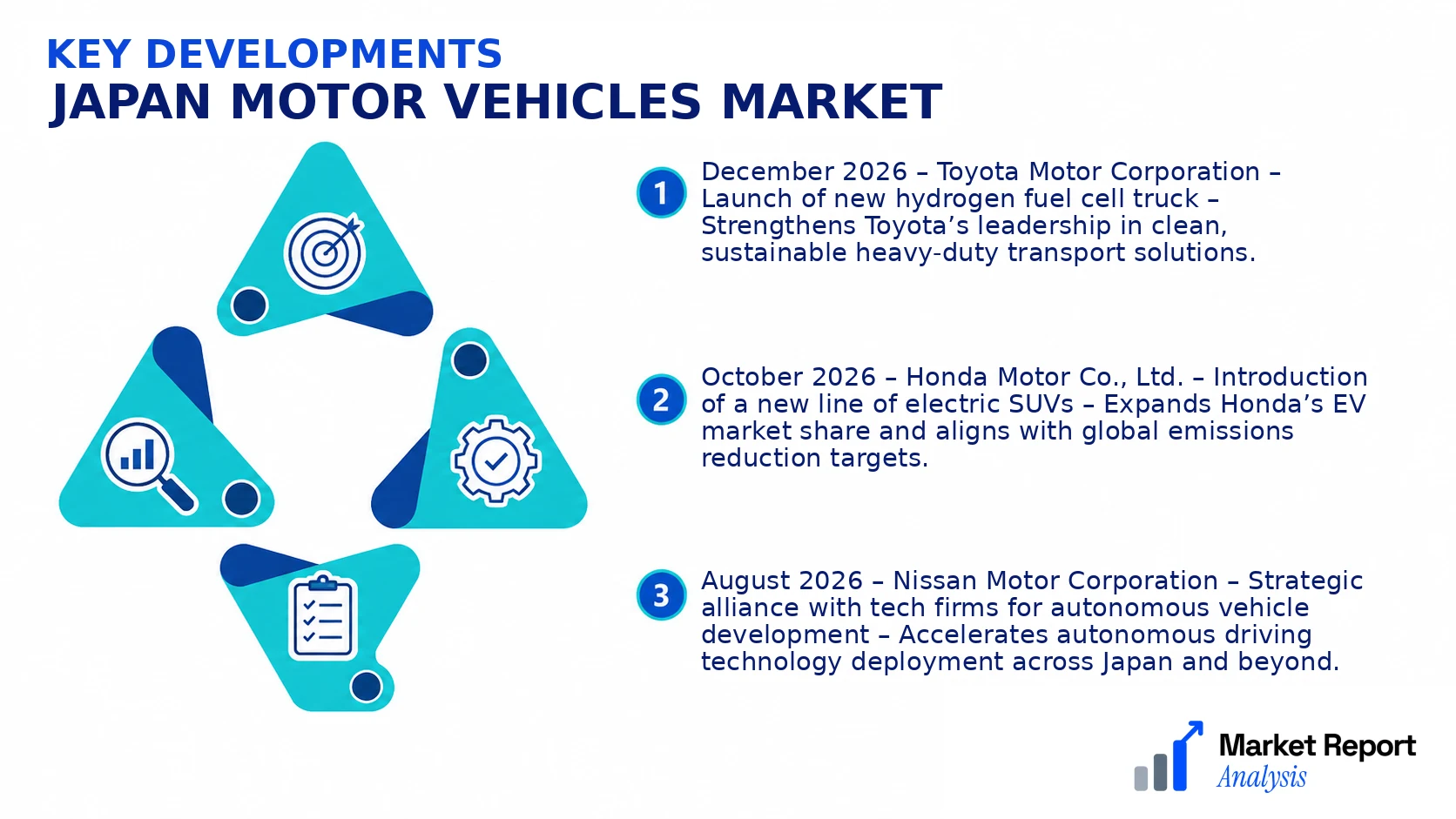
- December 2026 – Toyota Motor Corporation – Launch of new hydrogen fuel cell truck – Strengthens Toyota’s leadership in clean, sustainable heavy-duty transport solutions.
- October 2026 – Honda Motor Co., Ltd. – Introduction of a new line of electric SUVs – Expands Honda’s EV market share and aligns with global emissions reduction targets.
- August 2026 – Nissan Motor Corporation – Strategic alliance with tech firms for autonomous vehicle development – Accelerates autonomous driving technology deployment across Japan and beyond.
- May 2026 – Suzuki Motor Corporation – Capacity expansion in hybrid vehicle manufacturing plant – Enhances production efficiency and meets rising consumer demand for eco-friendly vehicles.
- March 2026 – Mitsubishi Motors Corporation – Investment in solid-state battery R&D center – Positions Mitsubishi at the forefront of next-generation energy storage technologies for EVs.
Frequently Asked Questions
What is the Japan Motor Vehicles Market?
The Japan Motor Vehicles Market encompasses the production, sale, and consumption of automobiles within Japan. It includes various segments such as passenger cars, commercial vehicles, and electric vehicles, reflecting Japan's significant role in global automotive manufacturing and innovation.
What is the current market size of Japan Motor Vehicles Market?
As of 2026, the market size of Japan's motor vehicles industry is valued at approximately USD 360 Billion. This includes sales of all vehicle types and represents Japan’s prominent position in the global automotive landscape, driven by established manufacturing sectors and technological advancements.
What factors are driving the Japan Motor Vehicles Market?
Key drivers include technological innovation, government incentives for electric vehicles, and increasing consumer demand for safety and fuel efficiency. Additionally, Japan's focus on sustainable mobility and exports further bolster the sector's growth prospects.
Which region dominates the Japan Motor Vehicles Market?
The Kanto region, particularly Greater Tokyo, leads the market due to its dense population, advanced infrastructure, and high vehicle ownership rates. Regional manufacturing hubs also contribute significantly to the market’s overall dynamics.
Which segment is expected to grow the fastest?
The electric vehicle (EV) segment is forecasted to exhibit the fastest growth, driven by government policies promoting clean energy and automakers’ investments in EV technology to meet global emission standards and consumer preferences.
Who are the leading companies operating in the Japan Motor Vehicles Market?
Leading firms include Toyota Motor Corporation, Honda Motor Co., Ltd., and Nissan Motor Corporation. These companies dominate through innovative product offerings, large-scale manufacturing, and expanding electric vehicle portfolios, maintaining Japan’s leadership in the global automotive industry.
Analyst Perspective
The long-term outlook for the Japan Motor Vehicles Market remains positive, driven by technological innovation and evolving consumer preferences towards electrification and smart mobility solutions. Commercial opportunities are particularly promising in the electric vehicle (EV) segment, where advancements in battery technology and government incentives support accelerated adoption. Investment priorities should focus on establishing domestic EV manufacturing capabilities, advanced supply chain integration, and developing regional EV charging infrastructure, especially in urban centers like Tokyo and Osaka. Competitive intensity is expected to increase as traditional automakers face new entrants from the tech sector and international players expanding into Japan, fostering rapid innovation. Regionally, Tokyo and neighboring metropolitan areas will continue to be hubs of growth driven by dense urban populations and stringent emission policies. Strategic investments aligned with sustainable mobility and digital transformation will be critical for maintaining market leadership. Long-term success will depend on balancing innovation, regulatory engagement, and regional focus to capture emerging urban mobility services in Japan.
