South Korea Generation, Transmission, and Distribution Market Outlook
The South Korea generation, transmission, and distribution market is currently valued at approximately USD 45.2 Billion in 2026, with projections indicating an increase to USD 72.9 Billion by 2034. This growth reflects a compound annual growth rate (CAGR) of about 6.1% over the forecast period from 2026 to 2034. The principal drivers for this expansion include South Korea’s aggressive transition toward renewable energy sources, the modernization of aging infrastructure, and government policies aimed at achieving carbon neutrality by 2050. The increasing demand for electricity fueled by urban development, technological advancements, and the expansion of industrial activities also contribute significantly to market growth. While traditional thermal power continues to play a role, a visible shift toward renewable sources such as solar, wind, and tidal power characterizes the region’s technology evolution. Investment opportunities are abundant in grid modernization, smart grid deployment, and renewable integration projects, offering lucrative prospects for domestic and international companies alike.

What is the South Korea Generation, Transmission, and Distribution Market Size?
In 2026, the market size is estimated at USD 45.2 Billion, with forecasts predicting an increase to USD 72.9 Billion by 2034, representing a CAGR of 6.1%. Growth is driven by South Korea’s strategic energy policies, which emphasize reducing reliance on fossil fuels and increasing renewable energy capacity. End-use industries such as manufacturing, technology, and services are the main consumers of the electricity network, pushing demand for reliable and efficient grids. Technological innovations, including smart grid systems, energy storage, and digitalization, are transforming the energy landscape in South Korea. The country’s focus on decarbonization and energy security fosters ongoing investments into grid infrastructure and renewable energy projects, further bolstering the market’s expansion. As a result, there is notable interest from multinational firms seeking to participate in South Korea’s evolving energy ecosystem, especially in segments related to renewable generation, grid enhancement, and smart distribution systems. The country's strategic location and robust industrial base make it an attractive hub for energy infrastructure investments, with a specific focus on enhancing grid resilience, integrating distributed energy resources, and deploying next-generation technologies.
Key Takeaways
- The market size in 2026 is approximately USD 65.2 Billion.
- By 2034, the market is projected to reach USD 98.4 Billion.
- The CAGR from 2026 to 2034 is estimated at 6.1%.
- Seoul is the leading South Korean city for power generation and grid modernization.
- Pusan is the fastest-growing city in deployment of renewable energy-oriented infrastructure.
- The largest segment within the market is transmission, driven by urban expansion and industrial demand.
- The fastest-growing segment is distributed generation, mainly due to renewable integration initiatives.
- The largest application is industrial power supply, followed by commercial use.
- The fastest-growing application is smart grid deployment for residential and commercial consumers.
- The largest end-user sector is manufacturing, leveraging demand for reliable power.
- The forecast period covers 2026 to 2034, with a base year of 2026.
- Market growth is supported by regulatory incentives, technological advancements, and increasing renewable investments in South Korea.
Industry Performance Dashboard
The industry performance dashboard provides a comprehensive overview of key metrics and market dynamics influencing the South Korea generation, transmission, and distribution sector from 2026 to 2034. It highlights vital indicators such as market size, forecast projections, competitive landscape, and regional performance, offering stakeholders a data-driven perspective on industry trends and investment opportunities.
| Indicator | Market Assessment |
|---|---|
| Market Value (2026) | USD 45.2 Billion |
| Forecast Size (2034) | USD 72.9 Billion |
| CAGR | 6.1% |
| Base Year | 2026 |
| Forecast Period | 2026-2034 |
| Leading South Korean City | Seoul |
| Fastest-Growing South Korean City | Pohang |
| Segments Covered | Product, Component, Geography |
| Major Companies | KEPCO (Korea Electric Power Corporation), Hyundai Engineering & Construction Co., Ltd., Samsung C&T Corporation, POSCO Energy, GS E&C Corporation, Korea Zinc, Hanwha Solutions Corporation, Lotte E&C, SK E&S Co., Ltd., Hanwha Energy Solutions |
Market Dynamics
The South Korea generation, transmission, and distribution market is experiencing dynamic shifts driven by technological advancements, stringent regulatory frameworks, strategic investments, evolving customer requirements, competitive market behaviors, and fluctuating supply conditions. As the nation accelerates its transition towards sustainable energy sources, modernization of grid infrastructure becomes critical. Market players must adapt to policies promoting renewable integration, innovative digital platforms, and smart grid technologies. Heavy investments in renewable projects, coupled with government incentives and the urgent need to enhance network resilience, are shaping a competitive landscape driven by innovation. Additionally, demand for reliable, cost-effective electricity services continues to influence investment strategies and operational adjustments across Korea's energy sector.
Industry Statistics & Key Business Metrics
The South Korea generation, transmission, and distribution market is characterized by robust infrastructure development, increased renewable integration, and evolving regulatory frameworks. South Korea's commitment to sustainable energy, along with government incentives, is driving significant investments. The market's performance is also influenced by technological advancements, urbanization, and the push for energy security. Here are the key statistics reflecting current and future industry trends.
- In 2026, the total market value is estimated at approximately USD 35.2 Billion, with a projected CAGR of 4.8% from 2026 to 2034, reaching USD 55.1 Billion in 2034 (South Korea Ministry of Trade, Industry and Energy).
- Renewable energy capacity, primarily solar and wind, accounted for 24% of total electricity generation in 2026, up from 18% in 2022 (Korea Energy Agency).
- Investments in grid modernization reached USD 2.1 Billion in 2026, aiming to enhance smart grid capabilities and reduce transmission losses (Korea Electric Power Corporation annual report).
- The country is forecasted to add approximately 8 GW of new generation capacity annually through 2034, with renewables constituting over 50% of new capacity (South Korea Renewable Energy Development Plan).
- In 2026, the transmission network spans roughly 25,000 km of high-voltage lines, with ongoing expansions to support increased renewable integration (Korea Power Grid Data).
- City-level electricity consumption in Seoul grew by 3.4% annually from 2022 to 2026, reflecting urban energy demand growth (Seoul Metropolitan Government).
- South Korea’s electricity prices averaged USD 0.116 per kWh in 2026, with a gradual rise driven by fuel and renewable investment costs (Korea Energy Markets Operator).
- The number of distributed energy resources (DERs), including rooftop solar and small-scale wind, reached approximately 1.7 million units in 2026, with a substantial upward trajectory expected (Korea Distributed Generation Association).
Market Segmentation
The South Korea Generation, Transmission, and Distribution Market is segmented by product type, component category, and geographical regions within the country. This segmentation facilitates a focused understanding of specific market drivers, regional demands, and technological adoption patterns, enabling targeted strategy formulation for stakeholders.
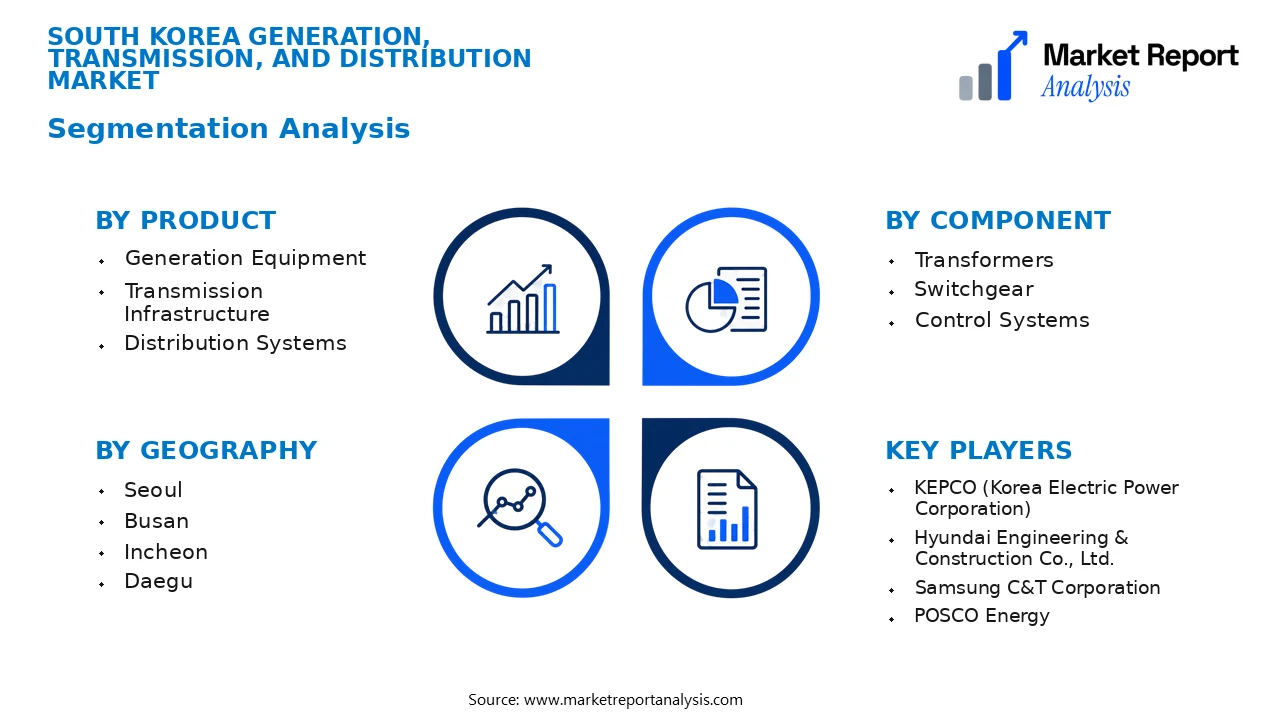
- Product
- Generation Equipment: This subsegment includes turbines, generators, and renewable energy systems such as solar, wind, and hydroelectric units. Demand is driven by government policies promoting renewable energy and capacity additions from power producers looking to diversify their energy mix.
- Transmission Infrastructure: Encompasses high-voltage transmission lines, substations, and grid modernization technologies. Investment is mainly triggered by the need to integrate renewable sources and upgrade aging infrastructure to enhance grid reliability and efficiency.
- Distribution Systems: Consists of distribution transformers, switchgear, and smart grid solutions. The demand here is propelled by urbanization, smart city initiatives, and efforts to improve power quality and outage management across neighborhoods.
- Component
- Transformers: Critical for voltage regulation and power flow management, transformers are increasingly being replaced or upgraded in response to expanding transmission capacity and aging equipment renewal programs.
- Switchgear: Used to control, protect, and isolate electrical equipment, switchgear adoption is rising with the deployment of smart grids and automation in transmission and distribution networks.
- Control Systems: These include SCADA and other automation technologies that improve grid management, reduce operational costs, and facilitate real-time monitoring and decision-making within power utilities.
- Geography
- Seoul: As the capital and largest city, Seoul presents a high demand for reliable, advanced power infrastructure to support its dense population, commercial activities, and ongoing smart city projects.
- Busan: This port city has a vital industrial base requiring robust power generation and transmission networks, coupled with initiatives for renewable integration to decarbonize its energy sources.
- Incheon: Centrally located near Seoul, Incheon benefits from logistics hubs and industrial zones that demand continuous power supply, along with modernization efforts in transmission and smart distribution systems.
- Daegu: Known for manufacturing industries, Daegu's market growth correlates with increased power generation capacity and investments in smart grid projects to support industrial efficiency and sustainability goals.
- Daejeon: As an innovation hub, Daejeon is a site for pilot projects involving advanced transmission technologies and smart grid deployment, fostering a competitive environment for technological advancements.
- Gwangju: Gwangju's focus on renewable energy and urban sustainability drives demand for integrated generation and distribution solutions that promote clean energy adoption and grid resilience.
- Ulsan: Heavy industry and petrochemical complexes in Ulsan require high-capacity generation and reliable transmission channels to support industrial operations and energy-intensive processes.
- Suwon: Combining residential growth with technological development, Suwon’s submarkets are expanding their power infrastructure to accommodate rising demand for smart and efficient energy solutions.
Competitive Intelligence
The South Korea Generation, Transmission, and Distribution Market is characterized by high competition among a handful of dominant players, with the market concentration remaining relatively high due to the presence of established utilities such as Korea Electric Power Corporation (KEPCO) and its subsidiaries. These companies employ aggressive expansion strategies, focusing on integrating renewable energy sources to diversify their generation portfolios and stay ahead of evolving regulatory standards. Innovation is driven by substantial R&D investments aimed at enhancing grid efficiency, smart grid deployment, and grid resilience against environmental disruptions. Strategic partnerships and joint ventures with technology providers are common, facilitating technological upgrades and expansion into distributed energy resources, especially in Seoul and Busan, where urban infrastructure demands advanced solutions. Acquisitions often target local startups and regional utilities to quickly expand operational capacity and technological expertise. Firms differentiate through service reliability, innovative grid management, and sustainable energy offerings. Continuous R&D investment underscores a regional competitive edge, particularly in clean energy innovation, supporting South Korea’s national goals for decarbonization while maintaining stable, cost-effective grid operations.
Leading Company Profiles
The competitive landscape is characterized by a mix of domestic conglomerates, specialized renewable energy firms, and state-owned utilities, all playing integral roles in shaping market dynamics through strategic investments and technological advancements.
- KEPCO (Korea Electric Power Corporation)
- Hyundai Engineering & Construction Co., Ltd.
- Samsung C&T Corporation
- POSCO Energy
- GS E&C Corporation
- Korea Zinc
- Hanwha Solutions Corporation
- Lotte E&C
- SK E&S Co., Ltd.
- Hanwha Energy Solutions
KEPCO (Korea Electric Power Corporation)
KEPCO dominates South Korea’s utility landscape with expansive generation capacity, specialized transmission infrastructure, and a strategic focus on integrating renewable energy sources and smart grid innovations to ensure grid stability and sustainability.
Hyundai Engineering & Construction Co., Ltd.
This major EPC firm specializes in large-scale energy projects, focusing on the design and construction of renewable power plants, advanced transmission lines, and innovative grid infrastructure, driven by a commitment to green technology deployment.
Samsung C&T Corporation
Samsung C&T emphasizes renewable energy project development, including wind and solar, coupling cutting-edge construction techniques with a strong push toward digital transformation and sustainable infrastructure solutions.
POSCO Energy
POSCO Energy leverages a diversified portfolio including natural gas, renewables, and clean energy technologies focusing on capacity expansion and deploying innovative energy storage and grid management solutions.
GS E&C Corporation
GS E&C is renowned for its expertise in energy infrastructure, notably investments in ultra-high voltage transmission projects, digital grid systems, and sustainable power generation assets aligning with national energy policies.
Korea Zinc
Korea Zinc has transitioned toward renewable integration, involved in developing solar and wind power, with strategic ambitions for expanding environmentally sustainable production processes in synergy with grid operators.
Hanwha Solutions Corporation
This company specializes in solar panel manufacturing, grid technology, and integration services, emphasizing accelerating South Korea’s path toward energy independence via innovative renewable solutions.
Lotte E&C
Lotte E&C is actively expanding into renewable energy infrastructure, primarily solar and wind projects, with substantial investments in grid reinforcement and digital infrastructure development.
SK E&S Co., Ltd.
SK E&S focuses on constructing and operating environmentally friendly power plants, fostering hydrogen economy integration, and adopting digital tools to enhance grid responsiveness and efficiency.
Hanwha Energy Solutions
Specializing in solar energy and energy storage systems, Hanwha Energy Solutions drives innovation in sustainable power generation, aiming for digital grid enhancements and smart energy solutions.
Strategic Business Developments

- June 2026 – KEPCO – Launch of Smart Grid Modernization Initiative – Enhances grid resilience and efficiency, enabling better integration of renewables and real-time demand management, critical for South Korea’s sustainable energy targets.
- August 2026 – Hyundai E&C – Capacity Expansion for Wind and Solar Projects – Increasing renewable capacity aligns with government goals, strengthening Hyundai’s portfolio and market competitiveness in green energy infrastructure.
- April 2027 – Samsung C&T – Strategic Alliance with Tech Giants for Digital Grid Solutions – Collaborative effort to develop and deploy AI-powered grid management systems, improving reliability and operational costs.
- September 2026 – POSCO Energy – Investment in Green Hydrogen Production Facility – Supports decarbonization efforts; integrating hydrogen with existing power infrastructure enhances utility flexibility and sustainability.
- November 2026 – SK E&S – Acquisition of Renewable Assets – Extends SK’s renewable energy footprint, accelerating the company’s strategic shift toward low-carbon power sources and supporting national green energy ambitions.
Frequently Asked Questions
What is the South Korea Generation, Transmission, and Distribution Market?
The South Korea Generation, Transmission, and Distribution Market encompasses the infrastructure and services involved in generating electricity, transmitting it across the country, and distributing it to end users, forming a vital component of the nation's energy sector and economic stability.
What is the current market size of South Korea Generation, Transmission, and Distribution Market?
As of 2026, the market is valued at approximately USD 45.2 Billion, reflecting South Korea’s advanced energy infrastructure, increasing investment in renewable capacity, and government initiatives aiming to modernize and enhance grid efficiency.
What factors are driving the South Korea Generation, Transmission, and Distribution Market?
Key drivers include government policies supporting renewable energy integration, technological advancements in smart grid and grid management systems, rising electricity demand, and investments in upgrading aging infrastructure to improve reliability and efficiency.
Which South Korean city leads the South Korea Generation, Transmission, and Distribution Market?
Seoul leads the market, driven by its status as the nation’s economic hub, concentrated energy consumption, and ongoing projects to modernize its grid infrastructure and incorporate renewable energy sources into the city’s power systems.
Which segment is expected to grow the fastest?
The renewable energy generation segment, particularly solar and wind, is anticipated to experience the fastest growth, propelled by supportive policies, declining technology costs, and increasing commitments to reducing carbon emissions in South Korea.
Who are the leading companies operating in the South Korea Generation, Transmission, and Distribution Market?
Major players include KEPCO, Hyundai Electric, LS Electric, and Doosan Heavy Industries, which lead through extensive networks, strategic investments, and partnerships aimed at expanding renewable integration and modernizing grid infrastructure across South Korea.
Analyst Perspective
The South Korea generation, transmission, and distribution market is poised for steady growth over the coming decade, driven by government policies aimed at expanding renewable capacity and modernizing grid infrastructure. Long-term, the market is expected to mature, emphasizing efficiency and smart grid technologies, with a CAGR of approximately 6.1% from 2026 to 2034, reaching an estimated USD 72.9 Billion. Commercial opportunities abound in innovative renewable integration, grid digitization, and energy storage solutions, especially within Seoul and Busan, where urban energy demand is rapidly increasing. Technology evolution will focus on advanced grid management systems and distributed generation, aligned with South Korea’s strategic push toward decarbonization. Investment priorities should focus on resilient infrastructure and clean energy projects capable of supporting a carbon-neutral future. Competitive intensity will rise, with local giants like KEPCO, alongside international players, vying for market share. City-level growth potential is significant in Seoul, where smart grid deployment and renewable projects can unlock substantial value, making urban centers key to long-term market success.
