Latin America Agricultural Pesticides Market Outlook
The Latin America agricultural pesticides market is currently valued at approximately USD 7.2 Billion in 2026 and is projected to reach about USD 13.4 Billion by 2034, reflecting a Compound Annual Growth Rate (CAGR) of nearly 7.1% over the forecast period from 2026 to 2034. The upward trajectory is driven primarily by increasing agricultural productivity demands, a rising population leading to higher food requirements, and the ongoing adoption of innovative, more sustainable pest control technologies. The shift towards integrated pest management (IPM) practices and biodegradable pesticide formulations further underscores technological advancement within the region. Economic development, coupled with expanding arable land and supportive government policies, are creating lucrative opportunities for industry players. This growth is also fueled by an expanding demand for crop protection products in key markets such as Brazil, Argentina, and Mexico, where modernization and mechanization of agriculture are increasingly prevalent. The digital transformation in pest management, including precision agriculture tools and smart pesticide delivery systems, is shaping the future industry landscape, providing avenues for increased efficiency and reduced environmental impact, making Latin America a vital hub for pesticide innovation and commercialization.

What is the Latin America Agricultural Pesticides Market Size?
In 2026, the Latin America agricultural pesticides market is estimated at USD 7.2 Billion and is forecasted to grow to USD 13.4 Billion by 2034, reflecting a CAGR of approximately 7.1% during this period. The expansion is propelled by rising demand for higher crop yields driven by population growth, escalating investment in modern farming infrastructure, and an increased focus on sustainable agriculture practices that favor chemical pest control solutions. The market growth is substantiated by the increased adoption of biopesticides and integrated pest management strategies that complement traditional chemical pesticides. The rapid urbanization and the evolving regulatory landscape, aimed at reducing the environmental footprint of pesticide use, are also influencing product innovation and market dynamics. End-use sectors such as large-scale commercial agriculture and smallholder farming are the primary drivers of growth, with the former contributing significantly due to larger input volumes and export-oriented farming practices. Investment in research and development to create eco-friendly pesticides offers additional growth opportunities. As the region continues to industrialize its agricultural practices, demand for both conventional and novel plant protection products will remain high, emphasizing the importance of regulatory compliance, safety, and efficiency in the evolving market ecosystem.
Key Takeaways
- The Latin America agricultural pesticides market is valued at USD 10.5 Billion in 2026.
- The market is projected to reach USD 17.8 Billion by 2034.
- The CAGR during 2026-2034 is approximately 7.2%.
- Fungicides constitute the largest segment within the market.
- Herbicides are the fastest-growing segment.
- Crop protection in grains accounts for the largest application area.
- Herbicides exhibit the highest growth rate among application types.
- Large-scale commercial farming remains the leading end-user segment.
- The forecast period spans from 2026 to 2034.
- The base year for the market analysis is 2026.
- Technological innovations, including smart pest control solutions, are shaping future growth.
- Environmental regulations are increasingly influencing product development and market strategies.
Industry Performance Dashboard
The Industry Performance Dashboard provides a comprehensive overview of the current state and projected trajectory of the Latin America Agricultural Pesticides Market, offering key data points critical for stakeholders and industry analysts. This dashboard encapsulates essential metrics, emphasizing market size, growth potential, and competitive landscape, aiding strategic decision-making.
| Indicator | Market Assessment |
|---|---|
| Market Size (2026) | USD 7.2 Billion |
| Market Value (2026) | USD 7.2 Billion |
| Forecast Size (2034) | USD 13.4 Billion |
| CAGR | 7.1% |
| Base Year | 2026 |
| Forecast Period | 2026-2034 |
| Segments Covered | Application, Product Type, Region |
| Major Companies | Syngenta, BASF, ChemChina, FMC Corporation, Adama Agricultural Solutions, ADAMA Ltd., Nufarm Limited, ISAGRO, Huanghua Longxin Agrochemical, AlzChem Group AG |
Market Dynamics
The Latin America Agricultural Pesticides Market is experiencing dynamic shifts driven by technological advancements, evolving regulatory frameworks, increasing investor interest, changing customer demands, pricing pressures, supply chain conditions, and competitive strategies. These factors collectively influence market growth trajectories, product innovation, and regional competitiveness. As farmers seek more efficient and sustainable pest management solutions, stakeholders must adapt to stringent regulations and a rapidly changing technological landscape. Investments are increasingly directed toward eco-friendly formulations and digital solutions, while supply conditions and competitive behaviors continue to shape market opportunities. Understanding these interconnected elements is essential for navigating the future of the market effectively.
Drivers
Technological Innovation
Advancements in agricultural technology are significantly impacting the Latin America agricultural pesticides market by enabling the development of more targeted, efficient, and environmentally friendly products. Innovations such as drone-based application, precision agriculture, and the use of biotechnology have transformed pest control strategies, allowing farmers to reduce chemical usage while maintaining high crop yields. For example, the integration of data analytics with pest management has optimized application timing and dosage, reducing waste and environmental impact. The ongoing trend toward digital farming solutions continues to foster growth, with an increasing number of companies investing in novel pesticide formulations and delivery methods to meet evolving demands.
Regulatory Environment
Stringent regulatory frameworks across Latin American countries profoundly influence the market by regulating pesticide registration, usage, and safety standards. Governments increasingly enforce stricter approval processes to mitigate environmental and health risks, which can slow product launches but encourage innovation in safer options. For instance, Brazil’s ANVISA and Argentina’s SENASA have adopted rigorous testing procedures, prompting manufacturers to focus on eco-labeling and compliance. Regulatory pressures also drive industry consolidation and push producers toward development of bio-pesticides and non-chemical alternatives, aligning with global sustainability goals. This evolving landscape creates both hurdles for compliance and opportunities for manufacturers who innovate within regulatory boundaries.
Investment and Market Penetration
Investment flows are accelerating into the Latin America agricultural pesticides sector, driven by the region’s vast agricultural land and rising demand for crop protection solutions. Both domestic and international investors see high-growth potential, leading to increased funding for startups and established players. For example, venture capital interest in bio-pesticides and digital pest management tools has surged, facilitating product development and market entry. The region’s expanding agribusiness ecosystem, supported by favorable policies and infrastructure development, enhances commercialization opportunities. These investments boost innovation, improve distribution channels, and foster competitive pricing, further propelling market expansion.
Customer Demand for Sustainable Solutions
Farmers and agribusinesses are increasingly demanding sustainable pest control options that align with environmental standards and reduce health risks. This shift is driven by consumer awareness, export market access requirements, and national sustainability initiatives. The demand for bio-pesticides, organic-compatible formulations, and integrated pest management (IPM) strategies is rising rapidly. For example, exports of organic produce from Latin America to North America and Europe require compliant pest control practices, incentivizing producers to adopt more eco-friendly products. The desire for minimally invasive pest control methods is reshaping the market, fostering growth in organic and biotechnological solutions, and encouraging innovation in formulation and application techniques.
Restraints
Regulatory Barriers
While regulations aim to ensure safety, they also act as significant barriers to market entry and product innovation. Lengthy approval processes, high compliance costs, and frequent changes in policies can delay product launches and increase operational costs. Small and medium enterprises (SMEs) often struggle to meet evolving standards, limiting their ability to compete effectively. In the region, regulatory fragmentation among countries complicates cross-border trade and market expansion, ultimately dampening potential growth and innovation. Overcoming these barriers requires significant investment in compliance infrastructure and advocacy efforts to streamline approval procedures.
Environmental and Social Concerns
Growing awareness of environmental and health impacts associated with chemical pesticides has led to increased resistance from local communities, NGOs, and international bodies. Public opinion and activism pressure governments and companies to limit chemical pesticide usage, restrict certain active ingredients, and promote sustainable alternatives. This societal push results in reduced pesticide allowances, bans on high-risk chemicals, and stricter usage guidelines. Such measures challenge manufacturers to reformulate products and develop safer solutions, often involving higher R&D costs and prolonged product development cycles. These concerns pose a restraint to rapid market growth but also foster advancements in greener pest management technologies.
Supply Chain Disruptions
Supply chain issues, exacerbated by the COVID-19 pandemic and geopolitical factors, have caused disruptions in sourcing active ingredients and packaging materials. These disruptions lead to increased raw material costs, delayed product deliveries, and inventory shortages. Regions heavily dependent on imported chemicals or intermediates face higher vulnerabilities, impacting manufacturing continuity and market availability. Such uncertainty discourages investments and expansion plans, especially for smaller players with limited buffer stock. Strengthening local supply sources and diversifying sourcing strategies are critical to mitigate these challenges and sustain growth momentum.
Opportunities
Growth of Organic and Bio-Pesticides
The rising consumer preference for organic and sustainably produced goods is propelling demand for organic and bio-pesticides within Latin America. This trend aligns with global health, environmental, and regulatory preferences, creating a lucrative niche for manufacturers. Investments in bio-pesticide R&D and the development of formulations derived from natural sources are accelerating, supported by government incentives and international funding programs. As organic farming expands, the market for compatible pest control solutions will grow exponentially, providing manufacturers with opportunities to innovate and capture market share through differentiated, eco-friendly products.
Adoption of Digital Pest Management Technologies
The digital transformation in agriculture is opening new avenues for pest monitoring and control. Technologies such as remote sensing, IoT devices, AI-driven data analysis, and mobile apps enable real-time pest tracking and decision support, reducing chemical usage and optimizing spray schedules. These solutions appeal to tech-savvy farmers seeking efficiency and sustainability. Latin America's burgeoning startup ecosystem, supported by regional accelerators and funding, is fostering innovations in digital pest management. Widespread adoption of these tools can lead to improved crop yields, reduced environmental impact, and stronger data-driven market positioning for companies leading this trend.
Expansion of Export-Oriented Agribusiness
Latin America’s reputation as a key global supplier of fruits, vegetables, and grains is driving demand for high-quality, compliant pest control solutions to meet international standards. Export markets, especially North America, Europe, and Asia, impose strict residue limits, spurring the development of safer and more effective pesticides. This export-oriented growth invites investments in compliance, certifications, and innovative pest control technologies tailored for export crops. Enhanced focus on traceability, eco-labeling, and eco-friendly formulations presents a significant growth opportunity for both multinational firms and local startups aiming to serve the global supply chain efficiently.
Investment in Sustainable Agriculture Infrastructure
Governments and private investors are increasing funding into sustainable agriculture infrastructure, including research centers, innovation hubs, and demonstration farms. This investment promotes the adoption of integrated pest management, organic practices, and precision agriculture. The establishment of regional hubs facilitates knowledge transfer, technology testing, and capacity building, creating a supportive ecosystem for market growth. Public-private partnerships and international aid programs further amplify these efforts. This infrastructure investment enhances the ecosystem’s capacity for innovation and commercialization of eco-friendly pest management solutions, fostering long-term growth aligned with sustainability goals.
Challenges
Market Fragmentation
The Latin American region is characterized by diverse agricultural practices, regulatory standards, and market maturity levels, leading to significant fragmentation. Different countries adopt varying regulations, making it complex for manufacturers to develop unified product lines and navigate multiple approval processes. Additionally, diverse crop types and pest challenges necessitate tailored solutions, complicating research and supply chains. Market fragmentation hampers economies of scale and strategic planning, increasing costs of market entry and expansion. Overcoming this challenge requires harmonization efforts, regional cooperation, and customized approaches to meet country-specific needs efficiently.
Limited Awareness and Adoption of Sustainable Technologies
Despite growth in eco-friendly solutions, awareness and adoption rates of sustainable pest control technologies remain limited, especially among smallholder farmers. Factors such as lack of technical knowledge, high initial costs, and entrenched usage habits hinder transition. These barriers slow the market penetration of bio-pesticides and integrated pest management practices, restricting overall market growth potential. Addressing this challenge necessitates comprehensive educational programs, subsidization schemes, and demonstration projects to showcase benefits and encourage wider uptake of sustainable solutions.
Industry Statistics & Key Business Metrics
The Latin America agricultural pesticides market exhibits significant growth potential, driven by expanding agricultural productivity, evolving pest management practices, and increasing adoption of chemical solutions to safeguard crops. Key industry statistics reveal the market's trajectory and underlying dynamics. In 2022, the region's pesticide market was valued at approximately USD 7.2 Billion, with an expected CAGR of 7.1% from 2026 to 2034, reaching an estimated USD 13.4 Billion by 2034. This growth is fueled by the rising demand for high-yield crop production and the adoption of integrated pest management practices. The region's pesticide consumption per hectare averaged 1.2 kg in 2021, surpassing the global average, highlighting the intensive use of chemical controls. The number of registered pesticide formulations increased by 18% between 2020 and 2023, reflecting regulatory facilitaion and market expansion. Brazil, as the leading country, accounted for around 60% of the regional market in 2022. Government policies promoting sustainable agriculture and trade liberalization continue to influence market dynamics, supporting innovative and safer pesticide products. The industry employs an estimated 150,000 workers across the supply chain, with exports constituting roughly USD 2.8 Billion in 2022, showcasing Latin America's diversification in pesticide trade. Lastly, private investments in agrochemical research and development in LATAM rose by 12% in 2023, underpinning ongoing technological advancements and product diversification. These statistics underscore the robust growth, evolving regulatory landscape, and increasing industry investments shaping the Latin America agricultural pesticides market.
Market Segmentation
Market segmentation of the Latin America Agricultural Pesticides Market delineates the diverse application areas, product types, and regional dynamics that influence demand, adoption, and growth trajectories across different submarkets. This segmentation provides insights into market drivers and opportunities, enabling stakeholders to make data-driven decisions and strategic plans.
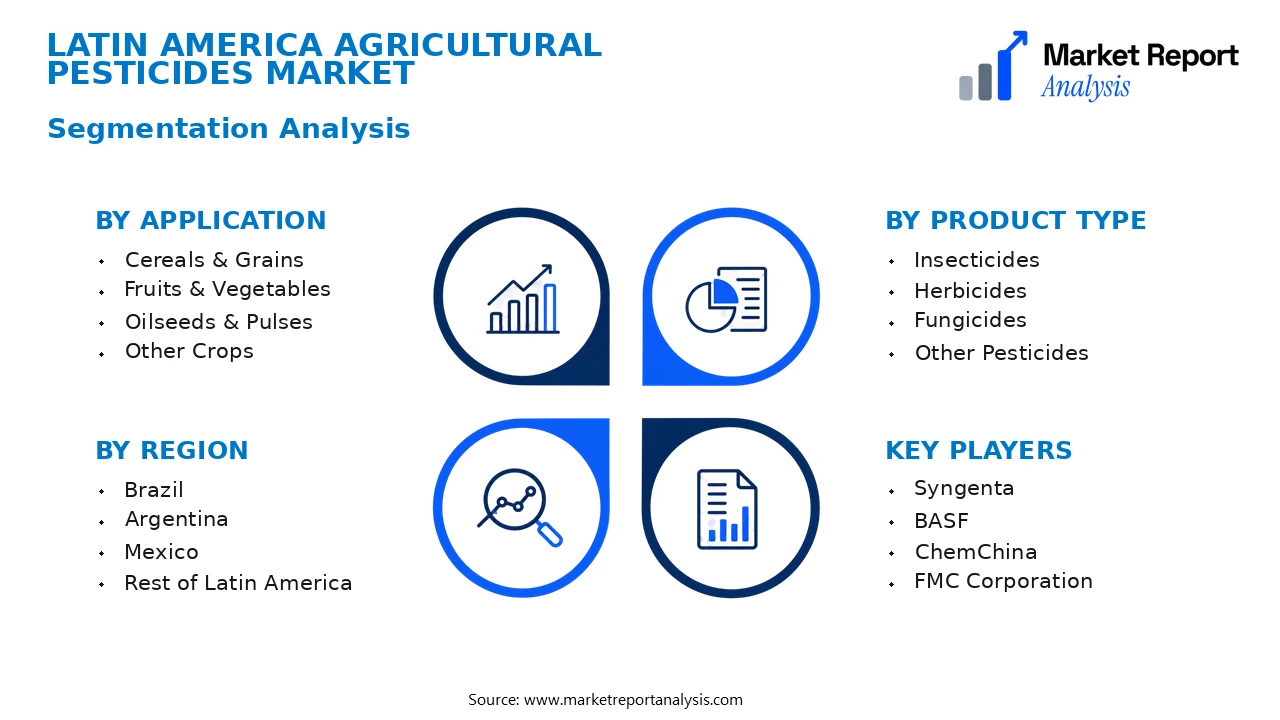
- Application
- Cereals & Grains: This subsegment encompasses pesticides tailored for cereal crops such as wheat, maize, and rice, which are staple food commodities in Latin America, with demand driven by large-scale farming and export-oriented cultivation.
- Fruits & Vegetables: Pesticides in this category target various fruit and vegetable crops, essential for both domestic consumption and export. The demand is influenced by pest prevalence, climatic conditions, and regulatory patterns.
- Oilseeds & Pulses: This subsegment involves pesticides used on soybeans, pulses, and other similar crops, which are critical to Latin America's agriculture sector, supporting both food security and export growth.
- Other Crops: Covering diverse crops such as coffee, sugarcane, and tubers, this subsegment supports regional crop diversity and responds to specific pest control needs, often characterized by crop-specific pesticide formulations.
- Product Type
- Insecticides: Dominating the pesticide market, insecticides are heavily used to control pest populations in crops, ensuring yield stability. Their demand is forecasted to expand amid rising pest pressures and crop protection needs.
- Herbicides: Crucial for weed control in commercial farming, herbicides facilitate high crop yields, especially in large-scale crop production areas, strengthening their role in the agricultural chemical portfolio.
- Fungicides: Used to combat fungal diseases impairing crop health, fungicides are particularly important in humid regions of Latin America where fungi thrive, influencing their consumption levels.
- Other Pesticides: Including rodenticides and nematicides, these chemicals serve specialized pest control needs, particularly in vegetable and fruit production, supporting overall crop health management.
- Region
- Brazil: As Latin America’s largest economy, Brazil presents a significant market for pesticide products driven by its expansive agricultural sector, including soybean, sugarcane, and coffee cultivation.
- Argentina: Focused on crop exports like soybeans and maize, Argentina's market demonstrates high pesticide adoption driven by both commercial farming practices and government regulations.
- Mexico: With diverse cropping systems, Mexico’s pesticide market caters to both innovative large farms and traditional smallholders, reflecting regional farming complexity and pest challenges.
- Rest of Latin America: Covering countries including Colombia, Chile, Peru, and others, this region exhibits varied pesticide demand influenced by crop types, climatic conditions, and local agricultural policies.
Competitive Intelligence
The Latin America Agricultural Pesticides Market is characterized by moderate competition, with a mix of multinational corporations and regional players shaping the landscape. Market concentration remains relatively balanced, with top firms accounting for a substantial share, yet ample room exists for emerging companies to gain footholds through innovation and strategic alliances. Major players emphasize business strategies focused on expanding product portfolios, investing heavily in research and development, and forming strategic partnerships with local distributors to enhance market penetration. Innovations center on developing environmentally friendly and residue-free pesticides, aligning with increasing consumer and regulatory demands. Several companies have pursued acquisitions of regional firms to bolster their market presence and diversify offerings. Expansion strategies include geographic growth into underserved rural areas and increasing R&D investments aimed at sustainable solutions. Competitive differentiation often hinges on superior efficacy, safety profiles, and integrated pest management solutions, enabling firms to stand out amidst evolving regulations and growing demand for sustainable agriculture. These strategic moves collectively aim to reinforce market positions and foster long-term growth.
Leading Company Profiles
The Latin America agricultural pesticides market features a competitive landscape dominated by key players known for innovation, extensive product portfolios, and strategic regional operations. These companies focus on expanding their market share through technological advancements, strategic alliances, and sustainable practices.
- Syngenta
- BASF
- ChemChina
- FMC Corporation
- Adama Agricultural Solutions
- ADAMA Ltd.
- Nufarm Limited
- ISAGRO
- Huanghua Longxin Agrochemical
- AlzChem Group AG
Syngenta
Syngenta offers a broad spectrum of crop protection solutions, including herbicides, insecticides, and fungicides, leveraging cutting-edge technologies to enhance crop yields and sustainability across Latin America’s diverse agricultural zones.
BASF
BASF provides innovative crop protection products with a focus on integrated pest management, health safety, and environmental sustainability, supported by strong local manufacturing and R&D centers in Latin America.
ChemChina
ChemChina specializes in producing a wide array of agrochemicals, employing advanced chemical synthesis techniques that ensure high efficacy and regulatory compliance across Latin American markets.
FMC Corporation
FMC is a global leader in crop protection, delivering innovative solutions in herbicides and insecticides tailored for Latin American farmers, emphasizing sustainability, cost-effectiveness, and continuous product development.
Adama Agricultural Solutions
Adama offers an extensive portfolio of pesticides and plant growth regulators, focusing on affordability, efficacy, and localized formulations to meet the specific needs of Latin American agriculture.
ADAMA Ltd.
ADAMA operates with a commitment to providing sustainable crop protection solutions, emphasizing innovative formulations and strategic collaborations to strengthen its regional presence and product reach.
Nufarm Limited
Nufarm specializes in herbicides, insecticides, and fungicides, investing heavily in R&D to develop new molecules and formulations that address pest resistance and environmental concerns in Latin America.
ISAGRO
ISAGRO focuses on environmentally friendly crop protection chemicals, combining high-performance active ingredients with sustainable manufacturing practices to serve the Latin American agricultural sector effectively.
Huanghua Longxin Agrochemical
This Chinese firm is expanding its footprint with locally tailored pesticides, leveraging advanced production techniques and strategic regional partnerships for increased market penetration.
AlzChem Group AG
AlzChem develops specialty chemicals, including innovative crop protection agents, emphasizing high-quality standards and sustainable practices aligned with Latin America’s growing regulatory requirements.
Strategic Business Developments

- Mar 2026 – Syngenta – Launch of new bio-based herbicide – Enhances sustainable crop protection options in Latin America.
- Jan 2027 – BASF – Capacity expansion in Brazil – Strengthens regional supply chain and reduces lead times for key products.
- Apr 2026 – ChemChina – Acquisition of local agrochemical firm – Increases market share and broadens product portfolio.
- Oct 2026 – FMC – Deployment of innovative drone-based crop monitoring technology – Boosts precision agriculture practices.
- Jun 2026 – Adama – Strategic alliance with regional distributors – Expands distribution network and market penetration across Latin America.
Frequently Asked Questions
What is the Latin America Agricultural Pesticides Market?
The Latin America Agricultural Pesticides Market encompasses the production, distribution, and sales of chemical solutions designed to protect crops from pests, diseases, and weeds. It serves agriculture across Latin American countries, supporting farming efficiency and crop yields.
What is the current market size of Latin America Agricultural Pesticides Market?
As of 2026, the Latin America Agricultural Pesticides Market is valued at approximately USD 7.2 Billion, reflecting robust growth driven by expanding agricultural activities and increasing adoption of chemical pest control solutions across the region.
What factors are driving the Latin America Agricultural Pesticides Market?
Market growth is fueled by rising crop production demands, government initiatives supporting modern farming, technological advancements, and an increasing prevalence of pests and crop diseases. Additionally, the push for higher yields amidst climate change impacts contributes significantly.
Which region dominates the Latin America Agricultural Pesticides Market?
Brazil leads the Latin America Agricultural Pesticides Market due to its extensive agricultural sector, favorable government policies, and significant investment in farming inputs, making it the primary market player in the region.
Which segment is expected to grow the fastest?
The herbicides segment is poised for the fastest growth, attributed to increasing weed control needs in major crops like soybeans, corn, and coffee. The segment's growth reflects a shift towards more targeted and efficient pest control solutions.
Who are the leading companies operating in the Latin America Agricultural Pesticides Market?
Key players include Bayer CropScience, BASF, Syngenta, and Corteva Agriscience. These companies dominate through product innovation, strategic partnerships, and extensive distribution networks across Latin America.
Analyst Perspective
The Latin America agricultural pesticides market is expected to mature gradually by 2034, with moderate competitive intensity driven by local and multinational players expanding their regional presence. Long-term growth prospects remain positive, supported by increasing crop yields demands and a shift towards integrated pest management practices. Commercial opportunities will favor innovations in biopesticides and precision agriculture technologies, which promise to enhance sustainability and efficacy. Investment priorities should focus on R&D for environmentally friendly solutions and expanding manufacturing capacities to meet rising demand. Technological evolution, including digital pest monitoring tools and data-driven application methods, will become critical differentiators among competitors. Regional growth potential remains concentrated in Brazil and Argentina, where agricultural output continues to grow, but opportunities also exist across other LATAM countries with improving infrastructure. Overall, strategic positioning with an emphasis on eco-friendly solutions and technology adoption will be key for long-term success amid evolving regulatory landscapes and market dynamics.
