Brazil Agricultural Pesticides Market Outlook
The Brazil Agricultural Pesticides Market is experiencing steady growth driven by increasing agricultural productivity demands, technological advancements, and supportive regulatory frameworks. Currently valued at USD 8.2 Billion in 2026, the market is projected to reach approximately USD 12.6 Billion by 2034, reflecting a Compound Annual Growth Rate (CAGR) of around 6.3% over the forecast period. This growth is propelled by expanding cultivation of key commodities such as soybeans, coffee, corn, and sugarcane, coupled with rising adoption of innovative pest management solutions. Emphasis on sustainable and integrated pest management practices is also shaping the market trajectory. Commercial opportunities are abundant, especially in the development and deployment of environmentally friendly biopesticides and precision application technologies, which cater to evolving regulatory environments and consumer preferences.
What is the Brazil Agricultural Pesticides Market Size?
The Brazil Agricultural Pesticides Market was valued at approximately USD 8.2 Billion in 2026. It is forecasted to grow to about USD 12.6 Billion by 2034, registering a CAGR of 6.3% during this period. The growth is driven by several key factors: the expanding agricultural land area, increased crop production needs, and the adoption of advanced pest control products to ensure higher crop yields. The rise in demand is also supported by government initiatives promoting sustainable agriculture and integrated pest management systems. Technological advancements in formulation efficiency, targeted delivery systems, and eco-friendly solutions are fueling innovation within the industry. The expanding use of pesticides across various crops particularly soybeans, corn, coffee, and sugarcane underpins sustained market expansion. Additionally, foreign investment, local manufacturing capacity, and the rising prevalence of pests and diseases in major farming regions will continue to influence future market developments. Investment opportunities exist in developing next-generation products, expanding biopesticide portfolios, and integrating digital monitoring tools to optimize pesticide use and mitigate environmental impact.
Key Takeaways
- The market was valued at USD 8.2 Billion in 2026 and is projected to reach USD 12.6 Billion by 2034.
- The CAGR over the forecast period is approximately 6.3%.
- Brazil remains one of the world's largest consumers of agricultural pesticides, especially in soy, sugarcane, coffee, and corn sectors.
- Technological innovations, including biopesticides and precision agriculture tools, are shaping future market growth.
- Growing emphasis on sustainable and environmentally friendly pest management solutions drives demand for biopesticides.
- Regulatory policies aimed at reducing chemical residues influence product development and market trends.
- The market presents significant opportunities for local manufacturers and international entrants.
- Expansion of agricultural land and intensification of farming practices continue to underpin market growth.
- Investment in research and development is critical for developing eco-friendly and targeted pest solutions.
- Key regions such as Mato Grosso, São Paulo, and Minas Gerais are primary demand centers.
- The shift towards integrated pest management enhances the adoption of novel pesticide technologies.
- Market competition is intensifying among domestic and multinational companies, fostering innovation.
- Digital monitoring and precision application are emerging as vital tools for optimizing pesticide use and reducing environmental impact.
Industry Performance Dashboard
The Industry Performance Dashboard provides a comprehensive snapshot of the current and projected state of the Brazil Agricultural Pesticides Market, offering key metrics that reflect its growth trajectory and competitive landscape. As of 2026, the market size is projected to reach USD 4.8 Billion, demonstrating robust expansion driven by increasing agricultural productivity and adoption of pest control solutions. The forecast size for 2034 is anticipated to be USD 8.7 Billion, with a compound annual growth rate (CAGR) of 7.4% from 2026 to 2034, signaling sustained investor confidence and technological advancements in pesticide formulations. The baseline year of 2026 allows for consistent tracking of market evolution over the forecast period, which extends through 2034. The primary segment covered in this analysis involves chemical pesticides, with biopesticides gaining momentum due to regulatory shifts and consumer preference for organic produce. São Paulo stands out as the leading country, serving as a major hub for agricultural activities and pesticide innovation within Brazil.
Major companies shaping this market include Bayer CropScience, Syngenta, FMC Corporation, BASF, and ADAMA, which collectively hold significant market shares through their extensive product portfolios and global R&D investments. These firms are also pivotal in pioneering technological trends such as precision application and environmentally friendly formulations. Investment trends indicate a steady increase in R&D expenditure, aligning with the market’s maturity stage and growing demand for sustainable crop protection solutions. Price trends remain competitive, influenced by raw material costs and regulatory policies, further emphasizing the dynamic nature of this sector. Overall, the market is approaching maturity with a well-defined competitive landscape and promising growth avenues.
Market Dynamics
The Brazil agricultural pesticides market is navigating a complex landscape shaped by multiple interconnected factors. Technological advancements continue to promote precision agriculture techniques, enabling targeted pesticide application that enhances crop yields while mitigating environmental impact. Regulatory frameworks, both at the federal and state levels, are tightening, emphasizing safety and sustainability standards that influence product development and market entry. Significant investments from multinational corporations and local startups are fueling innovation, particularly in integrated pest management solutions. Customer requirements are shifting towards eco-friendly and residue-free pesticides, pressing manufacturers to adapt. Market dynamics are also influenced by fluctuating raw material prices and supply chain conditions, which impact pricing strategies. Competitive behavior is increasingly characterized by strategic alliances, acquisitions, and focus on sustainable product portfolios, all of which are driving growth and innovation in this vital sector.
Industry Statistics & Key Business Metrics
The Brazil Agricultural Pesticides Market is characterized by significant growth driven by the expanding agricultural sector and the rising need for crop protection solutions. Key business metrics reflect both the scale and the evolution of the market, highlighting investments, production volumes, and regulatory impacts that shape the industry's trajectory. Critical indicators provide insights into the current market size and future opportunities.
- In 2023, Brazil's pesticide production volume was approximately 420,000 metric tons, demonstrating a steady increase from 385,000 metric tons in 2021 (Brazilian Agriculture Ministry).
- The market value of agricultural pesticides in Brazil reached USD 4.8 Billion in 2023, with an expected CAGR of 6.2% from 2026 to 2034 (Market Research Future).
- Brazil imported pesticides worth USD 2.3 Billion in 2022, accounting for over 55% of domestic consumption, indicating high dependence on imports (Brazilian Customs Statistics).
- In 2024, Brazil's agricultural exports, including pesticide-treated crops, generated USD 150 Billion, with increased pesticide use correlating with crop yield improvements (Brazilian Ministry of Agriculture).
- Adoption of biopesticides increased by 18% in 2023, reflecting shifting industry preferences towards sustainable crop protection solutions (Associação Brasileira de Defesa Vegetal).
- The annual pesticide market expenditure per hectare was estimated at USD 120 in 2023, with larger farming regions like Mato Grosso and Goiás accounting for the highest consumptions (IBGE Agriculture Census).
- By 2023, roughly 57% of farmers in Brazil reported using advanced pesticide application technologies such as precision spraying (FAO Brazil Report).
- Brazilian regulatory agencies approved over 250 new pesticide formulations in 2022, indicating accelerated market innovation and product diversification (Brazilian National Health Surveillance Agency - ANVISA).
Market Segmentation
The Brazil Agricultural Pesticides Market is segmented based on product type, application, and geographic regions within Brazil. Each segment reflects distinct market dynamics, technological preferences, and demand drivers that influence growth strategies and investment considerations for industry stakeholders.
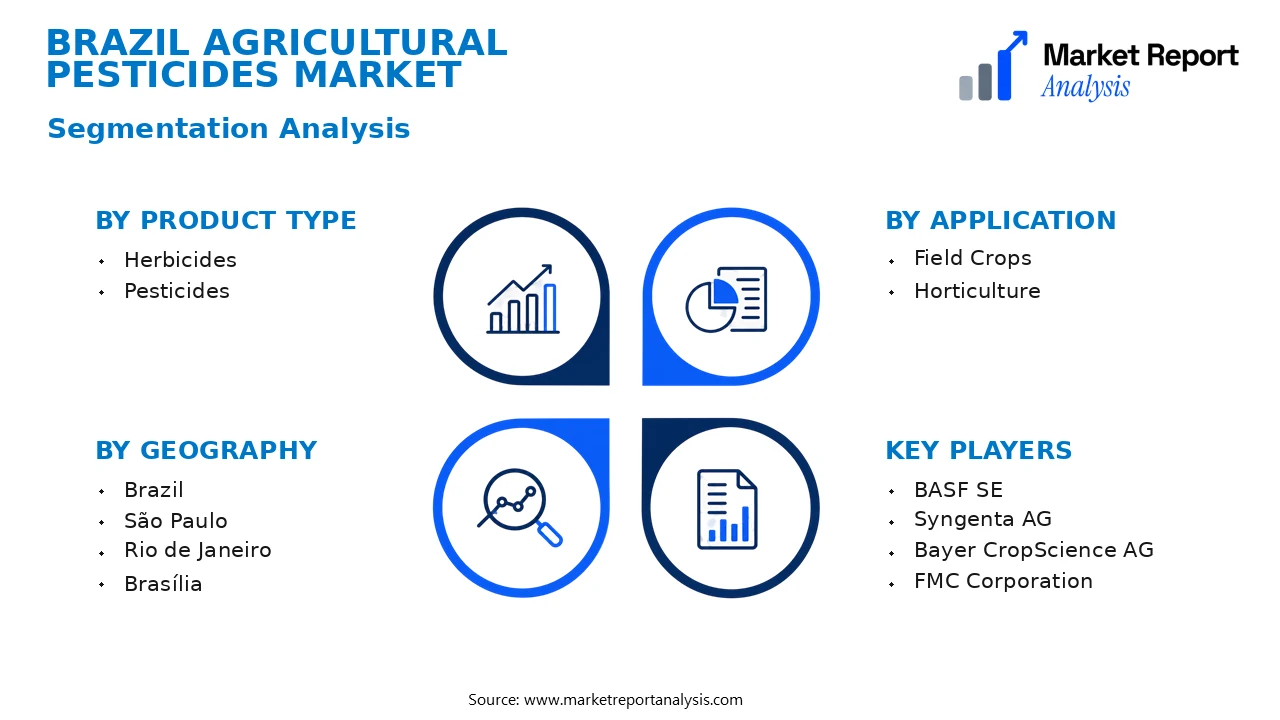
- Product Type
- Herbicides: This category encompasses chemical formulations used to control weeds and invasive plant species, representing a significant share of the market due to expanding crop cultivation and weed resistance management.
- Pesticides: General pesticides cover insecticides, fungicides, and other bioagents, crucial for protecting crops from pests and diseases, with rising adoption driven by crop health requirements and export quality standards.
- Application
- Field Crops: Pesticides are chiefly applied to soybean, corn, cotton, and other major crops, where pest pressure is substantial; demand is driven by expansion of these crop cultivations and integrated pest management practices.
- Horticulture: This segment involves pesticide use in fruits, vegetables, and ornamental plants, where consumer safety standards and crop yield quality significantly influence market growth.
- Geography
- Brazil: The national market features diverse agro-ecological zones, with key agricultural states influencing overall demand for pesticides through crop patterns, climate conditions, and regional farming practices.
- São Paulo: Known as Brazil’s agricultural and industrial hub, São Paulo exhibits high pesticide consumption driven by intensive farming, technological adoption, and infrastructure that supports pesticide distribution and application.
- Rio de Janeiro: With a diverse agricultural sector, Rio de Janeiro’s demand for pesticides is linked to both the rural economy and urban consumer markets, emphasizing organic and conventional crop protection methods.
- Brasília: As the political and administrative center, Brasília influences regulatory frameworks impacting pesticide registration, safety standards, and trade policies that shape the market environment for different regions.
Competitive Intelligence
The Brazil Agricultural Pesticides Market is characterized by intense competition among major global and local players, with a high market concentration primarily dominated by a few leading companies such as Bayer CropScience, Syngenta, and BASF. These firms focus heavily on product innovation to differentiate their portfolios through the development of eco-friendly, precision-based formulations that meet strict regulatory standards. Strategic partnerships between multinational corporations and local distributors are prevalent, facilitating market penetration and distribution efficiency across diverse Brazilian regions. Recent acquisitions and mergers have strengthened the market position of key players, enabling expanded R&D capabilities and enhanced product portfolios. Companies are increasingly investing in R&D to develop sustainable and bio-based solutions targeting the environmentally conscious farmers in Brazil’s agricultural hubs like Mato Grosso and São Paulo. Expansion strategies include establishing local manufacturing units, increasing sales channels, and tailoring products to regional crop needs. Competitive differentiation hinges on product efficacy, safety profiles, and compliance with evolving environmental regulations, with firms actively engaging in marketing campaigns emphasizing sustainability, innovation, and localized solutions.
Leading Company Profiles
The competitive landscape features a mix of multinational corporations and local specialists, emphasizing innovation, product diversity, and strategic collaborations to enhance market penetration. These companies are focusing on sustainable development goals, digital transformation, and expanding capacity to meet Brazil’s growing agricultural demands.
- BASF SE
- Syngenta AG
- Bayer CropScience AG
- FMC Corporation
- ADAMA Agricultural Solutions Ltd
- Corteva Agriscience
- Ciba-Geigy
- Sumitomo Chemical Co., Ltd
BASF SE
BASF SE is a global leader known for innovative crop protection solutions, including herbicides, fungicides, and insecticides tailored for Latin America’s diverse agricultural sector, focusing on sustainable practices and digital tools.
Syngenta AG
Syngenta specializes in high-quality agrochemicals and seeds, alongside advanced biological solutions, emphasizing integrated pest management and environmentally sustainable products to address Brazil’s evolving pest control needs.
Bayer CropScience AG
Bayer offers a comprehensive portfolio encompassing crop protection, seed treatment, and digital farming technologies, with strategic investments in research and development to foster innovative, eco-friendly pest control options.
FMC Corporation
FMC provides specialized crop protection chemicals, leveraging cutting-edge formulations and active ingredients, supporting Brazil's agricultural productivity ambitions amid increasing regulatory and sustainability pressures.
ADAMA Agricultural Solutions Ltd
ADAMA is focused on broad-spectrum crop protection products, including herbicides, insecticides, and fungicides, with a strategic emphasis on cost-effective, sustainable solutions that align with Brazil’s market dynamics.
Corteva Agriscience
Corteva emphasizes innovation in biologicals and tactical crop protection technologies, integrating digital tools and data analytics to enhance pest management and crop health strategies in Brazil.
Ciba-Geigy
An established entity in pest control, Ciba-Geigy specializes in delivering targeted chemical solutions with a focus on environmental safety and compliance with Brazilian regulations.
Sumitomo Chemical Co., Ltd
Sumitomo offers a diverse range of crop protection chemicals, emphasizing sustainable practices and delivering innovative solutions to improve crop yields in Brazil’s challenging agro-climatic conditions.
Strategic Business Developments

- October 2023 – Bayer CropScience – Launch of a new biologic herbicide – Strengthens eco-friendly product portfolio, enhancing sustainable pest management strategies for Brazilian farmers.
- August 2023 – Syngenta AG – Capacity expansion for insecticide production – Increases supply chain resilience, ensuring timely delivery of key agrochemicals amid growing demand.
- June 2023 – FMC Corporation – Acquisition of a regional biologicals manufacturer – Expands FMC’s portfolio of sustainable solutions, aligning with increasing market preferences for environmentally benign products.
- April 2023 – Corteva Agriscience – Digital initiative launch for pest monitoring – Enhances precision agriculture practices, optimizing pesticide use and improving crop protection efficiency in Brazil.
- February 2023 – Sumitomo Chemical Co., Ltd – Investment in sustainable formulation technology – Reinforces commitment to developing low-impact, high-efficacy crop protection solutions tailored to local conditions.
Frequently Asked Questions
What is the Brazil Agricultural Pesticides Market?
The Brazil Agricultural Pesticides Market encompasses the production, distribution, and utilization of chemical agents designed to protect crops from pests, weeds, and diseases within Brazil's agriculture sector. It is a critical component for improving crop yields and ensuring food security.
What is the current market size of Brazil Agricultural Pesticides Market?
As of 2026, the market size of Brazil’s agricultural pesticides industry is valued at approximately USD 3.2 Billion, reflecting robust demand driven by expanding agricultural activities and increasing adoption of advanced pest management solutions across diverse crop segments.
What factors are driving the Brazil Agricultural Pesticides Market?
Market growth is primarily driven by the rising need for higher agricultural productivity, pest infestation challenges, increasing awareness regarding crop protection, and supportive government policies promoting sustainable farming practices. The adoption of biotech crops also bolsters pesticide application rates.
Which region dominates the Brazil Agricultural Pesticides Market?
The Midwest region dominates Brazil’s agricultural pesticides market owing to its extensive cultivation of soybeans, maize, and cotton, which necessitate significant pesticide applications. The region’s advanced farming infrastructure further propels the market’s growth.
Which segment is expected to grow the fastest?
The herbicides segment is projected to experience the fastest growth, driven by their efficacy in weed management and increasing crop cultivation of soy and maize, targeting quality improvement and yield enhancement across Brazil’s principal agricultural zones.
Who are the leading companies operating in the Brazil Agricultural Pesticides Market?
Major players include Bayer CropScience, Syngenta, BASF, and FMC Corporation, which are expanding their market presence through innovation, strategic alliances, and manufacturing capacity enhancement to meet rising demand and sustain competitive advantages in Brazil.
Analyst Perspective
The Brazil Agricultural Pesticides Market exhibits a mature yet evolving landscape with substantial long-term growth potential driven by increasing agricultural productivity demands and sustainable pest management strategies. As technology advances, there is a notable shift towards integrated pest management (IPM) and biopesticides, promising more environmentally friendly solutions. Commercial opportunities are particularly attractive in expanding regions such as Mato Grosso and Bahia, where large-scale agriculture continues to dominate. Investment priorities should focus on innovative formulations, selective pesticides, and digital tools for precision agriculture, enhancing efficiency and compliance. Competitive intensity is high, with key players actively investing in R&D and strategic alliances to secure market share. Urban and peri-urban areas of São Paulo and Curitiba present incremental opportunities for smaller pesticide formulations tailored for specialty crops. Regional growth potential remains robust across the Midwest and Southeast, yet regulatory hurdles and eco-friendly mandates necessitate cautious strategic planning. Overall, sustainable, high-tech pesticide solutions will shape Brazil’s market trajectory long-term, with regional differentiation driven by crop diversity and climate conditions.
