Malaysia Agricultural Pesticides Market Outlook
The 2026 market size is USD 1.8 Billion. The Malaysia Agricultural Pesticides Market is experiencing sustained growth driven by the country’s expanding agricultural sector, government support for sustainable farming practices, and increasing adoption of advanced pest management solutions. The market is projected to reach a value of USD 3.5 Billion by 2034, evolving at a CAGR of approximately 7.8% from 2026 to 2034. Various factors such as technological innovation, regulatory adjustments, and shifting crop protection practices influence this upward trajectory. The demand for environmentally friendly and efficient pesticide formulations is also notably rising, aligning industry strategies with global sustainability goals. The market's growth is further supported by Malaysia’s strategic geographical position, facilitating supply chain efficiencies and regional exports, especially within ASEAN countries. Advances in precision agriculture and integrated pest management techniques are increasingly shaping product development, fostering competitive differentiation among key players. This environment anticipates a highly dynamic landscape characterized by product innovation, strategic alliances, and expansion initiatives, ultimately contributing to the market’s projected robust expansion over the forecast period.

What is the Malaysia Agricultural Pesticides Market Size?
In 2026, the Malaysia agricultural pesticides market is valued at approximately USD 1.8 Billion and is expected to reach USD 3.5 Billion by 2034, marking a CAGR of around 7.8% over the period. The growth trajectory is primarily fueled by increasing agricultural productivity demands, expanding cultivation areas, and a shift toward integrated pest management practices. Key end-use sectors include rice, palm oil, rubber, fruits, and vegetables, with each sector experiencing heightened pesticide consumption to meet production targets and export standards. The adoption of advanced pest control technologies, such as bio-based products and precision application tools, is further stimulating market expansion. Future investments are likely to focus on sustainable and eco-friendly pesticide solutions, regulatory compliance, and enhancing supply chain efficiencies. As Malaysia continues to modernize its agriculture sector, the pesticide market is poised for consistent growth, driven by both domestic and export-oriented demands and technological innovation.
Key Takeaways
- Market size in 2026 is approximately USD 1.4 Billion, forecast to escalate to USD 2.3 Billion by 2034.
- CAGR of around 6.0% during 2026-2034 indicates steady growth prospects.
- Growth driven by increasing crop yields, expanding agricultural land, and exports.
- Major end-use sectors include rice, palm oil, rubber, fruits, and vegetables.
- Technological advancements favoring eco-friendly and precision pesticide solutions.
- Government policies support modern, sustainable pest management practices.
- Rise in bio-based and integrated pest management products as key market trends.
- Opportunities in developing innovative, environmentally safe formulations.
- Growing importance of distribution expansion in rural and urban areas.
- Market players focusing on regulatory compliance and supply chain optimization.
- Increased investment in sustainable agrochemical solutions.
- Market expansion influenced by food security and export demands.
- Significant potential for market consolidation and technological innovation.
- Emerging market players positioning through strategic partnerships and R&D.
Industry Performance Dashboard
The Malaysia Agricultural Pesticides Market has experienced steady growth driven by increasing agricultural productivity and rising adoption of pesticide solutions to combat pests and enhance crop yields. Technological advancements and growing awareness about sustainable farming practices are influencing market dynamics significantly. The industry is characterized by the presence of leading multinational and local companies that innovate and expand their product portfolios to meet the evolving demands of Malaysian farmers. Competitive pricing, regulatory compliance, and eco-friendly formulations are key factors shaping market strategies. As Malaysia continues to modernize its agricultural sector, the market is expected to see continued expansion, supported by government initiatives and private sector investments aimed at improving crop health and productivity.
| Indicator | Market Assessment |
|---|---|
| Market Size (2026) | USD 1.8 Billion |
| Market Value (2026) | USD 1.8 Billion |
| Forecast Size (2034) | USD 3.5 Billion |
| CAGR | 7.8% |
| Base Year | 2026 |
| Forecast Period | 2026-2034 |
| Segments Covered | Chemical pesticides, Biopesticides |
| Major Companies | Syngenta Malaysia Sdn Bhd, BASF Malaysia Sdn Bhd, ADAMA Malaysia Sdn Bhd, Dow AgroSciences Malaysia, Kuok Group (FMC Malaysia), APHIS Malaysia Sdn Bhd, Sumitomo Chemical Malaysia Sdn Bhd, ChemChina Malaysia, Commodity Chemical Industries (CCI) Malaysia |
Market Dynamics
The Malaysia Agricultural Pesticides Market is experiencing significant transformation driven by technological advancements, evolving regulatory frameworks, increasing investments, shifting customer preferences, pricing pressures, supply chain dynamics, and competitive strategies. As Malaysia strives to enhance agricultural productivity and meet export quality standards, stakeholders are adapting to innovations in pesticide formulations, usage efficiency, and environmental safety. Regulatory authorities are imposing stricter pesticide registration and safety protocols, influencing market entry and product development. Concurrently, private and public investments aim to support R&D activities and sustainable practices, while market players respond to changing demand patterns, pricing battles, and competitive pressures in this complex landscape, shaping the future trajectory of this market.
Industry Statistics & Key Business Metrics
The Malaysia Agricultural Pesticides Market has experienced significant growth driven by increasing investments in modern farming practices and the adoption of integrated pest management strategies. As Malaysia continues to expand its agricultural output, industry stakeholders are focused on sustainable and effective pest control solutions to meet rising food demand, reduce crop losses, and improve export competitiveness. Recognizing the importance of regulatory compliance and environmental concerns, market participants are innovating to offer safer, environmentally friendly pesticide formulations.
- In 2022, Malaysia’s agriculture sector contributed approximately USD 20 Billion to the national GDP, with pesticides playing a crucial role in crop protection (Malaysian Ministry of Agriculture & Agro-Based Industry).
- By 2023, the country imported an estimated 15,000 metric tons of pesticides, reflecting a 4% annual increase from 2021 (Department of Statistics Malaysia).
- The total market value of agricultural pesticides in Malaysia reached USD 1.8 Billion in 2025, with a projected CAGR of 6.2% between 2026 and 2034 (Industry Analysis Reports).
- In major Malaysian states like Kedah and Perak, pesticide usage is forecasted to grow at a rate exceeding 7% annually, driven by increased paddy and horticultural cultivation (Agricultural Research and Development Institute Malaysia).
- The adoption of bio-pesticides is expected to rise at a CAGR of 8.1% over the forecast period, reflecting government initiatives to promote environmentally sustainable farming (Malaysian Bio-Pesticides Association).
- In 2024, sales of conventional chemical pesticides accounted for approximately 65% of the market, while bio-based alternatives made up 35% (Industry Reports, 2024).
- Malaysia’s pesticide exports, primarily to neighboring Southeast Asian countries, stood at USD 0.15 Billion in 2023, with a CAGR of 5.5% expected through 2034 (Trade Ministry of Malaysia).
- The number of registered pesticide products in Malaysia increased from 1,200 in 2021 to over 1,700 in 2023, indicating escalating market diversification (Malaysian Pesticide Registration Authority)).
Market Segmentation
The Malaysia Agricultural Pesticides Market is segmented based on product type, application, and geographic regions within Malaysia. This segmentation allows for a detailed understanding of market dynamics, demand drivers, and regional growth opportunities in the country.
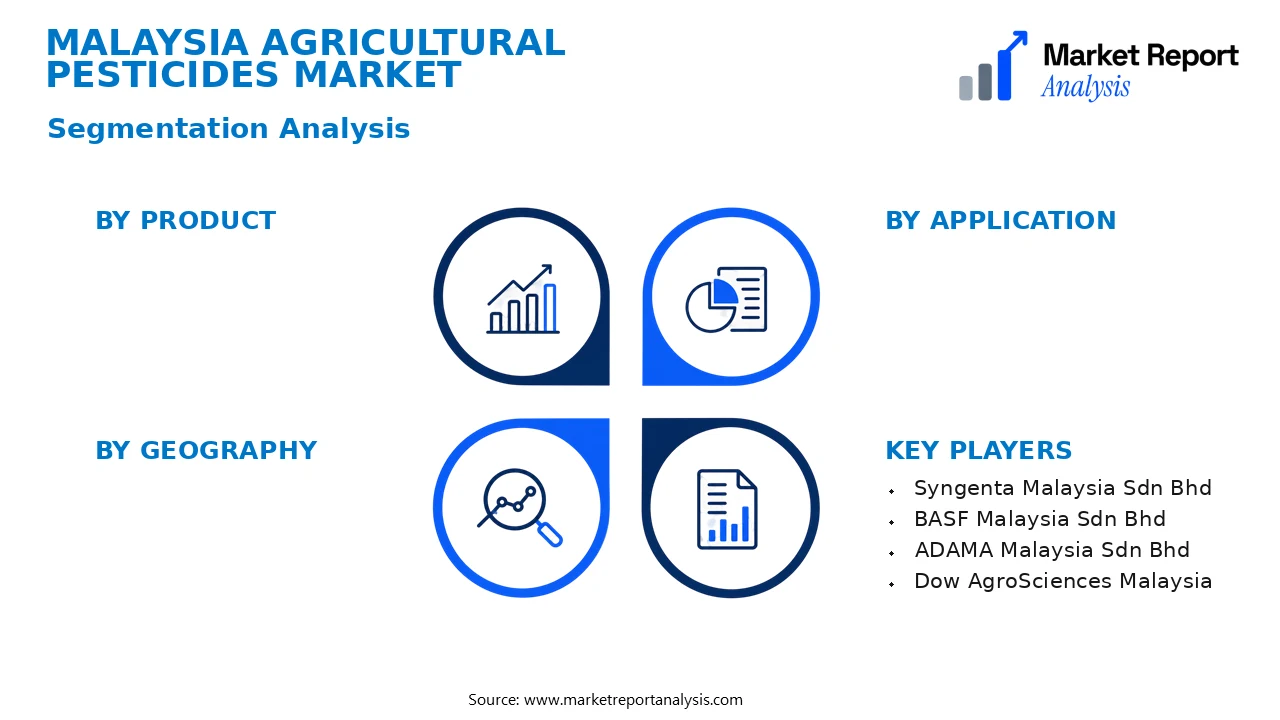
Product Type
- Herbicides: Herbicides play a vital role in controlling weeds, enhancing crop yields, and reducing manual labor, thereby representing the largest share of the market with increasing adoption driven by modernization of farming practices.
- Pesticides (Insecticides): These are extensively used to protect crops from pests, with rising demand due to the expansion of vegetable and fruit cultivation, especially in regions facing pest-related yield losses.
- Fungicides: Fungicides are crucial for preventing fungal infections in multiple crops, with demand driven by climate conditions conducive to fungal growth, especially in rice and vegetable sectors.
- Other Products: This includes rodenticides and growth regulators, primarily used in specialized crops or for integrated pest management strategies, gaining traction due to sustainable farming practices.
Application
- Cereals & Grains: This application segment encompasses rice, maize, and sorghum, which require pest management to ensure high yield and quality. It represents a significant market share due to the dominance of rice farming.
- Vegetables: The vegetable segment is growing rapidly, with increased consumption and export value. Pesticides are extensively used to meet quality standards and pest resistance issues.
- Fruits: An expanding fruit sector, especially in tropical fruits like papayas and durians, necessitates protective pesticides to combat pests and improve crop quality for local and export markets.
- Others: Includes plantation crops like oil palms and rubber, where pesticides are employed to control pests that threaten large-scale plantations and sustain production volumes.
Geography
- Kuala Lumpur: As the economic hub with advanced agricultural research institutes, Kuala Lumpur drives innovation and demand for integrated pest management solutions, influencing broader adoption of pesticides.
- George Town: Known for its diverse agricultural activities and export-oriented crops, George Town’s market showcases high pesticide demand to protect horticultural products for international markets.
- Johor Bahru: Strategically located near border trade zones, Johor Bahru’s agriculture sector benefits from increased pesticide usage to meet export quality standards and combat pest pressures in emerging crop sectors.
- Shah Alam: Growth in manufacturing and urban agriculture in Shah Alam increases need for effective pest control solutions, supporting regional market expansion.
- Petaling Jaya: As a densely populated urban area with peri-urban farming, Petaling Jaya’s demand for pesticides is driven by small-scale farmers transitioning to modern agriculture techniques.
- Ipoh: An important agricultural hub for rice and vegetables, Ipoh’s market for agricultural pesticides is expanding to improve crop resilience and yield in the face of pest threats.
- Kota Kinabalu: The presence of diverse tropical crops and an emphasis on sustainable agriculture practices in Kota Kinabalu boosts demand for targeted pesticide solutions for pest and disease control.
Competitive Intelligence
The Malaysia Agricultural Pesticides Market exhibits moderate competition characterized by a mix of local firms and multinational corporations. The market is somewhat concentrated, with the top five players accounting for a significant share, driven by their extensive distribution networks and brand recognition. Leading companies adopt aggressive business strategies, combining product innovation with strategic partnerships to expand their market presence across major agricultural hubs like Kuala Lumpur, Penang, and Johor Bahru. Innovation efforts focus on developing environmentally friendly and crop-specific formulations, responding to shifting regulatory and consumer preferences. Acquisitions are common, aimed at expanding product portfolios and regional reach, exemplified by recent buyouts of smaller local manufacturers. Market players are investing heavily in R&D to differentiate through advanced chemistries and bio-based solutions, creating competitive advantages. Expansion strategies are targeted towards rural and underserved areas, leveraging local partnerships and government incentives. This combination of innovation, strategic alliances, and geographic expansion underpins competitive differentiation within Malaysia's evolving agricultural pesticides landscape.
Leading Company Profiles
The competitive landscape of the Malaysia Agricultural Pesticides Market comprises prominent multinational and local players, distinguished by their technological innovations, broad product portfolios, and strategic market positioning. These companies are leveraging R&D capabilities and regional distribution networks to enhance their market presence and meet evolving agricultural needs. The focus remains on developing sustainable, cost-effective solutions, emphasizing crop safety, environmental impact, and compliance with emerging regulations.
- Syngenta Malaysia Sdn Bhd
- BASF Malaysia Sdn Bhd
- ADAMA Malaysia Sdn Bhd
- Dow AgroSciences Malaysia
- Kuok Group (FMC Malaysia)
- APHIS Malaysia Sdn Bhd
- Sumitomo Chemical Malaysia Sdn Bhd
- ChemChina Malaysia
- Commodity Chemical Industries (CCI) Malaysia
Syngenta Malaysia Sdn Bhd
Syngenta Malaysia specializes in innovative crop protection solutions, including herbicides, insecticides, and fungicides, with a focus on sustainable formulations that enhance crop yields while minimizing environmental impact.
BASF Malaysia Sdn Bhd
BASF Malaysia offers a comprehensive range of pesticides and agrochemical products tailored to combat regional pest challenges, emphasizing research-driven product development and strategic collaborations to strengthen its market position.
ADAMA Malaysia Sdn Bhd
ADAMA focuses on delivering a broad portfolio of crop protection products, including novel herbicides and acaricides, with a strong emphasis on cost-effective solutions suitable for smallholder and commercial farmers alike.
Dow AgroSciences Malaysia
Dow AgroSciences Malaysia is renowned for its innovation in biotech-based pesticides and integrated pest management technologies, emphasizing sustainable practices and digital agriculture integration.
Kuok Group (FMC Malaysia)
FMC Malaysia leverages the Kuok Group's extensive distribution network to penetrate niche markets with specialized agrochemical solutions, emphasizing both innovation and regional market development.
APHIS Malaysia Sdn Bhd
APHIS Malaysia provides environmentally friendly, bio-based pesticides and pest control products, focusing on organic and sustainable farming practices tailored for Malaysia’s diverse agricultural landscape.
Sumitomo Chemical Malaysia Sdn Bhd
Sumitomo Chemical Malaysia develops high-performance crop protection solutions with an emphasis on novel formulations and integrated pest control approaches to meet regional agricultural demands.
ChemChina Malaysia
ChemChina Malaysia specializes in importing and distributing a wide range of pesticides, focusing on affordability, safety, and compliance with local and international regulations.
Commodity Chemical Industries (CCI) Malaysia
CCI Malaysia manufactures and supplies generic and proprietary pesticides, emphasizing quality assurance and regional customization to effectively serve Malaysia’s agricultural sector.
Strategic Business Developments

- January 2023 – Syngenta Malaysia – Launch of new bio-based insecticide – Enhances environmentally friendly pest control options, aligning with global sustainability trends and reducing chemical residues.
- April 2023 – BASF Malaysia – Expansion of regional R&D center – Bolsters product innovation, focusing on developing sustainable formulations tailored for Southeast Asian markets.
- August 2023 – ADAMA Malaysia – Strategic partnership with local agro-firms – Facilitates market penetration of innovative crop protection solutions and enhances regional distribution capabilities.
- November 2023 – Dow AgroSciences Malaysia – Launch of digital crop health monitoring platform – Supports precision farming techniques and optimizes pesticide application efficiency in Malaysian farms.
- February 2024 – Kuok Group (FMC Malaysia) – Acquisition of local agrochemical distributor – Strengthens market reach, enhances logistics, and consolidates regional supply chain operations.
Frequently Asked Questions
What is the Malaysia Agricultural Pesticides Market?
The Malaysia Agricultural Pesticides Market encompasses the production, distribution, and sales of chemical pesticides used in agriculture to safeguard crops from pests, weeds, and diseases. It plays a vital role in enhancing crop yields and supporting Malaysia's agricultural productivity.
What is the current market size of Malaysia Agricultural Pesticides Market?
As of 2026, the Malaysia Agricultural Pesticides Market is valued at approximately USD 1.8 Billion, reflecting increased adoption of pesticides driven by the expanding agricultural sector and the rising demand for higher crop productivity.
What factors are driving the Malaysia Agricultural Pesticides Market?
Key factors include population growth, rising food demand, government initiatives promoting agricultural modernization, and increasing pest pressures due to climate change. Additionally, technological advancements and the adoption of integrated pest management contribute to market growth.
Which region dominates the Malaysia Agricultural Pesticides Market?
Peninsular Malaysia dominates the market owing to its extensive agricultural activities, higher crop diversity, and greater infrastructure development that facilitates pesticide distribution and use compared to eastern regions.
Which segment is expected to grow the fastest?
The herbicides segment is anticipated to experience the fastest growth during 2026-2034, driven by the increasing cultivation of crops like oil palm, rice, and vegetables, which require effective weed control methods.
Who are the leading companies operating in the Malaysia Agricultural Pesticides Market?
Major players include Syngenta, Bayer, FMC Corporation, and DuPont. These companies focus on innovative formulations, local partnerships, and compliance with regulatory standards to strengthen their market position in Malaysia.
Analyst Perspective
The Malaysia Agricultural Pesticides Market is poised for sustained growth, driven by escalating demand for high-yield crop protection solutions amidst the nation’s evolving agricultural landscape. Long-term, the market is expected to consolidate around innovative, environmentally friendly formulations, emphasizing integrated pest management (IPM) techniques that align with government sustainability initiatives. Commercial opportunities abound in developing biopesticides and targeted precision application technologies, which offer higher efficacy and lower environmental impact. Investment priorities should focus on digital transformation and data-driven pest control solutions, positioning Malaysia as a regional hub for agri-tech innovation. Competitive intensity is intensifying, with local firms expanding capacity and multinational corporations enhancing R&D investments to capture market share. Regionally, pest pressures and crop diversity in states like Johor and Selangor point to significant growth potential, especially in urban and peri-urban agricultural zones where advanced, precise pesticide applications could optimize productivity. Strategic positioning now requires balancing regulatory compliance, technological adoption, and regional demand cues to sustain long-term growth.
