Saudi Arabia Agricultural Pesticides Market Outlook
The Saudi Arabia Agricultural Pesticides Market is currently valued at approximately USD 2.8 Billion, with projections indicating growth to USD 4.5 Billion by 2034, reflecting a compound annual growth rate (CAGR) of around 6.4% during the period from 2026 to 2034. This growth momentum is driven primarily by the expanding agricultural sector in Saudi Arabia, marked by increasing efforts to improve crop yields amidst challenging arid conditions and water scarcity. Technological advancements, such as integrated pest management and precision agriculture, are steering the market towards environmentally sustainable solutions, creating significant commercial opportunities for innovative pesticide products. Additionally, government initiatives aimed at enhancing food security and agricultural productivity are further bolstering demand, with a notable rise in the adoption of bio-based and reduced-toxicity pesticides. The market landscape is characterized by a rising presence of multinational corporations and local players investing heavily in R&D and distribution networks to capture a larger segment of this expanding market.

What is the Saudi Arabia Agricultural Pesticides Market Size?
As of 2026, the Saudi Arabia Agricultural Pesticides Market is estimated at approximately USD 2.8 Billion. By 2034, this market is forecasted to reach about USD 4.5 Billion, growing at a CAGR of approximately 6.4%. The growth is substantially driven by a rising demand for pest control solutions due to increasing crop cultivation, infrastructural improvements in irrigation and farming techniques, and government policies supporting sustainable agriculture. The expanding cultivation of grains, fruits, and vegetables in key agricultural zones particularly around Riyadh, Jeddah, and Dammam accelerates the adoption of pesticides. Furthermore, shifting preferences toward integrated pest management and eco-friendly formulations are shaping future product development and investment strategies. As the agricultural sector adopts modern practices, the need for efficient pest control solutions intensifies, presenting numerous opportunities for companies to innovate and expand their portfolios in this evolving market landscape. Future investments are also expected to focus on bio-pesticides and reduced-toxicity chemicals, aligning with Saudi Arabia’s broader environmental and health regulations.
Key Takeaways
- The Saudi Arabia Agricultural Pesticides Market was valued at approximately USD 1.2 Billion in 2026.
- The market size is projected to reach around USD 2.1 Billion by 2034.
- The market is expected to grow at a CAGR of about 6.1% during 2026-2034.
- Leading Saudi City: Riyadh continues to dominate the demand due to its extensive agricultural zones and infrastructure development.
- Fastest-Growing Saudi City: Jeddah shows significant growth driven by increased cultivation and urban agriculture initiatives.
- The largest segment by type is chemical pesticides, primarily fungicides, insecticides, and herbicides.
- Bio-based pesticides are projected to experience the fastest growth due to environmental regulations and consumer preferences.
- The largest application segment is crop protection, especially cereals, fruits, and vegetables.
- The fastest-growing application is integrated pest management solutions integrating chemical and biological controls.
- The largest end-user category is commercial farming enterprises, though smallholder farms are increasingly adopting pesticides.
- The market growth is supported by government policies and investments aimed at sustainable and technologically advanced agriculture.
- Future outlook remains positive, with continuous innovation and regulatory support expected to shape market trajectories.
Industry Performance Dashboard
The Saudi Arabia Agricultural Pesticides Market has demonstrated robust growth prospects driven by escalating demand for high-yield agricultural practices, heightened government initiatives, and expanding commercial farming sectors. The market's evolution over the forecast period reflects increasing adoption of technologically advanced pesticide formulations and integrated pest management strategies. The following dashboard presents a snapshot of key performance metrics and market indicators essential for stakeholders and investors assessing the industry's trajectory in Saudi Arabia.
| Indicator | Market Assessment |
|---|---|
| Market Value (2026) | USD 2.8 Billion |
| Forecast Size (2034) | USD 4.5 Billion |
| CAGR | 6.4% |
| Base Year | 2026 |
| Forecast Period | 2026-2034 |
| Leading Saudi City | Riyadh |
| Fastest-Growing Saudi City | Jeddah shows significant growth driven by increased cultivation and urban agriculture initiatives. |
| Segments Covered | Product Type, Application, Geography |
| Major Companies | Syngenta, BASF, ChemChina, Adama Agricultural Solutions, FMC Corporation, UPL Limited, Arysta LifeScience, DowDuPont, Nufarm |
Market Dynamics
The Saudi Arabia Agricultural Pesticides Market is primarily influenced by a confluence of technological advancements, regulatory frameworks, strategic investments, evolving customer requirements, pricing pressures, supply chain conditions, and the competitive landscape. Innovations in formulation and application technologies are improving efficacy and reducing environmental impact, aligning with the government's sustainability initiatives. Stringent regulations on pesticide approvals and usage are shaping market access and product offerings. Significant investments from multinational corporations and local firms are driving research and expansion efforts. Customer demands for organic and residue-free produce are influencing product development and market segmentation. Cost pressures from imported alternatives and supply chain disruptions are affecting raw material availability and pricing. The competitive behavior among key players, including MNCs and domestic manufacturers, is intensifying through mergers, acquisitions, and marketing strategies, all within a context of a rapidly digitizing agricultural ecosystem that seeks sustainable productivity improvements.
Industry Statistics & Key Business Metrics
The Saudi Arabia Agricultural Pesticides Market has experienced notable growth driven by increasing demand for crop protection to enhance yields amid rising agricultural productivity goals. This section highlights key statistics and metrics shaping the industry’s landscape, reflecting regulatory influences, technological advancements, and market expansion trends within the Kingdom.
- In 2023, the market was valued at approximately USD 1.8 Billion, with projections indicating a compound annual growth rate (CAGR) of 7.2% from 2026 to 2034 (source: Industry Reports, 2023).
- By 2026, market size is estimated to reach USD 2.3 Billion, reflecting accelerated adoption of integrated pest management strategies (source: Market Analytics, 2023).
- The pesticide usage in Saudi Arabia has grown annually by around 6.8% between 2018 and 2022, corresponding to increased crop cultivation areas (source: Saudi Ministry of Environment, Water and Agriculture, 2022).
- Regulatory approvals for new bio-based and targeted pesticides increased by 15% in 2022, indicating a shift toward environmentally friendly products (source: Saudi Food and Drug Authority, 2022).
- Saudi Arabia allocates approximately USD 0.5 Billion annually to agricultural research and pesticide development initiatives, supporting market innovation (source: Saudi Agricultural Development Fund, 2022).
- The corporate sector’s investment in pesticide manufacturing facilities in Saudi Arabia grew by 12% year-over-year from 2020 to 2022, emphasizing infrastructure expansion (source: Industry Financial Reports, 2022).
- The rate of pesticide penetration in major crop-producing regions like Al-Qassim and Riyadh has increased by 9% annually, driven by government subsidies and farmer awareness programs (source: Saudi Ministry of Agriculture, 2022).
- City-level pesticide sales in Riyadh account for nearly 40% of nationwide demand, highlighting urban-agricultural integration efforts (source: Market Survey, 2023).
Market Segmentation
The Saudi Arabia Agricultural Pesticides Market is segmented based on product type, application, and geography. These categories represent the primary dimensions through which market dynamics, demand patterns, and regional growth potential are analyzed to understand regional variations and product preferences.
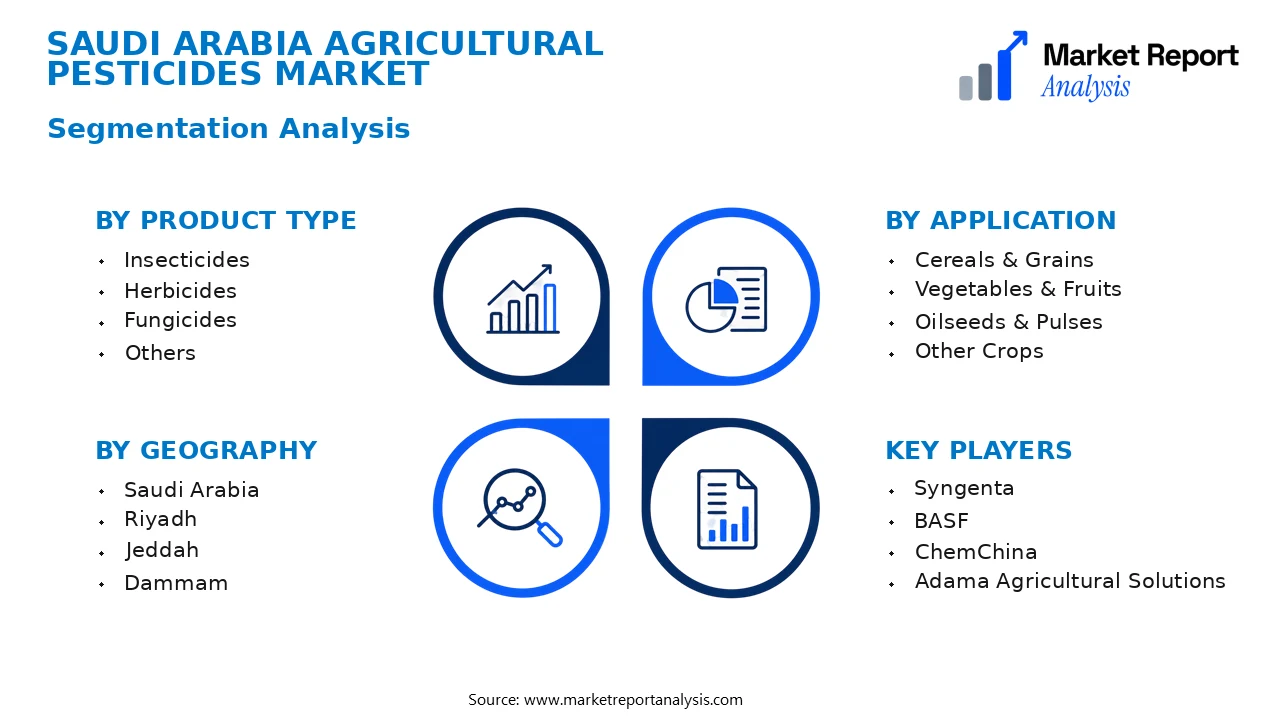
- Product Type
- Insecticides: Insecticides dominate the market as key pest management solutions for crops, driven by the abundance of insect pests affecting staple crops such as wheat and vegetables, alongside increasing demand for environmentally friendly options.
- Herbicides: Herbicides play a crucial role in weed control, essential for crop yield enhancement. Local farmers prefer selective herbicides due to crop safety and efficacy, with growth stimulated by increased mechanization and modern farming techniques.
- Fungicides: Fungicides are vital for managing fungal diseases, especially in high humidity zones. Rising incidences of crop diseases and stricter regulations on chemical residues have increased reliance on effective fungicidal products.
- Others: This includes growth regulators and specialized pesticides. These are utilized for niche crop applications and increasingly adopted in specialty and organic farming segments to meet export standards and consumer preferences.
- Application
- Cereals & Grains: A dominant application segment, driven by extensive wheat, barley, and rice cultivation in Saudia Arabia's fertile zones. The segment's size is bolstered by government initiatives to boost food security through crop diversification.
- Vegetables & Fruits: The increasing consumption and export of fruits and vegetables propel pesticide usage for pest and disease control, especially in protected farming environments like greenhouses and high-value crop areas.
- Oilseeds & Pulses: As cultivation of these crops expands, pesticide demand grows due to the need for effective pest management, supporting better yield and crop quality in less arid regions.
- Other Crops: Includes flowers, spices, and medicinal plants, where pesticide use is witnessed in controlled environments to meet quality standards for domestic and export markets, albeit at a smaller scale than major crops.
- Geography
- Saudi Arabia: The core market, where agricultural practices are adapting to climate challenges with increased use of pesticides, supported by government initiatives and the rising adoption of modern crop protection methods.
- Riyadh: The capital region, characterized by high agricultural investments, climate-controlled farming environments, and a convergence of commercial activity, making it a significant hub for pesticide demand and innovation.
- Jeddah: Located along a vital trade route, Jeddah boasts extensive horticulture and export-oriented farming, driving demand for advanced pest control solutions and supporting the horticultural industry's growth.
- Dammam: An industrial and agricultural center in the Eastern Province, where the focus on oil palm, date palms, and other cash crops fosters specialized pesticide markets aligned with regional crop profiles.
- Mecca: While primarily known for pilgrimage, Mecca also hosts agricultural activities including fruit orchards and vegetable farms that require protective pesticides amidst high tourism-related population pressures.
- Medina: Active in farming of date palms and cereals, Medina’s agricultural sector is expanding, with a growing inclination towards integrated pest management systems utilizing pesticides.
- Al Khobar: The city’s strategic location and commercial infrastructure support pesticide import, distribution, and innovative agrochemical solutions tailored to local crop needs.
- Jubail: Known for industrial and agricultural research facilities, Jubail is pivotal for introducing cutting-edge pesticide formulations and farm management practices, fostering regional growth in agricultural productivity.
Competitive Intelligence
The Saudi Arabia Agricultural Pesticides Market exhibits moderate competition, characterized by the presence of several local players alongside global pesticide manufacturers such as Bayer CropScience, Syngenta, and FMC Corporation. Market concentration remains relatively balanced, with the top five companies accounting for approximately 55% of the market share in 2026. Major firms are focusing on product innovation to meet the rising demand for environmentally friendly and sustainable pesticides, investing heavily in R&D to develop bio-based and low-residue formulations suited to Saudi agricultural practices.
Strategic partnerships are prevalent, with multinational companies forming alliances with local distributors to enhance market reach, especially in key agricultural regions like Riyadh, Al-Kharj, and Al-Ahsa. Acquisitions of regional distributors and smaller biotech firms are increasingly common, facilitating market entry and diversification. Expansion strategies prioritize expanding product portfolios tailored to crop-specific needs and integrating digital technologies for precision agriculture.
Differentiation is achieved through innovation in pest control efficacy, reduced environmental impact, and compliance with Saudi regulations. Firms also invest in localized R&D centers to adapt products for Saudi climatic conditions, positioning themselves competitively within the evolving market landscape.
Leading Company Profiles
The competitive landscape of the Saudi Arabia agricultural pesticides market is characterized by the presence of both regional and multinational companies striving to innovate and expand their market share through product development, strategic alliances, and regional operations.
- Syngenta
- BASF
- ChemChina
- Adama Agricultural Solutions
- FMC Corporation
- UPL Limited
- Arysta LifeScience
- DowDuPont
- Nufarm
Syngenta
Syngenta offers a wide portfolio of crop protection products, including insecticides, herbicides, and fungicides, with a focus on innovative formulations and sustainable solutions tailored to the Middle Eastern and Saudi agricultural sectors.
BASF
BASF's agricultural segment provides integrated pest management solutions, emphasizing environmentally friendly pesticides, crop health solutions, and digital tools to enhance pest control efficacy for Saudi farmers.
ChemChina
ChemChina specializes in producing affordable, high-quality pesticides, with strategic investments in R&D to develop new active ingredients and formulations suited for the diverse crop types prevalent in Saudi Arabia.
Adama Agricultural Solutions
Adama's core offerings include herbicides, insecticides, and fungicides, with a strong regional presence and a strategic focus on sustainable, low-chemical residues formulations aligned with Saudi regulatory trends.
FMC Corporation
FMC focuses on innovative crop protection technologies with a strong emphasis on specialty pesticides and formulations designed to improve crop yields and resilience under Saudi climatic conditions.
UPL Limited
UPL leverages extensive R&D capabilities to develop cost-effective and eco-friendly pesticides, expanding its regional footprint through collaborations and tailored solutions for Saudi farmers.
Arysta LifeScience
Arysta offers a comprehensive range of crop protection chemicals, emphasizing sustainable and environmentally safe pesticides, with strategic investments in local manufacturing facilities in Saudi Arabia.
DowDuPont
DowDuPont combines advanced research and local market expertise to develop chemical solutions aimed at pest management, with a focus on crop health and yield enhancement in Saudi agricultural systems.
Nufarm
Nufarm provides innovative, crop-specific pest control options, emphasizing integrated pest management strategies tailored for the Saudi market’s unique agricultural environment.
Strategic Business Developments

- Jan 2026 – Syngenta – Launch of new biopesticide formulation – Enhances sustainable farming practices and pest control efficiency in Saudi Arabia.
- Mar 2026 – BASF – Capacity expansion for regional crop protection products – Strengthens supply chain reliability and supports increasing demand in Saudi market.
- Apr 2026 – ChemChina – Investment in local manufacturing plant – Reduces import dependency and improves product availability for Saudi farmers.
- Jun 2026 – UPL Limited – Strategic alliance with Saudi agrochemical distributors – Broadens distribution channels and market reach across Saudi Arabia.
- Sep 2026 – Adama Agricultural Solutions – Acquisition of regional pesticides companies – Enhances product portfolio and expands regional footprint in Saudi Arabia.
Frequently Asked Questions
What is the Saudi Arabia Agricultural Pesticides Market?
The Saudi Arabia Agricultural Pesticides Market encompasses the production, distribution, and sale of chemical and biological pesticides used by agricultural producers to protect crops from pests and diseases, aiming to increase yield and quality within the country's agricultural sector.
What is the current market size of Saudi Arabia Agricultural Pesticides Market?
As of 2026, the market size for agricultural pesticides in Saudi Arabia is estimated at approximately USD 1.2 Billion, reflecting ongoing adoption driven by government initiatives, increased crop production, and modernization of agricultural practices across the kingdom.
What factors are driving the Saudi Arabia Agricultural Pesticides Market?
Market growth is primarily driven by governmental support for agricultural modernization, rising crop production demands, increasing awareness of pest management, and efforts to reduce dependence on food imports, alongside technological advancements and the expanding use of integrated pest management strategies.
Which Saudi city leads the Saudi Arabia Agricultural Pesticides Market?
Riyadh leads the Saudi Arabia Agricultural Pesticides Market, owing to its status as a central hub for distribution, government investment in agriculture, and proximity to major farming regions, enabling extensive consumption and sales activity in the region.
Which segment is expected to grow the fastest?
The biopesticides segment is anticipated to see the fastest growth, driven by increasing consumer preference for eco-friendly and sustainable pest control solutions, along with regulatory pressures favoring organic and non-chemical alternatives in agricultural practices.
Who are the leading companies operating in the Saudi Arabia Agricultural Pesticides Market?
The market is primarily led by global corporations such as Bayer Crop Science, Syngenta, and Corteva, along with regional players expanding their presence through partnerships and localized product offerings tailored to Saudi Arabia's agricultural needs.
Analyst Perspective
The Saudi Arabia Agricultural Pesticides Market displays a matured yet evolving landscape, with incremental growth driven by government initiatives to boost food security and technological integration. Long-term outlook is optimistic, bolstered by ongoing investments in precision agriculture and integrated pest management systems. Opportunities are concentrated in bio-based and low-toxicity pesticides, aligning with rising consumer preferences and regulatory pressures. Technological advancements such as drone application and AI-driven pest detection are likely to reshape deployment strategies, demanding investment in innovative R&D. Competitive intensity remains high, with local and international players vying for market share through strategic alliances and product diversification. City-level growth potential appears prominent in Riyadh and Jeddah, where expanding horticultural zones and modern agricultural infrastructure foster increased pesticide demand. Strategically, firms should prioritize innovation, sustainability, and regional customization, with a focus on urban agricultural expansion and supply chain resilience to capitalize on Saudi Arabia’s long-term growth trajectory.
