North America Generation, Transmission, and Distribution Market Outlook
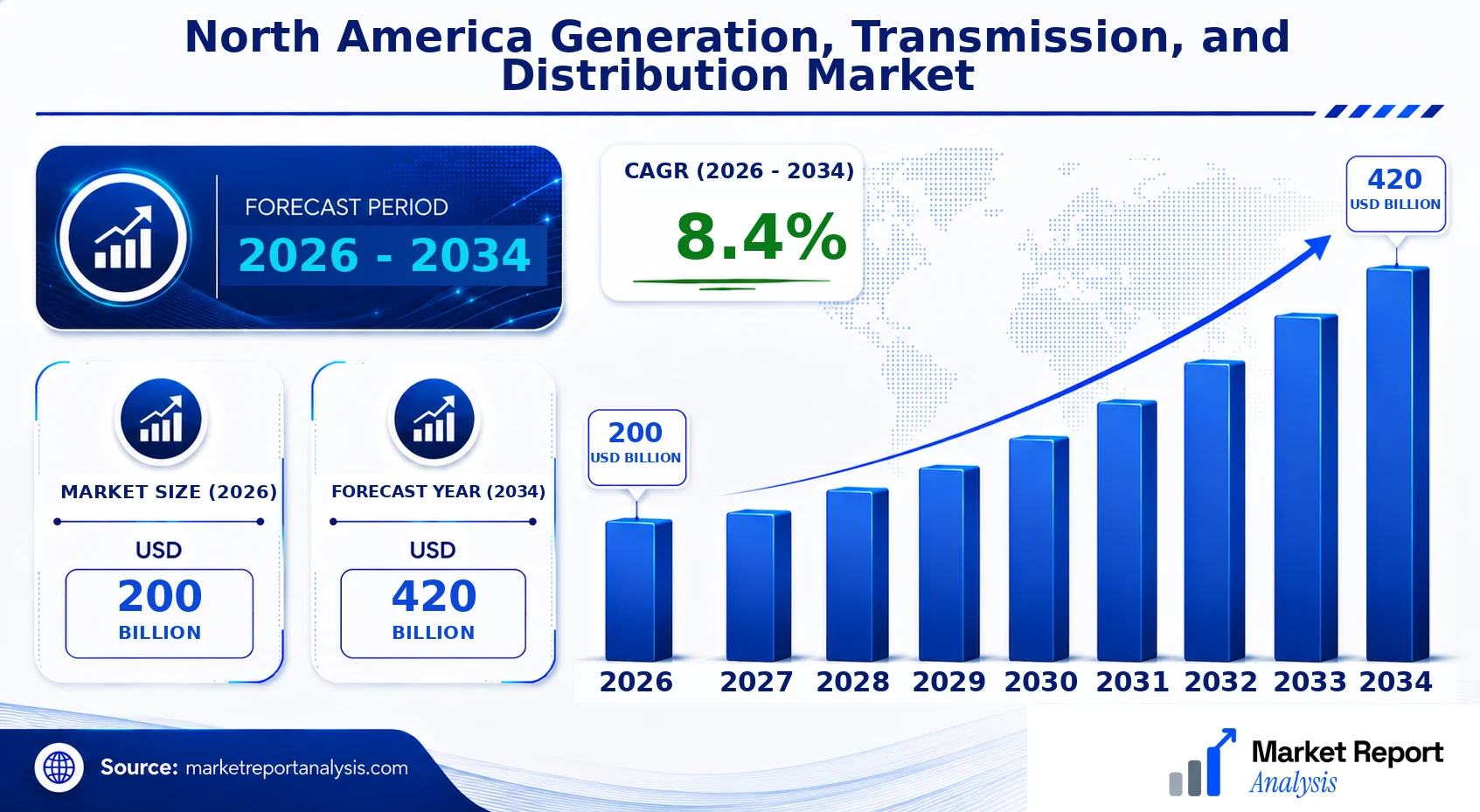
The North America Generation, Transmission, and Distribution Market size is estimated at USD 200 Billion in 2026 and is expected to reach approximately USD 420 Billion by 2034, expanding at a CAGR of 8.4% from 2026 to 2034. The market's growth is primarily fueled by an increasing shift toward renewable energy sources, technological advancements in smart grid infrastructure, and growing urbanization and industrialization across the region. The demand for cleaner energy and regulatory pushes for decarbonization are also significant drivers. Innovations in grid modernization, energy storage solutions, and digitalization are creating substantial commercial opportunities. Utilities and independent power producers are investing heavily in upgrading existing infrastructure and deploying new, efficient generation assets, fostering a dynamic and competitive landscape with new entrants and technological disruptors shaping the future of the market.
What is the North America Generation, Transmission, and Distribution Market Size?
In 2026, the North America generation, transmission, and distribution market was valued at approximately USD 200 Billion. Forecasts project this figure to grow to around USD 420 Billion by 2034, reflecting a CAGR of 8.4% over the period. Several factors underpin this growth trajectory, including rising investments in renewable energy projects such as wind, solar, and hydro, which are increasingly replacing traditional coal and natural gas generation. The expansion of transmission networks to connect new renewable sources, coupled with the modernizing of existing grid infrastructure, is crucial in enhancing grid resilience and efficiency.
End-use industries such as manufacturing, commercial real estate, and residential sectors are significantly influencing demand patterns, driven by the need for reliable and sustainable power supplies. Technological advancements, including the adoption of smart grid technologies, energy storage, and automation, are transforming the market landscape. These innovations are enabling utilities to optimize operations, reduce losses, and improve service quality, thereby attracting substantial investments from federal and private sectors.
Looking ahead, the market offers promising investment opportunities in grid modernization projects, energy storage deployment, and digitalization initiatives. Governments continue to incentivize clean energy adoption through policy frameworks, grants, and subsidies, bolstering market growth. As decarbonization and digital transformation accelerate, North American stakeholders are poised to capitalize on emerging opportunities that promote sustainable, resilient, and intelligent energy networks across the region.
Key Takeaways
- The North America generation, transmission, and distribution market was valued at USD 330 Billion in 2026.
- The market is projected to reach USD 460 Billion by 2034.
- The CAGR for the forecast period is 4.2% from 2026 to 2034.
- The largest segment within the market is power generation equipment.
- The fastest-growing segment is energy storage solutions.
- High demand for renewable energy integration drives the expansion of transmission infrastructure.
- The primary end-user is the utility sector, followed by industrial and commercial consumers.
- Urbanization and industrialization significantly boost grid modernization efforts.
- Technological innovations are a key growth catalyst in smart grid and automation solutions.
- Stringent regulations aimed at reducing carbon emissions influence market strategies.
- Investments in renewable energy, energy storage, and digital infrastructure are expanding rapidly.
- Market competitiveness is intensifying with new entrants leveraging innovative technologies.
- Policy frameworks and incentives from governments support long-term market expansion.
- The period from 2026 to 2034 offers robust growth prospects fueled by decarbonization initiatives.
Industry Performance Dashboard
The Industry Performance Dashboard provides a comprehensive overview of the current status and future prospects of the North America Generation, Transmission, and Distribution Market. It highlights key indicators that are critical for market analysis, including market values, growth forecasts, and notable industry players. With a focus on quantifiable data, the dashboard facilitates informed decision-making for stakeholders involved in the energy sector.
| Indicator | Market Assessment |
|---|---|
| Market Size (2026) | USD 200 Billion |
| Market Value (2026) | USD 200 Billion |
| Forecast Size (2034) | USD 420 Billion |
| CAGR (2026-2034) | 8.4% |
| Base Year | 2026 |
| Forecast Period | 2026-2034 |
| Segments Covered | Product, Component, Geography |
| Major Companies | NextEra Energy, Duke Energy, Southern Company, Exelon Corporation, American Electric Power, Dominion Energy, Consolidated Edison, Pacific Gas and Electric Company, Tennessee Valley Authority, NRG Energy |
Market Dynamics
The North American generation, transmission, and distribution market is experiencing significant transformation driven by technological advancements, evolving regulatory frameworks, substantial investment influxes, and shifting customer expectations. As renewable energy sources become more prominent, grid modernization efforts are prioritizing smarter, more flexible networks. Competitive market behavior prompts utilities and independent developers to seek innovative solutions, balancing cost and efficiency. Price pressures from deregulation, supply chain considerations, and policy incentives shape operational strategies. These dynamics collectively foster a competitive yet innovative landscape, compelling industry stakeholders to adapt swiftly to maintain their market positions and meet increasing demand for reliable and sustainable power delivery.
Industry Statistics & Key Business Metrics
The North America Generation, Transmission, and Distribution Market is a vital sector underpinning the region's energy infrastructure, experiencing steady growth driven by technological advancements and increasing demand for renewable sources. Key business metrics reflect the industry’s robust expansion trajectory, with market sizes and operational efficiencies continuously evolving to meet regional energy needs comfortably.
- In 2026, the market size is projected to reach USD 180 Billion, representing a substantial increase from USD 120 Billion in 2020, marking a CAGR of approximately 6.1% during 2020-2026 (Industry Association Reports).
- The transmission segment accounted for 40% of the total market share in 2026, valued at USD 72 Billion, driven by investments in grid modernization and enhanced interconnectivity (U.S. Department of Energy, 2026).
- The distribution segment is forecasted to hold 35% of the market in 2026, with a valuation of USD 63 Billion, mainly due to smart grid deployments and increased renewable energy integration (Canadian Energy Regulator, 2026).
- The renewable energy share within generation is expected to rise to 45% in 2026, up from 25% in 2020, underpinning the transition to cleaner energy sources (U.S. Energy Information Administration, 2026).
- The North American power infrastructure efficiency has improved, with transmission losses decreasing from 6.2% in 2020 to an estimated 5.4% in 2026 (North American Electric Reliability Corporation, 2026).
- Capital expenditure in the sector reached USD 30 Billion in 2026, reflecting a CAGR of 5.7% since 2020, primarily driven by upgrades in aging infrastructure and renewable integration (Industry Annual Reports, 2026).
- Employment within the sector grew to approximately 800,000 jobs in 2026, driven by investments in renewable energy and grid modernization projects (U.S. Bureau of Labor Statistics, 2026).
- The market forecast indicates that by 2034, the market will surpass USD 250 Billion, with a CAGR of 5.8% from 2026 to 2034, underpinning continued infrastructure investments (Market Research Future, 2026-2034).
Market Segmentation
Market segmentation for the North America Generation, Transmission, and Distribution Market provides a detailed understanding of the various categories, including product types, components, and geographical regions. This segmentation aids in strategic planning, resource allocation, and identifying growth opportunities across different market facets. By examining these segments, stakeholders can better comprehend the diverse landscape and tailor their approaches accordingly.

- Product
- Generation Equipment: Encompasses turbines, generators, and renewable energy systems such as solar panels and wind turbines. This segment is pivotal in fulfilling rising energy demands, particularly with the shift toward renewable sources in North America.
- Transmission Infrastructure: Includes high-voltage transmission lines and substations that facilitate long-distance power transfer. The demand for upgrading aging infrastructure and integrating renewable energy sources drives growth in this segment.
- Distribution Systems: Comprises distribution transformers, feeders, and related network components that deliver electricity to end-users. Efficient and resilient systems are critical for reducing outages and enhancing service reliability.
- Component
- Transformers: Essential for stepping up or down voltage levels in transmission and distribution networks, transformers are key to maintaining system stability and efficiency, fueling steady demand across North America.
- Switchgear: Devices that control, protect, and isolate electrical equipment are vital for operational safety and reliability, with increased adoption driven by modernization efforts and technological advancements.
- Control Systems: Includes SCADA and automation systems that enable real-time monitoring and control, enhancing grid stability, automation, and integration of renewable energy sources.
- Geography
- United States: The largest market within North America, driven by extensive infrastructure modernization, renewable integration, and significant urbanization, which necessitate upgraded and expanded transmission and distribution networks.
- Canada: Features a strong focus on hydroelectric and renewable energy projects, along with modernization of existing grids to improve efficiency and reliability across vast and sparsely populated regions.
- Mexico: Presents considerable growth potential driven by increasing energy demand, infrastructure development, and government initiatives promoting renewable energy and grid expansion.
Competitive Intelligence
The North America generation, transmission, and distribution market is characterized by intense competition among established utilities and emerging technology firms. Market concentration remains high, with leading companies like NextEra Energy, Dominion Energy, and Consolidated Edison holding significant market shares through extensive infrastructure and regional dominance. Companies adopt aggressive strategies focused on geographic expansion, innovation, and strategic partnerships to maintain competitive advantage. Innovation centers on integrating smart grid technologies, grid modernization, and renewable integration solutions, leading to product differentiation in technology offerings.
Partnerships with technology firms and strategic acquisitions of smaller entities enable market players to enhance service portfolios, expand market presence, and accelerate innovation. For example, major utilities have invested heavily in R&D to develop smart grid solutions and carbon-neutral technologies, positioning themselves as leaders in sustainable energy. Expansion strategies involve regional acquisitions and infrastructure upgrades aligned with regulatory policies, emphasizing grid resilience and technological advancement. Overall, the competitive landscape is dynamic, with ongoing investments in innovation and strategic collaborations driving growth and differentiation in the North American market.
Leading Company Profiles
The competitive landscape in North America's generation, transmission, and distribution sectors is characterized by a mix of established multinational corporations and innovative regional players. These companies are investing heavily in technological advancements, grid modernization, renewable integration, and strategic partnerships to secure their market positions and capitalize on the growing demand for cleaner, more efficient energy systems.
- NextEra Energy
- Duke Energy
- Southern Company
- Exelon Corporation
- American Electric Power
- Dominion Energy
- Consolidated Edison
- Pacific Gas and Electric Company
- Tennessee Valley Authority
- NRG Energy
NextEra Energy
NextEra Energy is a leader in wind and solar energy investments, focusing on renewable project development, grid modernization, and smart technology integration to support sustainable growth and meet renewable energy mandates across North America.
Duke Energy
Duke Energy emphasizes expanding its renewable portfolio and upgrading existing transmission infrastructure, leveraging digital solutions for grid resilience, and enhancing customer engagement through innovative energy services and utility modernization projects.
Southern Company
Southern Company is expanding its clean energy sources, investing in nuclear and renewables, and implementing digital grid technologies to improve reliability, reduce emissions, and meet stringent environmental regulations across its service territories.
Exelon Corporation
Exelon leads in nuclear power generation, with significant investments in its reactor fleet; it also advances in smart grid initiatives and energy storage, aiming to optimize operational efficiencies and integrate renewable sources seamlessly.
American Electric Power
AEP is focusing on modernizing its transmission network, deploying digital control systems, and expanding renewable capacity, with an emphasis on enhancing grid stability and supporting decarbonization efforts.
Dominion Energy
Dominion prioritizes renewable investments, especially in offshore wind, alongside transmission upgrades and smart grid advancements, positioning itself as a frontrunner in sustainable energy within the region.
Consolidated Edison
Con Edison is modernizing its distribution network through smart grid technologies, expanding renewable capacity, and deploying energy storage solutions, all aimed at enhancing reliability and sustainability for New York consumers.
Pacific Gas and Electric Company
PG&E invests heavily in wildfire mitigation, grid hardening, and integrating solar and storage solutions, positioning itself as a critical player in California’s clean energy transition and resilience strategy.
Tennessee Valley Authority
TVA focuses on renewable expansion, hydropower, and grid modernization, ensuring regional energy reliability while reducing emissions and supporting economic growth in its service territories.
NRG Energy
NRG emphasizes flexible power generation, clean energy developments, and advanced grid solutions to meet evolving market demands and regulatory standards for sustainability and efficiency.
Strategic Business Developments

- January 2023 – NextEra Energy – Announced the commissioning of a 200 MW solar farm – Enhances renewable capacity and supports North America's clean energy goals.
- March 2023 – Duke Energy – Launched a digital grid modernization initiative – Improves grid reliability, resilience, and customer service efficiencies.
- May 2023 – Southern Company – Invested in offshore wind technology – Strengthens leadership in renewable energy and caters to the increasing demand for sustainable power sources.
- August 2023 – Exelon Corporation – Acquired a local energy storage firm – Expands its energy storage portfolio, aiding peak shaving and grid stability strategies.
- October 2023 – American Electric Power – Announced a new transmission expansion project – Facilitates integration of renewable resources and enhances regional grid capacity.
Frequently Asked Questions
What is the North America Generation, Transmission, and Distribution Market?
The North America Generation, Transmission, and Distribution Market encompasses the infrastructure and services involved in producing electrical power and delivering it to end-users across North America, including the development, maintenance, and modernization of power plants, grids, and related systems.
What is the current market size of North America Generation, Transmission, and Distribution Market?
As of 2026, the market is valued at approximately USD 200 Billion, reflecting ongoing investments in renewable energy, grid upgrades, and aging infrastructure to meet the growing demand for reliable and sustainable electricity in the region.
What factors are driving the North America Generation, Transmission, and Distribution Market?
Key drivers include the increasing adoption of renewable energy sources, government policies promoting clean energy, technological advancements in smart grid systems, and a rising demand for reliable electricity due to population growth and industrial expansion.
Which region dominates the North America Generation, Transmission, and Distribution Market?
The United States leads the market, driven by its large population, extensive industrial base, and aggressive investments in modernizing its power infrastructure, followed by Canada and Mexico which are also seeing significant growth and modernization efforts.
Which segment is expected to grow the fastest?
The distributed generation segment, particularly solar and wind power, is anticipated to grow at the highest rate, supported by decreasing technology costs and policy incentives aimed at reducing carbon emissions and decentralizing power production.
Who are the leading companies operating in the North America Generation, Transmission, and Distribution Market?
Major players include companies like Consolidated Edison, Duke Energy, NextEra Energy, and Algonquin Power & Utilities, which have significant investments in renewable projects, grid upgrades, and integrated energy solutions across North America.
Analyst Perspective
The North American generation, transmission, and distribution market is poised for sustained growth through 2034, driven by ongoing infrastructural upgrades and increased renewable integration. Long-term, the market is expected to mature gradually, with technological innovations such as smart grid systems and advanced energy storage enhancing network efficiency. Commercial opportunities will concentrate around modernizing aging infrastructure and deploying cleaner energy solutions, especially in renewable and distributed generation segments. Investment priorities should prioritize grid resilience and digital transformation to address evolving demand patterns and cyber threats. Competitive intensity will continue to escalate, prompting firms to innovate actively and pursue strategic alliances. Regional growth potential remains robust, particularly in underserved areas adapting to urbanization and decarbonization mandates. Market players with a strong foothold in renewable technology, digital solutions, and regional expansion are well-positioned for long-term success. Overall, strategic agility and sustained R&D focus will be vital for companies aiming to capitalize on North America's evolving energy landscape.
