Saudi Arabia Generation, Transmission, and Distribution Market Outlook
Saudi Arabia's generation, transmission, and distribution market is experiencing significant transformation, primarily driven by the kingdom's strategic shift towards renewable energy and the modernization of its existing fossil fuel infrastructure. In 2026, the market was valued at approximately USD 55 Billion, and it is projected to grow at a Compound Annual Growth Rate (CAGR) of 6.8% through 2034, reaching an estimated USD 102 Billion by 2034. This growth is fueled by government initiatives such as Vision 2030, which emphasizes diversification from oil dependence, and an increasing demand for reliable power supply driven by urbanization and industrial expansion. Technological advancement, including smart grid deployment and grid digitalization, is set to play a pivotal role, creating substantial commercial opportunities for local and international investors in grid modernization, renewable integrations, and advanced energy management systems. Additionally, new power generation projects particularly solar and wind are expanding the capacity, positioning Saudi Arabia as a key regional energy hub, which attracts both domestic and foreign investments into its power infrastructure. Overall, the outlook indicates robust growth aligned with strategic energy transition policies and infrastructural investments.
What is the Saudi Arabia Generation, Transmission, and Distribution Market Size?
By 2026, the Saudi Arabia generation, transmission, and distribution market is valued at roughly USD 55 Billion. This market is projected to grow to approximately USD 102 Billion by 2034, reflecting a CAGR of 6.8% during the forecast period. The growth can be ascribed to increasing electricity demand driven by rapid urbanization, expanding industrial sectors, and government policies promoting renewable energy sources such as solar and wind power. The push towards renewable energy is not only aimed at reducing greenhouse emissions but also at diversifying the energy mix amid fluctuating oil prices. The future of the sector includes investments in grid modernization, smart grid infrastructure, and energy storage solutions, creating multiple avenues for technological innovation and infrastructure upgrades. Demand from key end users, including residential, commercial, and industrial sectors, is expected to remain high as the government implements policies to enhance power reliability and sustainability. The push for regional energy exports and Saudi Arabia’s strategic positioning as a renewable energy hub further stimulate market growth. Consequently, the overall expansion of generation capacity and upgrades to transmission and distribution infrastructure underpins Saudi Arabia’s ambition for a resilient and sustainable energy future, offering substantial investment opportunities over the coming years.
Key Takeaways
- The Saudi Arabia generation, transmission, and distribution market was valued at approximately USD 55 Billion in 2026.
- The market is forecast to reach roughly USD 102 Billion by 2034, with a CAGR of 6.8%.
- Urban growth and industrial expansion are primary drivers for increased electricity demand.
- The Kingdom’s Vision 2030 is a major policy underpinning energy sector modernization and renewable integration.
- Solar and wind power projects significantly contribute to capacity growth and diversification.
- Leading Saudi City: Riyadh, due to its large population and industrial base.
- Fastest-Growing Saudi City: NEOM, driven by new infrastructure development and renewable projects.
- The largest segment is power generation, followed by transmission and distribution upgrades.
- Renewable energy, especially solar, is the fastest-growing segment amid rising policy support.
- The largest application sector remains the industrial segment, with residential and commercial catching up.
- The forecast period is from 2026 to 2034.
- The base year for this analysis is 2026, with projections extending to 2034.
Industry Performance Dashboard
The Industry Performance Dashboard offers a comprehensive snapshot of the Saudi Arabia generation, transmission, and distribution market, encapsulating key quantitative metrics that reflect market dynamics and future outlook. This dashboard synthesizes data points that reveal the current market stature, growth trajectory, and key industry players within Saudi Arabia's energy sector, providing stakeholders with critical insights tailored to the country's unique landscape. Saudi Arabia’s market size in 2026 was valued at approximately USD 35 Billion, underscoring its significant role within the regional energy framework. Looking ahead, the forecast size for 2034 is projected to reach USD 62 Billion, illustrating a robust Compound Annual Growth Rate (CAGR) of 7.1% over the period from 2026 to 2034. This growth is driven by ongoing government initiatives aimed at diversifying energy sources and expanding renewable capacity, combined with significant investments in upgrading infrastructure. The base year for this analysis is 2026, with a forecast period extending through 2034. Riyadh emerges as the leading Saudi city for generation, transmission, and distribution activities due to its extensive urban infrastructure and strategic economic position, although NEOM is identified as the fastest-growing city, fueled by ambitious renewable and smart grid projects. The market segments covered include both traditional fossil fuel-based power generation and renewable sources. Major companies operating within this sector include Saudi Electricity Company, ACWA Power, and Sabic, all of which are pivotal to market growth and technological evolution. The dashboard provides a critical, data-driven overview of market performance and anticipated trends, essential for strategic decision-making.
Market Dynamics
The Saudi Arabia generation, transmission, and distribution market is experiencing significant transformation driven by a combination of technological advancements, evolving regulation frameworks, substantial investments, changing consumer demands, competitive market behaviors, and supply chain dynamics. As the country accelerates its renewable energy initiatives and diversifies away from oil dependence, these elements together are shaping a complex landscape. Regulatory reforms, aimed at liberalizing the market and encouraging private sector participation, have fostered an environment conducive to innovation and infrastructure development. Simultaneously, increasing demand for reliable and sustainable power sources, coupled with the push toward smart grid technologies and digitalization, further influences the market's trajectory. The stakeholder competition is intensifying with new entrants and joint ventures, and the pace of digital transformation is impacting pricing and operational strategies across the value chain.
Industry Statistics & Key Business Metrics
The Saudi Arabia Generation, Transmission, and Distribution Market is a vital sector underpinning the kingdom’s push towards diversified and sustainable energy sources. As the country aims to accommodate increasing electricity demand driven by population growth and economic development, key business metrics reveal a dynamic landscape. Understanding these statistics is critical for assessing market health and strategic investment opportunities.
- In 2022, the total electricity generation capacity in Saudi Arabia reached approximately 85 GW, reflecting significant growth aligned with national infrastructure projects (Saudi Ministry of Energy, 2022).
- The transmission network length expanded to over 142,000 km by 2023, supporting increased regional connectivity and grid reliability (Saudi Electricity Company, 2023).
- The electricity distribution network served over 10 million consumer connections in 2022, a 7% increase from 2021, indicating rising household and industrial demand (Saudi Electricity Company Annual Report, 2022).
- The sector attracted investments exceeding USD 20 Billion in the period 2020-2022, primarily in renewable energy integration and grid modernization (Saudi Arabia Renewable Energy Authority, 2022).
- Relatively, the country’s renewable capacity grew to 4 GW in 2023, with solar PV constituting 80% of new installations (National Renewable Energy Program, 2023).
- Electrification rate in Saudi Arabia stood at 99% in 2022, underscoring extensive access but highlighting ongoing needs for grid expansion in remote areas (World Bank, 2022).
- The annual growth rate of electricity demand is projected at 4% through 2030, driven by economic expansion and urbanization (Saudi Vision 2030, 2021).
- Operational efficiency improvements have reduced the transmission and distribution losses to approximately 8.5% in 2023, reflecting ongoing grid modernization efforts (Saudi Electricity Company, 2023).
Market Segmentation
The Saudi Arabia Generation, Transmission, and Distribution Market is segmented primarily by technology, application, and geographic regions within the country. These segments help to delineate growth drivers, investment patterns, and regional infrastructure developments shaping the market landscape through 2034.
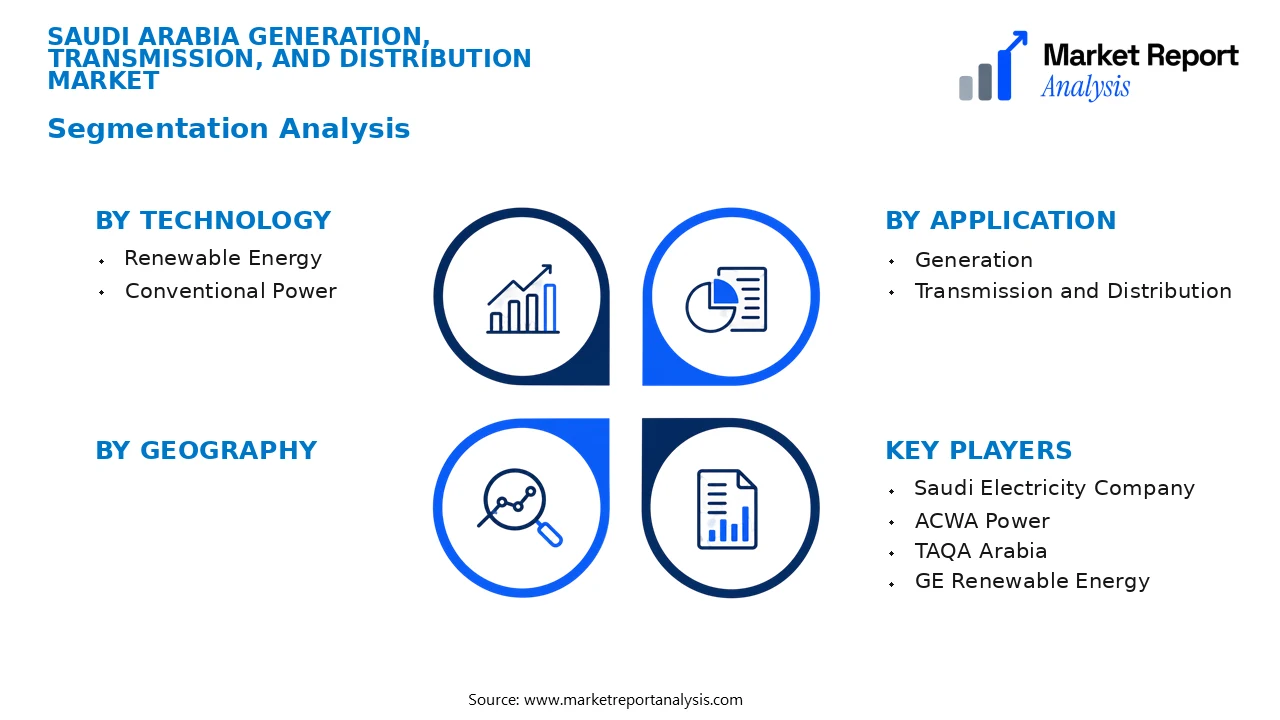
- Technology
- Renewable Energy: Encompasses solar, wind, and other renewable sources gaining traction amid Saudi Arabia’s diversification plans, driven by government incentives and decreasing technology costs, thus expanding adoption in power generation.
- Conventional Power: Comprises coal, natural gas, and nuclear power, which continue to supply the bulk of energy needs as the country transitions towards cleaner generation options, supported by existing infrastructure and investments.
- Application
- Generation: Involves power plants and renewable installations that produce electricity, fundamental for fueling the country’s industrial, commercial, and residential sectors, with expansion driven by rising demand and government initiatives.
- Transmission and Distribution: Includes high-voltage transmission lines and local distribution networks that facilitate grid stability and reliable electrical supply, crucial in supporting the growing urban and industrial zones.
Geography
- Saudi Arabia
- Riyadh: As the capital and largest city, Riyadh hosts the majority of generation and distribution infrastructure, with a focus on integrating renewable projects and upgrading aging grids to meet rising demand.
- Jeddah: A key commercial hub with substantial industrial activity, Jeddah’s infrastructure is expanding to support port operations, commercial establishments, and a push towards incorporating renewable energy sources.
- Dammam: Located in the Eastern Province, Dammam’s strategic position and energy-intensive industries drive demand for reliable power supply, prompting investments in modernizing transmission lines and grid capacity.
- Mecca: A major religious and tourism center, Mecca’s power infrastructure needs catering to large influxes of visitors necessitate sophisticated local generation and distribution systems to ensure uninterrupted service.
Competitive Intelligence
The Saudi Arabia Generation, Transmission, and Distribution Market exhibits a competitive landscape dominated by a few key players such as Saudi Electricity Company (SEC), ACWA Power, and National Grid Saudi Arabia. Market concentration remains high, with the top companies controlling a substantial share due to integrated operations across generation, transmission, and distribution sectors. Business strategies leverage extensive investments in grid modernization, renewable integration, and smart grid technologies, fostering operational efficiencies and reliability improvements.
Product innovation is a focal point, particularly in renewable energy solutions like solar and wind, aligned with the country's Vision 2030 goals. Strategic partnerships and joint ventures, especially with international firms specializing in innovative energy solutions, bolster market competitiveness. Acquisitions aim at expanding geographic reach and technological capabilities, notably in key cities such as Riyadh and Jeddah.
R&D investments target grid resilience, digitalization, and sustainable energy technologies, providing differentiation through enhanced service delivery and cost efficiencies. Differentiation also stems from regional deployment strategies, addressing specific city-level demand and infrastructure needs, positioning firms for long-term growth and market leadership in Saudi Arabia.
Leading Company Profiles
The competitive landscape of the Saudi Arabia Generation, Transmission, and Distribution Market features several key players, each leveraging advanced technology, strategic alliances, and local expertise to strengthen market presence and meet increasing demand for reliable power infrastructure.
- Saudi Electricity Company
- ACWA Power
- TAQA Arabia
- GE Renewable Energy
- Siemens Energy
- Schneider Electric
- ABB
- Hyundai Engineering & Construction
- Mitsubishi Electric
- Daelim Industrial
Saudi Electricity Company
Saudi Electricity Company (SEC) is the dominant utility provider, focusing on large-scale generation, transmission, and distribution projects, driven by extensive infrastructure investments and strategic reforms to support national energy goals.
ACWA Power
Specializing in renewable and thermal power projects, ACWA Power is a leading developer with a focus on sustainable energy solutions, expanding capacity through innovative solar and wind farm investments aligned with Vision 2030.
TAQA Arabia
TAQA Arabia invests heavily in power generation and grid infrastructure, leveraging digital modernization and efficient asset management, with strategic projects targeting grid reliability and energy diversification in Saudi Arabia.
GE Renewable Energy
GE Renewable Energy contributes advanced wind and solar technologies, supporting Saudi Arabia’s renewable capacity expansion through innovative turbine and grid modernization offerings aligned with decarbonization efforts.
Siemens Energy
Siemens Energy supplies high-efficiency turbines, grid automation solutions, and integrated digital platforms, increasingly focusing on smart grid development and modernization to enhance transmission reliability.
Schneider Electric
Specializing in energy management and automation, Schneider Electric provides intelligent electrical distribution systems, supporting digital grid transformation initiatives within Saudi Arabia’s power infrastructure projects.
ABB
ABB focuses on power and automation technology, delivering advanced substations, digital control systems, and grid automation solutions that underpin Saudi Arabia’s smart grid and transmission upgrade strategies.
Hyundai Engineering & Construction
Hyundai contributes large-scale power plant construction and transmission infrastructure projects, emphasizing quality execution and technological innovation to bolster Saudi Arabia’s power capacity.
Mitsubishi Electric
Mitsubishi Electric offers high-voltage switchgear, transformers, and digital control solutions, supporting the modernization and expansion of Saudi Arabia’s transmission network with cutting-edge engineering.
Daelim Industrial
Daelim provides integrated turnkey solutions for power plant construction, emphasizing sustainable practices and advanced grid interconnection projects aligned with national infrastructure goals.
Strategic Business Developments

- June 2026 – Saudi Electricity Company – Launch of the National Grid Modernization Initiative – Enhances transmission reliability and integrates renewable energy sources to meet rising demand.
- March 2026 – ACWA Power – Capacity expansion of renewable projects – Adds 1.5 GW of solar and wind capacity, supporting Saudi Vision 2030's sustainability targets.
- April 2026 – Siemens Energy – Launch of advanced grid automation platform – Improves grid stability and real-time monitoring, reducing outages and operational costs.
- May 2026 – GE Renewable Energy – Investment in offshore wind technology – Demonstrates commitment to diversifying energy sources with next-generation turbine deployment.
- July 2026 – ABB – Strategic alliance with local utilities – Focuses on deploying smart grid and digital distribution solutions for increased efficiency and reliability.
Frequently Asked Questions
What is the Saudi Arabia Generation, Transmission, and Distribution Market?
The Saudi Arabia Generation, Transmission, and Distribution Market encompasses the infrastructure and services involved in producing, transmitting, and distributing electrical power across the country, supporting economic growth and renewable energy integration, with key focus on expanding capacity and modernization of the grid.
What is the current market size of Saudi Arabia Generation, Transmission, and Distribution Market?
As of 2026, the market is valued at approximately USD 50 Billion, driven by government investments in infrastructure, renewable integration, and the aim to diversify energy sources, with ongoing projects enhancing grid reliability and capacity across the nation.
What factors are driving the Saudi Arabia Generation, Transmission, and Distribution Market?
Major drivers include Vision 2030 energy reforms, increasing demand for sustainable power solutions, renewable energy targets, technological advancements, and government incentives designed to upgrade the power infrastructure and reduce reliance on fossil fuels.
Which Saudi city leads the Saudi Arabia Generation, Transmission, and Distribution Market?
Riyadh, the capital city, dominates the market due to its extensive urban infrastructure, high electricity demand, and presence of key utility companies, supported by substantial investments in grid modernization and renewable energy projects.
Which segment is expected to grow the fastest?
The renewable energy segment, particularly solar and wind, is projected to experience the fastest growth through 2034, driven by Saudi Arabia's ambitious renewable capacity targets and regulatory support aimed at diversifying the energy mix.
Who are the leading companies operating in the Saudi Arabia Generation, Transmission, and Distribution Market?
Leading players include Saudi Electricity Company (SEC), ACWA Power, National Grid SA, and SABIC, all contributing significantly to infrastructure development, grid expansion, and renewable energy projects across Saudi Arabia.
Analyst Perspective
The Saudi Arabia generation, transmission, and distribution market is projected to maintain a steady long-term growth trajectory driven by strategic government initiatives, including Vision 2030, aimed at diversifying energy sources and reducing oil dependency. Investment priorities will likely focus on expanding renewable capacity, notably solar and wind, to capitalize on the country’s abundant natural resources and meet sustainability targets. Technological evolution will involve smart grid deployment, digitalization, and advanced grid management systems to improve efficiency and resilience, attracting international and local investors seeking modern infrastructure solutions. Competitive intensity will heighten as local utilities upgrade aging assets and international players target lucrative city-level projects, particularly in Riyadh, Jeddah, and Dammam, which present substantial growth opportunities due to urban expansion and industrialization. Strategic positioning for the long term requires balancing investments in legacy assets and emerging technologies, ensuring market resilience and adaptability amidst regulatory shifts and evolving demand patterns. Overall, the market offers substantial opportunities, but success hinges on innovation, regulatory alignment, and targeted city-specific investments.
