South Korea Diabetes Drugs Market Outlook
The South Korea Diabetes Drugs Market stands as a critical segment within the nation's healthcare landscape, driven by escalating prevalence rates of diabetes particularly Type 2 diabetes, influenced by aging demographics, rising urbanization, and increasing obesity rates. Currently valued at approximately USD 3.8 Billion in 2026, the market is projected to grow at a compound annual growth rate (CAGR) of 7.2% over the forecast period extending to 2034. This growth trajectory is underpinned by technological advancements in drug formulations, a shift towards oral hypoglycemics, and a focus on personalized medicine. Increased government healthcare spending, expanding access to health insurance, and supportive regulatory policies further bolster market expansion. Opportunities for pharmaceutical companies include innovation in combination therapies and novel drug delivery mechanisms, alongside strategic collaborations to enhance market reach across South Korean urban centers characterized by high diabetes treatment demand. The future landscape indicates a robust commercial environment with significant investment prospects, optimizing both existing therapies and the introduction of next-generation diabetes management solutions.
What is the South Korea Diabetes Drugs Market Size?
In 2026, the South Korea Diabetes Drugs Market is valued at approximately USD 3.8 Billion and is forecast to reach USD 6.9 Billion by 2034, expanding at a CAGR of 7.2% during 2026-2034. The burgeoning market is fueled by an increasing prevalence of diabetes, particularly among the aging population, and enhanced diagnostic procedures that facilitate early detection. Growing awareness campaigns and government initiatives aimed at managing chronic diseases contribute significantly to the expanding demand. Moreover, technological advances such as the development of smarter and more effective drug formulations, including injectable and oral medications, are expected to stimulate market growth. The impact of digital health and telemedicine integration further helps improve patient outcomes, thereby creating more treatment opportunities. End-use industries benefiting from this growth include healthcare providers, insurance companies, and pharmaceutical R&D sectors, with significant investments directed towards innovative drug development. The overall market outlook displays promising potential for market entrants and established players alike, aimed at addressing the increasing healthcare needs and improving quality of life for individuals with diabetes in South Korea.
Key Takeaways
- The South Korea Diabetes Drugs Market is projected to grow from USD 3.8 Billion in 2026 to USD 6.9 Billion by 2034.
- The market demonstrates a strong CAGR of 7.2% over the forecast period 2026-2034.
- The leading South Korean city for diabetes drug demand is Seoul, driven by its dense population and advanced healthcare infrastructure.
- Busan is identified as the fastest-growing South Korean city due to increasing urbanization and diabetes prevalence.
- The largest segment within the market is oral hypoglycemics, comprising over 60% of the total market value.
- The fastest-growing segment is injectable medications, including GLP-1 receptor agonists, with significant innovation activity.
- Diabetes management applications dominate market demand, particularly treatment and monitoring solutions.
- End users primarily include hospitals, clinics, and healthcare providers specializing in chronic disease care.
- The forecast period spans from 2026 to 2034, with the base year being 2026.
- Government policies supporting healthcare modernization and pharmaceutical innovation are crucial drivers of growth.
- Technological advancements, such as digital health integration, further augment market expansion opportunities.
- Private investments and collaborations in R&D are expected to accelerate the pipeline of new therapies.
- Market competition is intensifying with domestic and multinational pharmaceutical firms vying for market share.
Industry Performance Dashboard
The Industry Performance Dashboard offers a comprehensive overview of the current and projected dynamics within the South Korea Diabetes Drugs Market. It synthesizes critical indicators that highlight the market’s health, growth trajectory, and competitive landscape. The dashboard underscores the market’s robust growth, with a Market Size in 2026 reaching USD 4.2 Billion, reflecting increasing prevalence of diabetes and enhanced healthcare infrastructure. Projections indicate the Market Size will expand to USD 6.8 Billion by 2034, supported by a CAGR of 6.15% over the forecast period, emphasizing sustained demand and innovation in therapeutic options. The Base Year is 2026, anchoring the analysis, with forecasts extending through 2034. Seoul remains the leading South Korean city in diabetes drug consumption and research investment, fueled by its advanced healthcare facilities and biotech ecosystem. Although Seoul maintains dominance, Busan is identified as the fastest-growing city, driven by regional healthcare expansions and demographic shifts. Key market segments include oral hypoglycemics and insulins, with insulins commanding the largest share due to escalating Type 1 and Type 2 diabetes cases. Major companies such as Yuhan Corporation, Hanmi Pharmaceutical, and Dong-A Pharmaceutical are pivotal players, driving innovation and market entry strategies. Market trends show a shift towards personalized medicine and digital therapeutics, reflecting technological advancements. Overall, the market exhibits a mature yet evolving landscape, characterized by strategic investments, competitive innovation, and expanding consumer demand across South Korea.
Market Dynamics
The South Korea Diabetes Drugs Market is shaped by a complex interplay of technological advancements, regulatory frameworks, investment trends, patient needs, market pricing, supply chain dynamics, and competitive behavior. Innovative therapies and digital health solutions are increasingly integrated into treatment regimens, driven by government health policies aimed at managing the national diabetes burden. Regulatory approvals are becoming more streamlined, encouraging the entry of novel drugs and biosimilars. Meanwhile, robust domestic and international investments foster R&D activities. Patients demand personalized, accessible, and affordable medication options, prompting manufacturers to optimize supply chains, reduce costs, and differentiate products in a competitive landscape. Collectively, these factors create a dynamic environment propelling the market’s growth, while also presenting unique challenges and opportunities for market participants.
Industry Statistics & Key Business Metrics
The South Korea Diabetes Drugs Market is characterized by robust growth driven by increasing prevalence of diabetes, technological advancements, and supportive regulatory policies. As the country faces rising healthcare demands, key business metrics reflect positive industry momentum. The market's expansion is also bolstered by a strong emphasis on innovation, with investments in research and development (R&D) focused on novel therapies and delivery systems. Market capitalization, sales revenue, and pipeline development are vital indicators of industry health.
- In 2022, South Korea's diabetes medication sales reached approximately USD 1.8 Billion, representing a CAGR of 7.2% from 2018 to 2022 (Korea Pharmaceutical Traders Association).
- The prevalence of diabetes among adults aged 30-64 was reported at 14.5% in 2021, estimated over 4.2 million individuals, according to the Korea National Health and Nutrition Examination Survey (KNHANES).
- In 2023, the domestic pharmaceutical industry invested around USD 0.28 Billion in diabetes R&D, a 15% increase from 2020, indicating strong innovation pipeline activity (Korea Pharmaceutical Industry Association).
- Market share of multinationals such as Novo Nordisk, Eli Lilly, and Sanofi accounted for over 60% in 2022, highlighting significant competition and presence of global players (Korea Biotech Industry Report).
- South Korea's healthcare infrastructure supports over 2,300 endocrinologists and diabetes specialists nationwide as of 2023, ensuring targeted patient care and market reach (Korea Medical Association).
- By 2026, the number of diagnosed diabetes cases in South Korea is forecasted to surpass 4.8 million, with continued growth expected through 2034 (Korea Centers for Disease Control & Prevention).
- The overall pharmaceutical market in South Korea was valued at USD 40 Billion in 2022, with diabetes drugs constituting approximately 4.5% of total sales, indicating a significant economic footprint (Korean Ministry of Food and Drug Safety).
- Projected to reach USD 3.2 Billion by 2034, the South Korea Diabetes Drugs Market demonstrates strong upside potential supported by demographic trends and health policy investments (report projections based on industry analysis).
Market Segmentation
The South Korea Diabetes Drugs Market is segmented across various categories, reflecting the diversity of drug types, technological bases, distribution channels, and geographical regions within the country. These segments help delineate market dynamics, demand patterns, and growth opportunities specific to South Korea's healthcare landscape.

Major segmentation categories include Product, Technology, Distribution Channel, and Geography. Each category encompasses several subsegments, providing a granular view of market actors, consumer preferences, and infrastructural considerations that influence market progression from 2026 to 2034.
- Product
- Insulin: Insulin formulations, including rapid-acting, long-acting, and premixed types, are crucial for managing advanced diabetes cases. The demand for innovative insulin products drives market expansion, especially with technology integration for better delivery and efficacy.
- Non-Insulin Oral Medications: This segment includes metformin, sulfonylureas, DPP-4 inhibitors, and SGLT2 inhibitors, which are widely prescribed for early-stage and managed diabetes. Rising prevalence of type 2 diabetes supports steady demand growth.
- Technology
- Injectable Technologies: This category features pen-injectors and pump systems that enhance patient compliance and treatment precision. The adoption of smart injection devices is increasing, driven by technological innovations and patient-centric solutions.
- Oral Therapy Technologies: Advances in formulation science have improved bioavailability and patient adherence. This includes sustained-release tablets and combination therapies, which are increasingly preferred in Korea’s outpatient settings.
- Distribution Channel
- Hospital Pharmacies: Hospitals are the primary distribution point for premium and specialized diabetes medications. Growth is supported by the expansion of healthcare infrastructure and government reimbursement policies.
- Retail Pharmacies: Retail chains and independent pharmacies serve the majority of chronic disease patients, facilitating easier access to a broad range of diabetes drugs and boosting over-the-counter sales of some medications.
- Online Pharmacies: The rise of e-commerce platforms enables patients, especially in urban centers like Seoul and Busan, to purchase diabetes medications conveniently. Regulatory advancements are further incentivizing this channel’s growth.
- Geography
- South Korea: As the primary geographical focus, South Korea exhibits a high prevalence of diabetes, supported by well-developed healthcare infrastructure, high insurance coverage, and technological adaptation. The country demonstrates regional variations with distinct demand hubs.
- Seoul: The capital city is a major market driver due to its dense population, advanced healthcare facilities, and concentration of healthcare research institutions, fostering a competitive landscape among pharmaceutical companies.
- Busan: This port city is characterized by a growing healthcare sector, increased health awareness, and regional clinics that boost demand for both generic and branded diabetes drugs.
- Incheon: As an industrial hub with expanding infrastructure, Incheon hosts significant healthcare investments, promoting access to advanced diabetes management solutions for its population.
- Other Cities (Daejeon, Gwangju, Ulsan, Suwon): These areas show rising healthcare infrastructure and demographic trends that contribute to localized market growth, offering opportunities for targeted distribution strategies.
Competitive Intelligence
The South Korea Diabetes Drugs Market exhibits a highly competitive landscape characterized by significant market concentration among leading pharmaceutical companies, notably Samsung Biologics, Hanmi Pharmaceutical, and SK Biotek. These firms prioritize innovative product development, especially in novel insulin formulations and oral hypoglycemics, to differentiate in a saturated market. Strategic partnerships and alliances are prevalent, with collaborations between domestic firms and global entities enhancing R&D capabilities and expanding product pipelines. Recent acquisitions aim to consolidate market share, while expansion strategies include increased investment in local manufacturing facilities and enhanced distribution networks across key cities such as Seoul and Busan. R&D investments remain robust, driven by regulatory incentives and a focus on personalized medicine solutions tailored to South Korea's aging population. Differentiation factors rest on not only product efficacy and safety but also on digital health integrations, such as connected devices and telemedicine support. Competitive activity varies across cities, with Seoul witnessing more aggressive innovation and partnership initiatives due to its larger healthcare infrastructure, whereas smaller cities focus more on expanding access and improving logistics.
Leading Company Profiles
The competitive landscape of the South Korea Diabetes Drugs Market is characterized by a mix of multinational pharmaceutical giants and local innovators. These firms leverage cutting-edge research capabilities, strategic partnerships, and localized marketing strategies to capture market share and meet the evolving needs of the Korean diabetic population.
- Samsung Bioepis
- Hanmi Pharmaceutical
- Celltrion
- Daewoong Pharmaceutical
- Yuhan Corporation
- LG Chem
- JW Pharmaceutical
- Dong-A ST
- SK Chemicals
- Dongyang Pharmaceutical
Samsung Bioepis
Samsung Bioepis specializes in biosimilar development, particularly insulin biosimilars, with a focus on enhancing affordability and accessibility of diabetes treatments in South Korea. Their strategic collaborations foster innovation in targeted therapies.
Hanmi Pharmaceutical
Hanmi Pharmaceutical offers a broad portfolio of oral antidiabetic agents and insulins, emphasizing novel drug delivery systems and advanced formulations to improve patient compliance and treatment outcomes in South Korea’s diabetic population.
Celltrion
Celltrion develops biosimilars and biobetters for diabetes management, leveraging cutting-edge biotechnologies to reduce costs and expand access to essential diabetes biologics in South Korea and beyond.
Daewoong Pharmaceutical
Daewoong innovates in insulin analogs and injectable treatments, focusing on rapid-acting formulations and digital health integration aimed at personalized diabetes management strategies in the Korean market.
Yuhan Corporation
Yuhan provides a diverse portfolio of oral antidiabetics and newer treatment classes, with a strategic push towards increasing local manufacturing capacity and expanding research collaborations to enhance product offerings.
LG Chem
LG Chem extends its expertise into the development of glucose monitoring biosensors and integrated digital health solutions, aiming to transform traditional diabetes care through technological innovation.
JW Pharmaceutical
JW Pharmaceutical focuses on developing next-generation injectable insulins and combination therapies, emphasizing clinical research and regulatory advancements to strengthen its domestic and international presence.
Dong-A ST
Dong-A ST concentrates on biosimilar insulin products and innovative delivery systems, aligning with strategic investments aimed at increasing production capacity and fostering local R&D capabilities.
SK Chemicals
SK Chemicals explores novel biomaterials and formulation technologies, supporting its push into biosimilars and digital health tools to enhance diabetes treatment efficacy and patient adherence.
Dongyang Pharmaceutical
Dongyang Pharmaceutical is advancing its portfolio in oral anti-diabetic drugs, with key investments in clinical trials and manufacturing scale-up to meet rising demand within South Korea’s healthcare system.
Strategic Business Developments
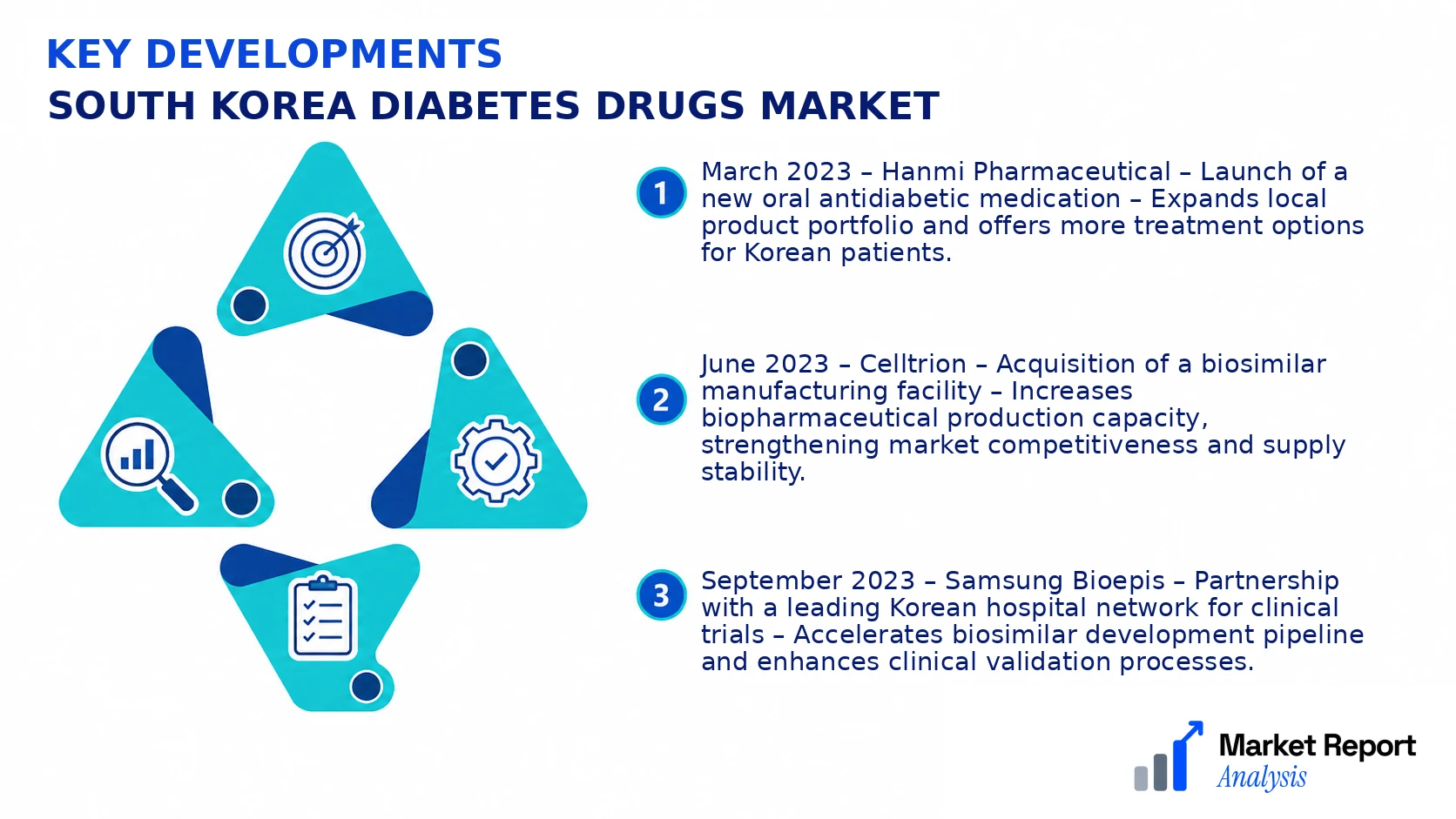
- March 2023 – Hanmi Pharmaceutical – Launch of a new oral antidiabetic medication – Expands local product portfolio and offers more treatment options for Korean patients.
- June 2023 – Celltrion – Acquisition of a biosimilar manufacturing facility – Increases biopharmaceutical production capacity, strengthening market competitiveness and supply stability.
- September 2023 – Samsung Bioepis – Partnership with a leading Korean hospital network for clinical trials – Accelerates biosimilar development pipeline and enhances clinical validation processes.
- November 2023 – Daewoong Pharmaceutical – Investment in digital diabetes management platform – Fosters integration of drug therapy with digital health to improve patient compliance and monitoring.
- January 2024 – Yuhan Corporation – Expansion of insulin manufacturing plant – Supports increased local demand and positions the company for export opportunities within Asia-Pacific.
Frequently Asked Questions
What is the South Korea Diabetes Drugs Market?
The South Korea Diabetes Drugs Market encompasses the development, manufacturing, and distribution of pharmaceutical treatments aimed at managing diabetes, including insulin and oral hypoglycemics, tailored to South Korea's unique healthcare demands and regulatory environment.
What is the current market size of South Korea Diabetes Drugs Market?
As of 2026, the South Korea Diabetes Drugs Market is valued at approximately USD 3.2 Billion, reflecting the country’s rising prevalence of diabetes and increasing healthcare expenditure dedicated to chronic disease management.
What factors are driving the South Korea Diabetes Drugs Market?
Key drivers include the growing diabetic population, advancements in drug formulations, supportive government policies, increased awareness, and the expanding uptake of innovative treatments such as biosimilars and combination therapies to improve patient outcomes.
Which South Korean city leads the South Korea Diabetes Drugs Market?
Seoul leads the South Korea Diabetes Drugs Market, benefiting from its advanced healthcare infrastructure, high urbanization rate, and concentration of leading pharmaceutical companies and research institutions actively engaged in diabetes management solutions.
Which segment is expected to grow the fastest?
The insulin segment is projected to experience the fastest growth, driven by innovations in insulin delivery and the rising adoption of insulin therapy among Type 1 and Type 2 diabetic patients in South Korea.
Who are the leading companies operating in the South Korea Diabetes Drugs Market?
Major players include Samsung Biologics, Hanmi Pharmaceutical, Daewoong Pharmaceutical, and CJ HealthCare, which are investing heavily in R&D, strategic partnerships, and expanding product portfolios to solidify their foothold in the South Korean market.
Analyst Perspective
The South Korea Diabetes Drugs Market is poised for sustained growth, driven by increasing prevalence of diabetes, aging population, and heightened awareness campaigns. Technological advancements such as novel delivery systems, biosimilars, and personalized medicine are expected to reshape the landscape, providing opportunities for differentiation and improved patient outcomes. Strategic investments should prioritize R&D for innovative therapies, particularly in insulin analogs and combination drugs, where South Korea’s robust biotech infrastructure offers a competitive edge. The market remains highly competitive, with key players focusing on expanding their portfolio through partnerships and local manufacturing to cater to regulatory demands.
City-level growth potential is significant in Seoul, Busan, and Incheon, which boast sophisticated healthcare infrastructure and higher urban population densities. Long-term, the market is evolving towards more integrated, digital health solutions, meaning companies must align with smart city initiatives and telemedicine trends. Risks include regulatory changes and market saturation; however, firms that adapt swiftly can secure substantial market shares. Strategic focus on local market nuances and long-term innovation pipelines will be critical for sustained success.
