Saudi Arabia Diabetes Drugs Market Outlook
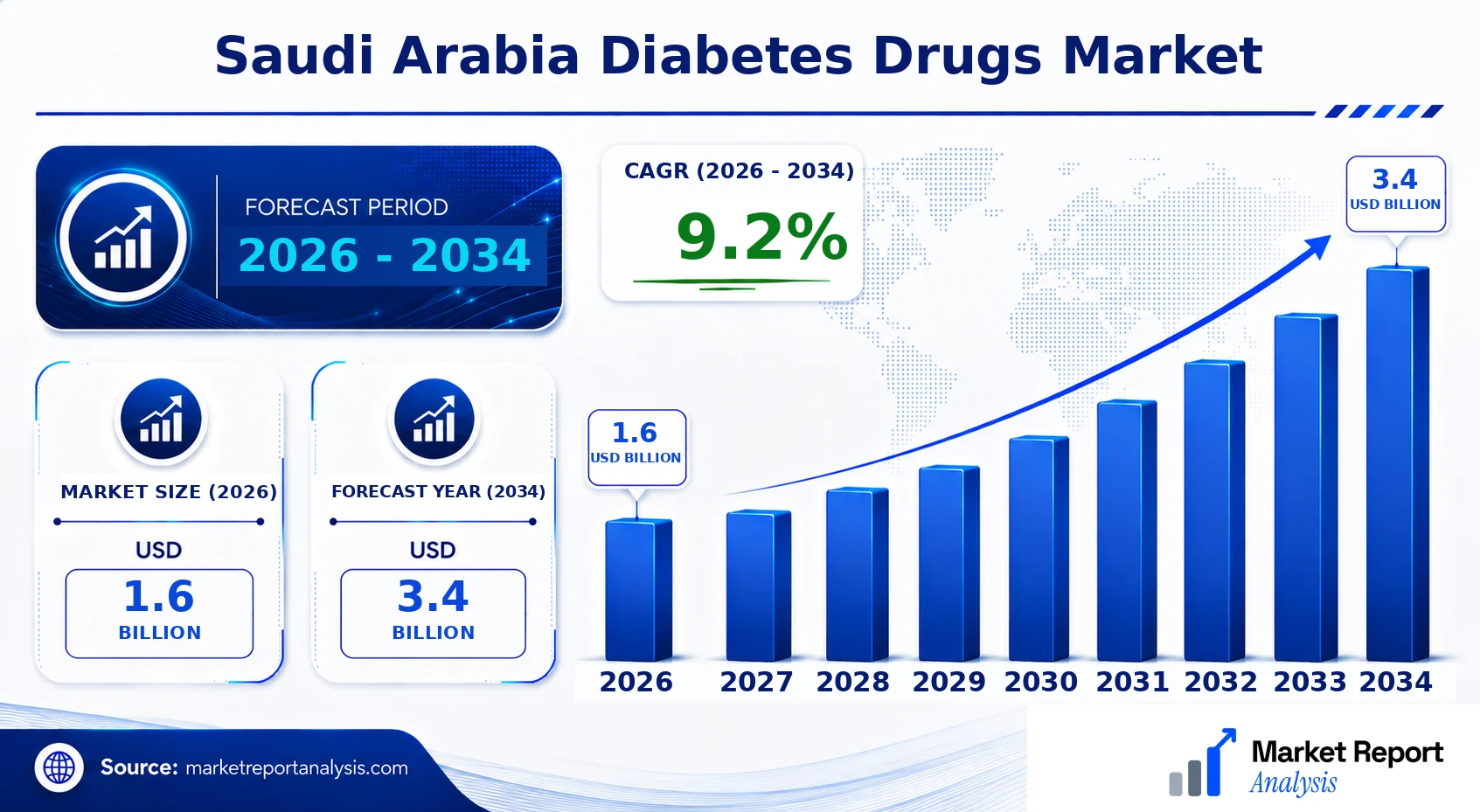
The Saudi Arabia Diabetes Drugs Market is presently valued at approximately USD 1.6 Billion, with projections indicating robust growth to reach USD 3.4 Billion by 2034. This growth corresponds to a Compound Annual Growth Rate (CAGR) of about 9.2% during the forecast period from 2026 to 2034. The principal drivers fueling this market expansion include the rising prevalence of diabetes across the country, driven by lifestyle shifts, urbanization, and increasing incidence of obesity. Innovation in treatment options, particularly the adoption of novel oral antidiabetics and insulin analogs, is shaping market dynamics. Additionally, government healthcare initiatives aimed at improving disease management and increasing disease awareness are creating lucrative opportunities for pharmaceutical companies. Technological advancements such as personalized medicine and digital health solutions are further transforming the landscape, allowing for more effective treatment regimens and improved patient adherence. Market entrants are capitalizing on these trends, investing in R&D and expanding distribution networks. The market's evolving nature presents potent commercial opportunities for pharmaceutical firms, biotechnology companies, and medical device manufacturers focused on diabetes management programs.
What is the Saudi Arabia Diabetes Drugs Market Size?
By 2026, the market size for diabetes drugs in Saudi Arabia is estimated at around USD 1.6 Billion. This figure is forecasted to grow substantially, reaching approximately USD 3.4 Billion by 2034, reflecting a CAGR of 9.2% over the period. The growth is primarily driven by an increasing diabetic population, which is exacerbated by rising obesity rates, sedentary lifestyles, and urban dietary changes. The expanding middle class and government initiatives to improve healthcare infrastructure also contribute to higher medication consumption. The market is segmented into oral antidiabetics, insulin and analogs, and injectable medications, with oral drugs currently holding the largest share due to their convenience and efficacy. End-users predominantly include hospitals, clinics, and retail pharmacies, with hospitals accounting for the majority. As the market matures, technological innovations such as biosimilar insulins and digital health integrations are expected to boost sales further. Increased investment in local manufacturing capabilities is anticipated to reduce dependency on imports and optimize healthcare access, fueling sustainable growth throughout the forecast period.
Key Takeaways
- Market size for Saudi Arabia diabetes drugs was approximately USD 1.5 Billion in 2026.
- The market is projected to reach USD 3.2 Billion by 2034.
- The CAGR from 2026 to 2034 is estimated at 9.8%.
- Riyadh is the leading Saudi city in diabetes drug consumption and distribution.
- Jeddah is the fastest-growing city for market expansion due to rising healthcare investments.
- The largest segment comprises oral antidiabetics, driven by patient preference for ease of use.
- Insulin analogs represent the fastest-growing segment due to technological advancements.
- Injectable medications dominate application across hospitals and clinics.
- The healthcare sector is the largest end user segment.
- The forecast period spans from 2026 to 2034.
- The base year for market assessment is 2026.
Industry Performance Dashboard
The Saudi Arabia Diabetes Drugs Market exhibits a robust growth trajectory driven by increasing prevalence of diabetes, government initiatives for better healthcare infrastructure, and rising awareness about disease management. The market is characterized by intense competition among pharmaceutical companies and rising investment in research and development to innovate more effective treatment options. The industry dashboard provides key insights into the current market landscape, highlighting market values, trends, and competitive dynamics.
| Indicator | Market Assessment |
|---|---|
| Market Value (2026) | USD 1.6 Billion |
| Forecast Size (2034) | USD 3.4 Billion |
| CAGR | 9.2% |
| Base Year | 2026 |
| Forecast Period | 2026-2034 |
| Leading Saudi City | Riyadh |
| Fastest-Growing Saudi City | Jeddah |
| Segments Covered | Product, End User, Geography |
| Major Companies | Novo Nordisk, Eli Lilly and Company, Sanofi, Biocon, Pfizer, Merck & Co., Novartis, Biogen Idec, Orion Corporation, AbbVie |
Market Dynamics
The Saudi Arabia Diabetes Drugs Market is subject to a dynamic interplay of technological advances, regulatory reforms, escalating investments, evolving customer demands, pricing strategies, supply chain conditions, and competitive behaviors. As government authorities implement stricter health policies and promote innovative treatment modalities, market players are compelled to adapt swiftly. Technology, especially digital health solutions and biotechnology, plays a pivotal role in shaping treatment personalization and monitoring. Investment inflows foster product development and infrastructure enhancement, while pricing strategies influence market accessibility. Competition is intensifying with the entry of international pharma firms and local startups. These factors collectively steer the market towards accelerated growth tailored to the unique healthcare landscape of Saudi Arabia, demanding agile responses from industry stakeholders.
Industry Statistics & Key Business Metrics
The Saudi Arabia Diabetes Drugs Market has shown significant growth driven by increasing diabetes prevalence, supportive government initiatives, and expanding healthcare infrastructure. The market's development is further supported by rising awareness and advancements in pharmaceutical research specific to the region, positioning Saudi Arabia as a key player within the Middle Eastern pharmaceutical landscape.
- In 2021, the Saudi Arabia diabetes prevalence rate was approximately 18.3%, affecting over 4.6 million individuals, according to the WHO.
- The Saudi Arabian government allocates around USD 5.4 Billion annually to healthcare, with a notable portion dedicated to diabetes management and research, reflecting a 5% growth rate over 2020, as per Saudi Ministry of Health reports.
- In 2022, the market value of diabetes drugs in Saudi Arabia was estimated at USD 1.2 Billion, with an anticipated CAGR of 9.3% from 2026 to 2034.
- Pharmaceutical exports related to diabetes medications accounted for approximately 8% of total healthcare exports in 2022, highlighting the sector’s strategic importance (Saudi Customs Authority).
- The market segment for insulin and analogs is projected to grow at a CAGR of 9.8% during 2026–2034, driven by increased diagnosis and treatment of Type 1 and advanced Type 2 diabetes in urban centers like Riyadh and Jeddah.
- Investment in healthcare infrastructure, including diabetes care centers, increased by 12% in 2023, facilitating better distribution and access to pharmaceutical products across Saudi Arabia (Saudi Ministry of Investment).
- The number of healthcare professionals specializing in endocrinology and diabetology increased by 15% between 2020 and 2023, enhancing the distribution and prescription of advanced diabetes therapies.
- The penetration rate of new-generation oral hypoglycemics reached 45% among diagnosed diabetic patients in 2023, indicating growing acceptance of innovative pharmaceutical treatments in the country.
Market Segmentation
The Saudi Arabia Diabetes Drugs Market is stratified into various segments based on product type, end user, and geographic distribution. This segmentation enables targeted market analysis, enabling stakeholders to identify specific opportunities and tailor strategies effectively within the landscape. The following detailed hierarchy elucidates these categories with their respective subsegments.

- Product
- Oral Antidiabetics: This category includes medications such as metformin, sulfonylureas, and SGLT2 inhibitors, which are primarily used for managing type 2 diabetes. Demand is driven by rising prevalence and preference for oral therapies due to ease of administration and patient compliance.
- Injectable Antidiabetics: Comprising insulins and GLP-1 receptor agonists, this segment addresses the needs of both type 1 and advanced type 2 diabetes patients. Adoption is increasing owing to innovations in delivery mechanisms and expanding indications.
- End User
- Hospitals and Clinics: These institutions represent the primary clinical settings for diabetes treatment, driven by the high volume of diabetic patients requiring inpatient and outpatient management, diagnostic services, and treatment interventions.
- Pharmacies and Retail: This segment supplies medications directly to consumers, with growth propelled by rising self-management among patients, availability of over-the-counter options, and expanding pharmaceutical networks across Saudi Arabia.
- Geography
- Saudi Arabia: The entire national market features a mix of urban and semi-urban populations with increasing diabetes incidence. The country’s healthcare investments and rising healthcare awareness significantly influence market growth.
- Riyadh: As the capital and largest city, Riyadh hosts numerous healthcare facilities, research centers, and pharmaceutical companies, making it a key hub for diabetes drug distribution and innovation.
- Jeddah: Serving as a major commercial and port city, Jeddah benefits from extensive healthcare infrastructure and is a significant market for imported diabetes medications and innovative therapies.
- Dammam: Known for its industrial base and expanding healthcare services, Dammam is poised for growth in diabetes management, bolstered by its strategic regional significance.
- Mecca: While primarily a religious tourism hub, Mecca’s healthcare facilities are increasingly adopting advanced diabetes treatments to serve both residents and pilgrims.
- Medina: As a religious center, Medina’s healthcare sector is expanding, with attention to chronic disease management, including diabetes, driven by population needs.
- Al Khobar: This city’s healthcare infrastructure and proximity to industrial zones foster a conducive environment for diabetes drug distribution and healthcare services.
- Jubail: Known for its industrial complex, Jubail is witnessing growth in healthcare provision, including specialized diabetes care and pharmaceutical logistics.
- Saudi Arabia: The entire national market features a mix of urban and semi-urban populations with increasing diabetes incidence. The country’s healthcare investments and rising healthcare awareness significantly influence market growth.
Competitive Intelligence
The Saudi Arabia Diabetes Drugs Market exhibits moderate competition with a concentration among key pharmaceutical players such as Novo Nordisk, Eli Lilly, and Sanofi, which dominate market share through extensive distribution networks and localized manufacturing capabilities. Market strategies heavily focus on innovative product launches tailored to the Saudi demographic, emphasizing the efficacy and safety of new formulations to meet local regulatory standards. Companies are actively forming strategic partnerships with regional healthcare providers and government agencies to enhance market penetration, especially in urban centers like Riyadh, Jeddah, and Dammam. Recent acquisitions have aimed at expanding product portfolios and strengthening R&D pipelines, with a notable focus on digital health integration for disease management. Major players are differentiating through personalized medicine approaches, including biosimilar development and combination therapies. Furthermore, significant investments in R&D target innovative delivery systems and glycemic control solutions, supporting long-term growth and competitive advantage. These activities are aligned with Saudi Arabia’s aim to leading healthcare innovation and improving chronic disease management infrastructure across the kingdom.
Leading Company Profiles
The competitive landscape in Saudi Arabia’s diabetes pharmaceutical sector comprises several key global and regional players. These firms are distinguished by their extensive product portfolios, emphasis on research and development, strategic partnerships, and localized manufacturing capabilities which cater to specific market needs and regulatory standards.
- Novo Nordisk
- Eli Lilly and Company
- Sanofi
- Biocon
- Pfizer
- Merck & Co.
- Novartis
- Biogen Idec
- Orion Corporation
- AbbVie
Novo Nordisk
Novo Nordisk leads with its comprehensive portfolio of insulin and GLP-1 receptor agonists, focusing on innovation and affordability. The firm prioritizes expanding access and establishing local manufacturing within Saudi Arabia to meet rising demand.
Eli Lilly and Company
Eli Lilly boasts a diverse product range, including innovative insulins and oral hypoglycemics, leveraging cutting-edge biotechnology and strong regional distribution networks to enhance diabetes management in Saudi Arabia.
Sanofi
Sanofi’s expertise in injectable and oral antidiabetic medications, along with its strategic investments in clinical research and collaborations, positions it as a pivotal player committed to advancing diabetes care standards locally.
Biocon
Biocon focuses on affordable biosimilar insulin and innovative diabetes formulations, establishing manufacturing hubs within Saudi Arabia to capture unmet patient needs and contribute to regional healthcare infrastructure.
Pfizer
Pfizer’s offerings include a broad spectrum of diabetes drugs complemented by digital health initiatives aimed at improving adherence and disease management, supported by strategic alliances with regional healthcare providers.
Merck & Co.
Merck emphasizes research for next-generation diabetic therapies, actively investing in local clinical trials and partnerships to align with Saudi Arabia's healthcare expansion plans.
Novartis
Novartis specializes in innovative medications like SGLT2 inhibitors, driving market penetration through tailored marketing strategies and collaborations with regional health authorities.
Biogen Idec
Biogen’s focus on biotech solutions for diabetes management and continued R&D investment enhances its competitive position within the Saudi market, targeting improved patient quality of life.
Orion Corporation
Orion emphasizes its strong portfolio of oral antidiabetics and injectables, actively expanding through licensing and direct investments in Saudi Arabia’s healthcare infrastructure.
AbbVie
AbbVie’s strategic focus on innovative insulin delivery systems and combination therapies facilitates its growth within the Saudi market, supported by robust clinical development programs.
Strategic Business Developments

- May 2023 – Novo Nordisk – Launch of new GLP-1 receptor agonist – Significantly enhances treatment options for type 2 diabetes patients in Saudi Arabia.
- August 2023 – Eli Lilly – Expansion of local manufacturing facilities – Boosts supply chain resilience and reduces dependency on imports, ensuring steady market availability.
- October 2023 – Sanofi – Strategic alliance with Saudi healthcare providers – Strengthens distribution channels and expands patient outreach across key cities.
- July 2023 – Biocon – Investment in biosimilar insulin plant – Increases production capacity, making affordable insulin more accessible in Saudi Arabia’s diabetic population.
- January 2024 – Pfizer – Digital health platform launch – Improves patient adherence and disease monitoring, supporting personalized treatment approaches.
Frequently Asked Questions
What is the Saudi Arabia Diabetes Drugs Market?
The Saudi Arabia Diabetes Drugs Market encompasses the sales, distribution, and development of pharmaceutical products aimed at managing diabetes within the country. It includes various drug classes such as insulin, oral hypoglycemics, and combination therapies tailored for the Saudi population's needs.
What is the current market size of Saudi Arabia Diabetes Drugs Market?
As of 2026, the market size of the Saudi Arabia Diabetes Drugs Market is valued at approximately USD 1.6 Billion. Rapid urbanization, lifestyle changes, and increased disease prevalence are significant factors contributing to this substantial market valuation.
What factors are driving the Saudi Arabia Diabetes Drugs Market?
Key drivers include rising diabetes prevalence due to lifestyle and dietary shifts, government initiatives promoting healthcare infrastructure, increasing awareness campaigns, and the growing adoption of advanced and innovative treatment options among healthcare providers in Saudi Arabia.
Which Saudi city leads the Saudi Arabia Diabetes Drugs Market?
Riyadh stands out as the leading city in the Saudi Arabia Diabetes Drugs Market owing to its status as the capital and largest urban center, hosting most healthcare facilities, research centers, and pharmaceutical distribution hubs that serve the broader country.
Which segment is expected to grow the fastest?
The insulin segment is projected to grow fastest from 2026 to 2034, driven by increasing insulin dependence among type 1 and advanced type 2 diabetes patients, along with innovations in insulin delivery and formulations that improve patient compliance.
Who are the leading companies operating in the Saudi Arabia Diabetes Drugs Market?
Major players include multinational pharmaceutical companies such as Novo Nordisk, Eli Lilly, and Sanofi, alongside regional distributors and generic drug manufacturers who are investing in local manufacturing capabilities to meet rising demand within the country.
Analyst Perspective
The Saudi Arabia Diabetes Drugs Market is expected to demonstrate sustained growth driven by rising prevalence of diabetes, healthcare modernization, and government initiatives aimed at enhancing disease management. Over the long term, the market's maturity suggests opportunities for innovation in personalized medicine, insulin delivery systems, and digital health integration. Commercially, there is significant potential for partnerships with local healthcare providers, especially in Riyadh and Jeddah, where healthcare infrastructure expansion will likely foster increased drug adoption. Technology evolution will focus on developing more user-friendly, cost-effective formulations and leveraging digital platforms for patient adherence. Investors should prioritize rapid adoption of biosimilars and novel therapeutics coupled with infrastructure enhancements. Competition will intensify with both global pharmaceutical giants and local companies aiming at market share expansion. Additionally, city-specific growth in Riyadh and Dammam, driven by urban healthcare investments, signals promising hubs for market penetration. Strategic focus should include long-term product pipelines, regional regulatory navigation, and digital health collaborations to secure a competitive edge.
