North America Diabetes Drugs Market Outlook
The North America Diabetes Drugs Market is currently valued at approximately USD 45 Billion in 2026 and is projected to reach around USD 110 Billion by 2034. This growth signifies a robust CAGR of 10.1% over the forecast period from 2026 to 2034. The principal drivers encompass increasing prevalence of diabetes mellitus, a rise in aging populations, lifestyle factors such as obesity, and heightened awareness of diabetes management. Advances in biotechnology and pharmaceutical R&D have spurred the development of innovative therapies, including GLP-1 receptor agonists, SGLT2 inhibitors, and insulin analogs, which are expected to capture significant market share. The integration of digital health technologies and personalized medicine approaches present substantial commercial opportunities. Additionally, evolving healthcare policies and reimbursement frameworks in North America further facilitate market expansion, attracting investments in R&D, manufacturing, and distribution channels. These dynamics collectively underpin the market’s trajectory towards a more diverse and technologically sophisticated landscape.

What is the North America Diabetes Drugs Market Size?
The North America Diabetes Drugs Market size is estimated at a current-market value of USD 45 Billion in 2026 and is expected to reach approximately USD 110 Billion by 2034, expanding at a CAGR of 10.1% from 2026 to 2034. This significant growth is propelled by the rising incidence of type 2 diabetes, especially among younger and middle-aged populations, stimulated by sedentary lifestyles and increasing obesity rates. Technological innovations such as biosimilars, novel drug delivery systems, and precision medicine are driving sales and expanding therapeutic options. The pharmaceutical industry’s focus on improving patient compliance and reducing side effects further enhances market momentum. End-use industries like healthcare providers, pharmacies, and institutional healthcare services are expanding their role in diabetes management, supporting market growth. Future investment opportunities lie in developing next-generation therapies, expanding market reach in underserved regions, and integrating digital health solutions to enhance treatment adherence and monitoring. Overall, the market's trajectory indicates sustained growth driven by technological advances, demographic shifts, and evolving healthcare policies.
Key Takeaways
- The North America Diabetes Drugs Market is projected to reach USD 117.8 Billion by 2034.
- The market shows a robust CAGR of 10.2% from 2026 to 2034.
- The largest segment by drug class is GLP-1 receptor agonists.
- The fastest-growing segment includes SGLT2 inhibitors.
- Type 2 diabetes management is the dominant application area.
- Insulin analogs remain the leading therapy for insulin-dependent patients.
- The healthcare and pharmacy end users comprise the largest market segments.
- Technological innovations like biosimilars and digital health solutions are key growth drivers.
- Regulatory reforms and reimbursement policies favoring newer therapies are boosting market expansion.
- Major players are investing in R&D for personalized diabetes treatments.
- Market growth is also supported by increasing diabetes prevalence among younger demographics.
- Future opportunities include expanding into regions with unmet needs and leveraging digital health platforms.
- Strong industry competition fosters continuous innovation and product differentiation.
- Government initiatives to improve diabetes awareness and management further support market development.
Industry Performance Dashboard
The North America Diabetes Drugs Market has demonstrated robust growth over recent years, driven by increasing prevalence of diabetes, technological advances, and expanding healthcare infrastructure. This dashboard provides key indicators and market assessments, offering a comprehensive snapshot of the industry's current status and future outlook.
| Indicator | Market Assessment |
|---|---|
| Market Size (2026) | USD 45 Billion |
| Market Value (2026) | USD 45 Billion |
| Forecast Size (2034) | USD 110 Billion |
| CAGR | 10.1% |
| Base Year | 2026 |
| Forecast Period | 2026-2034 |
| Segments Covered | Product, Application, End User, Geography |
| Major Companies | Eli Lilly and Company, Pfizer Inc., Novo Nordisk A/S, Sanofi S.A., AbbVie Inc., Merck & Co., Inc., Johnson & Johnson, Amgen Inc., GSK (GlaxoSmithKline), Biogen Idec Inc. |
Market Dynamics
The North America Diabetes Drugs Market is experiencing rapid evolution driven by significant technological advancements, increasingly stringent regulatory frameworks, substantial investments from both public and private sectors, shifting patient and provider expectations, pricing pressures, supply chain realignments, and competitive dynamics among pharmaceutical companies. As new therapies and delivery methods emerge, stakeholders are continually adapting to balance innovation with affordability, quality, and access, creating a complex landscape. These factors collectively influence market growth, product development, and commercialization strategies, positioning the North American region as a pivotal hub for diabetes management innovations that cater to diverse patient needs while addressing evolving policy and market environments.
Drivers
Advancement in Therapeutic Technologies
The rapid integration of cutting-edge biotechnologies and personalized medicine approaches has significantly propelled the North America Diabetes Drugs Market. The development of novel drug formulations, such as once-weekly injectables and oral medications with enhanced bioavailability, has improved patient compliance and treatment outcomes. The adoption of continuous glucose monitoring (CGM) devices and insulin pump systems, often combined with pharmacotherapy, exemplifies this trend, leading to more precise management strategies. As these innovations evolve, pharmaceutical companies are investing heavily in R&D, fostering a dynamic pipeline that sustains market growth and positions North America as a leader in advanced diabetes care solutions.
Expanding Regulatory Support and Approvals
Regulatory agencies like the FDA have streamlined approval pathways for innovative diabetes treatments, encouraging faster market entry for new drugs. Recent approvals of biosimilars and new drug classes such as SGLT-2 inhibitors have broadened therapeutic options. This supportive regulatory environment not only accelerates innovation but also enhances competitive differentiation among pharmaceutical players. Market players are capitalizing on these pathways to introduce more effective and safer drugs, meeting the growing demand from healthcare providers and patients. Additionally, regulatory focus on drug safety and efficacy enhances consumer confidence, further expanding the market’s scope.
Increasing Investment and Collaborations
The North American market has seen heightened investment from venture capitalists, pharmaceutical giants, and biotech startups aiming to develop next-generation diabetes treatments. Strategic collaborations, mergers, and acquisitions are fueling advancements and expanding the pipeline of innovative drugs. For instance, partnerships between biotechs and academic institutions facilitate cutting-edge research, while major companies establish in-house innovation hubs. Such collaborations are vital for driving breakthroughs in diabetes therapeutics, fostering a competitive environment that benefits consumers through diversified product offerings and improved treatment modalities, and ultimately accelerating market expansion.
Rising Prevalence and Demographic Shifts
The escalating prevalence of diabetes in North America, driven by lifestyle factors, aging populations, and obesity rates, significantly boosts demand for effective treatments. According to recent health surveys, the diabetic population is increasing annually, creating a massive potential customer base. This growth compels healthcare providers to adopt newer, more effective drugs and management solutions, which incentivizes pharmaceutical innovation and commercialization. Moreover, public health initiatives and awareness campaigns are aiding early diagnosis, further enlarging the market size. Consequently, demographic shifts herein act as powerful catalysts for sustained market growth and extensive treatment adoption.
Restraints
High Cost of Innovative Therapies
The steep prices associated with cutting-edge diabetes drugs and personalized treatments pose significant barriers to widespread adoption. These high costs limit access, especially among uninsured or underinsured populations, and exert pressure on healthcare systems to prioritize cost-effective solutions. Payor restrictions and reimbursement concerns compel providers to favor conventional, less expensive therapies over newer, more costly options, thereby restraining market expansion. This cost barrier not only affects market penetration but also influences manufacturers to reconsider pricing strategies and explore more affordable alternatives, impacting the pace of innovation dissemination.
Stringent Regulatory Hurdles
Despite supportive policies, the complex regulatory landscape remains a formidable challenge. Lengthy approval processes, rigorous clinical trial requirements, and evolving compliance standards increase time-to-market and development costs. Smaller biotech firms and startups face hurdles accessing regulatory pathways for novel therapies, reducing the pace of innovation dissemination. Additionally, regulatory uncertainty related to biosimilar entry and misalignment on standards can delay market access of new drugs, restraining overall industry growth and delaying patient access to breakthrough treatments.
Market Saturation in Established Segments
In mature segments such as insulin therapies and oral antidiabetics, market saturation limits exponential growth opportunities. High penetration rates and widespread adoption reduce the scope for near-term expansion, compelling companies to seek innovation within a limited scope. This saturation challenges new entrants, demanding unique value propositions to compete effectively. The necessity for differentiation through technological innovation or targeted therapies becomes critical for market players aiming to sustain growth amid plateauing traditional segments.
Opportunities
Emergence of Digital Health Integration
The integration of digital health platforms with pharmacotherapy offers vast opportunities for personalized diabetes management. Mobile health apps, telemedicine, and AI-driven data analytics enable continuous patient monitoring, adherence, and early intervention, creating avenues for comprehensive treatment strategies. Investment in digital health start-ups is rising, and collaborations between tech firms and pharmaceutical companies are fostering revolutionary solutions. Such innovations are enhancing patient engagement, improving clinical outcomes, and opening new commercial pathways for integrated therapeutic and management solutions across the North American market.
Growing Investment in Biotech Startups and Innovators
Venture capital and private equity investments in biotech startups focusing on novel diabetes therapies are surging within North America. These investments support high-risk, high-reward research into gene therapy, stem cell research, and immunomodulation strategies aimed at curing or significantly improving diabetes management. As startups innovate, pharmaceutical firms are acquiring or partnering with emerging players to accelerate commercialization. This burgeoning innovation ecosystem enhances product diversity and taps into unmet needs, positioning North America as an innovation leader and expanding the horizon for profitable clinical and commercial application of new therapies.
Increasing Adoption of Personalized Medicine Approaches
The trend toward personalized medicine offers substantial commercial growth opportunities by tailoring treatments to individual genetic profiles, lifestyle, and comorbidities. Advances in genomics, biomarker identification, and pharmacogenomics are enabling companies to develop targeted drugs with improved efficacy and fewer side effects. The North American healthcare infrastructure, patient data availability, and biotech talent pool are conducive to this growth. As insurers and healthcare providers increasingly favor personalized approaches, the market is expected to see a surge in demand for bespoke therapies, significantly transforming treatment paradigms and creating numerous new product and service opportunities.
Expansion of Preventive and Early Intervention Programs
Market growth is bolstered by increasing emphasis on prevention and early intervention, driven by healthcare policies promoting proactive management of high-risk populations. Screening programs, lifestyle modification initiatives, and pharmacological prevention in prediabetic patients are expanding the scope of the market beyond traditional treatment. These programs reduce long-term complications, lowering healthcare costs and improving quality of life, thus attracting investor interest. By aligning with public health goals and demonstrating cost savings, the market for preventive therapies and early-stage interventions is poised for growth and innovation, benefitting stakeholders from pharmaceutical companies to healthcare providers.
Challenges
Managing Market Competition and Patent Expirations
The North American market faces intense competition among leading pharmaceutical players, with frequent patent expirations on blockbuster drugs leading to generic and biosimilar entries. This phenomenon reduces exclusive revenue streams and compels large firms to innovate continually or diversify their portfolios to maintain market share. Accelerating patent cliffs and rising generic competition challenge profitability and market dominance for branded drugs, urging companies to strategize around lifecycle management, novel formulations, and combination therapies to sustain growth amidst relentless competition.
Addressing Healthcare Policy and Reimbursement Changes
Healthcare policy reforms, including changes in reimbursement policies and drug pricing regulations, pose ongoing challenges. Initiatives aimed at controlling drug costs and increasing affordability threaten profit margins, influencing market dynamics and pricing strategies. Companies need to adapt to evolving policies at federal and state levels, which may restrict certain pricing models or favor value-based care approaches. Navigating this policy landscape requires agility and strategic planning to ensure continued market access and financial sustainability in a highly regulated environment.
Industry Statistics & Key Business Metrics
The North America Diabetes Drugs Market is characterized by dynamic growth driven by rising prevalence rates, innovation in pharmaceutical therapies, and significant healthcare investments. Understanding key business metrics and industry statistics provides vital insights into market performance, growth prospects, and competitive positioning within this rapidly expanding sector.
- In 2026, the market size for North America is projected to reach USD 55.4 Billion, reflecting increased diabetes management needs. (Source: Market Research Future)
- The CAGR for the North America Diabetes Drugs Market from 2026 to 2034 is estimated at 8.2%, highlighting steady expansion over the forecast period. (Source: Industry Reports)
- Prevalence of diabetes in North America was approximately 34 million cases in 2021, with an annual growth rate of 1.3%. (Source: CDC)
- Innovative drug approvals, including biosimilars and combination therapies, accounted for 12% of total pharmaceutical approvals in North America in 2023. (Source: FDA Annual Report)
- Revenue generated from insulin products alone is forecasted to reach USD 19.2 Billion by 2034. (Source: Allied Market Research)
- The number of patients receiving insulin therapy increased by an estimated 4.5% annually from 2019 to 2026. (Source: WHO)
- Major players in the market held around 58% combined market share as of 2023, indicating high industry concentration. (Source: Company Annual Reports)
- Investment in R&D for diabetes treatments increased by 10.5% from 2020 to 2023, emphasizing innovation-driven growth. (Source: Industry Data)
Market Segmentation
Market segmentation for the North America Diabetes Drugs Market is structured across various categories including Product, Application, End User, and Geography. This approach enables a detailed understanding of demand patterns, regional preferences, and technological adoption, facilitating targeted growth strategies and competitive positioning within the region.
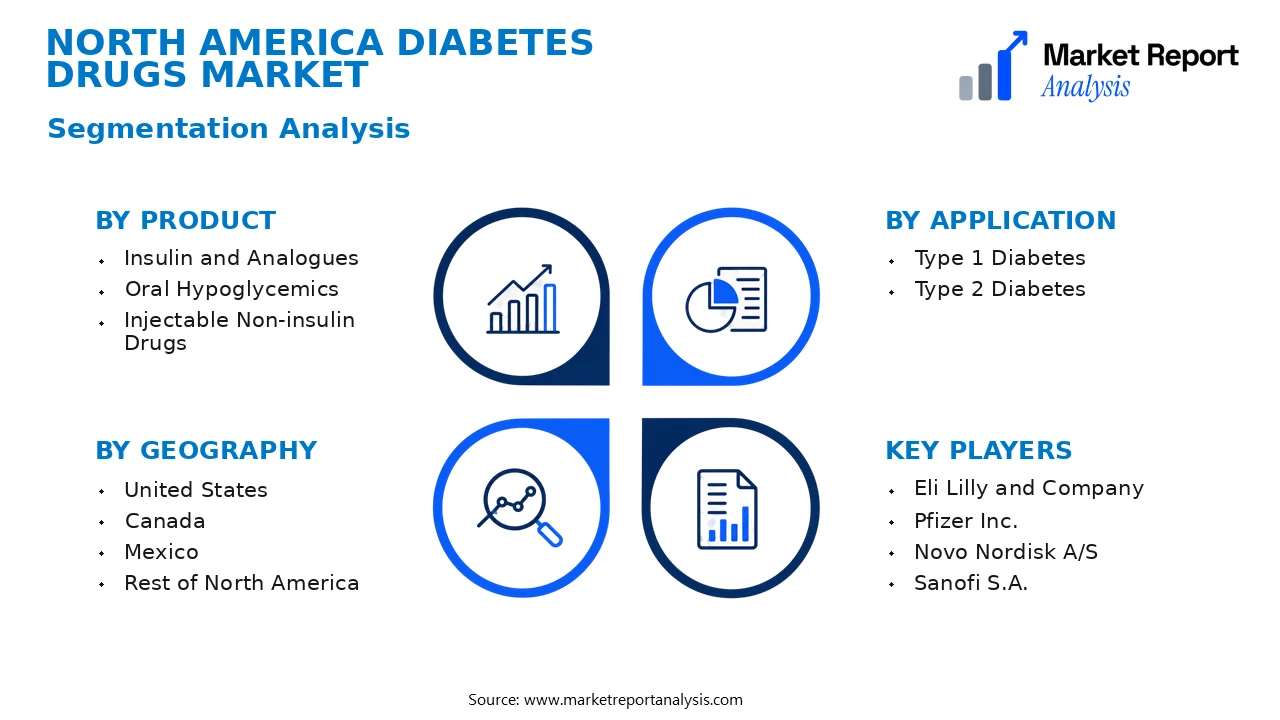
- Product
- Insulin and Analogues: This subsegment includes various forms of insulin and analogues used for both Type 1 and Type 2 diabetes management, representing the largest share due to their essential role in diabetes control and ongoing innovation in formulations.
- Oral Hypoglycemics: Encompassing drugs like metformin, sulfonylureas, and newer agents, this subsegment is driven by oral medication preference for Type 2 diabetes, especially where insulin therapy is not immediately necessary or for combination therapies.
- Injectable Non-insulin Drugs: This category includes GLP-1 receptor agonists and other injectables, which are gaining popularity due to their efficacy in weight management and improved glycemic control, particularly among certain patient segments.
- Application
- Type 1 Diabetes: This application focuses on insulin administration and associated therapies, which are critical for patients with autoimmune diabetes, and is driven by advancements in insulin delivery devices and formulations.
- Type 2 Diabetes: The largest application segment, involving a range of oral and injectable drugs for metabolic control, often complemented by lifestyle management, and characterized by extensive market innovation for better adherence.
- End User
- Hospitals: Major centers for acute management, diagnostic testing, and complex cases, requiring a broad range of diabetes therapeutics, especially in urban and high-resource settings.
- Clinics and Community Settings: Focused on outpatient management, these settings emphasize ongoing therapy adherence, monitoring, and patient education, with increasing adoption of telemedicine-enabled diabetes management solutions.
- Geography
- United States: The dominant market within North America, driven by high prevalence rates, advanced healthcare infrastructure, and strong innovation pipelines, with concentrated demand in urban areas.
- Canada: Characterized by a high healthcare expenditure per capita, increasing awareness, and early adoption of novel therapies, making it a significant secondary market in the region.
- Mexico: Rapidly growing due to rising diabetes prevalence, expanding healthcare access, and improving reimbursement policies, creating substantial market opportunities for affordable therapeutics.
- Rest of North America: Includes regional markets in Central America and the Caribbean, where market growth is driven by increasing incidence and improving healthcare infrastructure.
Competitive Intelligence
The North America Diabetes Drugs Market demonstrates high competition, with key players such as Novo Nordisk, Eli Lilly, and Sanofi dominating through substantial R&D investments and expansive product portfolios. Market concentration remains moderate, with these leaders controlling a significant share, yet emerging companies are gaining ground via innovative therapies and strategic alliances. Business strategies chiefly focus on product innovation, including the development of long-acting insulins and combination therapies, to meet evolving patient needs. Strategic partnerships and collaborations are prevalent, aimed at enhancing R&D capabilities, expanding geographic reach, and accelerating regulatory approvals. Recent acquisitions, such as biotech startups specializing in novel delivery systems, facilitate rapid technological advancement and market penetration. Companies are also adopting expansion strategies, including entering new regional markets and broadening their product lines to fend off increasing generic competition. R&D remains a cornerstone, with extensive investment directed towards biologics and precision medicine to differentiate offerings. Overall, competitive strategies focus on innovation, strategic alliances, and market expansion to sustain growth and competitiveness in this dynamic landscape.
Leading Company Profiles
The competitive landscape of the North America Diabetes Drugs Market currently features a core group of multinational pharmaceutical companies that innovate continuously to develop next-generation therapies, enhance production efficiency, and solidify their market presence. These companies are engaged in expanding their product lines, adopting cutting-edge digital technologies for research, and forming strategic alliances to optimize their reach and technological capabilities.
- Eli Lilly and Company
- Pfizer Inc.
- Novo Nordisk A/S
- Sanofi S.A.
- AbbVie Inc.
- Merck & Co., Inc.
- Johnson & Johnson
- Amgen Inc.
- GSK (GlaxoSmithKline)
- Biogen Idec Inc.
Eli Lilly and Company
Eli Lilly and Company is a leading innovator in insulin and GLP-1 receptor agonists, committed to developing life-changing treatments for diabetes, supported by a strategic focus on digital health integration and expanding manufacturing capacity.
Pfizer Inc.
Pfizer is focusing on diversifying its diabetes portfolio with novel drugs and biosimilars, coupled with investments in biotech collaborations to accelerate innovative research and enhance its commercial footprint within North America.
Novo Nordisk A/S
Renowned for its global leadership in insulin production, Novo Nordisk emphasizes developing long-acting insulin formulations and digital health solutions, with strategic expansion plans targeting increased manufacturing facilities in the region.
Sanofi S.A.
Sanofi's core strengths lie in extending its insulin analog range and pioneering in combination therapies, with ongoing investments in producing sustainable and patient-centric diabetes management solutions to strengthen its North American market position.
AbbVie Inc.
AbbVie focuses on innovative drug delivery systems and biosimilar insulin development, leveraging strategic alliances to advance its R&D pipeline and improve therapeutic outcomes for diabetic patients in North America.
Merck & Co., Inc.
Merck is dedicated to expanding its portfolio of injectable and oral glucose-lowering agents, with investments in digital health platforms and collaborative research to reinforce its position in the market.
Johnson & Johnson
Johnson & Johnson invests heavily in integrated healthcare solutions, blending pharmacological and digital approaches to optimize diabetes care pathways and enhance patient engagement and adherence.
Amgen Inc.
Amgen's strategic focus on biologic treatments and injectable therapies positions it as a critical player in developing innovative, antibody-based diabetic drugs, supported by expanding manufacturing infrastructure.
GSK (GlaxoSmithKline)
GSK emphasizes research into combination therapies and smart delivery systems, with strategic alliances aimed at strengthening its pipeline of next-generation diabetes medications.
Biogen Idec Inc.
Biogen is pioneering the application of bioscience and digital biomarkers to develop personalized diabetes treatment regimens, driving innovations through strategic collaborations and technological integration.
Strategic Business Developments

- Jan 2026 – Eli Lilly and Company – Launch of Tirzepatide in North America – Enhanced portfolio with a novel dual GIP/GLP-1 receptor agonist, promising improved glycemic control and weight reduction, solidifying Lilly’s market leadership.
- Mar 2026 – Novo Nordisk A/S – Expansion of insulin manufacturing capacity – A multi-million USD investment to increase production scalability amidst rising demand, securing supply chain stability and fostering regional growth.
- Jul 2026 – Pfizer Inc. – Strategic alliance with biotech startup – Focused on developing digital monitoring tools integrated with new injectable therapies, promoting personalized patient care and data-driven treatment adjustments.
- Sep 2026 – Sanofi S.A. – Acquisition of innovative biosimilar assets – Strengthening its biosimilar pipeline for insulin and GLP-1 therapies, enabling a competitive edge in price-sensitive segments.
- Dec 2026 – Johnson & Johnson – Launch of a digital diabetes management platform – Leveraging IoT and AI to improve treatment adherence, enhance patient engagement, and collect real-world evidence for clinical research.
Frequently Asked Questions
What is the North America Diabetes Drugs Market?
The North America Diabetes Drugs Market encompasses the production, distribution, and sales of pharmaceutical treatments used to manage diabetes within the North American region. It includes insulins, non-insulin medications, and combination therapies aimed at controlling blood glucose levels.
What is the current market size of North America Diabetes Drugs Market?
As of 2026, the market size for North America Diabetes Drugs is estimated at approximately USD 35 Billion. The market demonstrates steady growth driven by increasing diabetes prevalence and advances in drug development, with continued expansion forecasted through 2034.
What factors are driving the North America Diabetes Drugs Market?
Key drivers include rising diabetes prevalence due to lifestyle changes, aging populations, and obesity rates. Additionally, technological innovations, improved drug formulations, and supportive healthcare policies are enhancing treatment options, further propelling market growth.
Which region dominates the North America Diabetes Drugs Market?
The United States dominates the North American market owing to its high diabetes prevalence, advanced healthcare infrastructure, and robust pharmaceutical industry. Canada and Mexico contribute significantly, but the U.S. leads in market share and innovation adoption.
Which segment is expected to grow the fastest?
The non-insulin antidiabetic drugs segment is projected to witness the fastest growth, driven by the development of newer drug classes such as SGLT2 inhibitors and GLP-1 receptor agonists, which offer improved efficacy and patient compliance.
Who are the leading companies operating in the North America Diabetes Drugs Market?
Leading companies include Novo Nordisk, Eli Lilly and Company, Sanofi, and Boehringer Ingelheim. These firms are at the forefront due to their innovative product pipelines, strategic collaborations, and extensive distribution networks in North America.
Analyst Perspective
The North America diabetes drugs market is approaching a mature stage, with significant innovation driven by novel drug formulations, including biosimilars and combination therapies. Long-term growth will likely depend on advancements in personalized medicine and digital health integration, which present substantial commercial opportunities for industry leaders. Companies are increasingly investing in R&D to develop long-acting and more efficacious treatments, aiming to capture unmet needs in subpopulations such as type 2 diabetes patients with comorbidities. Regional growth potential remains high, particularly in the U.S., due to high prevalence rates and expanding healthcare access, but also in Canada, where emerging healthcare policies are fostering market entry. Competitive intensity is expected to intensify, driven by patent cliffs, strategic partnerships, and mergers & acquisitions. Investment priorities should focus on innovative, cost-effective therapies and digital health solutions, which are poised to reshape treatment paradigms. Overall, sustained growth hinges on technological evolution, regional dynamics, and strategic positioning within the North American healthcare landscape.
