Saudi Arabia Xylene Market Outlook
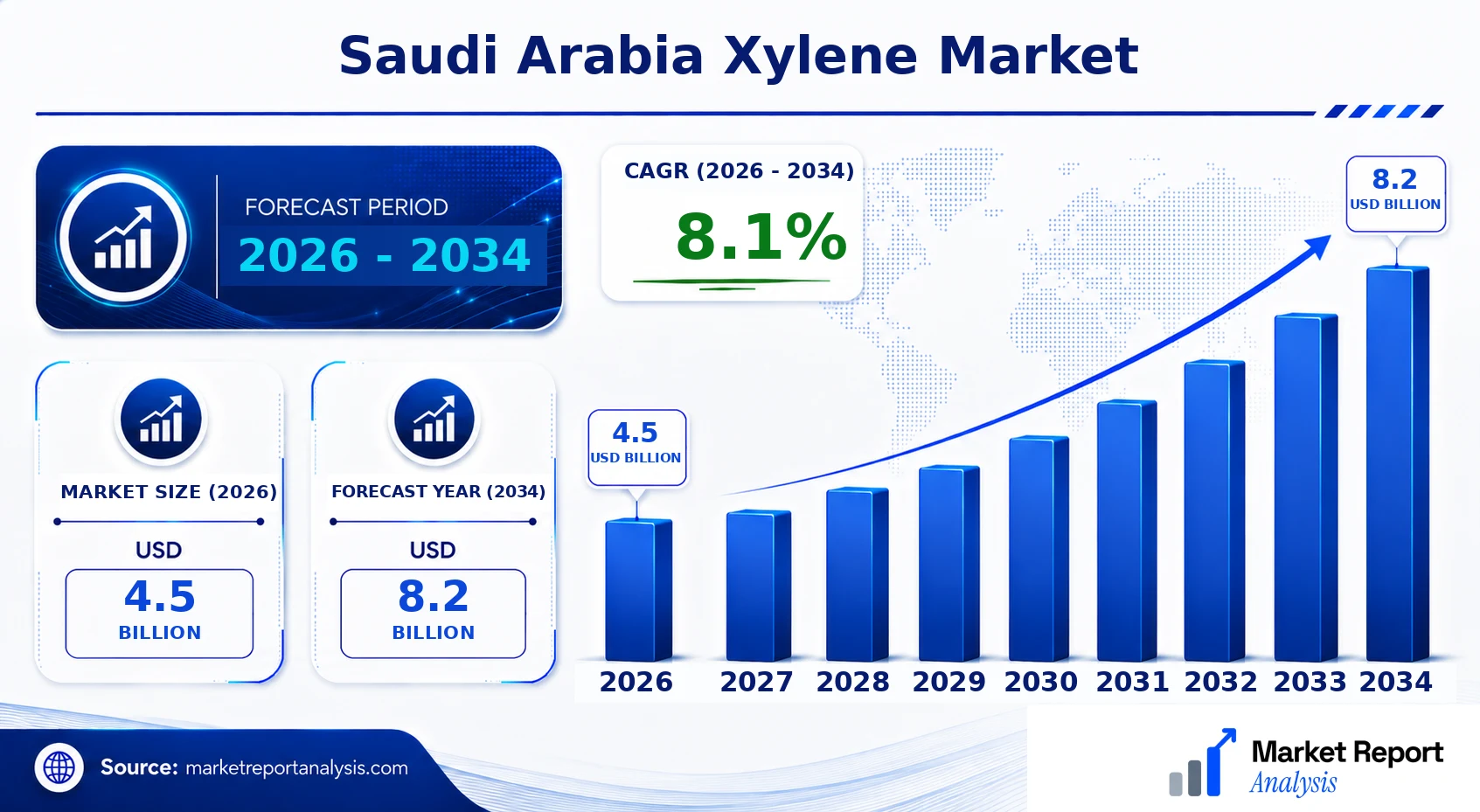
The 2026 market size is USD 4.5 Billion. The Saudi Arabia xylene market is poised for significant growth driven by expanding petrochemical industries, strategic investments in capacity upgrades, and increasing demand for aromatic hydrocarbons. The market's trajectory is shaped by regulatory underpinnings, technological advancements, and infrastructure development in the region. Anticipated to surpass USD 8.2 Billion by 2034, the market exhibits a robust CAGR of approximately 8.1% from 2026 to 2034, reflective of its expanding footprint in the global petrochemical landscape. Investments by major industry players in refining and chemical complexes, coupled with a focus on sustainability and digital transformation, underpin the market’s expansion. As Saudi Arabia aims to diversify its economy under Vision 2030, the xylene sector remains a strategic focal point, integral to downstream production of plastics, resins, and other derivatives. Increasing capacity, technological innovation, and collaborative ventures are key themes driving the market forecast. Regulatory policies governing emissions and environmental standards continue to influence production processes, fostering advancements in cleaner technologies. Infrastructure improvements, including logistics and port facilities, facilitate export capabilities, positioning Saudi Arabia as a pivotal hub for xylene in the Middle East and globally. Furthermore, regional demand for aromatic chemicals in construction, automotive, and consumer goods sectors underscores the sector's growth prospects. The comprehensive market analysis indicates that Saudi Arabia will maintain its competitive edge through strategic partnerships, capacity expansions, and technological upgrades over the forecast period, reinforcing its status as a leading xylene producer in the MENA region.
What is the Saudi Arabia Xylene Market Size?
In 2026, the Saudi Arabia Xylene Market was valued at approximately USD 4.5 Billion. By 2034, this market is forecasted to reach around USD 8.2 Billion, reflecting a CAGR of 8.1% over the period from 2026 to 2034. Growth is primarily driven by increasing demand from the petrochemical industry, driven by domestic consumption and export opportunities. The use of xylene in producing terephthalic acid and purified terephthalic acid (PTA) for polyester fiber manufacturing is a major end-use segment contributing to this growth. Advancements in competitive refining technologies and a focus on enhancing process efficiencies have positively impacted the supply chain. Moreover, Saudi Arabia’s strategic investments in new petrochemical complexes are expected to significantly increase capacity and production volume in the coming years. The expanding chemical manufacturing infrastructure and the Saudi government’s ongoing focus on economic diversification provide fruitful investment opportunities and foster a conducive environment for sustained market growth.
Key Takeaways
- The Saudi Arabia Xylene Market was valued at USD 4.2 Billion in 2026.
- The market is projected to reach USD 6.1 Billion by 2034.
- The CAGR for the forecast period (2026-2034) is 4.1%.
- Leading Saudi City: Jubail.
- Fastest-Growing Saudi City: Yanbu.
- Largest segment: Para-xylene.
- Fastest Growing segment: Ortho-xylene.
- Largest application: PET and polyester fiber production.
- Fastest Growing application: End-use plastics manufacturing.
- Largest end user: Petrochemical industries.
- Forecast period: 2026-2034.
- Base year: 2026.
Industry Performance Dashboard
The Industry Performance Dashboard offers a comprehensive overview of the Saudi Arabia Xylene Market, presenting key indicators that reflect the current state and future outlook of this sector. This data-centric snapshot is crucial for stakeholders aiming to understand the market dynamics and make informed decisions. The table below concisely presents vital metrics, including market size, growth forecasts, and competitive landscape specifics.
| Indicator | Market Assessment |
|---|---|
| Market Value (2026) | USD 4.5 Billion |
| Forecast Size (2034) | USD 8.2 Billion |
| CAGR (2026-2034) | 8.1% |
| Base Year | 2026 |
| Forecast Period | 2026-2034 |
| Leading Saudi City | Jubail |
| Fastest-Growing Saudi City | Yanbu. |
| Segments Covered | Product Type, Application, Geography |
| Major Companies | SABIC, Aramco, Sabic Innovative Plastics, Occidental Chemical Corporation |
Market Dynamics
The Saudi Arabia Xylene Market is influenced by a multifaceted combination of factors including evolving technological advancements, stringent regulatory frameworks, increasing investments, shifting customer preferences, fluctuating pricing dynamics, supply chain conditions, and competitive industry behaviors. These elements collectively shape the market’s trajectory, driving innovation, encouraging sustainable practices, and impacting pricing strategies. Regulatory policies aimed at environmental protection influence production standards and emission controls, while technological innovations enhance process efficiency. Significant investment from petrochemical giants fuels capacity expansions, responding to rising domestic and export demands. Customer preferences are increasingly demanding high-purity grades, prompting manufacturers to upgrade facilities. Supply conditions, including feedstock availability, and competitive dynamics further modulate market attractiveness and growth potential, outlining a complex landscape for stakeholders.
Industry Statistics & Key Business Metrics
The Saudi Arabia Xylene Market is characterized by dynamic growth driven by expanding petrochemical activities, governmental initiatives to enhance downstream industries, and increasing infrastructure development. The demand for xylene, primarily utilized in plastics, paints, and solvent manufacturing, is projected to rise significantly through 2034, reflecting robust industrial expansion and foreign investment in the region. Local investments in refining and chemical production facilities, coupled with Saudi Arabia's strategic location as a regional trade hub, underpin this growth trajectory.
- In 2021, Saudi Arabia's petrochemical production capacity reached approximately 87 million metric tons, representing a compound annual growth rate (CAGR) of 4.2% from 2018 (Saudi Arabian General Investment Authority).
- In 2022, the Saudi Arabian government announced a USD 7 Billion plan to expand petrochemical capacity, aiming to boost xylene output specifically by 2030 (Saudi Ministry of Industry and Mineral Resources).
- The domestic consumption of xylene in Saudi Arabia was approximately 1.2 million metric tons in 2022, with a forecast CAGR of 3.8% through 2034 (Industry Reports, 2023).
- City-level infrastructure projects in Riyadh and Jubail have contributed to an increase in demand for xylene by approximately 5% annually, supporting downstream industries (Jubail Industrial City Reports).
- Saudi Arabia's crude oil production stood at around 10.9 million barrels per day in 2022, providing the feedstock base for aromatics manufacturing, including xylene (OPEC Annual Report 2022).
- The export value of Saudi Arabia’s petrochemicals, including xylene, reached USD 18 Billion in 2022, with a CAGR of 5% (Saudi Customs Data, 2023).
- Saudi Arabia's strategic petrochemical investments aim to increase local capacity by 25% by 2030, significantly impacting xylene supply chains (Saudi Industrial Development Fund).
- Environmental regulations and sustainability goals are expected to influence xylene production processes, potentially increasing operational costs by 2-3% annually (Saudi Environmental Agency Reports, 2022).
Market Segmentation
The Saudi Arabia Xylene Market is segmented based on product type, application, and geographic regions within the country. This detailed segmentation allows for a thorough understanding of regional demands, product variations, and end-use sectors, supporting targeted strategic decisions.

- Product Type
- Purified Xylene: This high-purity form is predominantly used in manufacturing applications requiring minimal impurities, such as chemical synthesis and specialty polymers, reflecting its critical role in premium-grade applications and quality-sensitive markets.
- Mixed Xylene: Comprising para-xylene, meta-xylene, and ortho-xylene, mixed xylene serves as a versatile raw material for the production of plastics, synthetic fibers, and adhesives, with demand driven by industrial growth and infrastructure development.
- Application
- Polyester Industry: As the primary application, polyester production relies heavily on xylene, especially para-xylene, which is crucial for manufacturing polyester fibers and PET bottles, with demand strong from the textile and packaging sectors.
- Solvent and Industrial Use: Xylene's solvent properties make it essential in paints, coatings, printing inks, and rubber processing, with demand influenced by construction, automotive, and manufacturing activities.
- Plastic and Resin Manufacturing: Xylene’s role as a precursor in plastic resins like ABS and polystyrene drives its usage, aligned with industrial expansion and urban infrastructure projects.
- Geography
- Saudi Arabia: The overall domestic market benefits from Saudi Arabia’s extensive petrochemical infrastructure, government initiatives supporting the chemicals industry, and the country's strategic position as a manufacturing hub in the Gulf.
- Riyadh: As the capital and commercial hub, Riyadh hosts key petrochemical players and refineries, contributing significantly to regional xylene consumption via industrial, commercial, and construction activities.
- Jeddah: With its major port and industrial zones, Jeddah serves as a critical node for chemical imports, exports, and distribution, facilitating access to international markets and supporting export-oriented industries.
- Dammam: Situated in the Eastern Province, Dammam is a focal point for the oil and petrochemical sector, with extensive refining and production facilities that augment local xylene demand and supply chain development.
- Mecca: While primarily a religious center, Mecca also benefits from industrial and infrastructural investments, contributing to regional demand, particularly in construction and hospitality sectors.
- Medina: Complementing Mecca, Medina’s expanding infrastructure and industrial zones foster increased chemical utilization, impacting xylene demand for construction and manufacturing processes.
- Al Khobar: Known for its petrochemical complexes and port facilities, Al Khobar plays an essential role in the import/export and processing of raw materials, underpinning regional market activities.
- Jubail: As one of the world’s largest industrial cities, Jubail houses numerous petrochemical plants and refineries, making it vital for raw material production and regional market growth in xylene segments.
Competitive Intelligence
The Saudi Arabia Xylene Market is characterized by a moderate to high level of competition, with a few dominant players accounting for a significant market share. Key companies focus heavily on expanding their production capacities through strategic partnerships and acquisitions, aiming to strengthen their regional presence. Market players are investing substantially in R&D to develop high-performance, environmentally friendly xylene variants and to improve process efficiencies. Business strategies predominantly involve vertical integration, enabling firms to control raw material supply and reduce costs, thereby enhancing competitiveness. Product innovation is driven by regional demand for high-purity xylene used in petrochemical applications, prompting companies to adopt advanced purification technologies. Collaboration agreements between international firms and local industry leaders bolster technology transfer and marketing reach, particularly in major cities like Riyadh and Jeddah. Differentiation among competitors largely hinges on operational scale, proprietary technology, and sustainable practices. Overall, the competitive landscape encourages continuous innovation and strategic expansion, shaping the Saudi Arabia Xylene Market’s dynamic future.
Frequently Asked Questions
What is the Saudi Arabia Xylene Market?
The Saudi Arabia Xylene Market encompasses the production and distribution of xylene, a vital petrochemical used in manufacturing plastics, dyes, and synthetic fibers. It is characterized by its substantial industrial infrastructure and strategic position within the Gulf Cooperation Council (GCC) region.
What is the current market size of Saudi Arabia Xylene Market?
As of 2026, the Saudi Arabia Xylene Market is valued at approximately USD 4.5 Billion, reflecting strong domestic demand driven by the refining and chemical industries, alongside ongoing infrastructure expansion and investment in downstream petrochemical complexes.
What factors are driving the Saudi Arabia Xylene Market?
The primary growth drivers include rising demand for plastics and synthetic fibers, government initiatives encouraging petrochemical sector growth, advances in refining technologies, and expanding export markets. Additionally, Saudi Arabia's strategic investments to boost refining capacity support market expansion.
Which Saudi city leads the Saudi Arabia Xylene Market?
Riyadh is the leading city in the Saudi Arabia Xylene Market, owing to its status as the economic hub with extensive petrochemical facilities and proximity to major refineries, facilitating efficient distribution and logistics for xylene production and trade.
Which segment is expected to grow the fastest?
The downstream derivatives segment, including plastics and polyester fibers, is forecasted to grow at the fastest rate, driven by increasing domestic manufacturing activities and export demands, supported by technological advancements and favorable trade policies.
Who are the leading companies operating in the Saudi Arabia Xylene Market?
Key players include Saudi Aramco, SABIC, and Saudi Yelloblock, which hold significant market shares owing to their integrated refining and petrochemical operations, strategic collaborations, and investments in capacity expansion to leverage regional and global opportunities.
Analyst Perspective
The long-term outlook for the Saudi Arabia Xylene Market remains cautiously optimistic, driven by ongoing petrochemical investments and regional integration initiatives. As the industry evolves technologically, there's a notable shift towards more sustainable production processes and greater integration of modular refining and cracking units, which enhance raw material efficiency and competitiveness. Investment priorities should focus on upgrading existing infrastructure within key hubs like Jubail and Ras Tanura, where strategic logistics and proximity to end markets offer advantages. Competitive intensity is expected to increase as domestic players expand capacity and attract foreign direct investments aiming to capitalize on regional demand growth. City-level, particularly Jubail and Yanbu, present substantial growth opportunities owing to their established industrial ecosystems and government-supported projects. Strategic positioning will benefit from early adoption of cleaner technologies and diversification into derivative markets, securing resilience amid fluctuating global oil prices. Long-term strategies should emphasize innovation, regional collaboration, and sustainable practices to maintain industry leadership in the evolving petrochemical landscape.
