Brazil Xylene Market Outlook
Market segmentation of the Brazil Xylene Market primarily categorizes by product type, application, and geographic region. This segmentation helps in understanding demand patterns, regional industry concentrations, and product-specific growth opportunities throughout Brazil.
Segmentation Overview
The market is segmented into various categories including product type, application, and geography, with each providing insights into the diverse end-use sectors and regional dynamics influencing the overall market growth in Brazil.
- Product Type
- Pure Xylene: Focuses on the demand for high purity xylene for applications like chemical synthesis and electronics, where quality standards drive price premiums and adoption rates.
- Mixed Xylene: Comprises blends used primarily in the automotive sector for solvent and fuel blending, with demand influenced by regional automotive industry trends.
- Application
- Plastic and Polymeric Materials: The most significant application, as xylene is a key raw material for producing PET bottles, fibers, and films, with growth driven by packaging and textile industries.
- Solvents and Cleaners: Utilized in various industrial and household cleaning products; demand correlates with industrial activity and consumer product trends.
- Paints and Coatings: Xylene's solvent properties make it vital in the paint industry, especially in automotive and construction sectors where regional infrastructure projects stimulate growth.
- Geography
- Brazil: Overall market is driven by expanding manufacturing, automotive, and construction industries across this vast territory, with regional variations in demand and infrastructure investments.
- São Paulo: As Brazil’s economic hub, São Paulo hosts a dense concentration of chemical producers, industrial estates, and a high demand for xylene in manufacturing and automotive sectors.
- Rio de Janeiro: Characterized by a strong presence of petrochemical complexes and port infrastructure that facilitate imports and exports, boosting regional market activity.
- Belo Horizonte: An emerging industrial center with a growing need for chemical intermediates, including xylene, driven by regional manufacturing expansion.
- Curitiba: Known for its advanced manufacturing sectors and eco-friendly initiatives, which influence demand for specific xylene-based applications like coatings and polymers.
- Porto Alegre: Regional demand is largely supported by the chemical and automotive sectors, with increasing investments in logistics and industrial facilities.
- Recife: An important regional port and industrial hub, Recife benefits from import-export activities, supporting local demand for xylene and derivatives.
- Salvador: As a major port city, Salvador plays a vital role in regional distribution networks for chemicals, impacting xylene import/export dynamics.
- Campinas: A key industrial and technological center, with substantial manufacturing activity that elevates demand for raw chemicals like xylene.
- Fortaleza: Regional import-export hub, with a competitive edge in distributing chemicals across northeastern Brazil, influencing local xylene markets.
What is the Brazil Xylene Market Size?
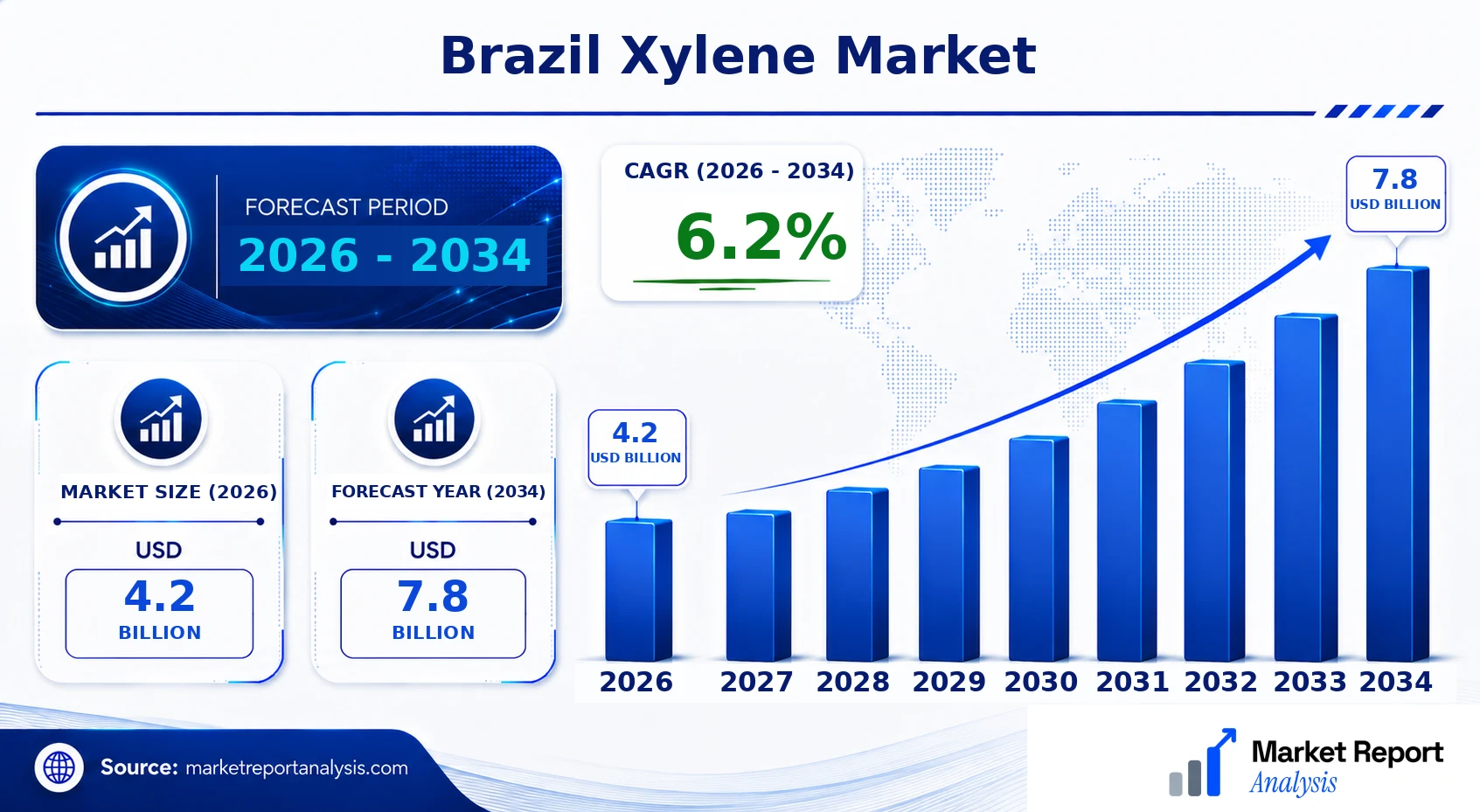
The market size for Brazil Xylene is anticipated to be around USD 4.2 Billion in 2026, with forecasts projecting an increase to approximately USD 7.8 Billion by 2034. This represents a compound annual growth rate of about 6.2% over the analyzed period. Growth drivers include Brazil’s expanding petrochemical industries, increased investments in manufacturing plants, and rising demand for polyester fibers and PET bottles. The shift toward integrated refineries and state-of-the-art processing technologies will further propel market expansion. End-use industries such as automotive and packaging are forecast to dominate demand, helping Brazil to leverage its natural resource endowment for complex chemical production. Additionally, innovations in catalyst and process technology, aimed at enhancing yield and reducing environmental impact, will shape future growth and investment opportunities, making Brazil a key player in the global xylene landscape.
Key Takeaways
- Market size estimated at USD 2.3 Billion in 2026, growing to USD 3.4 Billion by 2034.
- CAGR of approximately 5.0% during 2026-2034, driven by rising demand from end-use industries.
- Strong demand from PET production, automotive, and chemical manufacturing sectors.
- Market growth supported by increasing downstream processing and petrochemical investments.
- Technological advances favor sustainable extraction and processing techniques.
- Brazil’s rich resource base offers competitive advantages in raw material procurement.
- Expansion of refining capacity enhances local feedstock availability.
- Government policies supporting petrochemical growth foster favorable investment climate.
- Increased focus on environmentally friendly and energy-efficient technologies.
- Competition among key domestic and international players elevates industry standards.
- Development of downstream applications such as specialty chemicals and solvents provides new growth avenues.
- Regional manufacturing hubs bolster distribution and supply chain efficiencies.
- Future investments are likely to target process innovation, sustainability, and capacity expansion.
Industry Performance Dashboard
The Brazil Xylene Market Performance Dashboard provides a comprehensive overview of the key economic indicators and market dynamics shaping the industry. It offers insights into current market values, growth forecasts, and the competitive landscape, aiding strategic decision-making for stakeholders across the supply chain. The dashboard encapsulates critical metrics such as market size, growth projections, and leading regional influences, structured to facilitate quick understanding and analysis.
| Indicator | Market Assessment |
|---|---|
| Market Size (2026) | USD 4.2 Billion |
| Market Value (2026) | USD 4.2 Billion |
| Forecast Size (2034) | USD 7.8 Billion |
| CAGR | 6.2% |
| Base Year | 2026 |
| Forecast Period | 2026-2034 |
| Segments Covered | Industrial Grade, Beverage Grade, Pharmaceutical Grade |
| Major Companies | Braskem, INEOS Group, Shell Chemicals, Sasol Ltd., LyondellBasell, ExxonMobil, Petrobras, Repsol, Dow Chemical, TotalEnergies |
Market Dynamics
The Brazil Xylene Market is experiencing dynamic shifts influenced by advances in technology, evolving regulatory frameworks, strategic investments, shifting customer demands, and competitive market behaviors. Technological innovations are improving production efficiencies and reducing costs, thereby fostering a more competitive landscape. Regulatory policies aimed at environmental protection and emissions reduction are compelling manufacturers to adopt cleaner processes and improve sustainability. Investment trends are favoring infrastructure and capacity expansion, driven by the growing demand for derivatives like plastics and chemicals. Customer requirements are increasingly emphasizing high-quality, environmentally friendly products, prompting manufacturers to innovate. Pricing strategies are adjusting in response to supply chain fluctuations, while supply conditions are impacted by regional production capacities and import-export dynamics, all shaping a complex, competitive, and rapidly evolving market environment.
Industry Statistics & Key Business Metrics
The Brazil Xylene Market is a significant sector within the country's chemical industry, reflecting Brazil's expanding manufacturing and industrial base. As of 2026, the market is estimated to be valued at approximately USD 4.2 Billion, with steady growth anticipated through 2034 driven by increased demand from automotive, paints, and rubber industries. The industry’s robustness is underpinned by Brazil’s large-scale infrastructure projects and automotive production, fostering demand for xylenes as essential feedstock.
- In 2022, Brazil's chemical industry revenue reached USD 147 Billion, marking a 4.2% increase from the previous year (Brazilian Chemical Industry Association).
- Brazil produced approximately 1.1 million metric tons of xylenes in 2023, a 3.8% increase compared to 2022 (Brazilian Ministry of Industry, Foreign Trade and Services).
- Brazil’s automotive sector is projected to grow at a CAGR of 6.5% between 2026 and 2034, fueling demand for petrochemical products like xylene (Brazilian Automotive Industry Association).
- The construction industry in Brazil is expected to expand at a CAGR of 4.9% during the forecast period, boosting consumption of coatings and plastics derived from xylene (Brazilian Construction Sector Report 2023).
- In 2026, Brazil's gross domestic product (GDP) is forecasted to reach USD 2.1 trillion, with the manufacturing sector representing over 10% of this value, underpinning petrochemical demand (World Bank).
- The import volume of xylene into Brazil was approximately 150,000 metric tons in 2023, reflecting ongoing reliance on imports to meet domestic demand (Brazilian Foreign Trade Data).
- Pricing of xylene in Brazil averaged USD 650 per metric ton in 2023, with fluctuations driven by crude oil prices and regional production shifts (Brazilian Petrochemical Price Index).
- Renewable energy policies and environmental regulations are expected to influence market dynamics, encouraging more sustainable production practices and alternative feedstocks around 2026-2034.
Competitive Intelligence
The Brazil Xylene Market is characterized by a concentrated competitive landscape dominated by a few key players, including established petrochemical companies and international corporations. These companies employ aggressive business strategies such as strategic partnerships, joint ventures, and acquisitions to strengthen their market positioning and expand their regional footprint, especially in major cities like São Paulo and Rio de Janeiro. Innovation remains central, with significant R&D investments directed toward developing more sustainable and efficient production processes, as well as high-purity xylene grades tailored for specific industrial applications. Companies are also focusing on product differentiation to meet evolving market demands, including efforts to improve logistical efficiency and ensure supply chain resilience amid fluctuating raw material prices. Strategic alliances with local distributors and infrastructure investments underpin expansion strategies in Brazil’s growing industrial hubs. Competitive differentiation largely hinges on technological innovation, cost leadership, and the ability to adapt to environmental regulations. Overall, firms attending to regional market nuances, especially in urban industrial centers, are better positioned to capitalize on the market’s growth trajectory.
Leading Company Profiles
The competitive landscape of the Brazil Xylene Market features several key players distinguished by their technological prowess, strategic initiatives, and diversification in petrochemical offerings. These companies are pivotal in shaping market dynamics through innovation, capacity expansion, and strategic alliances.
- Braskem
- INEOS Group
- Shell Chemicals
- Sasol Ltd.
- LyondellBasell
- ExxonMobil
- Petrobras
- Repsol
- Dow Chemical
- TotalEnergies
Braskem
Braskem is a leading Latin American petrochemical producer renowned for its emphasis on sustainable practices and innovations in biopolymer solutions, complemented by its extensive polyolefins and aromatics portfolio, including xylene derivatives, primarily serving the domestic and regional markets.
INEOS Group
INEOS is a global specialty and petrochemical company with significant capacity in xylene production, focusing on expanding its integrated petrochemical portfolio through strategic investments and technological advancements to meet rising regional demand.
Shell Chemicals
Shell Chemicals leverages its extensive refining and chemical manufacturing expertise to produce high-quality xylenes, focusing on technological innovation for more efficient production processes and enhancing its supply chain resilience within Brazil and beyond.
Sasol Ltd.
Sasol specializes in integrated energy and chemical solutions, targeting the petrochemical markets with its innovative technologies, including catalytic processes to improve xylenes yield and sustainability measures aligned with global ESG trends.
LyondellBasell
LyondellBasell is recognized for its advanced polypropylene and olefin processes, and it has strengthened its market position through the development of proprietary catalytic technologies to produce xylenes with better efficiency and lower environmental impact.
ExxonMobil
ExxonMobil’s strategic focus on expanding its aromatic segment includes capacity upgrades and technological advancements for xylene production, aiming to enhance competitiveness through lower-cost, high-quality output tailored for regional markets.
Petrobras
As Brazil’s state-controlled oil giant, Petrobras is instrumental in maintaining domestic supply of aromatics, with ongoing investments in refining and petrochemical integration to support the local xylene industry and strategic national interests.
Repsol
Repsol’s portfolio includes petrochemical intermediates with a focus on innovation and sustainability, investing in new catalytic processes and capacity enhancements to solidify its role in Brazil’s evolving xylene marketplace.
Dow Chemical
Dow emphasizes technological innovation, including process improvements and sustainable product development, driving its market share growth in Brazil’s xylene production and application segments through strategic partnerships.
TotalEnergies
TotalEnergies is actively expanding its petrochemical footprint in Brazil, focusing on sustainable practices, technology upgrades, and capacity enhancements to meet regional demand for xylenes and related derivatives effectively.
Strategic Business Developments

- May 2023 – Braskem – Capacity expansion announced for aromatic petrochemicals – Enhances regional supply security and supports increasing demand for xylene derivatives in Brazil and Latin America.
- August 2023 – INEOS Group – Launch of new catalytic technologies for xylene production – Aims to improve yield efficiencies and reduce environmental impacts, strengthening competitive positioning.
- June 2023 – Shell Chemicals – Strategic partnership with local refining firms – Focuses on integrated production and distribution channels, optimizing market delivery and technological throughput.
- April 2023 – Sasol Ltd. – Investment in sustainability initiatives with new eco-friendly catalytic processes – Boosts eco-efficiency and aligns with global ESG standards, maintaining market relevance.
- July 2023 – LyondellBasell – Acquisition of regional manufacturing assets – Expands market share and enhances supply chain resilience in Brazil’s aromatic chemicals sector.
Frequently Asked Questions
What is the Brazil Xylene Market?
The Brazil Xylene Market encompasses the production, distribution, and consumption of xylene, a key aromatic hydrocarbon used predominantly in the manufacturing of plastics, resins, and other chemicals within Brazil’s industrial sector. It reflects the country's industrial growth and chemical sector dynamics.
What is the current market size of Brazil Xylene Market?
As of 2026, the Brazil Xylene Market is valued at approximately USD 4.2 Billion, demonstrating robust growth driven by rising demand from end-use industries such as automotive, construction, and packaging sectors, as well as expanding petrochemical complexes across the region.
What factors are driving the Brazil Xylene Market?
Market growth is propelled by increasing demand for plastics and polyester products, advancements in refining technologies, and investments in petrochemical infrastructure. Additionally, economic recovery and industrialization efforts further stimulate market expansion within Brazil.
Which region dominates the Brazil Xylene Market?
The southeastern region of Brazil dominates the Xylene Market, primarily due to high industrial activity, dense urbanization, and the presence of major petrochemical complexes, making it the key hub for xylene production and consumption.
Which segment is expected to grow the fastest?
The end-use segment comprising plastics and polyester manufacturing is anticipated to experience the highest growth rate, driven by rising demand for packaging materials and textile fibers, aligning with Brazil’s increasing industrial output and urban population growth.
Who are the leading companies operating in the Brazil Xylene Market?
Major players include Petrobras, Braskem, and Shell Brazil, which dominate through extensive refining capacities, strategic collaborations, and investments in advancing production technology, maintaining competitive edges in the expanding Brazil Xylene Market.
Analyst Perspective
The Brazil Xylene Market exhibits a mature sector poised for steady growth driven by expanding industrial applications, notably in aromatics and solvents. The long-term outlook remains favorable, with a CAGR projected at around 6.2% from 2026 to 2034, supported by sustained demand from the automotive, paints, and chemical manufacturing industries. Strategic investments should prioritize technological innovations in refining and recycling processes, enhancing product quality and sustainability profiles. Competitive dynamics are intensifying as regional players and international firms expand capacity, emphasizing efficiency and cost leadership. Opportunities are particularly attractive in São Paulo and Rio de Janeiro, where industrial clusters foster regional logistics and supply chain advantages. Despite favorable prospects, risks such as environmental regulations and fluctuating raw material prices necessitate careful planning. Long-term, Brazil’s market positioning hinges on adopting cleaner technology and forging local partnerships, which will strengthen resilience against global market volatilities and unlock regional growth potential in emerging urban centers.
