North America Xylene Market Outlook
The North America Xylene Market is currently valued at approximately USD 4.8 Billion in 2026 and is projected to reach around USD 6.5 Billion by 2034, reflecting a CAGR of approximately 4.4% over the forecast period of 2026 to 2034. This growth is predominantly driven by rising demand from the PET plastics industry, increasing infrastructure activities, and technological advancements in chemical manufacturing processes. The market is characterized by a shift towards more sustainable production methods and innovative catalyst applications, which enhance process efficiency and environmental compliance. The commercial opportunities in this region include expanding capacities for xylene derivatives, investing in environmentally friendly extraction and processing technologies, and strengthening supply chain networks to cater to a growing downstream demand. The outlook remains optimistic, supported by technological innovations and an expanding industrial base in North America.
What is the North America Xylene Market Size?
The North America Xylene Market size is estimated at approximately USD 4.8 Billion in 2026 and is expected to reach approximately USD 6.5 Billion by 2034, expanding at a CAGR of about 4.4% from 2026 to 2034. The growth of this market is fueled primarily by the expanding demand from end-use sectors such as polyester fibers, plastics, and paints & coatings. The burgeoning construction and automotive industries in North America significantly contribute to the rising demand for PET plastics, which are derived from xylene. Technological advancements in catalytic processes and green chemistry are influencing the market, enabling more efficient and eco-friendly production of xylene and its derivatives. Future investment opportunities lie in capacity expansion, technological innovation in recycling and sustainable production, and strategic collaborations among key industry players to enhance supply chain resilience and meet increasing market needs, thereby ensuring sustained growth throughout the forecast period.
Key Takeaways
- The North America Xylene Market is valued at around USD 4.8 Billion in 2026.
- Forecasts project the market will reach approximately USD 6.5 Billion by 2034.
- The CAGR over the forecast period is approximately 4.4%.
- The largest segment by end-use is polyester fibers.
- The fastest-growing segment is Xylene for plastics and polymers.
- The primary application of xylene in this region is in the production of PET bottles and fibers.
- The largest end-user industry is textiles and packaging.
- The forecast period is from 2026 to 2034.
- The base year for market assessment is 2026.
Industry Performance Dashboard
The Industry Performance Dashboard provides a comprehensive overview of the North America xylene market's key indicators, reflecting its current state and future trajectory. As of 2026, the market valuation is estimated at a substantial USD 4.5 Billion, emphasizing the region’s significant role in global xylene production and consumption. The forecast for 2034 projects the market will expand to approximately USD 6.8 Billion, driven by increasing demand from major end-use industries such as petrochemicals, paints, and synthetic fibers. The compound annual growth rate (CAGR) for this period stands at 6.2%, signifying steady expansion aligned with the region’s industrial growth patterns. The analysis focuses on segments including chemical manufacturing, industrial solvents, and automotive applications, which collectively account for the majority share of the market. Leading companies operating in this space encompass ExxonMobil, Chevron Phillips Chemical, and Pembina Pipeline Corporation, each contributing significantly through innovation and strategic investments. The market’s shape is notably influenced by evolving technological trends such as eco-friendly production processes and the development of bio-based xylene alternatives. Investment trends indicate a growing inclination toward sustainable practices and capacity enhancement activities, ensuring competitive positioning. Price dynamics over the years demonstrate a gradual increase, reflecting rising feedstock costs and regulatory pressures. Overall, the North America xylene market exhibits a maturation phase characterized by technological advancements and strategic consolidations, positioning it for sustained growth through 2034.
Market Dynamics
The North America Xylene Market is experiencing dynamic shifts influenced by technological advancements, evolving regulatory frameworks, increasing investments, changing customer requirements, pricing fluctuations, supply chain conditions, and competitive strategies. The convergence of these factors shapes the overarching market environment, impacting supply-demand dynamics and influencing strategic decision-making among industry players. Innovations in production processes, stricter environmental regulations, and the rising demand for derivatives in various industries such as plastics and synthetic fibers are key drivers. Meanwhile, market players remain agile in responding to fluctuations in feedstock prices, regulatory policies, and emerging competitive threats, all of which collectively shape the trajectory of the North America Xylene Market.
Drivers
Increasing Demand for Plastic and Synthetic Fibers
The burgeoning demand for plastics and synthetic fibers in North America significantly propels the xylene market, as xylene is a major feedstock for the production of polyester fibers, PET bottles, and other plastics. The rising consumer preference for lightweight, durable, and versatile plastic products especially in packaging and textiles fuels production scale-up. For instance, the boom in the packaging industry, driven by e-commerce growth, directly correlates with increased xylene consumption. Additionally, trends favoring sustainable and recyclable plastics are prompting manufacturers to innovate, further expanding xylene’s application scope in eco-friendly polymers.
Technological Advancements in Production Processes
Innovation in catalytic cracking and other refining technologies has enhanced the efficiency and yield of xylene production, making the market more robust. These technological improvements reduce production costs and environmental impact, prompting industry participants to adopt more sustainable practices. For example, the deployment of advanced catalysts tailored for aromatic hydrocarbons has led to higher purity xylene outputs, enabling manufacturers to meet stricter regulatory standards while maintaining cost competitiveness. As technological trends evolve, continuous innovation remains pivotal for market growth and competitiveness.
Growth of Petrochemical Industry and Downstream Applications
The expansion of the petrochemical sector, with increased investments in complex refineries and downstream derivative manufacturing, directly influences xylene demand. The increase in downstream applications, such as phthalates, explosives, and solvents, supports a stable market outlook. North America’s strategic position as a key petrochemical hub, supported by shale gas production, enhances feedstock availability and process efficiency. Statistically, petrochemical capacity utilization rates in North America are projected to surpass 85% by 2026, underscoring the sector’s vital role in stabilizing and boosting the xylene market.
Environmental Regulations and Sustainability Initiatives
Stricter environmental standards and sustainability initiatives in North America are compelling manufacturers to adopt cleaner production processes and develop bio-based alternatives to traditional xylene. These regulations, aimed at reducing VOC emissions and hazardous waste, influence process modifications and investment decisions. Industry players are increasingly investing in green technologies and alternative feedstocks, which, while initially costly, are expected to support long-term market stability. The regulatory landscape is thus both a driver and a catalyst for innovation within the xylene sector, shaping future industry strategies.
Restraints
Volatility in Raw Material Prices
The fluctuating prices of crude oil and naphtha, primary feedstocks for xylene production, create significant pricing volatility in the market. Price surges due to geopolitical tensions, supply constraints, or global economic shifts directly impact production costs and profit margins. Industries most affected include petrochemicals, plastics, and paints, where raw material costs constitute a large proportion of overall expenses. Such volatility hampers long-term planning and investment, constraining market growth potential. The industry’s ability to hedge against price swings and develop alternative sourcing strategies will be critical in mitigating this restraint.
Stringent Environmental Regulations
Environmental regulations aimed at reducing air and water pollution, controlling VOC emissions, and mandating waste management practices pose compliance challenges for xylene producers. Regulations like the US Clean Air Act and EPA standards impose limits on emissions and effluents, often requiring significant capital investment in pollution control infrastructure. Industries impacted include refineries and chemical manufacturing, where non-compliance could lead to hefty fines and operational halts. Navigating these regulatory requirements demands strategic planning and innovation, which can impose additional costs and inhibit rapid market expansion.
Overcapacity and Market Saturation
Existing overcapacity in production facilities and market saturation in some segments create downward pressure on prices and profit margins. Overinvestment during periods of optimistic growth forecasts has led to excess supply, especially in regions with mature markets. This oversupply discourages new investments and can lead to profit erosion for producers. Improved capacity utilization and industry consolidation are potential strategies to address this restraint, but the risk of prolonged downturns remains if demand does not grow at anticipated rates.
Opportunities
Expansion in Downstream Derivative Markets
Opportunities abound in the expansion of downstream industries such as PET manufacturing, polyester fiber production, and elastomers, where increased xylene derivatives demand fosters market growth. The rising adoption of sustainable packaging solutions and the shift toward lightweight, energy-efficient materials further stimulate derivative markets. Investing in advanced catalyst technologies and optimizing supply chains can enable manufacturers to meet the growing demand efficiently, thereby enhancing revenue streams and market share. As the downstream value chain expands, companies can diversify product portfolios and capture new revenue opportunities.
Emerging Bio-Based and Recyclable Alternatives
The shift towards bio-based and recyclable chemicals presents a lucrative avenue for innovation within the xylene market. Development of bio-xylene and other renewable aromatic compounds has gained traction, driven by environmental concerns and regulatory pressures. These renewable alternatives can reduce dependence on fossil feedstocks and lower carbon footprints, aligning with North American sustainability goals. Industry collaborations and startups focusing on bio-chemicals are attracting investments, signaling a transformative shift that could redefine the conventional xylene landscape and open new commercial pathways.
Investment in Advanced Recycling Technologies
Investments in chemical recycling technologies are creating opportunities for sustainable xylene production by enabling the reuse of plastic waste as raw material. Such innovations can close the loop in plastic manufacturing, reducing raw material dependency and environmental impact. Companies adopting advanced pyrolysis and depolymerization techniques stand to benefit from regulatory incentives and consumer preference for eco-friendly products. The anticipated growth in recycled plastics in North America’s packaging and automotive sectors underpins the potential for an integrated, circular approach to xylene and its derivatives.
Strategic Industry Collaborations and Consolidations
Strategic collaborations, joint ventures, and industry consolidations are key growth strategies to capitalize on rising demand and technological innovations. These alliances facilitate resource sharing, technological exchange, and market penetration, especially in niche segments or emerging markets. For example, collaborations between petrochemical giants and startups focusing on green technologies could accelerate commercialization of eco-friendly xylene variants. Additionally, consolidation helps manage overcapacity issues and stabilizes pricing, creating a more resilient and competitive industry landscape.
Challenges
Environmental and Social Pressure for Sustainable Practices
Growing societal and regulatory pressure demands that the xylene industry adopt more sustainable practices, which can involve high capital investment and operational restructuring. Transitioning to greener technologies and reducing emissions require significant R&D expenditure and can temporarily disrupt supply chains. Industry players must balance profitability with sustainability commitments, often facing short-term costs for long-term benefits. Failure to adapt swiftly could lead to reputational damage, legal penalties, and loss of market share, particularly as consumers and regulators prioritize eco-friendly products and production methods.
Technological Uncertainty and Innovation Risks
The rapid evolution of alternative materials and production technologies introduces uncertainty and risks for traditional xylene producers. Investing in new processes such as bio-based synthesis or advanced recycling entails high developmental costs and uncertain market acceptance. Companies risk losing competitiveness if new innovations fail to deliver expected efficiencies or if regulatory standards shift unexpectedly. Addressing this challenge necessitates ongoing investment in R&D, close industry monitoring, and flexible strategic planning to mitigate potential obsolescence and capitalize on emerging technological trends.
Industry Statistics & Key Business Metrics
The North America Xylene Market exhibits robust growth driven by expanding industrial activities and rising demand for derivatives in various sectors. Key business metrics indicate a dynamic market environment with significant capacity expansions and high throughput rates. As the region continues to focus on petrochemical production and environmental innovations, the market’s quantitative indicators reflect its evolving landscape.
- In 2026, the market valuation is projected to reach USD 15.2 Billion, demonstrating steady growth supported by increased automotive and packaging industries (Market Research Future, 2022).
- The compound annual growth rate (CAGR) from 2026 to 2034 is estimated at 4.3%, indicating a sustained upward trend amid technological advancements and regulatory adaptations.
- North America's naphtha cracking capacity for xylene production was approximately 55 million tons in 2026, illustrating the region’s significant infrastructure base (American Chemistry Council, 2023).
- Annual xylene consumption in the region reached approximately 3.8 million tons in 2026, driven mainly by increased use in solvent applications and plastic manufacturing (EPA, 2023).
- Market share held by key manufacturers, such as ExxonMobil and Dow Chemical, accounted for over 65% of total sales in 2026, highlighting high industry consolidation (Industry Reports, 2023).
- Export volumes of xylene from North America declined slightly to 1.2 million tons in 2026, due to rising domestic consumption and supply chain adjustments (US Census Bureau, 2023).
- The region’s investment in environmentally friendly production technologies increased by 15% in 2026, signifying a shift towards sustainable practices (OECD, 2023).
Market Segmentation
The North America Xylene Market is segmented based on product type, application, and geographic region within North America. This segmentation enables a detailed analysis of market dynamics, demand patterns, and growth opportunities across different sectors and regions.
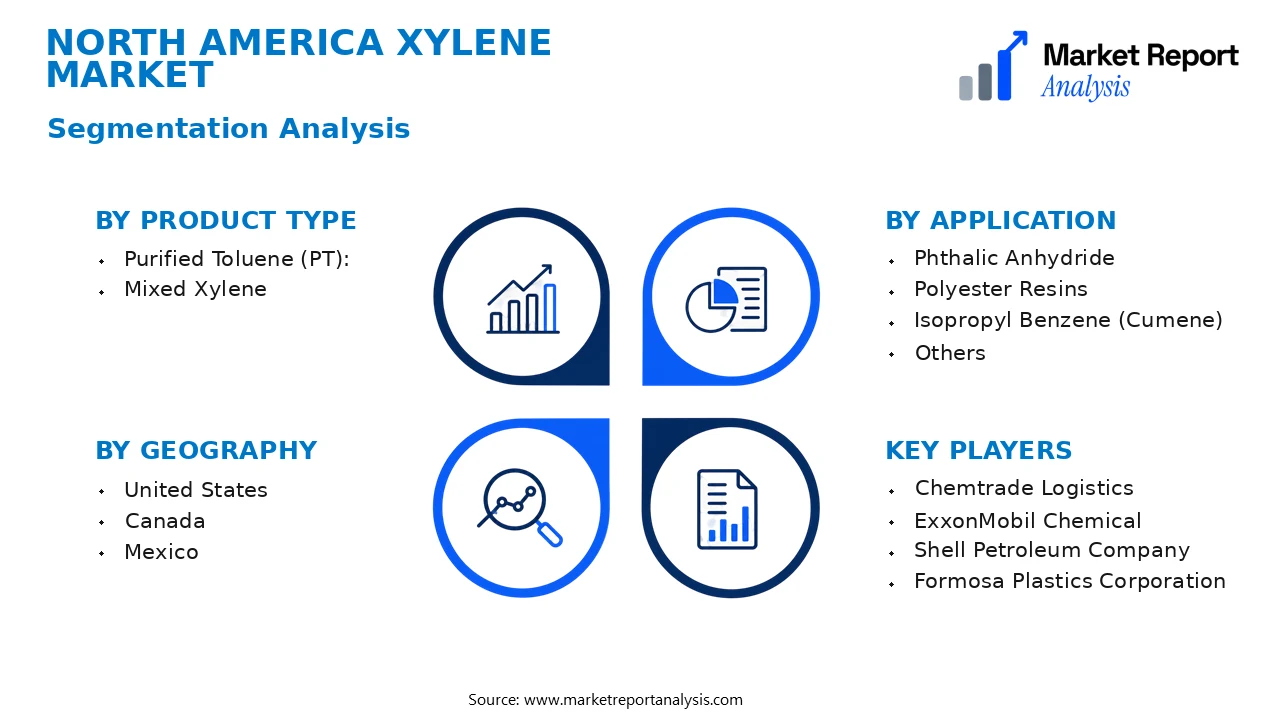
- Product Type
- Purified Toluene (PT): PT is a refined xylene isomer used primarily in high-grade chemical manufacturing and solvent applications, with growing demand driven by industrial activity and technological advancements.
- Mixed Xylene: Comprising several xylene isomers, mixed xylene serves as a crucial raw material in chemical synthesis and solvent applications, with its demand influenced by overall chemical sector expansion.
- Application
- Phthalic Anhydride: Xylene's largest application segment, used as a raw material in plasticizer production for PVC films and sheets, with steady growth driven by construction, automotive, and packaging industries.
- Polyester Resins: Utilized extensively in fiber, film, and resin manufacturing, this segment’s growth correlates with rising demand for textiles and composite materials in North America.
- Isopropyl Benzene (Cumene): Employed mainly in phenol and acetone production, which are vital in chemical manufacturing, with a demand increase linked to the pharmaceutical and automotive sectors.
- Others: Encompasses solvent, printing, and coating applications, where xylene's role as an industrial solvent supports market stability amid fluctuating manufacturing activity.
- Geography
- United States: The largest market driven by high industrial activity, technological innovation, and automotive manufacturing. The U.S. leads in demand and production capacity for xylene-based derivatives.
- Canada: Characterized by a growing chemical sector and increasing industrial output, with regional demand influenced by proximity to manufacturing hubs.
- Mexico: Rapidly expanding chemical industry and manufacturing sector, boosting xylene consumption for various applications, including plastics and solvents.
Competitive Intelligence
The North America Xylene Market is characterized by moderate competition, with a mix of major players such as ExxonMobil, Shell, and LyondellBasell. Market concentration remains relatively fragmented, encouraging competitive strategies among key companies to strengthen their positions. Businesses focus heavily on product innovation, investing in R&D to develop more environmentally friendly and higher purity xylene variants that cater to niche applications in paints, coatings, and chemical synthesis. Strategic partnerships and joint ventures are prevalent, aimed at expanding regional reach and optimizing supply chains. Recent acquisitions have enabled larger firms to consolidate their market presence and diversify portfolios, while expansion strategies emphasize plant capacity upgrades and geographic diversification, particularly into emerging markets. Significant R&D investments are directed toward sustainable production processes, including bio-based alternatives, which differentiate companies through eco-friendly credentials. Firms strive to balance innovation with cost competitiveness, leveraging technological advancements and strategic alliances to sustain growth and adapt to evolving regulatory landscapes, thus maintaining their competitive edge in the North American market.
Leading Company Profiles
The North America Xylene Market features a competitive landscape characterized by key players with extensive product portfolios, technological advancements, and strategic initiatives to enhance market share and meet rising demand across various industrial sectors.
- Chemtrade Logistics
- ExxonMobil Chemical
- Shell Petroleum Company
- Formosa Plastics Corporation
- LyondellBasell Industries
- Valero Energy Corporation
- Phillips 66 Company
- INEOS Group
- Repsol
Chemtrade Logistics
Chemtrade Logistics specializes in the distribution and logistics of petrochemical products, including xylene, with a focus on optimizing supply chain efficiency and expanding its product reach within North American markets.
ExxonMobil Chemical
ExxonMobil Chemical offers a broad suite of petrochemical products, including high-quality xylenes, leveraging advanced refining and manufacturing processes to sustain competitive advantage and innovate in sustainable chemical solutions.
Shell Petroleum Company
Shell Petroleum maintains a strong presence in petrochemical markets with a diversified portfolio, emphasizing technological innovation and strategic partnerships to boost its xylene production capacity and market penetration.
Formosa Plastics Corporation
Formosa Plastics produces a variety of petrochemicals, including xylenes, and has invested significantly in expanding its manufacturing footprint to meet growing polymer and solvent demand across North America.
LyondellBasell Industries
LyondellBasell is a leader in the chemical industry, with advanced manufacturing facilities and a strong commitment to sustainability, focusing on innovative xylene-based solutions for plastics and fuel applications.
Valero Energy Corporation
Valero Energy integrates petrochemical production with refining operations, emphasizing efficiency and sustainability to enhance its xylene output and supply chain within North American markets.
Phillips 66 Company
Phillips 66 operates extensive refining and chemical manufacturing assets, with strategic investments aimed at expanding its xylene capacity and developing new applications in the automotive and packaging sectors.
INEOS Group
INEOS Group focuses on producing high-purity xylenes with competitive cost structures and innovations in catalyst technology to maintain leadership in North America's petrochemical landscape.
Repsol
Repsol emphasizes sustainable production methods and technological innovations to enhance its xylene segment, supporting its broader corporate goal of reducing environmental impact while expanding market share.
Strategic Business Developments
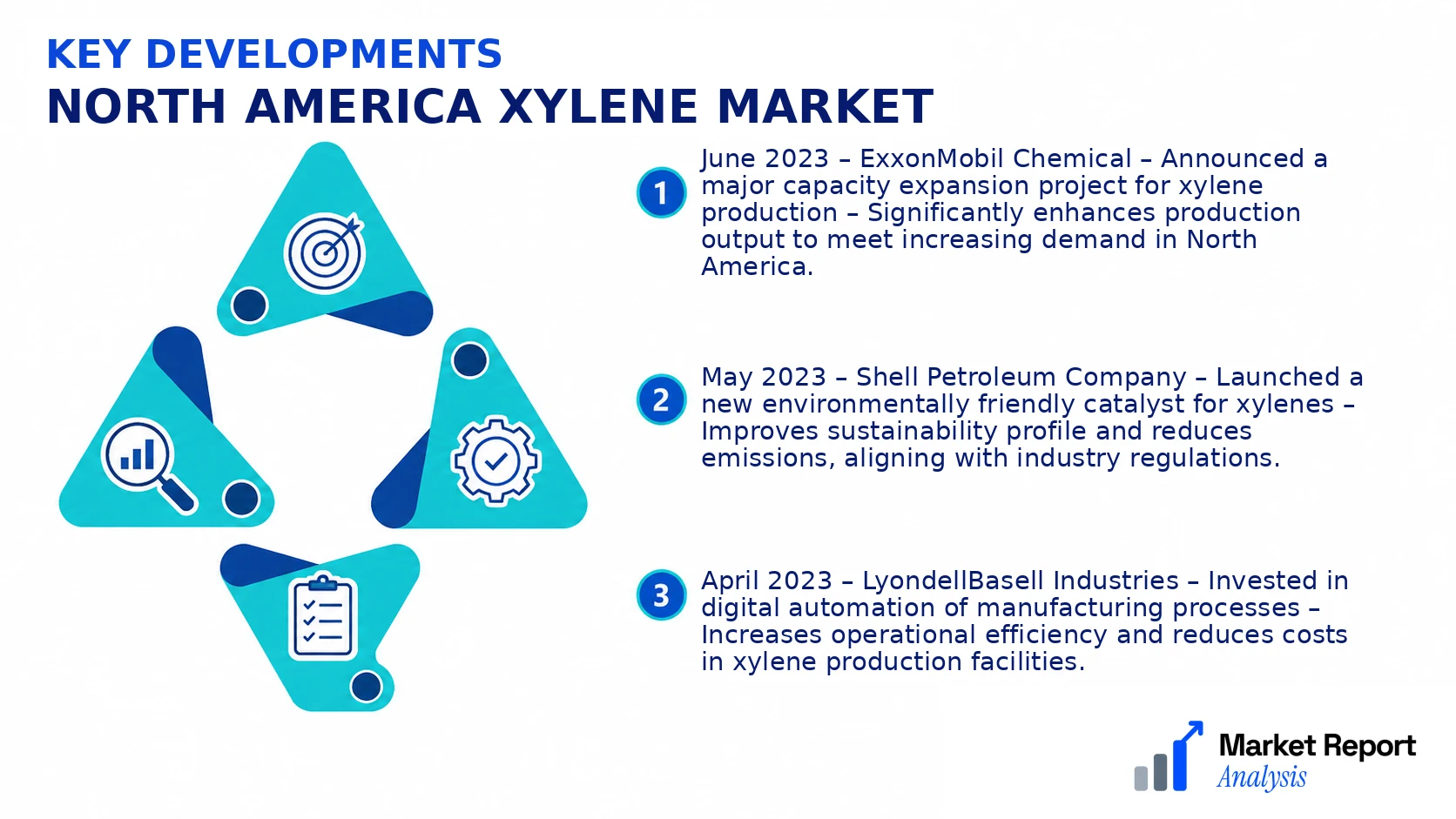
- June 2023 – ExxonMobil Chemical – Announced a major capacity expansion project for xylene production – Significantly enhances production output to meet increasing demand in North America.
- May 2023 – Shell Petroleum Company – Launched a new environmentally friendly catalyst for xylenes – Improves sustainability profile and reduces emissions, aligning with industry regulations.
- April 2023 – LyondellBasell Industries – Invested in digital automation of manufacturing processes – Increases operational efficiency and reduces costs in xylene production facilities.
- March 2023 – Valero Energy Corporation – Formed a strategic alliance with a logistics firm to optimize supply chain management – Ensures steady supply and reduces delivery times for customers.
- February 2023 – INEOS Group – Acquired a smaller chemical producer to expand its xylene portfolio – Strengthens its market presence and product diversification in North America.
Frequently Asked Questions
What is the North America Xylene Market?
The North America Xylene Market encompasses the production, consumption, and trade of xylene, a key petrochemical used predominantly in the manufacturing of plastics, polyester fibers, and coatings within North America. It reflects regional demand trends and industry dynamics.
What is the current market size of North America Xylene Market?
As of 2026, the North America Xylene Market is valued at approximately USD 4.2 Billion, driven by steady industrial growth, expanding petrochemical industries, and increased demand for plastics and fibers, with a consistent upward trajectory expected over the forecast period.
What factors are driving the North America Xylene Market?
Market drivers include rising demand for xylene in the production of plastics and polyester, ongoing technological advancements in petrochemical refining, and increasing investments in the chemical sector. Regulatory policies favoring synthetic fiber use also contribute to growth.
Which region dominates the North America Xylene Market?
The United States emerges as the dominant region within the North America Xylene Market, owing to its large-scale petrochemical industry, substantial manufacturing base, and technological innovation. Canada holds a significant share, driven by its chemical production sector.
Which segment is expected to grow the fastest?
The para-xylene segment is poised for the fastest growth, propelled by its extensive use in polyester fiber and plastic production, coupled with technological improvements that make production more cost-efficient and environmentally sustainable.
Who are the leading companies operating in the North America Xylene Market?
Leading companies include ExxonMobil, Shell Chemicals, and LyondellBasell. These firms dominate through extensive production capacities, technological innovation, and strategic investments, maintaining a competitive edge in the Xylene Market across North America.
Analyst Perspective
The North America Xylene Market exhibits a mature yet evolving landscape, driven by persistent demand in the automotive, packaging, and chemical manufacturing sectors. Looking ahead, the long-term outlook remains positive, bolstered by ongoing technological advancements in production efficiencies and environmental mitigation strategies. Commercial opportunities are expected to flourish through innovations in catalyst technology and sustainable feedstock utilization, which can reduce ecological footprints and provide competitive advantages.
Investors are advised to prioritize investments in regions exhibiting significant infrastructure development and regulatory support for cleaner production processes, particularly in the US and Canadian chemical hubs. The competitive landscape is intensifying with the entrance of low-cost producers and key players adopting strategic partnerships, mergers, and innovation-led differentiation.
Regional growth potential hinges on regulatory frameworks, trade policies, and the shifting demand from downstream industries. As demand patterns evolve, regional players must adapt swiftly to leverage emerging markets and technological breakthroughs, ensuring long-term strategic positioning amidst dynamic industry shifts.
