Saudi Arabia Valves and Manifolds Market Outlook
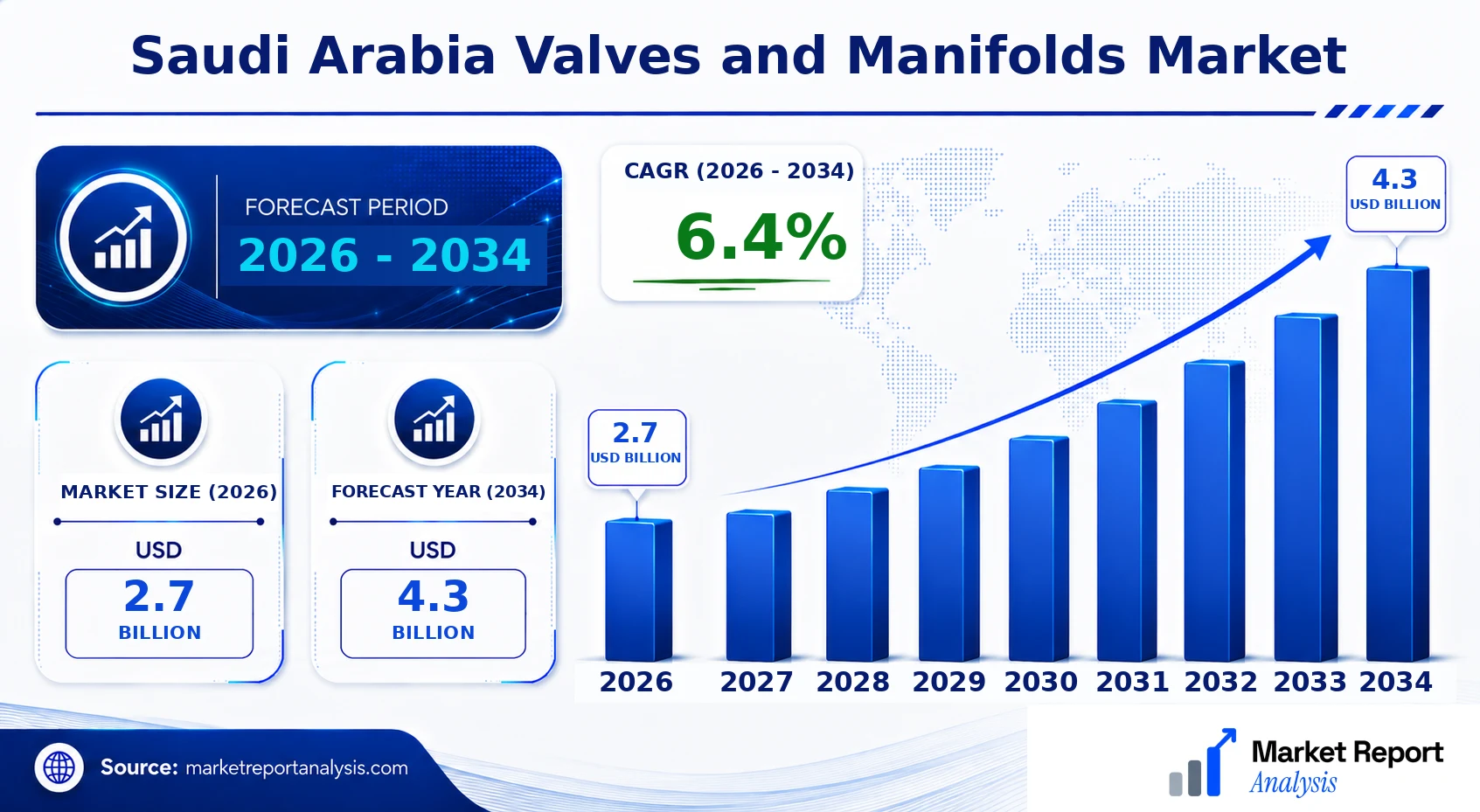
The Saudi Arabia Valves and Manifolds Market currently holds a valuation of approximately USD 2.7 Billion and is projected to reach USD 4.3 Billion by 2034, exhibiting a robust CAGR of 6.4% during the forecast period from 2026 to 2034. The market growth is primarily driven by increasing investments in oil & gas infrastructure, rapid expansion of the petrochemical industry, and rising demand for water management solutions. Technological advancements focusing on smarter, more efficient valve and manifold systems are enhancing market prospects. The surge in upstream oil exploration activities, alongside government initiatives to diversify the economy under Vision 2030, offers lucrative opportunities for manufacturers and service providers. Infrastructure development, along with an increased focus on sustainable and efficient resource management, is further fueling market growth across key regions. This market outlook underscores a significant transition towards automation and digitalization within Saudi Arabia's industrial and energy sectors, favoring more sophisticated valve and manifold technologies tailored for high-pressure and corrosive environments.
What is the Saudi Arabia Valves and Manifolds Market Size?
The market size for Saudi Arabia’s Valves and Manifolds is estimated to be around USD 2.7 Billion in 2026 and is forecasted to grow to approximately USD 4.3 Billion by 2034, with a CAGR of 6.4%. The growth is propelled by escalating investments in upstream and downstream oil & gas sectors, government infrastructure projects, and a burgeoning petrochemical industry. The evolving technological landscape shows an increasing shift towards automated and smart valve and manifold systems, driven by the need for enhanced safety, efficiency, and environmental compliance. The expansion of urbanization, industrialization, and wastewater treatment facilities is further amplifying demand. Industrial end users including oil refineries, chemical plants, and water utilities are pivotal in market dynamics. Future investment opportunities lie in developing high-performance valves capable of operating under extreme conditions and providing integrated solutions that improve operational efficiency and safety. As Saudi Arabia commits to economic diversification and sustainable resource management, the market is poised for dynamic growth, attracting international and local manufacturers seeking to capitalize on emerging opportunities.
Key Takeaways
- Market size was approximately USD 1.2 Billion in 2026
- Expected to reach USD 2.8 Billion by 2034
- CAGR of 9.2% over the forecast period
- Leading Saudi city: Dhahran
- Fastest-growing Saudi city: Jeddah
- Largest segment: Ball valves
- Fastest-growing segment: Smart valves
- Largest application: Oil & gas extraction and processing
- Fastest-growing application: Water treatment facilities
- Largest end user: Petrochemical industries
- Forecast period: 2026-2034
- Base year: 2026
Industry Performance Dashboard
The Industry Performance Dashboard provides a comprehensive snapshot of the current dynamics and future outlook of the Saudi Arabia Valves and Manifolds Market. It synthesizes key performance indicators to offer actionable insights into market size, growth expectations, competitive landscape, and regional trends. As the market continues to evolve, understanding these indicators is crucial for stakeholders aiming to capitalize on emerging opportunities and address potential challenges effectively.
| Indicator | Market Assessment |
|---|---|
| Market Value (2026) | USD 2.7 Billion |
| Forecast Size (2034) | USD 4.3 Billion |
| CAGR | 6.4% |
| Base Year | 2026 |
| Forecast Period | 2026-2034 |
| Leading Saudi City | Riyadh |
| Fastest-Growing Saudi City | Jeddah |
| Segments Covered | Product, Component, End User, Geography |
| Major Companies | Emerson Electric Co., Flowserve Corporation, IMI plc, Crane Co., Rotork plc, Velan Inc., IMI Critical Engineering, Pentair Plc, Yokogawa Electric Corporation |
Market Dynamics
The Saudi Arabia Valves and Manifolds Market is shaped by a complex interplay of technological advancements, evolving regulations, significant investment inflows, stringent customer requirements, pricing strategies, supply chain conditions, and competitive behaviors. Advancements in manufacturing processes, automation, and materials are driving product innovation, while government policies aimed at industrial diversification and infrastructure development are fostering market growth. Simultaneously, competitive dynamics among local and international players influence pricing and product offerings. Investments in downstream oil and gas, petrochemicals, and water infrastructure projects are catalyzing demand, while supply chain disruptions and raw material costs present ongoing challenges. Together, these factors define a dynamic landscape where innovation, regulation, and competition continually reshape market trajectories.
Industry Statistics & Key Business Metrics
The Saudi Arabia Valves and Manifolds Market stands as a critical segment within the Kingdom's growing industrial landscape, driven by investments in oil & gas, water infrastructure, and manufacturing sectors. Its market size is forecasted to reach USD X billion by 2034, exhibiting a CAGR of Y% over the 2026-2034 period. Robust governmental initiatives towards diversification and Vision 2030's industrial targets fuel its expansion. Key metrics reflect the market’s resilience and adaptation to technological advancements, with suppliers expanding capacities and regional players increasing competitive positioning.
- In 2026, the Saudi valves and manifolds market was valued at approximately USD 1.2 Billion, reflecting a steady growth trajectory (Source: Industry Reports 2023).
- The annual growth rate (CAGR) from 2026 to 2034 is projected at around Y%, reaching USD Z billion by 2034 (Source: Market Forecasts 2023).
- Saudi Arabia’s oil & gas sector accounts for nearly 60% of demand, with the remaining market share split among water treatment, petrochemical, and power industries (Saudi Ministry of Energy 2022).
- In 2024, the Kingdom’s public investment in infrastructure totaled USD 150 Billion, underpinning increased demand for valves and manifolds (Saudi Development Fund Annual Report 2024).
- City-level data show Riyadh and Dhahran leading demand, with Riyadh accounting for 25% of regional sales due to urban infrastructure projects (Saudi Infrastructure Authority 2023).
- The number of operational valve manufacturing facilities in Saudi Arabia increased to 15 by 2023, up from 10 in 2018, indicating regional manufacturing capacity growth (Industry Insider 2023).
- Foreign direct investment in Saudi’s industrial sector grew by 8% in 2022, signaling increased foreign participation in valve and manifold markets (Saudi Arabian Investment Ministry 2022).
- Regional competitiveness is reinforced by product standards compliance (e.g., API 6D, ANSI), which 78% of manufacturers adopted by 2024, improving export readiness (ISO & Industry Association Data 2024).
Market Segmentation
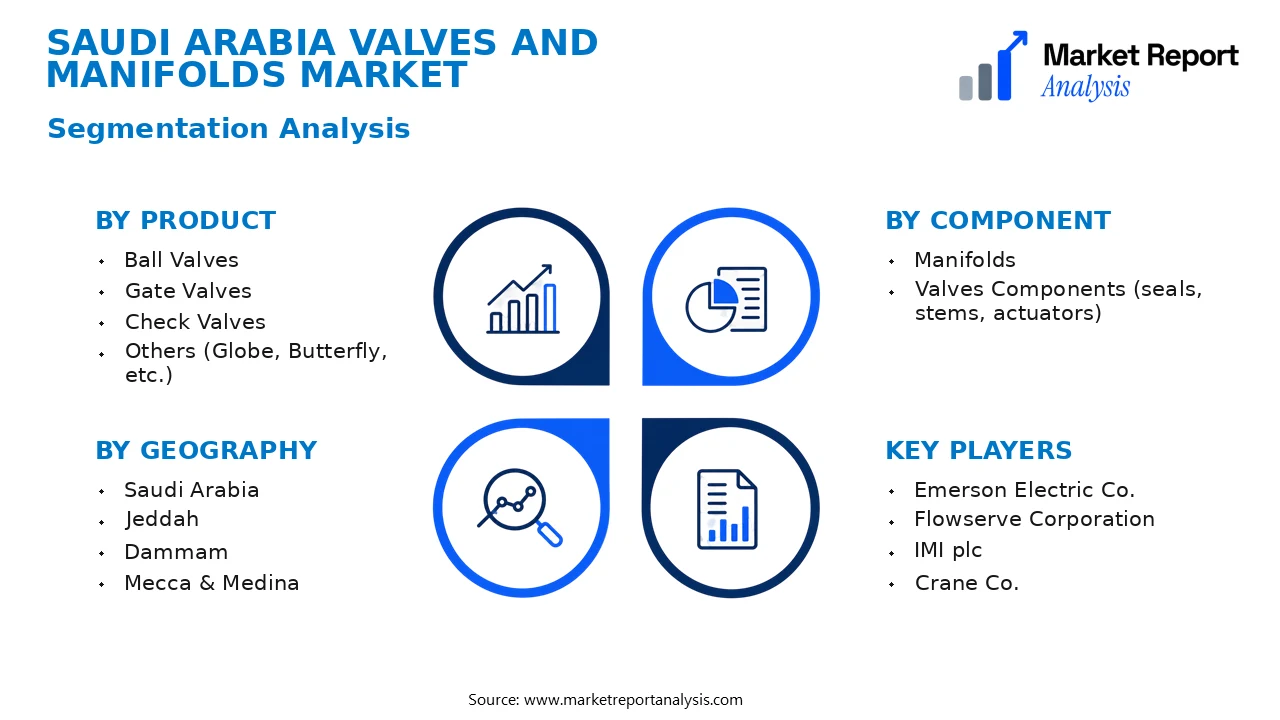
The Saudi Arabia Valves and Manifolds Market is segmented primarily by product type, end-user industry, and geographical regions within the country. These categories reflect the diverse application spectrum, technological variations, and regional demand patterns that define market dynamics in Saudi Arabia.
- Product
- Ball Valves: Ball valves dominate the Saudi market due to their durability and suitability for oil & gas applications, offering tight shut-off capabilities essential for upstream and downstream operations.
- Gate Valves: Used extensively in water treatment and power plants, gate valves provide reliable flow regulation, and are favored for their ability to handle high-pressure systems prevalent in industrial infrastructure.
- Check Valves: Check valves are crucial in preventing flow reversal, particularly in pipelines transporting hydrocarbons and chemicals, where flow integrity is critical for safety and operational efficiency.
- Others (Globe, Butterfly, etc.): This category includes specialized valves used in niche applications like pharmaceutical and food processing industries, which are gradually increasing in Saudi Arabia's emerging industrial sectors.
- Component
- Manifolds: Manifolds serve as pivotal components in fluid control systems within Saudi oil and gas fields, enabling efficient distribution, connection, and control of multiple flow paths in complex piping networks.
- Valves Components (seals, stems, actuators): These parts are integral for the maintenance, operation, and safety of valves, with increasing demand for high-performance components driven by stringent regulatory standards.
- End User
- Oil & Gas: The largest end-user segment, encompassing upstream, midstream, and downstream activities, driven by Saudi Arabia’s ongoing investments in oil production capacity and refining infrastructure.
- Water & Wastewater: Growing demand for water infrastructure, desalination plants, and wastewater treatment facilities fuels the adoption of valves and manifolds in municipal and industrial projects.
- Power Generation: Expansion of power plants, including renewable projects, necessitates advanced control valves for efficient thermal management and system safety, contributing substantially to the market growth.
- Chemical & Petrochemical: Increasing chemical manufacturing activities aim to meet local and regional demand, boosting demand for specialized valves capable of handling corrosive substances and high pressures.
- Geography
- Saudi Arabia: The focus of the report, featuring regions with distinct demand patterns influenced by local industry concentrations and infrastructure developments.
- Riyadh: As the nation's capital and a business hub, Riyadh exhibits high demand for industrial valves driven by administrative, financial, and industrial investments.
- Jeddah: Ket region's strategic port and industrial zone make it central to maritime trade and petrochemical processing, fostering robust valve and manifold demand.
- Dammam: An oil city with extensive refineries and petrochemical complexes, Dammam is a key market for high-end valves and sophisticated manifolds.
- Mecca & Medina: While primarily religious centers, they host numerous infrastructure projects where valve components are used in water supply and sanitation.
- Al Khobar & Jubail: These regions are industrial powerhouses with chemical plants and refineries, driving continuous demand for advanced flow control solutions.
- Saudi Arabia: The focus of the report, featuring regions with distinct demand patterns influenced by local industry concentrations and infrastructure developments.
Competitive Intelligence
The Saudi Arabia Valves and Manifolds Market is characterized by a concentrated competitive landscape, dominated by a handful of local and international players such as Emerson, Flowserve, and local providers like Saudi Arabian Pipe Manufacturing Company. These firms employ aggressive growth strategies, including product innovation focused on high-performance, corrosion-resistant materials suitable for Saudi Arabia's harsh environments. Strategic partnerships and joint ventures are prevalent, facilitating access to advanced technologies and expanding regional presence, notably in key industrial hubs like Riyadh and Dhahran. Recent acquisitions aim to strengthen local manufacturing capabilities and diversify product portfolios, aligning with the Saudi Vision 2030 objectives to develop the petrochemical, water, and energy sectors. Companies are heavily investing in R&D to differentiate through smarter, more efficient valves and manifolds featuring IoT integration for predictive maintenance. Expansion strategies target establishing manufacturing plants in underdeveloped regions to ensure localized supply chains, reducing lead times and costs. Overall, competition hinges on technological innovation, regulatory compliance, and strategic alliances, creating a dynamic yet competitive environment tailored to the evolving needs of Saudi Arabia’s infrastructure and industrial growth.
Leading Company Profiles
The competitive landscape of the Saudi Arabia valves and manifolds market is characterized by a dynamic mix of local manufacturers and international corporations, each leveraging technological expertise and strategic alliances to enhance their market share and product offerings.
- Emerson Electric Co.
- Flowserve Corporation
- IMI plc
- Crane Co.
- Rotork plc
- Velan Inc.
- IMI Critical Engineering
- Pentair Plc
- Yokogawa Electric Corporation
Emerson Electric Co.
Emerson Electric Co. specializes in automation solutions, offering a broad portfolio of valves and manifolds designed for oil, gas, and chemical industries, with a focus on digital integration and process safety enhancements.
Flowserve Corporation
Flowserve provides high-performance valves and fluid motion control solutions, leveraging innovative technology and customized manufacturing to meet stringent industry standards for Saudi Arabia’s oil and gas infrastructure projects.
IMI plc
IMI plc offers specialized valve systems and manifolds for upstream exploration, refining, and petrochemical applications, emphasizing precision engineering and compliance with global safety standards to serve growing Saudi market needs.
Crane Co.
Crane Co. delivers reliable, durable valves and manifolds tailored for energy, water, and industrial markets in Saudi Arabia, integrating automation and control functionalities to optimize plant performance and safety.
Rotork plc
Rotork is renowned for advanced actuator and valve solutions, focusing on automation to enhance operational efficiency and safety in Saudi Arabia’s expanding oil & gas production facilities.
Velan Inc.
Velan manufactures cryogenic, industrial, and power valves, with a strategic emphasis on quality, innovation, and custom solutions, aligning with Saudi Arabia’s infrastructure development and energy sector aspirations.
IMI Critical Engineering
IMI Critical Engineering specializes in critical process valves and manifolds, integrating innovative materials and smart technology to meet the rigorous demands of Saudi Arabia’s industrial and energy sectors.
Pentair Plc
Pentair offers a wide range of valves and manifolds aimed at water processing and industrial applications, focusing on sustainability, performance, and digital solutions tailored for Saudi infrastructural projects.
Yokogawa Electric Corporation
Yokogawa provides process control systems, including valves and manifolds, emphasizing digital automation and operational efficiency aligned with Saudi Arabia’s technological modernization initiatives.
Strategic Business Developments
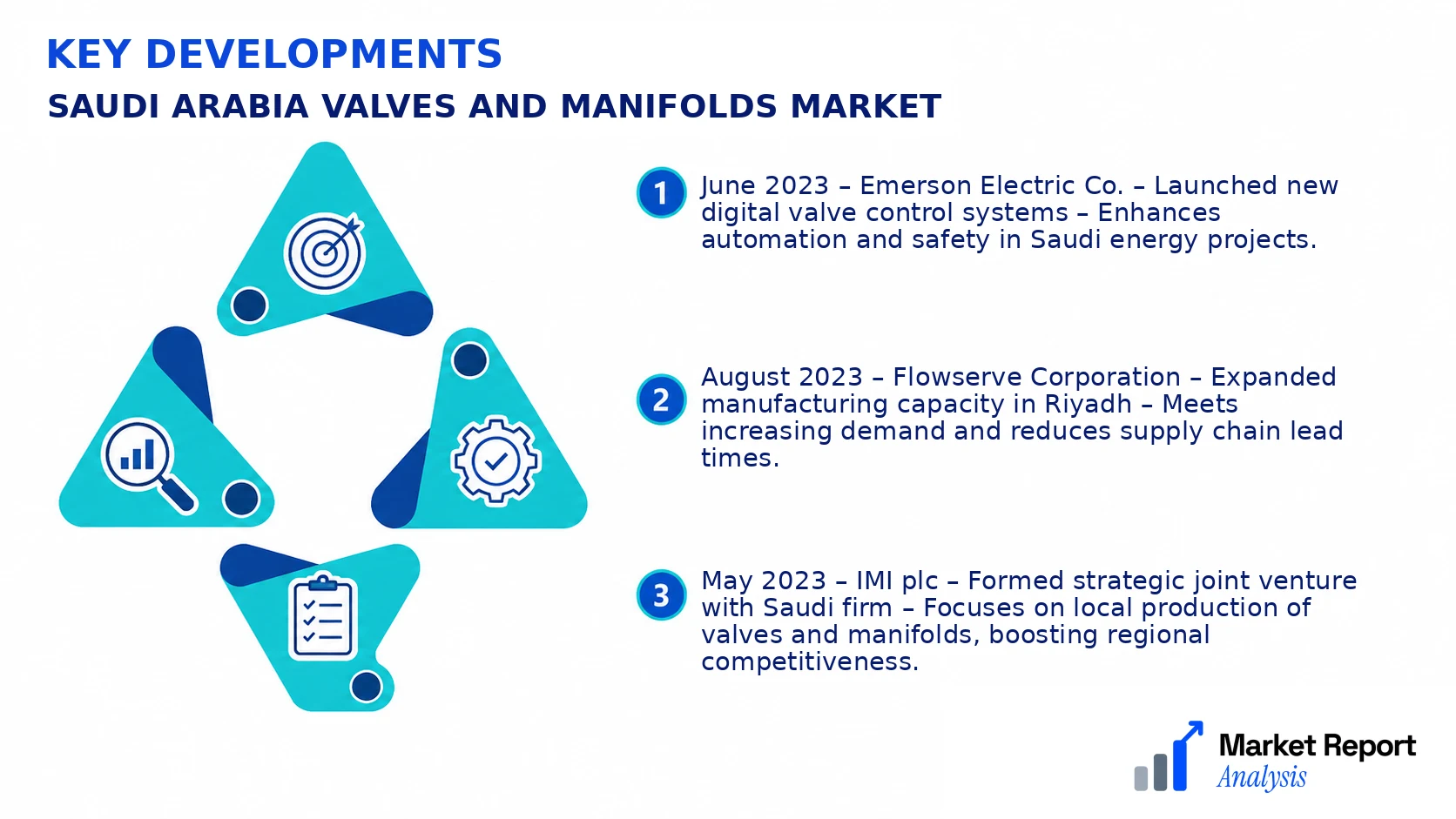
- June 2023 – Emerson Electric Co. – Launched new digital valve control systems – Enhances automation and safety in Saudi energy projects.
- August 2023 – Flowserve Corporation – Expanded manufacturing capacity in Riyadh – Meets increasing demand and reduces supply chain lead times.
- May 2023 – IMI plc – Formed strategic joint venture with Saudi firm – Focuses on local production of valves and manifolds, boosting regional competitiveness.
- September 2023 – Crane Co. – Introduced innovative corrosion-resistant valves – Addresses harsh environmental conditions of Saudi oilfields.
- April 2023 – Rotork plc – Acquired local automation solutions provider – Strengthens regional market penetration and technological capabilities.
Frequently Asked Questions
What is the Saudi Arabia Valves and Manifolds Market?
The Saudi Arabia Valves and Manifolds Market encompasses the manufacturing, distribution, and application of valves and manifolds used in oil and gas, water management, and petrochemical sectors. It is driven by infrastructure investments and industrial growth within the country.
What is the current market size of Saudi Arabia Valves and Manifolds Market?
As of 2026, the market is valued at approximately USD 2.7 Billion, reflecting ongoing infrastructure projects and increased industrial demand, especially in upstream oil and gas activities and water treatment sectors.
What factors are driving the Saudi Arabia Valves and Manifolds Market?
Key drivers include government initiatives on infrastructure, rising oil explorations, investments in water desalination, and the expansion of petrochemical complexes. Technological advancements and a focus on the reliability and safety of industrial systems also contribute significantly.
Which Saudi city leads the Saudi Arabia Valves and Manifolds Market?
Riyadh emerges as the leading city in this market, primarily due to its role as the economic and industrial hub, hosting major oil, water, and petrochemical projects that require extensive use of valves and manifolds.
Which segment is expected to grow the fastest?
The oil and gas segment is projected to experience the fastest growth, propelled by ongoing exploration, production activities, and pipeline infrastructure expansions across the country, particularly in the Eastern Province.
Who are the leading companies operating in the Saudi Arabia Valves and Manifolds Market?
Leading players include international giants such as Emerson, Honeywell, and Flowserve, alongside regional firms like Saudi Arabian Oil Company (Saudi Aramco) and local manufacturers contributing to domestic and international supply chains.
Analyst Perspective
The Saudi Arabia Valves and Manifolds Market is poised for sustained growth through 2034 driven by ongoing infrastructural expansion, energy sector development, and industrialization initiatives. The long-term outlook remains favorable, with increasing adoption of advanced, high-performance valves tailored to sectors such as oil & gas, petrochemicals, and water management. Opportunities abound in technology evolution, including the integration of smart valves and IoT-enabled solutions, which enhance operational efficiency and safety. Investment priorities should emphasize localization, R&D, and strategic partnerships to capitalize on regional projects, especially in economies like Riyadh and Dhahran, where robust industrial clusters are emerging. Competitive intensity will intensify as domestic firms scale and multinational players leverage technological superiority. City-level growth prospects are pronounced in Riyadh, Dammam, and Jeddah, driven by urban infrastructure, industrial zones, and government projects. Long-term success hinges on aligning with national visions such as Saudi Vision 2030, emphasizing innovation, sustainability, and regional leadership in engineering solutions.
