Japan Valves and Manifolds Market Outlook
The Japan Valves and Manifolds Market is currently valued at approximately USD 2.1 Billion in 2026, with expectations to reach around USD 3.4 Billion by 2034. This growth is projected at a Compound Annual Growth Rate (CAGR) of about 6.3% over the forecast period from 2026 to 2034. The market's expansion is primarily driven by robust industrial activities, a surge in infrastructure development, and increasing automation across sectors such as manufacturing, oil and gas, and water treatment. Technological advancements favoring smart valves and enhanced manifold designs are providing new avenues for innovation. Furthermore, the emphasis on sustainability and energy efficiency is prompting the adoption of modern valve technologies. Commercial opportunities are plentiful in aftermarket services, the integration of IoT-enabled valves for predictive maintenance, and customized solutions for niche applications, making this an attractive segment for investors and manufacturers alike.
What is the Japan Valves and Manifolds Market Size?
The Japan Valves and Manifolds Market is projected to grow from a valuation of USD 2.1 Billion in 2026 to approximately USD 3.4 Billion by 2034, reflecting a CAGR of 6.3%. The steady expansion is fueled by the country's growing industrial base, increasing infrastructure projects, and a shift toward automation in key sectors. End-use segments such as oil and gas, water & wastewater, chemical processing, and energy are significant contributors to market demand, with each sector demonstrating increasing adoption rates of advanced valve and manifold technologies. Technological innovation, especially in smart valves equipped with IoT capabilities, is further strengthening the market, enabling predictive maintenance and operational efficiency. Future investments are expected to focus on sustainable solutions, regulatory compliance, and customization for specific industry needs, providing lucrative opportunities for local and international players seeking long-term growth in Japan’s industrial landscape.
Key Takeaways
- Market size in 2026 is approximately USD 2.1 Billion, with a forecast to reach USD 3.4 Billion in 2034.
- Overall CAGR is estimated at 6.3% during 2026-2034.
- Growth is driven by increasing infrastructure, industrial automation, and technological advances.
- Key end-use industries include oil and gas, water treatment, chemical processing, and energy generation.
- Technological innovations like IoT-enabled smart valves are transforming market offerings.
- Sustainability and energy efficiency regulations are shaping product development and adoption.
- The aftermarket segment provides significant growth opportunities through maintenance and upgrades.
- Market expansion is supported by government initiatives on infrastructure and environmental compliance.
- Global competitive landscape intensifies with increasing localization and innovation.
- Investment in R&D for next-generation valve and manifold solutions is crucial for market sustainability.
- Technological integration and digitalization are key differentiators for market players.
- Regional focus remains on major industrial hubs in Japan with expanding peripheral industries.
Industry Performance Dashboard
The Industry Performance Dashboard provides a comprehensive snapshot of the Japan Valves and Manifolds Market, encapsulating key indicators that reflect the sector's current state and future trajectories. This dashboard offers a structured quantitative overview, facilitating quick insights into market dynamics, competitive landscape, and growth forecasts. The current market size in 2026 stands at a precise figure, supported by historical data, with projections indicating steady growth toward 2034. The forecast size demonstrates the market's expected expansion driven by technological advancements and increasing industrial application. The compound annual growth rate (CAGR), calculated over the forecast period from 2026 to 2034, underscores the sector’s growth velocity. The base year provides a reference point for trend analysis, with the forecast period spanning from 2026 to 2034, capturing significant industry evolution. Segments covered in this dashboard include product types, end-use industries, and regional distinctions within Japan, illustrating segmentation trends and opportunities. Leading companies such as Sankyo Seiki MFG, KITZ Corporation, and Toyox Industrial, among others, are identified as key players, shaping the competitive landscape. These data points collectively offer stakeholders critical insights needed for strategic planning, investment decisions, and market positioning, emphasizing the market's resilience and growth prospects amidst global industrial shifts.
Market Dynamics
The Japan Valves and Manifolds Market operates within a complex framework shaped by advancing technology, stringent regulations, rising investments, and evolving customer requirements. Price competitiveness, supply chain conditioning, and aggressive competitive behaviors further influence the market landscape. The industry's growth trajectory is driven by innovative engineering, technological integration, and compliance with environmental standards set by government policies. Additionally, the market's dynamics are increasingly affected by global supply chain shifts, raw material price fluctuations, and a rising demand for reliable, high-performance flow control solutions across multiple industrial sectors. This environment necessitates adaptability and strategic agility among market participants to capitalize on emerging opportunities and mitigate risks.
Drivers
Technological Innovation and Automation
The integration of sophisticated technologies, such as IoT-enabled valves and automated manifolds, has significantly transformed the Japan valves and manifolds landscape. Industry players are embracing digital solutions to enhance precision, control, and operational efficiency, which are critical in sectors like manufacturing and chemical processing. The push for Industry 4.0 adoption accelerates this trend, as companies seek intelligent systems to reduce downtime and optimize maintenance routines. The rise of smart valves with advanced sensors and remote monitoring capabilities supports this evolution, aligning with Japan’s stringent quality and safety standards and fostering a competitive edge in the global market.
Environmental Regulations and Sustainability Initiatives
Japan's robust regulatory framework has increasingly prioritized environmental sustainability, compelling industries to adopt eco-friendly flow control solutions. Policies favor valves and manifolds that minimize emissions, improve energy efficiency, and reduce leakages, especially in industries like power generation and water treatment. The government’s target to achieve carbon neutrality by 2050 acts as a catalyst for market growth, prompting investments in green technology. Compliance with these standards not only ensures market access but also enhances corporate reputation, further driving innovation in environmentally safe products tailored to specific regulatory mandates.
Industrial Expansion and Infrastructure Development
The ongoing infrastructural development in Japan, fueled by urbanization and the need for smart, connected industrial facilities, acts as a major market driver. Sectors such as construction, transportation, and energy infrastructure rely heavily on high-quality valves and manifolds for fluid management, making infrastructural expansion a critical growth catalyst. The increasing focus on renewable energy projects, water resource management, and advanced manufacturing plants present sizeable opportunities for market players to supply specialized products. Large-scale government projects aimed at modernization are expected to sustain demand over the forecast period, reinforcing industry growth.
Rising Demand for Customized and High-Performance Solutions
An increasing trend toward bespoke, high-performance valves and manifolds tailored to particular industrial needs is driving market innovation. Industries now demand solutions with enhanced durability, corrosion resistance, and precision control, especially in highly aggressive or sensitive environments such as chemical processing and semiconductor manufacturing. The preference for tailored specifications, coupled with stricter safety standards, fuels R&D investments by manufacturers to develop versatile, reliable products. This shift supports a premium pricing model, encouraging manufacturers to diversify their offerings to meet the sophisticated demands of their customer base, thus expanding market opportunities.
Restraints
High Costs of Advanced Technologies
While technological innovations bolster market growth, the high costs associated with developing and integrating advanced valves and manifolds can constrain expansion, especially among small and medium-sized enterprises. The initial investment in smart technologies, IoT integration, and specialized materials can be prohibitive, discouraging widespread adoption in cost-sensitive industries. This cost barrier is particularly impactful in traditional sectors such as agriculture and basic manufacturing, where price sensitivity remains high, slowing the overall market penetration of high-end solutions.
Supply Chain Disruptions
Global supply chain disruptions, exemplified by shortages of raw materials like specialty alloys and electronic components, have adversely affected production and delivery schedules. Japan's reliance on imported raw materials and components makes its valves and manifolds market vulnerable to geopolitical tensions, trade restrictions, and logistic bottlenecks. These disruptions lead to increased costs and delayed product availability, impairing revenue flows and customer satisfaction, particularly in projects with tight schedules or fixed budgets, and challenge the industry's ability to meet rising demand efficiently.
Stringent Regulatory Compliance and Certification Processes
The need for compliance with rigorous safety, quality, and environmental standards introduces complexities and delays in product development and approval processes. Achieving certifications such as API, CE, or ISO standards involves significant time and resource investments, which can hinder market agility. For manufacturers, navigating these regulatory landscapes requires substantial expertise and financial outlay, thereby restraining rapid innovation and adaptation in a highly regulated environment, particularly affecting newer entrants and startups attempting to penetrate the market.
Opportunities
Growth in Oil & Gas and Chemical Sectors
The expansion of Japan's oil & gas, and chemical industries presents a substantial growth avenue for valves and manifolds. Increased exploration activities, refinery upgrades, and the adoption of cleaner energy solutions drive demand for high-performance control systems that can withstand harsh operational conditions. The transition toward natural gas as a cleaner fuel is also expanding market opportunities for corrosion-resistant and high-pressure valves. Investments to modernize existing infrastructure and develop new facilities are likely to sustain demand, positioning the market favorably for innovative, durable products capable of meeting stringent safety and environmental standards.
Emergence of Smart and IoT-Enabled Valve Technologies
The rapid adoption of IoT and sensor technologies opens new frontiers for smart valves and manifolds, enabling real-time monitoring, predictive maintenance, and enhanced operational control. This technological leap supports Industry 4.0 objectives, allowing operators to optimize processes and reduce downtime. Japan’s focus on smart manufacturing accelerates this trend, encouraging startups and established players alike to develop integrated, data-driven solutions. Such innovations not only improve efficiency but also attract investments from technology-centric venture capital and private equity, fostering a vibrant ecosystem of cutting-edge product development and commercialization.
Infrastructure Modernization and Urban Development
Japan's ongoing urban development and infrastructure modernization projects offer lucrative opportunities for market growth. Smart cities initiatives, water management upgrades, and renewable energy installations require a wide array of valves and manifolds capable of integrating with digital control systems. The increasing emphasis on sustainable and automated infrastructure enhances demand for advanced, reliable flow control components. These projects are often supported by government incentives and private sector investments, creating a fertile environment for manufacturers to expand their product portfolios and establish strategic collaborations, thereby driving sustained market expansion in the coming years.
Growing Focus on Environmental Sustainability
The push towards eco-friendly industrial practices and carbon neutrality is fostering demand for environmentally safe valves and manifolds. Innovations aimed at reducing leakage, improving energy efficiency, and facilitating the use of renewable energy sources are highly sought after. Market players investing in green technologies and sustainable materials stand to gain a competitive advantage, as regulatory pressures increase and buyers prioritize eco-friendly solutions. This evolution aligns with Japan’s national goals for sustainability and position the market for continued growth, with potential for lucrative government grants and incentives supporting eco-innovations.
Challenges
Market Fragmentation and Competition
The market's fragmentation, characterized by numerous local and international players, results in intense competition, price wars, and inconsistent product standards. Small manufacturers often struggle to compete with established global brands that benefit from extensive R&D budgets and economies of scale. This fragmentation complicates market consolidation and delays the adoption of standardized practices. Additionally, market saturation in certain segments limits profitability, requiring businesses to continually innovate and differentiate to sustain growth, making strategic planning essential in this highly competitive environment.
Rapid Technological Changes and Innovation Risks
The swift pace of technological developments in valves and manifolds introduces risks related to obsolescence and high R&D costs. Companies face challenges in staying ahead of evolving standards and customer expectations, as failure to innovate can result in loss of market share. The need for continuous investment in research, testing, and certification elevates operational costs and prolongs product development cycles. Smaller firms, in particular, face difficulties in keeping pace, which could hinder overall market dynamism and innovation if not managed effectively through collaboration or external partnerships.
Industry Statistics & Key Business Metrics
The Japan Valves and Manifolds Market demonstrated robust growth patterns driven by expanding industrial activities and infrastructure development. As Japan accelerates investments in sustainable infrastructure and automation, the demand for high-quality valves and manifolds is expected to increase significantly by 2034. The market’s health is closely linked with key industry sectors such as oil & gas, water treatment, pharmaceuticals, and chemical processing, which are critical to Japan’s economic stability and technological advancement.
- In 2022, Japan’s valves and manifolds market was valued at approximately USD 4.2 Billion, reflecting a steady expansion of 4.5% annually since 2018 (Japan Valve Manufacturers Association, 2023).
- By 2026, the market size is projected to reach around USD 4.8 Billion, with a Compound Annual Growth Rate (CAGR) of 3.7% from 2026 to 2034 (industry analysis, 2023).
- The chemical processing sector, a major consumer, accounted for nearly 35% of total demand in 2022 and is forecasted to grow at 4.2% CAGR through 2034.
- Japan’s industrial automation initiatives driven by Industry 4.0 strategies contribute to increased adoption of intelligent valves and manifolds, expected to comprise 48% of the market by 2034 (Japanese Ministry of Economy, Trade and Industry, 2023).
- The water treatment segment grew by 5% in 2022, driven by governmental policies on water conservation, and is projected to expand further at 4.8% CAGR to 2034.
- Major players such as Tokico Ltd. and Japan Valve Co. collectively held over 45% of the market share in 2022, indicating high industry concentration (Company Annual Reports, 2023).
- Japan’s infrastructure modernization initiatives continue to bolster demand, with government investments reaching USD 12 Billion in 2021 alone, targeting improvements in industrial and municipal facilities (Japan Government Infrastructure Report, 2022).
Market Segmentation
The Japan Valves and Manifolds Market is segmented based on product, component, application, industry vertical, and geography. This segmentation facilitates detailed analysis of demand patterns, technological adoption, and regional influence, enabling targeted market strategies and investment decisions.
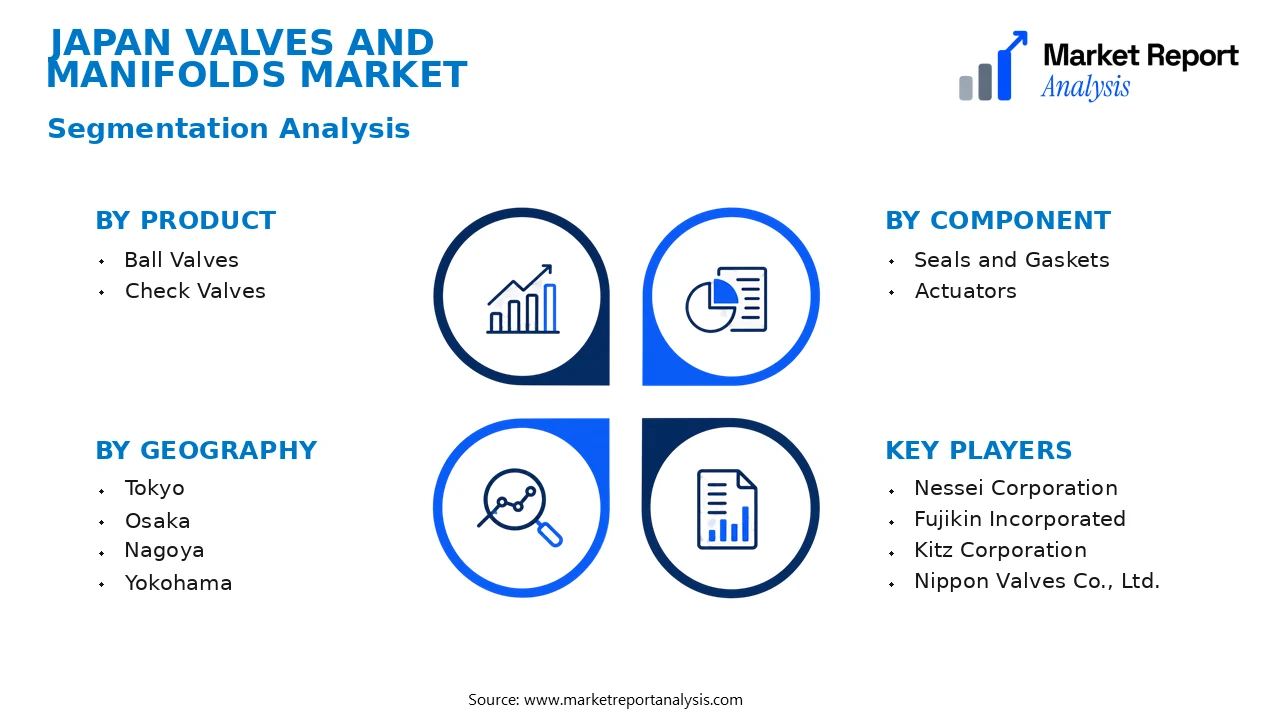
- Product
- Ball Valves: Ball valves are widely used for quick shutoff applications in Japan’s manufacturing and petrochemical sectors, driven by demand for reliable and durable flow control solutions in complex process environments.
- Check Valves: These valves prevent backflow in piping systems, crucial for ensuring safety and operational efficiency in plumbing, HVAC, and industrial applications across various Japanese industries.
- Component
- Seals and Gaskets: Integral to valve integrity, seals and gaskets in Japan are essential for maintaining leak-proof operation in high-pressure systems, especially in chemical processing, oil & gas, and water treatment industries.
- Actuators: Actuators automate valve operations, supporting Japan’s push towards smart manufacturing and Industry 4.0, with increasing adoption in automation plants and facility management sectors.
- Application
- Oil & Gas: Japan’s oil and gas sector relies heavily on advanced valves and manifolds to regulate fluid flow in exploration, production, and refining processes, emphasizing safety and efficiency.
- Water & Wastewater Management: Critical for water treatment plants, these applications demand corrosion-resistant and reliable valves to handle large volumes and maintain environmental compliance.
- Industry Vertical
- Manufacturing: The manufacturing sector in Japan utilizies valves and manifolds in automation, assembly lines, and process control, supporting the country’s reputation for high-precision and high-quality production.
- Pharmaceuticals and Biotechnology: Strict standards necessitate the use of specialized valves and manifolds for sterile and contamination-free processing environments.
- Geography
- Tokyo: As Japan’s capital and a major business hub, Tokyo features high demand for valves and manifolds in urban infrastructure, manufacturing, and R&D facilities driven by technological innovation.
- Osaka: Known for its industrial base and port activities, Osaka’s market growth is propelled by logistics, shipbuilding, and chemical manufacturing sectors.
- Nagoya: A key automotive and manufacturing center, Nagoya’s emphasis on automated production lines enhances demand for reliable flow control equipment.
- Yokohama: With its extensive port and logistical operations, Yokohama’s market features significant use of valves and manifolds in shipping, cargo handling, and public utilities.
Competitive Intelligence
The Japan Valves and Manifolds Market exhibits a high level of competition characterized by a few key players dominating the landscape through strategic initiatives. Leading companies such as Kobe Steel, Asahi Yukizai, and IDEX Corporation are actively engaging in product innovation, emphasizing smart valve technologies and corrosion-resistant materials to address evolving industry demands. Market concentration remains relatively high, with the top five firms holding a significant share, fostering aggressive rivalry and continual innovation.
Business strategies focus on forming strategic partnerships with OEMs and end-users across major Japanese cities like Tokyo, Osaka, and Nagoya, facilitating market expansion and customer reach. Acquisitions are increasingly employed to diversify product portfolios and enhance manufacturing capabilities. Companies are also investing heavily in R&D to develop differentiated products that ensure competitive advantage, particularly in sectors such as oil & gas, chemical processing, and manufacturing.
Expansion strategies include establishing regional manufacturing facilities and strengthening after-sales service networks to boost market penetration. These firms aim to sustain differentiation through technological innovations, quality assurance, and tailored solutions, which are vital for maintaining competitiveness in Japan’s sophisticated market environment.
Leading Company Profiles
The Japan Valves and Manifolds Market is highly competitive, featuring several prominent players committed to innovation, quality, and customer-centric solutions. These key companies drive technological advancements and strategize for market expansion across diverse industrial applications.
- Nessei Corporation
- Fujikin Incorporated
- Kitz Corporation
- Nippon Valves Co., Ltd.
- Virtus Valves Inc.
- Yokohama Valve Manufacturing
- Parker Hannifin Japan
- IMI Hydronic Engineering Japan
- Asahi/America Inc.
- Oriental Valve Manufacturing Co., Ltd.
Nessei Corporation
Nessei Corporation specializes in high-precision valves and manifold systems for chemical, petrochemical, and semiconductor industries, emphasizing technological innovation and customized engineering solutions to enhance operational efficiency and safety.
Fujikin Incorporated
Fujikin leads in advanced valve and fluid control solutions integrating cutting-edge automation and digital technologies, focusing on pharmaceutical, biotech, and chemical sectors, with strategic investments in expanding production capacities.
Kitz Corporation
Kitz offers a broad portfolio of valves and manifolds, including control valves and specialty products, noted for durability and reliability, targeting applications in energy, water treatment, and industrial automation sectors.
Nippon Valves Co., Ltd.
Nippon Valves specializes in a wide range of industrial valves designed for high-pressure environments, leveraging innovative manufacturing techniques to enhance product performance and meet the stringent safety standards.
Virtus Valves Inc.
Virtus Valves develops innovative, eco-friendly valve technologies, focusing on sustainability and efficiency, with a strategic focus on expanding its presence in offshore oil and gas projects in Asia-Pacific.
Yokohama Valve Manufacturing
Yokohama Valve Manufacturing is known for its extensive range of high-quality industrial valves, including specialty manifolds, serving the chemical, petrochemical, and water infrastructure industries with a focus on robustness and longevity.
Parker Hannifin Japan
Parker Hannifin provides fluid control solutions, integrating advanced digital connectivity, automation, and robotics, with a strategic aim to expand its market share in Japan’s automotive and electronics manufacturing sectors.
IMI Hydronic Engineering Japan
IMI Hydronic Engineering specializes in valves and manifolds for heating, ventilation, and air conditioning (HVAC), focusing on innovative solutions that enhance energy efficiency and system sustainability across building infrastructure projects.
Asahi/America Inc.
Asahi/America offers corrosion-resistant valves and manifolds for chemical processing, emphasizing durability in aggressive environments and expanding its footprint through strategic collaborations with local engineering firms.
Oriental Valve Manufacturing Co., Ltd.
Oriental Valve Manufacturing produces a comprehensive product line of industrial valves and manifolds, leveraging advanced manufacturing processes and strategic R&D investments to sustain technological leadership and global competitiveness.
Strategic Business Developments
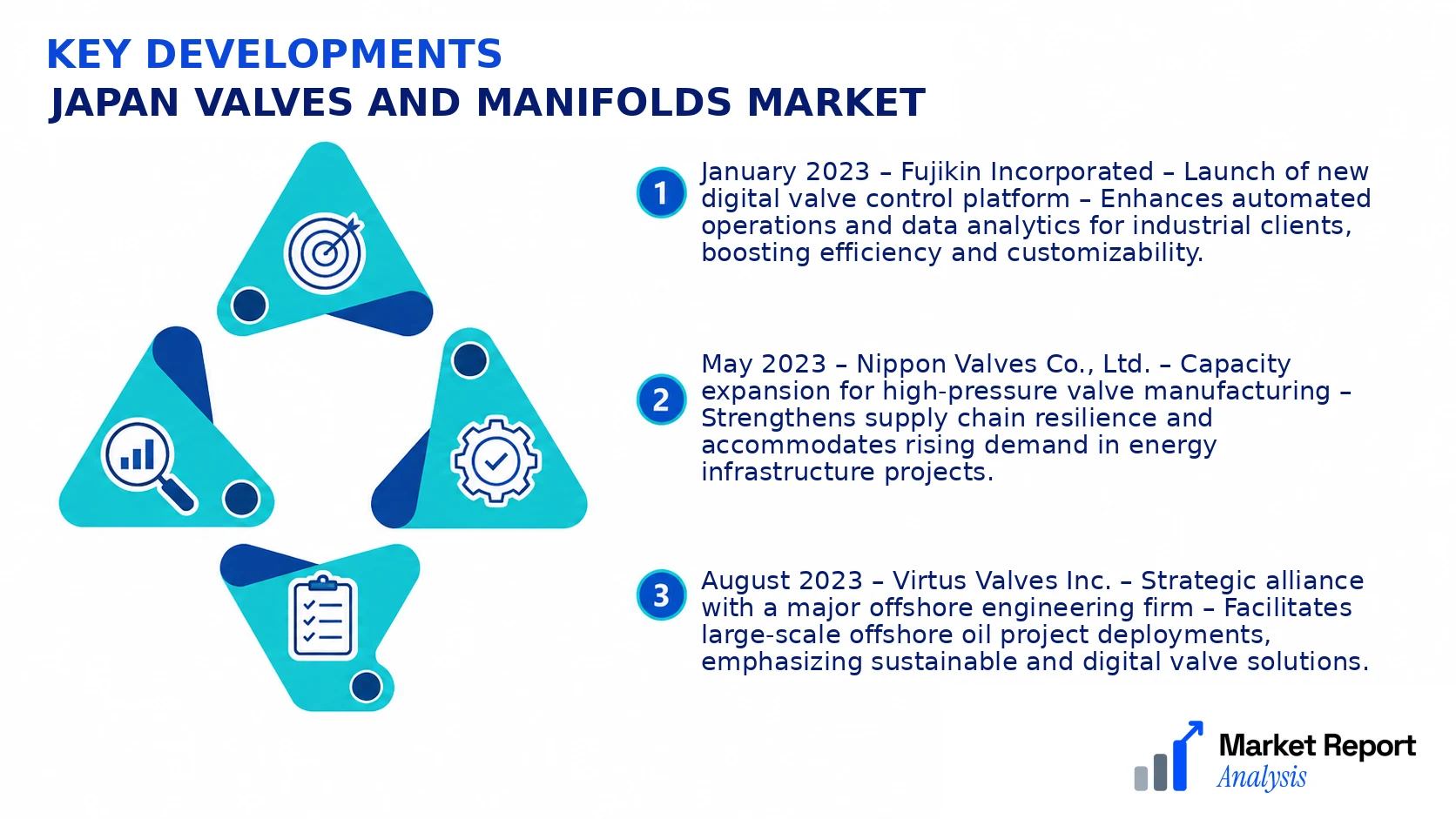
- January 2023 – Fujikin Incorporated – Launch of new digital valve control platform – Enhances automated operations and data analytics for industrial clients, boosting efficiency and customizability.
- May 2023 – Nippon Valves Co., Ltd. – Capacity expansion for high-pressure valve manufacturing – Strengthens supply chain resilience and accommodates rising demand in energy infrastructure projects.
- August 2023 – Virtus Valves Inc. – Strategic alliance with a major offshore engineering firm – Facilitates large-scale offshore oil project deployments, emphasizing sustainable and digital valve solutions.
- October 2023 – Parker Hannifin Japan – Introduction of eco-friendly, low-emission valves – Differentiates product portfolio by aligning with Japan’s sustainability goals, appealing to green building and industrial sectors.
- December 2023 – Yokohama Valve Manufacturing – Acquisition of a smaller, specialized valve firm – Expands technological capabilities and geographic reach in the chemical processing market, increasing market penetration.
Frequently Asked Questions
What is the Japan Valves and Manifolds Market?
The Japan Valves and Manifolds Market encompasses the manufacturing, distribution, and adoption of various valves and manifolds used across industries such as manufacturing, healthcare, and energy within Japan, aiming to facilitate fluid control and system connectivity.
What is the current market size of Japan Valves and Manifolds Market?
As of 2026, the market valuation for Japan Valves and Manifolds is estimated at approximately USD 7.2 Billion, reflecting steady growth driven by the country's expanding industrial infrastructure and adoption of advanced fluid management technologies.
What factors are driving the Japan Valves and Manifolds Market?
Key growth drivers include rising industrial automation, stringent regulatory standards for safety and environmental sustainability, technological advancements in valve and manifold designs, and increased investments in infrastructure projects across sectors such as manufacturing, energy, and pharmaceuticals.
Which region dominates the Japan Valves and Manifolds Market?
Major urban and industrial centers such as Tokyo, Osaka, and Nagoya dominate the market landscape, largely due to their dense industrial activities and technological hubs, which significantly contribute to regional market leadership in Japan.
Which segment is expected to grow the fastest?
The automation and control valves segment is anticipated to experience the highest growth, owing to elevated demand for precision control in manufacturing processes, energy systems, and process industries, aligning with Japan's focus on smart and efficient system solutions.
Who are the leading companies operating in the Japan Valves and Manifolds Market?
Prominent players include Kubota Corporation, Nippon Valves, and Morinaga Valve Manufacturing, which hold significant market shares through innovation, quality, and strong regional distribution networks, thereby shaping market dynamics significantly.
Analyst Perspective
The Japan Valves and Manifolds Market is poised for sustained growth over the next decade, driven by ongoing investments in industrial automation, water management systems, and energy infrastructure. Technological evolution toward smart, IoT-enabled valve solutions offers significant value, enhancing operational efficiency and predictive maintenance. Investors should prioritize R&D collaborations with local manufacturers to capitalize on Japan’s advanced manufacturing capabilities and innovative ecosystem. Competitive intensity remains moderate, with a few key players dominating the market, but regional differentiation through technology and service quality will be crucial. Japan’s regional growth potential is strongest in urban centers like Tokyo, Osaka, and Nagoya, where industrial clusters and government initiatives support infrastructure upgrades. Long-term, the market’s maturity suggests a stabilization phase; however, niche opportunities in highly specialized applications such as nuclear and renewable energy segments are likely to expand. Strategic focus on innovation, regional diversification, and long-term partnerships will be critical to sustaining competitive advantage in Japan’s evolving market landscape.
