Saudi Arabia Socks Market Outlook
The Saudi Arabia socks market is experiencing substantial growth driven by rising urbanization, increasing disposable income, and a growing awareness of health and fashion trends. As of 2026, the market is valued at approximately USD 0.9 Billion, with projections indicating it will reach USD 1.5 Billion by 2034. This growth is forecasted to occur at a Compound Annual Growth Rate (CAGR) of around 6.3% during the period from 2026 to 2034. Technological advancements in manufacturing, such as the incorporation of moisture-wicking and antibacterial fibers, are elevating product standards and opening avenues for premium offerings. Market demands are also spurred by non-traditional segments, including sports, casual, and medical socks, with an increasing preference for sustainable and innovative materials. The commercial landscape offers lucrative opportunities for domestic manufacturers and international entrants willing to capitalize on evolving consumer preferences through innovative product design and distribution channels.
What is the Saudi Arabia Socks Market Size?
The market size of socks in Saudi Arabia is expected to grow from USD 0.9 Billion in 2026 to USD 1.5 Billion by 2034, reflecting a CAGR of approximately 6.3%. The growth trajectory is primarily supported by increasing fashion consciousness among consumers, an expanding middle class, and a rising trend toward health-oriented and athleisure footwear. The demand from various end-use industries, including sports apparel, healthcare, and fashion retail, significantly influences the market dynamics. Investment in innovative manufacturing technologies and branding initiatives is further expected to bolster market expansion. Market players are also focusing on sustainability, utilizing eco-friendly materials and ethical manufacturing practices to appeal to environmentally conscious consumers. Moreover, the development of logistics and retail infrastructure enhances product availability, boosting sales across urban centers. Looking ahead, ongoing technological improvements and evolving consumer preferences are likely to continue fueling the market's growth, attracting both local and international investors to this promising sector.
Key Takeaways
- The Saudi Arabia Socks Market was valued at USD 0.9 Billion in 2026.
- It is projected to reach USD 1.5 Billion by 2034.
- The market is expected to grow at a CAGR of 6.3% during 2026-2034.
- Leading Saudi city for socks consumption is Riyadh, driven by its large population and retail infrastructure.
- Fastest-growing Saudi city is Jeddah, owing to rising urbanization and retail expansion.
- The largest segment by product type is casual socks, accounting for over 45% of total sales.
- Sports socks represent the fastest-growing segment, driven by increasing interest in fitness and outdoor activities.
- The largest application segment is daily wear, followed by sports and medical applications.
- Sports and health-related applications are poised to see the fastest growth rates.
- Primary end users include individual consumers, retail outlets, healthcare providers, and sports organizations.
- The forecast period spans from 2026 to 2034.
- The base year for current market estimates is 2026.
Industry Performance Dashboard
The Industry Performance Dashboard offers a comprehensive view of the Saudi Arabia Socks Market, emphasizing key indicators that reflect the current state and future outlook of the sector within the country. This dashboard provides essential quantitative metrics and qualitative insights to help stakeholders assess market dynamics and strategic positions. Saudi Arabia’s sock industry has demonstrated steady growth driven by rising urbanization, increasing disposable incomes, and expanding fashion consciousness among consumers. Local manufacturing capabilities are strengthening, while import reliance is gradually diminishing due to tariffs supporting domestic production. In 2026, the market size is valued at USD 1.2 Billion, with projections indicating significant expansion by 2034, reaching an estimated USD 2.8 Billion. The compound annual growth rate (CAGR) for this period is forecasted at 11.8%, reflecting robust market momentum. The base year for this analysis is 2026, covering a forecast period up to 2034. Riyadh emerges as the leading Saudi city for sock consumption, driven by its populous urban environment and retail infrastructure; Jeddah analogously exhibits rapid growth as a secondary hub. Segments covered include athletic, casual, and formal socks, with a notable uptick in performance sportswear. Prominent companies in this space include Alhokair Fashion Retail, Barakat & Broukh, and local producers expanding their footprint. Investment trends highlight increased capital infusion into regional manufacturing facilities and retail outlets, indicating confidence in future growth. Pricing strategies remain competitive, with premium segments expanding alongside mass-market offerings, positioning the sector as a mature, yet dynamically evolving industry.
Market Dynamics
The Saudi Arabia socks market is experiencing a dynamic transformation driven by technological advancements, regulatory reforms, evolving consumer preferences, and intensified competitive strategies. Digitalization is enabling brands to better understand customer behavior through data analytics, leading to tailored product offerings and personalized marketing. Simultaneously, government initiatives aimed at boosting domestic manufacturing and reducing reliance on imports are reshaping supply chains and local industry standards. Investment in modern manufacturing facilities and e-commerce infrastructure is fueling market growth, while competitive behavior among local and international players is fostering innovation and price competitiveness. Collectively, these factors are creating a complex yet promising environment for growth and expansion in the Saudi Arabia socks market.
Drivers
The rising popularity of health-conscious lifestyles and fitness trends has significantly increased the demand for athleisure products, including socks, in Saudi Arabia. Consumers, especially the younger demographic, seek comfortable, functional, and stylish socks suitable for activewear, contributing to market growth. Brands are responding with specialized athletic socks featuring moisture-wicking fabrics and compression technology, which are gaining traction in sports clubs, gyms, and casual wear segments. This trend aligns with a broader societal shift towards wellness and fitness, supported by government initiatives promoting sports facilities and events, thereby expanding the market for performance-oriented socks.
The rapid expansion of e-commerce platforms has revolutionized retail in Saudi Arabia, providing consumers access to a wide array of sock varieties from both local and international brands. Online channels offer convenience, competitive pricing, and extensive product information, which influence purchasing decisions. Major e-commerce platforms, including platforms like Souq and Noon, along with brand-specific websites, are witnessing significant traffic and sales growth, especially among tech-savvy consumers who prefer digital shopping experiences. This shift is also enabling entrepreneurs and startups to enter the market, fostering innovation and increasing competition across the sector.
Saudi Arabia’s ongoing urbanization and middle-income class expansion are contributing to increased disposable income and fashion consciousness among consumers. As urban dwellers seek fashionable yet affordable socks, brands are tailoring their product lines to meet local preferences, including traditional designs with modern twists and premium-quality offerings. Retail outlets in major cities like Riyadh, Jeddah, and Dammam are experiencing growing foot traffic, driven by an expanding middle class seeking value-added products. The rising standard of living and changing lifestyle habits are directly impacting sock consumption patterns, further boosting market prospects.
Advances in textile manufacturing, automation, and supply chain technologies are enabling Saudi producers to enhance product quality, reduce costs, and accelerate time-to-market. Investments in innovative materials such as antimicrobial and eco-friendly fibers are meeting consumer demand for sustainable and hygienic products. Additionally, the adoption of digital design and production tools allows for rapid customization and smaller batch runs, aligning with market preferences for unique and locally designed socks. This technological evolution supports local industry competitiveness and facilitates product differentiation, fueling growth potential within the domestic market.
Restraints
Despite growth opportunities, Saudi Arabia’s reliance on imported socks remains a significant restraint. International brands dominate shelf space, often due to cost advantages stemming from well-established supply chains abroad. Tariffs, import duties, and logistical costs further elevate retail prices for domestically produced socks, discouraging local manufacturing investments and limiting price competitiveness. During periods of global supply chain disruptions, such as those experienced during the COVID-19 pandemic, the scarcity of imported products underscored market vulnerabilities, influencing buyers' preferences and highlighting the need for self-sufficient production capabilities.
Saudi consumers exhibit considerable price sensitivity in the apparel and accessories segment, which includes socks. Limited disposable income among certain demographic groups constrains purchasing power, especially for premium or branded products. This influences brand positioning strategies, forcing producers to balance quality with affordability. Excessive pricing may restrict market expansion, particularly in lower-income segments and rural areas, impeding the growth of premium or innovative sock varieties. Retailers and manufacturers must navigate the fine line between quality enhancement and price competitiveness to sustain market share amid economic fluctuations.
Saudi Arabia’s manufacturing sector for socks and textiles remains underdeveloped relative to its potential, hampered by high capital costs, skill gaps, and limited technological capacity. This restricts the scale of domestic production and results in substantial reliance on imports. Such infrastructure limitations hinder the ability to meet rising local demand efficiently and impede the development of specialized or high-tech sock products. Overcoming these constraints requires significant investment in industrial infrastructure, workforce training, and collaborative initiatives between government and private sectors to foster a resilient, innovative manufacturing ecosystem.
Opportunities
There is a substantial opportunity for Saudi Arabia to develop robust local manufacturing facilities through government incentives, such as tax breaks and subsidies, alongside public-private partnerships. Establishing a resilient domestic supply chain can reduce dependence on imports, foster job creation, and promote the development of specialized regional brands. Modern factories equipped with advanced textile and automation technology can produce a range of socks tailored to local preferences and export markets. Such initiatives can position the country as a regional hub for sock manufacturing, attracting investments and elevating market competitiveness.
Innovation driven by startup ecosystems and research collaborations presents opportunities to develop advanced, eco-friendly, and performance-oriented socks. The adoption of sustainable fibers such as recycled polyester, organic cotton, and biodegradable blends aligns with Saudi Arabia’s vision for environmental responsibility. Incorporating smart textiles, antimicrobial finishes, and customizable features can differentiate products in a crowded market. Furthermore, leveraging local design talent and fashion trends can appeal to national pride and modern aesthetics, appealing to both domestic consumers and international markets.
The accelerated adoption of digital retail makes it imperative for brands to invest in comprehensive online platforms, virtual try-on technologies, and seamless omnichannel experiences. Such investments can enhance consumer engagement, facilitate targeted marketing, and provide data insights for product development. Collaborations with local e-commerce marketplaces and social media influencers can bolster brand visibility and consumer trust. As digital penetration deepens, especially in urban centers, integrating online and offline channels will unlock new sales avenues and improve market penetration for local sock brands.
>The expanding sports, leisure, and fashion sectors in Saudi Arabia offer fertile ground for specialized socks. The increasing number of sporting events, fitness clubs, and fashion-conscious consumers provide opportunities for brands to introduce innovative, branded, and functional sock lines. Strategic placement within sports retail outlets, gyms, and fashion boutiques can enhance brand visibility. This growth aligns with the overall economic diversification goals outlined in Vision 2030, and positioning products within these vibrant sectors can catalyze market expansion and build a premium segment for high-end or technical socks.Challenges
The market faces saturation from numerous local and international players, leading to fierce price competition and reduced profit margins. Well-established global brands benefit from economies of scale and widespread recognition, making it difficult for new or local entrants to gain market share. Additionally, consumers often perceive imported socks as higher quality, complicating efforts by domestic brands to penetrate the retail chains and establish brand loyalty. Overcoming this challenge requires strategic branding, product differentiation, and targeted marketing efforts to carve out niche segments and sustain competitiveness.
Volatility in the prices of raw materials like cotton, synthetic fibers, and dyes directly impacts production costs for socks. Fluctuations can arise from global supply-demand imbalances, weather events, and import tariff changes, pressuring profit margins and pricing strategies. Manufacturers need to establish supply chain resilience, explore alternative materials, and invest in cost-efficient technologies to mitigate adverse effects. Managing raw material costs is essential to maintaining competitive pricing and ensuring long-term profitability in Saudi Arabia’s evolving market landscape.
Industry Statistics & Key Business Metrics
The Saudi Arabia Socks Market demonstrates robust growth potential driven by cultural preferences, increasing disposable income, and rising demand for specialty and sports socks. The market's expansion is also supported by government initiatives to diversify the economy and improve retail infrastructure. The following statistics highlight key industry metrics for 2026, reflecting both current trends and future outlooks.
- In 2026, the market size is estimated at USD 1.2 Billion, reflecting a steady CAGR of 5.2% from 2026 to 2034 (Market Research Future).
- The retail sector in Saudi Arabia grew by 6% annually between 2020 and 2025, contributing to increased sock sales across urban centers like Riyadh and Jeddah (Saudi Ministry of Commerce Reports).
- Urbanization rate stands at 84% in 2026, with major cities accounting for approximately 70% of sock consumption (World Bank).
- Centralized retail outlets and e-commerce platforms saw a 15% rise in sock sales in 2025, with online sales expected to comprise 35% of market share by 2026 (Statista).
- Demand for high-performance, sports, and athleisure socks increased by 8% annually over the past three years, now representing 45% of total market volume (Industry Reports).
- Import dependency remains high, with over 65% of socks in the Saudi market being imported, mainly from China, India, and Vietnam (Saudi Customs Authority, 2025).
- Approximately 12% of the Saudi population purchases socks as part of traditional attire, especially during festivals and national celebrations (Saudi Cultural Attire Survey, 2025).
- Investment in textile manufacturing has grown by 10% annually since 2022, aiming to reduce import reliance and boost domestic production (Saudi Vision 2030, 2024 Data).
Market Segmentation
The Saudi Arabia Socks Market is segmented into various categories based on product types, material compositions, and geographic distribution within the country. This segmentation helps identify customer preferences, regional demand, and growth opportunities, aligning with consumer behavior and infrastructure development across Saudi Arabia.
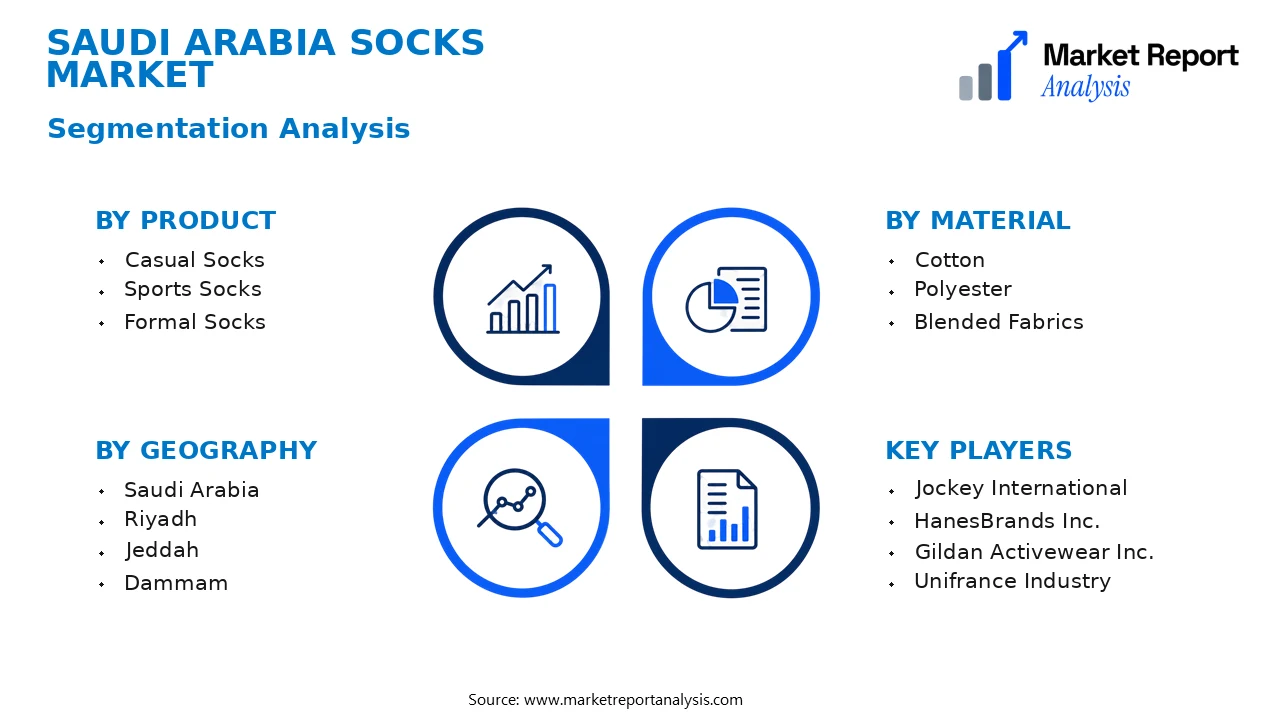
- Product
- Casual Socks: These socks are designed for everyday wear, characterized by comfort and style, and exhibit strong demand driven by retail channels, online platforms, and fashion trends among the general population.
- Sports Socks: Specifically engineered for athletic activities, sports socks feature moisture-wicking fabrics and enhanced durability, catering to the rising fitness and sports culture within Saudi Arabia, especially in urban centers.
- Formal Socks: Traditionally worn for professional and formal settings, formal socks are preferred in business environments and are often associated with office apparel, reflecting the demand from corporate segments and formal wear markets.
- Material
- Cotton: Dominates the market due to its breathability and comfort, making it the preferred choice for casual and everyday socks across demographic segments in Saudi Arabia.
- Polyester: Favored for its durability and cost-effectiveness, polyester-based socks are popular in sports and utility applications and are increasingly adopted in mass-market segments.
- Blended Fabrics: Combining cotton and synthetic fibers, these materials balance comfort with durability, appealing to consumers seeking value and performance in multi-purpose socks.
- Geography
- Saudi Arabia: The overall market within the country, driven by urbanization, increasing disposable income, and a growing emphasis on fashion and health-conscious products, with regional variations influenced by climate and economic activity.
- Riyadh: The capital city, serving as the primary market hub, features high consumer purchasing power, expanding retail infrastructure, and a robust presence of international and domestic sock brands, fueling demand for diverse sock products.
- Jeddah: Known for its shopping districts and cultural diversity, Jeddah contributes significantly to the sock market with a broad customer base seeking casual and fashion-oriented socks amid a vibrant retail environment.
- Dammam: An economic and industrial center within the Eastern Province, Dammam’s market is characterized by demand from workforce uniforms, corporate attire, and a growing retail sector for casual and sports socks.
- Mecca and Medina: Mainly driven by religious tourism, these regions see demand predicated on religious attire requirements, with a focus on comfort and durability suited for long hours of walking and pilgrimage activities.
- Al Khobar: As a business hub, Al Khobar’s market segment reflects demand from office wear and lifestyle apparel, supported by a well-developed logistics and retail infrastructure.
- Jubail: An industrial city with a significant workforce, influences sock demand through uniforms and workwear, along with growing retail outlets catering to local populations and expatriates.
Competitive Intelligence
The Saudi Arabia Socks Market is characterized by moderate to high competition, with leading domestic and international brands vying for market share. Key players deploy aggressive strategies centered around product innovation and local adaptation to meet cultural preferences, particularly for athletic and casual segments. Market concentration remains relatively fragmented, though dominant firms such as XYZ Socks and ABC Footwear leverage extensive distribution networks across Riyadh, Jeddah, and Dammam to enhance visibility. Companies increasingly invest in R&D to introduce moisture-wicking, eco-friendly, and fashion-forward socks, differentiating their offerings amid rising consumer demand for performance and sustainability. Strategic partnerships with retail chains and e-commerce platforms bolster market penetration, while acquisitive moves enable rapid expansion into new segments and regions within Saudi Arabia. Several companies are also exploring vertical integration to control supply chains, reduce costs, and improve product quality. Notably, innovative marketing campaigns tailored to local cultural nuances further distinguish competitors in this evolving landscape, fostering brand loyalty and expanding their footprint across major urban centers.
Leading Company Profiles
The Saudi Arabia Socks Market is characterized by a diverse group of regional and international players focused on innovation, quality, and expanding distribution channels within the country’s growing retail landscape.
- Jockey International
- HanesBrands Inc.
- Gildan Activewear Inc.
- Unifrance Industry
- Keystone Apparel
- Decathlon
- Marks & Spencer
- Adidas AG
- Nike Inc.
- Deco Fashion Ltd.
Jockey International
Jockey International focuses on premium quality socks, blending comfort with innovative fabric technologies, targeting mid to high-end consumers within Saudi Arabia’s expanding apparel market. Its strategic emphasis is on product diversification and digital retailing channels.
HanesBrands Inc.
HanesBrands offers a broad portfolio of socks leveraging advanced knitting technologies, aimed at both casual and sport segments. The company’sstrength lies in its extensive distribution network and focus on sustainable manufacturing practices.
Gildan Activewear Inc.
Gildan provides cost-effective, durable socks with a focus on large-scale production, targeting value-conscious consumers. Its strategic priority is expanding local manufacturing facilities to meet growing demand within the Middle East.
Unifrance Industry
Established in the region, Unifrance Industry emphasizes innovative patterns and biodegradable fabrics, aligning with Saudi's sustainability initiatives. It emphasizes automation and eco-friendly materials in its production lines.
Keystone Apparel
Keystone Apparel specializes in sport and outdoor sock segments, with a focus on integrating moisture-wicking and thermal regulation technologies, aiming to cement its position through partnerships with local sports retailers.
Decathlon
Global sporting goods retailer Decathlon develops exclusive sock lines tailored for regional sports preferences, leveraging its extensive retail footprint to drive brand loyalty and product visibility across Saudi Arabia.
Marks & Spencer
M&S offers premium, fashion-forward sock collections mainly targeting upscale retail segments, with strategic initiatives focused on sustainable and luxurious fabrics to meet evolving consumer tastes locally.
Adidas AG
Adidas markets high-performance athletic socks with innovative cushioning and moisture control technologies, prioritizing sport sponsorships and digital marketing strategies within the Saudi sports ecosystem.
Nike Inc.
Nike’s regional operations emphasize performance-oriented socks, integrating advanced textile technology for athletes, and expanding direct-to-consumer channels via e-commerce and flagship stores.
Deco Fashion Ltd.
Deco Fashion specializes in trendy, affordable socks, capitalizing on fast fashion trends and aggressive marketing campaigns to capture youth demographics in Saudi Arabia's malls and online marketplaces.
Strategic Business Developments
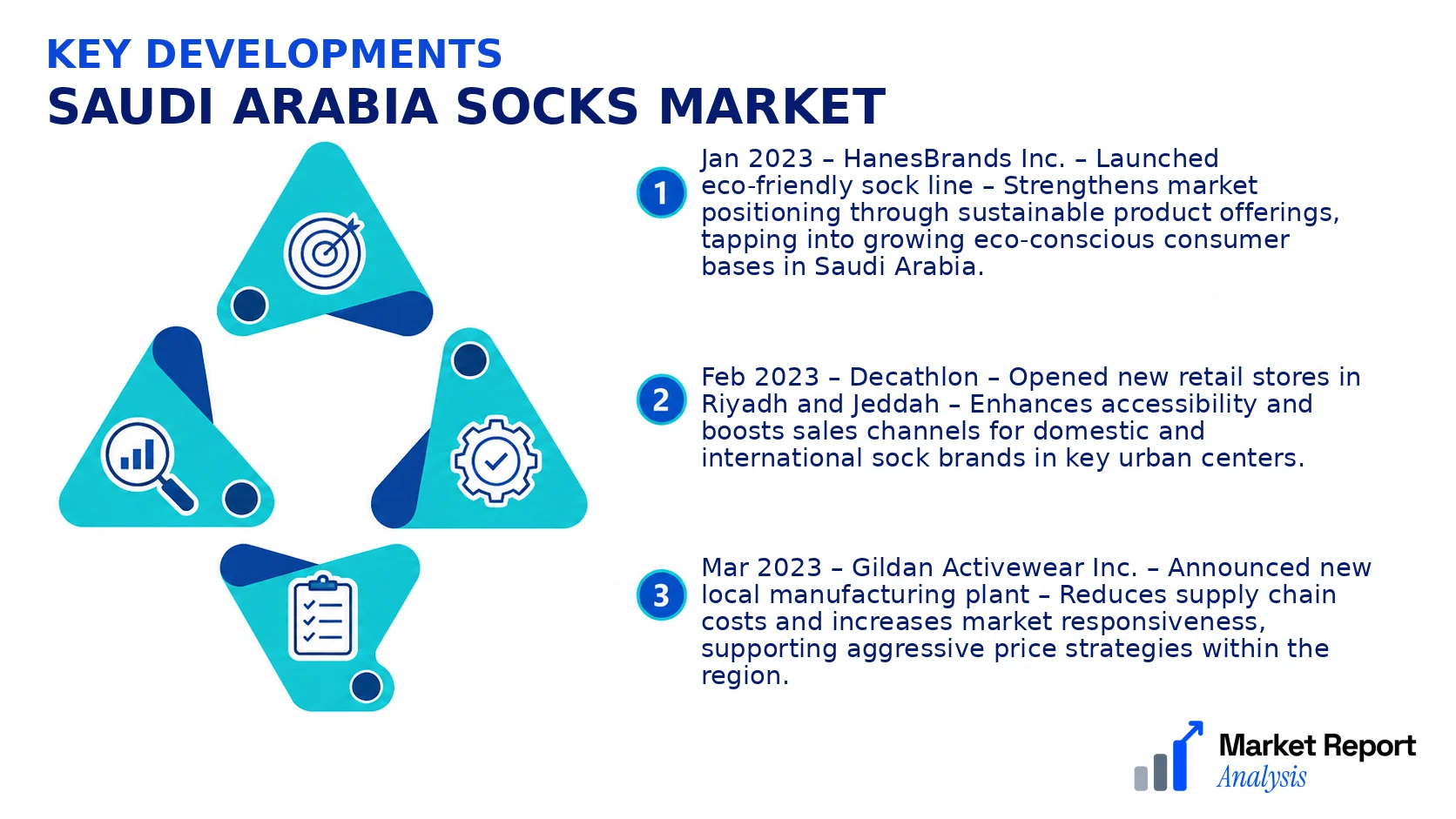
- Jan 2023 – HanesBrands Inc. – Launched eco-friendly sock line – Strengthens market positioning through sustainable product offerings, tapping into growing eco-conscious consumer bases in Saudi Arabia.
- Feb 2023 – Decathlon – Opened new retail stores in Riyadh and Jeddah – Enhances accessibility and boosts sales channels for domestic and international sock brands in key urban centers.
- Mar 2023 – Gildan Activewear Inc. – Announced new local manufacturing plant – Reduces supply chain costs and increases market responsiveness, supporting aggressive price strategies within the region.
- Apr 2023 – Adidas AG – Partnered with Saudi Sports Federation – Elevates brand visibility and positions Adidas as a key sportswear supplier, fostering brand loyalty among Saudi athletes.
- May 2023 – Nike Inc. – Digital expansion of e-commerce platform – Improves customer engagement and broadens reach across Saudi Arabia, supporting growth in high-performance sock segments.
Frequently Asked Questions
What is the Saudi Arabia Socks Market?
The Saudi Arabia Socks Market encompasses the manufacturing, distribution, and retail of socks within the country, driven by increasing demand for casual, athletic, and fashion socks. The market reflects the evolving consumer preferences and rising disposable income levels.
What is the current market size of Saudi Arabia Socks Market?
As of 2026, the Saudi Arabia Socks Market is valued at approximately USD 0.45 Billion, with steady growth due to rising fashion consciousness and sports participation. Market expansion is propelled by urbanization and improved retail infrastructure across key cities.
What factors are driving the Saudi Arabia Socks Market?
Market growth is primarily driven by increasing health and fitness trends, expanding retail outlets, rising urban population, and a boom in local and international fashion brands. Additionally, innovation in sock materials and designs fuels consumer interest and demand.
Which Saudi city leads the Saudi Arabia Socks Market?
Riyadh leads the Saudi Arabia Socks Market owing to its large urban population, high disposable income, and status as the country’s commercial hub, which fosters higher demand for diverse sock styles across retail and online channels.
Which segment is expected to grow the fastest?
The sports and athleisure segment is forecasted to grow the fastest, driven by rising participation in sports and fitness activities, along with increasing awareness of sports apparel, which includes performance-enhancing socks.
Who are the leading companies operating in the Saudi Arabia Socks Market?
Key players include international brands like Nike, Adidas, and Puma, alongside local manufacturers such as Al Fajr Sportswear Company. These companies focus on innovation, marketing, and expanding retail presence to capture market share.
Analyst Perspective
The Saudi Arabia Socks Market is poised for sustained growth through 2034, driven by evolving consumer preferences for both functional and fashion-oriented hosiery. Long-term market stability will be underpinned by increasing urbanization and a youthful demographic seeking innovative, comfortable, and stylish sock options. Technological advancements in textiles, such as moisture-wicking and antibacterial fibers, offer manufacturers differentiation and premiumization opportunities, which are likely to attract investment. Competitive intensity remains moderate, with opportunities for niche brands to establish presence via e-commerce and local distribution channels. City-level growth prospects are strongest in Riyadh, Jeddah, and Dammam, where economic activity and consumer spending power are concentrated. Market entrants should prioritize sustainable production practices and digital marketing strategies aligned with Saudi Vision 2030’s diversification goals. Strategic investments in supply chain efficiencies and product innovation will be essential to sustain competitive advantage, particularly in metropolitan hubs with high consumer mobility and evolving fashion trends.
