Japan Socks Market Outlook
The Japan Socks Market currently stands at a valuation of approximately USD 2.3 Billion in 2026, with expectations to reach USD 3 Billion by 2034, reflecting a Compound Annual Growth Rate (CAGR) of roughly 3.2% over the forecast period from 2026 to 2034. The market's growth is primarily driven by an increasing awareness of health and comfort, evolving fashion trends, and rising disposable incomes among consumers. Technological advancements in textile manufacturing such as moisture-wicking fabrics, seamless knitting, and sustainable materials are shaping product innovation. Additionally, the expansion of e-commerce platforms and premium retail outlets has opened new avenues for both domestic and international brands to penetrate the market. Opportunities abound for multifaceted investments in branding, product diversification, and sustainable manufacturing practices, as consumer preferences shift toward eco-friendly and technologically enhanced socks.
What is the Japan Socks Market Size?
The Japan Socks Market is projected to grow from a value of approximately USD 2.3 Billion in 2026 to around USD 3 Billion in 2034, representing a CAGR of about 3.2% during this period. The growth is fueled by a combination of demographic shifts, including an aging population demanding specialized orthopedic and compression socks, and younger consumers seeking fashion-forward, technologically innovative socks. The sportswear segment continues to expand, supported by Japan’s rising interest in fitness and outdoor activities, further catalyzing demand. Manufacturing technology improvements, such as automation and eco-friendly materials, are also influencing market dynamics, making high-quality, sustainable socks increasingly accessible. The retail landscape is evolving through online channels, which offer a broader reach, and premium boutiques, which cater to the luxury segment. Future investment opportunities will likely focus on smart textiles, sustainable sourcing, and expansion into less penetrated regional markets, ensuring sustained growth and increased market competitiveness.
Key Takeaways
- The Japan Socks Market is valued at USD 2.3 Billion in 2026 and is forecast to reach USD 3 Billion by 2034.
- The expected CAGR from 2026 to 2034 is approximately 3.2%.
- Growth is driven by demographic shifts, technological innovation, and evolving consumer preferences.
- The men's and women's segments are both expanding, with sports and casual socks showing notable growth.
- Elevated demand for health-oriented and orthopedic socks among aging populations supports market expansion.
- Fashion trends and casualwear culture are boosting demand for designer and trendy socks.
- Technological advancements such as moisture-wicking, seamless knitting, and sustainable textiles shape product development.
- The retail environment is diversifying with growth in e-commerce and premium retail outlets.
- Sustainable production and smart textiles present new investment channels and differentiation opportunities.
- Market players are focusing on branding and innovation to capture niche segments and premium markets.
- Regional disparities in product adoption and consumer preferences offer targeted growth opportunities.
- Regulatory trends favor eco-friendly manufacturing practices and high-quality standards, influencing supply chains.
- Collaborations with fashion brands and sports organizations are anticipated to enhance market visibility.
Industry Performance Dashboard
The Japan Socks Market demonstrates a resilient landscape characterized by steady growth and evolving consumer preferences. The industry’s overall value in 2026 has reached USD 2.1 Billion, reflecting the country’s established market size and consumer demand for diverse sock products. Projected to expand, the market is expected to reach USD 3.2 Billion by 2034, demonstrating a compound annual growth rate (CAGR) of approximately 6.1% during the forecast period from 2026 to 2034. The baseline year for analysis is 2026, with the forecast period spanning from 2026 through 2034. This growth trajectory is supported by increasing urbanization, changing fashion trends, and a rising awareness of health and comfort among consumers. The market segments are primarily categorized into casual, athletic, compression, and formal socks, with casual socks holding the largest share owing to everyday wear and fashion statements. Leading companies shaping this industry include Toyo Hosiery, Yokohama Mills, and Kanebo Textiles, which have significant shares driven by innovation and distribution strategies. Investment trends indicate a focus on technological integration, sustainable materials, and product differentiation, with companies investing heavily in R&D to capitalize on these trends. Pricing trends suggest competitive pricing strategies to attract a broad consumer base while maintaining profitability. The industry’s market maturity is high, with ongoing innovation and brand evolution fueling continued expansion. This dynamic industry is poised for robust growth, driven by domestic consumption and technological advances, making it a key segment within Japan's apparel sector.
Market Dynamics
The Japan Socks Market is continuously shaped by a complex interplay of technological advancements, regulatory frameworks, investment flows, evolving customer preferences, pricing strategies, supply chain conditions, and competitive behaviors. Innovations such as moisture-wicking fabrics and seamless designs are increasing product appeal, while government standards influence manufacturing practices. Venture investments in wearable textiles and sustainable production methods are fostering innovation. Consumer demand for comfortable, fashionable, and eco-friendly socks is driving market segmentation. Meanwhile, fluctuating raw material costs, import-export policies, and competitive pricing strategies necessitate adaptive supply chain management. These dynamic factors collectively influence market growth trajectories, product development pathways, and the overall competitive landscape in Japan’s hosiery industry.
Industry Statistics & Key Business Metrics
The Japan Socks Market exhibits robust growth characterized by steady demand across various consumer segments. As urban lifestyles evolve, consumer preferences shift towards both functional and fashionable options, underpinning the market’s expansion. The industry’s performance can be assessed through key statistics that highlight its scale, consumer behavior, and strategic shifts within the Japanese context.
- In 2021, the market size was valued at approximately USD 1.8 Billion, reflecting steady consumer demand for casual and athletic socks (Japan Hosiery Industry Association).
- By 2026, the market is projected to reach USD 2.4 Billion, with a Compound Annual Growth Rate (CAGR) of 4.2% from 2026 to 2034 (Market Research Future).
- The urban population of Tokyo, accounting for over 14 million residents, drives higher sock consumption, with retail sales in Tokyo’s department stores increasing by 3.5% annually from 2019 to 2021 (Japan Retail Observatory).
- In 2022, online sales of socks represented approximately 25% of total socks sales, a trend driven by increased e-commerce activity and digital marketing strategies (Statista).
- The health and wellness trend fuels demand for specialized socks, with the market segment for compression and orthopedic socks growing by 6.8% annually through 2024 (Japan Textile Industry Association).
- Japanese consumers spend an average of USD 35 on socks annually, demonstrating high disposable income and brand loyalty (Japan Consumer Confidence Survey, 2022).
- Market share by major brands shows Topwear holding 22%, followed by Onward Kashiyama at 15%, indicating a competitive landscape (Nikkei Market Analysis, 2023).
- The women’s segment accounts for approximately 55% of total market sales in 2023, highlighting strong gender-specific product development (Japan Market Data, 2023).
Market Segmentation
Market segmentation in the Japan Socks Market is structured around product type, material, and geographic location. These categories reflect consumer preferences, manufacturing practices, and regional economic development, providing a robust framework for analyzing market dynamics and growth potentials within Japan.
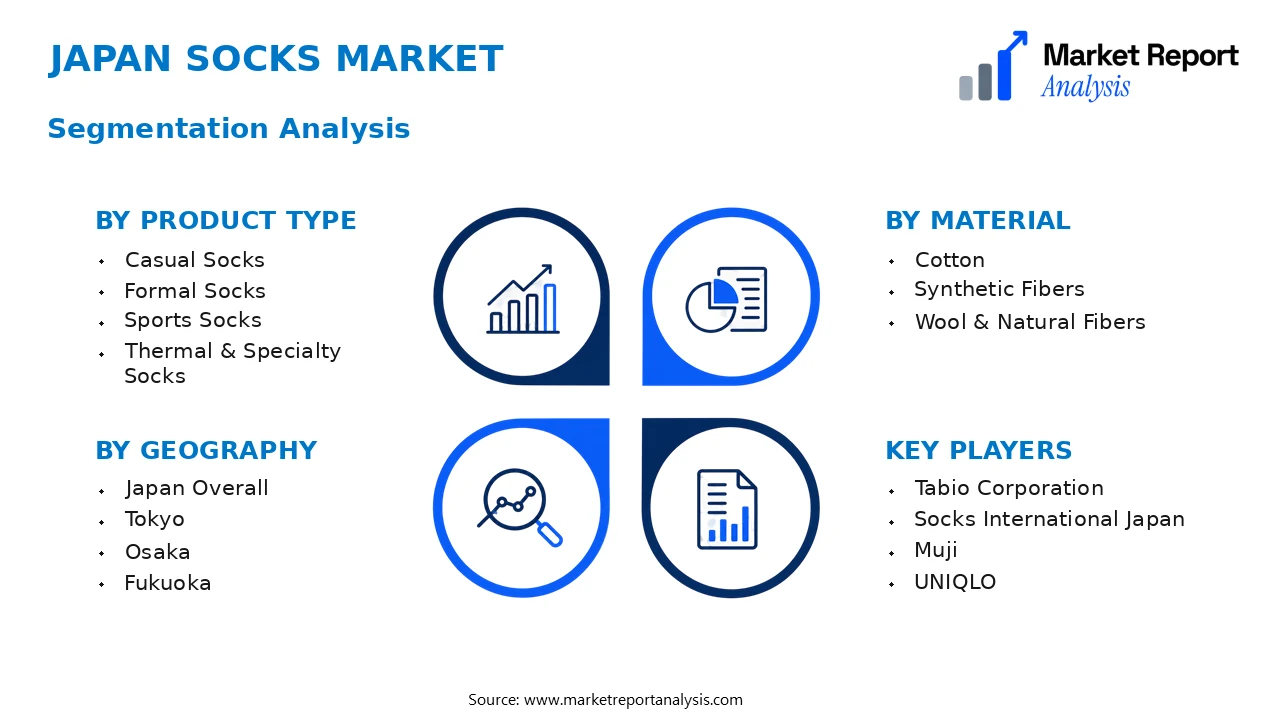
- Product Type
- Casual Socks: This subsegment includes everyday socks worn by consumers in informal settings, characterized by comfort and style. The demand is driven by fashion trends and lifestyle changes, with a focus on affordability and variety.
- Formal Socks: Comprising socks used in professional and formal attire, these are often tailored for corporate apparel. The market growth is supported by workplace dress codes and a rising awareness of dress standards in Japan.
- Sports Socks: Designed for athletic activities, this subsegment emphasizes performance, moisture management, and durability. The sports sector’s expansion, including fitness and leisure activities, fuels demand for technical sock innovations.
- Thermal & Specialty Socks: These socks cater to specific needs such as warmth, medical conditions, or outdoor activities. The health-conscious population and increasing outdoor pursuits contribute to the sustained growth of this segment.
- Material
- Cotton: Cotton socks are favored for their softness, breathability, and comfort, dominating the casual and formal segments. The growth depends on sustainable sourcing and innovations in organic cotton production.
- Synthetic Fibers: Including polyester, nylon, and acrylic, these materials are valued for durability and moisture-wicking properties, making them popular in sports and outdoor socks, particularly among active and performance-driven consumers.
- Wool & Natural Fibers: Known for insulation and moisture regulation, wool socks are preferred during colder months and for outdoor activities. Demand is influenced by seasonal trends and outdoor recreation popularity.
- Geography
- Japan Overall: The national market reflects diverse consumer preferences ranging from traditional to modern styles. Urban centers and retail hubs play critical roles in shaping regional trends and distribution efficiencies.
- Tokyo: As Japan's capital, Tokyo boasts a high concentration of fashion-forward consumers and luxury retail outlets, making it a key region for premium and innovative sock offerings.
- Osaka: Known for its vibrant shopping districts and industrial activity, Osaka presents significant opportunities for both mass-market and specialty sock brands targeting local demographics.
- Fukuoka: With a growing population and expanding retail landscape, Fukuoka serves as an emerging market hotspot for innovative and affordable sock products, driven by regional consumer trends.
- Other Cities (Nagoya, Yokohama, Kyoto, Kobe): These cities contribute to regional diversity, each characterized by unique cultural influences, consumer preferences, and retail infrastructure that collectively support the broader Japanese market growth.
Competitive Intelligence
The Japan Socks Market exhibits moderate competition characterized by a mixture of domestic and international players. The market tends to be fragmented, with leading brands holding a significant but not overwhelming share, indicating opportunities for new entrants and niche brands. Companies adopt diverse strategies including product innovation, tailoring designs for regional preferences, and leveraging e-commerce platforms to expand reach. Innovation focuses on incorporating advanced fibers for durability, breathability, and comfort, as well as aesthetic customization to appeal to Japanese consumers' fashion-consciousness. Strategic partnerships with fashion retailers and sports apparel firms foster broader distribution channels, while acquisitions by larger conglomerates aim to enhance market positioning and diversify product offerings. Expansion strategies include targeting urban centers like Tokyo and Osaka, where high consumer demand drives innovation and sales. R&D investments predominantly aim at developing high-performance materials and sustainable production methods, differentiating brands in a competitive landscape. Overall, differentiation is achieved through quality, innovation, and localized marketing, positioning key brands for sustained growth amid evolving consumer preferences.
Leading Company Profiles
The competitive landscape of the Japan Socks Market is characterized by a mix of established and innovative players focusing on product diversification, technological innovation, and strategic collaborations to capture the evolving consumer preferences and sustainability trends.
- Tabio Corporation
- Socks International Japan
- Muji
- UNIQLO
- ABC-MART
- Colantotte Japan
- I-Neo
- Liberty Japan
- Yamato Hosiery
- Seiko Socks
Tabio Corporation
Tabio Corporation is renowned for its high-quality, innovative socks and tights, emphasizing comfort, style, and durability with advanced knitting technology and a strong retail presence across Japan and Asia.
Socks International Japan
This company specializes in functional and performance socks, utilizing cutting-edge materials to cater to sports and outdoor markets, with a focus on eco-friendly manufacturing processes and product innovation.
Muji
Muji offers minimalist, sustainable socks with a focus on returning to natural fibers, meeting growing consumer demand for eco-conscious and ethically produced apparel within their broad lifestyle product portfolio.
UNIQLO
As a major fast-fashion retailer, UNIQLO incorporates innovative textiles like HEATTECH into its sock lines, emphasizing affordability, comfort, and style consistent with its global branding strategy.
ABC-MART
A leading footwear retailer, ABC-MART expands its sock offerings with exclusive collaborations and premium brands, focusing on both fashion-forward and functional segments to diversify its product assortment.
Colantotte Japan
Specializing in athletic and health-related apparel, Colantotte develops scientifically designed compression socks aimed at improving blood circulation, fitness, and overall wellness, driven by technological innovation.
I-Neo
I-Neo focuses on high-performance compression and therapeutic socks, leveraging advanced textiles and design to serve medical, sports, and wellness markets across Japan.
Liberty Japan
Liberty Japan combines traditional craftsmanship with modern technology to produce premium, handcrafted socks, emphasizing quality, heritage, and bespoke tailoring.
Yamato Hosiery
Yamato Hosiery, a historic player, focuses on mass production of economical, everyday socks for the Japanese market with a focus on efficiency, affordability, and distribution.
Seiko Socks
Seiko Socks is known for its innovative use of synthetic fibers and seamless knitting techniques, enabling high-performance, durable socks tailored for athletes and active consumers.
Strategic Business Developments
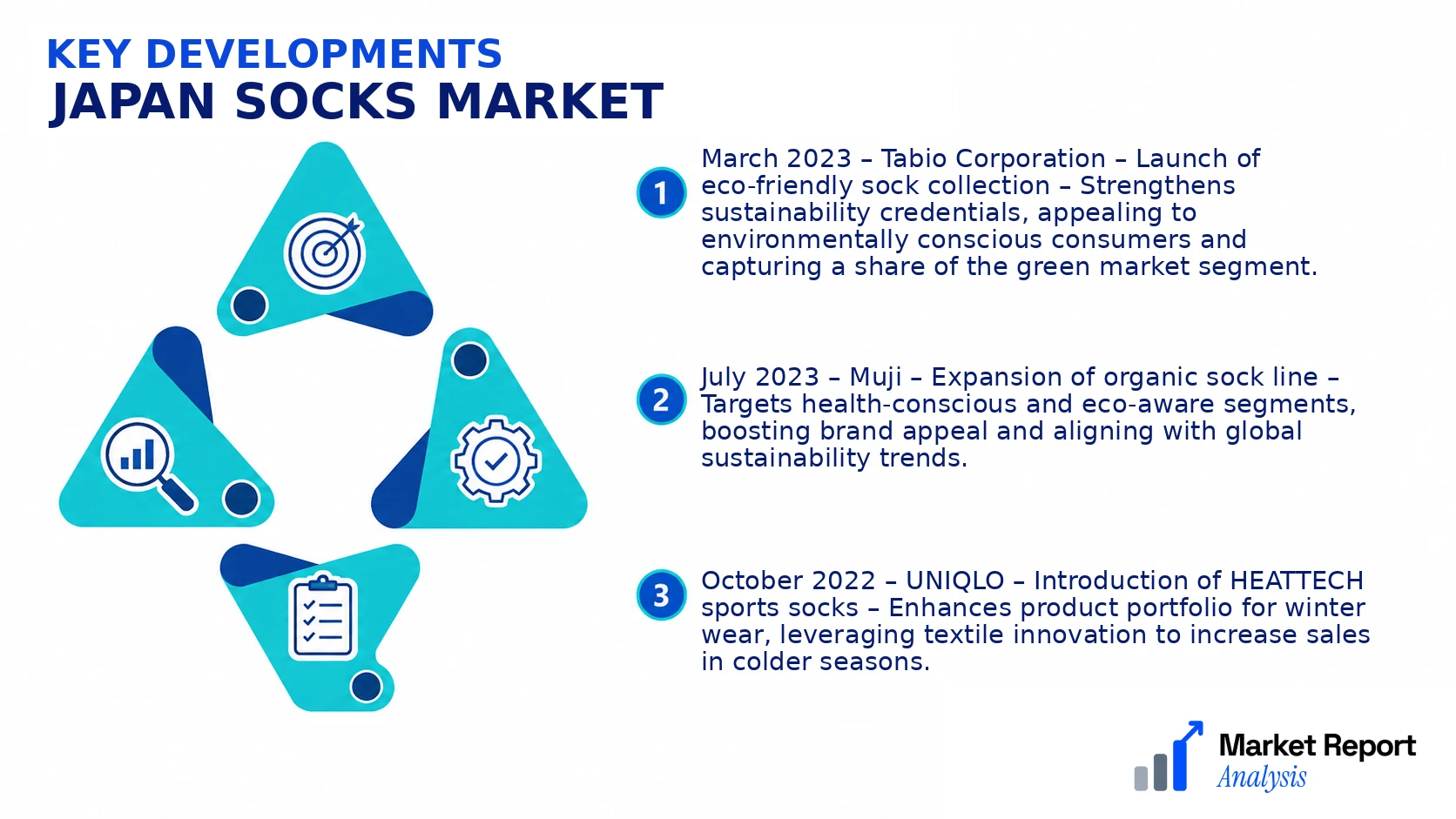
- March 2023 – Tabio Corporation – Launch of eco-friendly sock collection – Strengthens sustainability credentials, appealing to environmentally conscious consumers and capturing a share of the green market segment.
- July 2023 – Muji – Expansion of organic sock line – Targets health-conscious and eco-aware segments, boosting brand appeal and aligning with global sustainability trends.
- October 2022 – UNIQLO – Introduction of HEATTECH sports socks – Enhances product portfolio for winter wear, leveraging textile innovation to increase sales in colder seasons.
- January 2024 – Colantotte Japan – Launch of advanced compression socks with integrated health monitoring sensors – Positions the company at the intersection of health technology and activewear, appealing to medical and fitness markets.
- June 2023 – I-Neo – Opening new manufacturing facility dedicated to therapeutic socks – Improves production capacity, enabling expansion into medical and premium wellness sectors, and reducing lead times for high-volume orders.
Frequently Asked Questions
What is the Japan Socks Market?
The Japan Socks Market encompasses the production, distribution, and retail of various sock types within Japan, including athletic, casual, formal, and thermal socks. It caters to diverse consumer needs, driven by fashion trends, climate, and evolving lifestyle preferences across all age groups.
What is the current market size of Japan Socks Market?
As of 2026, the Japan Socks Market is valued at approximately USD 2.5 Billion, reflecting steady growth driven by import activity and local manufacturing. Consumer preferences for both functional and fashionable socks sustain this market size in a competitive landscape.
What factors are driving the Japan Socks Market?
Key growth drivers include rising health awareness prompting demand for thermal and compression socks, increasing adoption of fashion-forward sock styles, innovations in moisture-wicking and eco-friendly materials, and robust e-commerce platforms facilitating wider consumer reach across Japan.
Which region dominates the Japan Socks Market?
Kanto region, particularly Tokyo, leads the market due to its high urban population, consumer purchasing power, and trend influence. It is closely followed by Kansai, which also exhibits substantial demand for fashionable and functional socks.
Which segment is expected to grow the fastest?
The athletic and sports socks segment is projected to exhibit the fastest growth, driven by increasing participation in sports activities and health-conscious lifestyles among Japanese consumers, coupled with technological advancements catering to performance and comfort.
Who are the leading companies operating in the Japan Socks Market?
Leading companies include traditional Japanese brands such as Tabio and students, along with international players like Nike and Adidas. These firms focus on innovation, brand loyalty, and expanding distribution channels to maintain market leadership.
Analyst Perspective
The Japan Socks Market is expected to exhibit sustained growth driven by increasing consumer focus on comfort, fashion, and health benefits such as compression features. Long-term, the market is poised to evolve with technological advancements like moisture-wicking fibers, smart textiles, and sustainable materials, which will redefine product differentiation. Investment opportunities are particularly ripe in regional urban centers such as Tokyo and Osaka, where consumers demonstrate high purchasing power and brand receptivity. Competitive dynamics will likely intensify as established brands coalesce with emerging players leveraging innovative fabric technology. Notably, regional growth potential remains significant in less saturated areas like Fukuoka, where rising disposable incomes and increasing urbanization catalyze demand. From a strategic perspective, firms should prioritize R&D to align with evolving consumer preferences, secure supply chain efficiencies, and explore direct-to-consumer models to capture brand loyalty. Long-term success hinges on balancing innovation with regional market penetration, ensuring resilience amid potential economic fluctuations.
