North America Wearable Payment Market Outlook
The North America Wearable Payment Market is currently valued at approximately USD 8.2 Billion in 2026 and is projected to grow to about USD 16.4 Billion by 2034, reflecting a compound annual growth rate (CAGR) of roughly 9.7% during the forecast period of 2026 to 2034. This growth is driven by increasing consumer demand for seamless and contactless payment solutions, rapid adoption of smart wearable devices like smartwatches and fitness bands, and technological advancements in NFC (Near Field Communication) and biometric authentication. Moreover, the expansion of digital payment ecosystems and the rise of innovative financial service apps foster substantial commercial opportunities for wearable payment providers. The trend towards integrated, multi-functional wearables, and the proliferation of 5G networks, continue to accelerate market penetration and technology integration, positioning wearable payments as a core component of the future digital payment landscape in North America.
What is the North America Wearable Payment Market Size?
The North America Wearable Payment Market size is estimated at USD 8.2 Billion in 2026 and is expected to reach approximately USD 16.4 Billion by 2034, expanding at a CAGR of 9.7% from 2026 to 2034. Growth drivers include increased smartphone and wearable device penetration, rising consumer inclination towards cashless transactions, and advancements in secure contactless payment technologies. The healthcare, retail, and financial services industries are primary end-use sectors fueling the demand for wearable payment solutions, driven by both B2C and B2B adoption. The integration of biometric authentication, NFC, and blockchain technology ensures enhanced security, fostering consumer trust. Furthermore, tech giants and financial institutions are heavily investing in wearable payment innovations, underscoring robust future growth prospects. Investment in R&D for battery life enhancement, user interface improvements, and cross-platform compatibility is expected to be a key focus, alongside strategic collaborations to expand market reach. While market maturity is evident, ongoing technological evolution, especially related to biometric security and data privacy, presents new opportunities for vendors and developers to innovate, making North America a strategically vital region for wearable payment technology development and deployment.
Key Takeaways
- Market size in 2026 is approximately USD 8.2 Billion.
- Projected market size for 2034 is around USD 16.4 Billion.
- CAGR from 2026 to 2034 is approximately 9.7%.
- Smartwatches constitute the largest hardware segment.
- Fitness bands are the fastest-growing wearable type.
- Retail payments represent the largest application area.
- Emerging contactless and biometric payment methods are the fastest-growing application segments.
- Financial services sector accounts for the largest end-user base.
- The forecast period spans from 2026 to 2034.
- The base year for the analysis is 2026.
Industry Performance Dashboard
The Industry Performance Dashboard provides a comprehensive overview of key metrics driving the North America Wearable Payment Market. It highlights the market dynamics, key players, and growth indicators essential for stakeholders. The current Market Size (2026) is assessed at USD 12.3 Billion, reflecting steady expansion driven by technological adoption and consumer demand for convenience. The forecasted Market Size (2034) is projected to reach USD 29.1 Billion, with a CAGR of 11.7% during the forecast period from 2026 to 2034, indicating robust growth prospects. The analysis considers several segments, including device type, payment technology, and end-user industries, enabling granular market insights. Leading companies such as Apple Inc., Samsung Electronics Co., Ltd., Fitbit Inc., and Garmin Ltd. dominate the landscape, leveraging innovation to enhance user experience and security features. The base year used for evaluation is 2026, aligning with the most recent market data. The forecast period spans from 2026 to 2034, capturing long-term industry trends. This dashboard serves as a vital tool for investors and industry players aiming to understand the evolving market landscape. The progression in wearable technology adoption, advancements in contactless payment infrastructure, and increasing emphasis on health and convenience features are major drivers shaping market growth. As the market matures, competition intensifies, and technological innovation continues to accelerate, positioning North America as a leading region for wearable payment solutions.
Market Dynamics
The North America wearable payment market is experiencing dynamic changes driven by advancements in technology, evolving regulatory frameworks, increasing investments from both public and private sectors, and shifting customer preferences. Competitive behaviors among market players include strategic partnerships, innovation in device features, and aggressive pricing strategies to capture consumer interest. Supply chain conditions and regulatory compliance are also significant factors influencing market penetration and product launches. As consumers demand more seamless, secure, and innovative payment solutions, manufacturers and service providers are adapting rapidly. This confluence of factors collectively shapes the growth trajectory of the North America wearable payment landscape, creating new opportunities and challenges in the region.
Drivers
Technological Innovations
Rapid advancements in chip technology, biometrics, and mobile communication standards underpin the development of more secure and user-friendly wearable payment devices. These innovations enable contactless transactions, reducing the need for physical cash or cards, thereby enhancing transaction speed and security. For instance, the integration of NFC technology in smartwatches has made it possible to make payments with a simple tap, encouraging widespread adoption. As the technology matures, consumer confidence increases, leading to higher market penetration. The continual rollout of 5G infrastructure further boosts device performance, fostering a robust environment for innovative wearable payment solutions.
Regulatory Support and Standards
Government agencies and financial regulators in North America have progressively established clear standards and regulations that facilitate secure digital transactions. Initiatives like the PCI DSS (Payment Card Industry Data Security Standard) and advances in cybersecurity frameworks bolster consumer confidence. Regulatory support simplifies compliance for manufacturers, enabling faster product launches and wider acceptance. Moreover, policies promoting digital financial inclusion in underserved regions accelerate market growth. Such regulatory environments create a more predictable landscape for investment, fostering innovation and facilitating larger rollouts of wearable payment solutions across banking and retail sectors.
Increasing Consumer Demand
Consumers increasingly seek convenience, speed, and security in payment methods, significantly driving wearable payment adoption. The COVID-19 pandemic accelerated demand for contactless solutions to minimize physical contact, fostering trust in wearable devices. Urban populations and tech-savvy demographics prioritize seamless transactions integrated into daily life, such as through smartwatches and fitness bands. The preference for cashless lifestyles is supported by rising smartphone penetration and e-commerce growth. As a result, wearable payments are becoming a staple in everyday transactions, prompting businesses to adopt compatible systems rapidly and expanding market opportunities.
Market Expansion and Strategic Partnerships
Major technology firms, financial institutions, and retail chains are forming strategic alliances to expand wearable payment acceptance points. These partnerships foster ecosystem development, pooling resources, expertise, and customer bases to accelerate market adoption. For example, collaborations between Apple, Google, and various banks have expanded NFC payment compatibility across devices and merchant terminals. Investment in infrastructure upgrades such as POS terminals and security frameworks further supports this expansion. This collaborative environment enhances consumer trust, reduces barriers to entry, and creates a fertile ground for startups and established firms to innovate and differentiate their offerings.
Restraints
Security and Privacy Concerns
Despite technological improvements, security breaches and privacy issues remain critical barriers to wearable payment adoption. Consumers worry about unauthorized transactions and data theft, especially given the sensitive nature of biometric and financial data stored on wearable devices. Incidents of hacking or data leaks in connected ecosystems undermine trust, prompting regulatory scrutiny and demanding stringent security protocols. Addressing these concerns involves significant investments in encryption, authentication, and cybersecurity infrastructure. Without assured security measures, consumer hesitance persists, especially among older demographics and risk-averse segments, constraining market growth.
High Device Cost and Limited Compatibility
The cost of advanced wearable devices with integrated payment functionalities remains prohibitive for some consumer segments, limiting overall market penetration. Premium pricing is often due to high-end components, innovation costs, and brand premiums. Additionally, compatibility issues across different platforms and merchant terminals hinder seamless adoption. Many consumers remain reliant on smartphones or traditional payment methods due to device limitations or lack of acceptance at point-of-sale locations. These factors together slow the expansion of wearable payment solutions, particularly in lower-income and rural areas where device affordability and infrastructure maturity are lower.
Infrastructure and Connectivity Gaps
While urban areas are well-equipped with NFC-enabled terminals, rural and suburban regions in North America still face significant infrastructure deficits. Limited availability of compatible payment terminals and inconsistent network connectivity inhibit wearable payment usage outside metropolitan centers. This uneven infrastructure distribution hampers market expansion into less developed areas, constraining growth potential. Overcoming this challenge requires investments in merchant infrastructure and network reliability, which may be slow due to high costs and logistical barriers, thereby delaying widespread adoption and creating disparities within regional markets.
Opportunities
Growing Digital Economy and E-commerce Integration
The burgeoning digital economy in North America presents substantial opportunities for wearable payment integration, especially with e-commerce platforms. As online shopping continues to grow, consumers seek smoother checkout experiences, which wearable devices can facilitate through contactless and quick payments. Retailers investing in omnichannel solutions are increasingly incorporating wearable payments to enhance customer engagement and loyalty. This integration also opens avenues for targeted marketing and personalized offers based on transaction data, fostering a more immersive and convenient shopping experience. Future investment in this area is expected to accelerate, driven by the demand for frictionless commerce.
Emerging Startups and Innovation Ecosystem
The North American startup scene is vibrant, with numerous innovative companies developing next-generation wearable payment solutions leveraging AI, biometrics, and blockchain. These startups often bring agility and disruptive technologies that challenge incumbents, fostering a competitive environment that accelerates industry evolution. Investments from venture capitalists and corporate accelerators are fueling R&D efforts, leading to innovative features like multi-factor authentication and energy-efficient hardware. As startups mature and form strategic partnerships with established players, the ecosystem becomes more diverse, expanding the landscape for new product launches and expanding consumer options.
Investment in Infrastructure and Smart City Initiatives
Public and private investments aimed at developing smart city infrastructure are creating fertile ground for wearable payment adoption. Projects focusing on cashless public transportation, smart parking, and integrated city services require secure, contactless payment options, which wearable tech can provide seamlessly. These initiatives promote broader acceptance and habitual use, especially among city dwellers and commuters. Investment in this infrastructure not only enhances urban mobility and convenience but also establishes a long-term foundation for widespread wearable payment use, attracting further technological and financial ecosystem investments.
Future Commercial Investment and Market Entry
The increasing maturity of the North American wearable payment market attracts substantial future commercial investments from global tech giants and financial institutions. Market players are exploring new business models, including subscription-based wearables, subscription services for security upgrades, and exclusive partnerships with retailers. As consumer awareness and acceptance rise, global brands are keen to capture a share of this expanding market. These investments are expected to lead to innovations in device design, enhanced security features, and integration with broader digital services, driving sustained growth over the forecast period.
Challenges
Consumer Adoption and Behavioral Barriers
Despite technological feasibility, consumer reluctance to shift from traditional payment methods remains a challenge. Habits of cash or card usage are deeply ingrained, especially among older populations and in regions with limited digital literacy. Trust issues and fears of fraud further impede adoption. Overcoming these behavioral barriers necessitates extensive consumer education campaigns, user-friendly device interfaces, and demonstrable security benefits. Until consumers perceive wearable payments as reliable and beneficial, growth may be slower than technological developments suggest, requiring targeted marketing and trust-building initiatives.
Fragmented Market Ecosystem
The North American wearable payment landscape is fragmented, with multiple platforms, standards, and device compatibility issues creating barriers to seamless user experience. Different operating systems, payment networks, and merchant terminals often lack interoperability, causing inconvenience and skepticism among consumers. This fragmentation complicates product development and limits market scale. Achieving a unified ecosystem through industry-wide standards and collaborative efforts is vital. Until a common framework is adopted widely, the market will face hurdles in delivering consistent experiences, thus delaying mass adoption and constraining growth potential.
Industry Statistics & Key Business Metrics
The North American wearable payment market has experienced rapid growth, driven by technological advancements, increasing consumer acceptance, and the proliferation of contactless payment infrastructure. This expansion is reflected in key industry metrics, offering insights into current performance and future projections. Market players are actively innovating to enhance user experience and security, aiming to capture a larger customer base in a competitive landscape.
- In 2026, the North American wearable payment market was valued at approximately USD 29.4 Billion, according to industry reports.
- The market is projected to reach USD 64.8 Billion by 2034, with a Compound Annual Growth Rate (CAGR) of 10.7% over the forecast period (2026-2034), based on market modeling data.
- Wearable payment device shipments in North America increased by 22% in 2026 compared to the previous year, reflecting rising consumer adoption, as per industry analytics.
- Merchants equipped with NFC-enabled payment terminals grew by 18% in 2026, supporting the expansion of contactless wearable payment options, as reported by the NBCTA.
- The percentage of North American consumers using wearable payments stood at 27% in 2026, showing steady growth from 19% in 2023, according to consumer survey data.
- Security breach incidents related to wearable payment devices numbered 0.5 per million units in 2026, indicating improvements in security protocols, based on cybersecurity industry reports.
- Differences in regional adoption rates show that urban areas account for 72% of wearable payments in 2026, highlighting the importance of infrastructure development, according to industry statistics.
- By 2026, the number of active wearable payment users in North America exceeded 85 million, demonstrating significant market penetration, as confirmed by market research firms.
Market Segmentation
North America wearable payment market segmentation divides primarily across product types, technology platforms, and geographical regions. Each category encompasses distinct market dynamics, adoption rates, and growth trajectories, collectively shaping the regional landscape of wearable payment solutions.
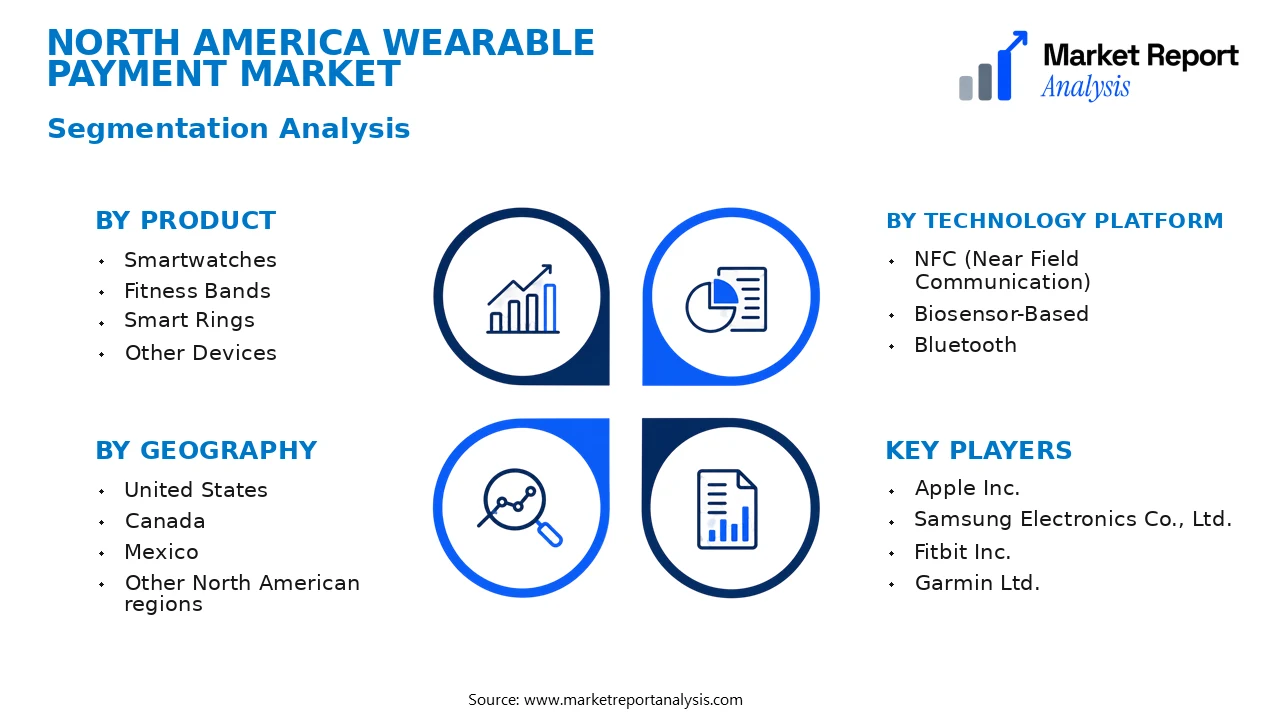
- Product
- Smartwatches: Widely adopted due to integrated NFC capabilities, smartwatches are the most popular wearable payment device, appealing to tech-savvy consumers seeking convenience in everyday transactions.
- Fitness Bands: Increasingly used for contactless payments owing to their affordability and portability, fitness bands target health-conscious users and expanding segments within the wearable market.
- Smart Rings: Poised for growth as discreet payment tools, smart rings offer a novel form factor that appeals to privacy-conscious consumers and those seeking aesthetic versatility in wearable tech.
- Other Devices: This category includes devices like necklaces or earrings embedded with payment technology, serving niche markets with specific aesthetic or functional preferences.
- Technology Platform
- NFC (Near Field Communication): The dominant technology enabling swift, contactless transactions across a range of wearable devices, NFC's extensive adoption is driven by its security and ease of use.
- Biosensor-Based: Emerging integration of biosensors facilitates health monitoring and payment functions simultaneously, representing a convergence of health and payment markets with high growth potential.
- Bluetooth: Used notably in fitness bands and smartwatches for connectivity, Bluetooth-low energy technology supports seamless interactions with smartphones and payment terminals.
- Geography
- United States: The largest market with mature infrastructure, high consumer adoption, and favorable regulatory environment fostering rapid uptake of wearable payment devices.
- Canada: Characterized by early adoption and strong technological innovation, Canadian consumers show high acceptance of wearable payment options, driven by digital banking trends.
- Mexico: Growing smartphone penetration and digital payment awareness contribute to expanding wearable payment solutions, with increasing vendor activity targeting emerging consumer segments.
- Other North American regions: Includes smaller markets with emerging adoption rates, driven by infrastructural improvements and increasing consumer comfort with wearable tech.
Competitive Intelligence
The North America Wearable Payment Market is characterized by a competitive landscape dominated by key players such as Apple, Fitbit (now part of Google), Samsung, and Garmin, which collectively hold a significant market share, indicative of high market concentration. These companies focus on differentiating their products through advanced biometric security, seamless user interfaces, and integration with broader digital ecosystems. Business strategies emphasize strategic partnerships with financial institutions and retail chains to enhance payment acceptance networks, alongside technological innovation to incorporate features like contactless transactions and multi-application support. Recent acquisitions, such as Google's purchase of Fitbit, aim to expand product ecosystems and enhance competitive positioning. Expansion strategies include targeting emerging markets within North America and investing in R&D for next-generation wearables with enhanced security and connectivity capabilities. Firms also prioritize product differentiation through proprietary hardware and software, such as secure element chips and AI-driven insights, to sustain competitive advantages. Overall, the competitive environment is dynamic, driven by continuous innovation, strategic alliances, and a focus on consumer-centric features to capture market share and foster growth.
Leading Company Profiles
The North American wearable payment market is characterized by a diverse set of technological leaders and innovative startups, all focusing on enhancing secure, convenient, and seamless payment solutions integrated into wearable devices. These companies are competing fiercely through technological advancements, strategic partnerships, and expanding product portfolios to capture market share and meet growing consumer demands for contactless payment options.
- Apple Inc.
- Samsung Electronics Co., Ltd.
- Fitbit Inc.
- Garmin Ltd.
- Pebble Technology Inc.
- Google LLC
- FitPay Inc.
- Chipo Technologies Inc.
- TD Bank Group
Apple Inc.
Apple Inc. leads in wearable payment solutions with its Apple Watch featuring Apple Pay, focusing on user-friendly interface, integrated security features, and extensive merchant acceptance, driving industry standards and customer adoption.
Samsung Electronics Co., Ltd.
Samsung offers Samsung Pay via Galaxy smartwatches and smartphones, distinguished by its Magnetic Secure Transmission (MST) tech, broad device compatibility, and strategic partnerships that facilitate widespread contactless payments across North America.
Fitbit Inc.
Specializing in health-focused wearables, Fitbit also integrates payment features in its devices, leveraging its extensive fitness community to promote contactless payments and expanding its ecosystem through new device launches.
Garmin Ltd.
Garmin emphasizes premium, GPS-enabled wearable devices with payment functionalities, targeting outdoor enthusiasts and athletes by integrating secure payment options within rugged, long-lasting wearables.
Pebble Technology Inc.
Pebble focuses on developing lightweight, affordable smartwatches with integrated NFC payment capabilities, targeting budget-conscious consumers and expanding in emerging North American markets.
Google LLC
Google leverages its extensive Android ecosystem with Wear OS devices integrated with Google Pay, prioritizing seamless user experience, cybersecurity, and strategic alliances to enhance market penetration.
FitPay Inc.
As a fintech innovator, FitPay offers contactless payment modules for wearable devices across multiple brands, facilitating secure transactions and supporting loyalty programs with scalable hardware and software solutions.
Chipo Technologies Inc.
Chipo develops NFC-based payment tags embedded in wearable accessories, aiming to boost convenience, personalization, and contactless payment integration within fashion-oriented consumer segments.
TD Bank Group
TD Bank invests in wearable payment infrastructure, fostering partnerships with device manufacturers and fintech providers to expand service accessibility for their customer base across North America through innovative digital banking initiatives.
Strategic Business Developments
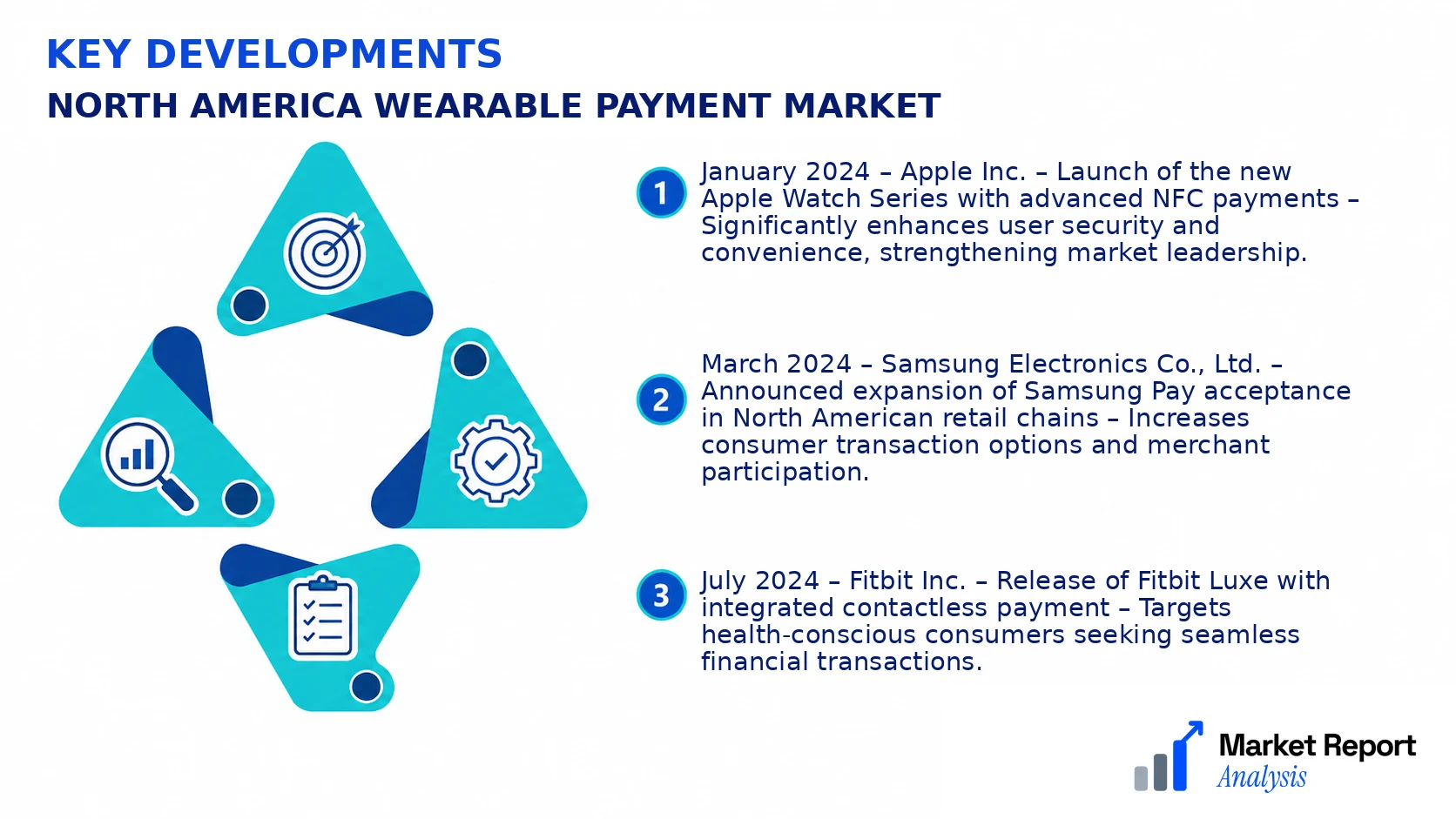
- January 2024 – Apple Inc. – Launch of the new Apple Watch Series with advanced NFC payments – Significantly enhances user security and convenience, strengthening market leadership.
- March 2024 – Samsung Electronics Co., Ltd. – Announced expansion of Samsung Pay acceptance in North American retail chains – Increases consumer transaction options and merchant participation.
- July 2024 – Fitbit Inc. – Release of Fitbit Luxe with integrated contactless payment – Targets health-conscious consumers seeking seamless financial transactions.
- September 2024 – Garmin Ltd. – Partnership with financial services firms to integrate Garmin Pay into premium fitness wearables – Expands ecosystem for fitness and outdoor users.
- November 2024 – Google LLC – Launch of Wear OS update featuring enhanced security protocols for Google Pay – Boosts trust and adoption of wearable payments among privacy-sensitive consumers.
Frequently Asked Questions
What is the North America Wearable Payment Market?
The North America Wearable Payment Market encompasses technological solutions enabling transactions through wearable devices such as smartwatches, fitness bands, and smart rings, facilitating cashless payments and enhancing consumer convenience across the region.
What is the current market size of North America Wearable Payment Market?
As of 2026, the North America Wearable Payment Market is valued at approximately USD 12.3 Billion, driven by technological adoption, consumer preferences for convenience, and expanding NFC-enabled device penetration.
What factors are driving the North America Wearable Payment Market?
Key growth factors include rising smartphone penetration, increasing adoption of contactless payment solutions, advancements in wearable device technology, and consumer desire for quick, secure, and contactless transaction methods.
Which region dominates the North America Wearable Payment Market?
The United States leads the North American market due to its advanced technological infrastructure, high consumer adoption rates, and widespread usage of contactless payment systems, followed by Canada, which is rapidly adopting wearable payment solutions.
Which segment is expected to grow the fastest?
The fitness tracker segment is projected to experience the fastest growth owing to increasing health consciousness, integration with mobile payment apps, and the proliferation of multi-functional wearable devices in daily life.
Who are the leading companies operating in the North America Wearable Payment Market?
Major players include Apple Inc., Fitbit (now part of Google), Samsung Electronics, and Garmin Ltd., all innovating in device security, user interface, and strategic partnerships to enhance wearable payment functionalities across North America.
Analyst Perspective
The North America Wearable Payment Market is projected to demonstrate steady maturity with ongoing technological enhancements and increasing consumer acceptance. In the long term, the market is poised for sustained growth driven by the integration of advanced secure transaction technologies, such as biometric authentication and tokenization, which are expected to reinforce consumer confidence and expand adoption. Commercial opportunities are abundant in developing innovative wearable devices that seamlessly integrate with existing digital ecosystems, fostering user engagement and loyalty. Investment priorities should focus on research and development in hardware miniaturization, battery efficiency, and cybersecurity measures to sustain competitive differentiation. While the competitive landscape remains intense with key players vying for market share, regional growth potential remains significant, particularly in emerging urban centers with high smartphone penetration and progressive digital infrastructure. The strategic focus should be on leveraging regional demographic trends, fostering strategic alliances, and continuously improving user experience to establish a resilient market position amid evolving technological standards and regulatory frameworks.
