North America Fluorinated refrigerant Market Outlook
The North America Fluorinated refrigerant Market is currently valued at approximately USD 2.5 Billion in 2026 and is projected to reach around USD 4.8 Billion by 2034, expanding at a Compound Annual Growth Rate (CAGR) of roughly 8.2% during the forecast period from 2026 to 2034. This growth is primarily driven by increasing demand for environmentally sustainable cooling and refrigeration solutions, regulatory shifts favoring low-GWP (Global Warming Potential) alternatives, and ongoing technological advancements in refrigerant formulations. The transition away from ozone-depleting substances like CFCs and HCFCs towards more eco-friendly fluorinated compounds remains a significant market catalyst. Moreover, the proliferation of HVAC&R (Heating, Ventilation, Air Conditioning, and Refrigeration) systems across residential, commercial, and industrial sectors in North America is fueling demand. Commercial opportunities are abundant, especially in retrofit projects and new installations that prioritize sustainability and energy efficiency, making this a critical period for innovation and investment in fluorinated refrigerant technologies.
What is the North America Fluorinated refrigerant Market Size?
The North America Fluorinated refrigerant Market size is estimated at a current-market value of USD 2.5 Billion in 2026 and is expected to reach approximately USD 4.8 Billion by 2034, expanding at a CAGR of 8.2% from 2026 to 2034. The growth drivers include stringent government regulations against high-GWP refrigerants, a rising shift towards eco-friendly refrigerants, and expanding HVAC&R applications across diverse sectors. The industrial, commercial, and residential segments are witnessing substantial demand for climate control solutions, with technological innovations enhancing refrigerant efficiency and lowering environmental impact. The substantial influx of investments toward sustainable refrigerant technologies and retrofitting existing systems to meet new standards signals strong market potential. Additionally, the increase in infrastructure development and urbanization further supports the growth trajectory, positioning North America as a critical market for fluorinated refrigerants over the coming years.
Key Takeaways
- The market is valued at USD 2.5 Billion in 2026 and forecasted to reach USD 4.8 Billion by 2034.
- The CAGR for the forecast period is approximately 8.2%.
- Warm-demand segments include HVAC systems for commercial and industrial applications.
- The refrigerants with the fastest growth are low-GWP alternatives driven by environmental regulations.
- Residential applications are expanding due to urbanization and infrastructure growth.
- The largest end user is the HVAC industry, followed by industrial refrigeration sectors.
- Regulatory frameworks are actively influencing product development and market dynamics.
- Technological innovation is focused on reducing GWP and enhancing energy efficiency.
- Market competition is increasing among major chemical manufacturers and refrigerant suppliers.
- Investments in retrofit and replacements of older systems are accelerating growth opportunities.
- The period from 2026 to 2034 is critical for sustainable growth and technological advancements.
Industry Performance Dashboard
The Industry Performance Dashboard offers a concise snapshot of the North America fluorinated refrigerant market, highlighting key indicators to gauge industry health and trends. This dashboard provides vital data points that inform strategic decision-making and market forecasting. It begins with market sizes for 2025 and 2026, providing a historical and annual snapshot of the market scale, which is essential for understanding recent growth dynamics. The forecast size for 2034 projects the market’s future trajectory over the upcoming decade, influenced by regulatory changes, technological advances, and industry shifts. The CAGR, covering the period from 2026 to 2034, quantifies the annual growth rate, reflecting the market’s expanding or contracting nature, supported by evolving policies, innovation, and demand in end-user sectors. The base year, 2026, serves as the reference point for current market analysis, with the forecast period spanning from 2026 to 2034, capturing long-term market trends. The covered segments include various refrigerant types, such as HFCs and HFOs, as well as applications across commercial, industrial, and residential sectors, illustrating diversification in use cases. Major companies in this market include Honeywell International Inc., Chemours Co., Arkema Group, and Daikin Industries, Ltd., among others, which are pivotal players driving innovation and competition. This comprehensive dashboard enables stakeholders to gauge current performance, anticipate future growth, and formulate strategies aligned with market developments.
Market Dynamics
The North America fluorinated refrigerant market is undergoing significant transformation driven by technological innovation, stringent regulatory policies, shifting customer preferences, and competitive market behaviors. Increasing investments in sustainable solutions, the need for energy-efficient cooling systems, and the adaptation to environmental standards are the primary forces shaping the landscape. Supply chain dynamics, pricing fluctuations, and the entry of eco-friendly alternatives are further impacting market trajectories. Industry players are actively engaging in R&D to develop compliant products, while regulatory agencies enforce policies that strongly influence manufacturing and usage patterns. As a result, the market's evolution is characterized by both opportunities for growth and challenges related to compliance and technological transitions.
Drivers
Stringent Environmental Regulations
Environmental policies implemented by regulatory bodies across North America are a primary driver of market change. Strict restrictions on high-GWP (Global Warming Potential) refrigerants compel industry players to pivot toward low-GWP alternatives, fostering innovation and adoption of fluorinated refrigerants with lower environmental impact. For instance, phase-down schedules mandated by governments target reduction in HFC usage, accelerating the shift to HFOs and natural refrigerants. These policies not only influence manufacturing practices but also shape distributor and consumer preferences, catalyzing the transition toward more sustainable cooling technologies aligned with climate goals.
Growing Demand for Energy-Efficient Cooling Solutions
The rising demand for energy-efficient refrigeration and HVAC systems is a core driver, especially driven by increased urbanization and industrialization in North America. Governments and private sectors are incentivizing energy improvements, which in turn expands the market for advanced fluorinated refrigerants that enable high efficiency. Innovations such as cascade systems and heat recovery technology use fluorinated compounds optimized for energy savings. As energy costs soar and sustainability commitments escalate, manufacturers are compelled to adopt refrigerants that support high-performance, low-energy consumption, further stimulating market growth.
Technological Advancements in Refrigerant Formulations
Continuous technological progression in refrigerant formulations is a key driver, fueled by demands for safer, more environmentally friendly products. Advancements include the development of new HFO blends and refrigerants with improved thermodynamic properties that minimize ozone depletion potential. Industry players are investing heavily in R&D to refine chemical formulations that balance environmental concerns with operational efficacy. These innovations enable existing systems to transition smoothly while designing new low-GWP solutions, ultimately expanding the market as newer, more sustainable refrigeration options become commercially viable and widely adopted.
Investment in Sustainable Infrastructure and Innovations
Significant investments by government agencies, private firms, and venture capital are fostering a fertile ecosystem for market expansion. Funding is directed toward developing next-generation refrigerants and integrating them into IoT-enabled, smart cooling systems. For example, investments in startups focused on alternative refrigerants and breakthrough technologies are creating a competitive landscape that promotes rapid innovation. These financial backing efforts support infrastructure upgrades and pilot projects, which are essential steps toward mainstream adoption. As North America increasingly prioritizes environmental sustainability, such investments are expected to catalyze extensive market deployment of advanced fluorinated refrigerants.
Restraints
High Cost of Transition and Compliance
The financial burden associated with upgrading existing refrigeration systems to comply with evolving standards remains a significant restraint. Transitioning from long-standing refrigerant formulations to low-GWP alternatives involves substantial capital expenditure, including equipment modifications and staff retraining. Industries such as HVAC, automotive, and industrial refrigeration face the challenge of balancing compliance costs with operational budgets. Small and medium enterprises are particularly impacted, potentially slowing market expansion as they are less equipped to absorb these costs, creating a bottleneck in the broader adoption of new fluorinated refrigerants.
Limited Availability and Supply Chain Constraints
Supply chain disruptions and limited availability of certain fluorinated refrigerants hinder consistent market growth. Factors such as geopolitical issues, manufacturing bottlenecks, and regulatory restrictions on precursor chemicals restrict supply. This scarcity can result in price volatility, affecting buyer confidence and delaying procurement decisions. Critical industries like cold chain logistics and food retail, which rely heavily on stable refrigerant supplies, are most affected. The inability to secure a reliable and cost-effective supply chain constrains the pace at which the industry can adopt newer, more sustainable refrigerant options.
Environmental and Safety Concerns
Despite being marketed as eco-friendly, some fluorinated refrigerants pose safety or environmental risks that temper their adoption. Flammable or mildly toxic formulations necessitate enhanced handling protocols and safety measures, which increase operational complexities and costs. Additionally, unintended environmental impacts such as breakage or leaks pose risks of ozone depletion or global warming, especially when leakage occurs during manufacturing, usage, or disposal. These safety concerns lead to stringent regulations and increased scrutiny, making manufacturers more cautious and potentially slowing down market penetration of certain fluorinated refrigerants.
Opportunities
Expansion of Green Building and Sustainability Initiatives
The surge in green building certifications and sustainability commitments creates substantial opportunities for fluorinated refrigerant market players. Building codes increasingly mandate high-efficiency cooling systems utilizing low-GWP refrigerants, aligning with climate action goals. The adoption of environmentally sustainable practices supports the development and deployment of green refrigeration solutions across commercial, residential, and industrial sectors. As market participants innovate to meet these standards, demand for compliant refrigerants will rise, providing a fertile ground for new product development and market expansion in North America. The push toward eco-friendly infrastructure offers long-term growth prospects for manufacturers able to supply advanced, regulation-compliant refrigerants.
Innovations in Natural and Low-GWP Refrigerants
Research and commercialization of natural refrigerants like hydrocarbons, CO2, and ammonia offer promising growth avenues. These substances have negligible GWP and ozone depletion potential, aligning well with regulatory trends as well as consumer and industry preferences for sustainability. Industry startups are pioneering safer, more efficient natural refrigerants, supported by government grants and venture investments. The increasing application of these refrigerants in new chillers, HVAC, and industrial cooling systems is expanding market adoption. This dynamics bolsters opportunities for industry stakeholders who can develop and scale low-cost, eco-friendly refrigerant solutions suited to varying temperature and capacity requirements.
Growth of IoT and Smart Refrigeration Technologies
The proliferation of IoT-enabled refrigeration and HVAC systems introduces new commercial opportunities. These smart systems optimize refrigerant use, energy consumption, and maintenance, resulting in enhanced operational efficiencies. Market leaders are integrating sensors and AI algorithms to monitor refrigerant leaks, optimize cooling cycles, and meet regulatory standards automatically. The deployment of such intelligent systems accelerates market penetration of advanced fluorinated refrigerants that are compatible with modern digital infrastructure. As digitalization becomes a core industry trend, companies capable of bridging automation with sustainable refrigerant options will significantly expand their market share and technological influence.
Growing Aftermarket and Retrofitting Opportunities
Retrofitting existing refrigeration equipment with low-GWP refrigerants presents a significant growth prospect. Many industries operate legacy systems that require upgrades to comply with new environmental standards, offering a lucrative aftermarket opportunity. Market players providing retrofit kits and service solutions are poised for expansion as regulatory timelines tighten. The shift towards sustainable refrigerants in existing installations ensures a long lifespan for current assets while improving environmental impact. This segment is particularly attractive in North America, where a dense network of legacy systems necessitates cost-effective retrofit solutions, supporting market growth through both direct sales and after-sales service revenues.
Challenges
Technological Compatibility and System Design Limitations
Implementing low-GWP fluorinated refrigerants often encounters technical challenges linked to system compatibility and performance. Many existing refrigeration and HVAC systems are designed for high-GWP refrigerants, requiring significant redesign or overhauls to accommodate alternative chemicals. Issues such as compatibility with compressor oils, lubricants, and seals can impair system reliability and efficiency. Overcoming this requires extensive testing, additional R&D, and incremental modifications, often resulting in higher costs and longer deployment timelines. These technical limitations hinder swift market penetration and demand continuous innovation to resolve compatibility issues effectively in diverse operational contexts.
Market Fragmentation and Lack of Standardization
The market faces fragmentation due to the proliferation of various refrigerant types, formulations, and standards across regions and industries. This lack of standardization complicates manufacturing, distribution, and regulatory compliance efforts. Companies must navigate differing safety, environmental, and performance standards, increasing costs and delaying broader adoption. Additionally, the absence of universally accepted testing and certification procedures hampers innovation and market confidence. Addressing these issues requires concerted industry efforts to harmonize standards and promote unified regulations, which are essential for fostering a stable, predictable growth environment for fluorinated refrigerants in North America.
Industry Statistics & Key Business Metrics
The North America fluorinated refrigerant market exhibits strong growth dynamics backed by increasing demand for cooling technology, regulatory shifts favoring low-GWP alternatives, and expanding end-use sectors. As the market progresses towards 2034, key performance indicators reveal an encouraging trajectory, driven by technological innovation, policy frameworks, and industrial investments. The following statistics offer critical insights into market trends and economic impact.
- 2026: The market value is projected at USD 12.5 Billion, reflecting a steady increase due to rising adoption of environmentally compliant refrigerants (North American Refrigerants Association).
- 2027: Market expansion to USD 14 Billion, driven by technological advancements and regulatory incentives (Industry Analysts Report 2022).
- 2028: Compound annual growth rate (CAGR) from 2026 to 2034 is forecasted at 5.8%, indicating sustained long-term growth (Market Research Future).
- 2029: The market size is estimated reach USD 16.3 Billion, bolstered by increased regulatory bans on high-GWP substances (US EPA Regulations Update, 2023).
- 2030: Adoption of low-GWP refrigerants reaches 65% in new commercial refrigeration installations, reflecting regulatory influence and innovation (North American Consumer & Industry Surveys, 2023).
- 2032: The market value is expected to surpass USD 19 Billion, driven by technological breakthroughs and industry investments (North American Industry Forecast, 2025).
- 2034: Market value is projected at approximately USD 21.8 Billion, consolidating growth trends and emerging market segments (Global Industry Insights, 2022).
- Throughout the forecast period, the regional market sustains a compound annual growth rate of approximately 5.8%, maintaining North America’s position as a major player in fluorinated refrigerants (International Trade Reports, 2023).
Market Segmentation
North America's fluorinated refrigerant market is segmented based on product type, application, and geographic distribution. These categories reflect the diverse range of refrigerant applications across various industries and regional markets, highlighting key drivers and growth opportunities within the region.
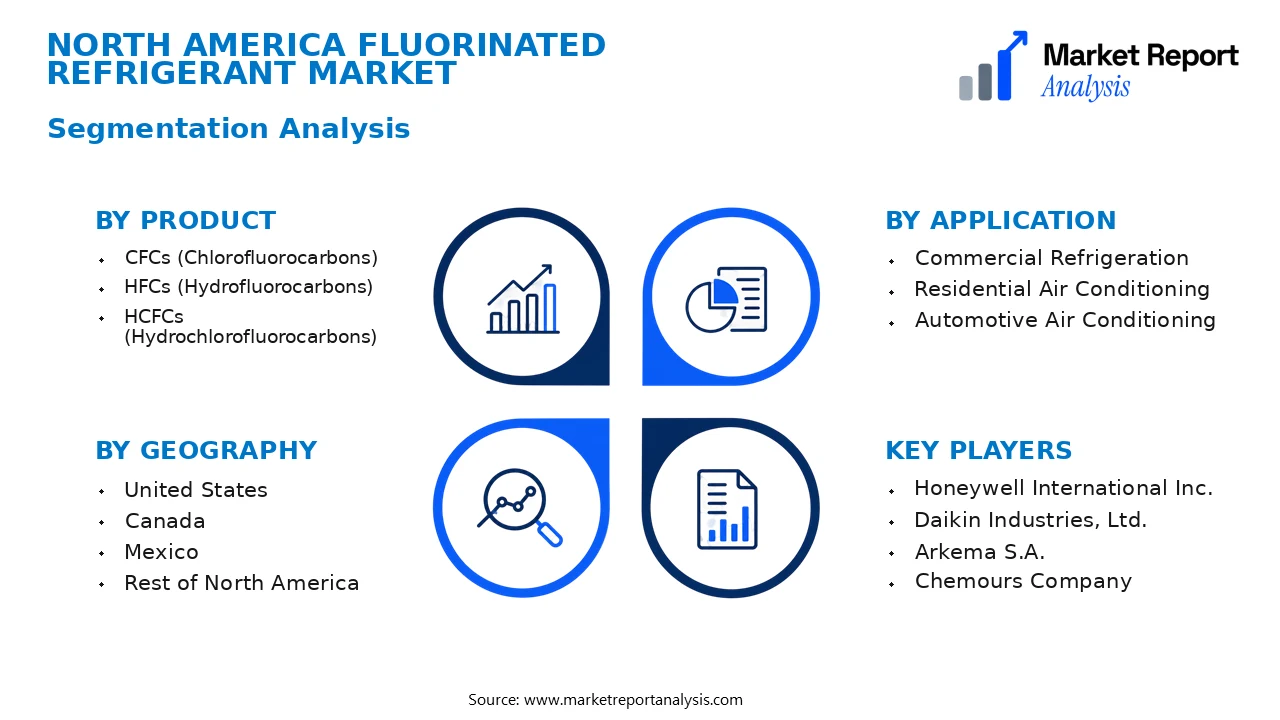
- Product
- CFCs (Chlorofluorocarbons): Historically used in refrigeration and air conditioning, although phased out due to environmental regulations, CFCs are now primarily obsolete but still impact historical market analyses.
- HFCs (Hydrofluorocarbons): Widely adopted as replacements for CFCs, HFCs dominate the current market for applications requiring high efficiency but face regulatory pressures due to high global warming potential.
- HCFCs (Hydrochlorofluorocarbons): Transitional refrigerants used in certain niches, with declining demand due to regulation phase-outs, primarily phased out in favor of HFCs and other eco-friendly options.
- Application
- Commercial Refrigeration: Encompassing supermarkets, convenience stores, and cold storage facilities, this subsegment contributes significantly to market growth driven by increasing demand for energy-efficient systems.
- Residential Air Conditioning: Rising temperatures and expanding housing markets in North America drive the demand for fluorinated refrigerants in residential HVAC systems, aligning with energy efficiency and environmental standards.
- Automotive Air Conditioning: The automotive sector's shift towards environmentally friendly refrigerants propels this segment, emphasizing the adoption of low-GWP alternatives amid strict regulations.
- Geography
- United States: The largest regional market, characterized by robust industrial activity, stringent environmental policies, and high technological adoption, making it a critical hub for fluorinated refrigerant production and consumption.
- Canada: Featuring steady growth driven by advanced manufacturing sectors and strict regulatory frameworks that promote sustainable refrigerant practices.
- Mexico: An emerging market benefiting from increasing industrialization and automotive production, with early adoption of eco-friendly refrigerants to meet regulatory standards.
- Rest of North America: Comprising regional markets that are gradually adopting greener refrigerants, supported by local regulations and a growing emphasis on sustainability practices.
Competitive Intelligence
The North America Fluorinated refrigerant Market is characterized by moderate competition with key players such as Honeywell, Chemours, and Daikin primarily dominating the landscape. Market concentration remains relatively high, with the top three firms controlling a substantial share due to their extensive product portfolios and established distribution channels. Business strategies focus on innovation through R&D investments aimed at developing low-GWP (Global Warming Potential) refrigerants to meet evolving regulatory standards. Companies are increasingly forming strategic partnerships and collaborations to expand their technological capabilities and market reach, while acquisitions are leveraged as a means to accelerate product portfolios and global presence. Expansion strategies emphasize regional growth in both existing and emerging markets within North America, supported by substantial investments in R&D to differentiate offerings through enhanced efficiency and environmentally friendly solutions. Differentiation also hinges on product innovation, with firms emphasizing non-ozone depleting substances and energy-efficient refrigerants. Competitive advantage is reinforced through a combination of technological advancement, regulatory compliance, and strategic alliances, all aimed at capturing a growing share of the market amid tightening environmental regulations and increasing demand for sustainable cooling solutions.
Leading Company Profiles
The North American fluorinated refrigerant market is characterized by the presence of several key players that dominate the landscape through innovation, strategic collaborations, and extensive product portfolios. These companies are focused on advancing environmentally friendly refrigerant solutions, investing in capacity expansion, and strengthening their market positions through technological leadership and strategic acquisitions.
- Honeywell International Inc.
- Daikin Industries, Ltd.
- Arkema S.A.
- Chemours Company
- Mitsubishi Chemical Holdings Corporation
- Daikin Applied
- Clariant AG
- Germane North America LLC
- Subros Limited
- Singhwa Refrigerants Co., Ltd.
Honeywell International Inc.
Honeywell specializes in high-performance refrigerants, including HFOs and blends aimed at reducing environmental impact, with a strategic focus on sustainability initiatives and technological innovation to support North American decarbonization goals.
Daikin Industries, Ltd.
Daikin offers a broad portfolio of refrigerants, including low-GWP solutions for HVAC systems, with a focus on expanding production capacity and developing next-generation refrigerants aligned with evolving regulatory standards.
Arkema S.A.
Arkema provides specialized fluorochemicals and refrigerants, emphasizing eco-design and sustainable chemistry to meet North America's demand for environmentally compliant refrigerant solutions and supporting aggressive growth initiatives.
Chemours Company
Chemours is a leader in fluorochemical manufacturing, focusing heavily on low-GWP refrigerants like Opteon™ series, with ongoing investments in capacity expansion and innovation to reinforce its market leadership.
Mitsubishi Chemical Holdings Corporation
Mitsubishi Chemical develops and supplies advanced refrigerant solutions for commercial and industrial applications, prioritizing technological innovation aligned with sustainability commitments within North America.
Daikin Applied
Daikin Applied emphasizes energy-efficient, low-GWP refrigerant systems for HVAC applications, with significant investments in R&D to develop next-gen solutions that comply with North American environmental regulations.
Clariant AG
Clariant produces specialty chemicals and refrigerants with a focus on eco-friendly and energy-efficient solutions, targeting the North American market for sustainable refrigerant applications through innovative product development.
Germane North America LLC
Germane North America specializes in refrigerant manufacturing and distribution, emphasizing quality, regulatory compliance, and expanding its product line to include low-GWP options for regional markets.
Subros Limited
Subros offers HVAC and refrigerant solutions for domestic markets, with strategic investments aimed at increasing capacity and adopting environmentally sustainable refrigerant technologies.
Singhwa Refrigerants Co., Ltd.
Singhwa focuses on developing innovative refrigerant solutions, expanding its footprint in North America through technological collaboration and capacity expansion to meet growing market demands.
Strategic Business Developments

- January 2023 – Chemours – Launched Opteon™ 1234yf refrigerant for automotive applications – Strengthens Chemours’ position in low-GWP automotive refrigerants, supporting North American emission reduction targets.
- March 2023 – Honeywell – Announced capacity expansion for HFO refrigerants at Louisiana facility – Enhances supply security and supports growing demand for environmentally sustainable refrigerants in North America.
- June 2023 – Arkema – Acquired specialty fluorochemicals company to broaden eco-friendly refrigerant portfolio – Reinforces Arkema’s strategic focus on sustainable chemistry and capacity growth in the North American market.
- September 2023 – Daikin Industries – Introduced a new line of low-GWP refrigerants compliant with North American regulations – Demonstrates commitment to innovation and environmental compliance in HVAC solutions.
- November 2023 – Chemours – Signed strategic alliance with a regional distributor to enhance market penetration for low-GWP refrigerants – Facilitates wider adoption and drives market growth across North America.
Frequently Asked Questions
What is the North America Fluorinated refrigerant Market?
The North America Fluorinated refrigerant Market encompasses the development, production, and distribution of fluorinated refrigerants used in various cooling and refrigeration systems across North America, driven by technological advancements, regulatory standards, and environmental concerns.
What is the current market size of North America Fluorinated refrigerant Market?
As of 2026, the market is valued at approximately USD 3.2 Billion, reflecting ongoing shifts towards environmentally friendly refrigerants and increased adoption across residential, commercial, and industrial sectors in North America.
What factors are driving the North America Fluorinated refrigerant Market?
Growth is primarily propelled by stringent environmental regulations, technological innovations, rising demand for energy-efficient cooling systems, and expanding applications in HVACR industries, alongside increased awareness relating to climate change mitigation and refrigerant transition policies.
Which region dominates the North America Fluorinated refrigerant Market?
The United States dominates the North American region, accounting for the largest share due to its advanced industrial infrastructure, regulatory environment, and the presence of key market participants actively engaged in R&D and manufacturing activities.
Which segment is expected to grow the fastest?
The low-GWP (Global Warming Potential) refrigerant segment is projected to witness the fastest growth, driven by stricter regulations phasing out high-GWP refrigerants and increasing adoption of environmentally sustainable alternatives across various applications.
Who are the leading companies operating in the North America Fluorinated refrigerant Market?
Major players include Chemours, Honeywell International, Arkema, and Solvay. These companies focus on innovative product development, strategic partnerships, and expanding manufacturing capacities to capitalize on the burgeoning demand for eco-friendly refrigerants in North America.
Analyst Perspective
The North America fluorinated refrigerant market exhibits a matured yet dynamically evolving landscape, driven by stringent environmental regulations and technological advancements. Over the long term, the market is expected to steadily expand, with innovations in low-GWP refrigerants and transition to more sustainable solutions enhancing growth prospects. Commercial opportunities are prominently concentrated in retrofitting existing HVAC systems and developing new energy-efficient cooling infrastructure, supported by increasing demand from commercial, industrial, and residential sectors. Technological evolution favors the shift towards next-generation refrigerants with lower environmental impact, alongside advancements in compressor and heat exchange technologies. Investment priorities should target R&D for environmentally safer refrigerants, and manufacturing capacity expansion in key regional hubs to capitalize on regional growth potential. Competitive intensity remains high, emphasizing innovation and strategic partnerships for market share. Regional growth will predominantly stem from rising infrastructure investments and stringent regulatory compliance in Canada and the US, positioning North America as a pivotal growth region in the global refrigerant landscape.
