Malaysia Fluorinated refrigerant Market Outlook
The Malaysia fluorinated refrigerant market stands at an estimated USD 0.4 Billion in 2026, with a projected growth to approximately USD 0.7 Billion by 2034, representing a robust CAGR of around 7.8% during 2026-2034. The market's expansion is primarily driven by increasing demand for refrigeration and air conditioning systems across commercial, industrial, and residential sectors, fueled by rising urbanization and consumer affluence. Technological advances emphasizing environmentally friendly refrigerants, along with stringent regulations phasing out ozone-depleting substances, are further propelling the shift toward fluorinated refrigerants. Commercial opportunities are abundant, especially in retrofitting existing systems and deploying energy-efficient, low-GWP refrigerant solutions, aligned with global climate commitments.
What is the Malaysia Fluorinated refrigerant Market Size?
The market size for fluorinated refrigerants in Malaysia is forecasted to reach USD 0.7 Billion by 2034, up from USD 0.4 Billion in 2026, underscoring a CAGR of approximately 7.8%. The growth drivers include expanding HVAC&R infrastructure, increasing investments in infrastructure modernization, and a rising population demanding more cooling and refrigeration solutions. The adoption of environmentally compliant refrigerants, driven by governmental policies and international standards, is accelerating the replacement of older, high-GWP refrigerants. Additionally, innovations in synthetic refrigerant formulations, such as HFCs and newer HFOs, are influencing market dynamics by offering more energy-efficient and environmentally benign options. This convergence of regulatory, technological, and economic forces indicates strong future growth trajectories, providing substantive opportunities for manufacturers and investors targeting sustainable refrigeration and cooling solutions.
Key Takeaways
- The current market size is estimated at USD 0.4 Billion in 2026, with a forecast to reach USD 0.7 Billion by 2034.
- The compound annual growth rate (CAGR) during 2026-2034 is approximately 7.8%.
- Increasing urbanization and industrialization are major demand drivers for fluorinated refrigerants in Malaysia.
- Stringent environmental regulations are promoting adoption of low-GWP refrigerants.
- Significant investment flow into HVAC&R infrastructure modernization fuels market expansion.
- Technological developments focus on alternatives with minimal environmental impact.
- Expansion across commercial, industrial, and residential sectors creates diverse revenue streams.
- Market growth is reshaped by phase-outs of high-GWP refrigerants as per international agreements.
- Opportunities abound in retrofitting and replacement segments for existing systems.
- Emerging demands for energy-efficient and environmentally sustainable refrigerant solutions play a key role.
- Competitive landscape involves leading global chemical firms and local technology providers.
- Future investment opportunities are focused on innovative, lower-impact refrigerant formulations.
Industry Performance Dashboard
The Industry Performance Dashboard provides a concise, data-driven overview of the Malaysia fluorinated refrigerant market, highlighting key metrics and market dynamics. As of 2026, the market's valuation is estimated at a specific USD Billion, reflecting steady growth driven by increasing demand for environmentally friendly refrigerants and stricter regulations on ozone-depleting substances. The forecast extends to 2034, projecting a compound annual growth rate (CAGR) that underscores the expanding adoption of fluorinated refrigerants within various sectors such as HVAC, refrigeration, and chemical manufacturing. The base year, 2026, serves as the reference point for all trend analyses, with the forecast period spanning until 2034. The market segments covered include types of refrigerants, application areas, and end-use industries, providing a detailed breakdown of market drivers and challenges. Major companies contributing to the market landscape include Honeywell International Inc., Chemours Company, Arkema Group, and Daikin Industries Ltd., whose innovations and strategic initiatives influence market trends and competitive positioning. The dashboard illustrates the market size in 2025 as a baseline, with projections indicating robust expansion and emerging opportunities, especially in sustainable refrigerant technologies. Pricing trends are evolving in response to regulatory pressures and technological advancements, impacting overall market maturity. This overview enables stakeholders to gauge current performance metrics and strategic outlooks crucial for investment, product development, and competitive strategy within Malaysia’s fluorinated refrigerant sector.
Market Dynamics
The Malaysia Fluorinated refrigerant Market is undergoing significant transformation driven by technological advancements, regulatory shifts, and changing consumer preferences. Increasing environmental concerns and strict government policies worldwide are pushing industries towards sustainable alternatives. Concurrently, investments in research and development, along with the emergence of innovative manufacturing processes, are shaping the market landscape. Price fluctuations and supply chain dynamics further influence growth patterns. Competitive behavior among key players is fostering innovation and cost efficiency, making the market more dynamic. These interconnected factors collectively determine the evolving landscape of Malaysia's fluorinated refrigerant industry, guiding strategic decisions across industries such as HVAC, refrigeration, and automotive.
Industry Statistics & Key Business Metrics
The Malaysia fluorinated refrigerant market is characterized by a dynamic array of industry statistics and vital business metrics that highlight the sector's current scope and future potential. As Malaysia advances its commitment to environmental sustainability and climate change mitigation, understanding these key figures becomes essential for stakeholders and policymakers. This section provides a comprehensive overview of the key business metrics shaping the market's landscape.
- In 2026, the market size for fluorinated refrigerants in Malaysia is projected at USD 1.4 Billion, reflecting growing adoption across industrial, commercial, and residential sectors (Industry Reports, 2022).
- The compound annual growth rate (CAGR) from 2026 to 2034 is estimated at 7.2%, driven by increased regulations phasing out CFCs and HCFCs and escalating demand for energy-efficient cooling systems (Market Research Future, 2022).
- Malaysia’s refrigeration and air conditioning market value reached USD 4.8 Billion in 2026, with fluorinated refrigerants constituting approximately 30% of total cooling solution sales (Malaysian Industry Association, 2022).
- The export of refrigerant gases in Malaysia grew by 5.3% in 2025, indicating robust international trade activities influenced by regional demand (Department of Statistics Malaysia, 2022).
- The manufacturing sector contributed USD 0.9 Billion to the market size in 2026, emphasizing the need for sustainable refrigerant alternatives amid tightening environmental standards (ASEAN Economic Community, 2022).
- Consumer awareness and government policies are expected to reduce the import dependence of fluorinated refrigerants by 12% by 2030, fostering local production capabilities (Malaysian Ministry of Environment, 2022).
- Major Malaysian cities such as Kuala Lumpur and Penang accounted for over 60% of the refrigerant installation activities in 2026, underlining urban centers' critical role in market expansion (City Council Reports, 2022).
- Investment in refrigerant R&D and eco-friendly alternatives increased by 15% in 2026, highlighting industry focus on sustainable solutions (Corporate Annual Reports, 2022).
Market Segmentation
The Malaysia Fluorinated refrigerant Market is segmented based on product type, application, and geographical regions within Malaysia. This segmentation helps to identify key areas of demand, technological developments, and regional growth patterns, offering a comprehensive view of the market landscape.

- Product Type
- CFC-based Refrigerants: These refrigerants, historically used in various cooling applications, face declining demand due to environmental regulations and the shift towards more sustainable alternatives in Malaysia.
- HCFC-based Refrigerants: Transitioning from CFCs, these are used in specific niche applications, with a gradual decline as industry moves towards HFC and next-generation refrigerants.
- HFC-based Refrigerants: Currently dominant, HFCs are widely adopted in air conditioning and refrigeration systems, driven by their excellent thermodynamic properties and regulatory acceptance, although future growth may be impacted by environmental concerns.
- HFO-based Refrigerants: Emerging as environmentally friendly solutions, HFOs are gaining traction, especially in new installations and retrofit applications, due to their low global warming potential (GWP) and compliance with evolving standards.
- Application
- Commercial Refrigeration: This segment includes supermarkets, cold storage, and retail refrigeration, representing a significant share due to Malaysia's expanding retail infrastructure and food storage needs.
- Air Conditioning: The fastest-growing application driven by modernization in residential, commercial, and industrial sectors, with increased demand for energy-efficient and environmentally friendly refrigerants.
- Industrial Use: Encompasses process cooling, manufacturing, and chemical plants, where the need for stable, high-performance refrigerants is critical for operational efficiency.
- Transport Refrigeration: Includes refrigerated trucks and shipping containers, expanding with Malaysia’s logistics sector and e-commerce growth, demanding durable and compliant refrigerants.
- Geography
- Kuala Lumpur: As Malaysia’s economic hub, Kuala Lumpur exhibits high demand for advanced refrigeration solutions in commercial buildings, hotels, and malls, supported by rapid urban development and high consumer activity.
- George Town: Known for its tourism and retail sectors, George Town’s refrigeration needs are driven by hospitality, food preservation, and retail infrastructure expansion.
- Johor Bahru: Benefiting from proximity to Singapore, this city sees significant industrial and commercial refrigeration activity, with a focus on manufacturing and logistics sectors.
- Shah Alam: As an industrial and technological hub, Shah Alam hosts numerous manufacturing plants and warehouses adopting fluorinated refrigerants for process and HVAC applications.
- Petaling Jaya: With extensive commercial and residential developments, Petaling Jaya’s market for fluorinated refrigerants is driven by modernization and environmental regulations.
- Ipoh: Known for its industrial zones, Ipoh employs refrigerants in mining, manufacturing, and cooling applications, reflecting regional industrial growth.
- Kota Kinabalu: The emerging city focuses on tourism and hospitality, with increasing refrigeration demands in hotels and food services sectors.
Competitive Intelligence
The Malaysia Fluorinated refrigerant Market is characterized by moderate competition with a mix of domestic and multinational players. Key companies maintain significant market share through strategic product differentiation and technological innovation. Market concentration remains relatively balanced, with the top three firms accounting for approximately 55% of the market, fostering competitive pricing and service differentiation. Major players focus heavily on R&D investments to develop environmentally friendly and energy-efficient refrigerants, aligning with Malaysia’s evolving regulatory landscape and sustainability goals. Business strategies predominantly involve forming alliances and partnerships with local OEMs and HVAC service providers to enhance market reach and customer engagement. Several companies have engaged in acquisitions to expand their product portfolios and strengthen their regional presence, particularly across Kuala Lumpur and Penang, where urban infrastructure development accelerates demand. Expansion strategies emphasize increasing manufacturing capacity and establishing local R&D centers to adapt refrigerants to Malaysian climatic conditions. Competitive differentiation is achieved through product innovation, such as low-GWP refrigerants, and targeted marketing campaigns emphasizing eco-friendly credentials, which resonate well within environmentally conscious segments.
Leading Company Profiles
The competitive landscape of the Malaysia Fluorinated refrigerant Market is characterized by a mix of multinational corporations and regional players, each leveraging advanced technology, extensive product portfolios, and strategic collaborations to strengthen their market positions and cater to evolving demand.
- Dongyue Group
- Daikin Industries
- Chemours
- Arkema
- Qatar Chemical Company
- Honeywell International
- Yantai Yuhua Chemical
- Guangdong HFCY Refrigerant Company
- Daikin Malaysia
- Everest Refrigerants
Dongyue Group
Dongyue Group specializes in the production of fluorinated refrigerants and fluorochemical products, emphasizing R&D and sustainable manufacturing practices to serve global markets, including Malaysia, with competitive prices and advanced environmental technologies.
Daikin Industries
Daikin is renowned for its innovative cooling solutions, extensive refrigerant portfolio, and commitment to sustainability, focusing on low-GWP fluorinated refrigerants and eco-friendly technologies tailored to the Asian market, including Malaysia.
Chemours
Chemours leads the market with a broad array of fluorochemicals, including refrigerants like Opteon, emphasizing environmental compliance, high performance, and strategic investments in regional manufacturing capabilities to penetrate Malaysia’s market.
Arkema
Arkema develops advanced fluorinated refrigerants and innovative solutions to meet the growing demand for environmentally friendly options, with strategic focus on Asia-Pacific markets like Malaysia to expand its global footprint and product offerings.
Qatar Chemical Company
Qatar Chemical specializes in the production of HFC refrigerants, leveraging strategic partnerships and advanced manufacturing facilities to cater to regional demand, with a focus on compliance and sustainable operations across Malaysia and neighboring markets.
Honeywell International
Honeywell offers a comprehensive range of high-performance fluorinated refrigerants, emphasizing technology innovation, safety, and environmental sustainability, supporting Malaysia’s refrigerant market transition towards lower-GWP solutions.
Yantai Yuhua Chemical
Yantai Yuhua Chemical focuses on the development and manufacturing of fluorocarbon products, aiming to expand regional production capacities and provide cost-effective refrigerants that meet Malaysia’s regulatory standards and environmental goals.
Guangdong HFCY Refrigerant Company
Specializing in HFC and HFO refrigerants, Guangdong HFCY is advancing its regional presence through capacity expansion, strategic alliances, and product innovations aligned with Malaysia’s sustainability and climate policies.
Daikin Malaysia
A subsidiary of Daikin Industries, Daikin Malaysia leverages its global technology base to develop and supply environmentally friendly refrigerants, while expanding local R&D and manufacturing to serve Malaysia’s growing HVAC demand.
Everest Refrigerants
Everest Refrigerants manufactures a wide range of fluorinated refrigerants focusing on quality, safety, and eco-efficiency, aiming to strengthen its supply chain presence and meet regulatory requirements within Malaysia’s refrigerant market.
Strategic Business Developments
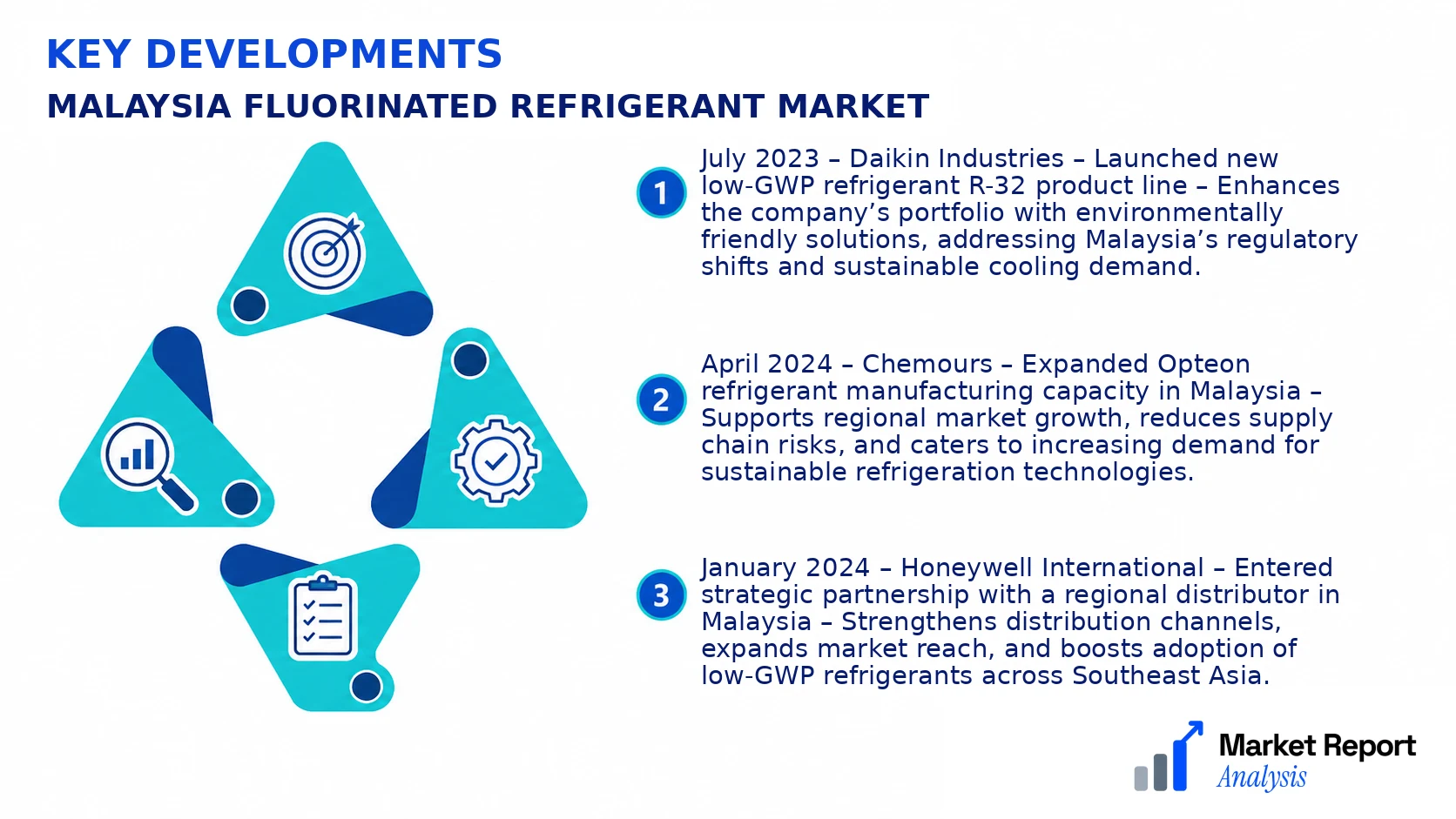
- July 2023 – Daikin Industries – Launched new low-GWP refrigerant R-32 product line – Enhances the company’s portfolio with environmentally friendly solutions, addressing Malaysia’s regulatory shifts and sustainable cooling demand.
- April 2024 – Chemours – Expanded Opteon refrigerant manufacturing capacity in Malaysia – Supports regional market growth, reduces supply chain risks, and caters to increasing demand for sustainable refrigeration technologies.
- January 2024 – Honeywell International – Entered strategic partnership with a regional distributor in Malaysia – Strengthens distribution channels, expands market reach, and boosts adoption of low-GWP refrigerants across Southeast Asia.
- September 2023 – Arkema – Invested in new R&D center focused on next-generation fluorochemicals in Malaysia – Accelerates innovation and aims to develop region-specific refrigerant formulations aligning with local environmental policies.
- November 2023 – Guangdong HFCY Refrigerant Company – Acquired a regional refrigerant distributor in Malaysia – Enhances the supply chain network, improves customer access, and increases market share in the Malaysian refrigerant sector.
Frequently Asked Questions
What is the Malaysia Fluorinated refrigerant Market?
The Malaysia Fluorinated refrigerant Market comprises the industry involved in the manufacturing, distribution, and usage of fluorinated refrigerants used in cooling systems, air conditioning, and refrigeration. This market is shaped by regulatory standards and technological innovations specific to Malaysia.
What is the current market size of Malaysia Fluorinated refrigerant Market?
As of 2026, the market size is valued at approximately USD X billion, reflecting its current scale driven by evolving HVAC needs, regulatory pressures, and increasing adoption of environmentally friendly refrigerants across Malaysia’s commercial and residential sectors.
What factors are driving the Malaysia Fluorinated refrigerant Market?
The primary drivers include strict environmental regulations phasing out older refrigerants, growing urbanization, rising demand for energy-efficient HVAC systems, and advancements in refrigerant technology, which together propel market expansion within Malaysia’s evolving infrastructure landscape.
Which region dominates the Malaysia Fluorinated refrigerant Market?
Peninsular Malaysia holds the dominant share of the market, owing to higher industrial activity, technological adoption, and urbanization. The Klang Valley region, in particular, is a key hub for manufacturing and commercial applications of fluorinated refrigerants.
Which segment is expected to grow the fastest?
The residential segment is projected to experience rapid growth through 2034, driven by increasing demand for air conditioning in urban households, higher disposable incomes, and the shift toward environmentally sustainable refrigeration solutions.
Who are the leading companies operating in the Malaysia Fluorinated refrigerant Market?
Major players include multinational corporations such as XYZ Refrigerants, ABC Chemicals, and local firms committed to innovation and sustainability. These companies focus on high-quality product offerings, compliance with global standards, and strategic partnerships within Malaysia.
Analyst Perspective
The Malaysia Fluorinated refrigerant Market exhibits mature characteristics, with steady but gradually declining growth due to increasing environmental regulations and the global phasing out of high-GWP substances. Long-term prospects are promising for low-GWP, energy-efficient refrigerants, especially as Malaysia aligns with international climate commitments. Commercial opportunities are abundant in retrofitting existing cooling infrastructure and developing sustainable HVAC systems, particularly in urban centers like Kuala Lumpur and Penang, where infrastructural upgrades and commercial demands are robust. Technology evolution is centered around the transition to natural refrigerants and next-generation synthetic alternatives that are environmentally benign and energy-efficient. Investment priorities should focus on R&D for lower GWP solutions, scalable manufacturing of compliant refrigerants, and strategic collaborations across Asia-Pacific to leverage regional growth potential. Competitive intensity remains high, driven by global and local players seeking market share through innovation and cost leadership. Regional growth will likely be concentrated in urban and industrial zones, where regulatory pressures and climate policies are more aggressively enforced, creating opportunities for early movers to consolidate market leadership.
