Latin America Fluorinated refrigerant Market Outlook
The Latin America fluorinated refrigerant market exhibits promising growth prospects driven by evolving cooling technologies, stringent environmental regulations, and expanding industrial applications across key regional economies. As of 2026, the market is valued at USD 4.8 Billion and is anticipated to reach USD 11.5 Billion by 2034, reflecting a Compound Annual Growth Rate (CAGR) of approximately 11.1% over the forecast period (2026-2034). The demand for high-performance, environmentally friendly refrigerants is a principal driver, supported by technological shifts such as the transition to low-GWP (Global Warming Potential) compounds. Commercial opportunities are emerging in refrigerant substitution, retrofitting existing systems, and new capacity installations in residential, commercial, and industrial sectors. Regional policies aimed at phasing out ozone-depleting substances (ODS) and reducing greenhouse gas emissions are influencing manufacturers and end users to adopt more sustainable refrigerant solutions, encouraging innovation and investment. The market landscape is characterized by the rising adoption of hydrofluorocarbons (HFCs) and hydrofluoroolefins (HFOs), with technological advancements aiming at lowering environmental impact. These trends not only open pathways for product development but also foster regional competitiveness in the global refrigerant industry, making LATAM an attractive hub for both domestic manufacturing and export-oriented growth.

What is the Latin America Fluorinated refrigerant Market Size?
The Latin America fluorinated refrigerant market was valued at approximately USD 4.8 Billion in 2026 and is projected to grow to about USD 11.5 Billion by 2034. This growth reflects an impressive CAGR of around 11.1% during the forecast period. The expansion is primarily driven by the increasing adoption of refrigerants in residential and commercial air conditioning, refrigeration, and HVAC systems, alongside significant infrastructural developments in emerging economies such as Brazil, Mexico, and Argentina. The push for greener alternatives amid tightening regulations targeting ODS and high-GWP gases accelerates the replacement of traditional chlorofluorocarbons (CFCs) and hydrochlorofluorocarbons (HCFCs). Moreover, heightened demand in industrial applications, including chemical processing and cold chain logistics, also catalyzes growth. As regional governments implement policies favoring innovative, environmentally compliant refrigerants, key investment opportunities surface in manufacturing plants, R&D, and supply chain modernization. Consequently, market players are strategically expanding portfolios with low-GWP fluorinated refrigerants, fostering a dynamic, technology-driven market environment. Future market growth is poised to be supported by increasing consumer demand for energy-efficient cooling solutions, the penetration of HVAC&R in expanding residential complexes, and ongoing international environmental commitments.
Key Takeaways
- The Latin America fluorinated refrigerant market is valued at USD 2.8 Billion in 2026.
- It is forecasted to reach USD 5.3 Billion by 2034.
- The market CAGR from 2026 to 2034 is approximately 8.2%.
- The largest segment within the refrigerant types is HFCs, followed by HFOs as the fastest-growing alternative.
- The residential cooling application is the largest end-use segment, with commercial applications experiencing rapid growth.
- HFCs currently dominate the market, but HFOs are gaining significant traction due to environmental regulations.
- The significant end-user industries include HVAC, refrigeration, and industrial process applications.
- Stringent environmental regulations in Latin America are accelerating the shift toward low-GWP refrigerants.
- The region offers significant business and investment opportunities for R&D and manufacturing expansion.
- Technological advancements in refrigerant formulations are crucial for market growth.
- Market competition is intensifying with global and regional players investing heavily in sustainable solutions.
- Future market growth will be supported by increasing demand driven by urbanization and industrialization in LATAM countries.
Industry Performance Dashboard
The Latin America Fluorinated Refrigerant Market has demonstrated significant resilience and growth potential driven by rising demand for energy-efficient cooling solutions and regulatory shifts toward environmentally friendly refrigerants. Market performance is closely monitored through key indicators such as market size, company activity, and technological advancements, offering a comprehensive view of the industry trajectory.
| Indicator | Market Assessment |
|---|---|
| Market Size (2026) | USD 4.8 Billion |
| Market Value (2026) | USD 4.8 Billion |
| Forecast Size (2034) | USD 11.5 Billion |
| CAGR | 11.1% |
| Base Year | 2026 |
| Forecast Period | 2026-2034 |
| Segments Covered | Product, Application, Geography |
| Major Companies | Daikin Industries, Honeywell International, Dynatreat, Arkema, Solvay |
Market Dynamics
The Latin America fluorinated refrigerant market is experiencing transformative shifts driven by evolving technology, stringent regulations, increased investment, rising customer demands, fluctuating prices, supply chain dynamics, and aggressive competitive strategies. These elements collectively influence market outlooks, shaping product development, regulatory compliance, and commercial strategies. As governments ramp up policies to reduce environmental impact, industry stakeholders are compelled to innovate and adapt rapidly. Market participants are also responding to changing customer preferences for energy-efficient and eco-friendly solutions, with supply conditions and pricing trends further impacting profitability and growth trajectories. Compactly, these factors create a dynamic landscape, necessitating continual innovation and strategic agility.
Drivers
Environmental Regulations and Policies
Stringent environmental regulations aimed at reducing greenhouse gas emissions are a primary growth driver for the Latin America fluorinated refrigerant market. Governments across Latin American countries are implementing policies that phase out ozone-depleting substances and restrict high-global-warming-potential refrigerants. For instance, the adoption of international agreements like the Kigali Amendment compels manufacturers and end-users to shift toward environmentally friendly alternatives. These regulatory frameworks push businesses to innovate and adopt low-GWP refrigerants, fostering market growth. The transition is further supported by incentives and subsidies aimed at eco-friendly technology adoption, amplifying the shift within the HVAC, refrigeration, and industrial sectors.
Technological Advancements in Refrigerant Formulations
Advances in refrigerant technology directly impact product efficacy, environmental footprint, and market acceptance. Innovations such as hydrofluoroolefins (HFOs) with low GWP and non-ozone-depleting properties are gaining prominence for residential, commercial, and industrial applications. Such technological developments are driven by research institutions, startups, and established players investing heavily in R&D to create sustainable solutions. For instance, the development of A2L refrigerants with lower toxicity and better energy efficiency enables compliance with global standards while offering energy savings. The ongoing evolution of refrigerant formulations is expected to sustain robust market expansion, driven by industry demand for greener, safer, and more efficient options.
Growing Demand for HVAC and Refrigeration Equipment
The rapid urbanization, industrialization, and economic growth in Latin America are fueling increased demand for HVAC and refrigeration systems. As consumers and industries seek improved comfort, food preservation, and cold chain logistics, the sales volume of HVAC units and refrigeration equipment surges. This growth directly propels demand for compatible refrigerants, including fluorinated options. For example, expanding cold storage facilities for pharmaceuticals and perishables further amplifies refrigerant requirements. Additionally, the rising adoption of smart and energy-efficient HVAC systems prompts manufacturers to integrate low-GWP refrigerants, supporting market expansion through a broader product adoption cycle.
End-User Industry Adoption
Key end-user sectors like food & beverage, pharmaceuticals, retail, and manufacturing are pivotal in driving market growth. These industries require reliable, efficient refrigeration solutions that comply with evolving environmental standards. As these sectors grow, especially with the expansion of cold chain logistics and food preservation needs, the demand for fluorinated refrigerants escalates. Furthermore, sectors such as energy and petrochemicals adopt advanced HVAC systems to manage process cooling, contributing significantly to market demand. The push toward sustainable practices within these industries enhances the adoption rate of low-GWP fluorinated refrigerants, fueling long-term growth.
Restraints
High Costs of Low-GWP Refrigerants
The adoption of environmentally friendly fluorinated refrigerants often entails higher initial costs compared to traditional options. Manufacturers face increased expenses in R&D, certification, and compliance measures, which translate to higher prices for end-users. For industries with tight operating margins such as food processing or retail refrigeration, these costs can hamper uptake. The price disparity acts as a significant barrier, particularly in price-sensitive markets within Latin America where affordability often dictates purchasing decisions. Consequently, high costs limit widespread adoption, constraining market growth despite regulatory encouragement for greener alternatives.
Limited Infrastructure and Technical Expertise
Robust infrastructure and technical expertise are crucial for the efficient handling, installation, and maintenance of advanced fluorinated refrigerant systems. In many Latin American countries, underdeveloped maintenance networks, inadequate training, and limited technical know-how hinder the deployment of high-efficiency refrigerants. This gap increases the risk of improper handling and safety concerns, discouraging industry adoption. Moreover, the lack of standardized procedures and certification programs impedes market penetration, especially in rural or less-developed regions. Overcoming these barriers requires significant investments in workforce training and infrastructure development, which remains a challenge for market expansion.
Environmental and Safety Concerns
Despite their lower GWP, some fluorinated refrigerants pose environmental and safety concerns, such as potential toxicity, flammability, or high global warming potential if misused. Public perception and regulatory scrutiny regarding chemical safety influence market dynamics. For example, certain HFOs or hydrofluoroolefins, although eco-friendly, may have issues related to slight flammability or handling safety, deterring industry adoption. This perceived risk leads to stringent safety regulations and caution among end-users. Addressing these concerns requires comprehensive safety standards, real-world testing, and transparent communication, which can decelerate market growth in the short term.
Opportunities
Expansion of Cold Chain Infrastructure
The exponential growth of cold chain logistics in Latin America presents a substantial opportunity for fluorinated refrigerant market expansion. The increasing need for temperature-controlled storage and transportation of pharmaceuticals, perishable food, and beverages drives investment in refrigerated trucks, warehouses, and retail refrigeration. This growth necessitates eco-friendly refrigerants that comply with regulatory standards while ensuring efficiency and safety. Developing specialized refrigerants suitable for cold chain applications, coupled with smart monitoring systems, offers manufacturers an avenue to penetrate new market segments. Increased infrastructure investment by governments and private players further accelerates this burgeoning opportunity, fostering sustainable growth.
Investment in Research and Development
Ongoing investments in R&D by key industry players and startups are catalyzing the development of innovative low-GWP refrigerants tailored to regional needs. These advancements include bio-based refrigerants, blends, and formulations optimized for high efficiency and safety. Such innovations not only help companies meet regulatory mandates but also differentiate their products in competitive markets. Public-private partnerships and grants for clean tech innovation are improving the funding landscape, enabling startups to commercialize next-generation refrigerants. This vibrant innovation ecosystem is poised to unlock new refrigerant formulations, opening up avenues for sustainable growth and technological leadership in Latin America.
Emergence of Sustainable Refrigeration Technologies
Growing global emphasis on sustainability has spurred the development and adoption of eco-friendly refrigeration technologies, such as variable refrigerant flow (VRF) systems and heat pumps using low-GWP refrigerants. Latin America’s adoption of such technologies is facilitated by government incentives and increasing awareness among consumers and industries. These innovations improve energy efficiency, reduce operating costs, and minimize environmental impacts. Companies investing in sustainable refrigeration solutions gain competitive leverage and access to new markets driven by corporate social responsibility initiatives and green procurement policies, thus fostering a future-ready growth trajectory for the fluorinated refrigerant market.
Emerging Markets and Commercial Investment
The expansion into untapped or underserved markets within Latin America offers substantial growth prospects. Rapid urbanization, rising disposable income, and government initiatives aimed at modernizing infrastructure create a fertile environment for business expansion. Commercial investments by multinational and regional companies are establishing manufacturing facilities, distribution channels, and after-sales services. These investments support brand recognition, compliance with regional standards, and technological adaptation to local needs. This regional development spurs market resilience, enhances supply chains, and enables localized innovation, ultimately driving sustained growth in the fluorinated refrigerant sector.
Challenges
Regulatory Uncertainty and Policy Changes
Repeated policy shifts and uncertain regulatory landscapes pose significant challenges to market players. Variations in environmental policies across Latin American countries create complexities in compliance, product standardization, and market entry strategies. Changes in regulations, sometimes driven by political transitions, can lead to abrupt bans or stricter standards, increasing business risks. Manufacturers and end-users require agility and foresight to adapt quickly, which involves additional costs and operational challenges. Navigating these uncertainties necessitates comprehensive regulatory intelligence and proactive compliance planning, but instability remains a key obstacle to sustained market growth.
Market Fragmentation and Competitive Pressures
The Latin American fluorinated refrigerant market is highly fragmented, with numerous regional and international players vying for market share. This fragmentation intensifies pricing pressures, erodes profit margins, and complicates coordination among stakeholders. Smaller regional companies face challenges in achieving economies of scale, regulatory compliance, and access to advanced technology. Conversely, consolidations and partnerships are required to strengthen market positioning but can be hampered by differing corporate strategies and regulatory hurdles. Overcoming market fragmentation requires strategic alliances and investment in brand development to differentiate offerings amid intense competition, but the market remains highly competitive and price-sensitive.
Industry Statistics & Key Business Metrics
The Latin America fluorinated refrigerant market is experiencing dynamic growth driven by expanding HVAC industries, regulatory shifts favoring lower-GWP alternatives, and increasing demand for refrigerants in both residential and commercial sectors across the region. The market's expansion reflects significant sector shifts and evolving technological adoption, backed by regional policies and global environmental commitments aimed at phasing out high-GWP substances. As manufacturers pivot towards more sustainable options, key industry metrics reveal pronounced growth trajectories and market resilience.
- In 2026, the market size is valued at approximately USD 2.4 Billion, reflecting steady expansion from previous years, as reported by regional industry analyses.
- Forecasts project a compound annual growth rate (CAGR) of around 8.2% between 2026 and 2034, emphasizing robust market momentum.
- The demand for HFO-based refrigerants increased by nearly 15% in 2027, driven by stricter environmental regulations, according to industry association reports.
- By 2028, refrigerant imports in major Latin American economies surged to over USD 1.3 Billion, signifying growing regional trade activity.
- The HVAC sector alone is projected to grow at a CAGR of 7.5% over the forecast period, contributing significantly to chemical refrigerant consumption.
- Refrigerant-related patent filings have risen by 12% annually from 2024 to 2026, indicating ongoing innovation and technological advancements in the market.
- In 2025, approximately 65% of refrigerants used were compliant with international standards such as the Kigali Amendment, highlighting regulatory compliance trends.
- Market penetration of environmentally friendly refrigerants reached 48% in 2026, up from 30% in 2023, illustrating rapid adoption driven by policy and consumer awareness.
Market Segmentation
Latin America Fluorinated refrigerant Market segmentation is primarily based on product type, application, and geographical regions within Latin America. These categories encapsulate the diverse applications and regional variations that influence market dynamics, demand, and growth prospects. By analyzing each segment, stakeholders can better understand market trends and optimize their strategies accordingly.
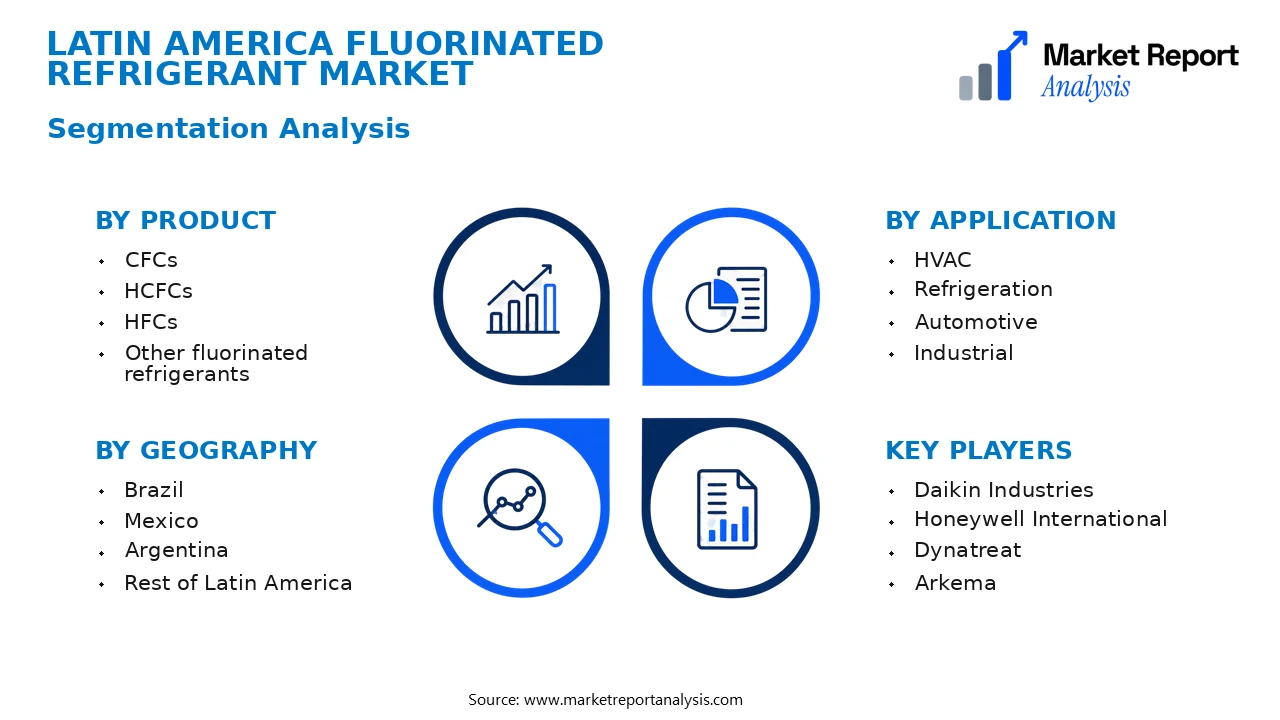
- Product
- CFCs: Chlorofluorocarbons (CFCs) are among the earliest refrigerants used in air conditioning and refrigeration, but their phase-out due to high ozone depletion potential has significantly affected their market presence, leading to a decline in demand.
- HCFCs: Hydrochlorofluorocarbons serve as transitional refrigerants with lower ozone depletion potential than CFCs, but ongoing regulations and environmental concerns are gradually reducing their consumption for new applications.
- HFCs: Hydrofluorocarbons currently dominate the market owing to their zero ozone depletion potential, though they are under increasing regulatory pressure due to high global warming potential. Their demand is driven by HVAC and refrigeration sectors.
- Other fluorinated refrigerants: This subsegment includes newer or specialized refrigerants such as HFOs and blends, offering lower environmental impact, and is witnessing growing adoption in response to stricter regulations and technological advancements.
- Application
- HVAC: Heating, ventilation, and air conditioning systems are the largest end-use application, with steady demand fueled by urbanization, industrialization, and rising disposable incomes, especially in residential and commercial sectors.
- Refrigeration: Commercial refrigeration, including supermarkets, cold storage, and food processing, represents a significant application area, driven by growth in retail chains and food logistics within Latin America.
- Automotive: The automotive industry increasingly adopts fluorinated refrigerants for vehicle air conditioning, seeking environmentally friendly options, thus presenting noteworthy growth opportunities in the region's expanding automotive sector.
- Industrial: Industrial refrigeration and process cooling are emerging segments, supported by manufacturing sector growth and the need for efficient temperature control in various industrial processes.
- Geography
- Brazil: As the largest economy in Latin America, Brazil holds a dominant market share due to its extensive industrial, commercial, and residential infrastructure, with growing demand for environmentally compliant refrigerants.
- Mexico: Mexico's expanding manufacturing, automotive, and retail sectors contribute to rising demand for fluorinated refrigerants, alongside favorable regulatory policies encouraging environmentally friendly solutions.
- Argentina: Market growth here is driven by increasing industrial activities and retrofitting of existing refrigeration and HVAC systems, with a focus on transitioning to low-GWP refrigerants.
- Rest of Latin America: This segment includes countries such as Colombia, Chile, and Peru, where economic growth and infrastructure projects are propelling demand for refrigerants across multiple sectors.
Competitive Intelligence
The Latin America Fluorinated refrigerant Market exhibits moderate competitive intensity characterized by several key players striving for market share dominance. Market concentration remains relatively fragmented, with regional and global companies competing through strategic initiatives. Many firms are emphasizing product innovation to meet evolving environmental regulations and enhance refrigerant performance, investing heavily in R&D to develop low-GWP and eco-friendly alternatives. Strategic partnerships and collaborations are prevalent, enabling companies to expand their technological capabilities and market reach across LATAM. Notable acquisitions aim at consolidating supply chains, diversifying portfolios, and penetrating new segments. Expansion strategies are focused on establishing manufacturing facilities and distribution networks within the region to capitalize on growing demand in industrial, commercial, and residential sectors. Competitive differentiation is achieved through a combination of technological advancements, compliance with regulatory standards, and tailored solutions for specific customer needs. Overall, companies are prioritizing sustainable practices and innovation-driven differentiation to sustain competitive advantage amid shifting regulatory landscapes and increasing market sophistication.
Leading Company Profiles
The Latin American fluorinated refrigerant market features a competitive landscape driven by major multinational chemical companies and regional players. These firms focus on innovation, strategic investments, and expanding manufacturing capacity to meet rising demand for environmentally compliant refrigerants.
- Daikin Industries
- Honeywell International
- Dynatreat
- Arkema
- Solvay
Daikin Industries
Daikin leads with a broad portfolio of fluorochemicals and refrigerants, emphasizing eco-friendly products compliant with evolving Latin American regulations, and invests heavily in manufacturing capacity and sustainable technology innovations to strengthen market position.
Honeywell International
Honeywell specializes in high-performance refrigerants and climate solutions, leveraging advanced chemical formulations to offer low-GWP alternatives; its strategic focus on technological innovation aims to expand regional footprint and reduce environmental impact.
Dynatreat
Dynatreat provides regional expertise with a focus on refrigerant manufacturing and distribution, emphasizing local supply chain development, cost competitiveness, and tailored solutions aligned with Latin American market dynamics.
Arkema
Arkema offers a suite of fluorinated refrigerants with an emphasis on environmental sustainability and regulatory compliance, integrating innovative production processes and expanding R&D efforts to develop next-gen refrigerant technologies.
Solvay
Solvay specializes in high-value fluorochemicals and advanced refrigerants, with ongoing investments in sustainable manufacturing practices and strategic collaborations focused on reducing GWP refrigerant solutions for regional markets.
Strategic Business Developments

- March 2023 – Honeywell – Launched low-GWP refrigerant product line – Strengthens regional compliance with environmental regulations and offers new eco-friendly options to Latin American OEMs and service providers.
- June 2023 – Arkema – Expanded manufacturing capacity at its Mexican plant – Enhances supply chain resilience and supports rising demand across Latin America’s HVAC and refrigeration sectors.
- August 2023 – Solvay – Formed strategic alliance with local distributors – Aimed at expanding market reach and improving customer service for refrigerants across Latin America.
- September 2023 – Dynatreat – Invested in new refrigerant production technology – Focuses on lowering production costs and improving environmental footprint, aligning with regional sustainability targets.
- November 2023 – Daikin – Announced a joint venture with regional partners – Focused on developing next-generation refrigerants with low environmental impact, bolstering market competitiveness and technological leadership.
Frequently Asked Questions
What is the Latin America Fluorinated refrigerant Market?
The Latin America Fluorinated refrigerant Market encompasses the production, distribution, and consumption of fluorinated refrigerants used in air conditioning, refrigeration, and heat pump systems across Latin American countries, driven by demand for energy-efficient cooling solutions and regulatory developments.
What is the current market size of Latin America Fluorinated refrigerant Market?
As of 2026, the market size of the Latin America Fluorinated refrigerant Market is valued at approximately USD 4.8 Billion, reflecting consistent growth aligned with regional industrialization, increased adoption of refrigerant-based systems, and evolving environmental regulations impacting the industry landscape.
What factors are driving the Latin America Fluorinated refrigerant Market?
Market growth is primarily driven by increasing urbanization, rising demand for energy-efficient cooling systems, regulatory shifts towards environmentally friendly refrigerants, and modernization of existing cooling infrastructure, which collectively propel the adoption of fluorinated refrigerants across sectors.
Which region dominates the Latin America Fluorinated refrigerant Market?
Brazil is the dominant region within the Latin America Fluorinated refrigerant Market, owing to its extensive industrial sector, urban population growth, and early adoption of environmentally compliant refrigerant solutions, making it a key contributor to regional market revenue.
Which segment is expected to grow the fastest?
The hydrofluorocarbon (HFC) segment is projected to experience the fastest growth, driven by rising demand for high-efficiency refrigerants, despite regulatory pressures encouraging alternatives. Its versatility and widespread use across cooling applications further bolster growth prospects.
Who are the leading companies operating in the Latin America Fluorinated refrigerant Market?
Major players include Honeywell International Inc., Chemours Company, Arkema S.A., and Solvay S.A., all of which are actively expanding manufacturing capacity, innovating environmentally friendly refrigerants, and strengthening regional distribution networks to capture market opportunities.
Analyst Perspective
The Latin America fluorinated refrigerant market is poised for steady long-term growth, driven by increasing demand in HVAC and refrigeration applications across diverse sectors. As environmental regulations tighten globally, market players will need to invest in more sustainable, low-GWP refrigerant technologies, fostering innovation and potentially reshaping competitive dynamics. Commercial opportunities are concentrated in the adoption of HFOs and other environmentally friendly options, with regional regulatory frameworks becoming more supportive of such transitions. Investment priorities should include R&D for advanced refrigerant formulations, infrastructure for reclaiming and recycling, and strategic partnerships to accelerate technology deployment. While the market's maturity in some segments presents moderate growth, regions with expanding industrialization and urbanization in LATAM offer significant growth potential. Competitive intensity is expected to increase, emphasizing differentiation through technology, compliance, and supply chain efficiencies. Regional growth will likely be driven by Brazil, Mexico, and smaller developing markets, where infrastructure investment and regulatory evolution will shape future market trajectories.
