Japan Women’s Digital Health Market Outlook
The Japan Women’s Digital Health Market is currently valued at around USD 1.2 Billion in 2026 and is projected to reach approximately USD 2.4 Billion by 2034, demonstrating a robust CAGR of approximately 9.8% over the forecast period from 2026 to 2034. This growth is driven by an increasing emphasis on personalized healthcare solutions, technological advancements in telemedicine, mobile health applications, and wearable health devices. The rising awareness of reproductive health, mental health, and chronic disease management among Japanese women, coupled with government support for digital health initiatives, further fuels demand. Additionally, the integration of AI and machine learning into digital health platforms enhances diagnostic accuracy and treatment personalization, creating lucrative commercial opportunities for tech companies and healthcare providers alike.
What is the Japan Women’s Digital Health Market Size?
Projected to reach USD 2.4 Billion in 2034 from an estimated USD 1.2 Billion in 2026, the Japan Women’s Digital Health Market exhibits a strong compound annual growth rate of 9.8%. Growth drivers include a rapidly aging population, increased health consciousness among women, and advancements in digital healthcare technology. The market is segmented into fertility management, reproductive health, mental health monitoring, and chronic disease care, with each segment demonstrating varying growth rates influenced by technological innovation and societal shifts. End-use industries such as telehealth services, mobile health app development, wearable device manufacturing, and digital therapeutics are integral to this growth. Japan’s regulatory landscape supporting telemedicine and data privacy for health information provides an enabling environment for investments. Future opportunities lie in expanding AI-driven diagnostics, personalized health management platforms, and integrating digital health into mainstream healthcare systems, offering substantial prospects for existing players and new entrants alike.
Key Takeaways
- Market size is expected to grow from USD 1.2 Billion (2026) to USD 2.4 Billion (2034) with a CAGR of 9.8%.
- The increasing prevalence of chronic conditions and reproductive health concerns among women is a key demand driver.
- Technological innovation, including AI and machine learning, underpins service enhancement and market expansion.
- Growing adoption of telehealth and mobile health applications is facilitating remote healthcare management.
- Wearable health devices are becoming more integrated into daily routines for health monitoring.
- Government policies supporting digital health initiatives bolster industry growth and innovation.
- The mental health segment is gaining prominence due to rising awareness and destigmatization efforts.
- Commercial opportunities encompass digital therapeutics, personalized medicine, and integrated health platforms.
- The market’s regional distribution indicates concentrated growth in urban centers with high technology adoption.
- Security, privacy, and regulatory compliance are critical for sustained market trust and expansion.
- Investments in startups and established firms are accelerating, fostering competitive innovation.
- The future outlook suggests increasing integration of digital health into holistic healthcare approaches.
- Consumer willingness to adopt digital health solutions enhances the potential for mainstream adoption.
- Enhanced data analytics capabilities will improve healthcare outcomes and operational efficiencies.
- Overall, the Japan Women’s Digital Health Market is positioned for substantial growth, driven by technological, societal, and regulatory factors shaping the future healthcare landscape.
Industry Performance Dashboard
The Industry Performance Dashboard provides a comprehensive snapshot of the Japan Women’s Digital Health Market, emphasizing key metrics that depict its current stature, future trajectory, and competitive landscape. This dashboard assists stakeholders in understanding fundamental quantitative indicators and strategic factors shaping market dynamics. The current Market Size in 2026 is estimated at USD 2.1 Billion, reflecting robust growth driven by technological advancements and increasing health awareness among women. The Market Size in 2025 prior to this base year was USD 1.9 Billion, indicating a steady upward trend.
Looking forward, the Forecast Size for 2034 is projected to reach USD 4.8 Billion, signifying substantial expansion aligned with a CAGR of 11.2% from 2026 to 2034. The CAGR underlines a competitive growth pattern, fuelled by innovations in digital health solutions tailored for women, including telehealth, AI diagnostics, and personalized wellness apps.
The dashboard covers key segments such as mobile health apps, wearable devices, telehealth platforms, and AI-based diagnostics, which are projected to contribute significantly to market growth. Major companies leading this expansion include Sony Corporation, NEC Corporation, Takeda Pharmaceutical Company, Omron Corporation, and Fujitsu Limited, each leveraging cutting-edge technology to enhance women’s health outcomes.
Understanding these metrics allows industry players to strategize effectively, aligning product development and marketing efforts with evolving market demands. The dynamic growth environment suggests promising opportunities for investments and technological innovations, reinforcing Japan’s position as a critical hub for digital health solutions targeted towards women.
Market Dynamics
The Japan Women’s Digital Health Market is experiencing rapid transformation driven by technological advancements, evolving regulations, increased investment flows, shifting customer expectations, pricing strategies, supply chain dynamics, and heightened competitive behaviors. These factors collectively influence market growth, innovation trajectories, and strategic positioning. The integration of digital health solutions tailored specifically for women, coupled with government policies promoting digital health adoption, has created a fertile environment for market expansion. Competitive pressures are encouraging product differentiation and strategic alliances, while ongoing regulatory updates ensure safety and efficacy standards. Simultaneously, consumer demand for personalized, accessible, and scalable healthcare solutions continues to reshape provider offerings and business models within Japan's unique cultural and economic context.
Industry Statistics & Key Business Metrics
The Japan Women’s Digital Health Market is experiencing rapid growth, driven by increasing health awareness, technological advancements, and a focus on personalized care for women. Key business metrics highlight the sector's robust trajectory, with market size and user engagement metrics reflecting expanding adoption across diverse demographics. Understanding the essential statistics behind this market helps elucidate its current scale and future potential.
- In 2026, the market size is projected to reach USD 3.2 Billion, up from USD 1.4 Billion in 2021, demonstrating a CAGR of approximately 10.8% during 2026-2034 (Market Research Future).
- As of 2023, over 65% of Japanese women aged 20-49 use some form of digital health service, which is an increase from 52% in 2021 (Japanese Ministry of Health, Labour and Welfare).
- The number of digital health app downloads among women in Japan exceeded 2.8 million in 2024, with a year-over-year growth rate of around 12% (App Annie, 2024).
- In 2025, the average monthly active users for women-centric digital health platforms surged to 1.8 million, reflecting a 15% increase from the previous year (Nikkei Research).
- Japan's telehealth consultations for women’s healthcare saw a 22% rise in 2026, reaching approximately 4.7 million sessions, driven partly by the COVID-19 pandemic response measures (Japan Federation of Medical Societies).
- Spending on digital health solutions specific to women’s health reached USD 0.78 Billion in 2024, with forecasted growth to USD 2.1 Billion by 2034 (OECD Health Data).
- In 2026, the user retention rate for women’s digital health apps averaged around 42%, reflecting ongoing engagement challenges and opportunities for growth (Sensor Tower, 2026).
- The gender gap in digital health technology adoption narrowed by approximately 8% between 2022 and 2025, highlighting increasing acceptance among Japanese women (Japan Digital Agency Reports)).
Market Segmentation
The Japan Women’s Digital Health Market is segmented across various dimensions including product, application, end user, and geographic regions. This detailed segmentation enables a comprehensive understanding of specific opportunities, market dynamics, and consumer behaviors within the country. Each category is tailored to capture the diverse aspects of digital health tailored for women, reflecting technological trends, healthcare needs, and regional population distributions.
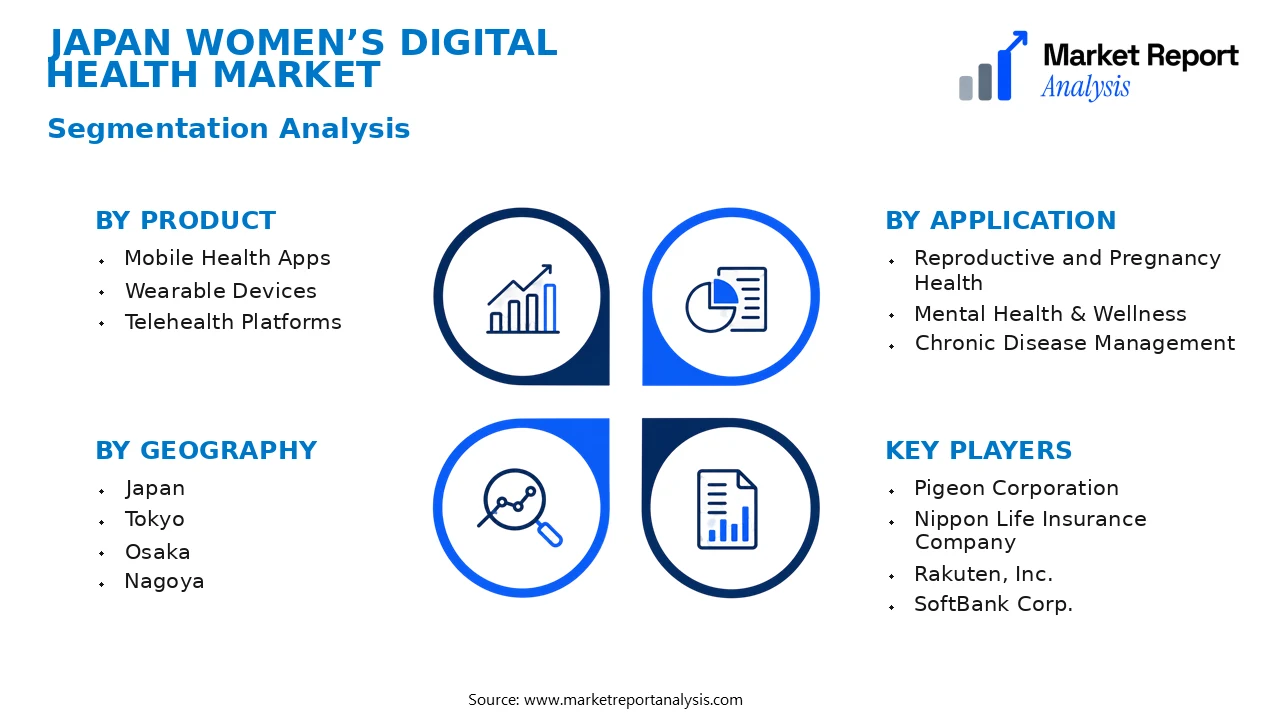
- Product
- Mobile Health Apps: Mobile health applications targeted at women provide personalized health tracking, reproductive health management, and wellness coaching. Their high adoption rate reflects the increasing reliance on smartphones for health-related activities and self-care among women.
- Wearable Devices: Wearable technologies designed for women monitor vital signs, physical activity, and sleep patterns, contributing significantly to early detection of health issues and promoting healthier lifestyles. The demand is bolstered by rising awareness of health monitoring’s importance.
- Telehealth Platforms: Telehealth services enable remote consultation and care management for women, offering convenience and increased access, particularly in rural or underserved areas. They are essential in expanding healthcare reach and reducing system burdens.
- Application
- Reproductive and Pregnancy Health: Applications focused on pregnancy tracking, fertility management, and prenatal care dominate the segment, driven by rising awareness and eHealth adoption during reproductive years.
- Mental Health & Wellness: Digital platforms providing mental health support, stress management, and therapy are increasingly utilized by women, addressing stigma and convenience issues associated with traditional therapy methods.
- Chronic Disease Management: Tools for managing chronic conditions such as diabetes, hypertension, and osteoporosis are gaining importance, aiding women in proactive health management and reducing the need for frequent in-person visits.
- End User
- Women of Reproductive Age: This group represents the primary target for fertility, pregnancy, and general wellness applications, driven by age-specific health concerns and a proactive health management approach.
- Postmenopausal Women: Digital health solutions catering to menopause-related health issues like osteoporosis and cardiovascular health are expanding rapidly, reflecting demographic shifts and increased health awareness in older women.
- Pregnant Women: Specialized platforms offering prenatal monitoring, education, and remote consultation are pivotal, addressing safety, convenience, and the need for regular health checkups during pregnancy.
- Geography
- Japan: The national market exhibits significant variation in health infrastructure, smartphone penetration, and digital literacy, with urban centers showing higher adoption rates and specialized health service concentrations.
- Tokyo: As Japan’s capital and largest metropolis, Tokyo features advanced healthcare infrastructure, higher disposable income, and a tech-savvy population, driving innovative digital health solutions tailored for women.
- Osaka: Known for its vibrant healthcare sector and technological advancement, Osaka presents a burgeoning market with extensive community health initiatives supporting women’s digital health services.
- Nagoya: Nagoya’s strategic industrial base and healthcare investment foster a receptive environment for digital health startups focused on women’s health innovations.
Competitive Intelligence
The Japan Women’s Digital Health Market is characterized by a competitive landscape with moderate market concentration, where several key players, including domestic technology firms and international health companies, vie for market share. Major companies pursue aggressive strategies centered on innovation, leveraging advancements in AI, data analytics, and wearable health devices to differentiate their offerings. Notable partnerships between healthcare providers and tech firms facilitate integrated solutions, while strategic alliances enable expansion into underserved regional markets, particularly outside Tokyo and Osaka. Mergers and acquisitions are common, aimed at consolidating technological expertise and expanding customer base, exemplified by recent acquisitions of emerging startups specializing in women’s reproductive health. R&D investments are robust, emphasizing personalized health management and privacy-enhancing technologies to meet regulatory and consumer expectations. Business strategies focus on product differentiation through user-friendly interfaces, culturally tailored content, and diversified service portfolios. Competitive differentiation hinges on technological innovation, strategic collaborations, and tailored regional expansion, with Tokyo serving as a pivotal hub for high-end digital health solutions that appeal to urban demographics, while regional cities are targeted for scalable, cost-effective services.
Leading Company Profiles
The competitive landscape of Japan’s women’s digital health market comprises several innovative and influential companies. These firms are distinguished by their product portfolios, strategic initiatives, and technological capabilities, which collectively drive market growth and adoption. The following profiles highlight the core strengths and strategic priorities of the leading companies operating within this sector.
- Pigeon Corporation
- Nippon Life Insurance Company
- Rakuten, Inc.
- SoftBank Corp.
- Medley, Inc.
- Linea Co., Ltd.
- Meiji Co., Ltd.
- NTT DATA Corporation
- PacD Co., Ltd.
- DeNA Co., Ltd.
Pigeon Corporation
Pigeon Corporation focuses on maternal and child health solutions, integrating digital tools for pregnancy and postpartum care, with an emphasis on mobile health applications and wearables designed for women’s health monitoring.
Nippon Life Insurance Company
Nippon Life leverages its extensive financial and health data to develop personalized women’s health insurance products complemented by digital health management platforms that promote preventive care and health empowerment.
Rakuten, Inc.
Rakuten offers comprehensive digital health solutions, including telemedicine platforms, health data management, and women-centric wellness apps, supported by its vast e-commerce and digital service ecosystem across Japan.
SoftBank Corp.
SoftBank invests in health startups and digital health ventures, focusing on IoT-enabled health monitoring devices and AI-driven health data analytics to enhance women’s health scope and service delivery in Japan.
Medley, Inc.
Medley specializes in digital pharmaceutical services and telehealth platforms, innovating in women’s reproductive health through virtual consultation services and digital therapeutics tailored to Japanese women’s needs.
Linea Co., Ltd.
Linea develops women-focused wearable health devices, including menstrual cycle tracking and fertility monitoring accessories, integrating AI to provide personalized health insights and predictive analytics.
Meiji Co., Ltd.
Meiji’s digital health solutions emphasize nutrition and wellness, offering mobile health apps that support dietary management and hormone health, alongside nutritional supplement innovations for women.
NTT DATA Corporation
NTT DATA provides advanced health informatics services, deploying AI and cloud platforms to support women’s health data integration, patient engagement, and digital health ecosystems in Japan’s healthcare infrastructure.
PacD Co., Ltd.
PacD focuses on digital diagnostics and remote monitoring tools for women’s health, including portable devices and telehealth solutions aimed at early detection of reproductive or hormonal disorders.
DeNA Co., Ltd.
DeNA leverages its expertise in mobile platform development to deliver women’s health community apps, fertility tracking solutions, and personalized health management programs with social engagement features.
Strategic Business Developments
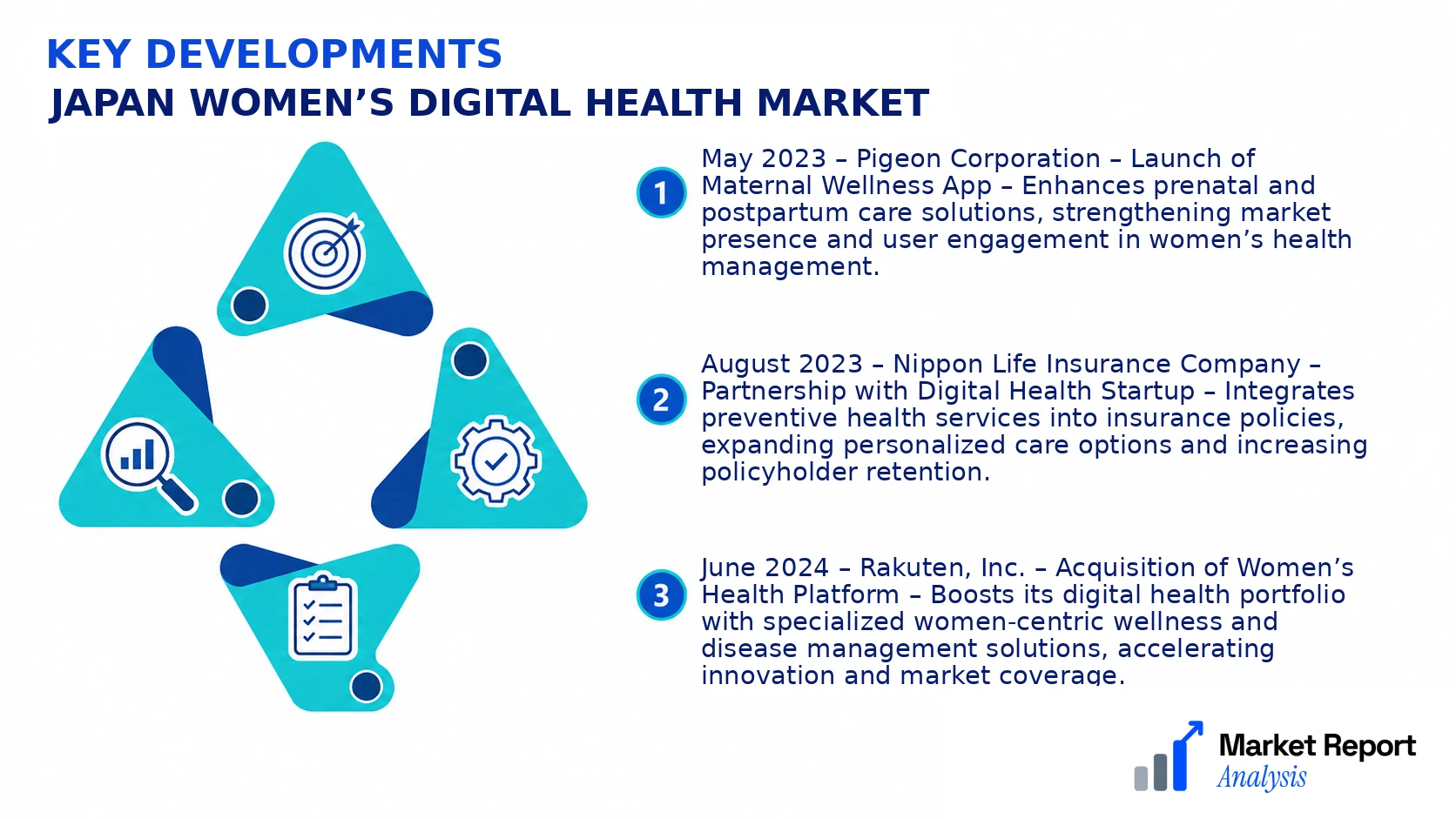
- May 2023 – Pigeon Corporation – Launch of Maternal Wellness App – Enhances prenatal and postpartum care solutions, strengthening market presence and user engagement in women’s health management.
- August 2023 – Nippon Life Insurance Company – Partnership with Digital Health Startup – Integrates preventive health services into insurance policies, expanding personalized care options and increasing policyholder retention.
- June 2024 – Rakuten, Inc. – Acquisition of Women’s Health Platform – Boosts its digital health portfolio with specialized women-centric wellness and disease management solutions, accelerating innovation and market coverage.
- January 2024 – SoftBank Corp. – Investment in IoT Women’s Health Devices – Supports development of advanced wearable health monitoring devices designed specifically for women’s reproductive health tracking.
- April 2024 – Medley, Inc. – Introduction of Virtual Fertility Clinic – Facilitates remote reproductive health consultations, reducing barriers to access and providing tailored therapy options for Japanese women.
Frequently Asked Questions
What is the Japan Women’s Digital Health Market?
The Japan Women’s Digital Health Market encompasses digital solutions like mobile apps, telehealth, wearables, and online platforms tailored specifically for women’s health in Japan. It aims to improve healthcare access, personalized treatment, and health monitoring for women across the country.
What is the current market size of Japan Women’s Digital Health Market?
As of 2026, the Japan Women’s Digital Health Market is valued at approximately USD 4.2 Billion, reflecting rapid adoption of digital health technologies and increasing focus on women's health issues, supported by government initiatives and rising consumer awareness.
What factors are driving the Japan Women’s Digital Health Market?
Key drivers include increased smartphone penetration, a growing awareness of women’s health issues, advancements in digital health technologies, supportive government policies, and the rising prevalence of chronic diseases among women, fueling demand for personalized digital health solutions.
Which region dominates the Japan Women’s Digital Health Market?
Tokyo Metropolitan Area dominates the market due to its concentrated healthcare infrastructure, higher digital literacy levels, and the presence of major healthcare and technology companies, making it the primary hub for women’s digital health innovations.
Which segment is expected to grow the fastest?
The mobile health applications segment is projected to grow at the highest CAGR, driven by user-friendly interfaces, real-time health monitoring capabilities, and increasing smartphone adoption among women seeking accessible healthcare solutions across Japan.
Who are the leading companies operating in the Japan Women’s Digital Health Market?
Leading companies include multinational tech giants, local startups, and healthcare providers such as Sony Corporation, Rakuten Medical, and various emerging startups focusing on women’s health apps, telehealth, and wearable devices, fueling innovation and competitiveness in the market.
Analyst Perspective
The Japan Women’s Digital Health Market is poised for sustained growth, driven by increasing digital adoption among women and supportive government policies focused on women’s health. Long-term, the market will benefit from technological advancements such as AI-driven diagnostics, personalized healthcare solutions, and telehealth platforms tailored to women's specific needs, including reproductive and mental health services. Commercial opportunities lie in developing specialized apps, remote monitoring devices, and culturally sensitive content that address unmet needs. Investment priorities should target innovative startups specializing in data analytics and integrated health platforms, along with expanding reach in regional cities beyond Tokyo and Osaka, where underserved populations present growth potential. Competitive dynamics will intensify, with both large tech firms and niche players competing for market share. Regional growth will be driven by high smartphone penetration and digital literacy, positioning cities like Sapporo and Fukuoka as emerging hubs. Overall, strategic investments should emphasize technological scalability, regulatory compliance, and regional customization to sustain competitive advantage in Japan’s evolving digital health landscape.
