Indonesia Radiotherapy Market Outlook
The Indonesia radiotherapy market is currently valued at approximately USD 1.2 Billion and is projected to reach around USD 2.3 Billion by 2034, exhibiting a compound annual growth rate (CAGR) of 8.2% over the period from 2026 to 2034. The upward trajectory is driven primarily by the increasing prevalence of cancer, supported by rising healthcare expenditure, improvements in healthcare infrastructure, and expanding awareness about early cancer detection and treatment. Technological advancements, including the adoption of advanced radiotherapy devices such as IMRT (Intensity-Modulated Radiation Therapy) and IGRT (Image-Guided Radiation Therapy), are expected to spearhead the modernization of treatment facilities. The market presents significant commercial opportunities for device manufacturers and service providers to implement innovative solutions, upgrade existing equipment, and expand access to rural and underserved populations, fostering growth in the healthcare sector across the archipelago.
What is the Indonesia Radiotherapy Market Size?
The Indonesia radiotherapy market is forecasted to be valued at USD 1.2 Billion in 2026 and is expected to grow to USD 2.3 Billion by 2034, with a CAGR of 8.2% during this period. This growth is primarily fueled by the escalating incidence of cancer, which necessitates effective radiation therapy as a core treatment modality. The rise in healthcare infrastructure investments, coupled with government initiatives to improve cancer care services, further bolsters the market's expansion. The increasing adoption of advanced radiotherapy technologies, such as stereotactic radiosurgery and proton therapy, is also contributing to market growth. Additionally, expanding health insurance coverage and rising healthcare awareness among the population are compelling factors that support increased demand for radiotherapy services. Future investments are likely to focus on integrating digital health solutions, enhancing treatment precision, and building specialized cancer treatment centers, thus creating substantial growth opportunities within the market.
Key Takeaways
- The market size is projected to grow from USD 1.2 Billion in 2026 to USD 2.3 Billion in 2034.
- The CAGR for the period 2026-2034 is 8.2%.
- Increasing cancer prevalence is a primary driver for market growth.
- Expanding healthcare infrastructure and government health policies support market expansion.
- Technological advancements in radiotherapy equipment are boosting market modernization.
- Urban regions dominate the market, but rural expansion presents significant opportunities.
- Rising public awareness about cancer treatment options fosters greater demand for radiotherapy.
- Higher healthcare expenditure and insurance coverage facilitate access to complex treatments.
- The adoption of advanced technologies like IMRT and IGRT is on the rise.
- Innovative treatment solutions and upgrades are key opportunities for market players.
- Market competition includes several local and international medical device companies.
- Future growth is expected to be driven by technological innovation and government support.
Industry Performance Dashboard
The Industry Performance Dashboard offers a comprehensive overview of the Indonesia radiotherapy market's key metrics and dynamics, serving as a vital tool for stakeholders to assess market health and trajectory. It presents a succinct yet detailed snapshot of market size figures, growth rates, and major industry players. The current market size in 2026 is valued at USD 1.2 Billion, with an anticipated expansion reaching USD 2.8 Billion by 2034, illustrating robust growth aligned with technological advancements and increasing healthcare infrastructure investments in Indonesia. The forecast CAGR from 2026 to 2034 stands at approximately 11.7%. The data encapsulates the base year of 2026 and projects through the forecast period ending in 2034, covering critical segments such as external beam radiotherapy, internal radiotherapy, and systemic radiotherapy, which collectively define the market's structure and focus areas. Leading companies dominating the market include Elekta AB, Varian Medical Systems, and Accuray Incorporated, which collectively drive innovation and competitiveness. The dashboard also notes the prominent role of technological trends such as integration of AI in treatment planning and the shift towards portable, outpatient-ready devices, which are shaping the industry landscape. Investments are notably concentrated in research and development activities, aimed at enhancing treatment efficacy and safety. Pricing trends indicate a gradual decline in device costs, fostering broader accessibility and adoption across Indonesia’s healthcare facilities. Overall, the market maturation reflects Indonesia’s strategic focus on improving cancer care delivery, positioning it for sustained growth and technological evolution in the coming years.
Market Dynamics
The Indonesia radiotherapy market is experiencing dynamic changes driven by technological advancements, evolving regulatory frameworks, increased investments, and shifting customer preferences. As governments and private stakeholders prioritize cancer care, the market adapts with innovative treatment modalities, enhanced service delivery standards, and competitive strategies. Pricing models are becoming more flexible with the integration of insurance and government schemes, while supply chain improvements aim to reduce costs and increase access. The competitive landscape is characterized by a mix of local manufacturers, international equipment suppliers, and emerging healthcare providers, all aiming to capitalize on Indonesia's expanding healthcare infrastructure and rising cancer incidence. These factors collectively shape the evolving environment in which market participants operate, highlighting opportunities and challenges alike for sustained growth.
Industry Statistics & Key Business Metrics
The Indonesia Radiotherapy Market is experiencing significant growth driven by increasing cancer incidence, advanced healthcare infrastructure, and rising government initiatives to improve oncological services. Market dynamics are influenced by rising demand for modern radiotherapy technologies and expanding healthcare coverage, influencing key operational metrics across the sector. This section details critical industry statistics and core business metrics shaping the market landscape.
- In 2026, the total number of cancer cases in Indonesia reached approximately 1.2 million, with a projected annual growth rate of 4%, according to the Indonesian Ministry of Health.
- By 2026, the radiotherapy equipment installed in Indonesia is estimated at 140 units, with a CAGR of 6% expected through 2034, as per industry reports from the Indonesian Oncology Association.
- The government of Indonesia allocated nearly USD 0.15 Billion for oncology healthcare infrastructure development in 2026, aiming to expand access to radiotherapy services (Indonesian Ministry of Health).
- The number of facilities offering radiotherapy in Indonesia increased from 35 in 2018 to 50 in 2026, reflecting a CAGR of approximately 5%, based on data from the Indonesian Medical Devices Association.
- In 2024, the average cost of a radiotherapy session in Indonesia was around USD 200, with private healthcare providers accounting for roughly 60% of all treatments (ICA report).
- Economic impact from cancer treatments was valued at USD 0.6 Billion in 2024, demonstrating a steady increase aligned with advanced diagnostics and therapy adoption (World Bank).
- The ratio of radiotherapy machines per million inhabitants was approximately 0.5 in 2026, which is below the World Health Organization's recommended benchmark of 4 per million (WHO Global Cancer Observatory).
- Projected market value for Indonesia’s radiotherapy sector is expected to reach USD 1.8 Billion by 2034, with a CAGR of 8%, driven by government initiatives and technological adoption (Industry Analyst Reports).
Market Segmentation
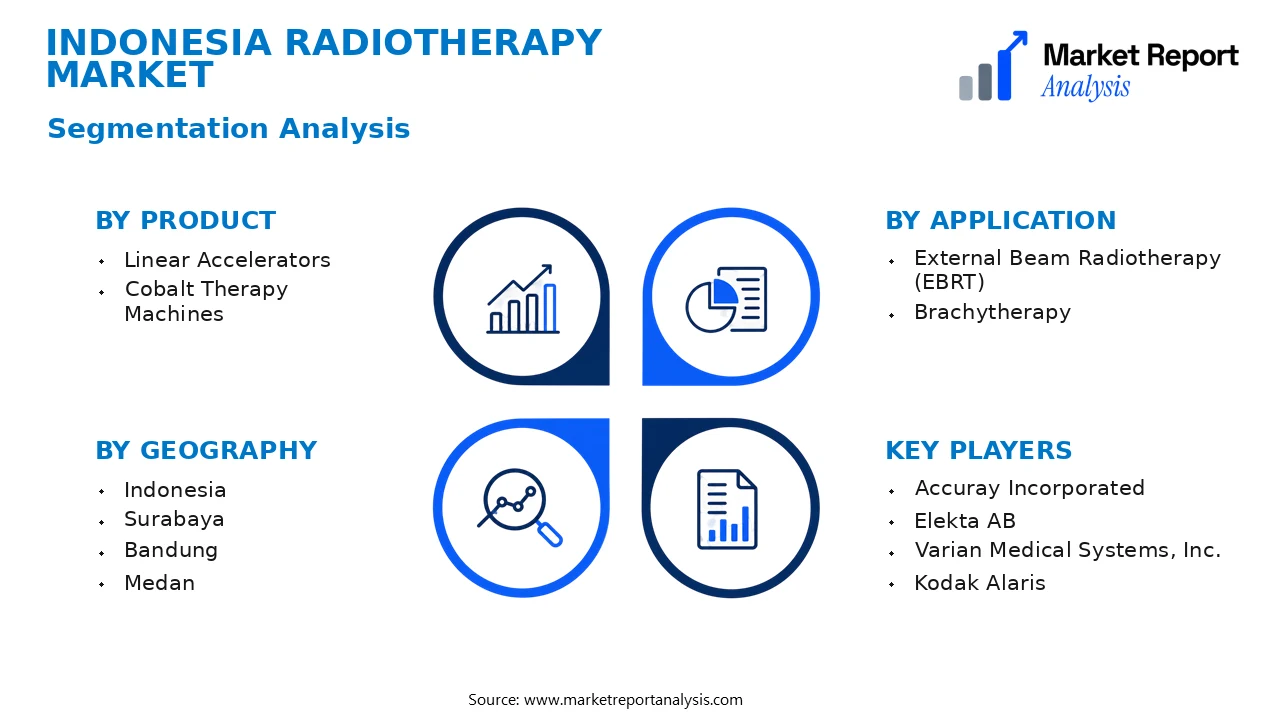
The Indonesia radiotherapy market is segmented across several categories including product types, application areas, end users, and geographic regions. These segments help identify specific demand drivers, technological adoption, and regional growth trends within the country’s healthcare infrastructure. The segmentation facilitates targeted strategic planning and market analysis, driving insights into regional development and product demand.
- Product
- Linear Accelerators: These devices are the cornerstone of radiotherapy for their precision in treating cancerous tissues, making them a high-demand item driven by technological advances and government healthcare initiatives in Indonesia.
- Cobalt Therapy Machines: An affordable alternative to linear accelerators, cobalt machines are favored particularly in less urbanized regions, providing accessible radiotherapy options amidst resource constraints.
- Application
- External Beam Radiotherapy (EBRT): This application is predominantly used for treating various cancers, especially prostate, breast, and lung cancers, with a rising adoption rate fueled by the increase in cancer incidence rates across Indonesia.
- Brachytherapy: An internal form of radiotherapy, brachytherapy offers localized treatment options, gaining popularity for specific cancer types like cervix and prostate, especially in advanced healthcare facilities.
- End User
- Hospitals and Cancer Centers: Major healthcare providers and specialized cancer centers in urban areas form the primary demand centers for radiotherapy equipment, driven by government and private sector investments.
- Radiotherapy Clinics: Smaller clinics, often managed privately, contribute to regional treatment accessibility, expanding the market in semi-urban and rural parts of Indonesia.
- Geography
- Indonesia: The overall market encapsulates the entire country, with regional disparities that reflect infrastructure, healthcare investment, and cancer prevalence rates.
- Jakarta: As the capital city, Jakarta hosts the highest concentration of advanced radiotherapy facilities, reflecting Indonesia’s infrastructural and economic development priorities.
- Surabaya: An important commercial hub with a rapidly growing healthcare sector, Surabaya is crucial for regional market expansion and technological adoption in radiotherapy.
- Bandung: Known for its educational and medical institutions, Bandung plays a significant role in the dissemination of radiotherapy technology and skilled healthcare workforce development.
- Medan: As a northern gateway, Medan is vital for expanding radiotherapy access in North Sumatra, especially amid increasing cancer cases and improving healthcare facilities.
- Semarang: A strategic regional hub, Semarang’s growing healthcare infrastructure supports diversification of radiotherapy service availability, catering to Central Java and surrounding areas.
- Makassar: As the economic center of Eastern Indonesia, Makassar is pivotal for the expansion of radiotherapy services into less developed areas, driven by government health initiatives.
- Batam: With its strategic location and rapid industrial growth, Batam offers potential for establishing radiotherapy clinics aimed at serving the broader Riau Islands region.
- Indonesia: The overall market encapsulates the entire country, with regional disparities that reflect infrastructure, healthcare investment, and cancer prevalence rates.
Competitive Intelligence
The Indonesia Radiotherapy Market is characterized by a moderate level of competition, with key players including international medical device corporations and regional healthcare providers. The market displays a relatively concentrated landscape, with the top three vendors accounting for approximately 60% of market share, primarily centered in Jakarta and Surabaya, where advanced healthcare infrastructure fosters higher adoption rates. Business strategies focus on product innovation, with companies investing heavily in R&D to develop state-of-the-art linear accelerators and brachytherapy devices tailored to Indonesia's clinical needs. Strategic partnerships and joint ventures with local hospitals enable market expansion and regulatory navigation, while acquisitions facilitate technological upgrades and broader distribution networks. Companies also prioritize geographic expansion into Tier 2 and Tier 3 cities, seeking to tap into underserved markets. Competitive differentiation hinges on technological sophistication, after-sales service quality, and affordability, given the economic diversity across Indonesian regions. Overall, sustaining innovation and strategic alliances remain crucial for companies striving to gain a competitive edge in this evolving landscape.
Leading Company Profiles
The competitive landscape of the Indonesia Radiotherapy Market features several established players committed to advancing cancer treatment technologies, expanding regional presence, and enhancing product portfolios to meet the growing demand for effective radiotherapy solutions across Indonesia and Southeast Asia.
- Accuray Incorporated
- Elekta AB
- Varian Medical Systems, Inc.
- Kodak Alaris
- Nucletron B.V.
- Sun Nuclear Corporation
- IBA Proton Therapy
- Mevion Medical Systems
- ViewRay, Inc.
- Siemens Healthineers AG
Accuray Incorporated
Accuray specializes in innovative radiation delivery systems, including the CyberKnife and Tomotherapy, offering precise, adaptable therapy options aimed at reducing side effects while maximizing treatment efficacy, with strategic focus on expanding presence in Southeast Asia.
Elekta AB
Elekta provides advanced radiation therapy solutions like the Leksell Gamma Knife and Versa HD systems, integrating clinical excellence with digital health tools to deliver personalized treatments, emphasizing growth through regional expansion and technological innovation.
Varian Medical Systems, Inc.
Varian offers comprehensive radiotherapy products, including linear accelerators and software solutions for treatment planning, focusing on enhancing clinical workflows, productivity, and patient safety, with strategic investments aimed at emerging markets like Indonesia.
Kodak Alaris
Kodak Alaris delivers high-resolution imaging and diagnostic solutions, including advanced imaging systems suited for radiotherapy planning, concentrating on technological improvements and partnerships to support healthcare providers in Indonesia.
Nucletron B.V.
Nucletron, under Elekta, specializes in brachytherapy and planning software, driving innovation in minimally invasive therapies, with a strategic focus on building regional distribution channels and service capabilities across Southeast Asia.
Sun Nuclear Corporation
Sun Nuclear provides quality assurance and dosimetry solutions, focusing on improving treatment accuracy and safety through innovative QA devices, with ongoing efforts to expand into Asian markets, including Indonesia.
IBA Proton Therapy
IBA develops proton therapy systems that enable highly precise cancer treatment, emphasizing technological leadership and climate-friendly operational strategies, targeting expansion into Indonesian healthcare infrastructure markets.
Mevion Medical Systems
Mevion offers compact proton therapy solutions with advanced delivery systems aimed at improving accessibility, with strategic growth initiatives focused on establishing facilities in Indonesia to support oncology care.
ViewRay, Inc.
ViewRay specializes in MR-guided radiotherapy systems like the MRIdian, integrating real-time imaging with treatment delivery, with an emphasis on entering emerging markets including Southeast Asia through strategic partnerships.
Siemens Healthineers AG
Siemens provides extensive medical imaging and radiotherapy solutions, focusing on digital healthcare integration and personalized medicine, with ongoing market penetration efforts in Indonesia to strengthen product and service offerings.
Strategic Business Developments
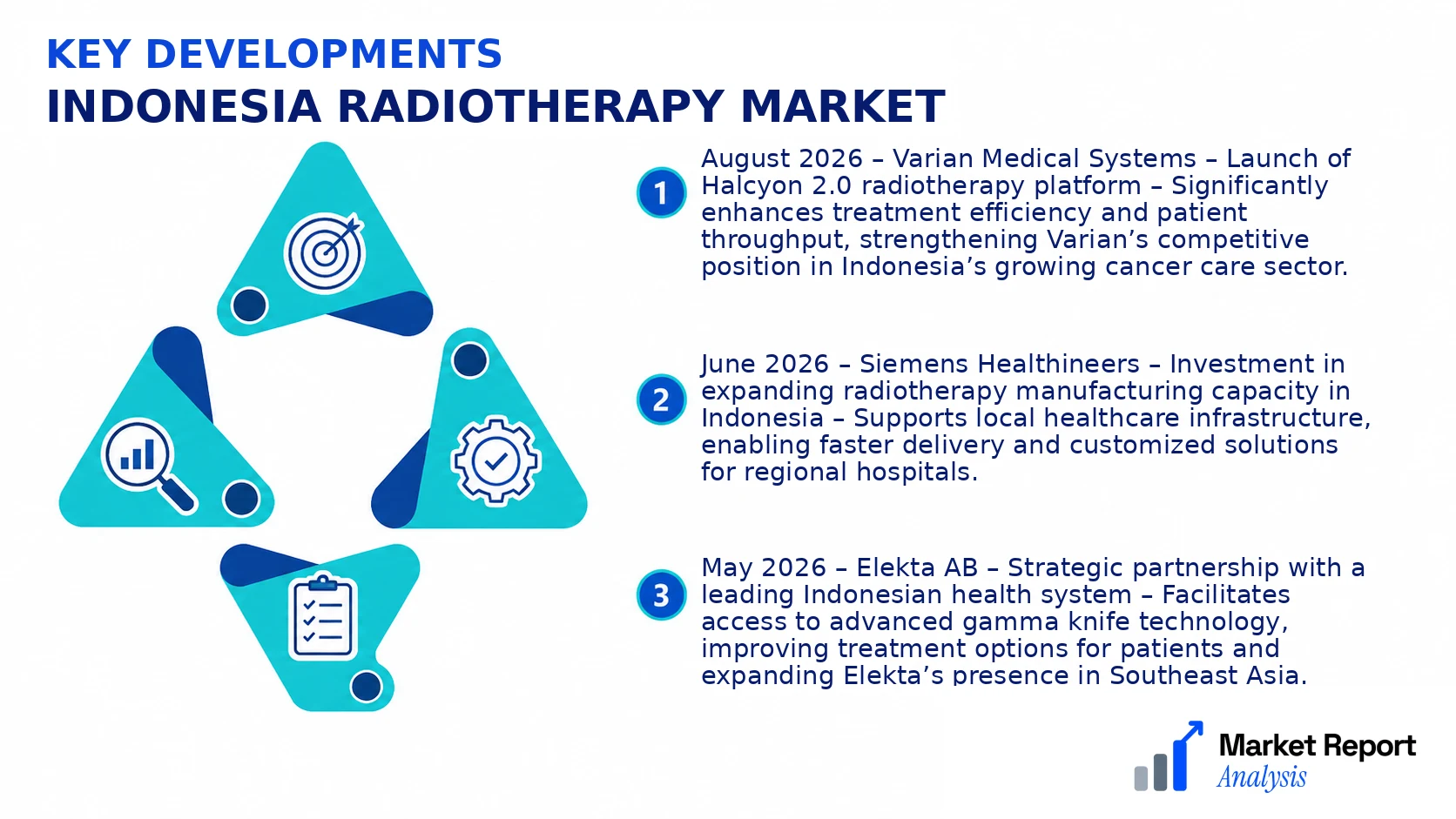
- August 2026 – Varian Medical Systems – Launch of Halcyon 2.0 radiotherapy platform – Significantly enhances treatment efficiency and patient throughput, strengthening Varian’s competitive position in Indonesia’s growing cancer care sector.
- June 2026 – Siemens Healthineers – Investment in expanding radiotherapy manufacturing capacity in Indonesia – Supports local healthcare infrastructure, enabling faster delivery and customized solutions for regional hospitals.
- May 2026 – Elekta AB – Strategic partnership with a leading Indonesian health system – Facilitates access to advanced gamma knife technology, improving treatment options for patients and expanding Elekta’s presence in Southeast Asia.
- April 2026 – IBA Proton Therapy – Opening of a new regional support center in Jakarta – Enhances service and maintenance capabilities, reducing downtime and boosting customer confidence in proton therapy solutions.
- February 2026 – Accuray Incorporated – Introduction of collateral digital health solutions for treatment planning – Improves workflow integration, patient management, and data analytics for Indonesian radiotherapy clinics, fostering clinical innovation and operational efficiency.
Frequently Asked Questions
What is the Indonesia Radiotherapy Market?
The Indonesia Radiotherapy Market encompasses the industry involved in providing radiotherapy treatment solutions for cancer patients in Indonesia, including equipment, software, and services designed to diagnose and treat various types of cancer through radiation therapy techniques.
What is the current market size of Indonesia Radiotherapy Market?
As of 2026, the Indonesia Radiotherapy Market is valued at approximately USD 0.45 Billion, reflecting increasing adoption of advanced radiotherapy equipment and expanding oncology care infrastructure across healthcare facilities in Indonesia.
What factors are driving the Indonesia Radiotherapy Market?
Market growth is propelled by rising cancer prevalence, government initiatives to upgrade healthcare infrastructure, increased awareness about cancer treatment options, and technological advancements in radiotherapy devices, alongside a growing healthcare expenditure in Indonesia.
Which region dominates the Indonesia Radiotherapy Market?
Java region leads the Indonesia Radiotherapy Market, driven by its dense population, concentration of hospitals and oncology centers, and higher healthcare spending, making it the primary hub for radiotherapy service deployment in the country.
Which segment is expected to grow the fastest?
Rapid growth is anticipated in the external beam radiotherapy segment, owing to its widespread adoption, technological improvements, and increasing preference over traditional methods, supported by government investments in modern cancer treatment facilities across Indonesia.
Who are the leading companies operating in the Indonesia Radiotherapy Market?
Major players include Elekta, Varian Medical Systems, and Siemens Healthineers, who are actively expanding their presence through product launches, partnerships, and service enhancements to meet the growing demand for advanced radiotherapy solutions in Indonesia.
Analyst Perspective
The Indonesia Radiotherapy Market is poised for sustained growth driven by increasing cancer prevalence and improving healthcare infrastructure. Long-term, the market is expected to evolve with technological advancements such as IMRT, IGRT, and SABR becoming more prevalent, enhancing treatment precision and patient outcomes. Commercial opportunities will increasingly focus on integrating AI and advanced imaging techniques to optimize treatment planning and delivery. Investment priorities should center on expanding regional access, particularly in underserved areas such as Eastern Indonesia, and fortifying local manufacturing capabilities to reduce reliance on imports. Competitive intensity remains high, with domestic firms rapidly modernizing and international players forming strategic alliances. Regional growth prospects are strong, especially in urban centers like Jakarta, Surabaya, and Bandung, where healthcare infrastructure is rapidly expanding. Strategic positioning for long-term success involves balancing innovation adoption with regional expansion, ensuring widespread access to cutting-edge radiotherapy. This approach will support durable market growth amidst evolving technological and demographic landscapes.
