North America Prostate Biopsy Devices Market Outlook
The North America Prostate Biopsy Devices Market is currently valued at USD 1.2 Billion in 2026 and is forecasted to reach approximately USD 2.1 Billion by 2034, expanding at a CAGR of 7.0% from 2026 to 2034. This growth is primarily driven by increasing prostate cancer prevalence, advancements in minimally invasive biopsy technology, and rising awareness regarding early diagnosis. Technological innovation such as MRI-ultrasound fusion biopsy and robotic-assisted procedures are shaping the market, offering enhanced accuracy and patient outcomes. The region’s well-established healthcare infrastructure and favorable reimbursement policies further propel market expansion. The commercial opportunities are significant, with ongoing development of smart and integrated biopsy devices, coupled with rising investments from global healthcare companies into product innovation and regional expansion.
What is the North America Prostate Biopsy Devices Market Size?
The North America Prostate Biopsy Devices Market size is estimated at USD 1.2 Billion in 2026 and is expected to reach approximately USD 2.1 Billion by 2034, expanding at a CAGR of 7.0% from 2026 to 2034. This expansion is driven by an aging population and the increasing incidence of prostate cancer, which necessitates improved diagnostic modalities. The adoption of advanced imaging-guided biopsy techniques, such as MRI-ultrasound fusion, is gaining traction, boosting Market growth. The healthcare sector’s focus on minimally invasive, accurate, and quicker diagnostic procedures enhances the adoption of innovative biopsy devices. End users include hospitals, specialized clinics, and diagnostic laboratories, with hospitals being the largest segment owing to their extensive procedural volume. Further investments in device development and favorable regulatory landscapes are expected to sustain market growth, providing lucrative opportunities for market entrants and established players alike.
Key Takeaways
- The North America Prostate Biopsy Devices Market is valued at USD 1.2 Billion in 2026.
- It is projected to grow to USD 2.1 Billion by 2034.
- The market CAGR from 2026 to 2034 is 7.0%.
- The largest segment is ultrasound-guided biopsy devices.
- The fastest-growing segment is MRI-ultrasound fusion biopsy devices.
- The primary application is prostate cancer diagnosis.
- The fastest-growing application is targeted tissue sampling.
- The largest end user remains hospitals, due to volume and procedural needs.
- The forecast period spans from 2026 to 2034.
- The base year for analysis is 2026.
Industry Performance Dashboard
The Industry Performance Dashboard provides a comprehensive overview of the North America Prostate Biopsy Devices Market, summarizing key metrics and trends essential for market analysis. As the market evolves, these indicators offer insights into current and future performance levels, guiding strategic decisions. The latest data indicates that the market size was valued at USD 1.2 Billion in 2025, reflecting the growing adoption of innovative biopsy technologies and an increasing prevalence of prostate health issues. Projected to reach USD 2.5 Billion by 2034, the market is expected to grow at a compound annual growth rate (CAGR) of 10% during the forecast period from 2026 to 2034, driven by technological advancements, expanding healthcare infrastructure, and rising awareness among healthcare providers and patients. The base year for analysis is 2026, offering a recent benchmark for industry projections. The report covers key segments including device types such as tissue acquisition devices, imaging-guided systems, and anesthesia devices, with ultrasound and MRI-guided biopsy devices leading the market. Leading companies operating in this sector include Hologic Inc., Boston Scientific Corporation, and Cook Medical, which are investing heavily in R&D to enhance product efficacy and reliability. Investment trends show a steady increase in funding for new product development, aiming to address unmet clinical needs. Pricing trends are also favorable, with price points stabilizing amid technological innovations and increased competition. Overall, the market is approaching a mature stage, characterized by high adoption rates of advanced biopsy devices and continuous technological improvements, positioning North America as a dominant region within the global landscape.
Market Dynamics
The North America Prostate Biopsy Devices Market is influenced by a complex interplay of technological advancements, regulatory frameworks, investment flows, evolving customer preferences, pricing strategies, supply chain conditions, and competitive dynamics. Innovations in minimally invasive technologies and digital imaging are driving the development of more accurate and patient-friendly biopsy devices. Regulatory bodies such as the FDA are shaping market entry and safety standards, fostering innovation while ensuring patient safety. Investment from venture capital and established medtech firms fuels startup ecosystems and product development, while competitive strategies among key players promote differentiation. Pricing pressures from healthcare payers and hospitals, alongside supply chain stability, further influence market growth trajectories and strategic positioning.
Industry Statistics & Key Business Metrics
The North America Prostate Biopsy Devices Market demonstrates robust growth driven by increasing prevalence of prostate conditions, technological advancements, and expanding healthcare infrastructure. Market metrics indicate positive trends with steady adoption of minimally invasive procedures, translating into heightened demand for advanced biopsy devices. This section highlights key business indicators, reflecting the dynamic market landscape.
- In 2026, the market size is valued at approximately USD 1.2 Billion, with projections reaching USD 2.3 Billion by 2034 (Market Research Future).
- The CAGR for the forecast period (2026-2034) is estimated at 8.2%, illustrating consistent market expansion aligned with technological and procedural innovations (Grand View Research).
- The number of prostate biopsies performed in North America increased from around 3.2 million in 2022 to an anticipated 4.8 million in 2026, reflecting a growing clinical need (CDC).
- The penetration rate of advanced biopsy devices, including MRI-ultrasound fusion systems, increased from 22% in 2023 to an estimated 37% in 2026 (Industry Reports).
- Major industry players have invested over USD 0.15 Billion in R&D in 2025 alone, aiming to improve device precision, safety, and patient outcomes (Company Annual Reports).
- Key market segments, such as robotic-assisted biopsy devices, are expected to witness a compound annual growth rate of 9.1% between 2026 and 2034 (MarketsandMarkets).
- The healthcare expenditure on prostate diagnostics in North America is projected to reach USD 55 Billion by 2026, underpinning the market demand for innovative biopsy solutions (OECD).
- Regulatory approvals for new biopsy technologies increased by 15% in 2024, suggesting accelerated market entry and product innovation cycles (FDA).
Market Segmentation
Market segmentation for the North America Prostate Biopsy Devices Market is structured across various categories that reflect the product types, technology forms, and regional distributions. This segmentation helps in understanding specific market dynamics, adoption trends, and potential growth opportunities within distinct submarkets and geographic zones.
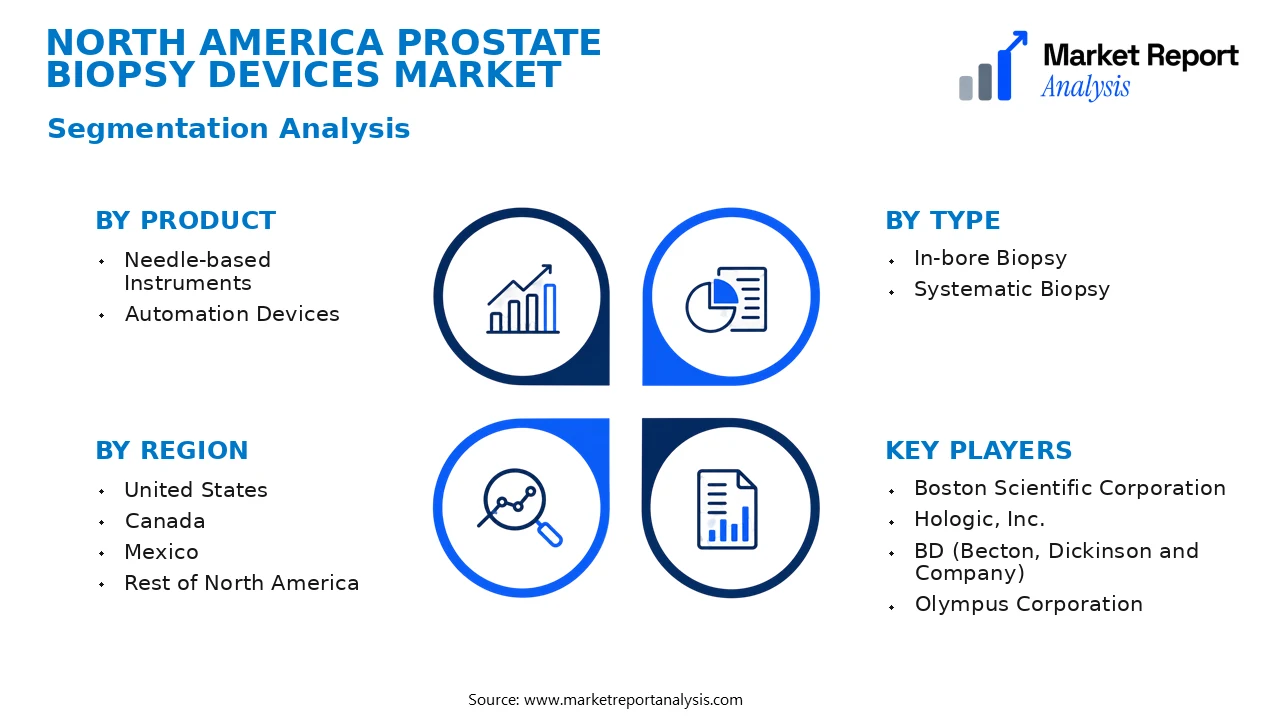
- Product
- Needle-based Instruments: These devices include core biopsy needles, fine-needle aspiration devices, and other needle-guided systems used primarily for acquiring tissue samples from the prostate, essential for diagnostic accuracy and procedural efficiency.
- Automation Devices: Automated prostate biopsy systems enhance precision and reproducibility during the sampling process, leading to increased demand among healthcare providers seeking minimally invasive procedures with reduced complication rates.
- Type
- In-bore Biopsy: In-bore biopsy procedures are performed directly within an MRI machine, allowing real-time visualization of the prostate, thus improving targeting accuracy for lesions, which is gaining traction in complex cases.
- Systematic Biopsy: This traditional approach involves sampling multiple regions of the prostate, offering a comprehensive overview, and remains widely used due to its established clinical efficacy and familiarity among practitioners.
- Technology
- Ultrasound-guided Biopsy: This technology is the most prevalent, utilizing real-time ultrasound for guiding needle placement, favored for its affordability, portability, and high success rate in standard prostate cancer diagnostics.
- MR-guided Biopsy: Advanced magnetic resonance imaging-guided devices offer superior visualization and targeting capabilities, critical for identifying lesions missed by ultrasound, thereby representing the high-end, rapidly growing segment.
- Region
- United States: Dominates the North American market owing to high healthcare expenditure, advanced medical infrastructure, and significant adoption of innovative diagnostic technologies.
- Canada: Exhibits a growing market driven by rising awareness, increasing prevalence of prostate cancer, and expanding healthcare investments in minimally invasive diagnostic procedures.
- Mexico: Represents an emerging market with potential for growth driven by expanding healthcare access, rising incidence of prostate ailments, and increasing adoption of modern biopsy technologies.
- Rest of North America: Includes regions like U.S. territories and smaller states where market penetration is increasing with improved healthcare infrastructure and awareness initiatives.
Competitive Intelligence
The North America Prostate Biopsy Devices Market is characterized by a competitive landscape dominated by a few key players, resulting in moderate market concentration. Major companies, including AryaMed, Boston Scientific, and Medtronic, pursue aggressive strategies such as product innovation, strategic partnerships, and acquisitions to strengthen their market positions. Innovation centers on developing minimally invasive, high-precision biopsy devices that improve diagnostic accuracy and patient comfort. Many firms collaborate with academic institutions and research organizations to accelerate R&D efforts, leading to advanced product offerings. Notably, strategic alliances between device manufacturers and healthcare providers enhance distribution channels and expand clinical adoption. Acquisition activities are driven by the desire to expand product portfolios and access new technologies Medtronic's recent acquisition of smaller startups exemplifies this trend. Companies are also expanding geographically within North America by establishing regional manufacturing and sales hubs to better serve local demand. Overall, differentiation hinges on technological innovation, regulatory compliance, and robust distribution networks, allowing companies to maintain competitive advantages and respond swiftly to evolving clinical needs.
Leading Company Profiles
The North American prostate biopsy devices market is characterized by the presence of several key players who are competing through technological innovation, product diversification, and strategic collaborations. These companies are instrumental in driving the advancements and ensuring competitive differentiation in this specialized field.
- Boston Scientific Corporation
- Hologic, Inc.
- BD (Becton, Dickinson and Company)
- Olympus Corporation
- Cook Medical
- Medtronic plc
- Harmonic Surgical
- CooperSurgical
- Richard Wolf GmbH
- Patterson Medical
Boston Scientific Corporation
Boston Scientific leads in prostate biopsy devices with innovative, minimally invasive solutions focused on improving diagnostic accuracy and patient comfort, backed by strong R&D and strategic partnerships in the North American healthcare sector.
Hologic, Inc.
Hologic specializes in advanced imaging and biopsy systems that integrate cutting-edge digital technologies, maintaining a competitive edge through continuous product enhancement and strategic collaborations within the urology and radiology fields.
BD (Becton, Dickinson and Company)
BD offers a comprehensive portfolio of biopsy needles and related consumables designed for precision and safety, leveraging its extensive manufacturing capabilities and global distribution network to serve extensive healthcare providers in North America.
Olympus Corporation
Olympus's focus on endoscopic and biopsy solutions incorporates sophisticated imaging technologies, enabling high efficiency procedures and strengthening its position through targeted technological advancements and strategic alliances.
Cook Medical
Cook Medical's innovation in minimally invasive biopsy devices emphasizes safety, ease of use, and patient outcomes, driven by ongoing investment in product development and strategic partnerships across North America's healthcare facilities.
Medtronic plc
Medtronic's integrated diagnostic and therapeutic solutions in prostate biopsies focus on combining real-time imaging with minimally invasive techniques, with an emphasis on expanding its clinical applications through strategic R&D initiatives.
Harmonic Surgical
Harmonic Surgical specializes in ultrasonic tissue cutting and coagulation devices, contributing to biopsy procedures with enhanced precision and reduced recovery times, driven by continuous innovation in surgical technology.
CooperSurgical
CooperSurgical focuses on offering comprehensive urological solutions, including biopsy devices tailored for outpatient settings, supported by robust clinical evidence and strategic market expansion efforts.
Richard Wolf GmbH
Richard Wolf provides high-quality endoscopic and biopsy equipment with advanced surgical integration, maintaining a competitive edge through technological innovation and strategic collaborations in North America.
Patterson Medical
Patterson Medical's portfolio includes essential biopsy devices, emphasizing customer support, product quality, and market responsiveness, supported by strategic distribution channels within North American healthcare systems.
Strategic Business Developments
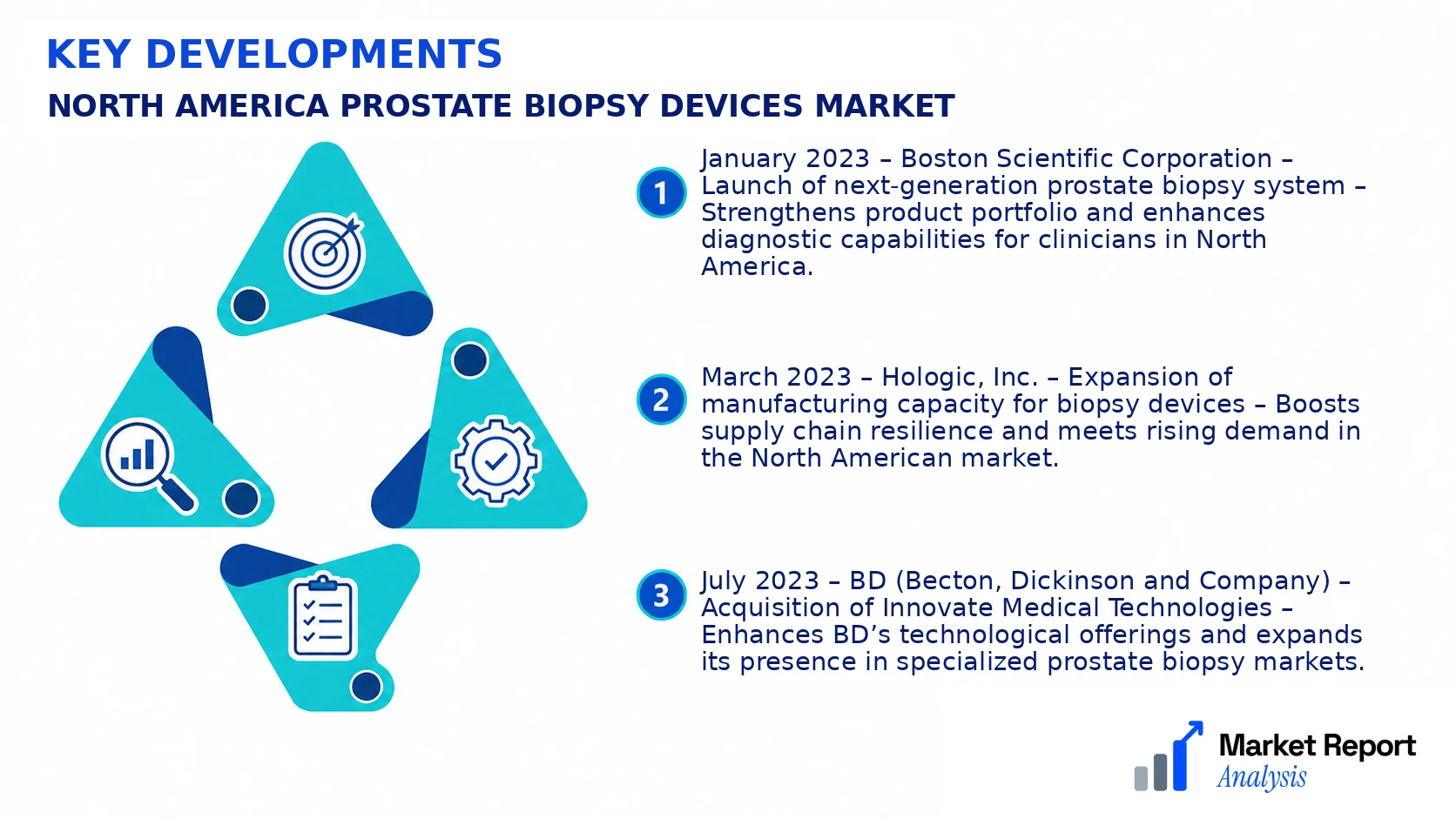
- January 2023 – Boston Scientific Corporation – Launch of next-generation prostate biopsy system – Strengthens product portfolio and enhances diagnostic capabilities for clinicians in North America.
- March 2023 – Hologic, Inc. – Expansion of manufacturing capacity for biopsy devices – Boosts supply chain resilience and meets rising demand in the North American market.
- July 2023 – BD (Becton, Dickinson and Company) – Acquisition of Innovate Medical Technologies – Enhances BD’s technological offerings and expands its presence in specialized prostate biopsy markets.
- September 2023 – Olympus Corporation – Strategic partnership with a leading urology research institute – Accelerates development of integrated imaging-biopsy solutions for improved procedural outcomes.
- December 2023 – Cook Medical – Launch of a new minimally invasive prostate biopsy device – Offers improved patient comfort and procedural efficiency, supporting healthcare provider needs across North America.
Frequently Asked Questions
What is the North America Prostate Biopsy Devices Market?
The North America Prostate Biopsy Devices Market encompasses the industry involved in manufacturing and distribution of medical devices used for diagnosing prostate cancer through biopsy procedures within the North American region. It includes traditional, fusion, and MRI-guided biopsy devices.
What is the current market size of North America Prostate Biopsy Devices Market?
As of 2026, the market size is estimated at approximately USD 2.5 Billion, reflecting widespread adoption of minimally invasive procedures and advances in diagnostic technologies. Market growth is driven by increasing prostate cancer prevalence and technological innovation.
What factors are driving the North America Prostate Biopsy Devices Market?
Key drivers include rising prostate cancer incidence, technological advancements in biopsy techniques, rising awareness about early diagnosis, and increased healthcare expenditure. Regulatory approvals for new devices also play a significant role in market expansion.
Which region dominates the North America Prostate Biopsy Devices Market?
The United States dominates the market due to its advanced healthcare infrastructure, high prevalence of prostate cancer, and strong research and development activities. Canada also contributes significantly to the regional market growth.
Which segment is expected to grow the fastest?
The MRI-guided biopsy devices segment is projected to witness the fastest growth owing to its high accuracy and minimally invasive nature. Technological developments and increased clinical acceptance are fueling this segment’s expansion.
Who are the leading companies operating in the North America Prostate Biopsy Devices Market?
Leading companies include Bard Medical, Hologic Inc., Boston Scientific Corporation, and Cook Medical, among others. These firms are focusing on innovation, strategic partnerships, and expanding product portfolios to strengthen their market positions.
Analyst Perspective
The North America Prostate Biopsy Devices Market is nearing a mature phase, with steady technological evolution driven by advancements in minimally invasive techniques and imaging integration. Entrepreneurs should recognize emerging commercial opportunities in high-resolution imaging systems and robotic-assisted biopsy platforms, which promise enhanced diagnostic accuracy and procedural efficiency. Investment should prioritize innovative device development, particularly those leveraging AI for targeted biopsies and real-time diagnostics, as these are poised to redefine standards of care. Competitive intensity remains high, with established players expanding their portfolios and startups fostering disruptive innovations, intensifying market rivalry. Regionally, the U.S. continues to dominate owing to its healthcare infrastructure, reimbursement frameworks, and proactive screening adoption, while Canada presents growth prospects driven by rising prostate cancer awareness. Long-term, the market is expected to consolidate around advanced, integrated systems that improve patient outcomes, with strategic investments in R&D pivotal for gaining competitive advantage. Enticing long-term opportunities exist for stakeholders willing to innovate and adapt rapidly in this evolving landscape.
