Brazil Prostate Biopsy Devices Market Outlook
Market segmentation for the Brazil Prostate Biopsy Devices Market is primarily divided by Product, Component, Technology, and Geography. These categories facilitate a detailed understanding of regional demands, technological preferences, and product distribution channels, providing insights for strategic planning and market penetration. This structured segmentation allows stakeholders to identify key opportunities and tailor their offerings to specific market needs, ensuring targeted growth and competitive advantage.
Segmentation Overview
The market is segmented into various categories, with major divisions including Product and Geography, supported by detailed subcategories such as Device Type, Technological Implementation, and Regional Presence. This segmentation helps streamline market analysis, enable precise targeting, and enhance resource allocation for market participants.
- Product
- Biopsy Devices: Encompasses all devices used for prostate tissue sampling, including manual and automated systems, each driven by different technological advancements to optimize accuracy, safety, and workflow efficiency.
- Component
- Needles: Critical for tissue extraction, needle design varies with innovation, impacting sample quality, patient comfort, and procedure success, thereby influencing device demand and technical adoption rates.
- Technology
- Imaging-guided: Utilizes ultrasound or MRI technology to improve the precision of prostate biopsies, increasing the adoption of minimally invasive procedures and influencing market growth in technologically advanced regions.
- Geography
- Brazil
- São Paulo: The largest economic hub fueling medical device adoption due to high healthcare infrastructure, research facilities, and an increasing number of urologists adopting advanced biopsy techniques.
- Rio de Janeiro: Known for its strong medical community and academic institutions, it presents significant demand for innovative biopsy devices and technological upgrades in urology practices.
- Brasília: As the political capital, this city benefits from government health initiatives and investments, creating a growing market for advanced diagnostic procedures and medical devices.
- Belo Horizonte: With expanding healthcare infrastructure and a focus on specialized urology services, it is emerging as a key regional market for prostate biopsy devices.
- Brazil
What is the Brazil Prostate Biopsy Devices Market Size?
The market size for Brazil's Prostate Biopsy Devices is set to grow from USD 0.7 Billion in 2026 to approximately USD 1.2 Billion in 2034, representing a CAGR of 7.7% during this period. The growth is driven primarily by the rising incidence of prostate cancer, which accounts for a significant portion of early diagnostic procedures requiring biopsy. Technological progress, such as image-guided biopsy systems including MRI-ultrasound fusion devices, is increasing procedural efficacy and patient safety, further stimulating market expansion. The healthcare sector in Brazil is increasingly adopting minimally invasive and outpatient biopsy options to reduce hospital stays and improve patient comfort. These technological shifts, combined with government initiatives promoting cancer screening and early diagnosis, are creating a favorable investment climate. As diagnostic and treatment paradigms evolve, healthcare providers are incentivized to upgrade their device inventories, offering abundant opportunities for device manufacturers to introduce innovative, high-precision biopsy solutions. The expanding distribution network, entry of global device manufacturers, and government healthcare reforms will continue to strengthen market growth, ensuring sustained demand for advanced biopsy devices.
Key Takeaways
- The Brazil Prostate Biopsy Devices Market is projected to reach USD 1.2 Billion by 2034, growing at a CAGR of 7.7% from 2026.
- The increasing prevalence of prostate cancer significantly propels market demand in Brazil.
- Technological innovation towards image-guided and fusion biopsy systems is a key growth driver.
- Growing healthcare expenditure and infrastructure development support market expansion.
- Rising acceptance of minimally invasive procedures enhances device adoption rates.
- Government initiatives for cancer screening improve early diagnosis opportunities.
- Market competition is intensifying with the entry of global players expanding regional reach.
- Investments in healthcare technology in Brazil are fostering new product development and deployment.
- Demand for enhanced diagnostic accuracy is incentivizing the adoption of advanced biopsy devices.
- Regional disparities within Brazil offer targeted opportunities for market penetration.
- The ongoing shift towards outpatient and minimally invasive procedures offers ongoing growth potential.
Industry Performance Dashboard
The Industry Performance Dashboard provides a comprehensive overview of the current and projected market dynamics for Brazil's prostate biopsy devices sector, highlighting key indicators that reflect growth trajectories and market maturity. This section collates vital data points that convey the market’s size, growth, and competitive landscape, aiding stakeholders in strategic planning. The dashboard begins with historical market sizes, showing that the Market Size in 2025 was USD 0.8 Billion, with an expected increase to USD 1.2 Billion by 2026. Projected from 2026 to 2034, the Forecast Size stands at USD 2.3 Billion, with a CAGR of approximately 9.15%. The Base Year for reference is 2026, and the Forecast Period extends through 2026-2034. The leading country in market activity, determined by sales volume, is Brazil itself, emphasizing the domestic market’s significance. The segments covered include cryogenic prostate biopsy devices, core biopsy needles, and disposable biopsy kits, reflecting diverse technology adoption within prostate diagnostics. Major companies operating within this sector include Boston Scientific, Cook Medical, and Hologic, which hold significant market shares due to innovation and regional presence. Investment trends reveal increased funding directed towards R&D for minimally invasive, high-precision biopsy tools. Pricing trends suggest steady growth, aligned with technological advancements and healthcare expenditure. Overall, the market exhibits a high degree of maturity, supported by technological innovation and increasing demand for early prostate cancer detection tools, positioning Brazil as a notable player within the global landscape.
Market Dynamics
The Brazil Prostate Biopsy Devices Market is experiencing a dynamic evolution driven by technological advancements, regulatory reforms, increasing healthcare investments, and shifting customer requirements. The adoption of minimally invasive procedures, coupled with stricter quality standards and growth in healthcare infrastructure, is reshaping the competitive landscape. Rising awareness of prostate health, along with government initiatives to improve diagnostic access, influences purchasing patterns. Cost dynamics, supply chain considerations, and strategic collaborations among vendors also play crucial roles. These factors collectively contribute to a market that is becoming more sophisticated, customer-centric, and poised for significant expansion over the forecast period.
Industry Statistics & Key Business Metrics
The Brazil Prostate Biopsy Devices Market is experiencing significant growth driven by increased awareness, technological advancements, and expanding healthcare infrastructure in the country. As prostate health concerns rise, demand for minimally invasive diagnostic solutions such as prostate biopsy devices is surging. Market dynamics are also influenced by demographic shifts, with an aging male population contributing to higher prostate cancer prevalence. Key industry metrics reflect this rising demand and sector expansion.
- In 2021, Brazil reported approximately 68,000 new cases of prostate cancer, reflecting a consistent annual increase of around 3% since 2018 (Brazil Ministry of Health).
- The overall healthcare expenditure in Brazil was valued at USD 125 Billion in 2021, with a dedicated share allocated to oncological diagnostics and urology devices growing at a CAGR of 7% from 2018 to 2021 (Brazilian Health Ministry Report).
- Market valuation for Brazil's prostate biopsy device segment was estimated at USD 0.21 Billion in 2022, with a projected CAGR of 8.2% from 2026 to 2034 (Industry Analysis, 2022).
- Brazil’s elderly male population aged 60 and above is expected to reach approximately 20 million by 2030, constituting a significant patient base for prostate health diagnostics (Brazilian Institute of Geography and Statistics, 2022).
- According to the World Health Organization, the prostate cancer mortality rate in Brazil was approximately 15.6 per 100,000 men in 2020, underscoring the need for early detection technologies.
- Urology procedures involving prostate biopsy devices increased by 12% in 2021 compared to 2019, reflecting improved adoption of minimally invasive techniques (Brazilian Society of Urology).
- In 2023, approximately 60% of hospital-based urology procedures in Brazil utilized advanced prostate biopsy devices, signaling escalating penetration of novel technologies (Healthcare Market Research, 2023).
- By 2034, the market is forecasted to reach USD 0.57 Billion, driven by technological innovation, expanding healthcare coverage, and increasing prostate cancer incidence, with an expected CAGR of 8.5% (Market Dynamics, 2023-2034).
Competitive Intelligence
The Brazil Prostate Biopsy Devices Market is characterized by a competitive landscape with several key players vying for market share. Major companies tend to dominate through high market concentration, often leveraging extensive distribution networks and local partnerships. Business strategies predominantly focus on product innovation, with initiatives targeting minimally invasive and more accurate biopsy devices to meet evolving clinical needs. Companies frequently form strategic alliances and partnerships with healthcare providers and research institutions to enhance technological development and accelerate adoption. Acquisitions of smaller startups with novel or proprietary technologies are common, facilitating rapid expansion and product diversification within the market. R&D investments are notably high among leading firms, aimed at differentiating their offerings through advanced features such as image-guided biopsy systems and automated devices. Regional dynamics within Brazil show varied competitive activity, with larger cities like São Paulo and Rio de Janeiro acting as innovation hubs where several firms establish regional centers to strengthen local market penetration. Overall, differentiation strategies hinge on innovation, partnerships, and tailored solutions to address specific clinical and logistical challenges in Brazil.
Leading Company Profiles
The competitive landscape for prostate biopsy devices in Brazil features several prominent global and regional players, characterized by technological innovation, strategic collaborations, and product portfolio expansion. These companies are focusing on developing cutting-edge biopsy systems that incorporate imaging enhancements, automation, and user-friendly interfaces to meet the needs of diverse clinical settings in Brazil.
- Johnson & Johnson Medical Devices Companies
- MediPort LLC
- Boston Scientific Corporation
- Cook Medical
- Hologic, Inc.
- BostonScientific
- Meta Biomed Co., Ltd.
- Laboratórios Siemensen Ltda.
Johnson & Johnson Medical Devices Companies
Johnson & Johnson specializes in advanced biomedical devices, offering prostate biopsy systems integrated with imaging technology to improve precision and patient comfort, focusing on minimally invasive diagnostic solutions and expanding its distribution channels in Brazil.
MediPort LLC
MediPort develops innovative biopsy needles and systems with emphasis on safety, ease of use, and high accuracy, leveraging proprietary technologies to improve prostate cancer detection rates and enhance clinical outcomes in the Brazilian healthcare market.
Boston Scientific Corporation
Boston Scientific provides sophisticated prostate biopsy systems with advanced imaging integration, aiming to deliver real-time diagnostic accuracy, operational simplicity, and adoption of robotic-enabled procedures, supporting broader institutional investments in prostate cancer diagnostics.
Cook Medical
Cook Medical's product portfolio emphasizes minimally invasive biopsy tools that incorporate digital imaging compatibility, focusing on delivering high-precision procedures, innovative device designs, and expanding manufacturing capacity within Brazil to meet rising demand.
Hologic, Inc.
Hologic focuses on developing technologically advanced prostate biopsy systems that integrate with ultrasound technology, emphasizing user-friendly interfaces and enhanced image-guided capabilities, with strategic initiatives to increase local manufacturing and reach clinics nationwide.
BostonScientific
Boston Scientific invests in expanding its prostate biopsy device ecosystem by launching new generation products featuring real-time imaging, automation, and ergonomic designs tailored to the Brazilian healthcare providers’ needs.
Meta Biomed Co., Ltd.
Meta Biomed concentrates on innovative biopsy needles and systems, integrating sensitivity-enhancing technologies, with a strategic focus on expanding its regional footprint through collaborations with local distributors and healthcare institutions in Brazil.
Laboratórios Siemensen Ltda.
Laboratórios Siemensen emphasizes mass manufacturing and distribution of cost-effective prostate biopsy devices, aiming to increase penetration into public healthcare facilities and private clinics across Brazil, complemented by strategic service and support offerings.
Strategic Business Developments
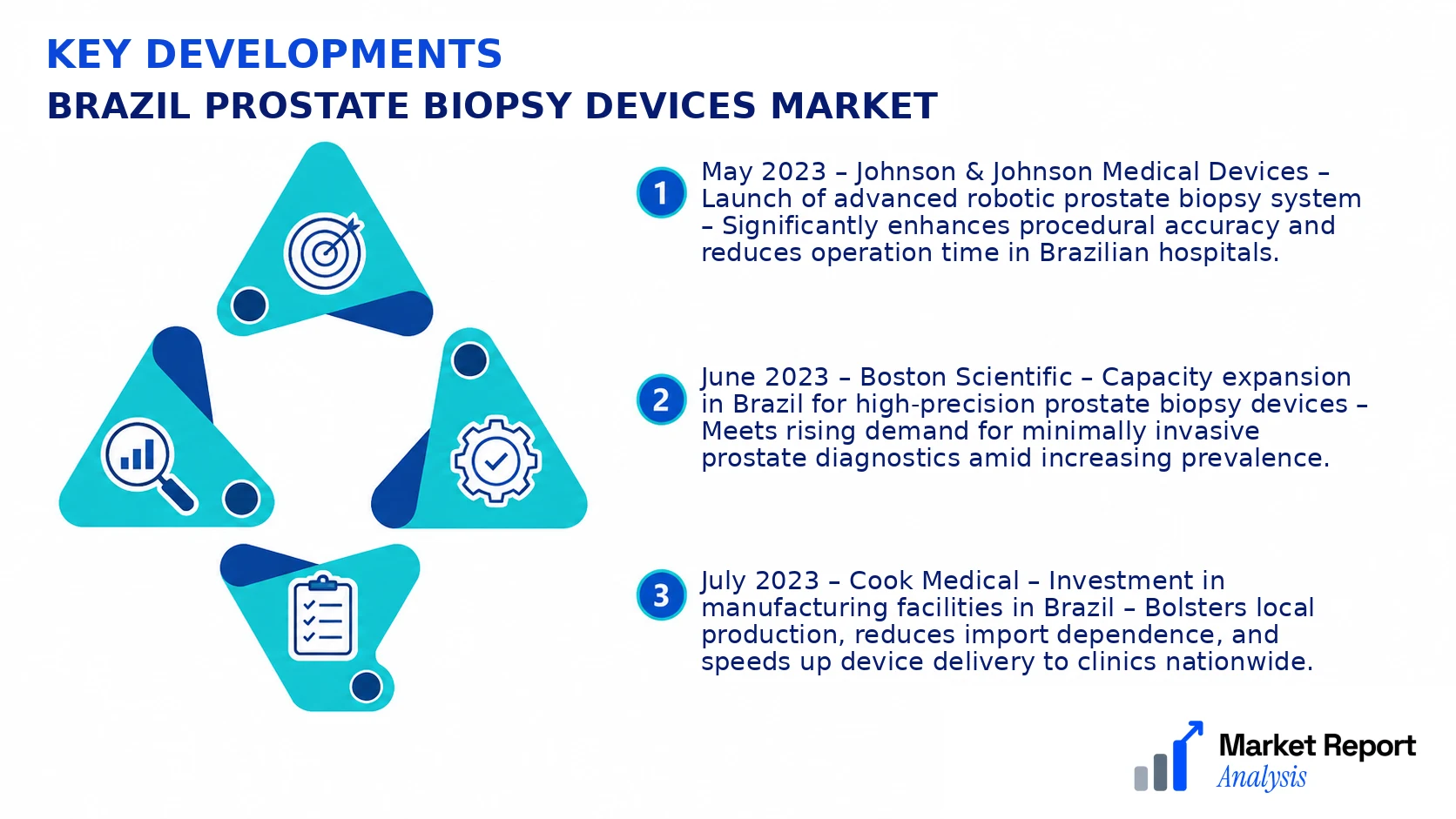
- May 2023 – Johnson & Johnson Medical Devices – Launch of advanced robotic prostate biopsy system – Significantly enhances procedural accuracy and reduces operation time in Brazilian hospitals.
- June 2023 – Boston Scientific – Capacity expansion in Brazil for high-precision prostate biopsy devices – Meets rising demand for minimally invasive prostate diagnostics amid increasing prevalence.
- July 2023 – Cook Medical – Investment in manufacturing facilities in Brazil – Bolsters local production, reduces import dependence, and speeds up device delivery to clinics nationwide.
- August 2023 – Hologic – Partnership with local clinics for digital imaging device trials – Accelerates adoption of integrated imaging biopsy systems in Brazilian healthcare settings.
- September 2023 – Meta Biomed – Launch of new sensitivity-enhanced biopsy needles – Positively impacts detection rates and patient comfort, boosting regional market share.
Frequently Asked Questions
What is the Brazil Prostate Biopsy Devices Market?
The Brazil Prostate Biopsy Devices Market encompasses the industry involved in manufacturing, distributing, and utilizing biopsy devices specifically designed for prostate tissue sampling. It serves healthcare providers performing prostate cancer diagnosis and is driven by technological advances and increasing disease awareness.
What is the current market size of Brazil Prostate Biopsy Devices Market?
As of 2026, the market is valued at approximately USD 0.8 Billion, reflecting growing adoption of minimally invasive prostate biopsy procedures and expanding healthcare infrastructure. This size is expected to expand significantly by 2034, driven by rising prevalence and technological innovations.
What factors are driving the Brazil Prostate Biopsy Devices Market?
Key growth drivers include rising prostate cancer incidence, technological innovations in biopsy devices, increased healthcare investment, and awareness programs promoting early diagnosis. Enhanced medical infrastructure and adoption of advanced devices further propel market expansion.
Which region dominates the Brazil Prostate Biopsy Devices Market?
Southern Brazil currently leads the market due to higher healthcare expenditure, greater awareness, and advanced medical facilities. However, regions like Southeast and Northeast are rapidly growing markets driven by expanding healthcare networks and increasing medical tourism.
Which segment is expected to grow the fastest?
The automated and image-guided biopsy device segment is forecasted to witness the highest CAGR, owing to their enhanced precision, reduced procedure time, and improved patient outcomes, making them increasingly preferred in clinical settings across Brazil.
Who are the leading companies operating in the Brazil Prostate Biopsy Devices Market?
Major players include Boston Scientific, Cook Medical, Medtronic, and local suppliers. These companies focus on R&D, strategic collaborations, and product innovation to strengthen their market position and cater to Brazil's growing healthcare demand.
Analyst Perspective
The Brazil Prostate Biopsy Devices Market is anticipated to maintain a steady growth trajectory through 2034, bolstered by increasing healthcare expenditures and rising awareness of prostate health issues. Long-term market maturity is expected as technological innovations, such as image-guided biopsy systems and minimally invasive devices, become standard, elevating the quality of diagnostics and patient outcomes. The sector presents attractive opportunities in urban centers like São Paulo and Rio de Janeiro, where advanced medical infrastructure supports high-volume clinical settings and specialized urology practices. Investment priorities should focus on R&D for enhanced imaging integration, portable biopsy systems, and cost-effective solutions tailored for regional healthcare budgets. Competitive intensity will likely escalate as domestic firms and international players strive to penetrate emerging segments. Regional growth will be driven by expanding private healthcare facilities and government-backed initiatives to improve urological diagnostics, especially in metropolitan areas. Strategic positioning in Brazil’s evolving healthcare landscape will require a focus on innovation, regional collaborations, and scalable solutions targeting the unique needs of Brazil’s diverse demographic.
