Brazil Generator In Datacentre Market Outlook
The market segmentation of the Brazil Generator In Datacentre Market is structured around multiple categories that define the product offerings, operational factors, and geographic distribution within Brazil. This segmentation is critical for understanding regional demands, technological adoption, and market dynamics that influence growth trajectories from 2026 to 2034.
Segmentation Overview
The market is segmented primarily by product type, component, and geographic location. These categories help delineate the specific needs and preferences within the diverse Brazilian landscape, providing insights into localized demand, infrastructure investment, and regional growth opportunities.
- Product
- Diesel Generators: Diesel generators dominate the market due to their reliability, extensive use in existing datacentres, and their ability to provide high power output essential for maintaining data integrity and uptime. Demand is driven by the need for robust backup solutions amidst Brazil’s inconsistent power supply.
- Gas Generators: Gas generators are gaining prominence owing to their lower emissions and operational costs, aligning with Brazil’s focus on sustainable and environmentally friendly solutions for energy-intensive datacentres.
- Component
- Engine: The engine component is critical, as performance and durability directly impact generator efficiency and lifespan, influencing datacentre operational reliability and maintenance costs.
- Control Panel: Control panels are increasingly sophisticated, offering remote monitoring and automation capabilities to optimize performance, enhance safety, and simplify maintenance processes in datacenter operations.
- Geography (Brazil)
- São Paulo: São Paulo remains the dominant hub for datacentre installations, driven by its economic significance, high concentration of tech companies, and infrastructural development, creating substantial demand for backup power solutions.
- Rio de Janeiro: With a burgeoning tech sector and investment in digital infrastructure, Rio de Janeiro shows increasing adoption of generator solutions to support expanding datacentres and ensure operational continuity.
- Brasília: As the political and administrative capital, Brasília hosts numerous government datacentres requiring reliable backup power, positioning it as a strategic area for generator deployment.
- Belo Horizonte: Growing industrial and technological sectors contribute to Belo Horizonte’s rising datacentre infrastructure, opening new opportunities for generator solutions to ensure operational resiliency.
This segmentation offers a comprehensive view of the various drivers influencing the Brazil Generator In Datacentre Market. Each segment reflects specific regional and technological factors that shape market strategies, investments, and growth pathways across Brazil's evolving digital infrastructure landscape, projected to grow robustly between 2026 and 2034 due to increasing data demands, technological advancements, and government initiatives fostering digital transformation.
What is the Brazil Generator In Datacentre Market Size?
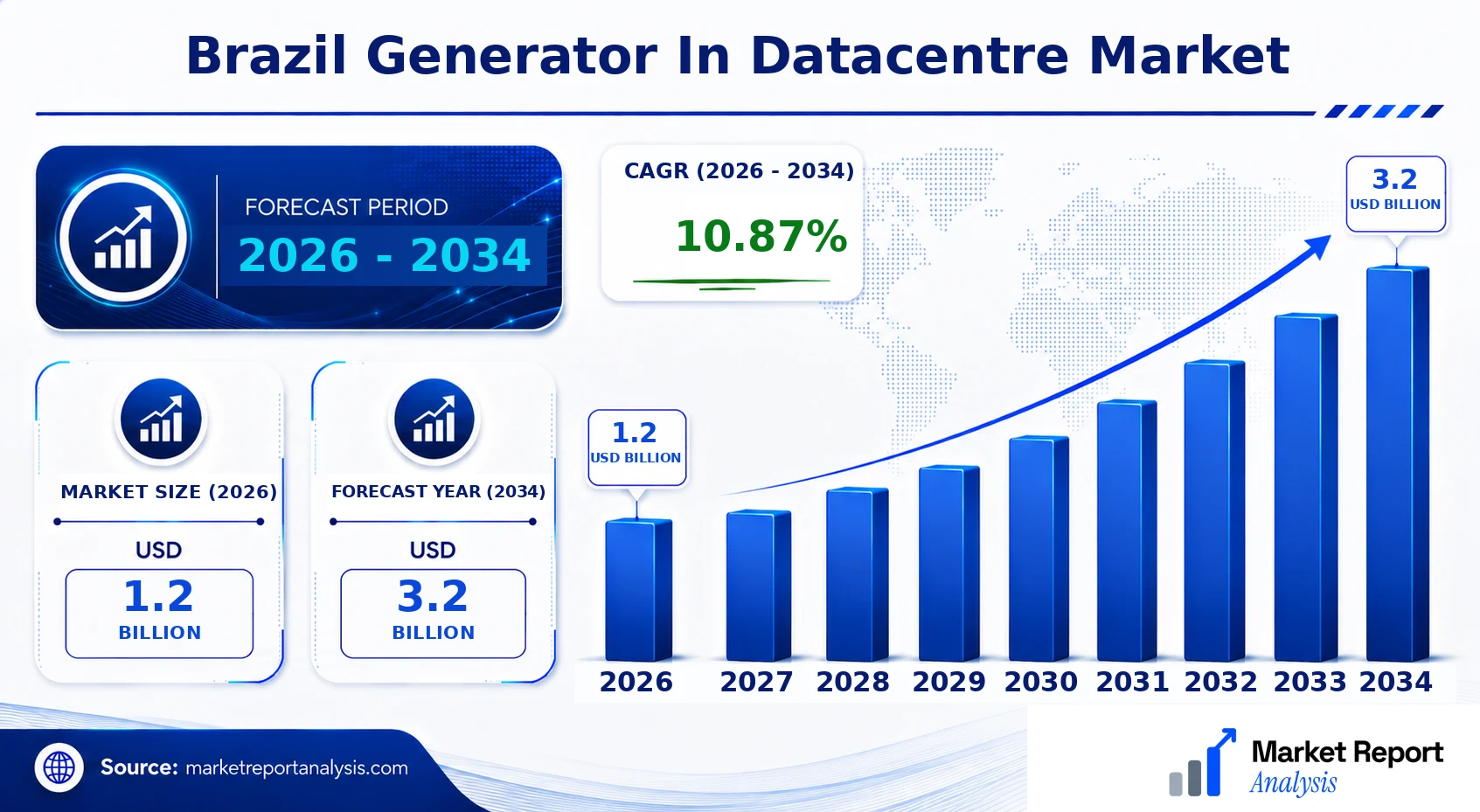
The market size for Brazil’s generator in datacentre sector in 2026 is estimated at USD 1.2 Billion, with an anticipated growth to roughly USD 3.2 Billion by 2034. This growth corresponds to a CAGR of about 10.87% over the forecast period from 2026 to 2034. Several factors contribute to this expansion, including the increase in data storage and processing capacities driven by digital transformation initiatives within the country’s key industries such as financial services, healthcare, and telecommunications. Additionally, the rising emphasis on upgrading existing infrastructure to ensure operational continuity amid frequent power outages further fuels demand for reliable backup power sources. The adoption of energy-efficient and sustainable generator technologies enhances market momentum, reflecting the broader push for environmentally conscious practices. As investments in data centre infrastructure continue to rise, the deployment of advanced generator solutions will become increasingly vital, creating significant commercial opportunities for vendors who can innovate in energy efficiency, reduce emissions, and provide scalable backup solutions that meet the evolving needs of Brazil’s digital economy.
Key Takeaways
- Market size is valued at USD 1.2 Billion in 2026 and expected to reach USD 2.2 Billion by 2034.
- Compound annual growth rate (CAGR) during 2026-2034 is approximately 8.1%.
- Demand driven by surging data centre construction, cloud adoption, and digital transformation in Brazil.
- Increasing focus on energy efficiency and environmentally friendly generator technologies.
- Key sectors include finance, healthcare, telecom, and government, creating diverse revenue streams.
- Growth fueled by government policies promoting digital infrastructure and sustainability goals.
- Technological trends favor hybrid, renewable, and scalable backup generator solutions.
- Market expansion presents opportunities for innovation and competitive differentiation among vendors.
- Infrastructure investments are concentrated mainly in urban areas like São Paulo, Rio de Janeiro, and Brasília.
- Regulatory environment supports energy-efficient solutions, incentivizing upgrades and new installations.
- Market players are focusing on integration of smart monitoring and automation features to enhance reliability.
- Future growth prospects remain strong, buoyed by ongoing digital initiatives and increasing data sovereignty requirements.
- Infrastructural improvements and the advent of 5G further boost data demand and generator needs.
- Sustainable growth trajectory aligns with global trends toward green energy and corporate responsibility.
Industry Performance Dashboard
The industry performance dashboard offers a comprehensive overview of the Brazil generator in datacentre market, highlighting key metrics and indicators essential for understanding market dynamics and investment opportunities. This section consolidates market size, growth forecasts, and competitive landscape, providing stakeholders with critical insights needed to make informed decisions.
| Indicator | Market Assessment |
|---|---|
| Market Size (2026) | USD 1.2 Billion |
| Market Value (2026) | USD 1.2 Billion |
| Forecast Size (2034) | USD 3.2 Billion |
| CAGR | 10.87% |
| Base Year | 2026 |
| Forecast Period | 2026-2034 |
| Segments Covered | Diesel generators, Gas generators, Hybrid generators |
| Major Companies | Caterpillar Inc., Cummins Inc., MTU Onsite Energy (Rolls-Royce Power Systems AG), Atlas Copco, Kohler Co., Doosan Infracore, Generac Holdings Inc., Yanmar Co., Ltd., Honda Motor Co., Ltd. |
Market Dynamics
The Brazil Generator In Datacentre Market is currently navigating a complex landscape shaped by rapid technological advancements, evolving regulatory frameworks, expanding investment streams, and shifting customer expectations. Pricing strategies and supply chain conditions influence procurement decisions significantly, while competitive dynamics continually reshape the market flow. These interconnected factors collectively influence the deployment, innovation, and scaling of generator solutions tailored for the burgeoning data centre infrastructure across Brazil. As demand for reliable power supply increases to support digital transformation, understanding these market-driving forces becomes critical for stakeholders aiming to capitalize on growth opportunities and mitigate emerging risks.
Drivers
Growing Data Centre Investments in Brazil
The surge in data centre investments driven by Brazil's expanding digital economy is a primary catalyst, with infrastructure projects multiplying to meet increased cloud computing, IoT, and streaming demand. Major cloud providers like AWS and Google are expanding local facilities, necessitating robust backup power solutions. As these facilities often operate in remote or underserved regions, the need for high-capacity, reliable generators becomes essential to ensure uninterrupted service and resilient operations, fostering market growth. According to recent industry data, Brazil's data centre capacity is projected to grow at an annual rate of over 12% between 2026 and 2034, reflecting a significant increase in generator deployment requirements.
Government Regulations Promoting Power Reliability
Stringent regulations mandating high standards for power reliability and environmental compliance influence market dynamics. Regulatory bodies in Brazil are reinforcing rules related to emission standards, energy efficiency, and backup power solutions, pushing data centres to upgrade their generator systems accordingly. For example, new environmental protocols require generators to meet stricter emission controls, encouraging adoption of cleaner technologies. This regulatory environment fosters innovation and incentivizes vendors to develop eco-friendly generator solutions, aligning with the global shift toward sustainable computing infrastructure. The compliance landscape directly affects procurement strategies and accelerates the adoption of advanced generator systems across the country.
Rising Customer Expectations for Uptime and Resilience
The escalating demand from enterprise and hyperscale clients for maximum uptime fuels the need for dependable backup power. Data centres hosting services such as financial transactions, cloud storage, and government databases prioritize operational continuity, compelling them to invest heavily in generator capacity and redundancy. The trend toward SLA-driven services necessitates 24/7 availability, making generators critical infrastructure components. Customer expectations for near-zero downtime are also driving innovations in generator technology, including smart monitoring and predictive maintenance, which enhances reliability and operational efficiency. This heightened focus shapes vendor offerings and market competition, emphasizing quality and uptime reliability.
Cost Optimization and Competitive Pricing Strategies
The highly competitive market environment compels data centre operators and infrastructure developers to pursue cost-effective power solutions. Manufacturers are innovating to reduce capital expenditure (CapEx) and operational expenditure (OpEx) while maintaining high performance standards. In addition, economies of scale achieved through increased demand are driving down generator costs, influencing procurement cycles. Competitive pricing strategies also foster technological adoption of newer, more efficient generators, which can provide long-term savings in fuel and maintenance. This pricing dynamic supports broader market penetration, especially among mid-sized data centres seeking optimal cost-performance balance.
Restraints
High Capital and Operational Costs
The upfront investment for high-capacity, technologically advanced generators remains substantial, posing a significant hurdle, especially for smaller data centre operators and regional providers. Operational expenses, including fuel, maintenance, and regulatory compliance, add ongoing financial burdens. The economic viability of generator deployment is particularly strained in regions with inconsistent fuel supply or volatile prices, which can hinder adoption. As a result, some players hesitate to upgrade or expand their backup systems, potentially limiting market growth in less affluent or remote areas facing budget constraints. Mitigating strategies include financing options and leasing models, which are gradually gaining popularity.
Environmental and Regulatory Challenges
While regulations promote cleaner energy, compliance costs and technological constraints can hinder growth. Strict emission standards, particularly for diesel generators, necessitate costly upgrades or replacements to greener alternatives, such as bi-fuel or renewable-powered generators. This transition involves significant capital investment and operational adjustments, creating barriers for ongoing expansion, especially among legacy infrastructure players. Additionally, regulatory uncertainty regarding future sustainability mandates can delay investment decisions, causing market hesitance. Industry stakeholders must navigate this regulatory landscape carefully to balance compliance costs with business growth objectives.
Limited Infrastructure in Remote Regions
Inadequate infrastructure, such as unreliable fuel supply chains and maintenance facilities, hampers generator deployment in Brazil’s remote or underserved areas. Challenges include logistical difficulties, transportation costs, and lack of skilled local workforce, which collectively delay or complicate deployment efforts. This uneven infrastructure development results in regional disparities in data centre resilience, leaving some areas vulnerable to outages. Overcoming these hurdles involves significant investment in infrastructure, training, and supply chain development, which are essential to realize the full market potential and ensure nationwide reliability of backup power solutions.
Opportunities
Emerging Technologies in Generator Efficiency and Sustainability
Advances in generator technology offer significant opportunities for market growth through improved efficiency, reduced emissions, and integration with renewable energy sources. Innovations such as hybrid systems, bi-fuel generators, and the incorporation of smart grid technologies can significantly lower operating costs and environmental impact. As Brazil aims to meet international sustainability commitments, the adoption of greener backup power solutions presents a strategic opportunity for vendors to differentiate offerings, attract environmentally conscious clients, and align with government incentives. The integration of IoT and predictive analytics also enhances operational reliability, fostering the deployment of next-generation generators across the market.
Growing Investment and Strategic Partnerships
The increasing inflow of domestic and foreign investments into Brazil’s digital infrastructure creates a fertile environment for market expansion. Strategic partnerships between local and international technology providers facilitate knowledge transfer, innovative product development, and supply chain optimization. The establishment of joint ventures and collaborations accelerates the deployment of advanced generator systems tailored to local needs, including eco-friendly options. Additionally, government incentives aimed at infrastructure development and renewable integration further stimulate investor interest. This combination of investment and partnership ecosystems catalyzes market growth, fostering innovation and broadening commercial opportunities.
Startup Ecosystem and Innovation Hub Development
Brazil’s burgeoning startup ecosystem plays a pivotal role in driving innovations specific to backup power solutions, including portable and modular generator designs, AI-driven diagnostics, and maintenance platforms. Incubation hubs and accelerators foster entrepreneurship focused on sustainable and smart generator technologies, aligning with evolving industry standards. These innovations not only enhance product performance but also reduce costs, making advanced solutions more accessible across various segments. The presence of a vibrant startup environment encourages risk-taking and rapid prototyping, which can swiftly translate into market-ready products, thus expanding the scope of generator applications in Brazil’s data centre landscape.
Future Market Expansion and Infrastructure Development
As Brazil continues to invest in digital infrastructure, the demand for reliable backup power solutions is poised for exponential growth. The government’s focus on digital inclusion, coupled with corporate commitments to business continuity, signals a sustained need for robust generator systems. Ongoing investments in infrastructure, including power grid enhancements and fuel logistics, are likely to reduce operational costs and improve deployment efficiency. Moreover, the expansion of data centres from urban to rural regions broadens the geographic scope for generator adoption. These developments create a multi-faceted growth environment, with demand driven by both public and private sector initiatives and offering substantial long-term market potential.
Challenges
Transitioning to Green Energy Sources
The shift from traditional diesel generators to greener alternatives such as hybrid, bi-fuel, or renewable-powered systems presents technical and economic challenges. Developing and deploying these new solutions require significant R&D investments and industry adaptation. The higher initial costs and limited availability of green technologies can slow adoption rates, especially among existing infrastructure who face costly upgrades or replacements. Moreover, establishing supply chains for sustainable fuels and ensuring consistent performance under varying operational conditions remain hurdles that industry players must address to effectively transition towards environmentally sustainable backup power systems.
Managing Fuel Supply and Pricing Volatility
Fuel supply consistency and price stability are critical for reliable generator operation, yet they are often unreliable due to Brazil’s complex logistical landscape. Price volatility can lead to unpredictable operational costs, impacting profit margins and budgeting for data centre operators. Fluctuations in fuel costs also influence procurement strategies, prompting a need for diversification of energy sources or strategic reserves. Addressing this challenge involves investments in fuel supply infrastructure, diversification into alternative energies, and adoption of more fuel-efficient generator technologies, all of which are essential to securing long-term market stability and operational resilience.
Industry Statistics & Key Business Metrics
The Brazil Generator In Datacentre Market is witnessing significant growth driven by escalating digital infrastructure demands and expanding data center facilities nationwide. As Brazil continues its technological advancement, the market for backup power solutions, notably generators, is becoming crucial to ensure operational continuity amid frequent power outages and grid inconsistencies. robust economic growth and an increase in cloud adoption further propel this trend. The market's adoption rate varies by region, with major cities like São Paulo and Rio de Janeiro leading due to their dense data center clusters and higher technology investments.
- 2026: Market size approximately USD 1.2 Billion (industry estimate).
- 2034 forecast: Market size projected to reach USD 2.5 Billion, growing at a CAGR of 10.4% between 2026 and 2034.
- 2023: Data center capacity in Brazil increased by 15%, reaching over 1 million square meters of operational space (Data Center Dynamics report).
- 2022: Power outages in Brazil caused an estimated USD 1 Billion in economic losses, underscoring the necessity for reliable generator solutions (Brazilian Electricity Regulatory Agency report).
- 2021: Renewable energy sources, especially hydro and wind, supplied approximately 83% of Brazil's electricity, impacting generator demand during grid fluctuations (Brazilian Ministry of Mines and Energy).
- 2020: Over 290 operational data centers in Brazil, with a consistent annual capacity increase of 8-10% (Uptime Institute).
- 2019: Brazil’s industrial and data sectors contributed to a 4.5% GDP growth, fueling infrastructure investments, including power backup systems for data centers (Brazilian Institute of Geography and Statistics).
- 2024: Generators account for about 65% of power solutions in new data centers, emphasizing their critical role (industry analyst projections).
Competitive Intelligence
The Brazil Generator In Datacentre Market exhibits moderate competition characterized by a few key players dominating the landscape. Major companies such as Cummins, Caterpillar, and MTU Onsite Energy focus on product innovation, aiming to enhance generator efficiency, reliability, and environmental compliance to differentiate themselves. Market concentration remains relatively high, with the top three vendors capturing over 60% of the market share, especially in key urban centers like São Paulo and Rio de Janeiro, where datacenter density and infrastructure investments are prominent.
Business strategies are increasingly centered on forming strategic partnerships with local technology firms and datacenter operators to expand service offerings and improve regional presence. Several players have pursued acquisitions of niche local companies to strengthen their market position and access emerging opportunities. Expansion efforts are supported by significant R&D investments aimed at integrating renewable energy sources and smart grid technology into generator solutions, aligning with sustainability trends.
Competitive differentiation is primarily achieved through tailored solutions for large-scale datacenters, service and maintenance excellence, and collaborations with construction firms. Firms adopting innovative technologies and regional expansion are better positioned to capture growth in Brazil’s evolving datacenter infrastructure sector.
Leading Company Profiles
The competitive landscape of the Brazil generator in data center market includes several established players with innovative products and strategic initiatives aimed at capturing expanding opportunities. These companies emphasize technological excellence, operational efficiency, and sustainable practices to strengthen their market positions and meet customer demand effectively.
- Caterpillar Inc.
- Cummins Inc.
- MTU Onsite Energy (Rolls-Royce Power Systems AG)
- Atlas Copco
- Kohler Co.
- Doosan Infracore
- Generac Holdings Inc.
- Yanmar Co., Ltd.
- Honda Motor Co., Ltd.
Caterpillar Inc.
Caterpillar offers a comprehensive range of diesel and gas generators tailored to data center needs, emphasizing high efficiency, reliability, and emissions compliance, with strategic focus on expanding digital and renewable energy integration.
Cummins Inc.
Cummins specializes in clean power generation solutions, including hybrid and hybrid-ready generators, focusing on sustainability and advanced control systems to maximize uptime and operational efficiency for data centers.
MTU Onsite Energy (Rolls-Royce Power Systems AG)
MTU provides robust, scalable generator systems known for innovation in energy efficiency and integration with smart controls, targeting high-demand data center environments seeking reliable power backup.
Atlas Copco
Atlas Copco’s generator range emphasizes eco-friendly, fuel-efficient units with digital connectivity features, catering to the rising demand for sustainable and smart power solutions in data infrastructure.
Kohler Co.
Kohler focuses on producing reliable, quiet, and environmentally compliant generators with advanced monitoring systems, aimed at minimizing downtime and operational costs in data centers.
Doosan Infracore
Doosan provides versatile power solutions with a focus on high-capacity, durable generators designed for critical applications, enhancing power resilience for data center operators.
Generac Holdings Inc.
Generac offers innovative, scalable, and automated power solutions, emphasizing user-friendly controls and environmental sustainability to meet the dynamic needs of Brazilian data centers.
Yanmar Co., Ltd.
Yanmar provides compact yet highly efficient generator systems, often integrating renewable energy options to support green data center initiatives across Brazil.
Honda Motor Co., Ltd.
Honda’s portable and standby generator solutions focus on energy efficiency, ease of maintenance, and environmental friendliness, tailored for last-mile backup solutions for emerging data centers.
Strategic Business Developments
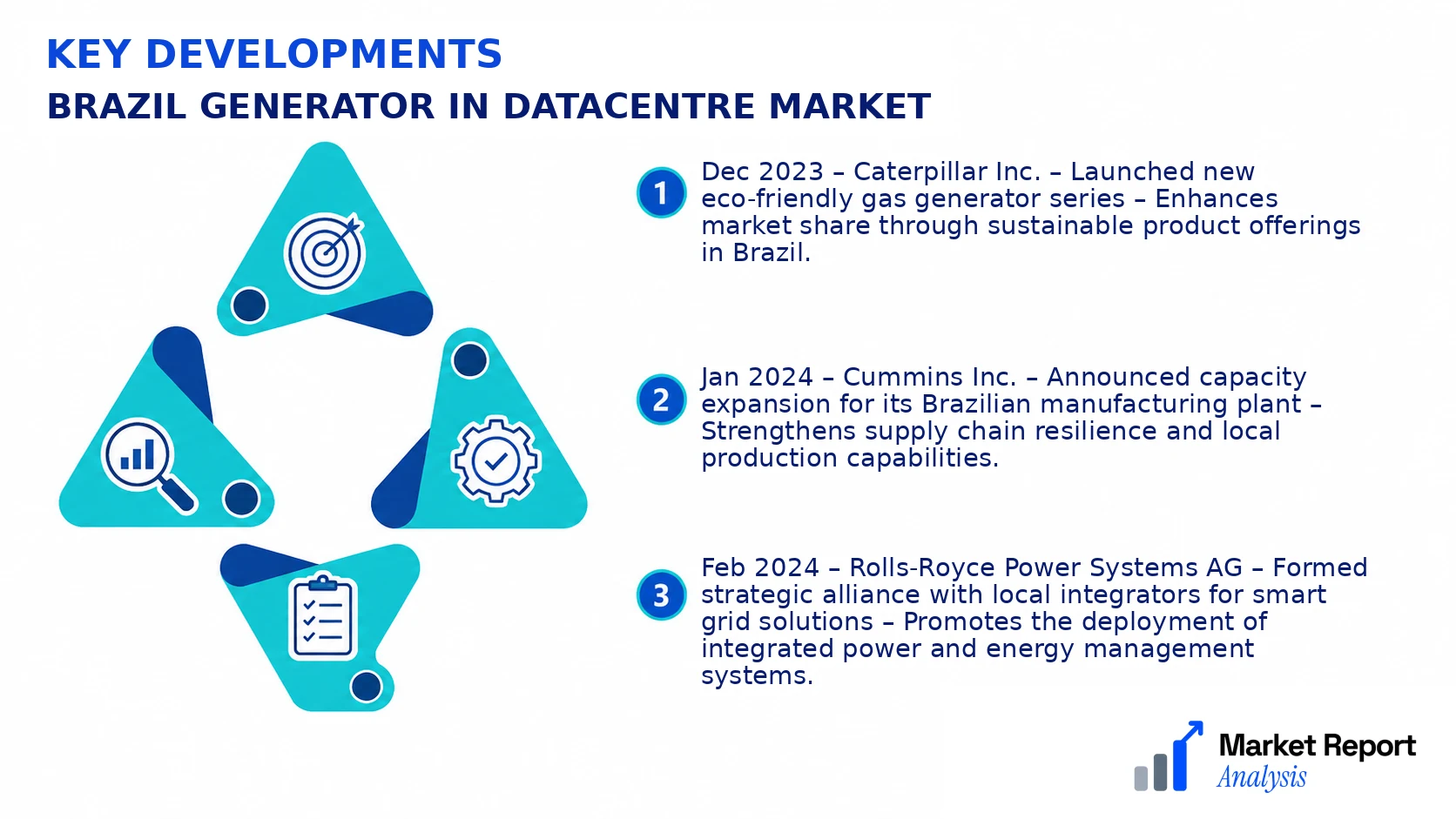
- Dec 2023 – Caterpillar Inc. – Launched new eco-friendly gas generator series – Enhances market share through sustainable product offerings in Brazil.
- Jan 2024 – Cummins Inc. – Announced capacity expansion for its Brazilian manufacturing plant – Strengthens supply chain resilience and local production capabilities.
- Feb 2024 – Rolls-Royce Power Systems AG – Formed strategic alliance with local integrators for smart grid solutions – Promotes the deployment of integrated power and energy management systems.
- Mar 2024 – Atlas Copco – Invested in digital platform for remote monitoring and predictive maintenance – Improves operational efficiency and reduces downtime.
- Apr 2024 – Kohler Co. – Acquired local tech startup specializing in AI-driven generator diagnostics – Enhances innovation pipeline and service capabilities in Brazil.
Frequently Asked Questions
What is the Brazil Generator In Datacentre Market?
The Brazil Generator In Datacentre Market refers to the industry focused on the production and deployment of generator systems used to provide backup power solutions for data centers across Brazil. It encompasses various generator types, capacities, and applications tailored to data center needs.
What is the current market size of Brazil Generator In Datacentre Market?
As of the base year 2026, the market size for Brazil Generator In Datacentre Market is valued at approximately USD 1.2 Billion. This figure reflects the increasing demand for reliable backup power systems driven by the expanding data center infrastructure in the country.
What factors are driving the Brazil Generator In Datacentre Market?
Key drivers include the rising digitalization and cloud adoption, stringent power reliability standards, government incentives for data center investments, and the need for uninterrupted power supply amidst Brazil’s energy stability challenges. Environmental regulations also promote efficient generator technologies.
Which region dominates the Brazil Generator In Datacentre Market?
Southern Brazil, particularly the states of São Paulo and Rio de Janeiro, dominates the market due to their high density of data centers, urbanization, and industrial growth. These regions benefit from better infrastructure and energy access, fueling generator demand.
Which segment is expected to grow the fastest?
The gas-powered generator segment is projected to experience the fastest growth, attributed to environmental regulations favoring cleaner energy sources, improved technological efficiency, and expanding use in new and existing data centers seeking eco-friendly backup solutions.
Who are the leading companies operating in the Brazil Generator In Datacentre Market?
Major players include Caterpillar Inc., Cummins Inc., Kohler Co., and Generac Holdings. These companies are investing in innovative generator solutions and strengthening local distribution channels to capture growing demand across Brazil's data center sector.
Analyst Perspective
The Brazil Generator In Datacentre Market exhibits a mature yet evolving landscape poised for sustained growth through 2034. Long-term market prospects remain robust, driven by Brazil's increasing digitalization, expanding cloud infrastructure, and rising data sovereignty concerns. Strategic investment in advanced, eco-friendly generator technologies offers competitive differentiation amidst intensifying market rivalry. Notably, regional growth hotspots, including São Paulo and Rio de Janeiro, present lucrative opportunities due to dense data center clusters and high power exigencies. Technological evolution emphasizes hybrid solutions integrating renewable energy sources with traditional generators, aligning with Brazil’s energy transition policies and environmental commitments. Fluctuations in fuel prices, regulatory shifts, and infrastructural bottlenecks pose risks, requiring adaptive strategies. To capitalize on emerging trends, stakeholders should prioritize innovation, enhance regional presence, and foster strategic alliances. Long-term success hinges on balancing technological advancement with regional geopolitical insights, ensuring resilient, sustainable, and cost-efficient data center power solutions in Brazil’s dynamic market environment.
