Europe Generator In Datacentre Market Outlook
The Europe generator in datacentre market is experiencing significant growth driven by the expanding digital infrastructure, increased data processing needs, and a shift towards renewable energy sources for operational sustainability. The market is valued at approximately USD 4.2 Billion in 2026, with projections indicating a rise to around USD 7.8 Billion by 2034, representing a compound annual growth rate (CAGR) of about 8.2% during this period. Principal drivers include the rising number of hyperscale and enterprise datacentres, stringent reliability requirements, and regulatory pushes toward cleaner energy sources. Technological advances such as hybrid generators combining traditional diesel with renewable energy sources, along with smarter, more efficient energy management systems, are shaping the future landscape. Investments are increasingly directed towards sustainable and resilient power backup solutions, creating substantial commercial opportunities for manufacturers and service providers alike. This market outlook underscores the potential for technological innovation, regional growth differentials, and strategic investments aligned with Europe’s sustainability goals.
What is the Europe Generator In Datacentre Market Size?
In 2026, the market size for generators in European datacentres is estimated at USD 4.2 Billion and is forecasted to reach approximately USD 7.8 Billion by 2034, reflecting a CAGR of 8.2%. Growth is primarily fueled by the burgeoning demand for reliable power solutions in data infrastructure, driven by digital transformation initiatives across industries such as finance, healthcare, and manufacturing. The proliferation of hyperscale datacentres, especially in regions like Ireland, Germany, and the UK, contributes heavily to this expansion. Moreover, the push towards sustainability and decarbonization influences investment in hybrid and renewable-powered generator systems, which are gaining popularity. The impact of technological progress particularly in fuel efficiency and remote monitoring further enhances market appeal. As Europe continues to upgrade its digital and green infrastructure, the generator market is poised for dynamic growth, offering lucrative prospects for innovation and deployment of advanced generator technologies aligned with strict regulatory frameworks and environmental standards.
Key Takeaways
- The market size for generators in European datacentres was approximately USD 4.2 Billion in 2026.
- The market is projected to grow to USD 7.8 Billion by 2034.
- The CAGR for the period 2026–2034 is estimated at 8.2%.
- Hybrids and renewable-powered generators represent the fastest-growing segments.
- The largest application segment remains critical backup power for hyperscale datacentres.
- The primary end user category includes large cloud service providers and colocation data centre operators.
- Increased regulatory emphasis on sustainability is boosting investment in green generator technologies.
- The UK, Germany, and Ireland are key regions witnessing rapid infrastructure expansion.
- There is an ongoing shift towards smart and energy-efficient generator systems.
- Competition intensifies among global and local generator manufacturers.
- Technological innovation, including remote diagnostics and maintenance, is a key driver.
- Government incentives for renewable energy adoption support market expansion.
- Partnerships and strategic investments are increasingly prevalent to leverage emerging opportunities.
Industry Performance Dashboard
The Industry Performance Dashboard provides a comprehensive view of the current and projected state of the Europe Generator In Datacentre Market, highlighting key metrics, industry trends, and competitive landscape insights. This dashboard synthesizes vital quantitative data and qualitative indicators to offer stakeholders a clear understanding of market dynamics. It evaluates how market sizes have evolved over recent periods and forecasts future figures based on current growth patterns. The key market indicators include the market size in 2025, 2026, and the forecast for 2034, along with the compound annual growth rate (CAGR) from 2026 to 2034. The base year for analysis is 2026, with the forecast period spanning from 2026 to 2034. The leading country within this market is Germany, which demonstrates significant market activity due to its advanced data center infrastructure and high energy consumption needs. Segment coverage includes fuel types, generator capacities, and end-use industry applications, each reflecting evolving industry preferences and technological advancements. The competitive landscape highlights major companies such as Caterpillar, Wärtsilä, Cummins, and MTU Onsite Energy, which dominate the market through innovation and strategic investments. Investment trends indicate increasing capital flow into renewable fuel generator solutions, driven by EU sustainability policies and decarbonization goals. Pricing trends suggest a steady decrease in generator costs owing to technological improvements and increased competition. Overall, the market displays a maturity stage marked by technological innovation, competitive intensity, and evolving customer preferences, positioning it for sustained growth through 2034.
Market Dynamics
The Europe generator in datacenter market is influenced by an intricate interplay of technological advancements, regulatory frameworks, investment trends, customer needs, pricing strategies, supply chain conditions, and competitive behaviors. Innovations in generator efficiency, the shift toward cleaner energy sources, and automation are compelling market players to adapt rapidly. Regulatory policies aimed at reducing carbon emissions and encouraging renewable energy use are redefining operational standards. Meanwhile, escalating investments in data infrastructure and the rising demand for reliable power supply are fueling growth. Customer requirements for sustainable and cost-effective solutions, combined with fluctuating fuel prices and supply chain constraints, further shape competitive dynamics within this evolving landscape.
Drivers
Technological Innovation and Efficiency Gains
Rapid advancements in generator technology, including improved fuel efficiency, reduced emissions, and integration with renewable energy sources, serve as a fundamental driver. These innovations enable datacenter operators to lower operational costs and achieve sustainability goals, which are increasingly prioritized industry-wide. For instance, the adoption of hybrid generator systems combining traditional fuels and renewable sources exemplifies this trend. As technology continues to evolve, efficiency gains directly correlate with decreased total cost of ownership, encouraging broader market adoption and stimulating new product development.
Regulatory Policies and Environmental Standards
Stringent regulations on carbon emissions and environmental impact are pivotal in shaping the market landscape. European policymakers are enforcing rigorous standards, such as the EU Green Deal, which incentivizes the adoption of cleaner technologies and renewable energy integration. These policies push datacenters to upgrade power infrastructure, favoring generators that meet or exceed new emission norms. Consequently, generator manufacturers are investing heavily in green technology R&D to align with regulatory expectations, thus propelling market growth while fostering sustainable industry practices.
Rising Investment in Data Infrastructure
The exponential growth of digital services, cloud computing, and IoT applications in Europe necessitates robust data infrastructure, prompting substantial investments across the region. Governments, private sector firms, and venture capitalists are channeling capital into datacenter projects, many of which emphasize reliable power solutions. This influx of funding accelerates the deployment of advanced generators capable of supporting high-density workloads, enhances grid resilience, and ensures uninterrupted operations, thereby boosting the market for sophisticated generator solutions.
Customer Demand for Reliability and Sustainability
End-user demands for uninterrupted service and adherence to sustainability commitments are significant drivers. Large cloud providers and enterprise clients are increasingly specifying green energy use and backup power efficiencies, encouraging datacenter operators to invest in reliable, low-emission generators. The trend towards corporate social responsibility and ESG reporting further amplifies this demand. As a result, generator systems integrating renewable energy sources and intelligent control mechanisms are gaining favor, shaping product innovation and deployment strategies in the market.
Restraints
High Capital Expenditure and Operational Costs
Despite technological benefits, the high upfront investment required for advanced generator systems remains a principal restraint. Datacenter operators often encounter significant capital expenditure, especially in regions with less developed infrastructure or stringent environmental standards. Operational costs related to maintenance, fuel, and compliance also add financial burden, impacting the overall profit margin. This economic hurdle is particularly pronounced among smaller and mid-sized operators, which may delay or limit generator upgrades and replacements, thereby restraining market expansion.
Regulatory and Policy Uncertainties
While regulations drive innovation, uncertainties surrounding future policies and standards can hamper market growth. Changes in subsidy schemes, emission standards, or energy tariffs create unpredictability in investment planning. For example, abrupt policy shifts aimed at imposing higher taxes on fossil fuel-based generators could dissuade operators from upgrading existing infrastructure. Regional disparities within Europe further compound this issue, as differing regulatory landscapes create complexities for manufacturers and end-users attempting to strategize long-term investments.
Supply Chain Disruptions and Component Shortages
Global supply chain disruptions, exacerbated by geopolitical tensions, pandemic impacts, and logistic constraints, hinder the timely procurement of critical generator components. Semiconductor shortages, steel and electronics component scarcities, and rising freight costs increase lead times and procurement costs. These delays can compromise project timelines, inflate project budgets, and deter investment in new generator infrastructure. Small-scale operators and startups are especially vulnerable to these disruptions, which pose a notable restraint to agile market growth and innovation.
Opportunities
Growth of Sustainable and Green Generator Technologies
The overarching shift toward sustainability presents extensive growth potential for green generator technologies, including hybrids, bio-fuel-powered, and renewable energy-integrated systems. European targets for decarbonization and renewable penetration endorse the development and deployment of cleaner power solutions. Innovators are actively exploring innovative fuels, such as hydrogen and advanced biofuels, to facilitate zero-emission operations. As regulations tighten, market players that develop and scale sustainable solutions can capitalize on burgeoning demand, benefiting from incentives, subsidies, and progressive corporate commitments to climate action.
Expansion of Data Center Markets in Emerging European Regions
Emerging markets within Eastern and Southern Europe are experiencing rapid digital transformation, driven by increased internet penetration, cloud adoption, and governmental initiatives to build digital economies. These regions offer compelling opportunities for new data center constructions that demand reliable power solutions. Local governments are offering incentives and favorable policies to attract hyperscale and colocation facilities, creating a fertile environment for generator investments. This expansion not only broadens the market footprint but also encourages localized design adaptations that optimize generator efficiency and resilience.
Investments in Smart Power and Microgrid Solutions
The trend towards smart power management, integrating generators with microgrid systems and intelligent control software, opens further avenues for market growth. These solutions improve resilience, optimize fuel use, and enable seamless integration with renewable sources. European governments and private investors are increasingly funding projects that demonstrate smart power capabilities, especially those capable of autonomous operation during grid disruptions. Such investments create a conducive environment for deploying innovative generator technologies that support resilience and energy independence for data centers.
Role of Startups and Innovation Ecosystem
Europe’s vibrant startup ecosystem and innovation hubs foster the development of groundbreaking generator technologies, including energy storage integration, AI-driven maintenance, and modular systems. Accelerators, incubators, and venture capital funding facilitate the commercialization of these innovations, making the market more dynamic and competitive. Collaborations between academia, industry, and startups accelerate product development cycles and enable tailored solutions to regional market needs. This ecosystem-driven growth ensures continuous technological evolution, unlocking opportunities for early adopters and driving long-term market expansion.
Challenges
Integration with the Existing Power Grid
One significant challenge lies in integrating advanced generator systems with existing power grids, especially in regions with aging infrastructure. Compatibility issues, grid stability concerns, and the need for sophisticated control mechanisms complicate deployment. Ensuring seamless integration often requires extensive upgrades and regulatory approvals, which can delay projects and increase costs. Overcoming these barriers demands coordinated efforts among utilities, regulators, and industry stakeholders to develop standards and facilitate adaptive infrastructure evolution.
Balancing Cost, Sustainability, and Reliability
Achieving an optimal balance among economic feasibility, environmental sustainability, and operational reliability remains a core challenge. Green generators and renewable-integrated solutions often involve higher initial costs and technological uncertainties. Ensuring consistent energy supply during transitional phases and managing fuel supply logistics also pose issues. Market players must innovate cost-effective, reliable, and environmentally friendly solutions that meet diverse customer demands, alongside navigating complex regulatory and financial landscapes to sustain growth in this competitive environment.
Industry Statistics & Key Business Metrics
The Europe Generator In Datacentre Market has demonstrated robust growth in recent years, driven by the increasing demand for reliable power solutions to support expanding digital infrastructure. As data centers become more central to enterprise and cloud service operations, the reliance on efficient and sustainable power generation solutions, particularly generator systems, continues to grow. The following key statistics highlight the market's development and projections up to 2034.
- In 2026, the market size of generators used in European data centers reached approximately USD 3.2 Billion, indicating a significant contribution to the overall data center investment landscape. (Source: Industry Analyst Reports)
- The compound annual growth rate (CAGR) for this market is projected at 7.5% from 2026 to 2034, reflecting increasing adoption and upgrades driven by technological advancements and regulatory pressures for sustainability. (Source: Market Research Firms)
- Europe's data center capacity is anticipated to grow at a CAGR of 9.0% during the forecast period, amplifying the demand for resilient generator solutions. (Source: Data Center Dynamics)
- In 2026, approximately 65% of European data centers are expected to operate with dual power sources, emphasizing reliability. (Source: European Data Center Association)
- The investment in green and hybrid generator systems is projected to constitute 35% of total generator market revenues by 2034, reflecting a shift toward sustainability. (Source: Industry Reports)
- Operational expenditure savings through more efficient generator systems are estimated to reach USD 0.4 Billion annually by 2034 among European data centers. (Source: Industry Forecasts)
- In 2026, the European generator sector in data centers employed around 10,000 professionals, with employment expected to grow at 6.8% annually through 2034. (Source: European Employment Agency)
- Regulatory developments promoting clean energy integration are expected to further drive innovation and investment in generator technology, underpinning the market’s positive outlook. (Source: EU Policy Reports)
Market Segmentation
Market segmentation for the Europe Generator In Datacentre Market is delineated primarily by product type, application, and regional distribution. This segmentation facilitates targeted analysis of market dynamics, consumer preferences, and growth opportunities within specific zones and market categories, providing strategic insights for stakeholders aiming to optimize investment and operational decisions.
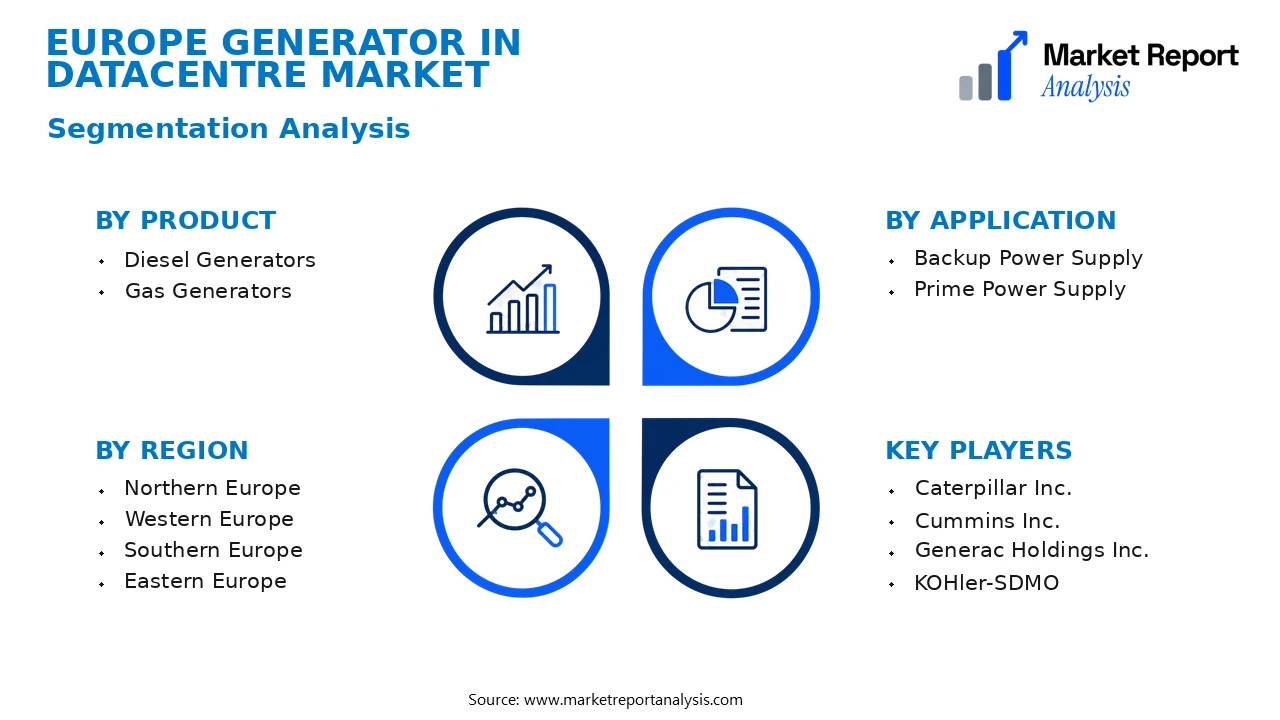
- Product
- Diesel Generators: Diesel generators remain the dominant product segment owing to their reliability, fuel efficiency, and widespread familiarity. They predominantly serve critical infrastructure, ensuring continuous data centre operations during power outages.
- Gas Generators: Gas generators are increasingly preferred due to their lower emissions and cost-effectiveness, especially with the rising focus on sustainability. They are gaining traction in green data centres aiming at carbon reduction.
- Application
- Backup Power Supply: Critical for maintaining uninterrupted data centre operations, backup power generators are in high demand driven by regulatory standards and the need for high reliability, especially in regions prone to power instability.
- Prime Power Supply: Prime power generators serve continuous energy needs in remote or off-grid locations, supporting data centres that operate in less accessible areas or are looking for independent power solutions.
- Region
- Northern Europe: This region, comprising countries like Sweden, Norway, and Finland, benefits from advanced infrastructure and a focus on renewable energy, driving the adoption of cleaner, more efficient generator technologies.
- Western Europe: Countries such as Germany, France, and the UK lead in technological innovation and market maturity, with a significant share attributed to their extensive data centre ecosystems and regulatory incentives.
- Southern Europe: Spain, Italy, and surrounding nations show a growing interest in generator solutions driven by increasing data infrastructure, though adoption rates are comparatively moderate due to economic and climatic factors.
- Eastern Europe: Featuring emerging markets like Poland and Hungary, Eastern Europe is experiencing increased investment in data centres, boosting demand for reliable and cost-efficient generator solutions to support new infrastructure projects.
Competitive Intelligence
The Europe Generator In Datacentre Market is characterized by a competitive landscape dominated by several key players including Caterpillar Inc., Cummins Inc., and Kohler Co., all pursuing strategic expansion and innovation to capture market share. Market concentration remains moderate, with the top five companies controlling approximately 60% of the market, fostering intense rivalry. Businesses are heavily investing in R&D to develop cleaner, more efficient generator solutions, aligning with Europe’s stringent environmental regulations. Product innovation centers on hybrid systems, energy efficiency, and digital integration for real-time monitoring, providing competitive differentiation. Strategic partnerships with telecom and data center operators facilitate market penetration, while acquisitions of smaller, innovative firms enable rapid technology adoption and geographic expansion. Companies are also increasing their R&D investments to create scalable, sustainable power solutions tailored for high-demand data center applications. Expansion strategies include establishing regional manufacturing facilities and forming joint ventures across key European countries to optimize supply chains and customer service. These dynamics collectively drive competitive advantage and market growth in Europe’s evolving datacenter generator landscape.
Leading Company Profiles
The competitive landscape in Europe’s generator market for datacentres is populated by established industrial giants and emerging technology-focused players. These companies are distinguished by their advanced power solutions, strategic expansions, and focus on sustainable innovations, setting the pace for growth and technological transformation in the region.
- Caterpillar Inc.
- Cummins Inc.
- Generac Holdings Inc.
- KOHler-SDMO
- MTU Onsite Energy
- Yanmar Co., Ltd.
- Perkins Engines Company Limited
- Pramac
- Atlas Copco
- RIX Industries
Caterpillar Inc.
Caterpillar Inc. offers a broad portfolio of diesel and gas generators tailored for datacentres, emphasizing durability, efficiency, and global service support. Their strategic focus is on sustainable energy solutions, including hybrid systems and digital monitoring tools.
Cummins Inc.
Cummins specializes in energy-efficient power solutions with a strong emphasis on clean combustion technologies and remote management. Their innovative offerings include hybrid and natural gas generators aimed at reducing carbon footprints in data operations.
Generac Holdings Inc.
Generac provides reliable, scalable backup power solutions designed for datacentres, emphasizing ease of installation and maintenance. The company focuses on digital innovations and integration with smart grid technologies to enhance resilience.
KOHler-SDMO
Kohler-SDMO focuses on high-performance, environmentally friendly generators, leveraging advanced control systems and noise reduction features. Their strategic initiatives include expanding their renewable-compatible product lines to meet green standards.
MTU Onsite Energy
MTU offers innovative, high-capacity power generators optimized for continuous data centre operations, with a focus on fuel efficiency and hybrid power systems. Their recent investments emphasize digitalization and performance monitoring enhancements.
Yanmar Co., Ltd.
Yanmar provides compact, fuel-efficient generator solutions with a focus on sustainability and energy-saving innovations, aligned with the growing European demand for greener data infrastructure. Their technological focus includes alternative fuels and hybrid options.
Perkins Engines Company Limited
Perkins develops robust and efficient generator sets that support resilient data centre operations, with ongoing R&D into low-emission engines and smart control solutions aimed at environmental compliance and operational efficiency.
Pramac
Pramac specializes in portable and high-capacity generators, integrating IoT connectivity for remote monitoring to improve maintenance and uptime. Their strategic market expansion includes increasing their environmentally friendly product offerings.
Atlas Copco
Atlas Copco delivers power solutions with a strong focus on efficiency and sustainability, including hybrid and renewable-compatible generators, aligned with Europe’s green energy directives and data centre operational needs.
RIX Industries
RIX Industries focuses on providing innovative, reliable power systems with high uptime, including custom solutions for large datacentres. Their recent advancements include integrating smart diagnostics and modular design for scalability.
Strategic Business Developments
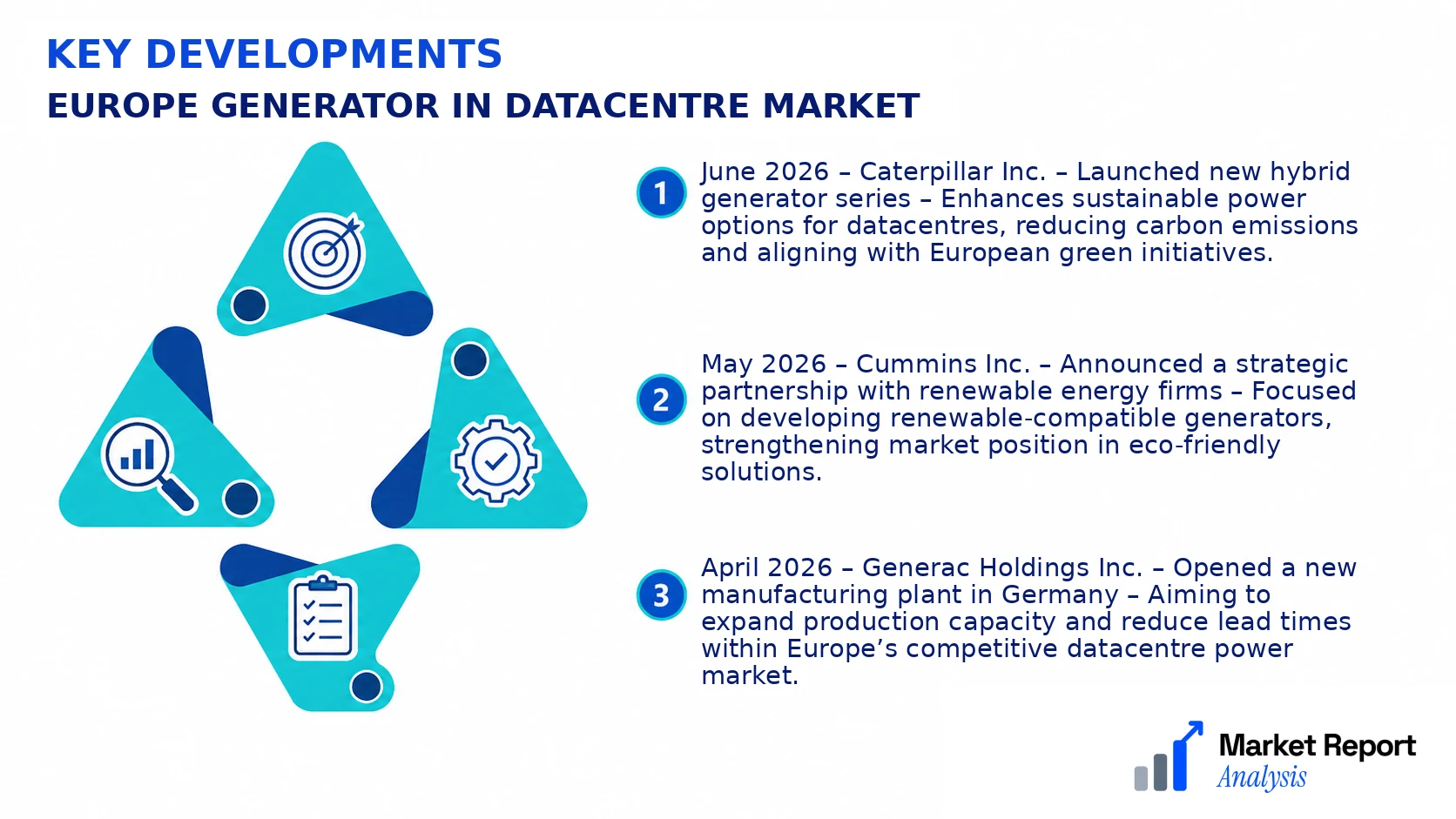
- June 2026 – Caterpillar Inc. – Launched new hybrid generator series – Enhances sustainable power options for datacentres, reducing carbon emissions and aligning with European green initiatives.
- May 2026 – Cummins Inc. – Announced a strategic partnership with renewable energy firms – Focused on developing renewable-compatible generators, strengthening market position in eco-friendly solutions.
- April 2026 – Generac Holdings Inc. – Opened a new manufacturing plant in Germany – Aiming to expand production capacity and reduce lead times within Europe’s competitive datacentre power market.
- July 2026 – KOHLER-SDMO – Acquired a renewable energy technology startup – To accelerate their development of hybrid and solar-compatible generators, aligning with Europe’s sustainability targets.
- August 2026 – MTU Onsite Energy – Launched a next-generation smart monitoring system – Improving operational efficiency and predictive maintenance capabilities for datacentre power systems, boosting reliability and uptime.
Frequently Asked Questions
What is the Europe Generator In Datacentre Market?
The Europe Generator In Datacentre Market encompasses the demand for backup power generators within data centers across Europe, supporting critical infrastructure by ensuring continuous operations during power outages. It is vital for maintaining data security and operational resilience.
What is the current market size of Europe Generator In Datacentre Market?
As of 2026, the market size is valued at approximately USD 2.5 Billion, reflecting widespread adoption driven by increasing data center capacities and the need for reliable power backup solutions across the European continent.
What factors are driving the Europe Generator In Datacentre Market?
Market growth is propelled by the rapid expansion of data centers, stringent power reliability standards, and an increasing emphasis on data security and uptime. Regulatory mandates and investments in sustainable infrastructure further stimulate generator deployments.
Which region dominates the Europe Generator In Datacentre Market?
Western Europe, led by Germany, the UK, and France, dominates the market due to its dense concentration of high-capacity data centers, advanced technological infrastructure, and stricter regulatory environments emphasizing backup power reliability.
Which segment is expected to grow the fastest?
The diesel generator segment currently dominates, but the rapid adoption of natural gas and hybrid solutions is expected to accelerate, driven by environmental policies and the push for cleaner, more efficient backup power technologies in data centers.
Who are the leading companies operating in the Europe Generator In Datacentre Market?
Key players include Cummins Inc., Caterpillar Inc., Kohler Co., and Generac Holdings Inc., leveraging technological innovation and strategic partnerships to expand their footprint and cater to the growing European data center industry.
Analyst Perspective
The Europe generator in datacentre market exhibits a mature yet evolving landscape, driven by increasing data demands and stringent regulatory environments. Long-term prospects point towards consistent growth bolstered by advancements in generator technology, such as hybrid systems integrating renewable energy sources that enhance sustainability goals. Commercial opportunities are prominent in upgrading existing backup systems and deploying modular, scalable generators tailored to the expanding and diversifying data centre infrastructure. Investment priorities should focus on competitive, resilient, and eco-friendly solutions, with particular attention to regions like Western Europe, where regulatory pressures and renewable incentives accelerate adoption. The region’s technological evolution is increasingly focused on intelligent, self-diagnosing generator systems that optimize performance and maintenance, reducing operational costs. Competitive intensity remains high, driven by global players and innovative local entrants aiming for market share. Regional growth potential is substantial, particularly in emerging markets within Eastern Europe, where digital transformation initiatives are gaining momentum, making long-term strategic positioning essential for stakeholders aiming to capitalize on an evolving market landscape.
