Vietnam Vegetable Chips Market Outlook
The Vietnam Vegetable Chips Market is currently valued at approximately USD 0.45 Billion and is projected to reach USD 0.89 Billion by 2034. Demonstrating a compound annual growth rate (CAGR) of around 9.4% over the forecast period from 2026 to 2034, the market is driven by rising health consciousness among consumers, increased disposable incomes, and a growing preference for snack foods that are perceived as healthier alternatives. Innovations in production technology, such as improved dehydration and frying techniques, are further supporting market expansion. Additionally, the expanding distribution networks and the rising presence of international brands in Vietnam are providing significant commercial opportunities. The evolving dietary trends favoring plant-based and gluten-free snacks are also favorable for market growth, alongside the increased integration of organic and locally-sourced ingredients in product offerings. This market outlook indicates a robust growth trajectory, with a focus on product innovation and sustainability to meet consumer demands and capture newer market segments.
What is the Vietnam Vegetable Chips Market Size?
The Vietnam Vegetable Chips Market size is estimated to be USD 0.45 Billion in 2026 and is forecasted to grow to USD 0.89 Billion by 2034, registering a CAGR of approximately 9.4%. This growth is primarily driven by increasing urbanization, changing consumer preferences towards healthier snacks, and the proliferation of modern retail channels across Vietnam’s major cities such as Hanoi, Ho Chi Minh City, and Da Nang. The rising awareness of health benefits associated with vegetable-based snacks and the collaborative efforts of local producers and international brands to introduce innovative product lines are significant factors. Technological advancements in processing and packaging are also boosting market penetration and shelf life, making these snacks more accessible and appealing. Moreover, the rapid expansion of e-commerce platforms continues to facilitate consumer access to a broader range of products, enhancing overall sales. Opportunities for investment are particularly high in niche segments like organic, gluten-free, and non-GMO vegetable chips, which align with the increasing demands of health-conscious consumers and sustainable practices.
Key Takeaways
- The Vietnam Vegetable Chips Market is projected to reach USD 0.89 Billion by 2034 from USD 0.45 Billion in 2026.
- The market exhibits a CAGR of 9.4% over the forecast period (2026-2034).
- Hanoi is the leading Vietnamese city for vegetable chips consumption and production.
- Ho Chi Minh City is the fastest-growing Vietnamese city in this market segment.
- The largest segment by product type is vegetable-based chips, including sweet potatoes, carrots, and beets.
- The fastest-growing segment is organic vegetable chips.
- Snacks consumption accounts for the largest application of vegetable chips in Vietnam.
- The market’s fastest-growing application is health and wellness-focused products, including organic and non-GMO labels.
- The largest end-user group comprises urban health-conscious consumers aged 25-45 years.
- The forecast period covers 2026 to 2034, with 2026 as the base year.
- Increasing urbanization, rising income levels, and greater health awareness are key market drivers.
- Innovations in processing technology and packaging are pivotal in enhancing market competitiveness.
- Modern retail and e-commerce channels significantly facilitate product accessibility and sales growth.
- Market entry opportunities abound for brands focusing on organic, gluten-free, and sustainable snack options.
Industry Performance Dashboard
The Vietnam Vegetable Chips Market has demonstrated steady growth driven by increasing consumer health consciousness and the popularity of snack foods made from natural ingredients. The market's performance reflects widespread acceptance of vegetable-based snacks as a healthier alternative to traditional potato chips, supported by favorable government policies promoting agri-food exports and local production. The market size in 2026 is estimated at USD 0.2 Billion, with a positive trajectory anticipated through 2034 as consumer demand for nutritious snack options intensifies. Advancements in processing technology and improvements in shelf life are fueling product innovation, thereby expanding the consumer base. Additionally, rising disposable incomes and urbanization, especially in major cities like Ho Chi Minh City and Hanoi, facilitate higher consumption rates. The presence of domestic manufacturers such as An Hòa Food and Thanh Ha Vegetable Snacks reinforces the market's competitive landscape, emphasizing regional sourcing and branding strategies. Economic incentives for agribusinesses and food manufacturers are attracting foreign direct investment, further stimulating growth and infrastructure development in this sector. Market players are also adopting innovative marketing channels, including e-commerce and social media platforms, to reach a broader demographic. The overall industry performance remains robust, underpinned by increasing export opportunities within ASEAN nations and broader Asia-Pacific markets. As consumer preferences shift toward healthier, plant-based snacks, the Vietnam Vegetable Chips Market is positioned for sustained expansion, with product diversification and quality improvements playing crucial roles in capturing additional market share.
Market Dynamics
The Vietnam Vegetable Chips Market is experiencing dynamic transformation driven by various factors including technological advancements, evolving regulations, increasing investments, changing consumer preferences, pricing strategies, supply chain conditions, and intensified competitive behavior. These elements collaboratively influence product innovation, market entry strategies, and consumer demand patterns, ultimately shaping the industry landscape. The growing focus on healthy snacking, along with Vietnam’s expanding agro-industrial base, has catalyzed the development of innovative vegetable snack options. Additionally, regulatory adjustments aimed at food safety and quality standards, coupled with investments in manufacturing infrastructure and supply chain efficiencies, further propel market growth. Competitive behavior among key players also fosters product differentiation, cost optimization, and market positioning, creating a dynamic environment for stakeholders.
Industry Statistics & Key Business Metrics
The Vietnam Vegetable Chips Market demonstrates robust growth potential driven by rising health consciousness and increasing urbanization in Vietnam. The market size is expanding at an impressive rate, with key business metrics indicating strong performance across regional sectors. Entrepreneurs and established players are investing heavily to meet the surging demand for healthier snack alternatives, leveraging Vietnam's rich agricultural resources and favorable government policies.
- In 2022, the market valuation reached approximately USD 0.45 Billion, reflecting steady annual growth (Vietnam Ministry of Industry and Trade).
- The Compound Annual Growth Rate (CAGR) from 2026 to 2034 is projected at 8.7%, driven by rising consumer preference for natural and organic snacks (Industry analysts, Market Research Future).
- Consumption of vegetable chips per capita in Vietnam is estimated to be around 1.2 kg in 2023, up from 0.8 kg in 2021 (Vietnam Food Administration).
- The country's vegetable exports, including diverse produce used in chips, totaled approximately USD 3.4 Billion in 2022, showcasing agricultural strength supporting the snack sector (Vietnam Customs Data).
- Major urban centers like Ho Chi Minh City and Hanoi account for 65% of the country's total snack sales, indicating concentration of demand (Vietnam Retail Association).
- By 2026, the number of retail outlets selling vegetable chips in Vietnam is expected to surpass 30,000, a significant increase from 19,000 outlets in 2022 (Vietnamese Market Intelligence Reports).
- Investments in snack manufacturing facilities are forecasted to grow at an annual rate of 9%, with over USD 0.15 Billion allocated in 2023 alone (Vietnam Investment Review).
- Market penetration of vegetable chips among Vietnamese youth aged 15-25 is estimated at 35% in 2023, reflecting expanding awareness and acceptance (Vietnam Youth Consumer Survey). These indicators collectively highlight a vibrant and expanding market landscape, driven by evolving consumer preferences and supportive infrastructural developments.
Market Segmentation
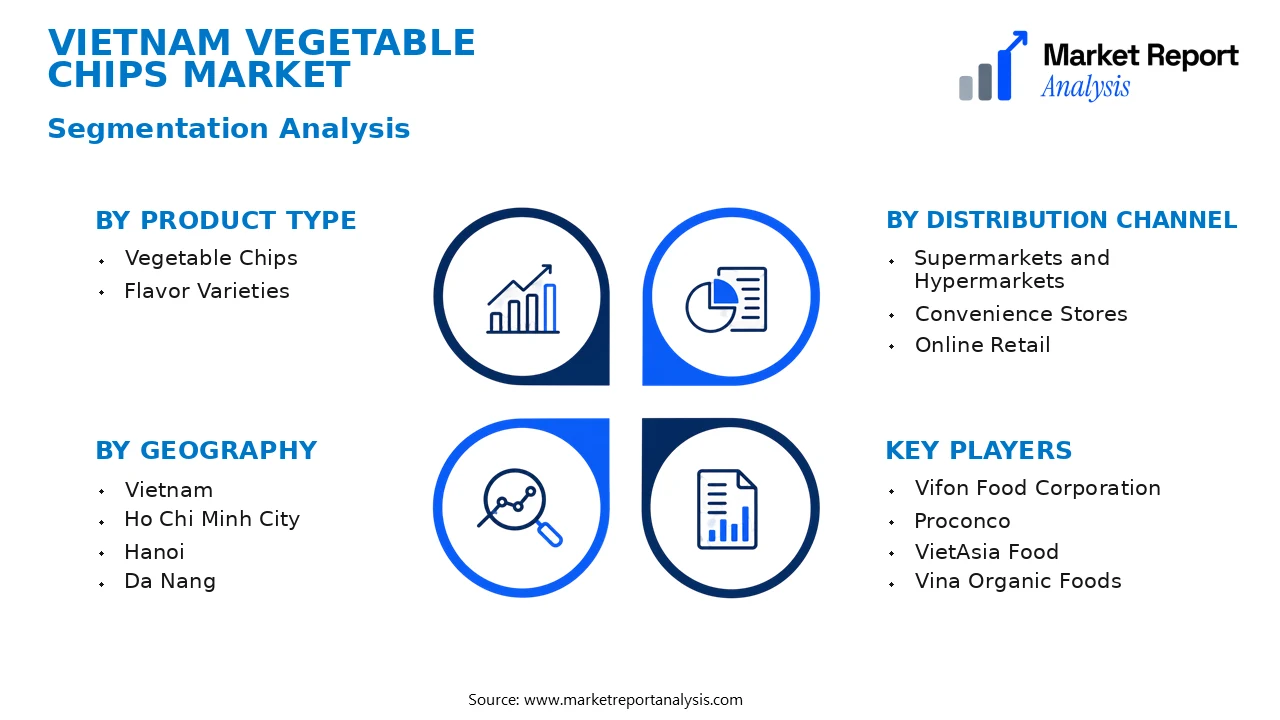
The Vietnam Vegetable Chips Market is segmented based on product type, distribution channel, and geography. These segments enable a detailed analysis of consumer preferences, sales strategies, and regional market dynamics, facilitating targeted growth initiatives and strategic planning.
- Product Type
- Vegetable Chips: This segment includes a variety of chips made from sliced vegetables such as sweet potatoes, carrots, spinach, and beets, catering to health-conscious consumers seeking nutritious snack options with innovative flavors.
- Flavor Varieties: Encompasses traditional, spicy, herbed, and exotic flavor profiles, driven by consumer demand for diverse, functional, and gourmet snack choices that enhance the sensory experience and boost sales volume.
- Distribution Channel
- Supermarkets and Hypermarkets: Dominating the supply chain, this channel offers mass distribution, extensive brand visibility, and convenience, making it the primary purchase point for retail consumers in urban and semi-urban areas.
- Convenience Stores: These outlets provide quick access for on-the-go consumers, especially in urban centers like Ho Chi Minh City and Hanoi, supporting impulse buying and increasing product penetration among younger demographics.
- Online Retail: The rising e-commerce trend in Vietnam supports direct-to-consumer sales, offering broader reach, shopping convenience, and access to niche and organic vegetable chip varieties that appeal to health-conscious buyers.
- Geography
- Vietnam: The primary market with high growth potential driven by increasing health awareness and snack consumption trends. Key cities such as Ho Chi Minh City and Hanoi serve as major hubs for distribution and innovation.
- Ho Chi Minh City: As Vietnam’s largest city, it exhibits a significant demand for snack foods, driven by expanding retail infrastructure, cosmopolitan consumer preferences, and the presence of numerous manufacturing and distribution facilities.
- Hanoi: With its vibrant urban population and rising disposable income, Hanoi demonstrates considerable market activity for vegetable chips, especially within modern retail formats and emerging health stores.
- Da Nang: This central Vietnamese hub combines industrial growth with increasing consumer interest in healthier snack options, making it a strategic location for expanding vegetable chip sales and regional distribution.
- Hai Phong: As a key port city, Hai Phong offers logistical advantages and a burgeoning consumer base receptive to innovative food products, positioning it as an important node within the supply chain network.
- Can Tho: In the Mekong Delta region, Can Tho’s agriculture-driven economy and expanding retail sector present unique opportunities for locally sourced and regionally branded vegetable chips targeting domestic markets.
- Bien Hoa: Its proximity to Ho Chi Minh City boosts demand for processed snack foods, supported by a well-developed industrial base for manufacturing and distribution of health-oriented products.
- Nha Trang: With its tourism-driven economy, Nha Trang offers a niche market for premium and organic vegetable chips, catering to both local consumers and international visitors seeking healthy snack options.
Overall, these segmentation categories and regional specifics provide a granular view of the Vietnam Vegetable Chips Market, guiding producers and marketers in tailoring their strategies to regional tastes, distribution preferences, and market maturity levels for sustained growth through 2034.
Competitive Intelligence
The Vietnam Vegetable Chips Market exhibits moderate competition, characterized by several local players and emerging startups focusing on organic and health-conscious segments. The market is somewhat consolidated, with top firms holding a significant share, yet niche brands continuously innovate to differentiate themselves. Companies adopt aggressive business strategies such as product innovation, emphasizing natural ingredients and unique flavors tailored to Vietnamese preferences. Strategic partnerships are prevalent, notably between snack producers and local organic farms, ensuring ingredient quality and supply chain stability. Acquisitions are gaining traction as larger corporations acquire smaller startups to expand their product portfolios and market reach, especially in major cities like Ho Chi Minh City and Hanoi. Expansion strategies include launching health-centric variants, expanding distribution channels into convenience stores and online platforms, and entering untapped regional markets. R&D investments focus on developing low-oil, nutrient-enhanced offerings to cater to health-conscious consumers. Competitive differentiation is largely driven by product innovation, quality assurance, and branding, with regional players leveraging local flavors to strengthen market positioning across Vietnam.
Leading Company Profiles
The competitive landscape of the Vietnam Vegetable Chips Market features a diverse group of companies focusing on innovative product offerings, quality manufacturing, and strategic expansion to increase market share across Vietnam and neighboring regions.
- Vifon Food Corporation
- Proconco
- VietAsia Food
- Vina Organic Foods
- Tasta Vietnam
- Lao Cai Food Co., Ltd.
- Huong Viet Foods
- Green Fields Vietnam
- Fresco Snacks
- Annam Food Processing
Vifon Food Corporation
Vifon Food Corporation specializes in producing vegetable-based snacks, focusing on natural ingredients, innovative recipes, and sustainable sourcing to meet increasing consumer demand for healthy snack options in Vietnam.
Proconco
Proconco is renowned for its wide portfolio of processed food products, including vegetable chips, leveraging modern manufacturing equipment and R&D capabilities to provide flavorful, premium-quality snacks aimed at both domestic and international markets.
VietAsia Food
VietAsia Food emphasizes organic ingredients, high culinary standards, and eco-friendly packaging solutions, positioning itself as a leading sustainable brand in the Vietnam vegetable chips industry with strong export focus.
Vina Organic Foods
Vina Organic Foods offers organic vegetable snacks with an emphasis on health-conscious formulations, integrating local vegetable varieties with innovative flavors, targeting urban middle-class consumers seeking nutritious snack alternatives.
Tasta Vietnam
Tasta Vietnam focuses on regional flavor integration, modernizing traditional recipes with contemporary packaging and distribution strategies to appeal to both local and ASEAN markets.
Lao Cai Food Co., Ltd.
Lao Cai Food Co., Ltd. invests heavily in capacity expansion and automation, enhancing production efficiencies while maintaining strict quality standards for the vegetable chips and snack sector in northern Vietnam.
Huong Viet Foods
Huong Viet Foods specializes in natural, additive-free vegetable chips, leveraging traditional drying and frying techniques combined with modern preservation technologies to ensure product freshness and nutritional value.
Green Fields Vietnam
Green Fields Vietnam focuses on organic farming and sustainable supply chains, aligning product development strategies with Vietnam’s growing organic market segment and export opportunities.
Fresco Snacks
Fresco Snacks is known for innovative flavor profiles and packaging, targeting younger demographics and premium retail segments within Vietnam’s evolving snack industry.
Annam Food Processing
Annam Food Processing integrates advanced processing technologies and strategic partnerships to enhance product quality, expand market reach, and reinforce its position as a leading regional supplier of vegetable snacks.
Strategic Business Developments
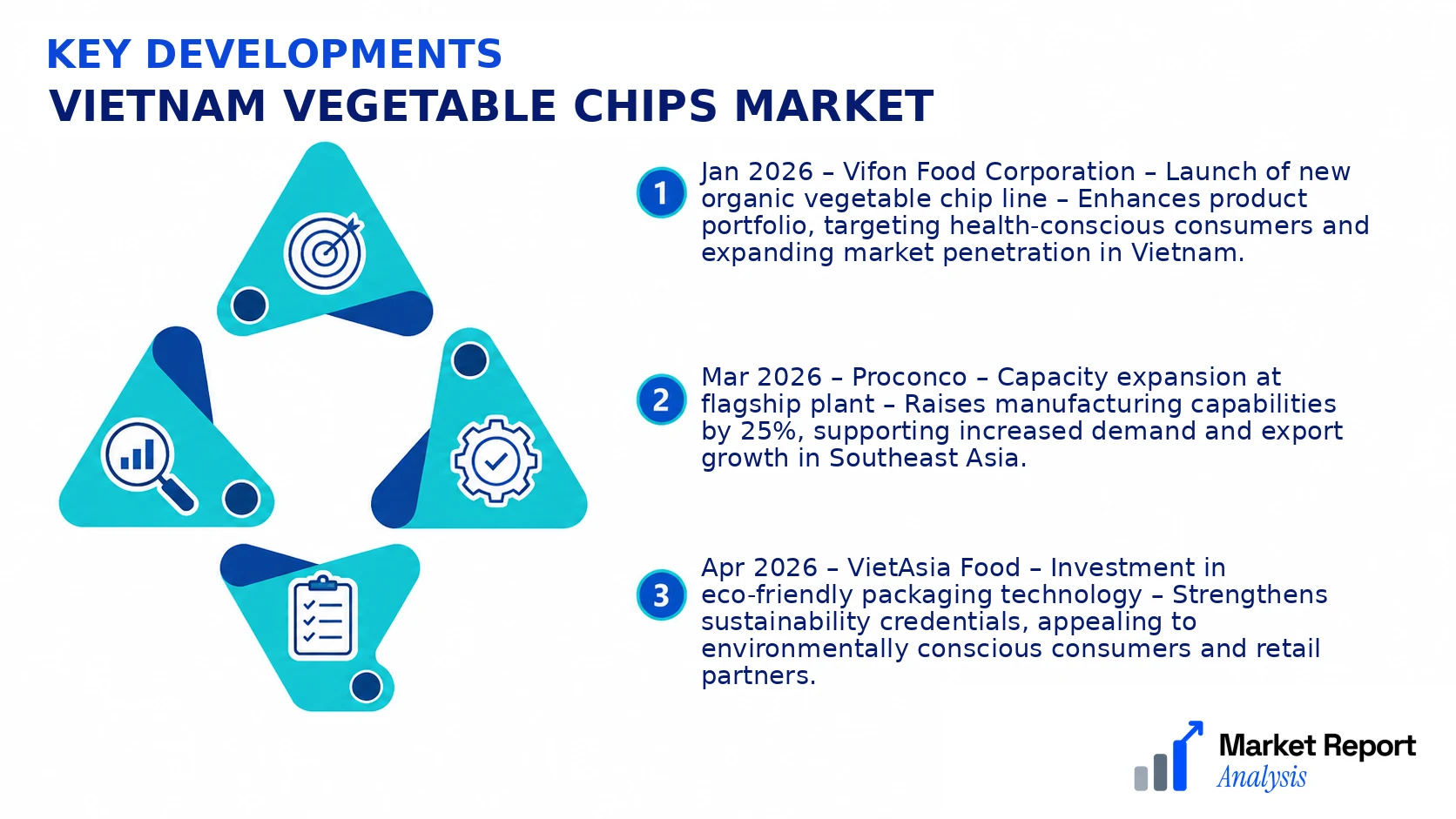
- Jan 2026 – Vifon Food Corporation – Launch of new organic vegetable chip line – Enhances product portfolio, targeting health-conscious consumers and expanding market penetration in Vietnam.
- Mar 2026 – Proconco – Capacity expansion at flagship plant – Raises manufacturing capabilities by 25%, supporting increased demand and export growth in Southeast Asia.
- Apr 2026 – VietAsia Food – Investment in eco-friendly packaging technology – Strengthens sustainability credentials, appealing to environmentally conscious consumers and retail partners.
- Jun 2026 – Vina Organic Foods – Strategic alliance with organic vegetable growers – Secures supply chain, ensuring consistent organic quality and expanding production capacity.
- Aug 2026 – Lao Cai Food Co., Ltd. – Introduction of automation technology – Drives efficiency and cost reduction, facilitating larger scale production to meet domestic and export demands.
Frequently Asked Questions
What is the Vietnam Vegetable Chips Market?
The Vietnam Vegetable Chips Market comprises the production, distribution, and retail of vegetable-based snack foods, primarily chips, made from locally sourced vegetables. It reflects growing consumer demand for healthy snack options and involves both domestic companies and international brands operating within Vietnam.
What is the current market size of Vietnam Vegetable Chips Market?
As of 2026, the Vietnam Vegetable Chips Market is valued at approximately USD 0.25 Billion, driven by rising health consciousness and expanding retail networks. The market has experienced steady growth fueled by increased urbanization and changing consumer preferences for nutritious snacks.
What factors are driving the Vietnam Vegetable Chips Market?
Key growth drivers include increasing health awareness among Vietnamese consumers, government initiatives promoting healthy eating, the popularity of vegetarian lifestyles, and the expansion of modern retail channels. Innovation in product flavors and packaging also boosts market expansion.
Which Vietnamese city leads the Vietnam Vegetable Chips Market?
Ho Chi Minh City stands out as the leading market, owing to its large urban population, higher disposable incomes, and the presence of major FMCG retailers and snack brands that drive demand for vegetable chips.
Which segment is expected to grow the fastest?
The organic and gluten-free vegetable chips segment is projected to experience the fastest growth, due to increasing consumer focus on health and wellness, along with a preference for natural and additive-free snack options within urban Vietnamese markets.
Who are the leading companies operating in the Vietnam Vegetable Chips Market?
Major players include local brands like Vina Food and Vietnam Snack Co., as well as international corporations such as Mondelez and Mars, which are expanding their product portfolios to include vegetable-based snacks tailored for Vietnamese consumers.
Analyst Perspective
The Vietnam Vegetable Chips Market is poised for sustained growth through 2034, driven by rising health consciousness and increasing disposable incomes among urban consumers. Long-term, the market is expected to mature, with the potential for premium, organic, and innovative flavor variants to command higher margins. Technological advancements in production efficiency, such as improved drying and slicing techniques, will enhance product quality and consistency, further boosting competitiveness. Investment priorities should focus on R&D, distribution infrastructure, and branding to differentiate in a crowded space. The market confronts moderate competitive intensity, yet opportunities remain for agile entrants with unique value propositions. Key Vietnamese cities like Ho Chi Minh City and Hanoi are poised as growth hubs due to their large, health-conscious populations and evolving retail landscapes, offering strategic advantages for market penetration. Overall, positioning for long-term strength will hinge on technological innovation, consumer engagement, and tailored regional strategies to capitalize on urban cluster growth and shifting dietary trends.
