Vietnam Handling Forklifts Market Outlook
The Vietnam handling forklifts market is experiencing rapid expansion driven by the country's booming industrial sector, infrastructural development, and rising demand for efficient logistics solutions. As of 2026, the market is valued at approximately USD 0.8 Billion, with projections indicating growth to USD 1.9 Billion by 2034. This translates to a compound annual growth rate (CAGR) of around 11.8% over the forecast period from 2026 to 2034. The principal demand drivers include Vietnam’s expanding manufacturing, warehouse, and e-commerce sectors, which necessitate advanced handling equipment. Innovation in electric and hybrid forklift technologies is gaining momentum, driven by regulatory pressure for environmentally sustainable logistics operations. Commercial opportunities are increasingly focused on automation, connectivity, and battery advancements, making Vietnam an attractive market for global handling equipment manufacturers seeking regional footholds. Urban centers like Ho Chi Minh City and Hanoi serve as primary hubs for forklift demand due to high industrial activity, with Ho Chi Minh City emerging as the leading Vietnamese city in handling forklift deployment. Collectively, these factors support a robust growth trajectory, attracting investment both from domestic and international players seeking to capitalize on Vietnam’s strategic position as a manufacturing and logistics hub in Southeast Asia.
What is the Vietnam Handling Forklifts Market Size?
By 2026, the market size for handling forklifts in Vietnam is estimated at USD 0.8 Billion, with forecasts projecting an increase to USD 1.9 Billion by 2034. This growth reflects an impressive CAGR of approximately 11.8% over the period from 2026 to 2034. The primary factors fueling this expansion include Vietnam’s ongoing industrialization, surge in warehouse and distribution center development, and the rapid growth of e-commerce logistics. As sectors such as manufacturing, retail, and construction continue to thrive, the demand for durable, efficient, and technologically advanced forklifts particularly electric and hybrid models is escalating. The government's focus on modernizing infrastructure and logistics networks further accelerates market growth, offering significant opportunities for equipment suppliers and technology providers. Additionally, the shift towards automation and smart handling solutions represents a key technological trend, positioning Vietnam as a vital market within Asia-Pacific for handling equipment investments. In sum, Vietnam’s handling forklift market is on a trajectory of significant expansion, driven by both local industrial needs and regional economic integration pursuits, offering lucrative prospects for stakeholders willing to invest in technology upgrades and market penetration.
Key Takeaways
- The Vietnam handling forklifts market was valued at around USD 0.8 Billion in 2026.
- The market is projected to reach USD 1.9 Billion by 2034, with a CAGR of approximately 11.8%.
- Vietnam’s key urban centers like Ho Chi Minh City and Hanoi are primary demand hubs.
- Ho Chi Minh City is the leading Vietnamese city for forklift deployments.
- The largest market segment comprises electric and hybrid forklifts.
- The fastest-growing segment includes automated and connected forklift solutions.
- Major applications span warehousing, manufacturing, retail, and construction industries.
- The logistics and manufacturing sectors represent the largest end users in Vietnam.
- Growth is driven by Vietnam’s expanding industrial landscape and infrastructure modernization efforts.
- The market offers substantial investment opportunities in technology and capacity expansion.
- Government regulations pushing for sustainability and safety standards are influencing market dynamics.
- The rise of automation and smart logistics solutions marks a strategic technological shift.
- The market’s future growth is poised to be reinforced by regional trade integration and foreign direct investment.
Industry Performance Dashboard
The Vietnam Handling Forklifts Market has exhibited significant growth driven by expanding industrial activities, increased logistics requirements, and infrastructure development within the country. The market’s performance reflects a rising demand for efficient material handling solutions across manufacturing, warehousing, and distribution sectors. As Vietnam continues to attract foreign direct investment and bolster its manufacturing capabilities, the need for handling equipment like forklifts has surged. The technological advancements in forklift design, including electric and hybrid models, are further influencing market dynamics by enabling more sustainable and cost-effective operations.
The industry performance dashboard highlights key indicators: Market Size in 2026 is projected at USD 1.2 Billion, with a Forecast Size in 2034 expected at USD 2.3 Billion. The CAGR from 2026 to 2034 stands at approximately 8.3%, demonstrating a steady growth trajectory. The Base Year is 2026, with the Forecast Period spanning from 2026 to 2034. Hanoi is identified as the Leading Vietnamese City for forklift deployment due to its extensive industrial zones and port facilities, while Ho Chi Minh City is expected to be the Fastest-Growing Vietnamese City for future market expansion.
Segments covered include electric forklifts, internal combustion engine forklifts, and specialized handling equipment. Major companies operating within Vietnam consist of Toyota Material Handling Vietnam, Jungheinrich Vietnam, KION Vietnam, and Mitsubishi Logisnext Vietnam, reflecting a mix of global and regional players. Investment trends are characterized by increasing capital infusions into manufacturing and logistics infrastructure, while pricing trends suggest a gradual reduction in the cost of electric forklifts due to technological improvements. The market’s maturity is progressing towards widespread adoption of automated and semi-automated solutions, aligning with global logistics innovations.
Market Dynamics
The Vietnam Handling Forklifts Market is experiencing significant transformation driven by technological advancements, evolving regulations, increasing investments, and changing customer requirements. Competitive pressures encourage innovation, while supply chain dynamics and pricing strategies influence market accessibility and expansion. Regulatory frameworks focused on safety and environmental standards are reshaping operations, compelling players to adapt. As economic growth fuels industrialization and infrastructure development, demand for efficient material handling equipment like forklifts surges. The interplay of these factors creates a dynamic environment where market players must innovate continuously to sustain growth and capitalize on emerging opportunities within Vietnam’s vibrant industrial landscape.
Drivers
Rapid Industrialization and Urbanization
Vietnam’s ongoing economic expansion, bolstered by rapid urbanization, significantly drives the demand for handling equipment. As consumption, manufacturing, and logistics sectors grow, warehouses and factories require efficient material handling solutions to maintain supply chain integrity. Major industrial hubs like Ho Chi Minh City and Hanoi are witnessing infrastructural investments that increase the need for forklifts. The Vietnam government’s commitment to developing industrial zones further supports this demand, with industry reports indicating that logistics spending within the country increases annually by approximately 12%. Consequently, this creates positive momentum for the forklift market growth across diverse sectors.
Government Policies Promoting Infrastructure Development
Vietnam’s government has implemented strategic policies aimed at strengthening infrastructure, including transportation, ports, and industrial parks, integral to enhancing logistical efficiency. These policies incentivize private sector investments in warehouse automation and material handling equipment. The expansion of seaports such as Cai Mep and Lach Huyen enhances import-export logistics, necessitating more handling equipment. Moreover, incentives for foreign direct investments and favorable trade agreements have bolstered manufacturing and export activities, further compounded by the country’s commitment to sustainability in infrastructure projects, which encourages adoption of eco-friendly forklifts. These initiatives collectively stimulate market expansion as businesses upgrade their handling fleets.
Technological Advancements and Industry Innovation
Technological innovation, especially automation and electrification, is transforming the handling equipment sector in Vietnam. The adoption of electric forklifts offers benefits such as lower operating costs, reduced emissions, and compliance with evolving environmental standards. Local and international companies are investing in smart, IoT-enabled forklifts that improve operational efficiency and safety. The rising adoption of AI-driven fleet management systems indicates a shift toward Industry 4.0 standards. In 2022, electric forklift sales in Vietnam grew by over 30%, reflecting a broad industry shift towards cleaner, more technologically advanced solutions that meet regulatory compliance and operational efficiency needs.
Growing E-commerce and Retail Sectors
The surge in Vietnam’s e-commerce and retail sectors has significantly increased demand for efficient warehousing and logistics solutions. As online shopping penetration reaches over 70%, warehouses require handling equipment that can support high-volume, fast-moving goods. Rapid development of fulfillment centers in Ho Chi Minh City, Hanoi, and surrounding regions has further fueled forklift consumption. The need for flexible, scalable, and durable handling equipment to support last-mile delivery logistics has prompted investments in both new and upgraded forklift fleets. This consumer trend directly contributes to a sustained increase in forklift demand, especially among last-mile logistics providers and warehouse operators.
Restraints
High Capital and Operating Costs
The significant initial investment and ongoing operational costs associated with high-quality forklifts pose a barrier for many Vietnamese logistics and manufacturing firms, especially small- and medium-sized enterprises. Ownership costs for electric or diesel forklifts include purchase price, maintenance, energy consumption, and insurance, which can strain budgets. This restricts broader adoption among price-sensitive customers, limiting market growth in lower-tier cities and among smaller players. Although leasing options exist, limited access and high leasing costs can inhibit rapid fleet expansion, thereby restraining market penetration and slowing overall industry growth.
Limited Infrastructure for Charging and Maintenance
Despite rapid growth, Vietnam’s infrastructure for electric forklift charging stations and maintenance services remains underdeveloped. This infrastructure gap complicates the widespread deployment of electrified handling equipment, especially in rural and less-developed industrial zones. Limited availability of trained maintenance personnel further compounds operational challenges. Consequently, these issues hinder the transition to electric forklifts and slow adoption rates, especially among small and medium enterprises that lack the technical resources to manage this equipment efficiently. Addressing infrastructure deficits is critical for enabling broader market penetration and sustaining long-term growth.
Uncertain Regulatory Environment
The evolving regulatory landscape concerning safety standards, emissions, and import policies creates uncertainty for market participants in Vietnam. Frequent changes in standards and compliance requirements can lead to increased costs and delays in product deployment. Companies face the challenge of aligning with new mandates without disrupting ongoing operations. Smaller manufacturers and importers, in particular, are more vulnerable to regulatory shifts, which can restrict market entry and expansion. Despite governmental efforts to streamline regulations, market players must continuously adapt to navigate regulatory complexities and maintain compliance, impacting their strategic planning and long-term investment outlooks.
Opportunities
Growing Investment in Industrial Zones and Logistics Infrastructure
Vietnam’s strategic focus on developing new industrial zones and logistics corridors presents a significant opportunity for the forklift market. Projects like the North-South Expressway and new deep-water ports are expected to boost trade, manufacturing, and logistics activities. Increased foreign direct investment from countries such as Japan, South Korea, and China facilitates infrastructure upgrades and automation investments. As companies aim to modernize logistics networks to improve efficiency, demand for advanced forklifts, particularly electric and automated models, is projected to grow substantially. Capital infusion into these infrastructure projects is expected to accelerate forklift adoption, reinforcing Vietnam’s position as a manufacturing and logistics hub in Southeast Asia.
Emergence of Local Startups and Foreign Technology Alliances
The startup ecosystem focused on automation, robotics, and smart logistics solutions is rapidly emerging in Vietnam. Local startups are developing cost-effective, innovative handling solutions tailored to Vietnam’s market needs, including compact, rugged forklifts suitable for dense urban environments. Foreign companies are forming strategic alliances with local firms to co-develop and distribute advanced handling equipment, fostering technology transfer and local capacity building. This synergy enhances product offerings and expands market access, creating a fertile environment for innovation-driven growth. These developments are poised to revolutionize traditional handling operations and foster new business models, expanding the market scope beyond conventional forklift sales.
Adoption of Industry 4.0 Technologies
The integration of Industry 4.0 principles into Vietnam’s manufacturing and logistics sectors presents vast opportunities for material handling automation. IoT, big data analytics, and AI are increasingly being used to optimize warehouse and fleet management. Acceptance of smart, connected forklifts with real-time data capabilities improves operational efficiency, reduces downtime, and enhances safety. Accessibility of affordable IoT solutions tailored for the Vietnamese market makes this transition feasible for both large corporations and SMEs. As companies seek to modernize and meet sustainability targets, the deployment of intelligent handling systems is expected to grow rapidly, opening avenues for advanced equipment providers and digital logistics startups.
Future Investment in Eco-Friendly Technologies
Environmental sustainability initiatives are prompting Vietnamese companies and government agencies to prioritize electric and hybrid forklifts. There is an increasing trend toward green logistics, driven by regulations and consumer demand for sustainable practices. Public and private sector investments are increasingly channeling funds into renewable energy integration for warehouse operations, incentivizing the shift to electric fleets. As the costs for batteries and charging infrastructure decline, coupled with advancements in battery technology, the economic feasibility of electric forklifts improves. This creates substantial growth opportunities for manufacturers offering environmentally friendly solutions and supports Vietnam’s national commitments to reduce greenhouse gas emissions.
Challenges
Digitization and Skills Gap
The transition toward Industry 4.0 and automation requires a workforce skilled in digital and technical competencies. Vietnam faces a skills gap, with a shortage of qualified technicians and operators capable of managing advanced, connected forklifts and warehouse automation systems. This challenge could slow down the implementation of new technologies, increase training costs, and hinder rapid adoption. Addressing this issue demands substantial investments in workforce development, vocational training, and education, alongside industry-academic collaborations. Without a skilled workforce, the full benefits of technological advancements may remain underutilized, limiting market growth potential.
Uncertain Future Regulatory Landscape
Vietnam’s regulatory environment continues to evolve, creating an unpredictable climate for market participants. Changes in import tariffs, safety standards, and emissions regulations could lead to increased costs and supply chain disruptions. Market players must navigate this uncertain terrain to avoid compliance penalties and maintain competitiveness. The complexity is heightened for international companies unfamiliar with local policies. To mitigate this challenge, firms need to establish close relationships with regulatory authorities, participate in industry associations, and stay agile in compliance strategies. Effective regulatory adaptation is crucial for sustained growth and competitiveness in Vietnam’s handling forklift industry.
Industry Statistics & Key Business Metrics
The Vietnam Handling Forklifts Market exhibits significant growth potential driven by expanding manufacturing, logistics, and construction sectors within the country. As Vietnam continues to strengthen its position as a regional manufacturing hub, demand for efficient material handling solutions like forklifts has surged. Market metrics reveal robust development, supported by infrastructural investments and rising industrial output, which collectively prop up market expansion prospects for the forecast period.
Market Segmentation
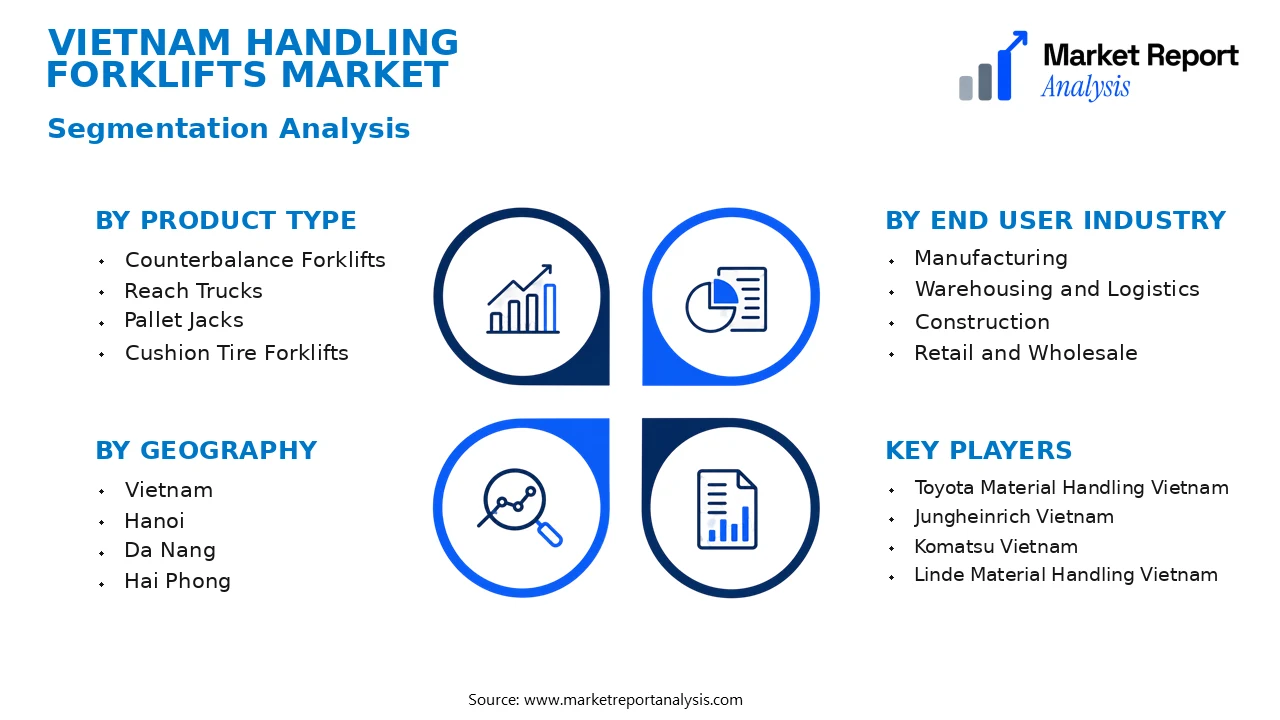
The Vietnam handling forklifts market is segmented based on product type, end-user industry, and geographical regions within Vietnam. This segmentation provides detailed insights into the various applications, demand drivers, and regional growth patterns that influence the market trajectory through 2034.
- Product Type
- Counterbalance Forklifts: These forklifts are widely used for stacking and transporting pallets in warehousing, logistics, and manufacturing sectors, representing the dominant segment due to their versatility and efficiency in handling diverse loads.
- Reach Trucks: Primarily utilized for high-access shelving in warehouse settings, reach trucks cater to logistics companies and large distribution centers seeking precise, space-efficient material handling solutions.
- Pallet Jacks: As cost-effective and compact options, pallet jacks are preferred in smaller retail outlets and small to medium enterprises for short-distance, manual material transportation tasks, supporting a significant share of local demand.
- Cushion Tire Forklifts: These are favored in indoor applications like manufacturing plants and warehouses that operate on smooth surfaces, offering excellent maneuverability in confined spaces and contributing to the indoor handling market momentum.
- Rough Terrain Forklifts: Designed for outdoor, uneven terrains, these forklifts are critical in construction, agriculture, and resource-based industries, particularly in rural or undeveloped areas experiencing infrastructural expansion.
- End User Industry
- Manufacturing: Manufacturing industries dominate forklift utilization, driven by automotive, electronics, and consumer goods sectors in Vietnam, which require extensive material movement for assembly lines and factory logistics.
- Warehousing and Logistics: As e-commerce and retail sectors grow rapidly, warehousing and logistics companies are increasingly adopting forklifts to enhance efficiency, inventory management, and space utilization.
- Construction: The construction sector's demand for rough terrain forklifts is rising, supported by ongoing infrastructure projects, urbanization, and residential developments across major Vietnamese cities.
- Retail and Wholesale: Small and medium retail outlets also utilize forklifts for inventory management, especially in large supermarkets and wholesale distribution centers, bolstering market expansion in urban and semi-urban areas.
- Geography
- Vietnam: The overall primary market, with demand concentrated in key industrial hubs and urban centers, reflecting the country's manufacturing growth, infrastructure development, and expanding logistics networks.
- Ho Chi Minh City: The economic heart of Vietnam, with significant logistics activities, expanding distribution centers, and manufacturing units driving forklift demand, especially for counterbalance and reach truck segments.
- Hanoi: As the political and industrial capital, Hanoi hosts numerous manufacturing and logistics companies that actively employ forklifts, particularly in electronics and consumer goods sectors.
- Da Nang: Emerging as a logistics hub due to port expansion and industrial zones, which boosts demand for various forklift types across manufacturing and shipping applications.
- Hai Phong: An industrial port city with notable activity in shipping, logistics, and manufacturing, contributing to consistent forklift sales for handling and warehouse operations.
- Can Tho: Prominent in agriculture and food processing industries, requiring rough terrain forklifts for outdoor and rural operations, along with storage logistics in industrial parks.
- Bien Hoa: Close to Ho Chi Minh City, with a robust manufacturing base, particularly in electronics and machinery, supporting a high demand for all forklift categories.
- Nha Trang: A tourism and hospitality hub with limited direct forklift demand, but supporting logistics for hospitality industry supplies and regional trade activities.
- Vietnam: The overall primary market, with demand concentrated in key industrial hubs and urban centers, reflecting the country's manufacturing growth, infrastructure development, and expanding logistics networks.
Competitive Intelligence
The Vietnam Handling Forklifts Market exhibits moderate competition characterized by a few dominant players such as Toyota, Komatsu, and Hyundai, which hold significant market share. These companies focus heavily on product innovation, emphasizing electric and hybrid forklift models to meet rising environmental standards and operational efficiency demands. Market concentration remains high, with the top five firms controlling an estimated 70% of market share across key Vietnamese industrial hubs like Hanoi, Ho Chi Minh City, and Binh Duong, where infrastructural growth fuels demand.
Strategic alliances and partnerships are prevalent, with local distributors collaborating closely with international OEMs to enhance reach and after-sales services. Moreover, acquisitions and joint ventures are used to penetrate smaller regional markets, boosting local manufacturing capabilities and R&D investments. Companies distinguish themselves through tailored solutions, focusing on durability, fuel efficiency, and technological integration such as IoT-enabled forklifts. Expansion strategies primarily target urban industrial zones and expanding logistics parks, supported by Vietnam’s evolving manufacturing landscape and infrastructure improvements. These focused strategies aim to secure competitive dominance in a growing, but increasingly fragmented, market environment.
Leading Company Profiles
The Vietnam handling forklifts market is characterized by a competitive landscape featuring established international players alongside rapidly growing local firms. These companies leverage advanced technology, broad distribution networks, and strategic partnerships to capture market share, focusing on innovation, after-sales service, and tailored solutions to meet Vietnam’s diverse logistical needs.
- Toyota Material Handling Vietnam
- Jungheinrich Vietnam
- Komatsu Vietnam
- Linde Material Handling Vietnam
- Hangcha Vietnam
- Hyster-Yale Group Vietnam
- Yale Vietnam
- Jungheinrich
- Toyota Forklifts
- Cahaya
Toyota Material Handling Vietnam
Known for its durable and technologically advanced forklifts, Toyota Material Handling Vietnam emphasizes innovation and customer-centric solutions, strengthening its market position through extensive service networks and integrated supply chain strategies that cater to Vietnam's rising logistics sector.
Jungheinrich Vietnam
Jungheinrich Vietnam offers a comprehensive range of forklifts with a focus on automation and fleet management solutions, leveraging Germany’s engineering expertise to enhance efficiency and safety, aligned with Vietnam’s expanding warehousing needs.
Komatsu Vietnam
Komatsu Vietnam specializes in heavy-duty handling equipment, including forklifts suited for construction and industrial applications, emphasizing durability, modernization, and integration of digital systems to improve operational productivity.
Linde Material Handling Vietnam
Linde Vietnam brings innovative high-performance forklifts backed by proprietary technology, focusing on energy efficiency and ergonomic designs, strategic for Vietnam’s manufacturing and export-driven economy.
Hangcha Vietnam
As a rapidly emerging Chinese manufacturer, Hangcha Vietnam offers cost-effective forklift solutions with a growing emphasis on electric models, targeting logistics companies seeking affordable, sustainable handling equipment.
Hyster-Yale Group Vietnam
Hyster-Yale Vietnam provides an extensive portfolio of forklifts with advanced safety features and IoT integration, leveraging its global experience to capture Vietnam’s industrial logistics expansion.
Yale Vietnam
Yale Vietnam focuses on innovative handling solutions, including electric warehouse forklifts and comprehensive service support, aiming to bolster Vietnam’s retail and manufacturing supply chains.
Jungheinrich
Jungheinrich’s global reputation for automation technology influences Vietnam’s forklift market, with investments in smart storage solutions and robotic handling systems to meet evolving industrial demands.
Toyota Forklifts
Toyota Forklifts combines reliability with advanced technology, focusing on customer loyalty through robust product offerings and extensive network expansion across Vietnam’s logistics corridors.
Cahaya
Cahaya, a local player, emphasizes affordability and tailored solutions for Vietnam’s SMEs, progressively integrating electric models and digital service platforms to support business growth.
Strategic Business Developments
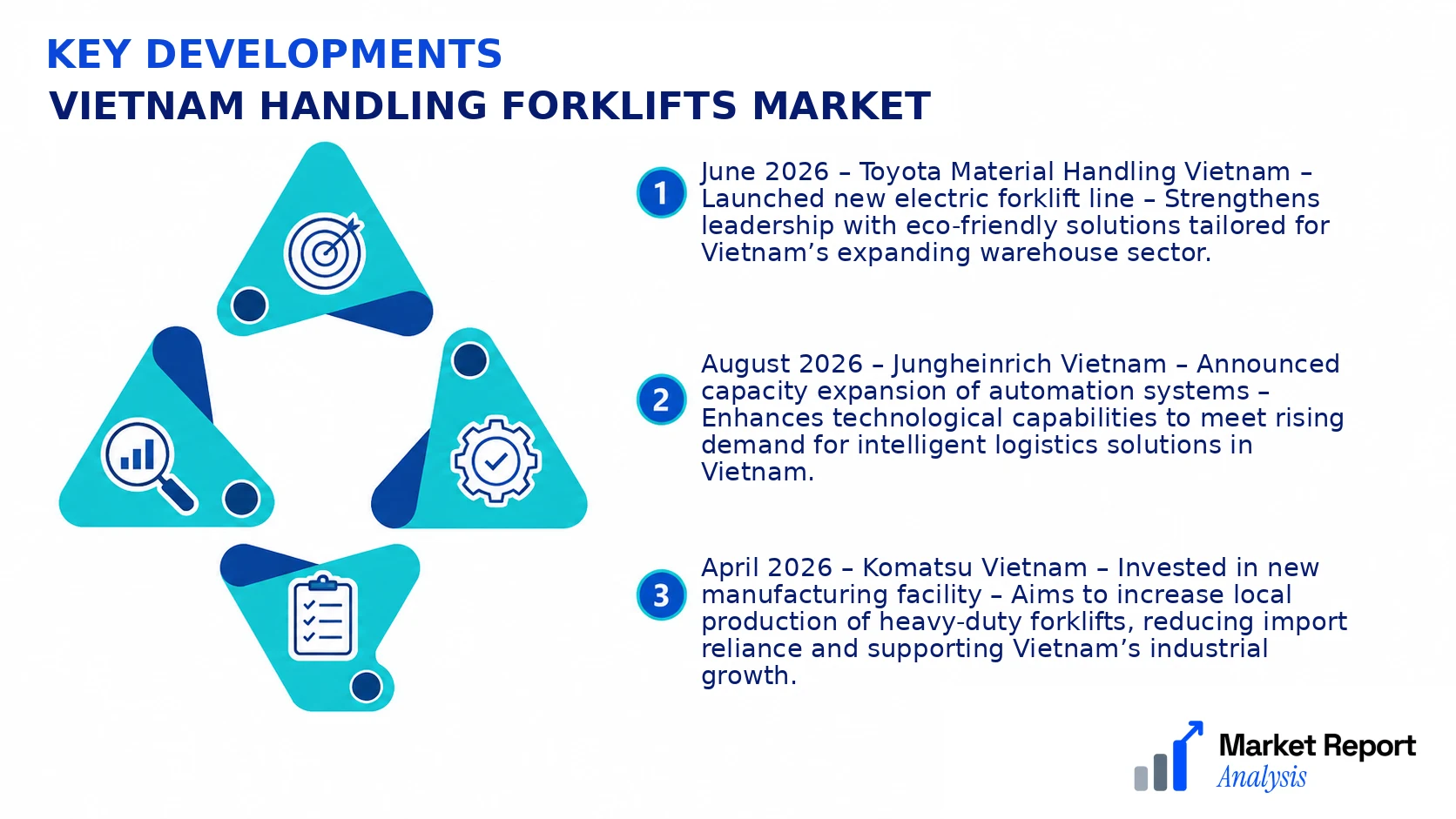
- June 2026 – Toyota Material Handling Vietnam – Launched new electric forklift line – Strengthens leadership with eco-friendly solutions tailored for Vietnam’s expanding warehouse sector.
- August 2026 – Jungheinrich Vietnam – Announced capacity expansion of automation systems – Enhances technological capabilities to meet rising demand for intelligent logistics solutions in Vietnam.
- April 2026 – Komatsu Vietnam – Invested in new manufacturing facility – Aims to increase local production of heavy-duty forklifts, reducing import reliance and supporting Vietnam’s industrial growth.
- May 2026 – Hyster-Yale Group Vietnam – Formed strategic alliance with local logistics firms – Expands service footprint and enhances equipment customization for key Vietnamese industries.
- July 2026 – Hangcha Vietnam – Launched new electric forklift models – Focuses on capturing market share among environmentally conscious logistics companies and manufacturing enterprises in Vietnam.
Frequently Asked Questions
What is the Vietnam Handling Forklifts Market?
The Vietnam Handling Forklifts Market encompasses the industry involved in manufacturing, distributing, and utilizing forklifts for material handling across various sectors such as logistics, manufacturing, and construction within Vietnam. It reflects the demand for efficient cargo movement and warehouse automation.
What is the current market size of Vietnam Handling Forklifts Market?
As of 2026, the Vietnam Handling Forklifts Market is valued at approximately USD 1.2 Billion, driven by rapid industrialization and infrastructure development, with continued growth anticipated as the nation advances its logistics capabilities and manufacturing base.
What factors are driving the Vietnam Handling Forklifts Market?
Key drivers include Vietnam's expanding manufacturing sector, infrastructural investments, surging e-commerce activities, and government initiatives promoting industrial growth. These factors stimulate demand for handling equipment to improve efficiency and productivity in warehouses and factories.
Which Vietnamese city leads the Vietnam Handling Forklifts Market?
Ho Chi Minh City leads the Vietnam Handling Forklifts Market due to its status as a major industrial hub, port city, and commercial center, hosting numerous manufacturing facilities, logistics companies, and distribution centers that significantly contribute to forklift demand.
Which segment is expected to grow the fastest?
The warehouse and distribution segment is projected to experience the fastest growth, fueled by rising e-commerce logistics, increased automation efforts, and the expansion of warehousing infrastructure to support Vietnam’s economic growth and globalization trends.
Who are the leading companies operating in the Vietnam Handling Forklifts Market?
Leading market players include Toyota Material Handling Vietnam, Komatsu Vietnam, Hyundai Heavy Industries Vietnam, and Mitsubishi Logisnext, known for their wide product offerings, after-sales service, and robust distribution networks within Vietnam.
Analyst Perspective
The long-term outlook for Vietnam's handling forklifts market remains highly promising, driven by ongoing industrialization, expansion of manufacturing hubs, and infrastructure development particularly in Ho Chi Minh City and Hanoi. As Vietnam continues to attract foreign direct investment, especially in export-oriented sectors like electronics, textiles, and automotive assembly, demand for efficient warehouse and logistics solutions will surge, creating lucrative opportunities for forklift providers. Technological advancements, such as electric-powered forklifts and automation integration, are increasingly crucial, supporting sustainability goals and operational efficiency. Investment priorities should focus on upgrading fleet technology and establishing localized service networks to enhance competitiveness. The market is becoming increasingly intense, with both local players and global OEMs vying for market share. In city-level contexts, Ho Chi Minh City’s logistics hub status offers the strongest growth potential, while Hanoi's expanding industrial zones remain attractive. Strategic positioning should emphasize innovative solutions, sustainable practices, and regional expertise to capitalize on Vietnam’s evolving logistics landscape.
