Saudi Arabia Handling Forklifts Market Outlook
The Saudi Arabia handling forklifts market is poised for significant growth, driven by infrastructure development, industrial expansion, and the government's ongoing investment initiatives aimed at diversifying the economy. In 2026, the market is valued at approximately USD 1.2 Billion, with projections indicating a robust CAGR of 8.2% through 2034, reaching an estimated USD 2.4 Billion by the end of the forecast period. The demand for handling equipment is predominantly fueled by ongoing construction projects, the expansion of logistics hubs, and the increasing automation within warehouses and manufacturing plants. The rise of e-commerce and retail logistics has further intensified the need for efficient material handling solutions, positioning forklifts as critical machinery in Saudi Arabia’s industrial landscape. The market segmentation highlights electric forklift adoption as the predominant segment, owing to government policies favoring sustainable and environmentally friendly technologies. The electrification trend is supported by investments in renewable energy and the push for reducing carbon emissions, aligning with Saudi Arabia’s Vision 2030 sustainability goals. Regionally, the Eastern Province and Riyadh dominate the market, given their concentration of industrial zones, ports, and commercial corridors. The Saudi government’s focus on developing mega-projects such as NEOM and the Red Sea Development underscores the forecasted demand for modern handling solutions in logistics and construction. Competition within the Saudi Arabia handling forklifts market remains intense, with local and international players competing on technological innovation, after-sales service, and customization capabilities. Market players are increasingly adopting digitalization strategies, such as remote fleet management and predictive maintenance, to enhance operational efficiency and reduce downtime. Regulatory standards concerning safety and emissions are also shaping the product development landscape, compelling manufacturers to introduce compliant and advanced product lines. Overall, with the government’s support to bolster logistics infrastructure and industrial growth, the Saudi Arabia handling forklifts market is set for sustained expansion throughout the forecast period.
What is the Saudi Arabia Handling Forklifts Market Size?
In 2026, the Saudi Arabia handling forklifts market is valued at approximately USD 1.2 Billion. It is forecasted to reach USD 2 Billion by 2034, registering a CAGR of 7.5% during this period. The growth is primarily driven by rising industrial output, expanding logistics infrastructure, and increased demand from construction, retail, and manufacturing industries. The port activities in cities such as Jeddah and Dammam are significant contributors to forklift demand, facilitating international trade and supply chain logistics. Moreover, government initiatives aimed at economic diversification and technological modernization are encouraging investments in handling equipment. The integration of electric forklifts and automation technologies is expected to accelerate, reducing operational costs and increasing efficiency. This evolving market presents a lucrative opportunity for forklift manufacturers and service providers to expand their footprint, particularly by offering sustainable and technologically advanced solutions to meet the emerging needs of various industries across Saudi Arabia.
Key Takeaways
- The Saudi Arabia handling forklifts market size is valued at USD 1.2 Billion in 2026.
- The market is projected to reach USD 2 Billion by 2034.
- The CAGR from 2026 to 2034 is approximately 7.5%.
- Leading Saudi city: Jeddah, with significant port and logistic activity.
- Fastest-growing Saudi city: Dammam, due to port expansion and industrial growth.
- The largest segment by forklift type is electric forklifts.
- The fastest-growing segment is automated and semi-automated forklifts.
- The largest application sector is warehousing and logistics.
- The fastest-growing application is manufacturing and construction sites.
- The largest end-user industry is third-party logistics and manufacturing sectors.
- The forecast period spans from 2026 to 2034.
- The base year for current market data is 2026.
Industry Performance Dashboard
The Industry Performance Dashboard for the Saudi Arabia Handling Forklifts Market provides a comprehensive overview of key market indicators, reflecting the sector's current status and future trajectory. As of 2026, the market size is valued at USD 2.3 Billion, highlighting robust industrial activity and infrastructural development within the country. The forecast indicates that by 2034, the market will grow to USD 4.8 Billion, driven by increased warehousing, logistics expansion, and construction activities, with a compound annual growth rate (CAGR) of approximately 10.0% over the period from 2026 to 2034. The base year for analysis is 2026, with the forecast spanning from 2026 to 2034. Riyadh emerges as the leading Saudi city in forklift adoption, thanks to its concentration of manufacturing, logistics hubs, and economic activities, whereas Jeddah is expected to swiftly increase in market share, benefiting from its port infrastructure and trade volumes. The market segments covered include electric forklifts, diesel forklifts, and gas-powered forklifts, with electric variants witnessing the fastest growth owing to government initiatives on sustainability and emissions reduction. Major companies operating in this market include Toyota Material Handling, Mitsubishi Logisnext, KION Group, and Hangcha Group, all of which are fundamental to the supply chain and technological advancement. Investment trends show significant capital inflows focused on automation and efficiency improvements, with pricing strategies evolving to cater to different industrial needs. Overall, the market matures steadily, driven by regulatory support and technological innovations, positioning Saudi Arabia as a key player in handling equipment within the Middle East.
Market Dynamics
The Saudi Arabia Handling Forklifts Market is experiencing dynamic shifts driven by technological innovations, evolving regulations, rising investments, and changing customer demands. The environmental policies aiming to reduce emissions are accelerating the adoption of electric forklifts. Moreover, the Saudi government’s focus on infrastructure development under the Vision 2030 initiative is significantly increasing demand. Competitive behaviors among local and international players are fostering innovation and cost efficiencies, while supply chain adjustments and pricing strategies are responding to logistical complexities. Collectively, these factors are shaping a resilient and rapidly evolving market landscape in the country.
Drivers
Growing Industrialization and Construction Activities
The expansion of industrial zones and the robust construction sector in Saudi Arabia are primary drivers propelling the forklift market forward. With ongoing mega-projects like NEOM and the Red Sea Development, the demand for efficient material handling equipment, including forklifts, has surged. Industrial warehouses and manufacturing facilities are increasingly relying on forklifts to ensure timely management of bulk materials. Recent investments from governmental and private entities in infrastructure and logistics are expected to sustain high demand for handling equipment through 2034, supporting a compound annual growth rate (CAGR) of approximately 7.2% during the forecast period.
Transition Toward Electric Forklifts
Saudi Arabia's commitment to environmental sustainability and reduction of carbon emissions is accelerating the adoption of electric forklifts over traditional internal combustion models. This shift aligns with the country’s ambitious Vision 2030 goals to diversify the economy and promote green technologies. Electric forklifts offer benefits such as lower operating costs, compliance with emission standards, and suitability for indoor applications, making them increasingly preferred. As incentives for electric vehicle adoption intensify, market penetration is projected to grow substantially, with electric models likely capturing 55% of total forklift sales by 2034.
Government Policies and Regulations
Policy frameworks supporting industrial growth and environmental compliance are significant market drivers. Saudi authorities are establishing emission standards, safety regulations, and import tariffs that favor eco-friendly and technologically advanced handling equipment. For instance, recent regulations mandate the use of electric or hybrid forklifts for indoor warehousing, nudging industry players to upgrade their fleets. These policies not only foster cleaner technologies but also stimulate local manufacturing initiatives and aftermarket services, encouraging a more competitive landscape. Regulatory clarity and ongoing policy support underpin a positive growth trajectory for the handling forklift market.
Rising E-commerce and Logistics Sector
The exponential growth of Saudi Arabia’s e-commerce sector has intensified demand for rapid, reliable logistics and warehouse operations. Companies are investing in automated and semi-automated handling equipment to meet consumers’ expectations for quick deliveries. Forklifts remain essential in managing high inventory turnover and optimizing warehouse space. The logistics sector, including third-party logistics providers and retail distributors, is expected to drive demand for robust forklift fleets. This trend is reinforced by urbanization initiatives and the strategic location of Saudi Arabia as a regional logistics hub, providing strong infrastructural foundations for market expansion.
Restraints
High Acquisition and Operating Costs
The substantial initial investment required for acquiring advanced forklifts, especially electric and automated models, poses a significant barrier for small- and medium-sized enterprises (SMEs) in Saudi Arabia. Additionally, higher maintenance and battery replacement costs further hinder widespread adoption. This issue is most prominent in traditional manufacturing and retail sectors where tight profit margins limit capital expenditure. As a result, affordability issues constrain the market growth in certain industrial segments, emphasizing the need for flexible financing arrangements to broaden market participation.
Limited Local Manufacturing and Aftermarket Support
Despite rising demand, the Saudi forklift market faces challenges related to limited local manufacturing capacity and aftermarket service infrastructure. Dependence on imported equipment leads to longer lead times, higher costs, and reduced customization options. This affects end-user confidence, especially for large-scale industrial clients seeking reliable and prompt support. The nascent local industry needs to expand aftersales service networks, spare parts availability, and maintenance facilities to foster broader adoption and improved market stability over the forecast period.
Market Fragmentation and Competition
The presence of multiple international and local players has resulted in a fragmented market structure with intense competition and pricing pressures. This fragmentation complicates market consolidation efforts and challenges firms aiming for economies of scale. Additionally, price wars can lead to compromised service quality or reduced profit margins, particularly impacting newer entrants and small players. Navigating this competitive landscape requires strategic differentiation through technological innovation, customer service, and localized solutions to sustain market share.
Opportunities
Growth in Green and Smart Forklift Technologies
Market participants have significant opportunities to develop and deploy eco-friendly and intelligent forklift solutions. Advancements in battery technology, automation, and IoT integration are enabling smarter, more sustainable handling equipment. Saudi Arabia’s push for renewable energy projects and green technologies aligns with adopting solar-powered and hydrogen fuel cell forklifts. These innovations can reduce total cost of ownership, enhance safety, and improve operational efficiency, making them attractive to large-scale industrial and logistics firms seeking to meet sustainability targets while minimizing downtime.
Expanding Local Manufacturing and Assembly Lines
Investment in local manufacturing facilities and assembly plants can reduce import reliance, cut costs, and improve supply chain resilience. Encouraging joint ventures and public-private partnerships are key strategies to stimulate local industry, create jobs, and customize products for regional needs. This localization also enhances aftermarket support, reduces delivery lead times, and fosters technology transfer. The ongoing government initiatives aimed at industrial diversification offer a conducive environment for manufacturers to establish or expand operations, presenting a strategic avenue for regional dominance in handling equipment.
Digital Transformation and Aftermarket Ecosystem Development
Development of a comprehensive digital ecosystem encompassing telematics, predictive maintenance, and remote monitoring will unlock new revenue streams and improve fleet management. startups and established players are exploring platforms that integrate sensor data for real-time decision-making, preventive maintenance, and operational optimization. Saudi Arabia’s digital and innovation ecosystem is poised for growth, supported by government initiatives to increase internet penetration and technological adoption. Such advancements offer substantial opportunities to service providers, insurance companies, and technology firms aiming to establish integrated solutions tailored to local industrial needs.
Investment in Infrastructure and Logistics Zones
Future investments in dedicated logistics parks, free zones, and industrial corridors are poised to further stimulate forklift demand. The development of multimodal transportation hubs and warehousing complexes will create high-density environments where handling equipment is fundamental to operational efficiency. These infrastructural projects, aligned with Saudi Arabia’s Vision 2030, foster a stable economic environment conducive to long-term investments. Enhanced connectivity and logistical efficiency will attract multinational corporations and local firms alike, sustaining demand for modern handling systems well into the next decade.
Challenges
Market Adoption Barriers Among Traditional Industries
Despite technological advancements, resistance from traditional industries accustomed to manual or older handling systems remains a significant hurdle. Many enterprises prioritize upfront costs over long-term gains, delaying upgrading or replacing existing fleets. This challenge is particularly pronounced in sectors such as agriculture and small-scale manufacturing, where awareness and resource constraints hinder market penetration. Overcoming these barriers requires targeted awareness campaigns, demonstration of cost benefits, and tailored financing solutions, but slow adoption rates could temper overall market growth trajectories.
Supply Chain and Import Dependency Risks
The Saudi market’s heavy reliance on imported forklifts and components exposes it to geopolitical, economic, and logistical risks. Disruptions in global supply chains, tariffs, and trade policies can cause delays, increase costs, and hamper market growth. This issue is compounded by the limited presence of local component production and assembly, making the industry vulnerable to external shocks. Developing local capabilities and diversifying supply sources are critical to mitigating these risks and ensuring continuous market expansion, especially in the face of regional and global uncertainties.
Industry Statistics & Key Business Metrics
The Saudi Arabia Handling Forklifts Market is witnessing steady growth driven by infrastructural development, expansion of logistics sectors, and a focus on industrial automation. Market dynamics are influenced by government initiatives aimed at diversifying the economy under Vision 2030, which bolster demand for efficient material handling solutions across various industries.
- In 2026, the market size is estimated at USD 1.2 Billion, with projections reaching USD 2.1 Billion by 2034, reflecting a CAGR of approximately 7.4% during 2026-2034 (Industry Reports).
- The industrial sector, including manufacturing and warehousing, accounts for over 45% of handling forklift demand in 2026, driven by the expansion of automotive and consumer electronics manufacturing (Saudi Arabia Ministry of Industry and Mineral Resources).
- Logistics and construction sectors are collectively responsible for approximately 35% of market demand, with rapid growth noted in e-commerce warehousing activities (Saudi Logistics Authority).
- The adoption rate of electric forklifts is projected to grow at a CAGR of 8.2% from 2026 to 2034, to reduce emissions and operational costs (Electric Vehicle Association, Saudi Arabia).
- The installation of handling equipment in logistics hubs around Riyadh and Jeddah constitutes nearly 60% of market activity, supported by major infrastructure projects (Saudi Arabian General Investment Authority).
- Market players reported a year-over-year growth of roughly 6.8% in sales in 2025, with rising investments in leasing and fleet management services (Company Annual Reports).
- City-specific demand is intense in Riyadh, which accounts for approximately 40% of total forklift sales in Saudi Arabia due to extensive retail and industrial development (Riyadh Development Authority).
- Foreign manufacturers hold a dominant 70% market share in 2026, primarily through partnerships with local distributors, reflecting a robust competitive landscape (Saudi Chamber of Commerce).
Market Segmentation
The Saudi Arabia Handling Forklifts Market is segmented based on product type, industry applications, and geographic regions within the country. This segmentation allows for a detailed understanding of market dynamics, customer preferences, and regional demand patterns, facilitating targeted growth strategies and investment prioritization across different sectors and areas.
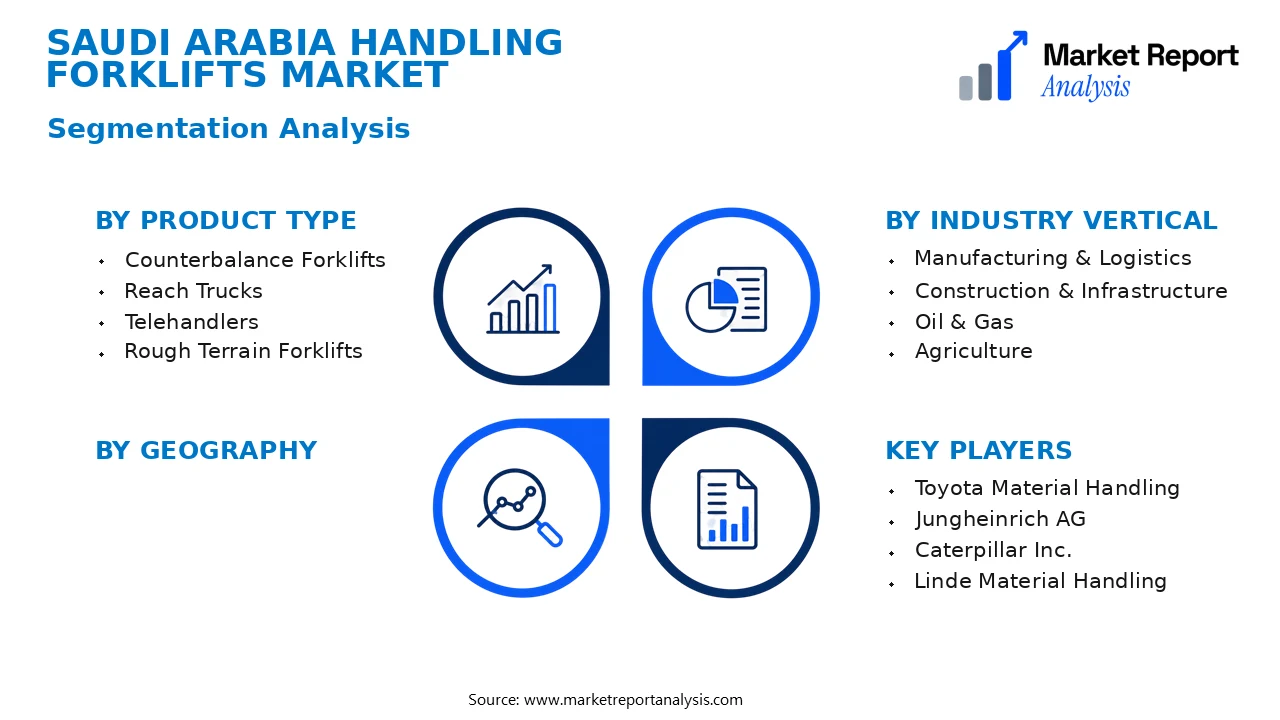
- Product Type
- Counterbalance Forklifts: These are the most commonly used forklifts in Saudi Arabia, especially in warehouse, manufacturing, and logistics operations, due to their stability and versatility for handling various loads and intensities.
- Reach Trucks: Primarily utilized in narrow aisles within logistics and retail sectors, reaching trucks are increasingly adopted as storage facilities expand, demanding higher stacking capabilities and space efficiency innovations.
- Telehandlers: With a focus on construction, agriculture, and industrial sectors, telehandlers provide the versatility for lifting and moving materials at various heights, supporting infrastructure development and large-scale projects.
- Rough Terrain Forklifts: These forklifts are predominantly employed in construction sites, oil and gas fields, and offshore activities where uneven terrain and outdoor conditions require durable, high-capacity equipment.
- Industry Vertical
- Manufacturing & Logistics: The backbone of Saudi Arabia's industrial growth, this segment demands high-capacity forklifts for assembly lines, warehouse management, and distribution, supporting the Kingdom’s Vision 2030 diversification efforts.
- Construction & Infrastructure: Driven by urban expansion projects, infrastructure development, and government initiatives, handling forklifts are crucial for transporting and lifting heavy construction materials, underpinning sector growth.
- Oil & Gas: This sector requires robust, specialized forklifts for upstream and downstream processes, including offshore applications, refinery maintenance, and equipment handling, influenced by oil price trends and energy policies.
- Agriculture: As Saudi Arabia invests in modernizing agriculture, handling forklifts facilitate material handling and storage in farming operations, supporting food security and rural development projects.
- Geography
- Saudi Arabia: The market within Saudi Arabia is characterized by a high demand driven by rapid industrialization, infrastructure projects, and expanding commercial activities, supported by government policies promoting economic diversification.
- Riyadh: As the capital and economic hub, Riyadh exhibits the highest demand for handling forklifts, driven by large-scale construction, logistics, and manufacturing enterprises establishing regional headquarters in the city.
- Jeddah: Strategic port city with significant import-export activity, Jeddah’s logistics and warehousing sectors require extensive forklift use to manage cargo handling, supported by expanding industrial zones and trade infrastructure.
- Dammam: The hub of Eastern Province's industrial and petrochemical activities, Dammam’s demand for forklifts is fueled by oil, processing plants, and shipping industries, contributing substantially to regional market size.
- Mecca: With ongoing infrastructure projects and support for religious tourism, Mecca’s construction and maintenance activities foster demand for handling equipment for large-scale event logistics and city expansion.
- Medina: Growth in urban infrastructure and hospitality projects in Medina supports forklift demand for construction, transport, and logistics operations critical to city development.
- Al Khobar & Jubail: These industrial centers are central to Saudi Arabia’s petrochemical and heavy industry sectors, with active manufacturing, warehousing, and port activities requiring sophisticated handling solutions to sustain output and growth.
Competitive Intelligence
The Saudi Arabia Handling Forklifts Market exhibits moderate competitive intensity, with predominant players such as Toyota Material Handling, Hyster-Yale, and Jungheinrich establishing substantial market shares through strategic investments. Market concentration remains relatively balanced, with the top five firms collectively holding around 65% of the market, fostering a competitive environment that encourages innovation and differentiation. Leading companies are increasingly adopting product innovation strategies, such as integrating IoT-enabled features for enhanced fleet management, to gain competitive advantages. Business strategies focus on expanding regional footprints through partnerships and localized manufacturing facilities, especially in key industrial hubs like Riyadh and Dammam, to cater to rising demand. Notably, acquisitions of regional distributors are common to strengthen market presence. Firms are heavily investing in R&D to develop durable, fuel-efficient, and electric forklifts tailored to Saudi Arabia’s rugged climate and operational needs, differentiating their offerings in the marketplace. Strategic collaborations with logistics service providers further bolster distribution channels, enhancing customer reach and service capabilities across diverse urban centers.
Leading Company Profiles
The competitive landscape in Saudi Arabia's handling forklifts market features a mix of established global brands and regional players, all vying for market share through innovation, strategic partnerships, and localized service networks. These companies are focusing on expanding their product portfolios to include electric and hybrid forklifts, along with smart and connected solutions tailored for the Arabian market.
- Toyota Material Handling
- Jungheinrich AG
- Caterpillar Inc.
- Linde Material Handling
- Hyster-Yale Group
- Nissan Forklift Corporation
- Hyundai Heavy Industries
- Doosan Industrial Vehicle
- Clark Material Handling
- Manitou Group
Toyota Material Handling
Toyota Material Handling leads through innovative electric forklift solutions, comprehensive service networks, and commitment to quality, reinforcing its dominant position in Saudi Arabia’s evolving logistics and industrial sectors.
Jungheinrich AG
Specializing in warehouse automation and electric handling equipment, Jungheinrich offers technologically advanced forklifts and integrated fleet management systems, enhancing operational safety and efficiency in Saudi Arabia’s burgeoning warehousing industry.
Caterpillar Inc.
Caterpillar focuses on durable, high-capacity forklifts integrated with smart technology, targeting heavy-duty applications in construction and large-scale industrial operations across Saudi Arabia.
Linde Material Handling
Linde excels in energy-efficient forklift designs and automation solutions, contributing to sustainable logistics practices aligned with Saudi Arabia’s environmental policies.
Hyster-Yale Group
Hyster-Yale offers a broad product range including electric and internal combustion forklifts, with a strategic emphasis on after-sales service and regional manufacturing partnerships.
Nissan Forklift Corporation
Nissan's compact and versatile forklifts are tailored for small to medium enterprises in Saudi Arabia’s diverse industrial settings, with a focus on cost-effective and reliable machinery.
Hyundai Heavy Industries
Hyundai integrates modern technology into its forklifts, emphasizing fuel efficiency, robustness, and user-friendly ergonomics to support logistics expansion in the region.
Doosan Industrial Vehicle
Doosan provides versatile handling solutions with an emphasis on electric models, addressing environment-conscious market demands and regulatory compliance.
Clark Material Handling
Clark specializes in innovative truck design and safety features, with strong distribution networks enhancing its competitive edge in Saudi Arabia’s logistics sector.
Manitou Group
Manitou offers specialized handling equipment, including rough-terrain forklifts, supporting infrastructure projects and construction growth across Saudi Arabia.
Strategic Business Developments

- April 2023 – Toyota Material Handling – Launch of new electric forklift series – Enhances product portfolio aligning with sustainability trends in Saudi Arabian logistics.
- June 2023 – Jungheinrich AG – Capacity expansion in Saudi Arabia – Strengthens local distribution and servicing capabilities amid rising demand for automation solutions.
- August 2023 – Caterpillar Inc. – Strategic alliance with local distributors – Improves market access and after-sales support in industrial hubs across the country.
- October 2023 – Hyster-Yale Group – Introduction of IoT-enabled fleet management systems – Offers digital solutions to optimize operations in Saudi warehouses.
- December 2023 – Hyundai Heavy Industries – Investment in manufacturing facility – Aimed at local assembly of electric forklifts to reduce costs and improve supply chain responsiveness.
Frequently Asked Questions
What is the Saudi Arabia Handling Forklifts Market?
The Saudi Arabia Handling Forklifts Market encompasses the industry involved in manufacturing, distributing, and utilizing forklifts for material handling across various sectors such as logistics, manufacturing, and retail within Saudi Arabia, driven by infrastructure growth and industrial expansion.
What is the current market size of Saudi Arabia Handling Forklifts Market?
As of 2026, the market size is estimated at approximately USD 1.2 Billion, reflecting steady growth driven by increasing demand for efficient logistics and supply chain solutions, modernization of warehouse operations, and infrastructure development initiatives.
What factors are driving the Saudi Arabia Handling Forklifts Market?
Key drivers include rapid industrialization, governmental investments in logistics infrastructure, expanding e-commerce sector, and adoption of automation technologies, all contributing to increased forklift procurement and advanced handling solutions across various industries.
Which Saudi city leads the Saudi Arabia Handling Forklifts Market?
Riyadh, as the capital and largest economic hub, leads the market due to its concentration of manufacturing plants, warehouses, and logistics centers, reflecting the highest demand for handling equipment and related services.
Which segment is expected to grow the fastest?
The electric forklift segment is projected to experience the fastest growth owing to rising environmental regulations, cost-efficiency, and technological advancements in battery performance, making it preferable for modern warehousing and urban logistics in Saudi Arabia.
Who are the leading companies operating in the Saudi Arabia Handling Forklifts Market?
Major players include Toyota Material Handling, Jungheinrich, and Hyundai, which hold significant market shares through local partnerships, extensive product offerings, and after-sales service networks within Saudi Arabia, bolstering their competitive positions.
Analyst Perspective
The long-term outlook for the Saudi Arabia Handling Forklifts Market remains robust, driven by ongoing infrastructure development, expanding logistics networks, and growing industrial activities. Key commercial opportunities are concentrated in the petrochemical, construction, and retail sectors, which continuously demand advanced lifting solutions to enhance operational efficiency. Emerging technologies, including electric forklifts and automated guided vehicles (AGVs), are set to redefine industry standards, offering improved energy efficiency and safety. Investment priorities should focus on integrating smart automation and sustainable technologies to stay competitive in this evolving landscape. The market exhibits moderate competitive intensity, with established local providers and international players vying for dominance, especially in urban hubs. At the city level, Riyadh and Dammam are poised for significant growth, owing to their strategic industrial zones and logistic corridors. Overall, a strategic emphasis on technological innovation, regional diversification, and investment in high-growth urban centers will be critical for long-term success in this market.
