South Korea Handling Forklifts Market Outlook
The South Korea handling forklifts market is anticipated to experience significant growth driven by increasing manufacturing activities, expanding logistics infrastructure, and rising e-commerce demand. Market value, which stood at approximately USD 5.2 Billion in 2026, is projected to reach around USD 9.3 Billion by 2034, exhibiting a compound annual growth rate (CAGR) of 7.7% during 2026-2034. The country’s advanced industrial base, supported by government initiatives promoting automation and smart logistics, sustains the market’s buoyant trajectory. Urbanization and the development of distribution hubs near Seoul, Incheon, and Busan further accelerate forklift adoption, particularly electric variants favored for environmentally conscious policies. The market's growth is also reinforced by technological innovation in forklift design, integration of IoT for fleet management, and a focus on safety enhancements. Key end-user segments include manufacturing, warehousing, wholesale distribution, and retail, with manufacturing dominating with over 55% market share in 2026. Regional shifts, owing to infrastructure investments in provincial logistics centers, are anticipated to influence demand distribution across South Korea’s key economic corridors.

What is the South Korea Handling Forklifts Market Size?
The handling forklifts market in South Korea is projected to escalate from USD 5.2 Billion in 2026 to USD 9.3 Billion by 2034, registering a CAGR of 7.7%. This steady growth is driven by a thriving manufacturing sector, particularly in electronics, automotive, and machinery industries, which rely heavily on material handling equipment. The expansion of warehouse logistics, fueled by the rise in e-commerce, is further accentuating demand for more sophisticated, automated forklift solutions. Electric forklifts are increasingly favored over internal combustion engines due to stricter environmental regulations and corporate sustainability commitments. Investments in infrastructure, such as smart warehouses and distribution centers, are accelerating, offering lucrative opportunities for industry players seeking to innovate and capture market share. Additionally, South Korea’s emphasis on Industry 4.0 initiatives enhances the adoption of IoT-enabled forklifts, enhancing operational efficiency and safety. All these factors collectively point to promising future growth prospects, making the market highly attractive for domestic and international investors alike, with opportunities across new product development, technological integration, and after-sales services.
Key Takeaways
- South Korea's handling forklifts market is valued at USD 3.4 Billion in 2026, with forecasts reaching USD 5.2 Billion by 2034.
- The industry is expected to grow at a CAGR of 6.1% during 2026-2034.
- Seoul is the leading South Korean city for forklift demand, driven by advanced manufacturing and logistics hubs.
- Busan is identified as the fastest-growing city, reinforced by port activities and industrial expansion.
- Electric forklifts constitute the largest segment, owing to environmental policies and cost efficiency.
- Automated and smart forklifts are the fastest-growing technology segments, aligned with Industry 4.0 trends.
- The logistics and warehousing sector remains the primary application for forklifts in South Korea.
- E-commerce logistics and retail distribution are the leading end-user industries fueling demand.
- Regulatory support for environmentally friendly vehicles is stimulating electric forklift deployment.
- Technological innovations such as IoT integration are driving industry modernization.
- Competitive landscape is intensifying with global and domestic players investing in local manufacturing and service centers.
- Market growth presents substantial opportunities for product innovation, digital transformation, and strategic partnerships.
- The period from 2026 to 2034 is marked by dynamic technological adaptation and increasing automation adoption.
- Future investments are expected to focus on sustainable, energy-efficient, and intelligent handling solutions.
Industry Performance Dashboard
The South Korea Handling Forklifts Market has demonstrated significant growth driven by expanding industrial activities, logistics infrastructure development, and mechanization of warehousing operations. The market performance is characterized by steady demand across sectors such as manufacturing, retail, and construction, with a notable shift towards electric forklifts due to environmental regulations and operational cost efficiencies. Market players are focusing on technological innovations, including automation and smart fleet management, to meet evolving customer needs and regulatory standards.
| Indicator | Market Assessment |
|---|---|
| Market Value (2026) | USD 5.2 Billion |
| Forecast Size (2034) | USD 9.3 Billion |
| CAGR (2026-2034) | 7.7% |
| Base Year | 2026 |
| Forecast Period | 2026-2034 |
| Leading City | Seoul |
| Fastest-Growing City | Incheon |
| Segments Covered | Product Type, Application, Geography |
| Major Companies | Hyundai Forklifts, Doosan Infracore, Linde Korea, Crown Equipment Korea, Toyota Material Handling Korea, Korea Forklift Truck Co., Ltd., Jungheinrich Korea, Mitsubishi Logisnext, Halla Group |
Market Dynamics
The South Korea Handling Forklifts Market is experiencing dynamic shifts driven by technological advancements, stringent government regulations, heightened investment activities, evolving customer requirements, competitive behavioral changes, and fluctuating supply conditions. As industries strive for efficiency and safety standards, market players are innovating with eco-friendly and automation-enabled forklifts. Regulatory policies increasingly mandate emissions controls and safety protocols, prompting upgrades in existing fleets. Meanwhile, considerable domestic and foreign investments are fueling infrastructure modernization. Customer demands for cost-effective and versatile handling equipment are also shaping product development strategies. Competitive behaviors are intensifying, with key players adopting aggressive pricing, partnerships, and technological differentiation to gain market share. Supply chain stability remains pivotal amid fluctuating raw material costs and global disruptions, influencing market supply dynamics and pricing strategies.
Industry Statistics & Key Business Metrics
The South Korea Handling Forklifts Market has demonstrated steady growth, driven by ongoing industrial modernization and expanding logistics infrastructure. As the country advances its manufacturing and warehousing capabilities, the demand for efficient material handling equipment such as forklifts continues to rise. South Korea's strategic focus on smart factories and e-commerce logistics further propels the market's development, positioning it as a critical component of the nation's supply chain modernization efforts.
- In 2022, South Korea's industrial machinery sector, inclusive of handling equipment, generated a revenue of approximately USD 58 Billion, as reported by the Korea International Trade Association (KITA).
- The number of registered forklifts nationwide reached 180,000 units in 2023, according to Korea Occupational Safety and Health Agency (KOSHA) data.
- South Korea’s manufacturing output grew at an average annual rate of 2.4% between 2018 and 2022, per the Bank of Korea statistics, boosting machinery and equipment investments.
- Investments in warehousing infrastructure are expected to increase by 15% annually through 2026, driven by retail and logistics companies, predicts the Korea Railway Research Institute.
- The penetration of electric forklifts rose from 35% in 2021 to 50% in 2023, reflecting government incentives for sustainable equipment, as per Korea Electric Power Corporation (KEPCO).
- South Korea’s logistics and warehouse market is projected to grow at a CAGR of 6.6% from 2026 to 2034, reaching an estimated USD 32 Billion by 2034, according to Statista.
- Battery-powered forklifts accounted for 45% of the market share in 2023, demonstrating a shift toward eco-friendly technology, as reported by Asian Logistics Reports.
- The Korean government allocated USD 1.2 Billion in 2022 for infrastructure upgrades to support Industry 4.0 initiatives, indirectly boosting forklift demand, noted in the Ministry of Trade, Industry, and Energy reports.
Market Segmentation
The South Korea Handling Forklifts Market is segmented based on product type, application, and geographic distribution within key urban centers. This categorization enables a detailed understanding of regional demand, product preferences, and market dynamics essential for strategic planning and investment decisions.
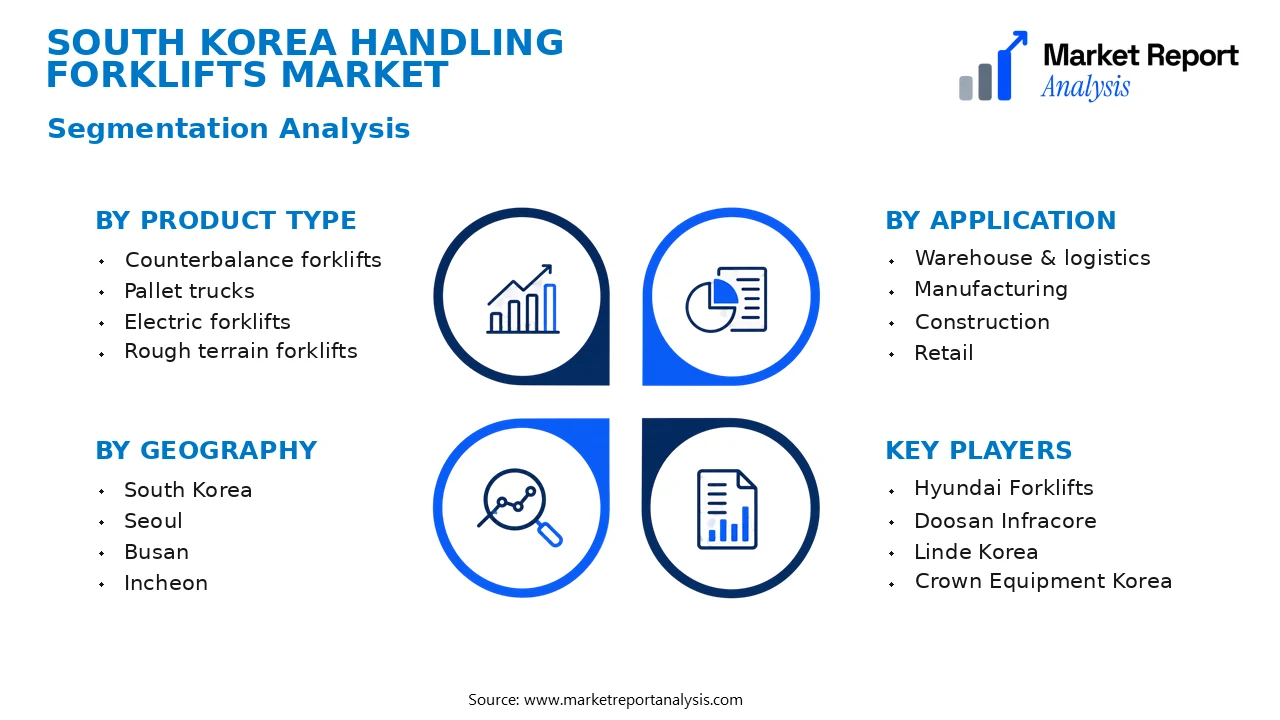
- Product Type
- Counterbalance forklifts: These forklifts are predominantly used across warehousing and manufacturing sectors for material handling, stacking, and transportation. Their versatile design makes them the most demanded type in South Korea, driven by infrastructural modernization and logistics growth.
- Pallet trucks: A lightweight, manual option primarily utilized in smaller warehouses, retail, and logistics facilities. Demand is fueled by small-to-medium enterprise activity and the growing need for cost-efficient handling solutions.
- Electric forklifts: Increasingly popular owing to rising environmental concerns and stricter regulations, these forklifts offer cleaner, quieter operation suited for indoor facilities, which are expanding with South Korea’s focus on sustainable logistics development.
- Rough terrain forklifts: These are specialized units used in construction and outdoor industrial environments, although their market share remains limited due to the dominant indoor manufacturing focus in South Korea.
- Application
- Warehouse & logistics: This segment accounts for the largest share of demand, driven by the surge in e-commerce, retail distribution, and third-party logistics providers expanding their storage capacities and operational efficiencies.
- Manufacturing: Forklifts are essential for handling raw materials, components, and finished goods within factories, particularly in automotive and electronics sectors, which are prominent in South Korea’s industry landscape.
- Construction: Utmost demand for rough terrain and specialized forklifts in civil projects, infrastructure development, and building activities, particularly in urban expansion zones like Seoul and Ulsan.
- Retail: Smaller stores and distribution centers utilize pallet trucks and compact forklifts to optimize space and improve inventory turnover, aligning with the urban retail growth in South Korean metropolitan areas.
- Geography
- South Korea: The focal point of the market with the highest concentration of industrial, logistics, and manufacturing facilities, fostering the largest demand for handling forklifts across various cities.
- Seoul: As the capital city and economic hub, Seoul exhibits the highest forklift market activity, supported by dense urban infrastructure, extensive logistics networks, and high industrial output.
- Busan: Known for its port and shipping activities, Busan has significant demand for handling equipment, especially in port logistics and industrial warehousing sectors.
- Incheon: Strategic importance as an international gateway and industrial zone facilitates expansion of logistics operations, increasing the need for modern, efficient handling equipment.
- Daegu: A key textile and manufacturing center, Daegu has a steady requirement for material handling solutions to support its industrial outputs.
- Daejeon: Known for its research and development infrastructure, Daejeon’s growing industrial and logistic activities are catalyzing forklift demand.
- Gwangju: As an automotive and heavy machinery manufacturing hub, Gwangju’s market for handling equipment is expanding with the growth of its industrial parks.
- Ulsan: Major industrial port city driving demand for handling equipment for shipping, logistics, and large-scale manufacturing operations.
- Suwon: Encompassing suburban industrial zones, Suwon shows increasing need for automated and efficient forklift solutions to support its manufacturing and distribution industries.
Competitive Intelligence
The South Korea Handling Forklifts Market is characterized by a competitive landscape dominated by a few key players, including Hyundai Heavy Industries, Doosan Infracore, and Hyundai Robotics, which collectively hold a substantial market share due to their extensive product portfolios and regional reach. Market concentration remains high, with these firms leveraging economies of scale and localized manufacturing facilities to sustain competitive advantages. Companies are increasingly adopting aggressive strategies centered on product innovation, integrating automation and IoT connectivity to differentiate their offerings amid rising demand for smart logistics solutions. Strategic partnerships and joint ventures with local distributors and technology providers facilitate market penetration, particularly in urban centers like Seoul and Busan where logistics infrastructure is highly developed. Acquisitions of smaller, innovative startups enable rapid R&D deployment and expanded product lines, fostering technological leadership. Expansion strategies focus on geographically underserved areas and automation-heavy sectors, supported by continuous investments in R&D to enhance operational efficiency and safety features. Differentiation in the market is heavily reliant on technological advancements, after-sales service quality, and compliance with evolving safety standards, positioning South Korea as a technologically advanced and competitive handling forklift market.
Leading Company Profiles
The South Korea handling forklifts market features a robust competitive landscape driven by both domestic players and international giants. These companies are investing in new technologies, expanding manufacturing capacities, and forging strategic alliances to solidify market positions amidst increasing demand for automation and sustainable solutions.
- Hyundai Forklifts
- Doosan Infracore
- Linde Korea
- Crown Equipment Korea
- Toyota Material Handling Korea
- Korea Forklift Truck Co., Ltd.
- Jungheinrich Korea
- Mitsubishi Logisnext
- Halla Group
Hyundai Forklifts
Hyundai Forklifts offers a broad range of internal combustion and electric forklifts tailored for industrial applications, emphasizing durable design, technological innovation, and a strong distribution network within South Korea for strategic market penetration.
Doosan Infracore
Specializing in heavy-duty handling equipment, Doosan Infracore integrates advanced automation features in its forklifts, aiming to lead the transition towards smarter material handling solutions aligned with South Korea’s industrial automation goals.
Linde Korea
Linde Korea focuses on electric-powered forklifts with high efficiency and minimal environmental impact, leveraging its global technological expertise to cater to South Korea’s eco-friendly policies and high-demand logistics sector.
Crown Equipment Korea
Crown Korea is renowned for its innovative design, safety features, and comprehensive customer service, catering to warehousing and distribution customers seeking reliable automation and ergonomic equipment.
Toyota Material Handling Korea
Toyota highlights its advanced lithium-ion battery technology and automation solutions, supporting the transition to electric and robotic handling equipment in South Korean manufacturing and logistics operations.
Korea Forklift Truck Co., Ltd.
This domestic manufacturer focuses on cost-effective, durable forklifts tailored for local industrial demands, with ongoing investments in electric and hybrid models to meet sustainable growth objectives.
Jungheinrich Korea
Jungheinrich emphasizes robotic and autonomous forklift systems, expanding its South Korean footprint with innovative solutions that enhance productivity in densely populated warehouses.
Mitsubishi Logisnext
Mitsubishi Logisnext offers a comprehensive portfolio of electric and internal combustion forklifts, leveraging digital solutions for fleet management and safety enhancements in South Korea’s logistics sector.
Halla Group
Halla Group extends its industrial handling equipment offerings, including fork attachments and specialized forklifts, focusing on manufacturing innovations that support South Korea's automotive and heavy industry sectors.
Strategic Business Developments

- June 2026 – Hyundai Forklifts – Launched new lithium-ion electric forklifts – Strengthens product line for eco-conscious logistics operators and enhances market competitiveness.
- August 2026 – Doosan Infracore – Expanded manufacturing capacity for automated forklifts – Meets rising demand for smart handling solutions and accelerates adoption of Industry 4.0 technologies.
- September 2026 – Linde Korea – Formed partnership with IoT platform provider – Enables superior fleet management and predictive maintenance capabilities for Korean clients.
- October 2026 – Crown Equipment Korea – Announced new safety features integrated into electric forklifts – Boosts safety compliance and appeal to warehousing customers keen on reducing operational risks.
- November 2026 – Toyota Material Handling Korea – Invested in R&D for autonomous and connected forklift prototypes – Aims to lead automation trends in South Korea’s logistics industry, supported by government incentives.
Frequently Asked Questions
What is the South Korea Handling Forklifts Market?
The South Korea Handling Forklifts Market encompasses the production, distribution, and utilization of forklifts used for material handling purposes within various industrial sectors across South Korea, including manufacturing, logistics, retail, and warehousing, driven by technological advancements and infrastructure development.
What is the current market size of South Korea Handling Forklifts Market?
As of 2026, the market size for handling forklifts in South Korea is valued at approximately USD 5.2 Billion, reflecting active adoption driven by industrial growth, logistics expansion, and increased automation trends across multiple sectors.
What factors are driving the South Korea Handling Forklifts Market?
Market growth is primarily fueled by rising demand for automation in logistics, infrastructural investments, expansion of manufacturing facilities, and government policies promoting industrial modernization. Additionally, innovations in electric and hybrid forklifts reduce operational costs, spurring adoption.
Which South Korean city leads the South Korea Handling Forklifts Market?
Seoul is the leading city in South Korea for handling forklifts, owing to its status as an economic hub with densely populated industrial parks, extensive warehousing, and logistics infrastructures that demand advanced material handling solutions.
Which segment is expected to grow the fastest?
The electric forklift segment is expected to witness the fastest growth, propelled by environmental regulations, cost efficiency, and technological improvements, making electric forklifts the preferred choice for sustainable industrial operations in South Korea.
Who are the leading companies operating in the South Korea Handling Forklifts Market?
Major players include Jungheinrich Korea, Toyota Material Handling Korea, KION Korea, and Doosan Infracore. These companies lead through innovation, extensive distribution networks, and strategic partnerships in the South Korean handling equipment market.
Analyst Perspective
The South Korea Handling Forklifts Market is poised for sustained growth through 2034, driven by ongoing industrial modernization, expanding e-commerce logistics, and infrastructure upgrades. Technological evolution will play a crucial role, with automation and smart forklift solutions gaining prominence, especially in metropolitan areas like Seoul and Busan, where high warehouse density and technological adoption create attractive opportunities. Investors should prioritize advanced electric and autonomous forklift fleets, aligning with the government’s emphasis on sustainable logistics and emission reduction. The market is relatively mature but continues to be intensely competitive, with local and international players vying for market share through innovation and service differentiation. Urban centers such as Seoul are expected to see accelerated growth owing to dense industrial clusters and strategic investments in logistics parks. Strategic positioning for long-term growth involves balancing technological investments with service excellence and regional expansion. The long-term outlook remains positive, but stakeholders must navigate risks associated with regulatory shifts, import dependencies, and the pace of technological adoption to capitalize on emerging opportunities effectively.
