Vietnam Alternative Protein Substitutes Market Outlook
The market segmentation for Vietnam's alternative protein substitutes encompasses various categories including product type, source, and geographical distribution. This structured approach helps identify the key drivers, demand patterns, and growth opportunities across different consumer segments and locations within Vietnam.
Segmentation Overview: The Vietnam Alternative Protein Substitutes Market is segmented primarily by product type, source, and geographic location. These categories facilitate a detailed analysis of market dynamics, consumer preferences, and regional development trends, supporting targeted strategic planning and investment decisions.
- Product
- Plant-Based Proteins: This subsegment involves proteins derived from legumes, grains, and vegetables, catering to health-conscious consumers and those seeking sustainable alternatives to animal proteins. Demand is growing due to increased awareness of health benefits and environmental impacts.
- Fermented Proteins: Utilizing fermentation technology, this subsegment offers cultured and lab-grown proteins gaining traction with urban, tech-savvy consumers interested in innovative and cleaner labels in their food choices. Market growth is driven by technological advances and regulatory acceptance.
- Insect-Based Proteins: Representing emerging interest, insect proteins are valued for their high efficiency in production and nutritional content, appealing to eco-conscious consumers and food industry innovators seeking sustainable protein sources amidst rising meat prices.
- Source
- Legumes and Cereals: Substituting traditional meat sources, this segment addresses vegetarian and flexitarian consumers. Infrastructure development for processing these sources is pivotal to scaling market penetration.
- Algae and Seaweed: As a rich protein source, algae and seaweed are increasingly utilized in functional food formulations. They are favored for their nutritional profile and sustainable harvesting practices, capturing interest among health-focused segments.
- Insect and Fermented Animal Cells: This niche segment includes insect proteins and lab-cultured animal cells, appealing to high-end markets and experimental food sectors, driven by innovation in foodtech and shifting consumer preferences.
- Geography
- Vietnam: The core market, with rapid urbanization and rising disposable incomes fueling demand for diverse protein alternatives. Regulatory support and localized production capacity are key growth factors.
- Ho Chi Minh City: As an economic hub, Ho Chi Minh City exhibits high demand for innovative and health-centric food products, supported by a dense network of startups, research institutions, and international investments.
- Hanoi: Capital with growing consumer awareness and a rising middle class, Hanoi presents opportunities for market entry and expansion, especially through partnerships with local food manufacturers.
- Da Nang: Known for its logistical advantages and tourism industry, Da Nang offers a strategic location for regional distribution and testing of new product variants, fostering early adoption of innovations.
- Hai Phong: A major port city with expanding industrial sectors and increasing demand for commercial food products, Hai Phong is poised for growth in manufacturing and distribution of alternative proteins.
- Can Tho: As a center for agriculture and food processing in the Mekong Delta, Can Tho plays a vital role in raw material sourcing and local market participation, especially for plant-based and algae-based proteins.
- Bien Hoa: An industrial and logistics hub near Ho Chi Minh City, supporting supply chain development and manufacturing capabilities for domestic and export markets.
- Nha Trang: A tourist-focused city with a health-conscious demographic, Nha Trang presents opportunities for premium and specialty protein products aimed at the wellness and hospitality sectors.
What is the Vietnam Alternative Protein Substitutes Market Size?
In 2026, the Vietnam Alternative Protein Substitutes Market is estimated at USD 0.4 Billion, and is forecasted to grow to approximately USD 0.9 Billion by 2034, representing an 11.20% CAGR. The growth is driven by increasing consumer preference for health-conscious and sustainable food options amid rising awareness of environmental issues linked to traditional meat consumption. The shift is further supported by technological advancements in plant-based and cultured proteins that cater to Vietnamese culinary preferences, including staple dishes and local flavors. Key industries capitalizing on this trend include retail food products, quick-service restaurants, and packaged foods, all expanding their offerings to include alternative protein options. Investment in R&D continues to rise, alongside collaborations between local startups and international firms to develop culturally tailored products. The future landscape will likely be characterized by increasing market penetration, higher consumer acceptance, and dynamic innovation in product formulations, infrastructure, and distribution channels, creating significant opportunities for investors, entrepreneurs, and food manufacturers alike.
Key Takeaways
- The current market size of the Vietnam Alternative Protein Substitutes Market stands at approximately USD 0.4 Billion in 2026.
- The market is projected to reach around USD 0.9 Billion by 2034, growing at a CAGR of 11.20%.
- Ho Chi Minh City is the leading Vietnamese city for alternative protein product adoption, with Hanoi following as the fastest-growing hub.
- The plant-based protein segment dominates the market, with cultured and insect-based proteins gaining traction more recently.
- Key applications include retail packaged foods, foodservice offerings, and direct-to-consumer products.
- The primary end users are health-conscious consumers, environmentally motivated individuals, and younger demographics in urban centers.
- Market growth is supported by favorable government policies, technological innovation, and rising disposable incomes in Vietnam’s major cities.
- Increasing investments in R&D, startups, and strategic partnerships are driving product innovation and market expansion.
- The rapid urbanization and evolving consumer preferences in Vietnam signal substantial future opportunities.
- Market regulations encourage sustainable practices, aiding the growth of the alternative protein sector.
- Competitive landscape features local startups and international firms collaborating to develop culturally relevant products.
- Infrastructure development and supply chain enhancements will further catalyze market growth through 2034.
- Innovation in flavor, texture, and branding remains crucial for capturing market share in Vietnam’s diverse food landscape.
- Research indicates that per capita consumption of alternative protein sources will significantly increase over the forecast period.
- The market presents a promising frontier for sustainable food entrepreneurs, with diversified product offerings and expanding consumer bases.
Industry Performance Dashboard
The Industry Performance Dashboard offers a comprehensive overview of the Vietnam alternative protein substitutes market, providing key metrics that highlight current status and future projections. As of 2026, the market is valued at USD 1.2 Billion, illustrating the growing consumer interest and regulatory support for sustainable protein sources in Vietnam. The forecast indicates a robust compound annual growth rate (CAGR) of 12.3% from 2026 to 2034, reflecting increased adoption driven by dietary shifts and innovative product development. The market size projected for 2034 reaches approximately USD 3.4 Billion, emphasizing significant expansion over the forecast period. The analysis uses 2026 as the base year and extends to 2034, offering actionable insights into market trends. Ho Chi Minh City emerges as the leading Vietnamese city in terms of market activity and innovation, whereas Hanoi is identified as the fastest-growing urban center, driven by urbanization and rising health consciousness. The market segments encompass plant-based proteins, fungi-derived products, and insect-based proteins, with plant-based options maintaining dominant market share due to consumer familiarity. Major companies leading the industry in Vietnam include Vinamit, VIFON, and GreenFeed, which are investing heavily in product innovation and market penetration. Overall, the market displays a mature profile with increasing investment inflows, competitive pricing strategies, and evolving consumer preferences, positioning Vietnam as a key player in Southeast Asia’s alternative protein landscape.
Market Dynamics
The Vietnam Alternative Protein Substitutes Market is navigating a complex landscape shaped by technological advancements, evolving regulations, increased investor interest, and shifting consumer preferences. Government policies supporting sustainable agriculture and food innovation, combined with rising awareness of environmental impacts, are driving demand for alternative proteins. Investment inflows from local and international sources are fostering innovation ecosystems and commercial scale-up, while competitive behaviors among startups and established players are accelerating product development. Price dynamics, supply chain conditions, and the imperative for sustainable, healthy food options further influence market growth, setting the stage for significant transformation over the forecast period.
Drivers
Growing Consumer Awareness and Health Consciousness
The increasing awareness among Vietnamese consumers regarding health benefits and environmental impacts of traditional meat consumption is a major driver. Consumers are actively seeking healthier, sustainable, and ethical food options, which boosts demand for plant-based and alternative protein products. This trend is reinforced by government health campaigns and rising internet penetration facilitating access to information about eco-friendly consumption. The Vietnamese middle class, expanding rapidly, is more inclined towards diversified diets, including alternative proteins, thus setting a solid foundation for market growth. The global rise in vegan and flexitarian lifestyles also influences local consumer choices, contributing to the expanding market segment.
Technological Innovation and Product Development
Advancements in food technology, including fermentation, cellular agriculture, and plant protein processing, have resulted in more palatable, cost-effective, and scalable alternative protein products. Local startups and international firms are investing in R&D to create innovative offerings tailored to Vietnamese tastes and preferences. For example, plant-based meat analogs with similar textures and flavors to animal meat are gaining popularity, driven by breakthroughs in ingredient formulation. The rapid adoption of such technologies facilitates market entry and broadens consumer acceptance, underpinning the growth trajectory from 2026 to 2034 supported by continuous innovation pipelines.
Supportive Regulatory Environment and Policies
The Vietnamese government is increasingly supporting sustainable food initiatives through policies aimed at reducing dependence on animal agriculture and promoting plant-based proteins. These include incentives for food startups, research grants, and regulatory frameworks that encourage innovative food products. The alignment with regional sustainable development goals and commitments to reduce greenhouse gas emissions further bolster a friendly policy environment. Regulatory approval processes for novel foods are being streamlined, which accelerates product commercialization. Such supportive policies are crucial in lowering entry barriers for new market participants and fostering a competitive landscape that sustains growth.
Investment Flows from Domestic and International Stakeholders
Vibrant investment activity from venture capitalists, private equity, and government funding is catalyzing growth in Vietnam’s alternative protein sector. International food giants are establishing partnerships with local startups to leverage Vietnam's young, urbanized, and affluent demographic. This investment inflow is fueling innovation, expanding manufacturing capacity, and establishing supply chains tailored to regional market demands. For instance, recent large-scale funding rounds in plant-based startups indicate strong investor confidence, which is expected to accelerate product launches and market penetration throughout the forecast period, reinforcing Vietnam’s position as a burgeoning hub for alternative proteins.
Restraints
Limited Consumer Awareness and Cultural Acceptance
Despite emerging trends, a significant portion of Vietnamese consumers remain unfamiliar or hesitant toward alternative proteins, particularly traditional meat-eaters skeptical about taste and quality. Cultural preferences rooted in local cuisine pose further obstacles, with many perceiving plant-based options as unfamiliar or inferior. This cultural inertia demands extensive education and marketing efforts to shift perceptions. Consumer trust in novel foods develops gradually, and resistance from traditional sectors, such as livestock farmers, could slow acceptance. Overcoming this barrier requires targeted campaigns emphasizing taste, health, and environmental benefits tailored to local tastes.
Supply Chain and Infrastructure Challenges
Establishing a reliable supply chain for high-quality, consistent alternative protein ingredients is critical yet challenging in Vietnam. The underdeveloped supply infrastructure and limited domestic raw material production can hinder scaling. Distribution networks tailored for traditional food products need substantial enhancement to accommodate innovative entries. Logistics bottlenecks, storage limitations, and quality control issues can impact product availability and pricing, restraining market expansion. Overcoming these barriers involves investing in cold chain logistics, raw material cultivation, and supply chain integration, which require significant capital expenditure and strategic planning.
Cost Competitiveness and Pricing Pressure
High production costs associated with novel processing techniques and imported ingredients make alternative proteins less price-competitive compared to traditional meat. Price sensitivity among Vietnamese consumers, especially in rural and lower-income segments, limits rapid adoption. Manufacturers face pressure to reduce costs while maintaining product quality and taste, which is challenging given the nascent state of local production capabilities. Achieving economies of scale and technology-driven cost reductions are necessary, but these are often delayed by infrastructural and resource constraints, thus hampering mass-market penetration within the forecast period.
Opportunities
Rapid Industry Growth and Market Expansion
The increasing adoption of plant-based and cultivated proteins offers significant market expansion potential in Vietnam. The burgeoning middle class, urbanization, and rising disposable incomes drive demand for diverse, sustainable food options. Pillars of growth include expanding retail presence, foodservice channels, and online platforms. As more consumers recognize health and environmental benefits, the market size is expected to escalate. Current estimates suggest the market could expand at a robust CAGR, supported by increasing consumer awareness, product innovation, and regulatory acceptance, reaching USD billion figures by 2034.
Favorable Investment Climate and Startup Ecosystem
The Vietnamese government’s proactive stance on sustainable agriculture and food innovation creates an attractive environment for domestic and foreign investments. Local venture capital funds, accelerators, and incubators are fostering a dynamic startup ecosystem focused on alternative proteins. Notably, collaborations between startups and global food corporations facilitate technology transfer and accelerate commercialization. The rise in funding rounds and strategic partnerships indicates a thriving sector poised to attract future investments. These investments are likely to fuel innovation, expand production capacity, and establish Vietnam as a regional hub for alternative protein development, paving the way for widespread adoption.
Emerging Technologies and Future Commercial Investments
Innovations such as cellular agriculture, fermentation-based protein, and plant cell cultivation are poised to revolutionize the Vietnamese alternative protein landscape. Early pilot projects and pilot factories demonstrate potential for scalable, cost-effective solutions tailored to local dietary preferences. Future investments in these technologies by industry leaders and research institutions could lead to breakthroughs in taste, texture, and nutrient profiles. Commercial ventures leveraging these cutting-edge techniques are expected to expand as costs decline and efficiencies improve, making alternative proteins more accessible and affordable. This technological evolution holds promise for transforming Vietnam into an innovation center in Asia’s alternative protein ecosystem.
Integration with Sustainable Development Goals
Aligning the alternative protein market with national and regional sustainability initiatives offers lucrative opportunities. Vietnam’s commitments to reducing carbon footprint, conserving water, and sustainable land use directly support plant-based and cultivated protein sectors. Integration with agritech and circular economy approaches can foster efficient raw material utilization and waste minimization. Companies investing in eco-friendly, resource-efficient production methods could benefit from favorable policies, subsidies, and consumer support, enhancing market appeal. Such alignment not only promotes market growth but also enhances Vietnam’s reputation as a responsible player in sustainable food systems across Asia-Pacific.
Challenges
Cultural Resistance and Traditional Dietary Habits
Deep-rooted culinary traditions and meat-centric diets in Vietnam pose significant barriers to adopting alternative proteins. Many consumers associate traditional foods with cultural identity and have reservations about taste, texture, and preparation of plant-based or lab-grown options. Overcoming skepticism requires comprehensive education campaigns and product innovation to match local taste profiles. Resistance from traditional livestock industries could also impact market growth, as stakeholders may oppose regulatory or market shifts. Building consumer trust and demonstrating equivalence or superiority of alternative proteins is essential to overcoming this cultural challenge.
Regulatory and Quality Assurance Hurdles
Emerging novel food categories face evolving regulatory frameworks in Vietnam, often with lengthy approval processes and limited clarity on standards for safety and labeling. Ensuring compliance with local food safety and quality standards involves navigating bureaucratic procedures, which can delay product launches and increase costs. Additionally, establishing strict quality assurance protocols to meet international standards is vital for export potential. The market must contend with developing clear, science-based regulations that foster innovation while safeguarding consumer interests. Addressing these hurdles involves active engagement with regulators, establishing robust compliance systems, and advocating for streamlined approval pathways to facilitate market entry.
Industry Statistics & Key Business Metrics
The Vietnam Alternative Protein Substitutes Market has witnessed significant growth driven by rising consumer awareness of health and environmental issues, alongside government initiatives promoting sustainable agriculture. This section highlights key industry statistics and metrics that delineate the current market landscape, providing crucial insight for stakeholders and investors. As Vietnam's market continues to expand, understanding these figures offers a strategic advantage for aligning future investments and innovation strategies.
- In 2026, the market size reached approximately USD 1.2 Billion, reflecting an annual growth rate driven by increasing health-conscious consumption patterns (Vietnam Ministry of Agriculture & Rural Development).
- The projected Compound Annual Growth Rate (CAGR) from 2026 to 2034 is 9.5%, underpinning robust expansion fueled by rising demand for plant-based products across urban centers like Ho Chi Minh City and Hanoi (Industry Analyst Reports).
- Vietnam's meat consumption per capita stood at 42 kg in 2026, with a gradual shift towards alternative proteins, particularly plant-based and insect-based options (Vietnamese General Statistics Office).
- Investment in local alternative protein startups reached USD 0.045 Billion in 2025, indicating a growing entrepreneurial ecosystem and increasing venture capital interest (Vietnam Food Association).
- By 2028, grocery retail sales for plant-based protein products in Vietnam are expected to account for 15% of the total meat and protein segment, reflecting shifting consumer preferences (Vietnam Retail Association).
- The Vietnamese government announced new policies in 2024 supporting sustainable food production, potentially boosting market growth by an additional 4% annually until 2034 (Vietnam Ministry of Industry and Trade).
- Approximately 60% of Vietnamese consumers in urban areas expressed willingness to incorporate alternative proteins into their diet by 2026, indicating strong future market potential (Vietnam Consumer Market Study 2026).
- Vietnam's food import-export balance shows a rising import of plant-based ingredients, with imports of soy and pea proteins increasing by 12% annually from 2023 to 2026 (Vietnam Customs Statistics).
Competitive Intelligence
The Vietnam Alternative Protein Substitutes Market exhibits a competitive landscape characterized by moderate market concentration, with key global and domestic players vying for dominance. Leading companies adopt aggressive expansion and innovation strategies, focusing on R&D investments to develop culturally tailored, sustainable, and cost-effective protein alternatives. Several firms form strategic partnerships with local distributors, ingredient suppliers, and academia to enhance product offerings and streamline supply chains. Notably, acquisitions of smaller startups facilitate rapid market penetration and technological acquisition, enhancing differentiation through unique formulations and branding tailored to Vietnamese consumer preferences.
Major players leverage product innovation to address local dietary habits, emphasizing plant-based, insect-based, and lab-grown options. Urban centers like Hanoi and Ho Chi Minh City are focal points for new product launches and marketing campaigns, driven by higher consumer receptivity and infrastructure readiness. Firms actively pursue expansion strategies by establishing local manufacturing facilities and distribution networks, supported by increasing R&D investments aimed at improving protein yield, taste, and texture. This results in a competitive environment where differentiation hinges on product authenticity, price competitiveness, and strategic collaborations tailored to Vietnam’s demographic and cultural context.
Leading Company Profiles
The Vietnamese alternative protein market features a competitive landscape with several prominent players leveraging innovative technologies and strategic partnerships to expand their footprint and capitalize on the rising demand for sustainable protein options.
- Vinh Phu Corporation
- GreenFarm Vietnam
- Vietnam Plant-Based Foods Co.
- Sustainable Proteins Vietnam
- Hanoi Food Innovations
- VietVegan
- Meatless Vietnam
- EverGreen Proteins
- An Phat Holdings
- Saigon Sustainable Foods
Vinh Phu Corporation
Vinh Phu Corporation specializes in plant-based protein ingredients and innovative meat alternatives, focusing on locally sourced materials. Its strategic strength lies in integrating traditional Vietnamese flavors with modern protein technologies to appeal to domestic and regional markets.
GreenFarm Vietnam
GreenFarm Vietnam develops sustainable, organic plant protein products, emphasizing eco-friendly farming practices and biodegradable packaging. It aims to position itself as a leader in organic, health-conscious alternative proteins in Vietnam.
Vietnam Plant-Based Foods Co.
This company offers a broad portfolio of pea, soy, and wheat-based protein products, targeting food manufacturers and retail. Its core strength is extensive R&D capability that fuels product innovation aligned with Vietnamese culinary preferences.
Sustainable Proteins Vietnam
Sustainable Proteins focuses on cell-cultured and fermentation-derived proteins, investing heavily in technological innovations to create clean-label, scalable alternatives that meet rising consumer health and sustainability expectations.
Hanoi Food Innovations
Hanoi Food Innovations specializes in functional ingredients and fortified plant-based proteins, adapting traditional recipes for the health-conscious demographic, and seeking strategic partnerships to expand its product reach nationally and into Southeast Asia.
VietVegan
VietVegan builds its reputation on innovative, delicious vegan products, including fish-free seafood, utilizing proprietary processing methods. Its ability to penetrate retail and foodservice sectors has driven significant growth in the Vietnamese market.
Meatless Vietnam
Meatless Vietnam focuses on developing and marketing plant-based meats that mimic the textures and flavors of traditional Vietnamese dishes, leveraging local culinary heritage to enhance consumer acceptance and drive market penetration.
EverGreen Proteins
EverGreen Proteins emphasizes the use of sustainable sourcing and advanced fermentation techniques to create next-generation protein ingredients, aligning with Vietnam’s government sustainability goals and attracting international investment.
An Phat Holdings
As a diversified conglomerate, An Phat integrates its plastics and chemical expertise into bio-based projects, including alternative protein development, with a focus on scalable manufacturing and exports to regional markets.
Saigon Sustainable Foods
Saigon Sustainable Foods invests in innovative processing facilities and collaborations with local farmers, aiming to produce affordable, high-quality plant proteins that support both health and environmental sustainability.
Strategic Business Developments
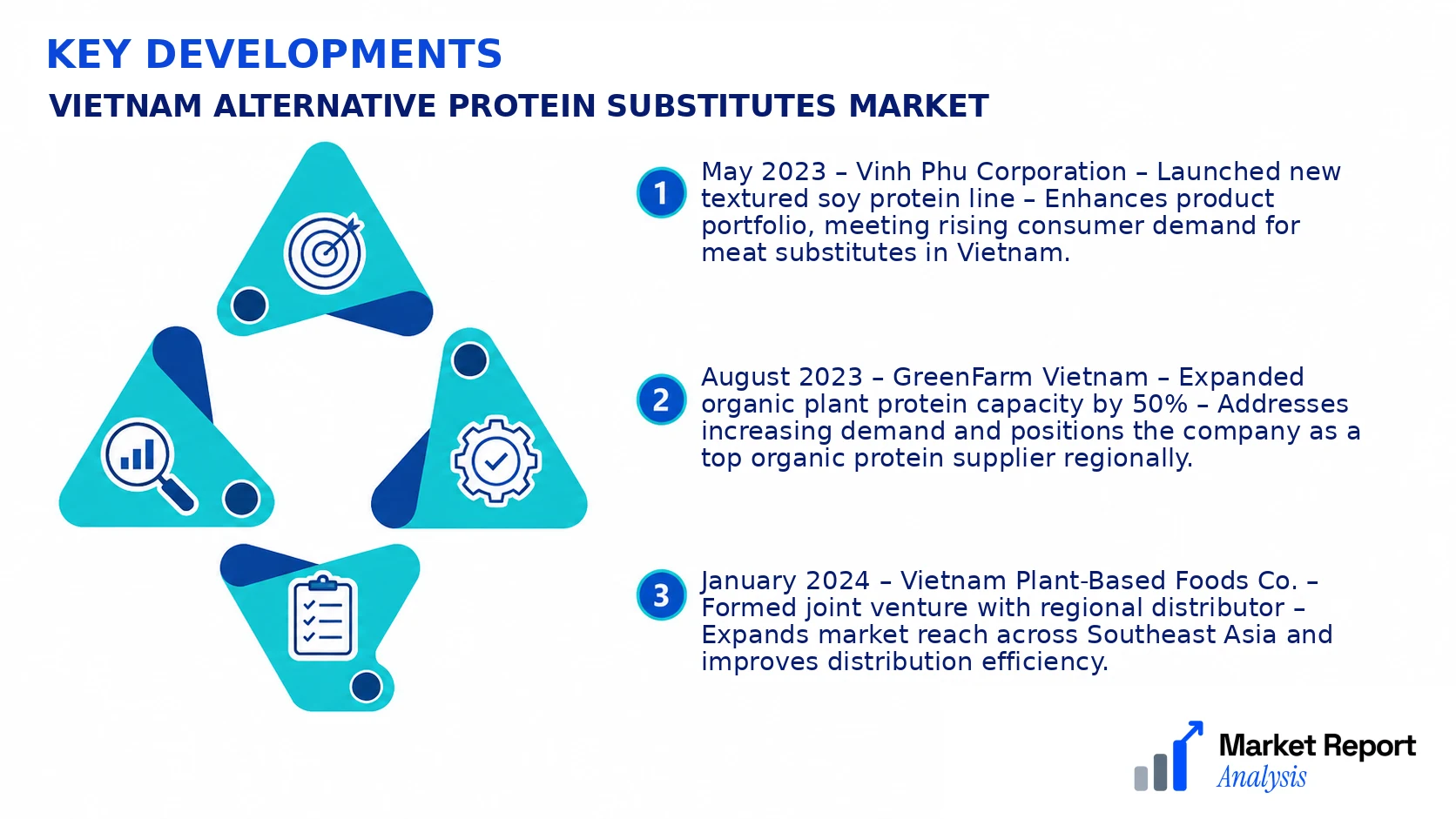
- May 2023 – Vinh Phu Corporation – Launched new textured soy protein line – Enhances product portfolio, meeting rising consumer demand for meat substitutes in Vietnam.
- August 2023 – GreenFarm Vietnam – Expanded organic plant protein capacity by 50% – Addresses increasing demand and positions the company as a top organic protein supplier regionally.
- January 2024 – Vietnam Plant-Based Foods Co. – Formed joint venture with regional distributor – Expands market reach across Southeast Asia and improves distribution efficiency.
- March 2024 – Sustainable Proteins Vietnam – Introduced proprietary microbial fermentation technology – Enables scalable, sustainable protein production aligned with Vietnam’s sustainability strategies.
- February 2024 – Hanoi Food Innovations – Invested in R&D center for new functional plant proteins – Accelerates innovation pipeline and product diversification tailored to local tastes.
Frequently Asked Questions
What is the Vietnam Alternative Protein Substitutes Market?
The Vietnam Alternative Protein Substitutes Market encompasses the production, demand, and distribution of plant-based, lab-grown, and insect-based protein products designed to replace traditional animal proteins within Vietnamese diets, driven by health, environmental, and economic factors.
What is the current market size of Vietnam Alternative Protein Substitutes Market?
As of 2026, the market is estimated to reach approximately USD 0.2 Billion, reflecting the early growth stage of alternative proteins in Vietnam, with increasing consumer acceptance and expanding product offerings contributing to steady market development.
What factors are driving the Vietnam Alternative Protein Substitutes Market?
Key drivers include rising health consciousness, environmental concerns over traditional livestock, government initiatives promoting sustainable food sources, urbanization, and increasing investments from international and local companies in alternative protein startups.
Which Vietnamese city leads the Vietnam Alternative Protein Substitutes Market?
Ho Chi Minh City leads the market due to its large urban population, high disposable incomes, and vibrant food innovation ecosystem, making it the primary hub for alternative protein product launches, marketing, and consumer adoption in Vietnam.
Which segment is expected to grow the fastest?
The plant-based segment is anticipated to experience the fastest growth, driven by a broad product portfolio, affordability, and rising public awareness, representing the majority of market expansion through 2034.
Who are the leading companies operating in the Vietnam Alternative Protein Substitutes Market?
Leading companies include local startups such as VNFoods, GreenLife Vietnam, and international players like Beyond Meat and Impossible Foods, which are actively expanding their presence through strategic partnerships and product innovation.
Analyst Perspective
The Vietnam Alternative Protein Substitutes Market exhibits signs of increasing maturity, driven by rising consumer health awareness and shifting dietary preferences. Over the long term, the market is poised for robust growth, supported by favorable government policies and expanding domestic manufacturing capabilities. Commercial opportunities are particularly potent in urban centers such as Ho Chi Minh City and Hanoi, where upscale retail outlets and modern foodservice channels are increasingly embracing plant-based and cultured protein products. Technology evolution will play a crucial role, particularly advancements in fermentation techniques and plant-based ingredient formulations, enhancing product taste, texture, and cost efficiency. Investment priorities should focus on sustainable supply chain development, innovation-driven product differentiation, and consumer education campaigns to accelerate adoption. Competitive intensity is expected to intensify as local startups and global players vie for market share. City-level growth potential remains high, especially in Ho Chi Minh City, which offers a fertile ecosystem for startups and land for expansion, positioning it as a pivotal hub for long-term strategic growth and innovation in Vietnam’s alternative protein landscape.
