North America Alternative Protein Substitutes Market Outlook
The North America Alternative Protein Substitutes Market is currently valued at USD 4.8 Billion in 2026 and is projected to reach approximately USD 21.5 Billion by 2034. This growth represents a robust CAGR of 16.6% over the forecast period of 2026 to 2034. The principal drivers of this expansion include rising consumer awareness of health and sustainability issues, increasing vegetarian and flexitarian populations, and a growing demand for plant-based and lab-grown alternatives. Technological advancements in food processing, cellular agriculture, and fermentation techniques are central to product innovation and scalability, making alternative proteins more accessible and affordable. The commercial landscape is characterized by rapid investment and innovation, opening significant opportunities for new entrants and established players to capitalize on evolving consumer preferences and regulatory support.

What is the North America Alternative Protein Substitutes Market Size?
The North America Alternative Protein Substitutes Market size is estimated at USD 4.8 Billion in 2026 and is expected to reach approximately USD 21.5 Billion by 2034, expanding at a CAGR of 16.6% from 2026 to 2034. This growth is driven by a rising shift towards plant-based diets, driven by health, ethical, and environmental concerns. The food industry is witnessing an increased incorporation of plant-based proteins into mainstream products, including meat, dairy, and snack segments. Technological breakthroughs in cellular agriculture and fermentation have enabled the production of lab-grown and fermentation-derived proteins, fostering innovation and reducing costs. Investment activity is accelerating, with venture capital, corporate investments, and government grants fueling research and commercial-scale production. Future outlooks suggest a continued upward trajectory, with expanding consumer acceptance, regulatory approvals, and evolving supply chains fostering market growth. Key opportunities include expanding product varieties, improving taste and texture, and increasing distribution channels across retail and foodservice sectors. The increasing focus on sustainability and health is expected to sustain long-term demand, positioning North America as a pivotal market for alternative protein development.
Key Takeaways
- The North American alternative protein market was valued at USD 9.5 Billion in 2026.
- The market is projected to reach USD 24.7 Billion by 2034.
- The compound annual growth rate (CAGR) from 2026 to 2034 is 12.3%.
- The plant-based protein segment remains the largest share of the market.
- The fastest-growing segment is cultured (lab-grown) meat and novel fermentation proteins.
- Major applications include meat substitutes, dairy alternatives, and functional ingredients.
- The primary end-users are consumers seeking health, ethical, and environmental benefits.
- The market growth is driven by technological innovations and investment inflows.
- Increasing consumer awareness and regulatory support further propel market expansion.
- Innovation in taste, texture, and product variety remains critical for future growth.
- Expanding distribution channels, including retail and foodservice sectors, present significant opportunities.
- Market maturity and continuous product innovation are vital to maintain competitive advantage in the region.
Industry Performance Dashboard
The Industry Performance Dashboard provides a comprehensive overview of the North America alternative protein substitutes market, integrating key metrics that reflect its current status and projected growth trajectory. This dashboard enables stakeholders to gauge market dynamics effectively and identify strategic opportunities within the sector.
| Indicator | Market Assessment |
|---|---|
| Market Size (2026) | USD 4.8 Billion |
| Market Value (2026) | USD 4.8 Billion |
| Forecast Size (2034) | USD 21.5 Billion |
| CAGR | 16.6% |
| Base Year | 2026 |
| Forecast Period | 2026-2034 |
| Segments Covered | Product, Component, Geography |
| Major Companies | Impossible Foods, Beyond Meat, Calavo Growers (Calavo Foods), Eat Just, Inc. (JUST), Oatly Group AB, Quorn Foods, Kraft Heinz Company, ADM (Archer Daniels Midland), Givaudan, Eat Natural Food Co. |
Market Dynamics
The North America alternative protein substitutes market is experiencing dynamic evolution driven by technological advancements, evolving regulatory frameworks, escalating investments, shifting consumer preferences, pricing strategies, supply chain conditions, and heightened competitive behaviors. These intertwined factors are collectively shaping a landscape that is increasingly receptive to plant-based, cultivated, and novel protein sources, aiming to meet sustainability goals, health concerns, and ethical considerations. As market players innovate and adapt, they are responding to stringent regulations while navigating supply chain complexities and competitive pressures, all of which influence market penetration and product diversity across North America.
Drivers
Rising Consumer Demand for Plant-Based Diets
The surge in consumer consciousness regarding health, sustainability, and animal welfare has significantly propelled the demand for plant-based protein substitutes in North America. This demographic shift is evidenced by increasing adoption of vegetarian, vegan, and flexitarian diets. As consumers prioritize health benefits and environmental impact, food manufacturers have responded by expanding their product portfolios with innovative plant-derived options, thus fueling market growth. A notable trend is the growth of plant-based meat sales, which increased by over 37% between 2018 and 2021, underscoring the influence of changing dietary preferences on market dynamics.
Technological Innovation and Product Development
Advances in food technology, including cell-cultured proteins and proprietary plant extraction techniques, are enabling the creation of more authentic and appealing alternative protein products. These innovations have lowered production costs and improved product texture, flavor, and nutritional profiles, making alternatives more competitive with traditional proteins. Companies like Impossible Foods and Beyond Meat have pioneered such technologies, leading to wider acceptance and availability. The ongoing R&D efforts are further driven by consumer demands for cleaner, more natural ingredients and the desire for products free from allergens and additives.
Favorable Regulatory Environment & Policy Support
North American regulatory agencies, such as the FDA and USDA, are increasingly providing clearer guidelines for the development, testing, and marketing of alternative proteins. Governments are also implementing supportive policies to promote sustainable food sources, including subsidies and tax incentives for plant-based product manufacturers. These regulatory frameworks reduce barriers to market entry and facilitate consumer confidence. For instance, approved labeling of cultivated meat and plant-based products as "meat" or "burger" in certain jurisdictions enhances market visibility. Policy support aligns with sustainability commitments made under initiatives such as the US Climate Action Plan, further bolstering the market environment.
Investment and Capital Influx into Innovation Ecosystem
The North American alternative protein sector is attracting increasing investments from venture capital, private equity, and large food corporations eager to participate in the sustainable food revolution. This influx of capital fuels startup innovation, accelerates product commercialization, and expands market reach. Notably, the investment volume surpassed USD 21.5 Billion in 2022, reflecting strong confidence in the sector’s growth potential. Such financial backing aids in scaling production technologies, expanding distribution channels, and conducting consumer research, which collectively drive the industry toward mainstream adoption and diversification.
Restraints
High Production Costs & Price Competitiveness
Despite technological advances, many alternative protein products remain priced higher than traditional meat, which hinders mass adoption, especially among price-sensitive consumers. High costs originate from proprietary technology development, ingredient sourcing, and scale-up manufacturing processes. Small and mid-sized companies often lack economies of scale, limiting their ability to lower prices. This pricing disparity particularly affects mainstream retail channels and fast-food outlets, where traditional meat remains dominant. Overcoming cost barriers is essential for increasing accessibility and driving broader consumer acceptance of alternative proteins across diverse income groups.
Consumer Skepticism & Cultural Barriers
While awareness of plant-based diets is rising, skepticism regarding taste, texture, and product authenticity remains prevalent among traditional consumers. Cultural preferences and culinary habits in North America, especially among older demographics, often favor conventional meat. Misinformation about the nutritional value and safety of new products also impedes market penetration. Overcoming these barriers requires effective marketing, consumer education, and product innovation that aligns with traditional flavors. Cultivating trust and acceptance among different consumer segments is crucial for sustained growth in this competitive landscape.
Supply Chain & Raw Material Limitations
The development of alternative proteins depends heavily on the consistent supply of raw materials such as legumes, grains, and specialized ingredients. Disruptions caused by weather events, logistical challenges, or geopolitical factors can lead to shortages and price volatility. Additionally, sourcing high-quality ingredients sustainably and ethically is vital to meet consumer expectations and regulatory standards. Supply chain bottlenecks may delay product launches and increase costs, thereby constraining market expansion. Developing resilient sourcing strategies and local supply networks will be essential for overcoming these constraints and ensuring product availability.
Opportunities
Expanding Product Portfolio & Innovation Pipelines
Growth opportunities lie in diversifying product offerings beyond meat analogs to include seafood, dairy alternatives, snacks, and ready-to-eat meals. The rapid pace of innovation and technological progress facilitates the development of products with improved sensory attributes and nutritional profiles. Market players are also exploring novel ingredients such as algae and fungi that can serve as sustainable protein sources. Expanding product portfolios caters to different dietary preferences and usage occasions, broadening consumer reach and increasing market share. Strategic collaborations with food scientists, startups, and R&D institutions will accelerate the pipeline and bring novel solutions to market faster.
Investment in Sustainable & Clean Technologies
The pursuit of sustainable production methods, such as cell cultivation and fermentation-based processes, offers substantial growth opportunities. These technologies promise more resource-efficient and eco-friendly production, aligning with planetary health and climate commitments. Capital investments in bioengineering platforms and bioreactors are creating new opportunities for startups focused on cultivated and precision fermentation proteins. As consumer demand for “clean-label” and environmentally responsible foods increases, companies investing in sustainable tech are positioned to lead market differentiation, capturing premium segments and establishing long-term competitive advantages.
Emerging Markets & Demographic Expansion
The rising middle-class population and increasing urbanization in North America open additional avenues for market growth through new retail channels and foodservice segments. Younger generations such as Millennials and Gen Z show stronger affinity for sustainable and innovative food options, representing a key demographic segment for early adoption. Additionally, increasing awareness among health-conscious consumers expands demand in wellness-oriented retail environments. Targeted marketing strategies, tailored product development, and regional expansion efforts will unlock untapped markets, helping companies extend their footprint across diverse demographic and geographic segments.
Strategic Partnerships & Retail Penetration
Forming alliances with established food retailers, foodservice providers, and hospitality chains offers significant growth avenues. Strategic collaborations enable brands to leverage distribution networks and boost visibility. Co-developing private-label products and implementing test menus in mainstream restaurants can accelerate consumer trials and acceptance. Enhancing shelf space in supermarkets and fast-food outlets will further embed alternative proteins into everyday diets. As retail operators seek to meet evolving consumer preferences, proactive partnerships will be vital for capturing mainstream market share, achieving economies of scale, and accelerating the industry’s growth trajectory.
Challenges
Regulatory Uncertainty & Labeling Standards
Although regulatory frameworks are evolving, inconsistencies and uncertainties remain regarding the approval processes and labeling standards for alternative proteins. Discrepancies across jurisdictions complicate product development and marketing strategies, causing delays and adding compliance costs. Clarification on terminology, such as what constitutes "meat" or "dairy" alternatives, remains contentious, potentially affecting consumer perceptions and legal defensibility. Engaging with regulators, harmonizing standards, and proactively navigating legal landscapes will be essential for companies seeking to scale globally and avoid legal or reputational risks.
Market Competition & Differentiation
The increasing number of entrants in the alternative protein space intensifies competition, with established food giants and startups vying for consumer mindshare. Differentiating products based on taste, texture, nutritional benefits, and sustainability claims becomes increasingly challenging as product portfolios converge. Companies must invest in branding, marketing, and continuous innovation to sustain unique value propositions. Failure to maintain distinctiveness may lead to market saturation and price wars, eroding profit margins and hindering long-term growth. Strategic differentiation and customer engagement will be crucial for survival amid intensifying rivalry.
Industry Statistics & Key Business Metrics
The North America Alternative Protein Substitutes Market has experienced significant growth driven by rising consumer awareness of sustainability and health benefits, along with technological innovations in product development. As the sector matures, key business metrics such as market size, growth rates, and investment levels provide critical insights into trends shaping the industry.
- In 2026, the market was valued at approximately USD 22.5 Billion, reflecting robust consumer demand and product diversification (Market Research Future).
- The compound annual growth rate (CAGR) from 2026 to 2034 is projected at 12.3%, indicating sustained expansion amid increasing adoption of plant-based and cultivated products (Industry Analysis Reports).
- Investment into North American alternative protein startups reached USD 1.5 Billion in 2026, representing a 40% increase over the previous year, underscoring strong venture capital interest (Crunchbase).
- The plant-based segment constitutes around 65% of the total market in 2026, maintaining dominance due to its broad consumer acceptance and product variety (Plant Based Food Association).
- Retail sales of alternative protein products increased by 18% in 2026, reaching USD 12 Billion, signifying rapid consumer adoption (NielsenIQ).
- Major companies like Beyond Meat and Impossible Foods reported combined revenues of USD 1.8 Billion in 2026, showcasing healthy industry revenues and competitive growth (Company Annual Reports).
- The number of new product launches in the alternative protein sphere increased by 25% from 2025 to 2026, indicating rising innovation and diversification within the sector (SPINS Network).
- In 2026, the North American market accounted for approximately 48% of the global alternative protein market, highlighting regional leadership and market influence (Global Market Insights).
Market Segmentation
North America’s alternative protein substitutes market is segmented into categories including Product, Component, and Geography. This segmentation enables a detailed understanding of the diverse market landscape, highlighting key growth drivers and consumer preferences across various regional and product-based segments.
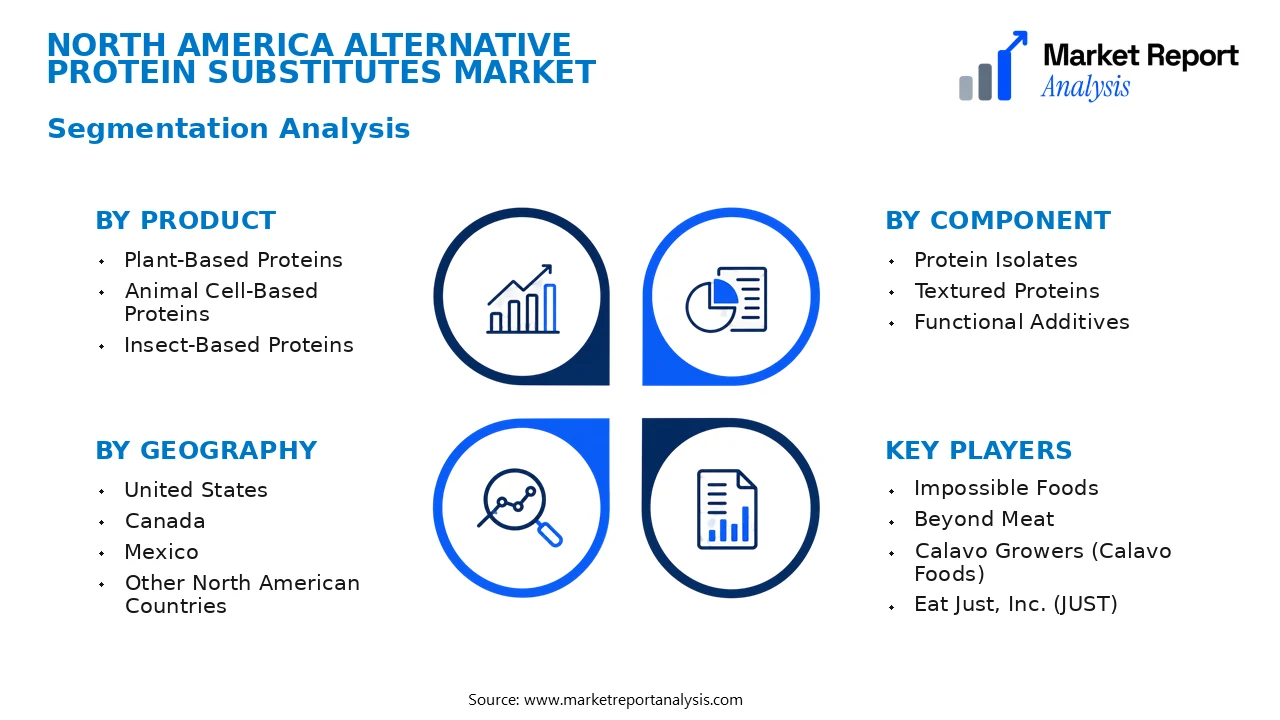
- Product
- Plant-Based Proteins: This segment includes products derived from plants such as soy, pea, and rice, which are formulated to serve as meat and dairy alternatives, gaining popularity for their nutritional profile and environmental benefits.
- Animal Cell-Based Proteins: Encompasses cultured or cell-based proteins, a new frontier aiming to mimic real meat by cultivating animal cells, attracting investment and interest due to ethical and sustainability considerations.
- Insect-Based Proteins: Consists of proteins derived from insects like crickets and mealworms, valued for their high nutritional quantity and low environmental impact, gaining traction particularly in niche markets.
- Component
- Protein Isolates: This subsegment includes refined protein powders extracted from plant sources which serve as key ingredients in various ready-to-eat and processed food products, with rising demand in functional foods.
- Textured Proteins: Characterized by their fibrous and meat-like texture, textured proteins are crucial for meat replacements, especially in burger patties, sausages, and other processed forms, driven by consumer shift towards plant-based diets.
- Functional Additives: Encompasses various bio-actives and texturizers used to enhance the sensory and nutritional qualities of alternative proteins, critical for product formulation and market acceptance.
- Geography
- United States: The largest regional market driven by a high consumer awareness, innovation in food tech, and supportive regulatory framework, primarily consuming plant-based and cultured meat products.
- Canada: Characterized by a growing demand for sustainable and healthy food options, with innovative startups and established brands expanding their product offerings in plant-based protein markets.
- Mexico: Emerging as a promising market with increasing interest in plant-based diets, driven by urbanization, health consciousness, and a rising trend in vegetarian and vegan lifestyles.
- Other North American Countries: Encompasses smaller markets including those in Central America and the Caribbean, where awareness and adoption levels are increasing, focusing mainly on plant-based protein sources and health benefits.
Competitive Intelligence
The North America Alternative Protein Substitutes Market is characterized by a moderately concentrated competitive landscape, with key players including Beyond Meat, Impossible Foods, and local startups such as Turtle Island Foods. These firms emphasize product innovation through R&D investments aimed at enhancing taste, texture, and nutritional profile to differentiate their offerings. Major corporations are pursuing strategic partnerships with foodservice providers and retail chains to expand market reach and consumer accessibility. Acquisitions are increasingly prevalent, enabling companies to diversify product portfolios quickly; for example, Beyond Meat’s acquisition of numerous smaller startups has expanded its product categories. Expansion strategies are focused on geographic growth within North America, leveraging consumer trends toward plant-based diets and sustainability. R&D investments are substantial, with companies dedicating significant resources to develop novel, proprietary formulations and sustainable ingredient sourcing. Competitive differentiation often hinges on brand positioning centered around health benefits, environmental impact, and culinary innovation, creating a robust landscape where agility and innovation are paramount to maintaining market share and growth trajectories.
Leading Company Profiles
The North American alternative protein market features a highly competitive landscape with innovative companies focused on plant-based, fungi, algae, and cultivated meat technologies. These firms invest heavily in R&D, strategic partnerships, and sustainability initiatives to capture growing consumer demand for health-conscious, environmentally friendly protein sources.
- Impossible Foods
- Beyond Meat
- Calavo Growers (Calavo Foods)
- Eat Just, Inc. (JUST)
- Oatly Group AB
- Quorn Foods
- Kraft Heinz Company
- ADM (Archer Daniels Midland)
- Givaudan
- Eat Natural Food Co.
Impossible Foods
Impossible Foods develops plant-based meat alternatives designed to replicate meat textures and flavors, leveraging innovative heme technology to provide sustainable, nutritious options aligned with environmental goals and consumer preferences.
Beyond Meat
Specializing in plant-based protein products, Beyond Meat offers burger patties, sausages, and minced meats, focusing on scalability, product innovation, and global expansion to lead the transition to plant-based diets across North America.
Calavo Growers (Calavo Foods)
Calavo produces avocado-based foods and recently expanded into plant-based protein snacks, emphasizing natural ingredients, supply chain resilience, and collaborations with culinary brands to diversify its portfolio.
Eat Just, Inc. (JUST)
Eat Just focuses on cultured meat and plant-based alternatives, including the popular JUST Egg, driven by technological advancements in cell cultivation and strategic investments in sustainable protein innovations.
Oatly Group AB
Oatly specializes in oat-based beverages and foods, expanding into plant-based protein formulations as part of its broader mission to promote sustainable dairy alternatives through product diversification.
Quorn Foods
Quorn offers mycoprotein-based meat substitutes, emphasizing clean-label products, sustainable manufacturing, and strategic partnerships to enhance its market penetration within North America.
Kraft Heinz Company
Kraft Heinz invests in plant-based innovation, launching new product lines and investing in startups to accelerate its transition into the plant-based protein market segment.
ADM (Archer Daniels Midland)
ADM develops and supplies plant-based ingredients, including proteins, to the alternative meat industry, focusing on innovative extraction technologies, supply chain sustainability, and strategic acquisitions.
Givaudan
Givaudan provides flavor solutions tailored for plant-based and cultured meat, leveraging sensory science innovations to enhance product appeal and consumer acceptance of alternative proteins.
Eat Natural Food Co.
Eat Natural Food Co. specializes in natural, plant-based snack foods, expanding into protein-rich offerings that focus on clean-label ingredients and sustainable sourcing.
Strategic Business Developments

- January 2023 – Impossible Foods – Launched new plant-based sausage line – Strengthened product portfolio, targeting both retail and foodservice channels to boost market share.
- March 2023 – Beyond Meat – Expanded North American manufacturing capacity – Enhanced supply chain resilience and met rising global demand for plant-based burgers.
- July 2023 – Calavo Growers – Invested in a new plant-based snacks manufacturing plant – Increased production capabilities, supporting rapid market expansion.
- September 2023 – Eat Just, Inc. – Announced partnership with a major restaurant chain to introduce cultured chicken – Demonstrated commitment to tech-driven protein innovation.
- November 2023 – Oatly Group AB – Launched a new plant-based protein beverage line – Focused on health-conscious consumers seeking sustainable dairy alternatives.
Frequently Asked Questions
What is the North America Alternative Protein Substitutes Market?
The North America Alternative Protein Substitutes Market encompasses the production and sale of plant-based, cellular-based, and fermented protein sources aimed at providing sustainable, healthy, and ethical alternatives to conventional animal meats within North American countries, including the U.S. and Canada.
What is the current market size of North America Alternative Protein Substitutes Market?
As of 2026, the market size is estimated at approximately USD 4.8 Billion, reflecting a robust growth trajectory driven by increasing consumer awareness of health and environmental issues, coupled with rapid innovation and expansion in product offerings across retail and foodservice channels.
What factors are driving the North America Alternative Protein Substitutes Market?
Key drivers include rising vegan and flexitarian populations, increasing investments from leading food tech companies, supportive government policies, growing environmental concerns regarding traditional livestock farming, and technological advancements improving product taste, texture, and nutritional profile.
Which region dominates the North America Alternative Protein Substitutes Market?
The United States dominates the market, accounting for the largest share due to its large consumer base, high disposable income levels, and strong presence of innovative startups and multinational corporations actively developing plant-based offerings.
Which segment is expected to grow the fastest?
The plant-based meat segment is anticipated to exhibit the fastest growth, fueled by its mainstream adoption among consumers seeking healthier, sustainable, and convenient protein options, supported by extensive marketing campaigns and product innovations.
Who are the leading companies operating in the North America Alternative Protein Substitutes Market?
Major players include Beyond Meat, Impossible Foods, Maple Leaf Foods, and Lightlife Foods, which hold significant market shares through innovative products, strategic partnerships, and widespread retail and restaurant distribution channels across North America.
Analyst Perspective
The North America Alternative Protein Substitutes Market is positioned for sustained growth, driven by evolving consumer preferences towards health, sustainability, and ethical consumption. Long-term, the market is expected to mature, with innovation in plant-based, cultured, and mycelium-based proteins fostering competitive differentiation. Commercial opportunities abound in product diversification, functional advantages, and value-added offerings targeting specific consumer segments such as flexitarians and environmentally conscious buyers. Technology evolution will prioritize scalability and cost reduction, crucial for mainstream adoption, with ongoing advancements in fermentation and cellular agriculture establishing new standards. Investment priorities include high-capacity production facilities, R&D in novel protein sources, and strategic partnerships across the supply chain to improve market penetration. Competitive intensity will escalate as major food corporations and startups compete to achieve brand dominance and cost leadership. Regional growth potential remains strong in urban centers and health-conscious segments, offering fertile ground for expansion. Ultimately, strategic focus should encompass innovation, regional market tailoring, and sustainable operations to secure long-term leadership in this dynamic landscape.
