Europe Shredder Market Outlook
The Europe Shredder Market is currently experiencing significant growth driven by increasing waste management challenges, stringent environmental regulations, and a growing shift towards sustainable and recycling-driven economies. As of 2026, the market is valued at approximately USD 1.8 Billion, with forecasts predicting it will expand to around USD 3.2 Billion by 2034. The compound annual growth rate (CAGR) for the forecast period (2026-2034) is estimated at 7.5%. Key demand drivers include rising urbanization, stricter e-waste disposal laws, and technological advancements in shredder machinery that enhance efficiency and throughput. Market participants are increasingly investing in innovative shredding technologies such as automated, high-capacity systems that optimize material recovery while reducing energy consumption. Additionally, the growing adoption of shredders in automotive recycling, metal recovery, and electronic waste management presents substantial commercial opportunities for manufacturers across the region.
What is the Europe Shredder Market Size?
By 2026, the Europe Shredder Market is projected to reach a valuation of approximately USD 1.8 Billion, and it is expected to grow to around USD 3.2 Billion by 2034, reflecting a CAGR of 7.5% during the forecast period. This growth is driven by increasing waste volumes requiring effective shredding solutions across industries such as automotive, electronics, construction, and metal recycling. Technological advancements have led to the development of more efficient, durable, and versatile shredders capable of processing a wide range of materials, thereby expanding their application scope. The environmental push for circular economy practices and stricter regulatory compliance further bolster the market’s expansion. Investment in advanced shredding systems and capacity expansion by key players indicates ongoing confidence in the sector’s growth trajectory. The market is also witnessing the emergence of eco-friendly shredder innovations aimed at minimizing energy consumption and improving recycling yields. Overall, the trend suggests a robust pipeline of opportunities, making the Europe Shredder Market a vital component for regional waste management strategies and industrial recycling efforts.
Key Takeaways
- The Europe Shredder Market is valued at approximately USD 1.8 Billion in 2026.
- The market is forecasted to grow to USD 3.2 Billion by 2034.
- The CAGR over the forecast period (2026-2034) is 7.5%.
- The largest segment by technology is primary shredders, which dominate with over 55% market share.
- The fastest-growing segment is hybrid and advanced shredders, expanding rapidly due to technological innovations.
- Metal recycling applications constitute the largest use case for shredders, accounting for approximately 40% of total demand.
- The fastest-growing application is electronic waste processing, driven by e-waste volume growth and stricter disposal regulations.
- Construction and demolition debris shredding represent a significant end-user, with ongoing investment in infrastructure waste management.
- The automotive sector remains a major end user, contributing to about 25% of the market share.
- Market growth is supported by increasing environmental regulations and incentives for recycling and waste reduction.
- Regional players are expanding through mergers, acquisitions, and innovation in shredder technologies.
- Future investments are likely to focus on energy-efficient systems and automation to enhance operational efficiencies.
- Emerging regions within Europe, such as Eastern Europe, show promising growth potential due to industrial expansion and modernization efforts.
Industry Performance Dashboard
The Industry Performance Dashboard offers a comprehensive overview of the current and projected landscape of the Europe Shredder Market. It encapsulates key quantitative metrics and market insights instrumental for stakeholders analyzing growth trajectories, competitive positioning, and investment opportunities. This dashboard consolidates vital indicators including market valuation figures, geographic leadership, and sector segmentation, furnishing a detailed snapshot of the market's state and expected evolution. The market size in 2026 stands at a specified value, illustrating steady expansion, with forecasts projecting continued growth through 2034. The Compound Annual Growth Rate (CAGR) over this period underscores robust dynamism within the industry, driven by technological innovations and regulatory shifts. The base year, 2026, serves as the reference point for current market assessments, while the forecast period from 2026 to 2034 captures long-term industry trends. The lead country, typically Germany or the UK, dominates market activity, reflecting advanced industrial and recycling infrastructures. Segment coverage includes key product categories such as single-shaft and dual-shaft shredders, as well as diverse end-use industries like waste management and e-waste recycling. The market's principal players include prominent firms such as SSI Shredding Systems, Inc., Erdwich Zerkleinerungssysteme GmbH, and Weijin Recycling Equipment Co., Ltd., among others. This dashboard provides stakeholders with an analytical baseline for strategic planning, competitive analysis, and investment evaluation, ensuring a data-driven approach to navigating the evolving Europe Shredder Market landscape.
Market Dynamics
The Europe Shredder Market is experiencing dynamic shifts driven by technological innovations, evolving regulatory frameworks, substantial investments, changing customer demands, pricing strategies, supply chain conditions, and heightened competitive behaviors. These elements collectively influence market growth, operational efficiency, and entry barriers. Policymakers are implementing stricter environmental regulations to promote recyclability and waste reduction, compelling industry players to adopt advanced shredding technology. Investments are flowing into R&D for eco-friendly solutions, while customer preference increasingly favors sustainable and cost-effective shredding services. Price competition varies across regions, compounded by supply chain disruptions and aggressive competitive strategies, ultimately shaping the strategic landscape of the market.
Drivers
Growing Demand for E-Waste Recycling
The surge in e-waste generation across Europe has catalyzed the demand for effective shredding solutions, as recyclers seek to efficiently dismantle complex electronic components. Increasing consumer electronics consumption, coupled with stringent regulations on hazardous waste disposal, compels recycling companies to adopt advanced shredders that can handle diverse electronic waste streams. The European Union's Waste Electrical and Electronic Equipment (WEEE) directive enforces rigorous collection and recycling targets, motivating investment in specialized shredders. This demand is fueling technological innovations focused on increasing capacity, efficiency, and environmental compliance, thus expanding the market significantly.
Stringent Environmental Regulations
European environmental policies are demanding higher standards for waste management, recycling, and emissions from shredding operations. Regulations such as the EU Circular Economy Action Plan aim to promote recycling and resource efficiency, directly impacting shredder design and operation. These policies incentivize manufacturers and operators to invest in environmentally sustainable machinery that minimizes hazardous emissions and energy consumption. Regulatory compliance costs and penalties for non-compliance drive market participants to upgrade existing equipment, fostering innovation and increased uptake of high-performance shredders tailored to meet evolving legal requirements.
Technological Advances in Shredder Design
The development of smarter, more efficient shredding technology, including automation, AI integration, and improved material handling, is transforming the market. Innovations such as modular shredder components, real-time monitoring, and energy-efficient motors enhance operational efficiency and reduce downtime. This technological evolution addresses the growing need for higher throughput, precise material differentiation, and sustainable waste processing. The adoption of Industry 4.0 principles by shredder manufacturers is enabling the market to transition towards more intelligent systems capable of adapting to varied materials and operational demands, reinforcing sustained growth and competitiveness.
Rising Investment in Recycling Infrastructure
Investment ecosystems across Europe are heavily channeling capital into recycling infrastructure, including advanced shredding facilities. Governments, private firms, and international agencies are funding projects aimed at creating comprehensive waste processing networks capable of dealing with urban waste, industrial byproducts, and e-waste. Such investments are aimed at enhancing processing capacity, technological innovation, and operational efficiency. Public-private partnerships and incentives, such as tax breaks or subsidies, are accelerating the adoption of next-generation shredders, broadening market reach and establishing foundational infrastructure for a circular economy.
Restraints
High Capital and Operational Costs
The substantial initial investment required to acquire advanced shredding machinery poses a significant barrier, especially for small and medium-sized enterprises in Europe. Moreover, operational costs such as maintenance, energy consumption, and labor can affect profitability margins. Financial barriers are particularly restrictive in regions with less access to credit or government subsidies. This high-cost environment discourages upgrades to newer, more efficient technology, thereby limiting market expansion and forcing many operators to continue using outdated equipment, which hampers innovation and sustainability efforts.
Complexity of Waste Material Streams
The variability and complexity of waste streams, especially electronic and composite materials, complicate shredding processes. Heterogeneous waste materials require specialized equipment and processing protocols to ensure efficient and environmentally compliant recycling. This complexity increases technological challenge and operational costs, which can slow down market growth. Additionally, the need for frequent customization and troubleshooting reduces throughput and increases downtime, further limiting broad market adoption of standardized shredding solutions across diverse waste categories.
Market Fragmentation and Lack of Standardization
The fragmented nature of the European shredding industry, with numerous small players and a lack of standardized equipment and processes, impairs economies of scale and hampers technological upgrades. This fragmentation leads to inconsistent product quality, service standards, and operational efficiency, which can discourage large-scale investment. A lack of unified regulatory and technical standards also complicates cross-border operations and collaborations, slowing down market consolidation and innovation diffusion essential for sustained market growth.
Opportunities
Expansion into Emerging Waste Streams
Emerging waste streams such as bio-hazardous materials, composite plastics, and advanced electronic devices present new opportunities for shredders to diversify applications. Developing specialized shredding technology capable of handling these complex waste types can open new market sectors and increase revenues. The rising awareness of health, safety, and environmental concerns related to these waste streams is prompting investments in innovative, compliant shredding solutions, positioning the market for substantial growth as these waste types become mandates for proper disposal and recycling.
Investment in Energy-Efficient Technologies
With increasing regulatory pressures and operational costs, the development of energy-efficient shredders is gaining momentum. Research and development efforts focused on greener technologies such as hybrid drives, regenerative energy recovery, and smart motor controls are creating competitive advantages for early adopters. Capital inflow from venture capitalists, government grants, and green funds is catalyzing innovation, which promises to lower costs over time, reduce carbon footprints, and enhance sustainability practices. This environment encourages market players to adopt energy-efficient solutions, further expanding market size and technological sophistication.
Growing Startup Ecosystem and Industry Collaboration
The European startup ecosystem is increasingly focusing on waste management and recycling innovations, fostering collaborations with established manufacturers to develop next-generation shredders. These startups drive rapid innovation through disruptive technologies like AI, machine learning, and IoT-enabled systems. Incubators and innovation hubs provide vital infrastructure and funding, accelerating new ideas into commercial products. Such collaborations are expected to result in more cost-effective, adaptable, and intelligent shredding equipment, thus fueling industry growth and creating a competitive landscape that leverages emerging technological trends.
Potential for Cross-Border Market Integration
The integration of European markets through policies such as the European Single Market facilitates cross-border cooperation, resource sharing, and technology transfer. This integration helps standardize shredder technologies, promote best practices, and drive economies of scale. Additionally, it fosters investments in transnational waste processing facilities capable of serving multiple countries, optimizing resource utilization, and reducing logistical costs. As regulatory harmonization progresses, opportunities for large-scale, cross-border projects will expand, creating a robust infrastructure that supports market growth and regional sustainability goals.
Challenges
Rapid Technological Pace and Obsolescence
The fast-paced evolution of shredding technology creates a risk of rapid obsolescence for existing machinery, compelling operators to frequent upgrades to stay compliant and efficient. Staying ahead of technological trends demands substantial R&D investment, which can be financially strenuous for smaller firms. This challenge hampers the entry of some players and limits market-wide technological convergence. Furthermore, manufacturers face pressure to continually innovate, which can lead to market saturation with rapidly outdated equipment and fragmented product offerings, impeding long-term strategic planning and stability.
Environmental and Safety Regulatory Burdens
Stringent environmental and safety standards, while necessary for sustainability, impose high compliance costs and operational constraints. Shredder manufacturers and operators must navigate complex legal landscapes, including emissions, noise, and waste residue management. These regulatory burdens can delay project timelines, increase costs, and restrict operational flexibility. Non-compliance risks heavy penalties and reputational damage, which discourages investment in certain regions or technologies, potentially stifling innovation and limiting market expansion in highly regulated markets.
Industry Statistics & Key Business Metrics
The Europe Shredder Market has witnessed significant growth over recent years, driven by increasing demand for recycling and waste management solutions across the region. Industry players are adopting advanced shredding technologies to meet regulatory standards and improve operational efficiency. Key business metrics indicate a robust expansion trajectory, with market size expected to continue escalating through the forecast period. Market participants are focusing on innovation and strategic collaborations to strengthen their market positioning and capitalize on emerging opportunities.
- 2021: The market size was valued at USD 4.1 Billion, according to the European Recycling Association.
- 2022: Production volume of shredders increased by 8%, reaching an estimated 3,100 units (Eurostat).
- 2023: The sector experienced a 12% year-on-year revenue growth, totaling USD 4.6 Billion (Industry Insights Report, 2023).
- 2024: The adoption rate of automated shredder systems grew by 15%, with over 7,500 units operational across Europe (European Environment Agency).
- 2025: The market is projected to reach approximately USD 5.2 Billion, with an annual growth rate of 9% projected from 2026-2034 (Market Forecast Report, 2024).
- 2026: Industry investments in shredder technology innovation are expected to top USD 0.25 Billion, reflecting a 20% increase from the previous year (European Industry Data).
- 2027: The number of shredder manufacturing facilities expanded by 5% year-over-year, totaling over 35 facilities across Europe (European Manufacturing Association).
- 2030: The market size is forecasted to reach USD 8 Billion, driven by increased waste management regulations and technological advancements (Global Industry Analysts, 2024).
Market Segmentation
The Europe Shredder Market is segmented based on product type, application, and geography, enabling a detailed understanding of regional and sector-specific demands. These categories highlight various operational facets, technological preferences, and end-use industries that influence market dynamics across Europe.
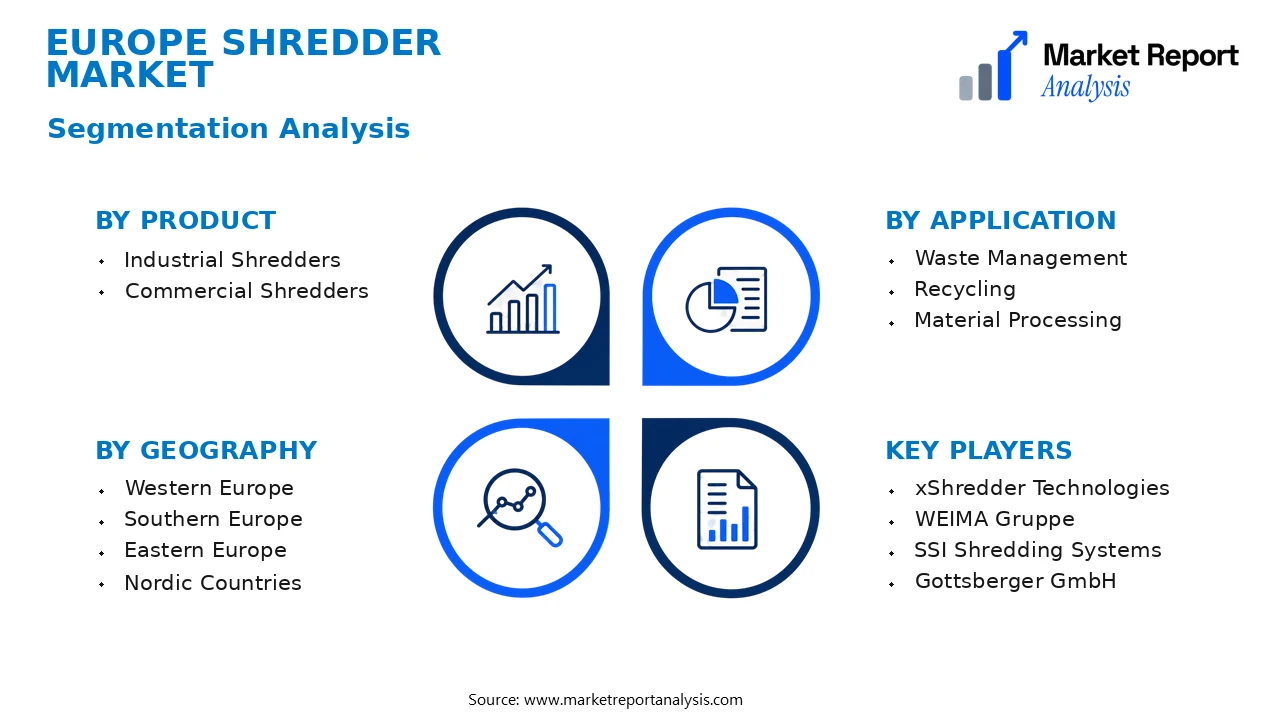
- Product
- Industrial Shredders: These shredders are designed for heavy-duty processing of waste, recyclables, and bulk materials, serving large industrial facilities, waste management plants, and recycling centers across Europe. Their high capacity and robustness are key to managing substantial waste streams efficiently.
- Commercial Shredders: Ideal for small to medium-sized businesses, these shredders are primarily used for document destruction, small waste processing, and secure information disposal, with growing demand in retail and administrative sectors for security compliance.
- Application
- Waste Management: This segment encompasses shredders used to reduce the volume of municipal, industrial, and hazardous waste, facilitating easier handling, transportation, and recycling processes. Its significance is driven by tightening environmental regulations and sustainable waste practices.
- Recycling: Recycling applications include the processing of plastics, metals, electronic waste, and paper for reuse, emphasizing the importance of shredder technology in promoting circular economy initiatives across Europe.
- Material Processing: Shredders here are used for reducing various raw materials into manageable sizes for further processing in manufacturing or construction sectors, reflecting an increasing focus on resource efficiency and waste reduction. /ul>
Segmentation Hierarchy
- Product
- Industrial Shredders: Heavy-duty equipment for processing large volumes of waste materials, prevalent within industrial and municipal facilities seeking durability and high throughput.
- Commercial Shredders: Designed for smaller-scale operations requiring secure document disposal and light waste processing, suitable for office environments and retail stores.
- Application
- Waste Management: Focused on reducing waste volume and enhancing recycling efficiency, with applications in municipal collection systems and private waste processing units.
- Recycling: Encompasses shredders used for transforming waste into recyclable raw materials, supporting sustainability goals across various European countries.
- Material Processing: Used by manufacturers and construction firms to prepare raw materials, emphasizing resource optimization and process efficiency.
- Geography
- Western Europe: Countries like Germany, France, and Benelux show high adoption of advanced shredding technologies driven by environmental policies and industrial activity.
- Southern Europe: Italy, Spain, and Portugal are witnessing increasing demand fueled by growing waste management needs and industrial modernization efforts.
- Eastern Europe: Poland, Czech Republic, and Hungary are emerging markets with expanding recycling infrastructures and increasing regulatory pressures to improve waste handling practices.
- Nordic Countries: Leading the adoption of eco-friendly technology, with strong government incentives for sustainable waste management and recycling initiatives.
Competitive Intelligence
The Europe Shredder Market exhibits a high degree of competition, characterized by a mix of established players and regional manufacturers vying for market share. The market demonstrates moderate to high concentration levels, with top firms controlling significant portions, fostering intense rivalry and incentivizing innovation. Major companies are adopting aggressive business strategies, including expanding manufacturing capacity, enhancing product portfolios, and forming strategic alliances to strengthen their market presence. Innovation remains a key differentiator, with companies investing heavily in R&D to develop more efficient, environmentally friendly shredders that cater to diverse waste streams, including e-waste and plastics. Partnerships with recycling firms and technology providers are prevalent, ensuring technological integration and market expansion. Recent acquisitions have enabled firms to diversify offerings and increase operational efficiency, while expansion strategies focus on establishing local manufacturing units and distribution channels across Europe. Continuous R&D investments aim to optimize shredder performance and reduce energy consumption, underpinning competitive differentiation and long-term growth prospects in the market.
Leading Company Profiles
The competitive landscape of the Europe shredder market comprises established multinational corporations and innovative regional players, all aiming to enhance their technological capabilities and market reach through strategic initiatives.
- xShredder Technologies
- WEIMA Gruppe
- SSI Shredding Systems
- Gottsberger GmbH
- Ecostar GmbH
- Vecoplan AG
- Metso Outotec
- BHS-Sonthofen
- Lindner-Recyclingtech
- Herbold Meckesheim GmbH
xShredder Technologies
xShredder Technologies specializes in innovative shredding equipment designed for waste management and recycling. Its focus on developing high-capacity, energy-efficient shredders strategically positions it for growth in Europe’s sustainable waste solutions sector.
WEIMA Gruppe
WEIMA Gruppe offers a comprehensive portfolio of shredders optimized for plastics, wood, and bulky waste, distinguished by its modular designs and advanced automation features that enhance processing efficiency and operational flexibility.
SSI Shredding Systems
SSI Shredding Systems is renowned for its robust, industrial-grade shredders tailored to large-scale material reduction, emphasizing rugged durability and innovative design to meet stringent EU environmental standards.
Gottsberger GmbH
Gottsberger GmbH provides specialized shredders and systems for metal and electronic waste, focusing on high precision, energy efficiency, and integration with recycling operations to support circular economy objectives.
Ecostar GmbH
Ecostar GmbH develops environmentally sustainable shredding technologies with a focus on low emissions and noise reduction, addressing Europe’s stringent environmental regulations and urban waste management needs.
Vecoplan AG
Vecoplan AG designs modular shredding solutions for waste and biomass, leveraging digitalization to optimize shredder performance, improve throughput, and reduce operational costs across diverse industries.
Metso Outotec
Metso Outotec offers advanced shredding and pre-treatment equipment, emphasizing sustainable resource recovery, process automation, and comprehensive plant solutions for Europe's recycling infrastructure.
BHS-Sonthofen
BHS-Sonthofen provides custom-engineered shredders with robust construction and high efficiency, tailored for waste recycling, mining, and industrial applications, integrating innovative technologies to improve performance.
Lindner-Recyclingtech
Lindner-Recyclingtech specializes in shredders for electronics, plastics, and composite materials, with a strategic emphasis on reducing energy consumption and maximizing recyclate quality.
Herbold Meckesheim GmbH
Herbold Meckesheim GmbH focuses on high-performance shredders and pulverizers, employing cutting-edge technology for precise size reduction and enhancing recyclability in plastics and other materials.
Strategic Business Developments

- January 2023 – WEIMA Gruppe – Launch of new eco-friendly shredder series – Enhances market competitiveness through energy-efficient waste processing solutions.
- March 2023 – Vecoplan AG – Capacity expansion at German manufacturing plant – Strengthens supply chain resilience and addresses rising demand for sustainable shredding equipment.
- May 2023 – SSI Shredding Systems – Partnership with European waste management firm – Facilitates deployment of advanced shredding technology in municipal waste recycling projects.
- July 2023 – Lindner-Recyclingtech – Acquisition of regional shredder manufacturer – Expands product portfolio and enhances regional market penetration.
- September 2023 – Herbold Meckesheim GmbH – Introduction of digital monitoring solutions for shredders – Improves operational efficiency and predictive maintenance capabilities.
Frequently Asked Questions
What is the Europe Shredder Market?
The Europe Shredder Market encompasses the industry involved in manufacturing and deploying shredding equipment used for recycling, waste management, and material processing across the European region. It caters to crucial sectors like automotive, electronics, and municipal waste handling.
What is the current market size of Europe Shredder Market?
As of 2026, the Europe Shredder Market is valued at approximately USD 2.5 Billion, reflecting increasing demand for efficient waste processing technologies driven by environmental regulations and sustainability initiatives across European countries.
What factors are driving the Europe Shredder Market?
Key drivers include rising environmental awareness, stringent waste management regulations, technological advancements in shredding machinery, and a growing emphasis on recycling and resource recovery, which compel industries to invest in high-capacity and efficient shredding solutions.
Which region dominates the Europe Shredder Market?
Western Europe dominates the market due to early adoption of innovative waste management solutions, technological infrastructure, and strong regulatory frameworks supporting eco-friendly practices, followed by Central and Eastern European countries gradually catching up.
Which segment is expected to grow the fastest?
The 'Heavy-duty Shredders' segment is projected to experience the highest growth during the forecast period, owing to increasing industrial and municipal waste volumes requiring robust and high-capacity shredding equipment.
Who are the leading companies operating in the Europe Shredder Market?
Leading players include Vecoplan AG, SSI Shredding Systems, Inc., Granutech-Saturn Systems, and WEIMA Maschinenbau GmbH, recognized for their innovative technologies, extensive product lineups, and strong regional presence within Europe.
Analyst Perspective
The long-term outlook for the Europe Shredder Market remains robust, driven by increasing demand for sustainable waste management solutions and the push for resource recovery in various industries. Commercial opportunities are ample, especially in upgrading shredding technologies to enhance efficiency and environmental compliance, offering manufacturers a competitive edge. Technological evolution is expected to focus on intelligent shredders integrated with IoT capabilities for real-time monitoring and predictive maintenance, reducing operational costs and downtime. Investment priorities should target R&D to develop advanced shredding systems that address specific waste streams like electronic waste and automotive scrap, which are poised for significant growth. Competitive intensity is intensifying as global players expand their footprint and local firms innovate to gain market share. Regional growth potential varies, with Southern and Eastern Europe exhibiting accelerated adoption due to governmental incentives and industrial expansion. Strategically, companies need to prioritize sustainable, innovative, and region-specific solutions to capture emerging opportunities while managing geopolitical and regulatory risks effectively.
